Sathyam Commentary
3 February 2001
Tamil Nation & the Unity of India
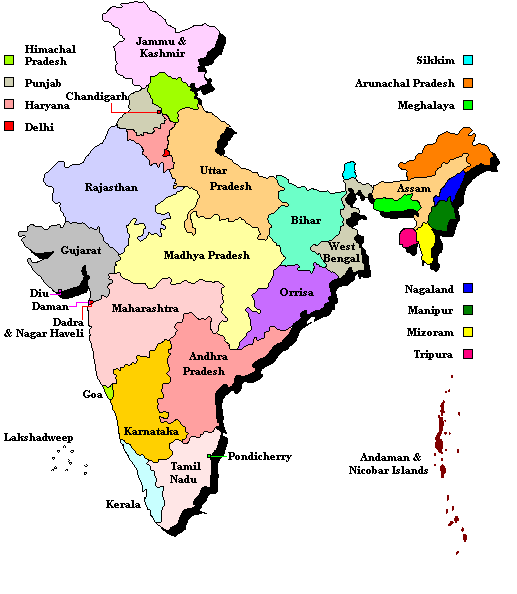
 "...The
break up of India, if it comes will not come from the efforts of
tamilnation.org.
It will come despite our efforts. It will come from a failure of political
leaders in India to openly recognise that India is is today a multi national
empire -
and recognise the enduring wisdom of the
words of Pramatha Chaudhuri... "...The
break up of India, if it comes will not come from the efforts of
tamilnation.org.
It will come despite our efforts. It will come from a failure of political
leaders in India to openly recognise that India is is today a multi national
empire -
and recognise the enduring wisdom of the
words of Pramatha Chaudhuri...
"...It is not a bad thing to try and weld
many into one but to jumble them all up is dangerous, because the only
way we can do that is by force. If you say that this does not apply to
India, the reply is that if self determination is not suited to us, then
it is not suited at all to Europe. No people in Europe are as different,
one from another, as our people. There is not that much difference
between England and Holland as there is between Madras and Bengal. Even
France and Germany are not that far apart."
The unity of India will not come simply by English speaking 'Indians'
speaking to each other in English... (Again),
the strength and unity of India lies not in the nuclear bomb, but in its
peoples. Nuclear capability will not guarantee unity. The nuclear bomb
did not prevent the disintegration of the Soviet Union and the emergence of
the non-nuclear states of Latvia, Estonia and Georgia. There is a need
to understand that a people's aspiration for equality and freedom is an
energy which is in many ways more potent than that contained in a nuclear
bomb. Those concerned to secure the unity of India will need to adopt
a more 'principle centred' approach towards
struggles for self determination
in the Indian region.. ."
Ravishankar Dixit a visitor to
tamilnation.org
wrote on 25 December
2000
"(Your) site has very good subject matter which reflects the
superior quality of the intellectuals in Tamil society. But alas, I am
an Indian and I cannot see a part of India going off. I cannot see why
Tamilians need a separate Tamil Land.... Every language has its own
self-respect, its own greatness. I don't know why Tamilians are so touchy
when it comes to their language. Look at Kannada for example (it is my
mother tongue) or Marathi. Kannadigas number some 50 million and Marathis a
little over 90 million. Do you think we do not have enough number of people
to ask for our own Kannadanadu or Marathisthan? Or do you think we do not
have that right because our cultures and languages are less supreme
than Tamil, for which reason we have to be a part of India?... So, just
learn how to live together and respect other languages and cultures. Just
learn to mingle peacefully with other people. Uphold the dignity of India.
Without the name of India, Tamilians will be dirt cheap. It is because of
the greatness that is India, Tamilians also are having a piece of the cake.
If they want to opt out, they will be eating pieces of shit..." (see
also
Response by Ravishankar Dixit, 16
February 2001)
We are moved to respond.
More than 80 years ago, in 1920,
Pramatha Chaudhuri wrote an
article titled "Bengali Patriotism". It appeared in the well known Bengali
monthly, Sabuj Patra (Green Leaves), which he edited. Pramatha Chaudhuri spoke
as a Bengali and wrote in Bengali, but that which he so eloquently said would
apply equally to the Tamils, the Marathis, the Malayalees, and the other nations
of the Indian sub continent.
Chaudhuri described the various people of India as different "nations"
entitled to national self determination. According to him the possibility of
harmony and co-operation was much more, if this separateness was recognised
rather than denied. He declared that the unity of India will not come from the
efforts of "minds bred on English textbooks" and insisted that that unity will
be built only on the foundation of "provincial patriotism".
It was Mark Twain who once remarked that reports of his death were greatly
exaggerated. Reports during recent years of the disintegration of India may also
be greatly exaggerated. Nevertheless, the challenge that India continues to face
(with increasing urgency) is the task of telescoping two different processes
which are at work.
On the one hand, after the departure of the colonial ruler in 1948, we have
seen the emergence of the separate national identities of the Indian sub
continent, seeking recognition and demanding equality, in the fullest sense of
that term - not dissimilar to the emergence of the nations of Europe in the
aftermath of the Industrial Revolution in the 18th and the 19th centuries.
On the other hand, we live in the 21st century, at a time when the increasing
inter-dependence of states has led to the growth of regional economic and
political communities. The same states who warred with each other in Europe to
assert their separate interests, have felt the need to pool their sovereignty
within the framework of a larger European Community.
True inter-dependence will come only between those who are independent.
Pramatha Chauduri's writing (in the 1920s) remains essential reading today
for all us who regard ourselves as Indians and who are concerned to secure
and protect the unity that is India. He said:
| "To be united due to outside pressure and to unite
through mutual regard are not the same. Just as there is a
difference between the getting together of five convicts in a jail
and between five free men, so the Congress union of the various
nations of India and tomorrow's link between the peoples of a free
country will be very different. Indian patriotism will then be built
on the foundation of provincial patriotism, not just in words but in
reality." |
A stable unity will emerge only when New Delhi acquires the vision and the
strength to structure a polity where the different peoples of the sub continent
(including those in the island of Sri Lanka) may freely associate with each
other in equality and in freedom. The price of failure, will be the
disintegration of the Indian state because, in the years ahead, the political
awakening of the different peoples of India will continue to gather momentum -
and this will be unstoppable.
If democracy means the rule of the people, by the people and for the people,
then it also means that no one people may impose their rule on another. It is
this appeal to democracy which has given national movements their enduring
appeal.
It will be futile for New Delhi, Canutelike, to order the rising tide of
nationalism to recede. The rising tide of Kashmiri nationalism will not recede
in the years to come. Neither will Assamese nationalism recede - on the
contrary, these nationalisms and others will grow from year to year.
If the disintegration of India comes, it may come with the same seeming
suddenness of the collapse of the centralised Soviet state - because the seeds
of disintegration have had several decades to germinate, underground and
in fertile soil. It will come because of the failure to learn the lessons
of the two world wars - lessons which led to the formation of the European
Union. It will come because of a failure to understand the underlying reasons
which contributed to the break up of the Soviet Union - a break up, which
showed, Gorbachov (amongst others) that too little too late was not
enough.
The real political question is not one of separation or division but
one of determining the terms on which different nations may 'associate'
with one another in equality and in freedom - and
this is the issue that
the 21st century will have to confront.
And, here we need to understand that the growing togetherness of the Tamil
people, is but a step in the growth of a larger unity. The words of
Sumantra Bose in
Reconceptualising State, Nation and
Sovereignty merit attention:
| "The clash between the ever-increasing clamour of
claims to nationhood and aspirations to sovereignty, on the one
hand. and the persistence, indeed consolidation, of visions of a
monolithic, unitarian, and indivisible statehood, on the other,
certainly represents one of the most striking contradictions, and
one of the most fundamental moral and ideological conflicts, of our
times...
Demands for 'national selfdetermination' are in one sense,
therefore, also a struggle for a higher form of democracy....The
poetical and philosophical vision that is required today has been
eloquently articulated, ironically enough,
by radical Tamil nationalists ('chauvinists' and 'separatist
terrorists', according to the official wisdom)..." |
It was a vision that was spelt out in
Tamil Eelam,
Kurds & Bhutan in July 1985, and
articulated on behalf of the Tamil national movement at Thimpu in
August 1985, more than 15 years ago:
| "... we are not chauvinists. Neither are we
racists.
The togetherness of the Tamil people is not the expression of an
exaggerated nationalism. We do not say that
our language is the sweetest in the world but we do say that our
language is sweet to our ears. We do not say that
our culture is the oldest in the world but we do say that it is
a culture of great antiquity and that it has made a rich
contribution to the world. We do not say that
our thinkers are the most influential that the world has known
but we do say that their thoughts have left the world with a greater
understanding of itself. We do not say that we are the chosen people
but we do say that
we, too, are a people, and
that we are entitled to live our lives in the way we choose.
The growing togetherness of the Tamil people, is but a step
in the growth of a larger unity.
We know that in the end, national freedom can only be secured by
a voluntary pooling of sovereignties, in a regional, and
ultimately in a world context. ... we recognize that our future
lies with the peoples of the Indian region and the path of a
greater and a larger Indian union is the direction of that
future.
It is a union that will reflect the compelling and inevitable
need for a common market and a common defence and will be rooted in
the common heritage that we share with our brothers and sisters of
not only Tamil Nadu but also of India. It is a shared heritage that
we freely acknowledge and it is a shared heritage to which we have
contributed and from which we derive strength..." |
It is this vision which has directed our efforts in cyberspace
during the past several months: And it was this vision which also led to the
caution in Culture and the Tamil
Contribution to World Civilisation:
| "The effort to acquaint the world of the important
contributions of Tamil culture, is not the expression of an
exaggerated nationalism. Tamil culture is a culture of great
antiquity and it has made, and will continue to make, a rich
contribution to world civilisation. At the same time, Tamils have
gained, and continue to gain, by their interaction with other
peoples and other cultures - particularly those of the Indian sub
continent. No people are an island unto themselves..." |
The break up of India, if it comes, will not come from the efforts of
tamilnation.org. It
will come despite our efforts. It will come from a failure of political leaders
in India to openly recognise that India is today a multi national empire - and
recognise the enduring wisdom of the words of
Pramatha Chaudhuri:
| "...It is not a bad thing to try and weld many into
one but to jumble them all up is dangerous, because the only way we
can do that is by force. If you say that this does not apply to
India, the reply is that if self determination is not suited to us,
then it is not suited at all to Europe. No people in Europe are as
different, one from another, as our people. There is not that much
difference between England and Holland as there is between Madras
and Bengal. Even France and Germany are not that far apart. If some
of our politicians shudder at the mention of provincial patriotism,
it is because their beliefs smack of narrow national selfishness." |
We recognise that Tamils are Indians. We are Indians because we are Tamils.
And, if we were not Tamils, we would not be Indians. Again, if there were no
Bengalis, no Marathis, no Kannadigas, no Tamils (to mention but a few of the
peoples of the Indian subcontinent), there would be no 'Indians'. Even apart
from anything else, in what language would they speak to each other? The
unity of India will not come simply by English speaking 'Indians' speaking to
each other in English. Pramatha
Chaudhuri said it all more than eighty years ago:
| "You have accused me of "Bengali patriotism". I
feel bound to reply. If it is a crime for a Bengali to harbour and
encourage Bengali patriotism in his mind, then I am guilty. But I
ask you: what other patriotism do you expect from a Bengali writer?
The fact that I do not write in English should indicate that non
Bengali patriotism does not sway my mind. If I had to make
patriotic speeches in a language of no part of India, then I would
have to justify that patriotism by saying that it does not relate to
any special part of India but that it means love for India as a
whole. In a language learnt by rote you can only express ideas
learnt by heart..." |
It is not that we are unmindful of the importance of securing a strong and
united India. But the strength and unity of India
lies not in the nuclear bomb, but in its peoples. Nuclear capability will
not guarantee unity. The nuclear bomb did not prevent the disintegration of the
Soviet Union and the emergence of the non-nuclear states of Latvia, Estonia and
Georgia. There is a need to understand that a people's aspiration for
equality and freedom is an energy which is in many ways more potent than that
contained in a nuclear bomb.
There are those (including Marxists) who would assert that conflicts between
peoples will be assuaged by economic growth. But, economic growth will not
happen unless the different peoples of India are energised to work
together to achieve their shared aspirations. Peoples speaking different
languages, tracing their roots to different origins, and living in relatively
well defined and separate geographical areas, do not somehow 'melt' and
disappear - and, in any case, a 'third world' economy will not provide a large
enough 'pot' for the 'melting' to take place. It is no accident that a Gujerati
does not stand for election in Tamil Nadu, or a Tamil in Bengal, or a Marathi in
Kashmir - and there is a need to recognise and address this political reality.
Those concerned to secure the unity of India will need to adopt a more
'principle centred' approach towards
struggles for self determination in the Indian region. A myopic
approach, even apart from anything else, may well encourage the very outside
'pressures' which New Delhi seeks to exclude.
Those truly concerned to secure the unity of India may need to attend more
seriously to the words of Julius Nyerere, an ex President of Tanzania and
one of Africa's most respected elder statesperson, in an interview reported in
the
New Internationalist, January/February
1999:
| "It seems that independence of the former colonies
has suited the interests of the industrial world for bigger profits
at less cost. Independence made it cheaper for them to exploit us.
We became neo-colonies. ... The majority of countries in Africa
and the rest of the South are hamstrung by debt, by the IMF. We
have too much debt now. It is a heavy burden, a trap. It is
debilitating. We must have a new chance. If we doubled our
production and debt-servicing capabilities we would still have no
money for anything extra like education or development. It is
immoral. It is an affront. The conditions and policies of the
World Bank and the IMF are to enable countries to pay debt, not
to develop. That is all! Let us argue the moral case. Let us
create a new liberation movement to free us from immoral debt and
neo-colonialism. This is one way forward. The other way is through
Pan-African unity...
Kwame Nkrumah and I were committed to the idea of unity... I did
not believe in these small little nations. Still today I do not
believe in them.
I tell our people to look at the European Union, at these
people who ruled us who are now uniting...."
|
It is this vision of an Indian Union, of free and equal nations, which will
continue to direct our work and we repeat:
| "...The growing togetherness of the Tamil people,
is but a step in the growth of a larger unity. We know that in the
end, national freedom can only be secured by a voluntary pooling of
sovereignties, in a regional, and ultimately in a world context. ...
we recognize that our future lies with the peoples of the Indian
region and the path of a greater and a larger Indian union is the
direction of that future. It is a union that will reflect the
compelling and inevitable need for a common market and a common
defence and will be rooted in the common heritage that we share with
our brothers and sisters of not only Tamil Nadu but also of India.
It is a shared heritage that we freely acknowledge and it is a
shared heritage to which we have contributed and from which we
derive strength..." |
And the words of a Gujerati and an Indian, Mahatma
Gandhi will
continue to inform our actions:
"Whatever you do will be insignificant,
but it is very important that you do it."
Response by Ravishankar Dixit, 16 February 2001
Though my mail
to you contained a few obscenities for which I owe apologies to you, you
have elucidated a concept that is very relevant in a very tolerant tone.
Thanks for such a maturity.
Mr. Nadesan Satyendra's commentaries and opinions are thoroughly
compiled and presented as a reaction to my outburst. There is a very
conscious effort on your side to make me understand things that I might not
have. But, I am an Indian and I repeat that. I uphold that which is Indian
basically. A Tamilian is not basically un-Indian. He might even represent
the whole sub-culture of the South India.
According to me, Tamilian
separatism stems from a deeply rooted psychological reason which can be
applied to a mass. Tamil language for example, is loud (not being offensive
here). If five languages are spoken simultaneously, Tamil is the one which
can be recognized immediately. Tamils have a distinct taste for strong
colours like deep red, dark green and dark . Tamils are the ones who
showed nationalistic fervour when Kannadigas, Telugus, Malayalees and others
in South India were virtually sleeping. Tamils are the ones who stand apart
in a loud way. As I gather through my limited Tamil knowledge, Tamil has
extreme words for even milder substances, strong intonations; the usage of
'ta' and 'ra' which are considered to be harsh consonants are the most
easily identifiable phenomenon of Tamil.
The reason behind this elaboration is to analyse the mass-psychology of
the body of Tamil people. I am not even a poor student of history or
geography or even literature, but as a common Indian who has a sensibility
whose wavelength matches that of common-Indian-sense, I have my own opinions
and thoughts regarding this effort of a Tamil Nation. With this background
knowledge, what I feel is that Tamil culture has a deep and very edgy
sensitivity. This sensitivity has become the reason for the willingness to
'stand apart', 'show to this world' and 'stand up and in front'. There is
this wretched question of
Brahminism and Non-Brahminism in Tamil Nadu too. Iyers and Iyengars who
by and large make up most of the opinion-building and pathfinders of
ideologies are shunned away by the non-Brahmin society. Iyers and Iyengars
do have to be extremely canny, smart and opportunistic in Tamil Nadu to get
what they want. While the Brahmins of Tamil Nadu are extremely touchy about
being proud Tamilians, others hate them. While they hate others, they
would not go as far as to belittle the Tamilness which is essentially the
same factor that forms their ideological inclinations as those of the
non-Brahmins. The issue of Brahmins and Non-Brahmins is not such a mangled
one, in say, Karnataka or Andhra or even Maharashtra (where I believe
Brahministic superiority sways its head in a vulgarity unseen anywhere).
This sensitivity has been carefully nurtured by the Cholas, Cheras and all
others. Tamilnadu is on the eastern side of Karnataka. Karnataka which is
the western demon to Tamilnadu has been built upon the ideologies of the
13th Shankaracharya of Sringer Mutt Vidyaranya (again a Brahmin!). Tamils
see Kannadigas as their evil twin, since they are towards their west.
Kannadigas are the traitors, cunning people holding the flowing water and
the slayers of Tamil kings. These curious insights towards the animosity
grown within the Tamil psyche have been carefully grafted by the political
ideology of exclusivism, Tamil-supremacy propaganda and the almost
ridiculous EVP anti-Rama agenda of yore. The chequered mass-mentality
of Tamil Nadu is extremely difficult to rationalize. The extremely
intelligent Tamil, the supremely hard-working Tamil, the highly sensitive
Tamil is also the most vulnerable to chauvinism. This chauvinism is encashed
by the political hegemony of the state. Tamil political agenda are in no way
different than say that of Bihar's politicians or Gujarat's.
The history of Sri Lankan Tamils that has been presented here in this
site is no different than a biased, opportunistic, populist,
mass-sympathy-encashing propaganda.
The atrocities against
Tamils are ofcourse condemnable, but at the same time, it is the
headlong attitudes of the Tamils that make them easy targets everywhere they
go.
Less on an ideological side, my own experiences with Tamils have been a
mixture of extremely calm, serene and friendly reach-outs to irritating and most
discouraging encounters of chauvinistic attitudes.
As I told you, I am
not even a student of history. I just rationalize things with common sense and
with the knowledge that I get from reading and observation. Thanks for the
elaborative insights into the ever-surprising Tamil mind though!
Though I never hope for a separate Tamil nation to exist, I always wish all
Tamilians to live in a way that is dignified and with their own cultural
identity respected by everyone in India. That can only happen when Tamils stop
feeling too touchy and sympathetic about themselves and commingle their
aspirations and ambitions with that of the common, less-fortunate (and
culturally inferior according to Tamils) states (like Karnataka, Kerala or up
Bihar). Good luck. Thanks.
Our Response: There
is one matter to which we may usefully respond - and that is the view that
you have expressed that the matters presented in this site
are 'biased, opportunistic, populist, mass-sympathy-encashing propaganda'.
The Oxford English Dictionary defines propaganda as 'any association,
systematic scheme or concerted movement for the propagation of a particular
doctrine or practise' and to the extent that we are concerned to propagate
our stated mission of nurturing the growing togetherness of the Tamil
people, it is perhaps right to say that it is engaged in 'propaganda'. But
it is in this 'neutral' sense of the word 'propaganda' and not in a
pejorative sense, that we would describe our efforts. We seek to present the
matters relevant to the
history,
language, literature,
culture,
suffering
and aspirations of
the Tamil people (living
today in many lands) in a fair and
truthful
manner, and the extent to which we have succeeded (or failed), is ofcourse,
a matter that visitors to the
website will judge for themselves.
At the same time, we have often asked ourselves
why it is that we write and we
have found
Sundara Ramasamy's reflections in this regard helpful. We do not agree
that 'it is the headlong attitudes of the Tamils that make them easy targets
everywhere they go'. Here, a fair minded perusal of
Sri
Lanka's Broken Pacts and Evasive Proposals may prove useful.
"One of the essential elements that must be kept in
mind in understanding the Sri Lankan ethnic conflict is that, since 1958 at
least, every time Tamil politicians negotiated some sort of power-sharing
deal with a Sinhalese government - regardless of which party was in power -
the opposition Sinhalese party always claimed that the party in power had
negotiated away too much. In almost every case - sometimes within days - the
party in power backed down on the agreement." - (Professor
Marshall Singer, at US Congress Committee on International Relations
Subcommittee on Asia and the Pacific Hearing on Sri Lanka November 14,1995)
Chauvinism is the expression of an exaggerated nationalism.
tamilnation.org
is not chauvinist. We do not say that we are better than other
peoples. We say that we are as good as - and that we too, are a people, and
have made and will continue to make a rich contribution, as such people,
to the
one world to which we
all belong.
|

 Copyright
1998/2009 All Rights Reserved
Copyright
1998/2009 All Rights Reserved