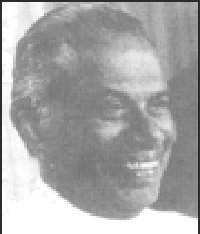
 Saumiyamoorthy Thondaman, who
passed away on 30 Octobe 1999, was the undisputed
leader of Sri Lanka's predominantly Indian Tamil
plantation proletariat. At 86, he was both the oldest
and the seniormost members of the Sri Lankan Cabinet:
he had served continuously for 21 years from 1978,
under Presidents J.R. Jayewardene, Ranasinghe
Premadasa, D.B. Wijetunge and Chandrika Kumaratunga.
Thondaman was the leader of Sri Lanka's Tamils of
recent Indian origin, known as "Indian Tamils" and
consisting mainly of tea and rubber plantation
workers...
Saumiyamoorthy Thondaman, who
passed away on 30 Octobe 1999, was the undisputed
leader of Sri Lanka's predominantly Indian Tamil
plantation proletariat. At 86, he was both the oldest
and the seniormost members of the Sri Lankan Cabinet:
he had served continuously for 21 years from 1978,
under Presidents J.R. Jayewardene, Ranasinghe
Premadasa, D.B. Wijetunge and Chandrika Kumaratunga.
Thondaman was the leader of Sri Lanka's Tamils of
recent Indian origin, known as "Indian Tamils" and
consisting mainly of tea and rubber plantation
workers...
Born in 1913, the political veteran celebrated
his 86th birthday on August 30. As president of Sri
Lanka's largest and one of the oldest trade unions, the
CWC, Thondaman played a prominent role in the country's
post-independence politics. His political life was
intertwined with the vicissitudes of the Indian Tamil
people of Sri Lanka, who form the most deprived section
of Sri Lankan society. His goal was to emancipate these
people from the wretched plight they were in owing to
historical injustice. Although he could not fully
realise these aspirations, it cannot be denied that the
pragmatic leadership of Thondaman helped the people he
represented to better their circumstances from the dire
position they were in at the dawn of Sri Lanka's
independence.
Thondaman's father Karuppiah Thondaman was
connected to the royal family of Pudukkottai. This
branch of the family, however, underwent a decline in
fortunes, and it was on the verge of impoverishment
when Karuppiah migrated to Ceylon, as Sri Lanka was
called by the British, to become a "Kankani", or
supervisor, of tea estate workers. Through hard work
and shrewd business acumen he became the owner of a
prosperous tea plantation, Wavendon estate, in Ramboda
in the Nuwara Eliya district.
Young Thondaman, born in Munappudoor, came
over at the age of 11. He went to secondary school at
St. Andrews, Gampola. He then took to planting as
estate management was then known. In his late teens and
early twenties Thondaman led the life of a brown sahib,
as the son and heir of a prosperous plantation
owner.
There was, however, an idealist streak in the
son, who was not content to lead a luxurious life.
Instead, he chose to espouse the cause of plantation
workers, who were exploited ruthlessly. The bulk of
these workers were Tamil people who were brought as
indentured labourers from the then Madras Presidency.
Thondaman and other like-minded idealists started
organising plantation workers on the lines of trade
union movements.
The Indian freedom struggle led by Mahatma
Gandhi had a demonstration effect. The Indian
community, guided by Jawaharlal Nehru, declared itself
formally, in his presence and according to his advice,
as the Ceylon Indian Congress (CIC) on July 25, 1939.
The War years saw trade unionism taking firm roots in
the estates. Thondaman at times spent his own money to
finance strikes. The CIC developed into a formidable
organisation at the time of independence, with
Thondaman as a leader.
In the elections to the first Parliament in
1947, eight persons representing plantation Tamil
interests were returned. Of these, six were from the
CIC. Thondaman himself won from Nuwara Eliya with a
majority of 6,135 votes. In addition to this, Tamil
workers helped influence results in a further 12
constituencies. Parliament at that time had 95 elected
and six appointed members. Interestingly, Thondaman was
the only member of the first Parliament to be a member
of the current Parliament.
The United National Party (UNP) government
under D.S. Senanayake felt threatened on class and
ethnic lines by this "alien presence". It
introduced legislation in 1948 and 1949 to deprive the
Indian Tamil community of citizenship and
franchise. Thondaman and other Indian Tamil
leaders, inspired by the Gandhian ethos, chose to
combat these blatantly discriminatory
measures by resorting to mass satyagraha. After 18
months the struggle was called off.
Accepting the inevitable, the plantation
workers began applying, under the new regulations, for
citizenship afresh. The stringent requirements imposed
and the strict application of those requirements during
processing saw most workers being denied citizenship
and, by extension, voting rights. Of the 1,071,000
Indian Tamil people who were residents of the Island at
the time of independence, only 1,32,000 became eligible
for citizenship by 1962. In the meantime, lakhs of
Indians returned to India voluntarily.
The 1958 communal riots accelerated this
process. The CIC transformed itself into the CWC in
1950. With the deprival of voting rights it became more
of a trade union with a political wing than a political
party with a trade union. No member of the CWC was
elected to Parliament in the 1950s.
In July 1960, Thondaman became an appointed
Member of Parliament under Sirima Bandaranaike's
government. He represented the hill country Tamil
category known as "stateless" people, that is, Tamils
who were citizens of neither Ceylon nor India. The
worst, however, was yet to come. In October 1964, Prime
Ministers Lal Bahadur Shastri and Bandaranaike signed
an accord which arbitrarily determined the future of
these so-called stateless persons. The Sirimavo-Shastri
Pact, as it was popularly known, divided the stateless
people on a ratio of seven to four between India and
Sri Lanka respectively. Out of the 9,75,000 stateless
persons, 5,25,000 were to be repatriated to India while
300,000 were to be granted Sri Lankan citizenship. The
fate of another 150,000 people was kept in abeyance. In
1974, Prime Ministers Bandaranaike and Indira Gandhi
signed another accord, which divided these people
equally - 75,000 each between the two
countries.
The tragic dimension to this exercise was that
the CWC, which represented the stateless persons, was
not consulted. Angered over these developments,
Thondaman joined with dissident Sinhala MPs and brought
about the downfall of the Bandaranaike government in
December 1964; Thondaman abstained during a crucial
vote, and the government fell by a one-vote
margin.
The incident also brought under the spotlight
the political animal that was Thondaman. Instead of
striking out against the government in opposition to
the Sirimavo-Shastri Pact and inviting political
isolation, Thondaman chose to bide his time and team up
with other Sinhala MPs on the question of press freedom
at the opportune moment and help deliver the coup de
grace.
In 1965, Thondaman became an appointed Member
of Parliament at the time of the UNP government of
Dudley Senanayake. He used the opportunity to delay the
repatriation while encouraging the process of
re-enfranchisement. Thondaman reportedly told a
political scientist that he had single-handedly
nullified an agreement entered into by two sovereign
governments.
The return of Bandaranaike to power in 1970
saw a reversal of this state of affairs. The
nationalisation of plantations saw Indian Tamil people
being evicted from the estates and landless Sinhala
people being settled in their place. A large number of
Tamil people were relocated in the Sri Lankan Tamil
districts of North and East.
In spite of the dire economic circumstances, a
silent revolution was on within the Indian Tamil
community. Aided by CWC leaders, more and more Indian
Tamils were regaining citizenship and consequently
voting rights. As more and more children grew up and
reached the voting age of 18, the community's voting
strength increased.
This empowerment became evident for the first
time in the 1977 elections when, after 30 years,
Thondaman was re-elected to the multi-member
constituency of Nuwara Eliya-Maskeliya. He joined the
UNP government of J.R. Jayewardene in 1978. The new
Constitution of 1978 removed the distinctions between
citizens of descent and citizens by registration. This
put an end to many problems faced by Indian
Tamils.
As Minister for Rural Industrial Development,
Thondaman was able to foster dairy projects and small
industries among the Indian Tamil people. When it was
found that there was a shortfall of 93,000 in the
number of applicants for Indian citizenship and a
corresponding excess for Sri Lankan citizenship.
Thondaman persuaded the Jayewardene government in 1987
to grant citizenship unilaterally to this category and
end for all time the "Thrishanku state" of the
stateless people. Concessions were also gained in the
case of Tamil people who had obtained Indian
citizenship but were staying on.
Thondaman was successful in these attempts
because of five factors. First, the increase in votes
within the community and the CWC's ability to deliver
them en bloc provided Thondaman considerable bargaining
power. Secondly, the rise of political violence in the
northeastern region of the country saw Colombo
awarding priority to the needs of the Indian Tamils.
Thirdly, India had begun to take greater interest in
the affairs of Sri Lanka, thereby impelling
governments in Colombo to remove possible irritants
pertaining to the plantation Tamil community, which
claimed an umbilical relationship with "mother
India".
Fourthly, the CWC illustrated through
well-executed strikes its capability to paralyse tea
and rubber production. This provided economic clout,
which enhanced the CWC's bargaining power. Fifthly,
Thondaman enjoyed close personal relations with UNP
leaders such as Jayewardene, Premadasa, Gamini
Dissanayake, Lalith Athulathmudali and Anandatissa de
Alwis, and used them to the advantage of his
people.
The CWC contested several elections in
association with the UNP. It was a mutually beneficial
arrangement, which helped both parties to increase
their representation. For the Indian Tamil people, it
was a slow return to political representation after
being in the cold for more than 25 years. The Indian
vote helped Jayewardene and Premadasa win the
presidential elections in 1982 and 1988.
The CWC contested the 1994 parliamentary
elections along with the UNP under the latter's symbol
of elephant. Seven of its candidates were elected and
two persons, including Thondaman, appointed National
List MPs. But the People's Alliance under Chandrika
Kumaratunga won the elections with a wafer-thin
majority. Thondaman then changed sides and became
Minister of Livestock Development and Estate
Infrastructure in her Cabinet. His colleagues, however,
sat in the Opposition but supported the government
during voting time. Thondaman helped increase the
majority of Kumaratunga in the presidential elections,
which were held subsequently, by once again delivering
the bulk of the plantation Tamil votes.
In spite of certain problems and tensions,
Thondaman remained supportive of Kumaratunga to the
very end. When she opted to advance the elections to
December 21 this year, the CWC decided to back her
again mainly because Thondaman decided to do so in
spite of some CWC MPs holding a different
opinion.
As the undisputed leader of the Indian Tamil
community, Thondaman enjoyed the reputation of being a
king-maker in Sri Lankan politics. Even during the
Provincial Council elections of April 6 early this
year, Thondaman lived up to this sobriquet. He floated
the India Vamsavali Makkal Perani. It won six seats in
the Central province and one seat each in the Uva and
Sabragamuwa provinces. Again, it was Thondaman who
provided a narrow but effective majority that enabled
the ruling alliance to form viable administrations in
the councils of these provinces.
Thondaman was sympathetic to the problems of
the Sri Lankan Tamil community but knew clearly that
there was no uniform identity of interests. In 1961 he
launched a plantation workers' strike as a
demonstration of sympathy for the satyagraha campaign undertaken by Sri Lankan
Tamils in the North and the East. However, against
the Sri Lankan Tamil community's expectations that he
would prolong the strike, he called it off early after
making his point.
Thondaman cooperated with Sri Lankan Tamil
political parties in forming the Tamil United Front in
1971. But when it metamorphosed into the Tamil United
Liberation Front (TULF) and opted for a separate state
in 1976, Thondaman opted out despite being elected as
one of the triumvirate of its leadership. Tamil Eelam
will not help resolve the problems of plantation Tamils
was his practical credo. He campaigned for the TULF in
1977 and enlisted TULF support for the CWC in
elections, but contested separately under the cockerel
symbol instead of the rising sun symbol of the
TULF.
He was also critical of the confrontational
tactics of Sri Lankan Tamils, both violent and
non-violent. He told this writer several times that the
trouble with the TULF leaders was that they did not
know how to negotiate. "The art is to put five demands,
win one completely, gain partial compromises on two and
put on hold the remaining two for another day. Since we
are trade unionists, we know that art. But TULF leaders
are all lawyers who only know how to argue their brief
eloquently but not how to extract concessions," he
said.
Thondaman was not overtly critical of the
Liberation Tigers of Tamil Eelam (LTTE) or the armed struggle by Sri Lankan Tamils.
His pragmatic proposal that power be handed over to
LTTE
leader V. Pirabaharan for a stipulated period of
time without being obligated to face elections was
thoroughly misunderstood in the South. He was accused
unfairly of collaborating with the LTTE to create a
"Malaya Naadu" upcountry. But actually Thondaman strove
hard to prevent violence entering the plantations. He
knew that if the upcountry youth started emulating
their northeastern counterparts, it would lead to
tragedy. He approved of violence only as a means of
self-defence. Thondaman was instrumental in preventing
violence from overwhelming the plantations. His
importance will be felt only in his absence.
He also had an earthy way of describing when
to call off a strike and go in for a negotiated
agreement. The comparison was to the cooking of dosa, a
staple of Tamils. "The cook has to flip-flop the dosa
alternately on the cooking tray so that both sides get
cooked. It has to be taken off at the right moment. If
this pakkuvam (finesse) is not adhered to, the dosa
will be either burnt or not cooked well on one side. It
is this pakkuvam of timing that is required in
conducting strikes and negotiations. If the correct
moment is not seized, everything will be
lost."
Tondaman's politics was that of brinkmanship
at times. There was however deep subtlety to it. A
major example is the plantation strike he launched
while being a Minister in the Jayewardene government.
"It was not a strike," Thondaman said, "but a prayer
campaign where every worker would attend a place of
worship and be there praying the whole day for a wage
increase instead of working."
To prevent personal pressure being exerted by
Jayewardene, the wily Thondaman got himself admitted to
hospital and got a no-visitors rule
implemented.
The government caved in to Thondaman's demand.
There was no triumphant boast by Thondaman. "Prayers
can move mountains. Our prayers have been answered," he
said in a deadpan tone. Thondaman was a man who could
reconcile seemingly irreconcilable
contradictions.
An estate owner leading plantation workers, a
Minister leading a strike against his own government,
an MP elected on the UNP ticket sitting with the P.A.
as a Minister - were some of these. When asked about
these different aspects of his personality, Thondaman
would say with a twinkle: "I am like the ideal woman.
She can be a daughter to her parents, sister to her
siblings, wife to her husband, and mother to her
children, and remain the same woman."
The king-maker role he played and the
pragmatic approach he adopted to the dynamics of
politics fuelled resentment against Thondaman in
certain chauvinist quarters. The fact that an "Indian
Tamil" was helping make and unmake Presidents and
administrations strengthened these feelings. Also, his
role in resolving the problems of the Indian Tamil
community was not fully appreciated by some sections of
the community.
Whatever the misgivings and misunderstandings,
there is no doubt that Thondaman was a leader who
helped his people with single-minded devotion for more
than 60 years to realise their aspirations against
overwhelming odds. The passing of the Tamil patriarch
is an irreparable loss.
Thondaman leaves behind a son, Ramanathan,
three granddaughters and a grandson, Arumugam
Thondaman. The grandson, in his early thirties, is both
a Member of Parliament and the general secretary of the
CWC and is tipped to be Thondaman's political
successor. There is speculation that the CWC may split
over the succession question. There was a time when the
CWC had 600,000 members. Now the membership has dropped
to around 350,000. Still it remains a force to be
reckoned with. The reason for this is the astute and
bold leadership of Thondaman....

 Thondaman - the Master of Real Politick
- S.Sivanayagam, 25 January 1986
Thondaman - the Master of Real Politick
- S.Sivanayagam, 25 January 1986
