"The digital revolution is
bringing Tamil from paper to the computer and the internet.
Swaminathatha Iyer and
Thamotherampillai heralded the
Tamil renaissance in the 19th century.
Today, a
Tamil digital
renaissance is taking place - and is helping to bring Tamil
people together not simply culturally but also in political and
economic terms."
- Tamil Digital Renaissance
* indicates link to
Amazon.com
online bookshop
** indicates link to
Amazon.co.uk
online bookshop
*A. P. J. Abdul Kalam, Y. S. Rajan -
India 2020; a Vision for the New Millennium /Hardcover / Published 1998
* John Arquilla(Editor) -
In Athena's Camp : Preparing for Conflict in the Information Age
Paperback / Published 1998
*H. J. Blommestein -
The New Financial Landscape: Forces Shaping the Revolution in Banking
*John Hagel, Arthur G. Armstrong -
Net Gain : Expanding Markets Through Virtual Communities / Hardcover /
Published 1997
 *Graham
Hamel & C K Prahalad -
Competing for the Future *Graham
Hamel & C K Prahalad -
Competing for the Future
"...(Organisations) are going to
have to unlearn a lot of their past � and also forget it! The future will not be
an extrapolation of the past... Like a space rocket on the way to the moon, (an
organisation) has to be willing to jettison the parts of its past which no
longer contain fuel for the journey and which are becoming, in effect, excess
baggage. That is particularly difficult for ... those who actually built the
past, and who still have a lot of emotional equity invested in it..."
[**
alternate link to amazon.co.uk]
* Andrew S. Grove -
Only the Paranoid Survive : How to Exploit the Crisis Points That Challenge
Every Company and Career / Hardcover / Published 1996
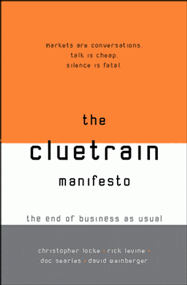 *Christopher
Locke, Rick Levine, Doc Searls, and David Weinberger -
The Cluetrain Manifesto / Published February 2000 - *Christopher
Locke, Rick Levine, Doc Searls, and David Weinberger -
The Cluetrain Manifesto / Published February 2000 -
"A powerful global conversation has begun. Through the
Internet, people are discovering and inventing new ways to share
relevant knowledge with blinding speed...For every entry in the
encyclopedia, there is now a Web site. For any idea you can
imagine - and some you can't - there are thousands of
articles and images electronically swirling around the globe.
But that's not the real story. That's not the big news. The word
that's going around, the word that's finally getting out, is
something much larger, far more fundamental. The word that's
passing like a spark from keyboard to screen, from heart to
mind, is the permission we're giving ourselves and each other:
to be human and to speak as humans..."
The Cluetrain Manifesto began as a
Web site
in 1999 when the authors, who have worked variously at IBM, Sun
Microsystems, the
Linux Journal, and NPR, posted 95 theses that pronounced
what they felt was the new reality of the networked marketplace.
"Like Zen masters, these four irreverent visionaries
produce startling insights by first confronting our most
cherished but often misguided beliefs about business. Seeing the
Internet as forcing profound and deeply humanistic change, this
book lights the way into the 21st century for e-businesses large
and small." Eric Severson, Executive Consultant
IBM
Global
Services.
*
John Naisbitt -
Global Paradox Paperback, January 1995
From an Amazon.com review by
D.J.Smith and F.Rendon: "(1) The bigger the world's economy, the more
powerful its smallest players. As globalization occurs, people seek linkages
which cater to smaller, more "tribal" concerns: language, culture and/or niche
markets. (2) Individualism will prevail over government-run structure. The
person can influence the direction of economic consumption and governance: both
tribal and global concerns, not one or the other, can be addressed. (3)
Technological driving forces: blending old and new technology allows ubiquitous,
anytime access to everyone. This allows community groupings to develop based
on desire to share certain knowledge, rather than in a predetermined or overtly
mediated fashion. A mixed-use approach to education and technology will give
fluidity and greater access to learners, educators and anyone who desires to
know something; and do so in a manner appropriate to the moment..."
*
Jakob Nielsen -
Designing Web Usability : The Practice of Simplicity December 1999
From Amazon.com Review: Creating Web sites is easy. Creating
sites that truly meet the needs and expectations of a wide range of online users
is quite another story. In Designing Web Usability: The Practice of
Simplicity, renowned Web usability guru Jakob Nielsen shares his insightful
thoughts on the subject. Packed with annotated examples of actual Web sites,
this book sets out many of the design precepts all Web developers should follow.
"...In 1997 the United States and Canada accounted
for around 80 percent of total web user population. By 1999, the
proportion of web users in the U.S. and Canada had dropped to 55
percent. It is close to guaranteed that the Web will achieve a 50/50
split between North America and overseas in 2000. The only question
is whether this will happen early or late in the year. It is likely
that the picture will have been reversed by 2005, with about 80
percent of users overseas and only about 20 percent of users in
North America. Around 2010, I expect the Web to reach a billion
users, distributed with about 200 million in North America, 200
million in Europe, 500 million in Asia, and 100 million in the rest
of the world..."
 *
David S. Pottruck, Terry Pearce -
Clicks and Mortar - Passion Driven Growth in an Internet Driven World, April
2000 *
David S. Pottruck, Terry Pearce -
Clicks and Mortar - Passion Driven Growth in an Internet Driven World, April
2000
David S. Pottruck, president and co-CEO of Charles Schwab, and Terry
Pearce, founder of Leadership Communication, are among those who believe the
Net will forever change the way business is conducted--if it hasn't done so
already. In Clicks and Mortar, they draw on personal experience to suggest
corporate officials prepare for this new reality by refocusing their
practices, principles, and passions on the real needs of a 21st-century
company....
"....Metaphors for leadership are changing, from 'General' to
'Coach', from 'Charismatic Boss' to 'Orchestra Conductor'. Corporate leaders
are trying not only to play the musical notes correctly, they are trying to
create music that fills the room. In the fields of music and art and at the
highest level of team sports, everyone can sense the difference between
participation with energy and passion and just participation. To be
effective, business leaders must now ask themselves, 'How do I tap into that
passion?' 'How can I connect with the part of myself and of the other person
that actually cares?' 'How can I inspire � them � and me?'..."[**Alternate
link to Amazon.co. bookshop]
 *Don
Tapscott et al -
Creating Value in the Network Economy - Hardback, 1999. *Don
Tapscott et al -
Creating Value in the Network Economy - Hardback, 1999.
"Collects 12 recent articles from the Harvard Business Review dealing
with how the new internet economy requires different paradigms on value
creation. The articles are grouped in three categories. First are those having
to do with the changing nature of value. The Net provides a new, function-rich,
high-capacity and nearly ubiquitous infrastructure for business�Value
propositions and the value chains used to create products and deliver them to
market can also become disaggregated, enabling value to be created in radically
different ways. The second group of articles moves on, to describe new models of
the firm, which appear to be as different from the integrated corporation of the
industrial economy as it was from the penultimate, agrarian economy. The third
describes how much of what is known about marketing is changing, as new
interactive relationships with customers become possible." [**Alternate
link to Amazon.co.uk bookshop]
* Alvin Tofler -
Third Wave
Mass Market Paperback / Published 1991
*Alvin Toffler -
Future Shock
Mass Market Paperback / Published 1991
* Alvin
Toffler -
Powershift : Knowledge, Wealth, and Violence at the Edge of the 21st Century
1991 Alvin
Toffler -
Powershift : Knowledge, Wealth, and Violence at the Edge of the 21st Century
1991
"Toffler argues that while headlines focus on shifts of power at the
global level, equally significant shifts are taking place in our everyday world
- supermarkets, hospitals, banks, television, and politics. As old antagonisms
fade, Toffler identifies where the next, far more important world division will
arise.."
*Peter
Senge -
The Fifth Discipline : The Art and Practice of the Learning Organization
"...The irony is that to do
things faster, you often have to go slower. You have to be more
reflective. You have to develop real trust. You have to develop the
abilities of people to think together. Why? Because it requires you to
go through basic redesigns. You need to build a shared understanding of
how the present system works.... People must trust one another through
difficult systemic changes..."
 *
Patrick Young & Thomas Theys
-
Capital Market Revolution /Hardcover / Published 1999 *
Patrick Young & Thomas Theys
-
Capital Market Revolution /Hardcover / Published 1999
"...When the printing press was invented it didn�t merely level
the playing field to make information more freely available to all levels of
society, rather it revolutionised society by providing a new, cheap method
of disseminating information to far more people than could be accommodated
by the handwritten copying of manuscripts in monasteries. In the information
age the internet provides the opportunity to pass on vast quantities of
information at little incremental cost to every form of trader, investor and
market counterpart. The old hegemony of existing institutional investors,
exchanges and brokers is doomed to collapse under the �new reality�. Just as
the clerics lost power after the printing press, the information revolution
undermines the power of established financial institutions...."
[**Alternate
link to Amazon.co.uk bookshop]
*
Jonathan Zittrain:
The Future of the Internet - And How to Stop It ISBN-10:
0300124872 ; ISBN-13: 978-0300124873 </p>
</td>
</tr>
</table>
</div>
</td>
</tr>
</table>
</div>
<!-- #EndEditable --><p> </p>
<div align=)
|