" ...Man's illusions are of all
sorts and kinds... The greatest of them all are those which
cluster round the hope of a perfected society, a perfected race,
a terrestrial millennium... One of the illusions incidental to
this great hope is the expectation of the passing of war... that
he should struggle even by illusions towards that end, is an
excellent sign; for it shows that the truth behind the illusion
is pressing towards the hour when it may become manifest as
reality... "
Sri
Aurobindo on the Passing of War
[see also
Conflict Resolution]
*
indicates link to
Amazon.com
online bookshop
** indicates link to
Amazon.co.uk
online bookshop
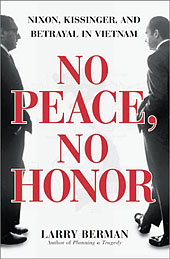 *Larry
Berman -
No Peace, No Honor: Nixon, Kissinger, and Betrayal in Vietnam,
2002 *Larry
Berman -
No Peace, No Honor: Nixon, Kissinger, and Betrayal in Vietnam,
2002
"...What Berman works to show is
the inherent dishonesty of Nixon's Vietnam policy. This is no
great challenge. Even before he was elected president, Nixon
strove to undercut the possibility (admittedly slim) of the
Johnson administration achieving any breakthrough in the Paris
peace talks. That dishonesty continued, and to little purpose,
in his and Kissinger's shared mania for secrecy in their
negotiations with the North. And, finally as well as most
important, there was his highly cynical view of the accords.
"Nixon," Berman writes, "recognized that winning the peace, like
the war, would be impossible to achieve, but he planned for
indefinite stalemate by using the B-52s to prop up the
government of South Vietnam until the end of his presidency.
Just as the Tonkin Gulf Resolution provided a pretext for an
American engagement in South Vietnam, the Paris Accords were
intended to fulfil a similar role for remaining permanently
engaged in Vietnam. Watergate derailed the plan."
The
Price of Peace - Mark Feeney / Boston Globe, 25 August 2001
Centre for Just Peace & Democracy -
Envisioning New Trajectories for Peace in Sri Lanka, 2006
Centre for Just Peace & Democracy -
Sri Lanka's Endangered Peace Process and the Way Forward, 2007
Centre for Just Peace & Democracy -
International Dimensions of the Conflict in Sri Lanka, First
Published 2008
 *Roger
Fisher &
William Ury -
Getting to Yes : Negotiating Agreement Without Giving in
Arrow Business Books, 1997 *Roger
Fisher &
William Ury -
Getting to Yes : Negotiating Agreement Without Giving in
Arrow Business Books, 1997
*Roger
Fisher
from the Harvard Law School, Andrea Kupfer Schneider from Marquette Law School,
Elizabeth Borgwardt from Stanford Center on Conflict and Negotiation and Brian
Ganson -
Coping with International Conflict, Prentice Hall, 1997
"From the Back Cover: This
text combines the clear, concise, proven principles and practice
of conflict management from Fisher's bestseller Getting to Yes
with the newest problem-solving approaches to international
relations. Many of the concepts presented grew out of materials
Fisher and his colleagues use in their international consulting
work to teach problem-solving and conflict management skills to
diplomats and heads of state involved in contentious
international disputes...."
"...Sometimes, an important factor in changing the course of an
international negotiation may be the introduction of a creative
perspective, a new understanding of what may have seemed to be
intractable conflict. Such a fresh idea will often provide the
kernel of a new question that can be asked of someone who, up
until now, has been saying 'no'...
"...Parties to a
conflict tend to get stuck because they have been going back and
forth arguing about the past and about the merits of their
respective positions. The debate has taken on a stale quality,
and new ideas are not being generated. Often, those involved
simply see no need for new ideas. They know what they are
opposed to. They see their primary concern as having their views
prevail. New ideas are a threat to existing ideas. Inventing
does not take place because parties are content with the ideas
they have. Or emotional involvement on one side of a conflict
makes it difficult to achieve the detachment necessary to think
of solutions that reconcile the interests of all parties....
Perhaps
the most serious constraint on creative thinking in a conflict
is the official role of those involved in it. Having authority
puts a negotiator in the position where a freely invented option
may be mistaken by adversaries as an official position. There
is a serious risk that she will be seen, at least personally, as
committed to accept an idea that she created or helped to
create.
Something said in a creative context may later be treated as a
concession by other negotiators or by critics at home..
....A
final reason for not coming up with better ideas is that most us
do not know how - we are untrained in the art of generating
fresh ideas.... few of those involved in a conflict ever spend
much time trying to invent better solutions for all concerned.
Parties rarely spend time consciously trying to invent
original ways of resolving their differences or
formulating principles that will appeal to both sides..."
Roger Fisher,
Elizabeth Kopelman & Andrea Kupfer Schnieder -
Beyond Machiavelli : Tools for Coping With Conflict 1994
"...Every
dispute has a history; we have been sending messages to them and
they have been sending messages to us, even if only by silence
or by a professed refusal to negotiate. Positions have been
staked out. Proposals have been made and rejected. One thing we
know for sure: if the conflict is continuing, whatever we have
been saying and doing so far has not worked. It has not produced
the result we want, or we would have turned our attention to
other matters by now..."
Adam Kahane - Solving Tough Problems:
An Open Way of Talking, Listening, and Creating New Realities John McGarry, Brendan O'Leary
(Editor)
The Politics of Ethnic Conflict Regulation: Case Studies of
Protracted Ethnic Conflicts, 1993 John McGarry, Brendan O'Leary
(Editor)
The Politics of Ethnic Conflict Regulation: Case Studies of
Protracted Ethnic Conflicts, 1993
John McGarry
(Editor)
Northern Ireland and the Divided World: The Northern Ireland Conflict and the
Good Friday Agreement in Comparative Perspective / 2001
*Harold
George, Sir, Nicolson -
Diplomacy
/ Paperback / Published 1988
Michael Mann -
The
Dark Side of Democracy: Explaining Ethnic Cleansing
Cambridge University Press, 2005
"...Where a significant minority movement is
already making collective political demands on a state dominated
by another ethnic or religious group, these demands will neither
wither away nor be repressed, once aired and organized. The
nation-state ideal is too strongly entrenched in the modern
world for them to be simply repressed or ignored... I predict
that Indonesia will be unable to assimilate or repress Aceh or
West Papuan autonomy movements;
India
will be unable to assimilate or repress Muslim Kashmiris or
several of its small border peoples;
Sri Lanka will be unable to assimilate or repress Tamils..."
more
Tanya Reinhart - The Road Map to
Nowhere: Israel/Palestine Since 2003
*
Robert I. Rotberg -
Creating Peace in Sri Lanka: Civil War and Reconciliation, ,
Washington, DC: The Brookings Institution Press, 1999.
*Robert
L.Rothstein -
After the Peace: Resistance and Reconciliation, 1999
"...many peace
agreements are fragile and the 'peace' that they create is
usually the extension of war by more civilised means... A peace
agreement is often an imperfect compromise based on the state of
play when the parties have reached a 'hurting stalemate' or
when the international community can no longer stomach a
continuation of the crisis. A peace process, on the other
hand, is not so much what happens before an agreement is
reached, rather what happens after it... the post conflict phase
crucially defines the relationship between former antagonists.
Hence the title, After the Peace..." from a review by Walter
Kemp, Organisation for Security and Co-operation in Europe,
Nations and Nationalism, Volume 6,Part2,April 2000
[**alternate
link to Amazon.co.uk]
*Edward
W. Said -
The End of The Peace Process: Oslo and After
From a review by
Chris Green for Amazon.com: "...Edward Said opposes the "peace
process" because it has been deliberately designed to confine Palestinians
to cantons which are isolated from one another, over which Israel controls
overall sovereignty, water , exits and entrances, overall security and so
on. The "peace process" has allowed Israel to extend its military occupation
of the West Bank and Gaza strip, with arrangements less costly than the old
direct military rule, letting the Palestinian Authority have "limited
autonomy" in Palestinian population centers, the cantons, while it retains
all the best land and continues expropriating Palestinian land and building
more settlements, most fervently under the "moderate" Labor governments,
contrary to much illusion. Israel currently retains direct rule in about
seventy two percent of the West Bank and about forty percent of the Gaza
Strip. Said makes very clear that he believes the "peace process" to be
similar to the effort in apartheid South Africa to establish
batustans,"homelands" for the blacks. Doubtless, he says, the Palestinian
cantons will one day be declared a "Palestinian state" but it will actually
be no more than a caricature of the bantustans of South Africa.
He was on close terms with Arafat and
many of the top PLO leaders before 1993. He offers an utterly scathing
critique of Arafat and the PLO leadership. He portrays them as unbelievable
morons and unbelievably corrupt and brutal. He says the main reason the PLO
succumbed to Israel's offer in 1993 was that Arafat and his goons were
facing an internal rebellion within the PLO because of their corruption,
stupidity and lack of democracy. So they jumped at an agreement that made
them Israel's collaborator and gave them protection. Their main duty is to
round up, and often torture and sometimes murder all people whom Israel
believes to be a threat to its always threatened "security" a very elastic
concept which includes a great many non-violent persons
Since 1993, Arafat has spent all of
the Palestinian Authority's money funding twelve or thirteen secret police
agencies and buying off his enemies, real or potential, often with salaries
for government jobs that entail absolutely nothing. He graphically portrays
Arafat's incredible stupidity as he has endlessly begged the Israelis for
more crumbs, and is always hoodwinked. Probably the best chapter in the book
(and by far the longest) is "On Visiting Wadie" where he describes, among
other incidents, an interview he was granted with the acid tongued PA
minister Yasser Abd Rabbo, that was very cordial. Several months later
Rabbo, on Arafat's orders, sent goons to all bookstores under Palestinian
jurisdiction to seize Said's books and carry them away.
A point that he constantly reiterates
throughout this book is something that he says that he has been making to
Arafat and other Palestinians for years. He says that Palestinians need to
try to emulate the international educational efforts, lobbying and other
forms of activism of the old anti-apartheid movement of South Africa. The
Arab world, he notes, is currently run by dictatorships of varying degrees
of brutality, most of them propped up by the West, and is at an all time
low. Arabs, he says, especially the various kept intellectuals of the
pro-Western regimes, are immensely ignorant of Israel. They focus all their
attention on the Labor party, but not on any genuine elements of peace in
Israel like Israel Shahak or the late General Matti Peled or his daughter
who expressed sympathy for the Palestinians after her daughter was blown up
by a Hamas suicide bomb. Or the composer Daniel Barenboim, with whom Said
has developed a friendship. Or Israel's revisionist historians like Benny
Morris, Illan Pappe, Zeev Sternhell, Tom Segev, etc. who were interviewed
about their findings on Israel's ethnic cleansing of Palestinians in 1948 on
Israel's fiftieth anniversary special on Israeli TV (of all places) in
1998..."
Isak Svensson - Bargaining, Bias and Peace Brokers: How
Rebels Commit to Peace,
Journal of Peace Research, 2007
What is the role of biased mediators in
bringing belligerents to a negotiated settlement in internal
armed conflicts? Previous research has suggested that biased
third parties may mitigate commitment problems between parties,
by serving as guarantors for the weakening side. This article
contributes to the previous debate by distinguishing,
theoretically and empirically, between government- and
rebel-biased mediation. When belligerents in internal armed
conflicts consider ending their armed conflict through a
negotiated settlement, the government stands to relinquish
authority, whereas the rebels stand to gain opportunities �
legitimacy, time and access to official structures � that can be
exploited in the post-agreement future. Hence, in the
pre-settlement phase of the conflict process, it is above all
the rebels that have problems committing to peace. The author
argues that government-biased mediators can decrease the fears
of the government and thereby mitigate the rebels' commitment
problems. Using new data on the dyadic level covering all
intrastate armed conflict in the period 1989�2003, this article
examines states, organizations and individuals that are
mediating in states' internal conflicts. The empirical analysis
supports the above-mentioned argument. Mediators on the side of
the government have a positive effect on negotiated settlements,
while rebel-biased mediators have no significant effect.
|