Cogs in the Wheel? Women in the
Liberation Tigers of Tamil Eelam - Miranda
Alison"This article examines
women�s involvement as combatants
in the Sri Lankan Tamil guerrilla organisation the
Liberation Tigers of Tamil Eelam (LTTE). It
addresses women�s motivations for
choosing to join the organisation, then examines
the debate over the LTTE�s brand
of nationalist feminism before looking at how
women�s experiences in the
movement have affected their views on gender in
society. The article hopes to shed some light on
the feminist debate about these women, and through
this on the broader global feminist debate about
women�s roles in nationalism and
war. The article argues for an analysis of
women�s involvement in the
movement that accords the women agency and is open
to certain positive results stemming from their
participation, yet recognises the problematic
nature of nationalist feminism."
சர்வதேச
மகளிர்
தினம், 2005:
கற்பும்
பெண்விடுதலையும்...
Sanmugam Sabesan, 2005
"�கற்பு�
என்ற
சொல்லை
வைத்து,
பெண்ணை
இன்னமும்
அடிமையாக்குகின்றது
எமது
இனம்....
ஆண்-பெண்
இருபாலாரும்
சரிசமமாக
சுதந்திரத்துடன்
வாழவேண்டும்
என்ற
நிலைமை
ஏற்பட
வேண்டும்
என்றால்,
கற்பு
என்பதன்
அடிப்படை
இலட்சியமும்,
கொள்கையும்
மாற்றப்பட்டு,
ஆண்-பெண்
இருவருக்கும்
ஒருப்போன்ற
நீதி
ஏற்பட
வேண்டும்
என்ற பெரியாரின்
கருத்து
பெண்ணியத்திற்கு
ஏற்றதொன்றாகவே
காணப்படுகின்றது..."
Women's International Day Message -
Velupillai Pirabakaran, 1996
"...So that our race may
honor humanness which is beyond masculinity and
femininity, womankind is extending its hand of love
and friendship. Only when man as a gender grasps this
loving hand with deep awareness will equality between
men and women be a reality.."
Women's International Day Message -
Velupillai Pirabakaran 1993 "The ideology of women liberation is a child
born out of the womb of our liberation struggle...
The Tamil Eelam revolutionary woman has transformed
herself as a Tiger for the liberation of our land and
liberation of women."
Women's International Day Message -
Velupillai Pirabakaran, 1992 "Our women are seeking liberation from the
structures of oppression deeply embedded in our
society. This oppressive cultural system and
practices have emanated from age old ideologies and
superstitions. Tamil women are subjected to
intolerable suffering as a consequence of male
chauvinistic oppression, violence and from the social
evils of casteism and dowry."
Off Site
Links
Documentary Video on Women Tigers
released - Part 1, 3 November 2003 "The
documentary video production titled Akkini Paravaikal
('Volcanic Birds') depicts the evolutionary growth of
the women Tiger movement, includes the early
experiences in the battle field, training methods
used and social difficulties faced by fighters within
the conservative Tamil society"
Revolution enables
women's struggle for gender equality- Vidhya Kumaraswamy, 2000 "..While
the liberation of Tamil women within Eelam society
and the liberation of Eelam are not the same thing,
they cannot be achieved independently of each other.
One is not a woman and Tamil separately, one
experiences both identities simultaneously. Nor
should women's liberation be thought of as a once and
for all phenomenon; gender attitudes are too deeply
entrenched. It has to be an ongoing process in which
all sections of society participate by being aware of
how ideas of gender can structure attitudes and
behaviour in way that is fundamentally antithetical
to the interests of both men and
women..."
Women, Tamil women, have been long subject to
oppression of a dual nature.
On the one hand, women comprising a little more
than fifty percent of the Tamil people have borne
the brunt of the national oppression stemming
from chauvinist Sinhala policies.
On the other hand, women have been subject to an
internal form of social oppression rising out of
male chauvinism. This form of oppression is
reinforced by the conservative traditions and some
of the cultural norms inherent in the Tamil
community. Oppression of women is rampant in the
plantation sector where females form half the work
force.
Also, caste oppression finds
its virulent expression when relating to women.
This brief article will however deal with one
aspect namely the impact of the war on Tamil women.
It will, in particular, trace the development of
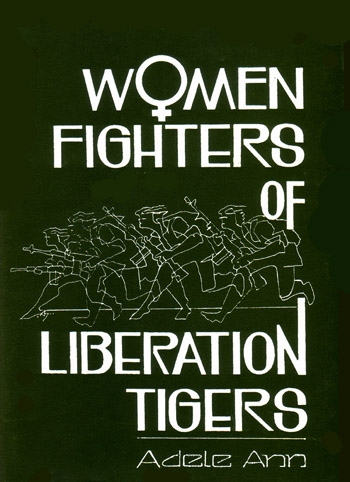
the "birds of freedom", the women military wing of
the LTTE.
The role of women in military combat has been
depicted in confusing terms in the Tamil Puranas.
Sathyabama and Kaikeyi actively participated in
battles aiding their husbands Krishna and Dasaratha
but Bheeshma in the Mahabharatha refuses to fight
Sikandi because he is in reality a woman, Ambai,
transformed into a male.
Tamil literature does not emphasise the active
participation of women in combat. Instead, it
glorifies the motherhood aspect. The puranaanooru
mother who describes her womb as the cave and the
warrior's son as a Tiger is one instance. There is
also the heroic mother who after loosing father,
husband, and brother sends her only son to war.
Misinformed that her son was pierced in the back,
she is ashamed that her son had run as a coward.
Upon reaching the battlefield, she finds the
valiant son has a chest wound and is proud that the son died as a
fighter.
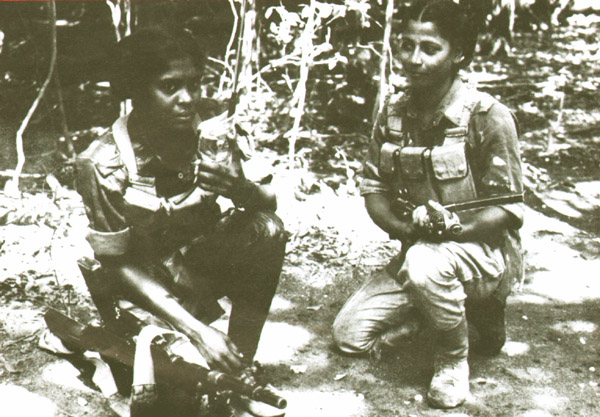
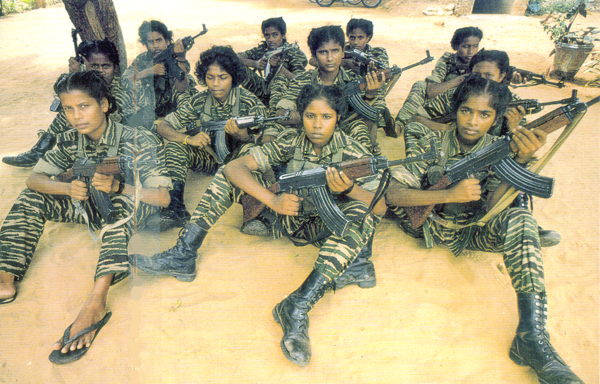
Initially the militant recruits were girls who
were either fired by romantic adventurist visions
or from families affected cruelly by the war. In
some cases, personal experience was the motivating
factor. The birds of freedom or "Suthanthirap
Paravaikal" were initially something like a
paramilitary division.
Great care was taken not to upset the cultural
values of the society at large. First aid, cooking
etc. were the overt functions. They also obtained
military training. As time went on, the birds of
freedom began to participate in fighting also.
The Indian invasion was a water shed. The Indian
army was brutal and male chauvinist. The rapes, and
molesting made a bitter impact.
The callous disregard of the mothers' front fast
by the Indian establishment was another turning
point. The abduction of one mother, Ponnamma David
and letting the other mother Poopathi
Kanapathipillai die without responding
positively to her request worsened the
situation.
Although the Tiger women militants had been
injured in combat with the Sri Lankan forces,
deaths occurred only with the Indian army. A total
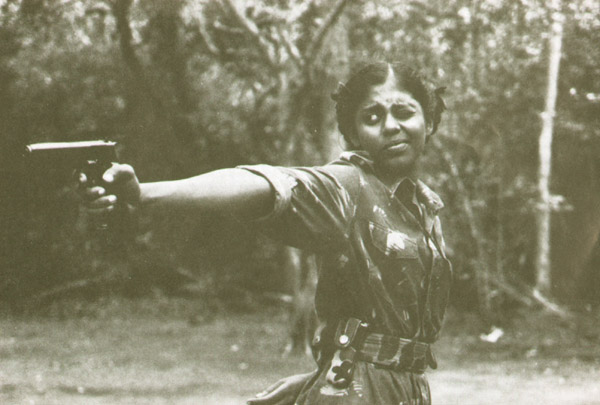
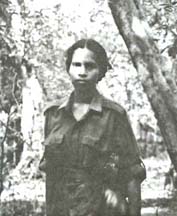
of 24 have died so far. (February 1990). The leader of
the women brigade, Vasanthi alias Sothia,
(photo alongside)
died in 1990 due to a natural cause - disease in
the form of meningitis. A brief sketch of LTTE
women fighters is as follows.
The armed Tamil struggle is more than seventeen
years old. (1990). The period of the armed women
struggle is less than seven years. The
repercussions of the 1983 anti-Tamil pogrom and the
ongoing armed oppression inspired
many young Tamils to join militant ranks. The
contribution of women was proportionately low
because of the cultural barriers. In the early
stages women cells were formed in various parts of
Tamil Eelam.
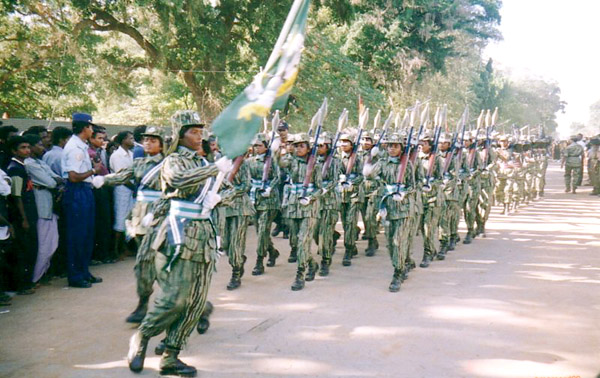
In 1985, the various women militant cells were
formed into a composite whole - the women army
division of the LTTE. For the first time in
contemporary Tamil history, Tamil women obtained
martial training and formed a revolutionary
fighting unit. The women organisations indulged in
a lot of political and propaganda work among women.
In a bid to raise consciousness among women about
the national liberation struggle and female
oppression, a journal called "Suthanthirap
Paravaikal" ("Freedom Birds") was published. The
first issue was in December 1984.
Soon, that name became a synonym for the women
unit. When the peninsula became a semi-liberated
zone, women's division activities were broad based
and intensified. The freedom birds integrated and
co-ordinated activity with women organisations,
trade unions, training centres, health centres, and
primary education centres. At the same time women
fighters engaged themselves in direct combat
against the Sri Lankan army in Mannar and
Vavuniya.
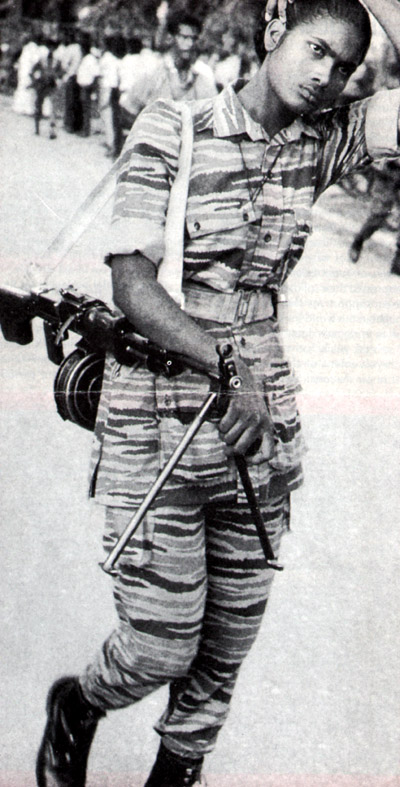
Women militants were active combatants in the
Adamban confrontation on 12th June 1986 where
Victor was killed. Women were involved in the
efforts to establish full control over Jaffna and
Killinochchi districts. Several girls were injured
and lost limbs while on duty at sentry points and
bunkers near the army camps at Jaffna Fort,
Navatkuli, Kattuvan and Valvettiturai.
Women militants also participated in the ....,
Mayiliathanai mini camp attack, KKS harbour view
camp attack, Kurrumpucity camp attack and the
famous Nelliadi attacks spearheaded by Miller.
After the signing of the Indo-Lanka accord, the women
division had its hands full. Initially, the women's
militia engaged themselves in propaganda. Their
task was to eradicate the false sense of confidence
that people had in India..... Boycott, protest
marches, preventing road transport, picketing etc.
were staged.
Thanks to the active work of the women cadres, a
large number of females participated in this mass
protest. When Thileepan commenced his death
fast, the women cadres began a series of
Padayathras in most regions of Jaffna. The girls
dressed in red continued this for all twelve days.
Person to person contact were made with domestic
housewives during these marches. The interaction
between domesticated women and the revolutionary
women raised consciousness among the former.
When the attempt was made to capture Jaffna, the
women militants fought with great courage. The
preliminary military operation against the IPKF was
by the women cadres. The first Tiger casualty in
the war against India was a women militant 2nd.Lt.
Malathi. She was also the first women casualty
among the Tigers. Three others Kasthuri, Thaya and
Ranji also died in the preliminary encounter.
At Sittankerni, the women cadres in an operation
entirely by themselves destroyed an Indian armoured
personnel carrier. Women militants fought
resolutely in countering commandos dropped by air
at the Jaffna University in Thirunelveli.....Women
militants also fought in Vanni. Notable among them
was the combined male female onslaught at Weli Oya.
....
The overall impact made by the fighting girls on
Tamil society is yet to be assessed. It is also too
early to predict the future in relation to the
position in Tamil society after the war is
over.
"..பெண்
அடிமைத்தனத்தின்
விலங்குகளை
உடைத்தெறியாத
எந்த
ஒரு
நாடும்,
எந்த
ஒரு
சமூகமும்,
முழுமையான
சமூக
விடுதலையைப்
பெற்றதாக
கூறமுடியாது..."-
Velupillai Pirabaharan, Leader of Tamil
Eelam
Tamil women, have been long subject to
oppression of a dual nature. On the one hand, women
comprising a little more than fifty percent of the
Tamil people have borne the brunt of national
oppression stemming from the chauvinist Sinhala
policies. On the other hand, women have subject to
an internal form of social oppression rising out of
male chauvinism. This form of oppression is
reinforced by the conservative traditions and
cultural norms inherent in the Tamil community.
However growing national oppression brought about a
situation where Tamil women took to arms. The
normal patterns of life underwent rapid
transformation with large numbers of youths
migrating.
In the early days of the formation of LTTE women
contributed to the freedom fight by performing
socially defined women's work. Giving moral
support, providing shelter, food and played a major
role in securing the safety and survival of the
cadres. This work carried with risk of exposure and
subsequently detention, torture and possibly death.
Indeed women were taken into custody on suspicion
subjected to rigorous and lengthy interrogations
and faced torture. Women have been deprived of
sleep during interrogation, sexual harassment and
even deaths.
The concrete condition which forced a tremendous
rupture, projecting women into a new depth of
participation for national freedom were the state
organized anti-Tamil riots of July 1983. This
horrific outburst of racial violence in which
thousands of innocent Tamil civilians were
murdered, which left a trail of rape, arson and
looting proved to be the ultimate revelation of the
depths of Sinhala chauvinism and racism.
The situation escalated in 1987 when the IPKF
was in Jaffna. Women experienced the worst in their
own soil at the very hands of the people whom they
trusted. The incidents are too many to mention. The
following is one from the stories of some women.
She was a lively, vivacious and self possessed 38
year old professional woman with a eleven year old
daughter. Her husband worked abroad.
"Why me?" I ask myself whether by chance, something
in me made them think they could do this to me? I
feel inside myself soiled, I feel small, two months
have gone past but I think I am getting worse. I
was scared to tell my husband. Only recently had I
written to him: I will tell you my story if you say
it will help other women.
On 12 November, in the morning, three Indian
soldiers came to our house at about 8 O' clock. My
mother was in the kitchen, only my daughter and I
met them. They said that they were checking and
started pushing my daughter into a room, I dragged
her shouted 'Amma, Amma, checking checking. Then
the soldiers at the sentry point near our house
came running to our house. They who were in our
house told them they were checking. ( I lost my
gold chain also ), They did not stay long. However,
we were scared. I took my daughter and hid her in a
small box room at the rear of the house and at
about 9.30, we saw the same three soldiers coming
again. This time they had not used the front gate
where the sentry point is located, but came through
another adjoining vacant house, jumping over the
parapet wall.
Then they locked my parents in one room, showed the
gun and raped me, one after the other, all three of
them. I did not scream. What if they shot my
parents? I can still recollect those beady eyes
could not handle. I left the village and Jaffna
when the first bus started running to Colombo. I
started having nightmares. I started seeing their
faces and hearing their voices�I
took my daughter and went abroad. I even went to a
psychiatrist. I could talk to him because he was a
total stranger. He gave me drugs. They quietened
me, but have not taken the memories away. I am
becoming worse, even more so, At least I saved my
daughter. I have written to my husband and he says
not to worry. But you know our men. Do you think he
will accept me? I feel so apart from the world. I
feel different."
The stories are so traumatizing and makes one
feel exhausted and impotent and as women angry at
ourselves, our class, our men, our whole passive
society. The above is a story of a survivor of
sexual violence. There are numerous reports of
suicides, deaths followed as a result of inhuman
gang rape and torture and molestation. The middle
class families in cases of rape and molestation
have always tried to hide and submerge the
incidents. This type of handling the victimization
of women individualized the pain and trauma and
created far reaching damage to their inner
selves.
Deepening genocidal oppression has now propelled
them out of their established social life into a
new revolutionary world. The very decisions of
young women to join armed struggle - in most cases
without the consent of parents- represents a vast
departure of behaviour for Tamil women. This is a
turning point in the Tamil society. Women have now
decided that talking about their problems will
never put an end to their problems. They have to
challenge. They have to change the norms. They have
stormed into a previously all male activity. They
have challenged the entire beliefs about women's
strength, endurance, potential, determination,
courage and talents. But it is only a certain
percentage of women in the age group 15- 30 who
have adopted themselves to a new style of life. The
majority are those who are still suffering the
communal oppression as women and national
oppression as women belonging to an ethnic minority
group, especially as women in a war torn country.
They are widowed, have lost children, brothers and
sisters as victims of war and as victims of the
atrocities of state terrorism.
In two incidents on the 12th, 15th and 18th of
August 1990, ninety, ninety five and ninety one
civilians, respectively, were shot and hacked to
death and burnt alive by Muslim home guards
supported by the army, in Senkallady,
Thuraineelavanai and Veeramunai in the Eastern
province.
Women with their memories haunting with the
sights of the distorted forms of bodies of their
beloved, but still with the responsibilities
awaiting their services as women, tending the
young, the elderly, adjusting life in the worst of
living conditions, still made incomprehensible, due
to indiscriminate shelling, aerial bombing and
torture.
Complete majoritarian Democracy, in
countries divided on ethnic lines will never
satisfy the minority. In circumstances where the
majority refuses to come to an amicable settlement
with the minorities, the minorities have no way
other than fighting for their right for self determination. Even
in such a situation the majorities are the gainers
as they easily brand these freedom fighters as
"terrorists", a word often used to
gain the attention and sympathy of all the so
called parliamentarians around the world.
Ultimately it is again the minorities who are the
losers.


 The leader of
the women brigade, Vasanthi alias Sothia,
(photo alongside)
died in 1990 due to a natural cause - disease in
the form of meningitis. A brief sketch of LTTE
women fighters is as follows.
The leader of
the women brigade, Vasanthi alias Sothia,
(photo alongside)
died in 1990 due to a natural cause - disease in
the form of meningitis. A brief sketch of LTTE
women fighters is as follows.