As a
national liberation movement the LTTE has a women
guerrilla wing which has been actively involved in the
political and the military struggle and has made
remarkable achievements in the awakening of women's
revolutionary consciousness. Though the armed
resistance campaign of the Liberation Tigers has a
history extended to seventeen years, the women's
military structure has a six year old history. The
conservative nature of our social formation, its
oppressive structures against women, its g e n d e r
discrimination, have contributed to the delayed
development of women's participatory role in the armed
struggle.
As a
national liberation movement the LTTE has a women
guerrilla wing which has been actively involved in the
political and the military struggle and has made
remarkable achievements in the awakening of women's
revolutionary consciousness. Though the armed
resistance campaign of the Liberation Tigers has a
history extended to seventeen years, the women's
military structure has a six year old history. The
conservative nature of our social formation, its
oppressive structures against women, its g e n d e r
discrimination, have contributed to the delayed
development of women's participatory role in the armed
struggle.
The racial holocaust of July 1983 and
the genocidal repression of the state that followed
awoke the Tamil national consciousness. Outraged by the
pogrom, the entire nation was stirred to resist the
mounting Sinhala oppression. This revolutionary
awakening had its impact on the Tamil women. It was
during this turbulent time, young radical women came
forward to participate in the armed struggle for
national liberation.
In August 1983, the LTTE formed the women wing and
began to recruit female cadres. A theoretical document
entitled Women and the Revolution was published in
English and Tamil outlining the role and function of
women in the Tamil Eelam national liberation struggle.
At the initial stages our women cadres were mainly
involved in the task of political propaganda. But it
was in mid 1984 that women cadres were militarily
trained and a well organised women guerrilla unit was
established.
Thus, a women fighting force emerged under the
leadership of the LTTE, for the first time in the
history of the Tamil national struggle ushering in a
new era of women's participation in the war of
liberation.
The armed cadres of our women wing were also
involved in the task of politicization and mobilisation
of Tamil Eelam women, campaigning against social
discrimination and national oppression and emphasising
the need for women's emancipation. Towards this
objective, a radical women's journal called
'Sunthanthira Paraivagal' was launched in December
1984.
From early 1985 the LTTE's women wing has been
expanding its political structures in the Jaffna
peninsula which was under the administrative control of
the LTTE. Our women unit co-ordinated and worked with p
o p u 1 a r women organisations, trade unions,
industrial training centres, health and welfare
associations, educational institutes and was
campaigning and organising women for the national
struggle.
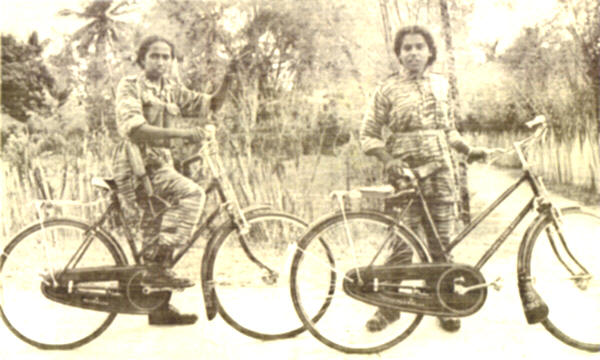
In the meantime, our women guerrilla units directly
participated in armed combat against the Sri Lankan
armed forces in the Vanni and Mannar districts. The
first major battle in which our women fighters
participated took place in Mannar under the command of
Lt. Colonel Victor who was martyred in the
fighting.
Our women guerrillas also participated in several
armed confrontations in the Killinochchi and Jaffna
districts to bring these areas under the control of the
LTTE.
In Jaffna, our women freedom fighters participated
in several successful operations launched against Sri
Lankan military targets. Significant among them are the
attacks on the Jaffna tele-com army camp, the commando
raids on Mayiliyathani and Kankesanthurai camps under
the command of Lt. Col. Ratha and the attacks on the
Kurumbaciddy and Nelliyadi army camps. Our women cadres
also manned several check points and defence bunkers
around Sri Lankan army camps in the peninsula and faced
regular shelling with tremendous courage.
By directly participating in the armed struggle, our
women guerrillas have demonstrated their courage,
commitment and dedication and have proved beyond doubt
that they are capable of sacrificing their lives for
the cause of our people. By their supreme sacrifices
they have inspired the female nation and paved the way
for greater participation of women in the national
struggle.
Soon after the Indo-Lanka Accord was signed, the
LTTE launched a massive popular campaign to expose the
sinister intentions behind India's military
intervention. In the protest meetings, in the
demonstrations, in the boycotts in all forms of mass
agitations organised by the LTTE it was women who
participated in large numbers in national politics.
Thileepan's fast unto death
campaign pinnacled the Tamil national protest against
India. During the fast our women cadres organised and
mobilised the popular masses to rally around
Thileepan's cause. Hundreds of thousands of women took
to the streets in mass demonstrations and public
protests and Thileepan's fast and his martyrdom became
a symbol of national struggle.
When the war broke out between the Indian army and
the LTTE, our women guerrilla units actively
participated in the armed conflict and stood shoulder
to shoulder with the men fighters in that historical
resistance. In the battle of Jaffna, our women
guerrilla units fought ferociously and slowed down the
pace of the advancing Indian columns. At the battle of
Sithankerni our female freedom fighters confronted a
contingent of Indian troops and in the fierce fighting
that ensued an Indian tank was destroyed and several
jawans were killed.
In the Indo-LTTE war which lasted for more than two
years, the role and function of the women combatants
has been crucial. Not only did they fight heroically
against the Indian occupation forces, but they also
involved themselves in non-combatant activities i.e.
medical care, food supplies, transportation of arms and
ammunitions etc., which helped the war effort. In the
Indo-LTTE war twenty six of our women freedom fighters
have attained martyrdom.
The women wing of our liberation movement has
contributed substantially to advance the legitimate
struggle of our oppressed people. The courage,
determination and commitment of our women fighters have
awakened the patriotic spirit of the female masses and
has mobilised them towards the cause of national
liberation.