My paper deals with the construction of Tamil national
identity in the LTTE-controlled areas of north-eastern Sri Lanka. In
particular it focuses on the relevance of the new LTTE burial practices
within the process of nation building. In this context I will pay
special attention to the perception that Tamil people, both civilians
and fighters, seems to have of the Tigers’ cemeteries as symbolic
centres of the new nation, the Tamil Eelam1.
In my paper I will analyse the reasons which have led to
this perception. On one side I will discuss the functional analogies
between the LTTE cemeteries and the war graveyards of military Western
tradition. On the other, I will emphasise their peculiarity of being
perceived as holy places. The Tigers’ cemeteries are indeed called
Tuillum Illam, literally “Sleeping houses”, and are often portrayed as
temples. I will argue that the LTTE, in spite of their secular nature,
have decided not to reject this religious interpretation, because it
allows them to include the Tuillum Illam in the mainstream of Hindu
tradition. In this context the ability to integrate the religious
dimension represents a crucial component in the process of nation
building.
This paper draws upon findings of fieldwork I carried
out between July 2002 and January 2003 in the north-eastern regions of
Sri Lanka controlled by the LTTE.
The change in funerary practices
At the beginning of the ’90s, in a Sri Lanka ravaged by
civil war, a great change in the funerary practices reserved to the LTTE
fighters took place. Until then the bodies of the Maaveraar (literally
“Great Heroes”) were cremated in accordance with Hindu tradition and the
ashes were given to the families. From that period onward LTTE began to
bury their dead and to collect them in the Tuillum Illam.
To understand the meaning of this change in ritual we
have to consider the mortuary practices which are performed in the north
and in the east of Sri Lanka. These practices depend on the religion
professed by the families of the dead. Both Christians and Muslims bury
their dead, and put the bodies in their graveyards2,
while Hindus resort to cremation and immerse the ashes in rivers, though
there are some exceptions that we will discuss later. This means that in
this context burial is not unknown, but is reserved to people belonging
to Christianity and Islam, and that most people, being Hindu, are not
accustomed to this practice. It might be argued that the shift from
cremation to burial should have been perceived as a radical move from
traditional practices, and therefore should not have been so readily
accepted.
Before discussing the strategies that are carried out by
Maaveerar’s relatives and Tamil civilians in order to accept the new
practices, I would like to illustrate the official explanation given by
the LTTE’s leadership to justify this change. When questioned about the
reasons for the shift in ritual, Mr. Pontyagam, in charge of Maaveerar’s
office, stated:
Before 1991 we burnt [the fighters] according to
Hindu rites. If the parents asked for the ashes, we gave them. But
Christians and Muslims didn’t take ashes. We had this problem. There
were Christian soldiers, and the parents didn’t want to burn them. A
meeting of the leaders was organized and they decided to study what
did for their soldiers other countries like America and England.
They saw that they used to bury their soldiers. Then they decided to
proceed in the same way […]3.
Then, when asked about the reaction of Hindu relatives,
Pontyagam replied:
Yes, relatives agreed because they [the LTTE
leaders] explained them it was a worldwide custom. Before that there
were problems, and then they decided, Prabhakaran4
decided, what to do. Indeed if we have a look at the pictures of
Tuillum Illam, we can recognize in their structure the pattern of
Western war graveyards, particularly if we compare the Tuillum Illam
with other cemeteries in the area.
It is not surprising that the LTTE chose to adopt
funerary practices utilized by Western armies. In fact, Tigers do not
like the epithet of “terrorist” and claim the status of liberation
fighters. That is why they never miss an opportunity to emphasize that
they are a regular army: for instance, they point out that they wear
uniforms. From this perspective, an acceptance of Western military
funerary customs might be considered a logic consequence of such a
claim.
Conversely, what is really surprising is to ascertain
that the official explanation for the transition from cremation to
burial is never mentioned by civilians or fighters. Indeed, if
questioned on this issue, both tend to refer to other explanations for
the change. In the course of my fieldwork, I interviewed LTTE fighters,
Tamil civilians living in both LTTE- and government-controlled
territories, and eventually Tamils living in Italy. The persons
interviewed gave me different interpretations for the transition, but
nobody referred to the official one. This official explanation is
probably neither significant nor acceptable to Tamil civilians,
particularly for the relatives of the dead. In fact, when a daughter or
a son, a sister or a brother are given burial as opposed to the
customary ritual cremation, it is likely that relatives would not be
satisfied with an explanation that justified this practice on the basis
of conformity with Western military tradition. Indeed, it is more than
likely that they would seek other more meaningful explanations.
There are in fact two main interpretations5
which tend to emerge to justify the change in the LTTE funerary
practices. The first one emphasizes the need for remembrance, whether
the second one places the burial practice within the mainstream of Hindu
tradition.
Tuillum Illam as places of remembrance
To elucidate the process which make it possible for the
Tuillum Illam to be regarded as places of remembrance, I would like to
quote some passages from interviews I took in Sri Lanka during my
fieldwork. For instance a fighter in Vavuniya asserted: “This is a place
of memory, if you burn them [Maaveerar] the history will be destroyed”.
Similarly a man in charge of Koppai’s Tuillum Illam explained:At the
beginning we burnt them [Maaveerar]. Then we thought: “It is not nice,
it is better to have a place to remember them”. If you have a monument,
every year you can celebrate them, and the relatives can come to visit
them, they often do this.
A civilian in Jaffna affirmed: In this situation we did
need a place to make our people happy. When our children ask [showing
the Tuillum Illam]: “What is it?”, we reply: “Here there are the people
who sacrificed their life for the freedom of Tamil Eelam”.
A young Tamil man living in Italy pointed out:
The Maaveerar are people who defend the land, our
homeland. If we burn them, they become dust, and they will
disappear. To keep their memory alive, the Tigers bury them and
build tombs. They write on the tomb “This person died to defend the
homeland” and in this way they [the Maaveerar] are with us longer.
Finally the sister of a fighter fallen at Elephant Pass clarified:
“We have to preserve the [Maaveerar] bodies, at least the bones must
be preserved”.
It could be argued that to have places of remembrance it
is not necessary to have tombs. However we must keep in mind that in
Hinduism, as Maurice Bloch and Jonathan Parry stress, nothing of the
individual is preserved which could provide a focal symbol of group
continuity. The physical remains of the deceased are obliterated as
completely as possible: first the corpse is cremated and then the ashes
are immersed in the Ganges and are seen as finally flowing into the
ocean. The ultimate objective seems to be as complete a dissolution of
the body as possible (1982: 36).
Such a dissolution imply the absence of a public space
where the dead are remembered. Even if there are postcremation rituals
in which ancestors are worshipped (Knipe 1977), such rituals are
performed in the private space of the house and are carried out by
relatives. The cultural background provides reasons for the lack of any
correlation between cremation and public place of remembrance.
The perception of Tuillum Illam as place of remembrance
would also explain, according to my informants, their destruction by Sri
Lankan Army
6. M. R. Narayan Swamy, a
journalist, describes in this way the capture of Jaffna:
It is clear Prabhakaran will one day certainly try
to recapture Jaffna, whatever be the cost, if nothing else to avenge
the humiliation of 1995 when victorious Sri Lankan troops rolled
into ancient Tamil town amid frenzied celebrations across the
country. The LTTE has not forgotten the way the military destroyed
without trace the LTTE’s sprawling martyrs’ graves that were spread
over a vast open ground (2002(3): 355) (italics mine).
At the entrance of Tuillum Illam in Koppai and Naundil
the visitor can see, encased in glass, the collected pieces of
devastated graves and cenotaphs. A stone book has been placed on the
pieces, and the following words are impressed on it:
"After our displacement in 1995, the Sri Lanka army
damaged and destroyed the monuments of our war heroes, treasured by
us. The stone remains of the left over have been collected by us.
Let us bow our heads and wait at this point for a few moments."
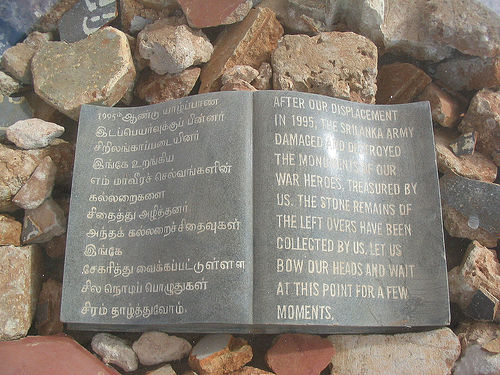
The destruction of tombs by Sri Lankan Army can be
considered as evidence of governmental soldiers’ appreciation of Tuillum
Illam’s significance within the Tigers’ struggle. In order to better
understand the symbolic value of the LTTE’s burial grounds, we need to
pay attention to the functional analogies between such places and the
war military cemeteries of Western tradition.
Functional analogies with war cemeteries in military
Western tradition
It could be argued that Tuillum Illam share many
functions with war cemeteries of Western tradition. As George Mosse
(1990) points out, to concentrate all the dead soldiers in the same
space gives the opportunity to stress the importance of their deeds and
to focus people’s attention on their sacrifice for the nation. It is
exactly in this perspective that we may read the words of Prabhakaran
who, talking about the graves, affirms “The tombs of the fallen Tigers
heroes will be the foundation of our new nation” (quoted in the 1995
LTTE diary).
Another important function of Western war cemeteries is
their being places of commemorations, which is also the case of Tuillum
Illam. The Maaveerar are celebrated on November 27th, officially
remembered as the day in which the first Tiger died. In this day the
LTTE pay honours to their dead fighters all over the world. Tamils of
the Diaspora organize celebrations in public places such as theatres and
public halls7, while in Sri
Lanka the ceremonies take place in the Tuillum Illam.
Ceremonies start in the afternoon, when people go to
the Tuillum Illam bringing flowers, incense, camphor and candles and
stay by the tombs; women weep and cry out in pain. The Maaveerar day is
a main LTTE political event, not only because of the extensive
involvement of civilians, but also because it is the occasion in which
Prabhakaran’s yearly speech is delivered and broadcast through
loudspeakers in all Tuillum Illam. Prabhakaran’s speech is considered,
as Cheran emphasizes, “a sort of throne speech in which he usually
elaborates on the victories, ground situation, future plans and an
analysis of the current political situation” (2001: 17). In this sense
the Tuillum Illam are the setting for the exercise of “intentional
rhetorics” which, as Elizabeth Tonkin stresses, are a central element in
the processes of nation building. Indeed “Intentional rhetorics” are
utilized “to convince people of a social identity which they may not
otherwise experience as such” (1992: 130).
Eventually - to conclude the analysis of functional
analogies - in war cemeteries belonging to Western tradition there are
symbols which can be interpreted in different ways. As George Mosse
clarifies, English cemeteries were centred upon the Cross of Sacrifice
and the Stone of Remembrance. The Cross of Sacrifice, in Rudyard Kipling
words, has “a stark sword brooding in the bosom of the cross” whose
symbolism, by the Commission’s own admission, was somewhat vague. It
could signify sacrifice in war or simply the hope of resurrection […].
The Stone of Remembrance and the Cross of Sacrifice projected a
Christian symbolism which dominated the cemetery, though originally the
Stone was conceived by its architect, Sir Edwin Lutyens, as a
non-Christian pantheistic symbol. Yet, at times, the Stone of
Remembrance was referred to simply as “the altar”, conferring the same
religious significance upon it that the Cross of Sacrifice possessed
(1990: 85).
Similarly in the Tuillum Illam the “flame of sacrifice”
burning on the central platform could be compared, as suggested by the
chancellor of Jaffna university, to the flame of the Arc de Triomphe in
Paris, but at the same time it could also be perceived as a symbolic
substitute of the fire of cremation.
Tuillum Illam as temples
I would now examine the second interpretation which
emerges from popular narrative to justify the transition in funerary
practices. This interpretation is given mainly by civilians and is
connected with the religious Hindu tradition. As already mentioned, in
Hinduism there are some exceptions to cremation. In the context of the
Sri Lankan civil war, such exceptions are utilized to give a sense of
cultural continuity to the funerary practices reserved to the LTTE’s
fighters. An analysis of the exceptions to cremation within Hinduism is
obviously beyond the aim of this paper. Therefore I will restrict myself
to mentioning that these exceptions are associated with either economic
reasons (poor people do not have the resources to cremate their dead) or
religious ones. From a religious perspective, the concept of the
cremation ritual as a sacrifice offered to the gods has in fact several
implications: in case of “bad death”, that is non-voluntary and untimely
death (for instance, death by drowning, act of violence or some kinds of
disease), the body does not symbolize an appropriate sacrifice to the
gods, and is therefore not cremated8.
However, there are other cases in which the corpse is
not cremated: this happens when the dead is a child or an ascetic. With
regard to children, there are cross-cultural evidences of different
practices performed for those who die in the early years of their life.
The reason for the specific treatment of dead children’s bodies within
Hinduism has given rise to a widespread debate (see Das 1976 and
Malamoud 1982). Scholars have suggested several interpretations, some of
them stressing on the characteristic of liminality showed by children.
With regard to ascetics, they can also be regarded as
liminal figures, because of their transcending the customary partitions
of Hindu society and being located in the symbolic limen between life
and death. The burial of ascetics is in fact justified on the basis of
their renunciation of ordinary life. As Charles Malamoud points out, La
cérémonie complexe qui marque l’entrée en “renoncement” consiste à
laisser s’éteindre les feux sacrificiels après y avoir fait brûler,
ultime oblation, ultime combustible, les divers ustensiles du sacrifice.
Les feux ne sont pas abolis pour autant : ils sont intériorisés,
inhalés, on les fait “remonter” en soi […]. cuit de l’intérieur, et de
son vivant même, le samnyasin n’a pas a être cuit après sa morte : il
n’est donc pas incinéré, mais inhumé […]. en intériorisant leurs feux,
ils ont aussi aboli la possibilité d’être transportés vers une divinité
qui leur soit extérieure. En s’instituant d’emblée comme offrande, et en
persistant jusqu’au bout dans ce rôle, ils ont fait de leur propre
personne, de leur atman identifié au Soi universel, leur divinité (1989:
65).
Thanks to the exception represented by the interment of
ascetics, Tamil civilians have the opportunity to place the burial
practice within the mainstream of Hindu tradition. In order to provide
an understanding of the symbolic analogy between ascetics’ interment and
the Maaveerar’s burial we have to dwell upon the self-representation of
the LTTE fighters. The combatants are portrayed as men and women who are
not involved in the “bad habits” of ordinary people: they do not drink,
do not smoke and do not have forbidden sexual intercourses. Abstaining
from alcohol and cigarettes is significant particularly for male
fighters, because in Tamil culture women are not supposed to drink or
smoke. With regard to female fighters the most important peculiarity is
therefore their purity:
The LTTE ideal of the armed guerrilla woman puts forward
an image of purity and virginity […]. The women are described as pure,
virtuous. Their chastity, their unity of purpose and their sacrifice of
social life supposedly give them strength. The armed virginal woman
cadre ensures that this notion of purity, based on denial, is a part of
the social construction of what it means to be a woman according to the
world view of the LTTE (Coomaraswamy quoted in Schrijvers 1999: 316).
Michael Roberts suggests that the ascetic mould of the
LTTE fighters implies “the influence of Hindu tradition of tapas
(strength via abstinence) as well as Maoist strains of revolutionary
selfdiscipline” (1996: 256). The ascetic attitude of fighters is also a
subject of LTTE-filmography. In this regard Peter Schalk, explaining the
plot of a film on the Black Tigers – the suicidal commandos –, points
out:
The hero of the film is described as a tavan, “ascetic”,
not by the word, but by his behaviour. Although he is of marriageable
age, there is no sign of a girlfriend […]. Living in the group of Black
Tigers, he seems to be dedicated to the holy aim [to free Tamil Eelam]
only (1997: 160).
The symbolic association between fighters and ascetics
is not restricted to their behaviour in life. After their death, the
combatants, as the ascetics, are worshipped and regarded as gods. When I
asked if Tuillum Illam were cemeteries, all the people replied saying
“How can you say such a thing? Tuillam Illam are temples, gods are
seeded [buried] there”. If we take into consideration the expected
behaviour of the Tuillum Illam’s visitors, actually we can realize that
the prescribed practices when going to or coming back from Tuillum Illam
are exactly the reverse of those contemplated in case of visiting
cemeteries. The absence of women and the need to take a bath when coming
back from burial grounds can be considered as the central differences.
The identification of Maaveerar with gods – which would
require a deeper analysis – is not rejected by the LTTE, in spite of
their secular nature. During my fieldwork, I observed that not only
civilians, but also some people involved in the movement, although not
fighters, assert that theMaaveerar are gods and Tuillum Illam are
temples. In my understanding the LTTE do not reject this interpretation
because it is necessary in order to make acceptable the introduction of
the new funerary rituals. In fact, as pointed out by Paul Connerton, in
his book How Societies Remember, All beginnings contain an element of
recollection. This is particularly so when a social group makes a
concerted effort to begin with a wholly new start. There is a measure of
complete arbitrariness in the very nature of any such attempted
beginning. […] But the absolutely new is inconceivable. It is not just
that it is very difficult to begin with a wholly new start, that too
many old loyalties and habits inhibit the substitution of a novel
enterprise for an old and established one (1989: 6).
It is not surprising, then, to find out that Prabhakaran
himself compares the fallen Tigers to ascetics:
Prabhakaran, the leader of the LTTE, requests the
people to venerate those who die in the battle for Eelam as
sannyasis (ascetics) who renounced their personal desires and
transcended their egoistic existence for a common cause of higher
virtue (Chandrakanthan 2000: 164).
I would argue that the attitude of the LTTE with regard
to the identification of the Maaveerar with gods emerges as an ambiguous
but necessary one. On one side the Tuillum Illam are the places where
the secular values of the future nation are displayed: the ideological
rejection of all the differences among people (caste, class and gender
differences) is symbolically carried out through the performing of the
same funerary rituals and the building of equal tombs. On the other
side, the idea that Tuillum Illam are temples where the Maaveerar/gods
are worshipped allows the LTTE to avoid a break with the religious
feelings of civilians, guaranteeing popular consent to the new project
of nation-building.
Notes
1 Tamil Eelam refers
to the separate state claimed by LTTE (Liberation Tigers of Tamil
Eelam).
2 Christians sometimes are buried
close to the area where Hindus perform cremation.
3 Personal interview, 7 December 2002.
4 In passing we may observe that
Prabhakaran is supposed to take all central decisions regarding the
fighters. The LTTE’s members themselves explained to me that, although
many decisions are joint resolutions, actually is better to ascribe them
to the leader. In this way people will accept them more easily.
5 Although the detailed description of
all the interpretations is beyond the aim of this paper, it is necessary
to mention that to some fighters (but not to civilian) the burial of
dead fighters is considered as a return to the practices of the ancient
Tamils, who in fact buried their fallen warriors. References to the
custom of the Chankam period are quoted also in some of the LTTE’s
publications. As Fuglerud points out, “The ideological project of the
LTTE is directed towards homologising the pre- and post-colonial
situation, of linking the present claim for statehood with the
restoration of authentic Tamil culture” (2001: 203). For further
details, see also Cheran 2001, Natali 2004.
6Here has to be reminded that the
destruction of Tuillum Illam is not officially acknowledged either by
Sri Lankan government or by international organizations such as
International Committee of the Red Cross (ICRC).
7 For further details on the
ceremonies outside Sri Lanka, see Cheran (2001) for the Canadian case,
and Natali (2002) for the Italian case.
8 This does not necessarily mean that
the body is buried: sometimes it is indeed set adrift on a river
(children too are often treated in this way).
References
Bloch, M. e Parry, J. (eds.)
1982 Death and the Regeneration of Life, Cambridge, Cambridge University
Press.
Chandrakanthan, A.J.V.
2000 “Eelam Tamil Nationalism. An Inside View”, in J.A. Wilson, Sri
Lankan Tamil Nationalism. Its Origins and Development in the 19th and
20th Centuries, London, Hurst: 157-175.
Cheran, R.
2001 “The Sixth Genre: Memory, History and the Tamil Diaspora
Imagination”, Colombo, Marga Monograph Series on Ethnic Reconciliation,
VII.
Connerton, P.
1989 How Societies Remember, Cambridge, Cambridge University Press.
Das, V.
1976 “The Uses of Liminality: Society and Cosmos in Hinduism”,
Contributions to Indian Sociology, X, 2: 245-263.
Fuglerud, Ø.
1999 Life
on the Outside. The Tamil Diaspora and Long Distance Nationalism,
London, Pluto Press.
Knipe, D.M.
1977 “Sapindiikarana: The Hindu Rite of Entry into Heaven”, in F.E.
Reynolds e E.H. Waugh (eds.), Religious Encounters with Death,
University Park and London, Pennsylvania State University Press: 111-
124.
Malamoud, Ch.
1989 Cuire le monde. Rite et pensée dans l’Inde ancienne, Paris, La
Découverte.
Mosse, G.L.
1990 Fallen Soldiers: Reshaping the Memory of the World Wars, New York,
Oxford University Press.
Natali, C.
2002 “Uno spazio scenico per la memoria: la commemorazione dei caduti
tamil attraverso la danza”, in A. Destro (ed.), Antropologia dello
spazio. Luoghi e riti dei vivi e dei morti, Bologna, Patron: 77-111.
2004 Sabbia sugli dèi. Pratiche commemorative tra le Tigri tamil (Sri
Lanka), Torino, il Segnalibro.
Roberts, M.
1996 “Filial Devotion in Tamil Culture and the Tiger Cult of Martyrdom”,
Contributions to Indian Sociology, 30, 2: 245-272.
Schalk, P.
1997 “ The
Revival of Martyr Cults among Ilavar ”, Temenos, 33: 151-190.
Schrijvers, J.
1999 “Fighters, Victims and Survivors: Constructions of Ethnicity,
Gender and Refugeeness among Tamils in Sri Lanka”, Journal of Refugees
Studies, XII, 3.
Swami, N.
2002 Tigers of
Lanka. From Boys to Guerrillas, Colombo, Vijitha Yapa.
Tonkin, E.
1992 Narrating Our Pasts. The Social Construction of Oral History,
Cambridge, Cambridge University Press.