|
SINHALA BUDDHIST ETHNO nationalism
Masquerading as Sri Lankan multi ethnic 'Civic
Nationalism'
The Mask Slips: Niranjan de Silva Deva-Aditya, MEP
frequently wonders about converting Tamils to Buddhism
"...Frequently now I wonder whether Sri Lanka would have
been a much more peaceful and much more homogeneous
place if say 40% or so of the Tamil speaking population
had been Buddhists and not exclusively Hindu or
Christian. Is taking the Buddhist religion to Tamil
people such a difficult task..."
Niranjan de Silva Deva-Aditya, Sinhala Member of
European Parliament (MEP) from U.K.
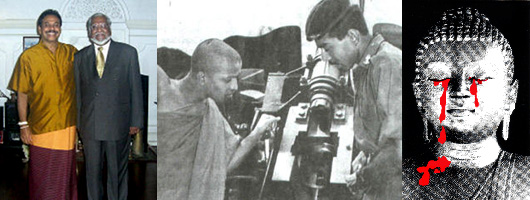
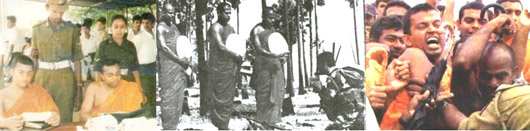
[see also
Pictures
that speak a thousand words...]
Comment by
tamilnation.org:
It is
right that the Member of the European Parliament,
Mr. Niranjan de Silva Deva-Aditya, who is a Sinhalese,
should wonder. And that too, frequently.
If Mr. Niranjan de Silva
Deva-Aditya wonders frequently enough he may even ask
himself why it is that for the past two thousand years
and more that which he appears to consider a not
'difficult task' was not accomplished. He may wonder why
it is that though the Buddha was born in India, Buddhism
is not a significant religion in India. Again he may
wonder why it is that though Sinhalese is spoken in an
island a mere twenty miles from the Indian sub
continent, it is not a language that is spoken in
India.
If Mr. Niranjan de Silva
Deva-Aditya wonders even more frequently, he may begin
to recognise (albeit slowly) that Buddhism in Sri Lanka
has grown, entwined together with the Sinhala language -
and it is this which is the Sinhala nation today. Mr.
Niranjan de Silva Deva-Aditya may then begin to
understand something that his Sinhala compatriot,
historian K. M. de Silva
said in 1996 -
"...In the Sinhala language, the words for nation, race and people are
practically synonymous, and a
multiethnic or multicommunal nation or state is incomprehensible to
the popular mind. The
emphasis on Sri Lanka as the
land of the Sinhala Buddhists carried an emotional popular appeal,
compared with which the concept of a multiethnic polity was a
meaningless abstraction..." -
Sinhala Historian K. M. de Silva in Religion, Nationalism and the State,
USF Monographs in Religion and Public Policy, No.1 (Tampa, FLA:
University of South Florida 1986) at p31 quoted by David Little in
Religion and Self Determination in Self Determination - International
Perspectives, MacMillan Press, 1996
And, as he continues to wonder, Mr. Niranjan de Silva
Deva-Aditya may want to widen his
understanding by reading something which Professor Stephen Grossl
said three years ago -
“The central place of Buddhism in the
constitution of the Singhalese territorial relation of a nation
goes back to the Sinhalese histories of the fourth and fifth centuries
of the Christian era, the Dipavamsa and the Mahavamsa. There one finds
the myth of the visit of the Buddha to Sri Lanka, during which he freed
the Island of its original supernatural and evil inhabitants, the
Yakkas. As a result the Buddha had sanctified the entire island
transforming it into a Buddhist territory. These histories thus asserted
a territorial relation between Sinhalese and Buddhism, the
stability of which was derived from a perceived order of the universe,
that is, the actions of the Buddha. The reaffirmation of that relation
may be observed to-day in the shrines throughout the island at
Mahiyangana, where the supposed collarbone of the Buddha is kept, at
Mount Samantakuta, where the Buddha’s supposed fossilized footprint may
be seen and the most important one at Kandy, supposedly containing the
relic of the Buddha’s tooth." Stephen Grossly, Professor of
Philosophy and Religion, Clemson University on The primordial, kinship
and nationality”. “When is the Nation?” Edited by Atsuko Ichijo and
Gordana Uzelac Routledge (2005) p 68
Mr. Niranjan de Silva Deva-Aditya may then begin
to recognise why it is that for the past two thousand
years and more that which he appears to consider a not
'difficult task' was not accomplished - why it is
that the Sinhala Buddhist nation which has sought to
conquer and rule the Tamil people has failed in its
'allotted' task for the past several centuries.
Mr. Niranjan de Silva Deva-Aditya may even begin to
understand (even if no more than begin to
understand) that the
task
of assimilation is a difficult one and usually leads
to indigestion.
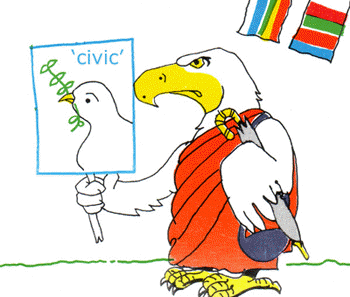 That
in today's world, the Sinhala Buddhist nation seeks to
masquerade as a 'Sri Lanka civic nation' (with
a
Sinhala
Lion Flag, with
an unrepealed
Sinhala Only Act, with
Buddhism
as the State religion, and with the
Sinhala 'Sri Lanka' name)
is understandable
- understandable that is in its
effort to conquer and rule the people of Tamil Eelam
within the confines of an unitary state. But as with all
masquerades, the mask slips, from time to time. It is
therefore right that Mr. Niranjan de Silva Deva-Aditya
should continue to wonder. Indeed, he should be
encouraged to do so. And as he continues to wonder, he
may even be impelled to reflect on the words of
Velupillai Pirabakaran, Leader of Tamil Eelam, in 1984 - That
in today's world, the Sinhala Buddhist nation seeks to
masquerade as a 'Sri Lanka civic nation' (with
a
Sinhala
Lion Flag, with
an unrepealed
Sinhala Only Act, with
Buddhism
as the State religion, and with the
Sinhala 'Sri Lanka' name)
is understandable
- understandable that is in its
effort to conquer and rule the people of Tamil Eelam
within the confines of an unitary state. But as with all
masquerades, the mask slips, from time to time. It is
therefore right that Mr. Niranjan de Silva Deva-Aditya
should continue to wonder. Indeed, he should be
encouraged to do so. And as he continues to wonder, he
may even be impelled to reflect on the words of
Velupillai Pirabakaran, Leader of Tamil Eelam, in 1984 -
"...If (Sri Lanka
President) Jayewardene was a true Buddhist, I would not
be carrying a gun..."
Velupillai Pirabakaran, Leader of Tamil Eelam, in 1984
Interview with Anita Pratap, Sunday Magazine, India
11-17 March 1984
[TamilNet, Wednesday, 30 July 2008, 20:45 GMT]
"Frequently now I wonder whether Sri Lanka would have been a
much more peaceful and much more homogeneous place if say
40% or so of the Tamil speaking population had been
Buddhists and not exclusively Hindu or Christian. Is taking
the Buddhist religion to Tamil people such a difficult task"
wonders Niranjan de Silva Deva-Aditya, Member of European
Parliament (MEP) from U.K. and Honorary Ambassador-at-Large
for Sri Lanka, in a statement after his recent visit to Sri
Lanka as Vice-Chairman of the EU delegation.
The Sinhala speaking MEP is tagged with a title, 'Vishwa
Keerthi Sri Lanka Abhimani' (universally famous pride of Sri
Lanka), bestowed onto him by the Buddhist clergy of Sri
Lanka.
The Conservative MEP, Mr. Niranjan de Silva, who is
popularly known by his shortened name Nirj Deva, is also a
member of the EU committees on Foreign Affairs, delegation
for relations with India, delegation for relations with the
countries of ASEAN and committee on development.
The recent EU delegation to Sri Lanka, led by Robert Evans,
Labour MEP and Chairman of the European Parliament's
Delegation to South Asia, came down heavily on the Sri
Lankan government, in its report last Friday.
According to observers, the aim of the statement on Tuesday
by Mr. Nirj Deva, was to clear him from the wrath of Sinhala
extremists and media for being a part of the delegation and
to reassert his sympathies with the Sinhala agenda. Mr. Nirj
Deva has extensive business interests and owns property in
Colombo.
The delegation was forced to cancel its main program of
visiting Trincomalee due to failure in deliberations between
the delegation and the government in facilitating travel to
Trincomalee.
Briefing on the cancellation, Mr. Evans has said: “The last
minute cancellation and a catalogue of chaos and confusion
meant that the delegation did not fly to Trincomalee,
despite repeated assurances and endless complications
resulted in the party being turned back from Ratmalana
Airport destroying months of preparation, time and expense."
The report of the delegation read out by Mr. Evans at the
press conference on Friday while condemning LTTE's violence
and urging them to come to the democratic process,
accusingly pointed out the Sri Lankan government's
deficiency in defending human rights.
The press briefing welcomed the beginnings of the democratic
process in the East, but expressed concerns about disarming
the 'former paramilitaries' and the continued use of child
soldiers by them.
On All Party Representative Committee (APRC) initiated by
the Sri Lankan government to come out with constitutional
means to resolve the Sri Lankan crisis, the delegation's
view put forth by Mr. Evans was that the APRC is incomplete
without the participation of the Tamil National Alliance
(TNA).
Talking about threatened media, Mr. Evans mentioned the
killing of 12 journalists and the continued detention of M.
Tissainayagam. There was a veiled warning that Sri Lanka
will not qualify for the GSP+ trade concessions, the way the
pre-requisites such as human rights and other international
conventions are handled at present by the government.
Nirj Deva, who was part of the delegation, differed with the
Chairman later. In 2006 he was awarded the title of “Vishwa
Keerthi Sri Lanka Abhimani,” by the Buddhist clergy in
recognition of his services to Sri Lanka.
It was at a conference organised by a foundation of Sri Sri,
in Norway, Nirj Deva was inspired with the idea of 'taking
Buddhism' to Tamils, after listening to a Buddhist monk
speaking in Tamil. Speaking to the media on Tuesday, Nirj
Deva, hit out at the EU delegation head for coming to Sri
Lanka and attempting to preach democracy, reported Daily
Mirror.
He even apologised on behalf of the British Conservative
Members of European Parliament for diplomatic failure in
engaging Sri Lanka.
Contradicting the spirit of the EU report, Nirj Deva, in his
9-page statement, sympathetically 'advises' the Sri Lankan
government to sort out at least one or two human rights
cases so that it can be in the good books of the
International Community. He was hinting at the cases of the
killings of 5 youth and 17 aid workers in Trincomalee.
He appreciates the 'mature
parliamentary democracy' and 'visible independent
judiciary' in Sri Lanka.
Comment by
tamilnation.org:
A mature parliamentary
democracy? "...The progressive destruction of the
political process in Sri Lanka has led to both domestic
and international tolerance of an enormous amount of
violence by the government (regardless of party
affiliation) against its citizens. Increasingly, it
seems that the government of Sri Lanka is accountable to
no one - not its citizens, and not its foreign
counterparts who rubber-stamped the recent parliamentary
elections. In Sri Lanka's current political climate,
power seems to be determined by the number of thugs a
given politician has at his/her disposal..."
Sri Lanka's Elections 2000: Fear and Intimidation
Rule the Day - An Observer's Report -
Laura
Gross in Democarcy, Sri Lanka Style
He says that the Government of Sri Lanka's "remarkable
achievement" in resettling "over 90%" of the Internally
Displaced People of the East in a short time should be
acknowledged.
|
Comment by
tamilnation.org:
A remarkable achievement?
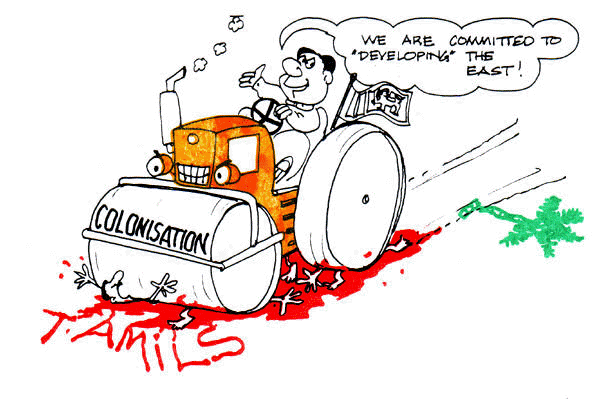 |
|
"...whilst the current landscape in the East is
one of humanitarian crisis and endemic human
rights abuses, the current focus on human rights
issues, which whilst performing the essential
task of exposing the authoritarianism and
violence of the current regime, is insufficient
to capture the cold calculations and reasoning
in the intentions of the Sri Lankan State which
has once again returned to the the logic of
Sinhala colonisation.."
David Rampton, Lecturer, SOAS, University of
London,22 September 2007 |
The facts and figures brought out on 23rd July by TNA leader
R. Sampanthan in the Sri Lankan Parliament on the plight of
IDPs and planned Sinhalicisation in the East in recent times
totally contradict the claims of Nirj Deva.
Mr. Nirj
Deva is a dual citizen of U.K. and Sri Lanka. He is proud of
his Sri Lankan heritage. He claims that he has great
affection for Sri Lanka. He also cites to his Rajput origins
from North India.
"It is an irony that having so
much attachment to his own 'identities', he fails to see
that it is an insult and perhaps a blasphemy to expect the
Tamils to change an identity of theirs, just because the Sri
Lankan state has failed in coming out with a viable model of
nationalism," commented a leading Tamil National Alliance
parliamentarian to TamilNet.
"This is in line with
the Sri Lankan state thinking that by Sinhalicising and
Buddhicising the Tamil homeland the Eezham crisis could be
resolved."
"The views of such politicians in handling
Sri Lankan affairs at such a crucial stage of the crisis,
gravely undermines the credibility of the European Union,"
he further said. |