"...In the Sinhala language, the words for nation, race
and people are practically synonymous, and a
multiethnic or multicommunal nation or state is incomprehensible to
the popular mind. The
emphasis on Sri Lanka as the
land of the Sinhala Buddhists carried an emotional popular appeal,
compared with which the concept of a multiethnic polity was a
meaningless abstraction..." [Sinhala Historian K. M. de Silva in
Religion, Nationalism and the State, USF Monographs in Religion and
Public Policy, No.1 (Tampa, FLA: University of South Florida 1986) at
p31 quoted by David Little in Religion and Self Determination in Self
Determination - International Perspectives, MacMillan Press, 1996]
"..In countries with internal conflicts, the traditional
way of reconciling people with distinct identities within a single
nation state is through some form of power sharing and devolution..."
British Commissioner in Sri Lanka on United Kingdom's Peace Building
Efforts in Sri Lanka, 15 June 2007
"...Having postulated a conflict
between ‘primordial’ and ‘civil’ sentiments it is an
easy step for politicians and social scientists to argue
for the substitution of one (civil ties) for the other
(primordial ties)...
But is one form of nationalism traditional and the other modern? .. What are
the distinguishing characteristics of the two
nationalisms? ... If modernity and cultural nationalism
are defined as in opposition to each other how do we
understand the resurgence of cultural nationalism (and
the definition of cultural variables as the relevant
determinants of political identity) in many
post-industrial societies?.."
Marguerite
Ross Barnett, Princeton University in Creating
Political Identity: The Emergent South Indian Tamils
"...The problem in nationally divided
societies is that the different groups have different
political identities... In this situation, the
options available to represent these distinct identities
are very limited... if the minority group seeks to be
self-governing, or to secede from the larger state,
increased representation at the centre will not be
satisfactory. The problem in this case is that the
group does not identify with the centre, or want to be
part of that political community... One conclusion that
can be drawn is that, in some cases, secession/partition
of the two communities, where that option is available,
is the best outcome overall. .."
Professor Margaret Moore in Normative justifications for
Liberal Nationalism
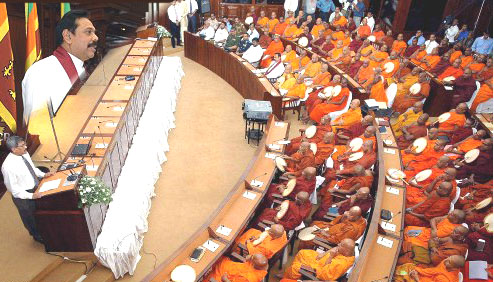
June 28, Colombo: Sri Lanka President
Mahinda Rajapaksa met with Maha Sanga (Buddhist monks) from
all over the country at the Presidential Secretariat this
evening. Defense Secretary Gotabhaya Rajapaksa updated the
assembly on the current situation in the North and East. The
commanders of the three forces, IGP and President's
secretary Lalith Weeratunga were also present.