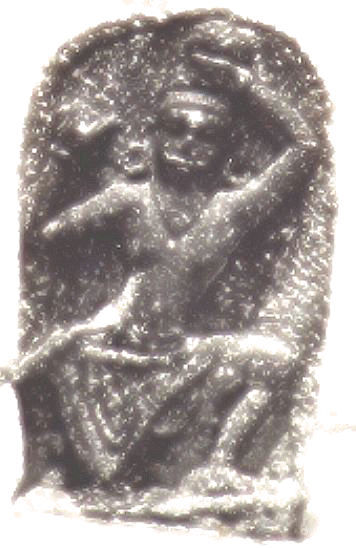
 This
is picture of a Virakkal dedicated to a warrior who performed
self-sacrifice. He is wearing a scabbard in his waist. He is also wearing
the "Vattudai" a garment worn by warriors. He grabs his hair with his
left-hand and smites his neck with a sword which is held with his right
hand. This statue is found in the Puumaayi Amman Temple of Tiruppathur,
Sivagangai District, Tamil Nadu, South India.
This
is picture of a Virakkal dedicated to a warrior who performed
self-sacrifice. He is wearing a scabbard in his waist. He is also wearing
the "Vattudai" a garment worn by warriors. He grabs his hair with his
left-hand and smites his neck with a sword which is held with his right
hand. This statue is found in the Puumaayi Amman Temple of Tiruppathur,
Sivagangai District, Tamil Nadu, South India.
Description:
Self-sacrifice or Navakantam was an ancient
practice among the Tamils in which a person sacrifices his own self
with his own hands. It is a form of ritualistic suicide. Though
outwardly resembling the Japanese Hara-Kiri, it differs in several
ways from it. In Hara-Kiri, sometimes, the best friend cuts the head
off, while the Samurai warrior slices his abdomen with his dagger. But
the Tamils did it absolutely unassisted.
This custom was prevalent among the ancient Tamil
warriors.
It was usually carried out as a fulfilment of a vow.
There were various reasons for this.
Some examples:
 Scenario
1: A war with a mighty enemy against tremendous odds. There is no chance
of winning. Divine intervention is besought. The warrior or warriors make a
vow to offer their heads to Durga - the Goddess of War and Victory.
Scenario
1: A war with a mighty enemy against tremendous odds. There is no chance
of winning. Divine intervention is besought. The warrior or warriors make a
vow to offer their heads to Durga - the Goddess of War and Victory.
Victory is attained. The warriors offer their
heads to Durga.
Scenario 2: The ancient Tamil kings had
personal body-guards. They were the "VeLaikkaarap padai" of the Cholas and
the "Thennavan AabaththudhavigaL" of the Pandyas. The latter were more
fiercesome. Marco Polo who met them calls them, the
" King's Trusty Lieges". The Pandya king is very ill. One of the body-guards
makes a vow for his king's recovery. He offers his own life in
place of the king's. The king recovers. So he gives his life as offering.
Scenario 3: A person suffering from
terminal illness or untreatable disease. He decides to end his life.
He chooses to sacrifice himself and attain Vira-Sorgam.
Scenario 4: A criminal is condemned. The king,
however, gives him a choice. The criminal chooses to perform the rirualistic
self-sacrifice. Thus his sins and crimes are washed away. He attains
Paradise.
Scenario 5: A person is about to die of
grievous wound or disease . But he has certain unfinished duties to
carry out . He asks a particular deity for a postponement of death .
He lives and finishes his task. After that, he voluntarily lays down his
life to the deity as he promised.
Scenario 6: A man undergoes a great insult.
He does not wish to live. But he does not wish to die a cowards death.
So he performs the ritualistic suicide.
The Ritual:
When a person wishes to perform this ritualistic
suicide, he calls all his friends and relatives for a very grand
celebration. A festival is held in honour of the occassion. He is
attired befittingly. There were certain rites which were performed at his
house. It was funerary in nature. He takes leave of every-one. Then
everybody goes in procession to the temple of the deity for whom the ritual
is to be performed.
In the temple of the deity, the necessary rites are
performed.
The self-sacrificer attains the proper posture on the
ground.
A rhythmic beating of drums are accompanied by
other musical instruments. While the priest is chanting the appropriate
Mantras, the self-sacrificer grabs his hair and holds up his head with
his left hand and holds a sword with his right hand.
Then, with a swift stroke, he smites his head off.
There was another variety called NavaKantam. In
this the sacrificer cuts off eight parts from his body. The
ninth and last part to be cut off, is the head. Hence, the name,
"NavaKantam". In this ritual, the sacrificer has to do it unassisted.
Since it is an elaborate rirual, it is time-consuming. So the whole process
takes place slowly. The Zamorins-Saamudhiri Kings- of Calicut used to
perform this.
Viirakkal:
The warriors are usually honoured with a Hero-stone
called "Viirak Kal".
References
Literary References:
This custom is mentioned in ancient Tamil literature
like the Maduraik Kaanchi, Chilappadhikkaaram, alingaththup ParaNi, etc. In
the Chilappadhikkaaram, the warriors who won a victory for their king
Karikaala Cholzhan are seen to scarifice themselves to the
Chadhukka Bhutham of Kaviri Pumpattinam. The Bhutham was one of the
guardians of the city. In another place, it perform for Durga. In the
Kalingaththup ParaNi, we it being performed for Kotrravai who is KaLi.
Foreign References:
Marco Polo who visited the Pandya country in
the 13the century A.D., was an eye-witness to such an event.
Friar Jordanus , Nicolas de Conti, and others have mentioned about it
in their travellogues.
Statues:
The above statue is in the Puumaayi Amman Temple in
Tiruppathur, Sivagangai District, Tamil Nadu of South India. The temple is
situated at the south-western part of the town. As such it was at the
outskirt of the giant fortress that was there. It is actually a temple
dedicated to Sapta Matrikas-The Seven Mothers. Puumaayi Amman is Vaishnavi
or Vishnu Sakthi. She is in the centre of the row of the seven Matrikas.
Such statues are also found in Mamallapuram(MahaBali
Puram), Thiruvaanaikkaa, and some other places. I found one such broken
statue in a temple of Vadakku Vaasal Chelvi Amman in Kalappur, near
Singampunari-same region as Tiruppathur. It is in the northern
boundary of the "Lost City of Aruviyur".