|
Understanding Kosovo
31 October
1998
"...Russia remains
one of the few friends of Serbia... A leader of the
Russian Liberal Party, proclaimed on a recent visit to
Serbia, the brotherhood of the Slavs, and declared, in
a rhetorical flourish, that he would rest content only
when the Slav people ruled a contiguous land stretching
from Russia, through Bulgaria to Serbia. One message
that is being conveyed by the
�international
community� may be that the Balkans is
not an area within the Russian circle of influence and
that it is time that the Serbs recognised this reality.
That is not to say that there may not be other messages
as well. The spill over effect on Albanians in
adjoining Macedonia and Albania, the destabilising
influx of refugees to other parts of the European
Union, and the support that may be given to
Muslim Kosovo by the Muslim
world, may be other matters of concern..."
 Similarities... Similarities...
Need to look below the surface....
Kosovo deeply embedded in psyche of the Serb
people...
There was no Albanian state before 1912...
International community quick to
�demonise� the Serb
leader...
Instructive
to explore some elements of the geo political
frame...
Present day
Albanian nationalists not unaware of the history of
'international' support...
[see also 1. Nato, Kosovo and Tamil Eelam - Nadesan
Satyendra April 1999 "Milosovich fears that
greater autonomy will lead to secession. NATO fears
that repression will lead to an increase in extra
regional Muslim influence and in that way to secession.
Milosovich believes that he can put down Kosovar
resistance if NATO stays out. But NATO fears that
even if Milosovich succeeds, this will strengthen the
Yugoslav-Russia-Belraus link with far reaching
implications for the future of the European Union."
more
2.
Kosovo Countdown: Lessons for Sri
Lanka: Comment by tamilnation.org 17 February
2008 and
3. Kosovo's
'Supervised Independence' , 17 February 2008 "This declaration
reflects the will of our people and it is in full
accordance with the recommendations of UN Special Envoy Martti
Ahtisaari and his
Comprehensive Proposal for the Kosovo Status
Settlement...We invite and welcome an
international civilian presence to supervise our
implementation of the Ahtisaari Plan, and a
European Union-led rule of law mission... We also
invite and welcome the North Atlantic Treaty
Organisation to retain the leadership role of the
international military presence in Kosovo... We
shall cooperate fully with these presences to ensure
Kosovo's future peace, prosperity and stability..."
]
Similarities...
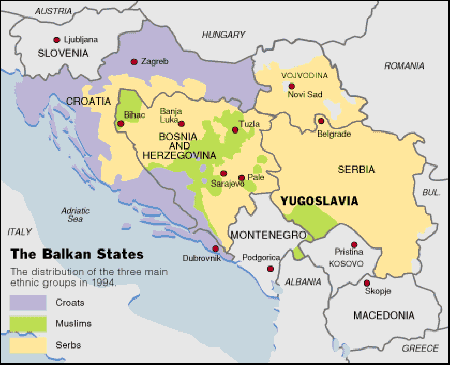 It is perhaps only
natural that the conflict in Kosovo should
have attracted comparisons with the
struggle in Tamil Eelam. It is perhaps only
natural that the conflict in Kosovo should
have attracted comparisons with the
struggle in Tamil Eelam.
The Kosovo Albanians are a
majority in Kosovo but a minority in Serbia. The Kosovo
Albanians are Muslims and the Serbs are Christians. The
Albanians speak a different language to that of the
Serbs. And adjoining Kosovo itself, lies Albania with
ethnic links to the Albanians in Kosovo.
The parallels to the situation
of the Tamils in the island of Sri Lanka, with a majority
in the North and East whilst being a minority in the
whole island, and with ethnic links to the Tamils in
nearby Tamil Nadu, may seem obvious.
The point is then made that
whilst the �international
community� has voiced support for the
Albanians in Kosovo, no such support has been forthcoming
for the people of Tamil Eelam who are facing what
many non governmental organisations have recognised as a
�genocidal�
situation.
And, Tamil voices are raised to
plead for �justice� and
�equality of
treatment�, encouraging the belief that
the �international
community� is actually engaged in the
business of dispensing
�justice� and
�equality�.
Again, it may be that Tamil
voices are raised simply to render it more difficult for
those who may be pretending to be asleep, whilst Chemmanis
multiply, to continue their slumber with any degree of
credibility.
 Need to
look below the surface
similarities... Need to
look below the surface
similarities...
However, be that all as it may,
there may be a need to look below the surface
similarities, and try to understand the significance of
Kosovo - both to the Serbs and to the
�international
community�.
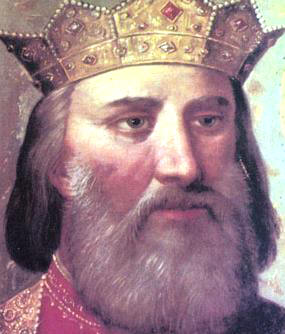
Some 600 years ago, on June 15,
1389 the Serbs confronted the Turkish invader of their
homeland in the two week Battle of Kosovo. The Serb army
was led by Prince
Lazar, who fought resolutely to the end. He was
wounded, taken prisoner and was beheaded on the orders of
the Turkish conqueror.
 "... the Serbs were allowed to
pick up the severed head of their leader, and carry it
together with the body to the Church of Vaznesenje
Hristovo in Prishtina (the main city of Kosovo). Later
the remains were moved to the Monastery Ravanitsa,
which Lazar had built. The Serbian Church proclaimed
Prince Lazar a saint and holy martyr. The mutilated
body of the Saint Prince could not however rest long in
his native land. As the Turks moved to the North, his
remains were carried to Frushka Gora in
Srem... "... the Serbs were allowed to
pick up the severed head of their leader, and carry it
together with the body to the Church of Vaznesenje
Hristovo in Prishtina (the main city of Kosovo). Later
the remains were moved to the Monastery Ravanitsa,
which Lazar had built. The Serbian Church proclaimed
Prince Lazar a saint and holy martyr. The mutilated
body of the Saint Prince could not however rest long in
his native land. As the Turks moved to the North, his
remains were carried to Frushka Gora in
Srem...
The wandering bones had to be
moved a fourth time, when in 1941, the Croatian Ustashi
began pillaging Serbian holy places in the newly
created Axis satellite, the Independent State of
Croatia. ..Lazar�s relics were taken
to Belgrade and now rest in front of the altar of the
main Orthodox Cathedral..." (The
Saga of Kosovo : Focus on Serbian-Albanian Relations -
East European Monographs, No 170 by
Alex N.Dragnich and Slavko
Todorovitch, distributed by Columbia University Press,
New York, 1984)
The defeat at Kosovo signalled
the end of the Serbian state for more than five hundred
years afterwards. However, during those 500 years and
more the spirit of Serb nationalism was kept alive by the
memory of Kosovo.
There were several Serbian
insurrections against the occupying forces of the
Turkish
Ottoman Empire, but they failed.
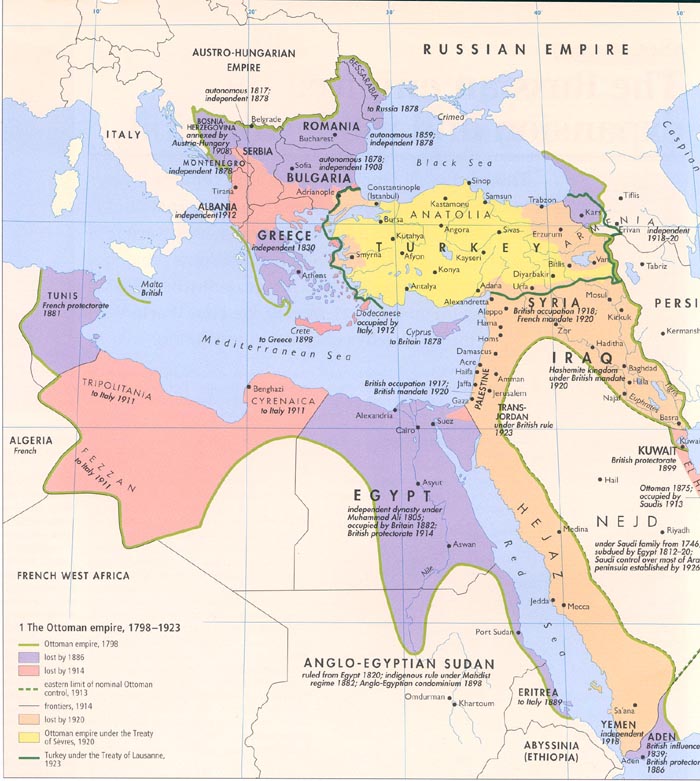
After the failure of a major
insurrection in 1690, a good part of the Serbian
population left Kosovo to escape murder and enslavement
by the Turks.
"The great migration of the
Serbs in 1690 constitutes one of the gravest and most
decisive events in Serbian history." (Cirkovic,
Kosovo and Metohija in Serbian History quoted in Kosovo
- In the Heart of the Powder Keg, Compiled and Edited
by Robert Elsie, East European Monographs, Boulder
distributed by the Columbia University Press,
1997)
Another insurrection that failed
resulted in another wave of Serbian emigration in
1735-39. It was in this way that the ethnic composition
of Kosovo changed. Albanians settled in the abandoned
villages and towns. In time, they adopted the religion of
their conquerors and became Muslims. A significant number
of Albanians rose to high rank in the Turkish
administration and some served as Grand Viziers or Prime
Ministers in the Ottoman Empire.
Kosovo deeply embedded in psyche of the Serb
people...
Kosovo is deeply embedded in
psyche of the Serb people.
"For the Serbs, Kosovo became
a symbol of steadfast courage and sacrifice for honour
... where the Serbs lost their whole nation... it would
be �remembered� and
avenged ... Kosovo is many diverse things to different
living Serbs, but they all have it in their blood. They
are born with it..." (The Saga of Kosovo, Alex
N.Dragnich and Slavko Todorovitch, Eastern European
Monographs, Boulder, Columbia University Press, New
York, 1984)
The
ballads of Kosovo (and about the later resistance of
the Serbs to Turkish occupation) have been sung by
children in Serbia for several centuries.
"I was ten years old when I
first read these heroic ballads. It was during one of
the bleak post war winters in Yugoslavia. There was not
much to eat and little money to heat our apartment
properly. I went to bed as soon as I got home from
school, to keep warm. Then I would listen to the radio
and read. Among the books that my father left was a
thick anthology of �Serbian Folk
Poems�. That�s what
they were called. In the next few years I read the
whole volume and some of the poems in it at least a
dozen times. Even today I can still recite passages
from my favourite ballads. None of this of course is in
any way unusual. Every Serbian loves these poems... I
first fell in love with the ballads that describe the
adventures and heroic feats of various rebels during
Turkish occupation...." (Charles Smic, Preface to
the Battle of Kosovo, translated by John Maththias and
Vladeta Vuckovic, Ohio University Press,
1987)
However, "the significance of
Kosovo in the national conscience of the Serbs does not
rest exclusively on the Battle of Kosovo.... This fertile
land in the South of Serbia was the heart of the feudal
Serbian state in the Middle Ages... Kosovo was also the
bread basket and economic heart of the Serbian Empire...
The Trepcha mines north of Prishtina produced silver,
lead and iron ore. The mines at Novoberda south of the
capital yielded not only silver but precious gold..."
( Kosovo - The Gordian Knot of the Balkans -
translated from the German by Robert Elsie in
Kosovo : In the Heart of the Powder Keg - East European
Monographs, No 478 - compiled
and edited by Robert Elsie, distributed by the Columbia
University Press, 1997)
It was after the Balkan Wars of
1912 and 1913 that the Serbs finally drove the Turks out
of southern Serbia and regained control of Kosovo. Later,
the First World War and the eventual collapse of the
Turkish Ottoman Empire consolidated that Serb
victory.
Again, during the Second World
war, Italy conquered Albania - and Kosovo (which at that
time was a part of Yugoslavia) was made a part of
Albania. Under Italian protection, the Albanians did not
delay in expelling as many Serbs as they could from
Kosovo.
At the same time, Croatia which
was conquered by Germany and had become an independent
state, collaborated with the Axis powers.
It was the Serbs of Yugoslavia
who led the resistance against both German and Italian
rule. And, at the end of the Second World War, Kosovo
reverted back to Yugoslavia.
Given this history, it is not
perhaps surprising that nine years ago, on 28 June 1989,
more than a million Serbs gathered in Kosovo to
commemorate the 600th anniversary of the battle for
Kosovo, and remember those Serbs who had given their
lives for the freedom of the Serb nation. The Serbian
leader, President Slobadan Milosevic declared:
"Today, six hundred years
later, we are fighting once again. New battles lie
ahead of us. They are not military battles, although we
cannot exclude such a possibility...."
There
was no Albanian state before
1912...
As for Albania itself, the views
expressed by Alain Ducellier in Studies of Kosovo are of
some relevance:
"In this context, the case of
Albania may seem astonishing, since this country was
the only national entity to emerge from Byzantium
which.... never succeeded in pouring her strong ethnic,
linguistic and cultural identity into the mould of a
political structure. As is known, this failure
persisted well beyond the Middle Ages, since there was
no Albanian state before 1912." (Alain Ducellier in
Studies of Kosovo, edited by Arshi Pipa and Sami
Rephisti, Easter European Monographs, Boulder,
distributed by Columbia University Press,
1984)
Today, the Kosovo Albanians
appear divided as to what they want - an independent
state, autonomy or union with Albania. But it is put out
that their �right to self
determination� will be protected for
three years in the sense that it will be kept in
�abeyance�. Meanwhile,
the �international
community� wants to secure effective
�autonomy� for the
Kosovo Albanians within the framework of the Serbian
state.
International community quick to
�demonise� the Serb
leader...
At the same time, sections of
the international community are quick to
�demonise� the Serb
leader President Slobadan Milosevic. These same sections
were, equally quick to praise President Pinochet of
Chile, President Suharto of Indonesia and President
Marcos of the Phillipines - and hail President
J.R.Jayawardene�s Sri Lanka in 1984
as a �an open, working, multiparty
democracy�. It was �an
open, working, multiparty democracy� in
which according to a recent statement by Sri Lanka
President Chandrika Kumaratunga, J.R.Jayawardene used
violence against all the people
in Sri Lanka. She cheerfully admitted in a TV interview
in South Africa in October 1998:
"Mr. J. R. Jayawardene ...
believed that he could use violence against the
Tamil people and solve the
problem in the same way he used violence continuously
against our people,
Sinhala people and all other
Sri Lankan people as a solution to all political
problems. The Tamil people were attacked 4 times
between 77
and 83, physically
attacked, bodily attacked, their properties destroyed.
1983 was of course, the high water mark of this
anti-Tamil violence practised by the UNP - horrendous
crimes were committed against the Tamil
people."
And today, despite the well documented
record of the genocidal war launched by Sri Lanka
President Chandrika Kumaratunga, and the charges of murder and
intimidation made by the Sinhala opposition party against
Chandrika Kumaratunga's People's Alliance, the US
State Department
continues to insist that �Sri Lanka
is a longstanding democratic republic with an active
multiparty system�.
Perhaps, ten years from now, yet
another Sinhala political leader will admit to President
Chandrika Kumaratunga�s responsibility
for the actions of those
under her command, including the Chemmani mass
graves and confess that Sri Lanka, after all, was not
much of a democracy under her rule.
It will be naive therefore, to
assume that today�s international
criticisms of the Serb leader President Slobadan
Milosevic have much to do with concerns about war
crimes or genocide. These criticisms may have more to
do with geo politics than with human rights.
Instructive to
explore some elements of the geo political
frame...
In the 1960s, the Shah
of Iran supported the Kurds to pressure Iraq and no
sooner Iran and Iraq settled their differences, the Kurd
leader was told to pack up and go home - and he ended up
in the US. In the 1980s, India
extended support to the Tamil Eelam struggle until Sri
Lanka recognised India�s geo political
interests in the Annexures
to the 1987 Indo Sri Lanka Accord.
In the case of the support
extended by the 'international community' to the
Kosovo Albanians, it may be instructive to explore some
elements of the geo political frame.
Some insights may be obtained
from an earlier involvement by the U.S. and the United
Kingdom in Albania. Nicholas Bethell, wrote in 1984, in
the �The Great
Betrayal�:
"Hardly anyone knows that the
United States and Britain chose to make Albania,
Europe's poorest country, a secret battleground between
West and East, and the central point of their efforts
to regain the initiative in the Cold War that began the
previous year in 1948....
The Albanian affair was
conceived by American and British officials at a
meeting in Washington, then approved by government
leaders. It was a carefully considered act of policy
based on the idea that Stalin would be impressed by a
Western decision to act against him militarily
even on a small scale and in
an outpost of his empire.
It would make him think twice
before launching further aggressive enterprises. It
might also, incidentally,
detach Albania from the Soviet orbit, ... and allowing
the emergence of a kinder and less anti-Western
government...
The military side began in
October 1949 when the first teams of armed
British-trained agents were landed on Albanian
territory. It ended in the last days of 1953 when the
failure of an important American-sponsored mission was
publicly revealed..." (Nicholas
Bethell,
The Great Betrayal%3C/i%3E%3C/p%3E%20%3C/font%3E%3C/blockquote%3E%3Cfont%20SIZE=)
Albanian exiles
were recruited to �fight for
Albania�. The Albanian exiles were
later to complain -
"(They) complain
that their innocence and trust were exploited by the
secret services of two powerful and sophisticated
countries. They were recruited, they say, on the
understanding that the United States and Britain
wanted to liberate Albania from communism. And on
this basis they were happy to agree. They would fight
and they would sacrifice lives, not only their own,
but also those of their brothers. wives and
children.
They were ready
to fight for Albania but for no other cause. And this
is why, they say. the truth was kept from them. They
were not told of the many other reasons why the
operation was taking place, about the need to relieve
communist pressure on Greece in the civil war. about
the decision to retaliate against Stalin's aggressive
moves... They were not advised that the conspiracy
against communist Albania was no more than a single
move in a great game of geopolitical chess and that
they, the 'little men�, were the
pawns most likely to be taken.
... American and
British intelligence men who took part in the
conspiracy point out in reply .... (that) even though
the liberation of Albania was not achieved, the
United States and Britain did succeed in giving
Stalin an effective demonstration of the West's will
to retaliate, thereby saving other countries. If the
West had faltered, Stalin would have resurrected the
Greek civil war, snuffed out Tito's rebellion and
boosted the Italian communists. Democracy in western
Europe would not have survived this
onslaught.
They concede
that the Albanian exiles were not told the full
truth. But, they say, Western intelligence services
cannot always observe the rules of fair play when
fighting the Soviet adversary. The Albanian exiles
who fought under their auspices were all enthusiastic
volunteers, men who from the outset begged to be
given the dignity of fighting men rather than being
left to rot in refugee camps. They knew the risks
they were running.
... In battle it
is sometimes necessary to give up a platoon so as to
facilitate a battalion's withdrawal. If 'pawns' have
to be 'sacrificed' in order to deter an adversary
from aggression, then so be it, it must be done. And
in extreme cases, when vital interests are truly at
risk, the victims must be deceived."(Nicholas
Bethell,
The Great Betrayal%3C/i%3E%3C/p%3E%3C/blockquote%3E%3Cp%20ALIGN=) Today,
50 years later, President Yeltzin�s
Russia remains one of the few friends of
Serbia�s President Slobadan
Milosevic. A leader of the Russian Liberal Party,
proclaimed on a recent visit to Serbia, the
brotherhood of the Slavs, and declared, in a
rhetorical flourish, that he would rest content only
when the Slav people ruled a contiguous land
stretching from Russia, through Bulgaria to
Serbia. Today,
50 years later, President Yeltzin�s
Russia remains one of the few friends of
Serbia�s President Slobadan
Milosevic. A leader of the Russian Liberal Party,
proclaimed on a recent visit to Serbia, the
brotherhood of the Slavs, and declared, in a
rhetorical flourish, that he would rest content only
when the Slav people ruled a contiguous land
stretching from Russia, through Bulgaria to
Serbia.
One message
that is being conveyed by the
�international
community� may be that the Balkans
is not an area within the Russian circle of
influence and that it is time that the Serbs
recognised this reality. That is not to say that
there may not be other messages as well. The spill
over effect on Albanians in adjoining Macedonia and
Albania, the destabilising influx of refugees to
other parts of the European Union, and the support
that may be given to Muslim Kosovo by the Muslim world,
may be other matters of concern. There is also the
importance that Germany attaches to its relations
with Croatia on the western border of Serbia.
Indeed, it was German recognition of Croatia which
hastened the collapse of the earlier
Yugoslavia.
Present day
Albanian nationalists not unaware of the history
of 'international' support...
Present day
Albanian nationalists are not unaware of the nature
of the support extended to them by the
�international
community�. Professor Qosja who, in
recent years has become a father figure of the
Albanian nation, remarked in a recent
interview:
"The
international community, the European Union and the
United States, still think they can solve the
question of Kosovo by ensuring human rights and
autonomy within Serbia.
This shows that they do not understand the issue
involved and approach the problem of Kosovo in a
superficial manner.
If they
understand the essence of the issue, they would
realise that public order, peace and justice can
never be established in Kosovo until it is united with
Albania.
The attitude of the
international community towards the Kosovo problem
has been disappointing, but history has taught us
that we can expect little from it. Just as
disappointing, however, has been our own attitude
towards ourselves." (Interview with Rexhep Qosja
quoted in
Kosovo : In the Heart of the Powder Keg - East
European Monographs, No 478 - compiled and Edited by Robert Elsie,
distributed by the Columbia University Press,
1997)
Rexhep Qosja's
disappointment with "our own attitude towards
ourselves" was not without significance. Though the
Kosovo Albanians declared a so called Republic of
Kosovo in 1992, no government, not even the Albanian
government has recognised it. Neither has the
Albanian government had the political will to
support the demand that Kosovo should be united with
Albania. Again, significantly, the 'seat' of the
Government of the Republic of Kosovo is stated to be
in Bonn in Germany. Qosja's comments are
caustic:
"How can I recognise a
national 'government' which calls itself a
government while under Serbian occupation?... How
can I recognise a (Kosovan) President, a Member
of parliament or a Minister who travels through the
country carrying a Serbian I.D., who crosses the
border of Kosovo using a Serbian Passport and who
fulfills all his duties as a citizen of Serbia?...
It is a tragi-comedy staged in order to smother
resistance..." (Interview with Rexhep Qosja
quoted in
Kosovo : In the Heart of the Powder Keg - East
European Monographs, No 478 - compiled and Edited by Robert Elsie,
distributed by the Columbia University Press,
1997)
Eelam Tamils may see some
parallels with the tragi-comedy played out by the
TULF leader, Appapillai Amirthalingam, whilst being a
guest of the Government of India in 1980s.
Yes, there may be
many similarities between the Tamil Eelam struggle
and the conflict in Kosovo - but there may be a need
to look beyond that which appears on the
surface.
|