A few months months ago a committed diaspora
Eelam Tamil activist concerned with the grave
humanitarian crisis faced by his kith and kin
in Tamil Eelam prepared a well researched booklet
for presentation to a member of the legislature
of the country in which he lived. The legislator
had indicated that such a booklet will be helpful
in the discussions that he planned to have with
the head of the government of that country. The
Eelam Tamil activist requested that I review the
booklet and offer my comments. In the context of
the
report by the distinguished westcentric
International Crisis Group dated 20 February
2008 that
my response to the Eelam Tamil activist may
have a general relevance and I set out here an
extended and revised
version of the reply that I had sent -
" Your booklet is comprehensive and has been
put together with care - and reflects your
commitment to the struggle of the people of
Tamil Eelam for freedom. You are right to
hope that 'the documentation will help the
government of the country' in which you live,
'see for itself the vital leadership role that
it can play as a protector of human rights and
a champion of the oppressed.'
Said that, we may also want to pay attention
to something which Velupillai Pirabakaran
said
in 1993 -
".. the world is not rotating on the axis
of human justice. Every country in this world
advances its own interests. It is economic
and trade interests that determine the order
of the present world, not the moral law of
justice nor the rights of people.
International relations and diplomacy between
countries are determined by such
interests...."
The cynicism of real politick in the world
in which we live, was pointed out by Amnesty in
a full page advertisement in the London based
Guardian many years ago, on 12 March 1994 in
the context of East Timor - comments which are
equally applicable to the situation of the
people of Tamil Eelam in the island of Sri
Lanka:
''...When governments pretend not to
notice suffering, to whom can peoples.. turn
for help? The United Nations? Alas, the
deeper you delve, the redder the faces. The
cynicism of realpolitick extends even to the
UN Commission on Human Rights... When Amnesty
attended the Commission in Geneva last month
to urge action on Indonesia and East Timor,
we met only embarrassment. The governments to
which we spoke repeated what they have been
promising us for thirty years: they will
pursue a policy of 'quiet diplomacy'''
Quiet diplomacy is more often than
not a cloak for the pursuit of the geo
strategic interests of the country concerned.
We need to pay careful attention to the
assessment of Sivaram (Taraki) in 2003 -
"..Today it is clear beyond all reasonable
doubt that India and the US-UK-Japan Bloc are
trying to influence and manage Sri Lanka's
peace process to promote and consolidate
their respective strategic and economic
interests... From 1983 to 86, it was taboo
among Tamils to propagate the truth that
India was exploiting their cause to gain a
foothold in Sri Lanka. The few who dared to
speak about India's hegemonistic designs were
admonished not to be too rash lest we provoke
Delhi's ire and cause a disruption in the
weapons handouts by the RAW....The price the
Tamil liberation movement as a whole had to
pay for not educating the people about the
truth of India's intentions was high. At this
juncture, even a doddering dullard would find
the deja vu inescapable...The Tamil nation
cannot afford to make the same mistake
again..."
Even 'a doddering dullard would find the
deja vu inescapable' and we cannot afford to
make the same mistake again. The political
reality is that the world is not rotating on
the axis of human justice. It is not the case that at the highest
levels of governments in the Western world, the
justice of the struggle of the people of Tamil
Eelam to be free from alien Sinhala rule is not
known. For instance, Congressman Mario
Baggio's declared
eloquently in the US House of Representatives
in May 1980 -
"To understand the problems that exist in
Sri Lanka - formerly known as Ceylon - it is
essential that we review its history. Located
in South Asia, the island of Sri Lanka has
been composed of two distinct populations for
centuries - the Tamils and the Sinhalese.
They lived not as one, but
as two nations, with separate languages,
religions, cultures, and clearly demarcated geographic
territories...
My colleagues and I have introduced the
following resolution because we believe it is
essential to express the concern of the
Congress about the army occupation in the
Tamil areas of Sri Lanka: the denial of basic
rights, including freedom of expression,
freedom of religion, equal citizenship and
educational opportunities; and the freedom to
exercise the right of political
self-determination."
That was 28 years ago, and Tamils lobbying
their elected representatives in the United
States, in Canada in Australia or in the United
Kingdom will be hard pressed to put the justice
of the Tamil struggle more effectively.
Again, the
resolution of US Massachusetts House of
Representatives in June 1981 calling for
the Restoration of the Separate Sovereign State
of Tamil Eelam makes it abundantly clear that
the United States, for instance, was not
without an understanding of the justice of the
Tamil Eelam struggle for freedom.
What then has changed in the ensuing 27
years? Not much, if we recognise that countries
do not have permanent friends but have
permanent strategic interests.
The political reality is that there are two
conflicts in the island of Sri Lanka - one the
conflict between the Sinhala nation and a Tamil
Eelam nation seeking freedom from alien Sinhala
rule, and the other, the conflict between
international actors in the asymmetric multilateral world in
which we live - a world in transition from
the unipolar to the multilateral.
Today, the China ward
tilt of President Rajapakse is a matter of
concern to the West - in the same way as the
Westward tilt of President Jayawardene was
a matter of concern to India in the 1980s.
I myself believe that these
strategic interests need to be discussed
openly - otherwise we may end up by ignoring
the elephant in the room.
Admittedly there are those who take the view
that this not the 'anuku murai', not the
'diplomatic way'. But I continue to believe in
something that I wrote in Black Pebbles & White
Pebbles in 2006 -
"..It seems that we avoid confronting the
international community for fear of provoking
its ire. We avoid seeking an open dialogue
with the international community on its own
strategic imperatives and the true rationale
for its actions…We say that our way is
the 'anuku murai' - the diplomatic way to
'approach' issues. We claim that this is the
effective way. But has this 'anuku murai'
succeeded? Again the result of not calling a
spade a spade is that we confuse our own
people... We confuse our people by leading
them to believe that all that needs to be
done is to wake up the international
community to the facts and the justice of our
cause and all will be well. This is the
limitation of our discourse. It is a
limitation that we need to transcend...."
It is not that each
of one us should not tirelessly, fearlessly and
openly lobby against the genocidal onslaught
launched by Sri Lanka on the people of Tamil
Eelam. We must. But at the same time, we must
equally tirelessly, fearlessly and openly
espouse the lawfulness and justice of the Tamil
Eelam struggle for freedom from alien Sinhala
rule. It is not either or - it is both. The
charge is
genocide - but the struggle is for freedom.
We must tirelessly, fearlessly and openly
point out to those who speak to us about a
creating a multi ethnic Sri Lanka that the
conflict continues not because of the LTTE but
because a
Sinhala Buddhist nation
seeks to masquerade as a 'multi ethnic' 'Sri
Lankan civic nation', with a
Sinhala Lion Flag, with as yet
unrepealed Sinhala Only Act,
with Buddhism as the State religion,
and with an occupying Sinhala
army in the Tamil homeland - a Sinhala army of
occupation which was first sent to the Tamil
homeland in 1961, long years before the
demand for an indedependent Tamil Eelam in
1975.
We need to ask those whom we lobby to
respond to our concern that in the same way as
in the 1980s, when India sought to use Sri
Lanka's violations of the human rights of
Tamils
to move Colombo away from the West, today
both the West and India are seeking to use Sri
Lanka's violations of the human rights of
Tamils to move Sri Lanka away from
too great linkage with China - and when
that is secured, we will be offered
'comic opera' reforms such as the 13th
Amendment and Provincial Councils, with a
Provincial Governor appointed by a Sinhala Sri Lanka
President who will exercise executive power in
respect of provincial matters.
We need to ask those whom we lobby some
simple questions which may help to focus their
minds (as well as ours). Let us say:
"Yes, let us forget a separate state. Let
us forget the Gandhian leader,
S.J.V.Chelvanayagam's independence
declaration of 1975. Let us forget the
Vaddukoddai Resolution of the Tamil
United Liberation Front (TULF) of 1976. Let
us forget
the TULF Manifesto for independence which
received the overwhelming support of the
people of Tamil Eelam in 1977. Let us forget
S.J.V.Chelvanayagam.
Let us forget the
LTTE. Let us forget Velupillai
Pirabakaran.
Indeed, let us go further. Let us forget
federalism. Let us forget devolution - yes,
even devolution.
Let us also forget decades of murder,
torture
and rape which
led Paul Sieghart Q.C. to conclude in 1984
that "communal riots in which Tamils are
killed, maimed, robbed and rendered homeless
are no longer isolated episodes; they are
beginning to become a pernicious habit."
Let us forget 1956, 1958, 1961, 1974, 1977 and 1983.
Yes, even 1983.
Let us forget decades of broken
pacts and dishonoured agreements entered
into by the dominant Sinhala majority with
the Tamil political leadership.
Yes, by all means, let us forget the past.
Let us live in the present and look to the
future. Let us explore dispassionately the
'disinterested' advice of the 'international
community' that the answer to the conflict in
the island of Sri Lanka lies in a multi
ethnic secular Sri Lanka.
Let us then ask: Will this unitary (yes,
unitary) 'multi ethnic secular state'
renounce the Sinhala flag as its 'national'
flag and adopt a
tricolor as its national flag? If not,
why not?
Will this 'unitary multi
ethnic secular state' repeal the
Sinhala Only
Act and declare explicitly and without
subterfuge that Sinhalese and Tamil shall
have parity throughout the island? If not,
why not?
Will this 'unitary multi ethnic
secular state'
repeal the Constitutional
recognition given to Buddhism? If not,
why not?
Will this 'unitary multi ethnic secular
state' agree to renounce its Sinhala name
which it gave
itself unilaterally in 1972? If not, why
not?
Will this 'unitary multi ethnic secular
state' stop changing the demography of the
land by state sponsored
Sinhala colonisation? If not, why
not?
Let us then ask -
If the Sinhala political leadership
cannot, even today,
(yes, even today) remotely consider doing any
or all of this, would the 'disinterested'
international community please tell us why
that is so? What is it in the Sinhala
political consciousness that prevents it
agreeing to a truly unitary (yes, unitary)
'multi ethnic secular state'? And given the
existential reality of that Sinhala political
consciousness what does the mantra of a
'multi ethnic plural soceity' actually
mean - despite its meditative ring?
Let us ask those whom we lobby -
Would you deny that Sinhala ethno
nationalism is a nationalism that dare not
speak its name?
Would you deny the reality that in the
island of Sri Lanka a Sinhala
Buddhist ethno nation seeks to masquerade
as a 'multi ethnic
civic Sri Lankan nation' so that
it may further its assimilative agenda?
Would you deny the political reality of
the homogeneous Pan
Sinhala Ministry of 1936 - yes, in 1936
under British rule when separation was not
even a remote threat, and devolution was not
on the table?
Would you deny that the record
shows that during the past sixty years
and more, the intent and goal of all Sinhala
governments (without exception) has been to
secure the island as a Sinhala Buddhist Deepa
?
 Would you deny that Sinhala
Buddhist ethno nationalism existed long
before Tamil demands for devolution or
federalism or an independent state - and that
Sinhala Buddhist ethno nationalism
has its roots in the Mahawamsa and in
Duttugemenu and that it has continued to
assert its hegemony with increasing
ferocity?
Would you deny that Sinhala
Buddhist ethno nationalism existed long
before Tamil demands for devolution or
federalism or an independent state - and that
Sinhala Buddhist ethno nationalism
has its roots in the Mahawamsa and in
Duttugemenu and that it has continued to
assert its hegemony with increasing
ferocity?
Would you deny that Sinhala Buddhist ethno
nationalism did not
arise as a response to the Tamil
demand for federalism or an independent
state?
Would you deny that Sinhala Buddhist ethno
nationalism is not the creation of S.J.V.Chelvanayagam
or Velupillai
Pirabakaran?
Would you deny that in fact and in truth,
it is the other way
around?
Would you deny that it this political
reality which prevents the Sinhala political
leadership even today, (yes, even today) from
agreeing to a truly unitary 'multi ethnic
secular state' without a Sinhala Lion Flag, without
the Sinhala Only Act, without
Buddhism as the State
religion, and without the
Sinhala 'Sri Lanka' name
Would you deny that it this political
reality of the existence of two nations in
the island of Sri Lanka (one which dares not
speak its name, and
the other which does) that any meaningful
conflict resolution process will need to
address?
Would you
deny that Velupillai
Pirabakaran was right when he declared
many years ago -
"We are not
chauvinists. Neither are we lovers of
violence enchanted with war. We do not regard
the Sinhala people as our opponents or as our
enemies. We recognise the Sinhala nation. We
accord a place of dignity for the culture
and heritage of the Sinhala people. We have
no desire to interfere in any way with the
national life of the Sinhala people or with
their freedom and independence. We, the Tamil
people, desire to live in our own historic homeland as
an independent nation, in peace, in freedom and with
dignity."
Would you admit that to deny all this is
to display the simple mindedness of the naive
or the trickery of the knave."
We are a reasonable people and we will
listen to reason. But let us say to those whom
we lobby (and who may be lobbying us) that
thousands upon thousands of Tamils, young and
old, men and women, and children as well, have
died and suffered so that we, their brothers
and sisters, may stand up and declare openly
and fearlessly that we will not be browbeaten
by those who would deny us reason.
We need to say openly and fearlessly to
those whom we lobby that former US Ambassador
Jeffrey Lumsted was
disingenuous when he declared some months ago in a paper on the
'United
States Role in Sri Lanka Peace Process
2002-2006' -
"..With the end of the Cold War, U.S.
interest in Sri Lanka waned...
Political-military interests are not high, and
the U.S. has no interest in
military bases in Sri Lanka."
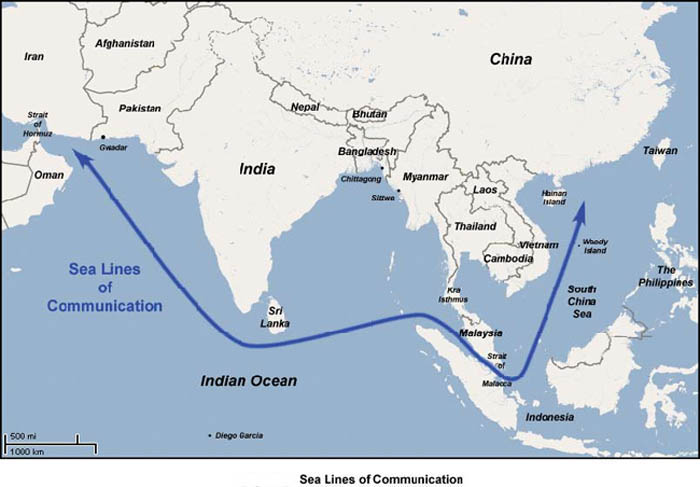
We need
to openly and fearlessly point out that
US Ambassador Jeffrey Lumsted failed to mention that with the end of
the old cold war a
new cold war has started and that he failed
to address the issues raised by United States
Lt.Col. Christopher J. Pehrson in
'String of Pearls: Meeting the Challenge of
China's Rising Power Across the Asian
Littoral'
"Militarily, the United
States must bear the cost of maintaining
superior military power to guarantee security
and serve as a hedge against a possible
future China threat. In the "String of
Pearls" region, U.S. efforts should be aimed
at broadening and deepening American
influence in ways that have wide appeal among
the various regional states."
We need to openly express our concern that
Sri Lanka is intent on using the political
space created by the uneasy
balance of power in the Indian ocean region
to further its genocidal onslaught on the
people of Tamil Eelam and to terrorise
them to submit to permanent rule by an
alien Sinhala majority within the confines
of a single state.
Again, it is true that
individual Congressmen, Senators and
Parliamentarians may not have the same
understanding that those at the highest levels
of their Governments may have - and indeed
they may not be privy to all the information
and strategic reasoning on which their own
government may choose to act. It is also true
that individual legislators may be impelled by
immediate considerations of securing votes in
an election and that therefore they may be
influenced by the presence of a significant
number of Tamil voters in their electorate.
Said that, the responses by individual
legislators will also be limited by that which
they may perceive to be the strategic interests
of the country to which they belong. It is
usual for the US State Department,the Canadian
External Affairs Ministry and the UK Foreign
& Commonwealth Office to provide a briefing
note to individual legislators explaining the
stand taken by their governments on important
foreign policy issues.
It was not that the gross violations of
human rights by the Shah of Iran, Pinochet,
Suharto and Marcos were not known to the West
(and their legislators) - they pretended to be
unaware at that time or else advised a 'quiet
diplomatic approach'.
And the flip side of this pretence is that
individual legislators often respond to
lobbying efforts by Tamils by a 'reverse'
lobbying exercise. They say for instance that
the problem of securing peace in the island of
Sri Lanka is because of the 'intransigence' of
the LTTE. Those Tamils who lobby are advised
that they should 'persuade' the LTTE to
'compromise' and be more reasonable - and give
up violence and give up on the demand for an
independent Tamil Eelam.
Given that the LTTE is banned in the US as
well as in Europe, and that Tamils (mostly
professionals) seek to act within the law, the
'moderate' Tamil 'lobbyist' then persuades
himself that the 'anuku murai', 'the diplomatic
way' is to distance himself from 'terrorists'
and 'intransigence'. The words of Frantz
Fannon in The
Wretched of the Earth in relation to Kenya
and the Mau Mau come to mind
-
"..the leader of the
('moderate') nationalist party... loudly
proclaims that he has nothing to do with
these Mau-Mau, these terrorists, these throat
slitters. At best, he shuts himself off in a
no-man's-land between the terrorists and the
settlers and willingly offers his services as
go-between; that is to say, that as the
settlers cannot discuss terms with these
Mau-Mau, he himself will be quite willing to
begin negotiations. Thus it is that the rear-guard of the national
struggle... find themselves somersaulted into the vanguard
of negotiations and compromise - precisely
because that party has taken very good care
never to break contact with
colonialism..."
And so
the
rear-guard of the national liberation struggle
persuade themselves that they are in the
vanguard of 'negotiations and
compromise'. The
'moderate' Tamil lobbyist offers
his services as a go between. He
persuades himself that the way forward is to
distance himself not only from those labelled
as 'terrorists', but also distance himself from
the 'ends' that the Eelam Tamil resistance
movement seeks to achieve. He is persuaded to
gloss over the political reality that the
demand for an independent Tamil Eelam did not
originate from the Tamil Eelam armed resistance
movement - and that the demand originated in
the declaration of the Gandhian (yes, Gandhian)
Tamil leader S.J.V.Chelvanayagam in 1975.
"Throughout the ages the Sinhalese and
Tamils in the country lived as distinct
sovereign people till they were brought under
foreign domination... We have for the last 25
years made every effort to secure our
political rights on the basis of equality
with the Sinhalese in a united
Ceylon."
"It is a regrettable fact that successive
Sinhalese governments have used the power
that flows from independence to deny us our fundamental rights
and reduce us to the position of a subject
people. These governments have been able
to do so only by using against the Tamils the
sovereignty common to the Sinhalese and the
Tamils."
"I wish to announce to my people and to
the country that I consider the verdict at
this election as a mandate that the Tamil Eelam nation should
exercise the sovereignty already vested in
the Tamil people and become free."
The 'moderate' Tamil lobbyist is then taken
down the slippery slope of 'federalism',
'devolution', 'decentralisation', the comic
opera of the
13th Amendment, and so on without knowing
how to stop - or where to go. He rationalises
his approach by speaking of the pressing need
to end the suffering of his kith and kin in
the Tamil homeland and speaks of the urgent
need for 'peace'. He chooses to forget that the
conqueror is always a lover of peace.
"The would be conqueror is always a lover
of peace, for he would like to enter and
occupy our country unopposed. It is in order
to prevent him from doing this that we must
be willing to engage in war and be prepared
for it." Clausewitz quoted in
Philosophers
of Peace and War, edited by Professor
Gallie
The 'moderate' Tamil lobbyist persuades
himself that the 'international
community' is actually engaged in the business
of dispensing 'justice' and 'equality'.
And the 'international community' concerned to
further its
own strategic interests actively encourages
(and
it now appears, is intent on creating the
political space for) such Tamil 'lobbying'.
The question here is: who is lobbying whom?
In 1885, it was a retired British civil
servant, A.O.Hume (in consultation with the
British Viceroy of India) who founded the
Indian National Congress. The British were far
seeing. David Hume declared:
"Every adherent of the Congress, however
noisy in declamations, however bitter in
speech, is safe from burning bungalows and
murdering Europeans and the like. His hopes
are based upon the British nation and
he will do nothing to
invalidate these hopes and anger that
nation."
The Indian National Congress of that time
was the 'Indian lobby' through which dissent
was channelled and managed by the ruler in such
a way so as to enable the ruler to secure its
strategic interests in the Indian sub
continent. Some 8 years after the founding of
the Indian National Congress, Aurobindo set about
showing where Hume was wrong. Aurobindo wrote
in 1893 in the Indu Prakash:
"...Popular orators, who carry the methods
of the bar into politics, are very fond of
telling people that the Congress has
habituated us to act together. Well, that is
not quite correct; there is not the slightest
evidence to show that we have at all learned
to act together; the one lesson we have
learned is to talk together, and that is a
rather different thing...Our appeal, the
appeal of every high souled and self
respecting nation, ought not to be to the
British sense of justice, but to our own
reviving sense of manhood, to our own sincere
fellow feeling - so far as it can be called
sincere - with the silent suffering people of
India. I am sure that eventually the nobler
part of us will prevail - that when we no
longer obey the dictates of a veiled self
interest, but return to the profession of a
large and genuine patriotism, when we cease
to hanker after the soiled crumbs which
England may cast to us from her table, then
it will be to that sense of manhood, to that
sincere fellow feeling that we shall finally
and forcibly appeal..."
Admittedly, it is difficult to
wake up an international community which
pretends to be unaware of the justice of the
struggle of Tamil Eelam for freedom - a
struggle which US Congressman Mario Baggio's
supported so
eloquently in the US House of
Representatives in May 1980. But the 'waking
up' process will be hastened by openly
discussing (and drawing public attention to)
the strategic
reasons for the international community's
sleep.
Let us also communicate to those whom we
lobby
that we also recognise that sovereignty is not
virginity. Let us say that if Germany and
France were able to put in place 'associate'
structures such as the European Union, despite
the suspicions and confrontations of two world
wars, it should not be beyond the capacity of
Tamil Eelam and Sri Lanka to work out
structures, within which each independent state
may remain free and prosper, but at the same
time pool sovereignty in certain agreed areas.
Let us say that Velupillai Pirabakaran was
right
when he declared in 1992 -
''It is the Sri Lanka government that has
failed to learn the lessons from the emergence
of the struggles
for self determination in several parts of the
globe and the innovative structural changes that
have taken place.''
Let us communicate to those whom we lobby
our belief that the 'asymmetric multilateral
world' of states in
their search for stability will find an
increasing need to adopt a more principle centred
approach towards struggles for self
determination not only in the Indian region but
also elsewhere in the globe. And let us say
that little will be gained by demonising
resistance to alien rule and the leaders of
that resistance - because, apart from anything
else, 'in those men thousands
more are contained, an entire people is
contained, human dignity is
contained.'
And to those who ask:
when will Tamil Eelam achieve freedom, let us
say that Mahatma Gandhi was right when he
declared in Transvaal, South Africa more
than one hundred years ago
"..If someone asks me when
and how the struggle may end, I may say that,
if the entire community manfully stands the
test, the end will be near. If many of us fall
back under storm and stress, the struggle will
be prolonged. But I can boldly declare, and
with certainty, that so long as there is even a
handful of men true to their pledge, there can
only be one end to the struggle, and that is
victory..."

 Copyright 1998/2009 All Rights
Reserved
Copyright 1998/2009 All Rights
Reserved