Sathyam
Commentary
23 June 2000
Mr.Martin Collacott is
Appalled...
Mr. Martin Collacott
writing on 13 June 2000 in the National Post On
Line, Canada has unburdened himself of his
feelings about the LTTE. His views deserve more than
passing consideration, not only because of that which
he asserts, but also because he writes with the
authority of one who served as Canada's High
Commissioner to Sri Lanka from 1982 to 1986 - and as
one whose links with the Canadian Foreign service may
not be entirely absent at the present time.... In
fairness to Mr.Collacott and also to enable readers
to judge for themselves the correctness or otherwise
of Mr.Collacott's assertions, his
article is also published below in
full.
Contents
 Mr. Martin
Collacott is appalled... Mr. Martin
Collacott is appalled...
Defaming a guerrilla movement as "terrorists" is a
useful way of discrediting them...
Mr.Collacott would have his readers ignore the views of
those, such as Jordon J.Paust that the conflict in the
island of Sri Lanka is an international armed
conflict..
Mr.Collacott fails to furnish evidence to support his
allegations about LTTE activities in
Canada...
Given that which he had to say, Mr.Collacott is at
pains to establish his credentials as a neutral
observer - and indeed, as a friend of the Tamil
people..
Mr.Collacott, Canadian Aid, Maduru Oya and the
Dimbugala Priest...
Paul Nallanayagam, Genocide'83 & Mr.Collacott's
'urgings'...
Harsh political reality is that despite Mr.Collacott's
'urgings' and his visits to 'demonstrate concern', the
Sri Lanka authorities continued to torture, continued
to massacre Tamil non combatants - and kill Tamil
Christian priests as well...
The armed resistance of the people of Tamil Eelam did
not just happen...
Mr.Collacott expresses concern at the fate of
'moderate' Tamil leaders, but in what lay their
'moderation'?
It is not that the LTTE have not on occasion violated
the humanitarian laws of armed conflict...but
Mr.Collacott may also want to consider some of the
Readings on International Humanitarian
Law...
US Under Secretary of State, Thomas R. Pickering's
statement that "it is the international community that
is the arbiter of who becomes states and who doesn't
become states" underlies much of that which
Mr.Collacott has asserted...
US may need to realise that self determination is not a
de stabilising concept and that it is the refusal to
recognise the right of a people to free themselves from
alien rule that will promote instability...
Deploying the 'terrorist' tag to defame struggles for
freedom will yield diminishing returns in an
increasingly 'politically awakened' world - and at best
will drive resistance underground...
There is a need for the US to adopt a more principle
centered approach to the struggle of the Tamil people -
the old style 'command - control' method of leadership
will not work...
Political wisdom is not necessarily a function of
gross national product and both Mr.Pickering and
Mr.Collacott may want to revisit the words of Tamil
Eelam leader, Velupillai Pirabaharan...

Mr. Martin Collacott
is appalled...
Mr. Martin Collacott writing in the Canadian
National Post on 13 June 2000 has unburdened himself of
his feelings about the LTTE. He is "appalled" by
the way in which the Tamil Tigers and their supporters
have "abused" and "exploited" Canadian hospitality.
Mr.Collacott's views deserve more than passing
consideration, not only because of that which he asserts,
but also because he writes with the authority of one who
served as Canada's High Commissioner to Sri Lanka from
1982 to 1986 - and as one whose links with the Canadian
Foreign service may not be entirely absent at the present
time.
His remarks also follow upon Asia Week's
editorial comment on 2 June 2000:
"...Tigers and their front organisations
operate with much freedom. They have offices in London,
Paris, Toronto and New Jersey, and propaganda units in
Sydney, Norway and Texas. Their network raises over $2
million a month from 38 countries. The LTTE boasts
ocean-going ships, which only the PLO and the IRA,
among other rebel groups, have. Such organisation and
resources make few nations willing to take on the
Tigers. But the world must pressure all sides in Sri
Lanka to talk peace, if necessary by
blocking money flows...".
Additionally, Mr.Collacott's article came on the
heels of attempts to prevent two public rallies
organised by Canadian expatriate Tamil groups to
celebrate Tamil
Tiger military successes around Jaffna - rallies
which had become a focus for fund collection to support
the struggle for Tamil
Eelam. And, Mr.Collacott's remarks also spawned
coverage in the BBC and in sections of the Indian media
as well.
Tamils will be forgiven if they take the view
that the timing of Mr.Collacott's intervention was not
unrelated with the concerted attempts being made in the
international arena, to demonise the Tamil Eelam leader,
Velupillai Pirabaharan, to marginalise the LTTE and to
'persuade' the Tamil people to give up their demand for
an independent State.
Guerrilla wars are primarily fought on the field
of morale and defaming a guerrilla movement as
"terrorists" is a useful way of discrediting
them...
John Harrington pointed
out perceptively in 1998, that though it may
not be the case that the media world wide is
collectively manipulative, the media do often interpret
and synthesise images in accord with the assumptions of
'the dominant ideology':
"...Truth doesn't stand alone; rather people engage
in a selection process... the real battle is over who's
interpretation, who's framing
of reality gets the floor... the maintenance of order
is the key idea to be examined in the media....
(ofcourse) the media world-wide would find it hard to
be so collectively manipulative... (but) it can still
maintain order by 'leading'
rather than 'ruling'... Repeated representations of
ideological domains continues to define or 'indicate'
culture, particularly for people who are heavily
exposed to the media… media often interpret and
synthesise images in accord with the assumptions of the
dominant ideology'... " (The Media, Framing, and
the Internet: Dominant Ideologies Persist - John
Harrington, February 1998, University College Cork,
Ireland)
In relation to the struggle for Tamil Eelam, the
assumptions of that dominant ideology are not far to
seek. Guerrilla wars are fought primarily on the
field of morale, and defaming a guerrilla movement as
"terrorists" is a useful way of discrediting them.
The message that the Canadian National Post and
Mr.Collacott wish to convey is simple and direct:
'terrorism' is a crime against humanity, the LTTE is a
terrorist organisation and therefore it should not be
supported.
It is a message which serves to create the
international political space within which the Sri Lanka
government may continue its genocidal onslaught
on the Tamil people - a genocidal onslaught which
illustrates, yet again, the truth of Jean Paul Sartre's assessment
in November 1967 at the Bertrand Russell War Crimes
Tribunal:-
"Against partisans backed by the
entire population, colonial armies are helpless. They
have only one way of escaping from the harassment which
demoralises them .... This is to
eliminate the civilian population. As it is the
unity of a whole people that is containing the
conventional army, the only anti-guerrilla strategy
which will be effective is the destruction of that
people, in other words, the civilians, women and
children..."
During the Vietnam war, mainstream media were
consistent in their support for US actions and the
findings of the Bertrand Russell Tribunal against the US
were dismissed as the contrived efforts of 'socialists'
and 'extremists' - in the same way as, today, the main
stream media pay scant attention to the documented indictment against
Sri Lanka.
But the lessons of Vietnam were not altogether lost
on those who failed to quell liberation movements despite
having recourse to superior arms and resources. Michael
Schubert writing 'On Liberation Movements And The Rights
Of Peoples' pointed out in 1992:
"The French Chief of Staff Andre Beaufre wrote about
his own experiences in Algeria and Vietnam in his 1973
German-language book 'Die Revolutionierung des
Kriegsbildes':
'The surprising success of the decolonization wars
can only be explained by the following: The weak seem
to have defeated the strong, but actually just the
reverse was true from a moral point of view, which
brings us to the conclusion that limited wars
are primarily fought on the field of
morale.'
In order for... states to quickly and effectively
wipe out "revolt", which could get out of hand despite
technical superiority (read: better weapons) due to the
political and moral convictions of the mass movement,
it is necessary to make comprehensive analyses early on
and to take effective action in the psychological
arena. It's no coincidence, therefore, that military
and police circles seem to stress the benefits of
'psychological warfare'...
The central aim of this defence approach is to
destroy the morale of the insurgent movement.. to
discredit it and destroy it using repressive means ...,
thereby preventing a mass movement from starting which
could be hard to control with conventional means.
Defaming the insurgents
as "terrorists" and punishing them accordingly -
thereby ignoring international law concerning the
rights of people in war - is a particularly useful
means..."
The National Post and Mr.Collacott would have
their readers ignore the views of those, such as Jordon
J.Paust that the conflict in the island of Sri Lanka is
an international armed conflict..
Today, the National Post and Mr.Collacott would
defame the LTTE as
'terrorists' and have their readers ignore the views
of those, such as
Jordon J.Paust that the conflict in the island of Sri
Lanka is an international armed
conflict:
"It is more appropriate to consider that the armed
conflict (in the island of Sri Lanka) lasting more than
a decade, in which the Tamil people are fighting for
self-determination, has reached
beyond an insurgency as such and implicates
Protocol I to the Geneva Conventions... Article I (4)
affirms that Protocol I supplements the general
provisions of the 1949 Geneva Conventions applicable in
case of an armed conflict of an
international character, and that such include:
"Armed conflicts in which peoples are fighting against
colonial domination and alien occupation and against
racist regimes in the exercise of their right of self
determination....." (Jordon J.Paust, Co Chair,
International Criminal Law Interest Group, American
Society of International Law - Vanderbilt Journal of
Transnational Law, Volume 31, Number 3, p 617 at p
619)
Mr.Collacott and the National Post would deny the
right
of the people of Tamil Eelam to rule themselves and
would have their readers ignore the lawfulness of
the struggle of the people of Tamil Eelam to liberate
themselves from alien Sinhala rule.
They would ignore the historical fact that the Tamil
people and the Sinhala
people were brought within the confines of a single state
for the first time under British rule in 1833. They
would ignore the legal
principle of reversion of sovereignty and dismiss the
views expressed by Mr.Timothy J. Moore, M.P. of the
Australian Section of the International Commission of
Jurists in 1983 as a legal quibble:
'...The proponents of Tamil Eelam argue that the
northern and eastern Provinces of Sri Lanka coincide
with the historic boundaries of the kingdom of Jaffna
and argue a case that seeks to establish that
sovereignty over these territories was never ceded to
any conqueror and that, even if such concession had
been made at any time in the past, the unilateral
renunciation of links with the United Kingdom which
took place at the assumption of office by the
government of Mrs. Srimavo Bandaranaike
in 1972 resuscitated the Tamil sovereignty which
had merely laid dormant until then... In the abstract
theory of international law, it would appear that the
Tamils have at the very least, an arguable case, and
possibly a sustainable one...' (1983 ICJ Report
on 'Ethnic Violence, the Independence of the Judiciary,
Protection of Fundamental Rights and the Rule of Law in
Sri Lanka - Fragile Freedoms?')
Mr.Collacott fails to furnish evidence to
support his allegations...
They would go even further in their efforts to
defame the LTTE. Mr.Collacott asserts:
"While the Tigers have not committed outright acts
of terrorism in Canada, they and their accomplices have
been involved in a wide range of criminal activities in
this country in addition to the extortion of huge
payments from Tamils here. These include drug
trafficking, migrant smuggling, passport forgery and
fraud. They have also been a major factor in the
spawning of Tamil street gangs in Toronto, which have
accounted for 40 shootings in the past three years and
five unsolved homicides."
Mr.Collacott chooses not to furnish evidence to
support his allegations - though it would seem that he
has taken some care in the choice of his words impelled,
perhaps, by the need to avoid the impact of the laws of
libel. For instance, though he refers to the alleged
actions of the 'accomplices' of the LTTE he is careful
to refrain from naming them.
He concedes that 'the Tigers have not committed
outright acts of terrorism in
Canada' but leaves open the implication that the LTTE
have committed some other type of acts of terrorism in
Canada. However, he does not specify what those 'non
outright' acts of terrorism are.
He asserts that the LTTE and their 'unnamed
accomplices' have also been a major factor in the
spawning of Tamil street gangs
in Toronto but he fails to state that there is no
evidence that establishes linkage between the LTTE and
these street gangs.
Mr.Collacott appears to suggest that the criminal
justice system of Canada is so incompetent that it has
permitted the LTTE and (their unnamed accomplices) to
involve themselves 'in a wide range of criminal
activities' in Canada. Mr.Collacott appears to suggest
that the criminal justice system of Canada is so
incompetent that it has permitted the LTTE and (their
unnamed accomplices) to extort huge payments from Tamils,
and furthermore engage in 'drug trafficking, migrant
smuggling, passport forgery and fraud.'
If Mr.Collacott had evidence in support of the
allegations that he made, many Tamils may take the view
that the appropriate course of action would have been for
Mr.Collacott to furnish that evidence to the Canadian
Attorney General so that justice may take its course. Mr.
Collacott presumably subscribes to the fundamental
principle of any civilised criminal justice system that
no one shall be punished without due process and without
being given the opportunity to be heard.
Tamils will be forgiven, if they take the view that
Mr.Collacott in his eagerness to discredit the LTTE, is
willing to ignore the central tenets of the rule of law
- and act as investigator, prosecutor, judge, jury, and
journalist without even naming the individuals whom he
accuses.
Given that which he had to say, he is at
pains to establish his credentials as a neutral observer
- and indeed, as a friend of the Tamil
people..
Given that which he had to say, Mr.Collacott
was, understandably, at pains to establish his
credentials as a neutral observer - and indeed, as a
friend of the Tamil people. He writes:
"When I served as Canadian High Commissioner to Sri
Lanka from 1982 to 1986, the period in which civil war
began in earnest, I urged the Sri Lankan government to
redress Tamil grievances and worked actively to ensure
that Canadian aid (and particularly our large-scale
involvement in irrigation programs) was used to benefit
the Tamils as well as the other races."
Many Tamils, including the kith and kin of those who
died in the organised pogrom of 1977, may well disagree
with Mr.Collacott's assertion that 1982 to 1986 was
the period in which the civil war began in earnest.
They may be more inclined to agree with Sir John Foster, David
Astor, Louis Blom-Cooper, Dingle Foot, Robert Birley,
James Fawcett, Michael Scott, who wrote to the London
Times on 20 November 1977:
"A tragedy is taking place in Sri Lanka: the
political conflict following upon the recent elections,
is turning into a racial massacre. It is estimated by
reliable sources that between 250 and 300 Tamil
citizens have lost their lives and over 40,000 made
homeless...(The Tamils) have now lost confidence in
their treatment by the Sinhalese majority and are
calling for a restoration
of their separate national status... At a time when
the West is wake to the evils of racialism, the
racial persecution of
the Tamils and denial of their human rights should
not pass without protest. The British have a special
obligation to protest, as these cultivated people were put
at the mercy of their neighbours less than thirty years
ago by the British Government. They need our attention
and support."
Again, Tamils who were victims of the genocidal attacks of
1958 will be reminded by Mr.Collacott's article, of
that which Tarzie Vittachi wrote some 40 years ago:
"Among the hundreds of acts of arson, rape, pillage,
murder and plain barbarity some incidents may be
recorded as examples of the kind of thuggery at
work...In the Colombo area the number of atrocities
swiftly piled up. The atmosphere was thick with hate
and fear. The (Sinhala) thugs ran amok burning houses
and shops, beating-up pedestrians, holding-up vehicles
and terrorising the entire city and the suburbs...
"Another Tamil officer, working in the same
Government department was unfortunate. The thugs
stormed into his house and assaulted, his wife and
grown-up daughter in the presence of his little child.
His mind cracked under the shock. In the French liner
Laos which took the family away to safety in Jaffna he
insisted on reciting large chunks of the Bhagavad Gita
to the captain of the ship. All his formal education -
he is a Cambridge scholar- had proved useless to him in
the face of disaster. His broken mind reached out for
the only solace a man has when his own ingenuity and
ability have proved futile."
"At Wellawatte junction, near the plantain kiosk, a
pregnant woman and her husband were set upon. They
clubbed him and left him an the pavement, then they
kicked, the woman repeatedly as she hurried along at a
grotesque sprint, carrying her swollen belly."
"....What are we left with (in 1958)? A
nation in ruins, some grim lessons which we cannot
afford to forget and a momentous question: Have the
Sinhalese and Tamils reached the parting of
ways?" (Tarzie Vittachi: Emergency
1958 - The Story of the Ceylon Race Riots, Andre
Deutsch, London 1958)
Mr.Collacott, Canadian Aid, Maduru Oya and the Dimbugala
Priest...
But, even apart from the time frame of the civil war
in the island of Sri Lanka, (and as to when it began
in earnest), it appears that
Mr.Collacott is somewhat doubtful about the 'substance'
of the 'allegations' of persecution made against Sri
Lanka. He takes the view that it is the LTTE which is
trying to give 'substance' to these 'allegations'. He
says:
"Their (LTTE) bombs... have been designed ... to
precipitate a violent reaction against Tamils
in order to give substance to
allegations that they are being persecuted by the Sri
Lankan government (a claim which, inter alia,
has enabled large numbers of Tiger members and
supporters to claim refugee status in Canada)."
Many Tamils will find it surprising that
Mr.Collacott, as a 'friend' of the Tamil people, did not
take the opportunity afforded by his article in the
Canadian National Post to advert, even in passing, to Sri
Lanka's horrendous record of systematic violations
of the rights of the Tamil people for a period of several
decades.
Mr.Collacott claims that he 'worked
actively to ensure that Canadian aid (and particularly
Canada's large-scale involvement in irrigation programs)
was used to benefit the Tamils as well as the other
races'.
It is a 'claim' that will raise many questions in the
minds of thinking Tamils. For instance did Mr.Collacott
agree with
the facts stated by 9 non governmental organisations
in February 1985 at the United Nations Human Rights
Commission and did he communicate that agreement in his
'urgings' to the Sri Lanka government to 'redress Tamil
grievances':
"The President of Sri Lanka has announced his
Government's plan to colonise all Tamil areas with
Sinhala settlers to reflect the nation-wide population
ratio of 75% Sinhalese and 25% other minority ethnic
groups. This is calculated to undermine the numerical
strength of Tamils in areas where they have
traditionally lived... In its recent report the Civil
Rights Movement has drawn attention to the arming of
civilians: "Civilians in the Trincomalee district have
been given arms by police, ostensibly for their
self-defence. Instances have been given reported of
such individuals and groups using arms to terrorise
persons of the Tamil community."
Was Mr.Collacott aware that the irrigation programs
were part of Sinhala Sri Lanka's war for land? Did he
agree with the facts as stated later by Sinhala Mahaveli
Ministry Official, Herman Gunaratne in the Sri Lanka
Sunday Times, 26 August 1990 or did the revelations come
as a surprise to him?:
"All wars are fought for land...The plan for
settlement of people in Yan Oya and Malwathu Oya basins
was worked out before the communal riots of 1983.
Indeed the keenest minds in the Mahaveli, some of whom
are holding top international positions were the
architects of this plan. My role was that of an
executor... We conceived and implemented a plan which
we thought would secure the territorial integrity of
Sri Lanka for a long time. We moved a large group of
45,000 land hungry (Sinhala) peasants into the
Batticaloa and Polonnaruwa districts of Maduru Oya
delta.
The second step was to make a similar human
settlement in the Yan Oya basin. The third step was
going to be a settlement of a number of people, opposed
to Eelam, on the banks of the Malwathu Oya. By settling
the (Sinhala) people in the Maduru Oya we were seeking
to have in the Batticaloa zone a mass of persons
opposed to a separate state...Yan Oya if settled by non
separatists (Sinhala people) would have increased the
population by about another 50,000. It would completely
secure Trincomalee from the rebels..." Sinhala
Mahaveli Ministry Official, Herman Gunaratne in the Sri
Lanka Sunday Times, 26 August 1990
What effect, if any, did Mr.Collacott's 'active work'
to secure that Canadian aid benefited Tamils as well,
have on the somewhat more active work of the
Dimbugala
Priest and the Sinhala armed settlers in Maduru Oya
supplemented by 'the keenest minds in the Mahaveli
Development Authority?
Paul Nallanayagam, Genocide'83 &
Mr.Collacott's 'urgings'...
Mr.Collacott's reticence about what it was that he
'urged' Sri Lanka to do and what effect that his
'urgings' had on those who ruled Sri Lanka is perhaps,
not altogether surprising.
Mr. Collacott will remember that it was
during his tenure of office in Sri Lanka, that Paul
Nallanayagam, a Canadian citizen and President of the
Kalmunai Citizens Committee, was arrested under the
Emergency Regulations. Nallanayagam was charged with
having 'conspired to discredit and bring disrepute to the
government of Sri Lanka by speaking false rumours' about
the notorious Sri Lankan Special Task Force (a Special
Task Force, which is now,
once again on a rampage in the East of Tamil Eelam).
The Canadian High Commission was powerless to intervene
effectively to secure the release of one of Canada's own
citizens - and it was left to the indefatigable efforts
of Somasunderam Nadesan Q.C. to secure the
acquittal of that particular Canadian citizen.
But, ofcourse, the Nallanayagam case was only a small
part of the happenings in Sri Lanka during
Mr.Collacott's tenure of office as High Commissioner.
Mr.Collacott's concern about the genocidal attack of
1983, is understandable. He writes:
"I visited the Tamil heartland in Jaffna immediately
after the anti-Tamil riots in 1983 and again in 1986 at
a time when no other high commissioners or ambassadors
went there to demonstrate their concern for the Tamil
population."
However, many Tamils who suffered during the fateful
days of July 1983, will want to know whether
Mr.Collacott conveyed to the Sri Lanka government his
agreement with the views of
the International Commission of Jurists in 1983 that
the violence against the Tamils amounted to genocide:
"... Under the Convention on the Prevention and
Punishment of the Crime of Genocide, acts of murder
committed with intent to destroy, in whole or in part,
a national, ethnical, racial or religious group as such
are considered as acts of genocide. The evidence points
clearly to the conclusion that the violence of the
Sinhala rioters on the Tamils amounted to acts of
genocide."
Again, many thinking Tamils will want to know whether
Mr.Collacott conveyed to the Sri Lanka government his
agreement with the views of
the International Commission of Jurists in 1984 that
it was extraordinary that no attempt was made to find out
the truth through an impartial public inquiry:
"But, what I find most extraordinary is that, to
this day, there has been no attempt to find out the
truth through an official, public and impartial
inquiry, when the situation in the country cries for
nothing less... I regard the appointment of such an
inquiry as one of the most important steps for the
Government to take in the immediate future."
(Paul
Sieghart: Sri Lanka-A Mounting Tragedy of Errors -
Report of a Mission to Sri Lanka in January 1984 on
behalf of the International Commission of Jurists and
its British Section, Justice, March 1984)
Tamils will also want to know whether Mr.Collacott's
'urgings' extended to urging Sri Lanka to honour the
pledge that Sri Lanka's
Ambassador had given to the UN Sub Commission in 1983
to investigate and punish the guilty.
"The Sri Lankan authorities....would leave no stone
unturned to bring to justice all those responsible for
killings, violence and acts of destruction, no matter
who they were and regardless of their status, ideology
or political alignments. There would be no exceptions."
(Sri Lanka Ambassador, Mr.Tissa Jayakody, at the
Sub Commission on the Prevention of Discrimination and
Protection of Minorities at Geneva, 22nd of August
1983)
Genocide is a crime which transcends national
frontiers. Furthermore, there is no time limit within
which a prosecution for genocide may be launched. Those
who committed the crime of genocide during the Second
World War continue to be hunted down today. Mr.Collacott
may have lent some credibility to his claim to be a
friend of the Tamil people, if he had made clear his
stand on
the question of bringing to justice those who planned and
executed Genocide'83.
The harsh political reality was that despite
Mr.Collacott's 'urgings' and his visits to 'demonstrate
concern', the Sri Lanka authorities continued to torture,
continued to massacre Tamil non combatants - and kill
Tamil Christian priests as well...
Tamils may also want to know whether
Mr.Collacott (during his tenure of office as
High Commissioner in Sri Lanka) 'urged' the Sri Lanka
authorities to stop torturing Tamils and in particular
whether he agreed with the views expressed by Mr.Timothy
Moore M.P.. in 1983:
"Several instances were reported to the author of
persons being hung upside down with a bag covering
their head into which was introduced fine ground dried
chilli powder. Evidence of the effect of this on the
metabolism of the lungs was read by the author in the
inquest depositions......the author accepts that it
is the almost universal practice of the military
authorities to physically assault and mistreat those
persons who have been in their custody with the
principal locations for that assault being the Elephant
Pass army camp and the Panagoda army camp in
Colombo...
...the author finds that this treatment is not only in
breach of Article 11 of the Sri Lankan Constitution
which states that 'no person shall be subject to
torture or to cruel, inhumane or degrading treatment or
punishment' but (that it) is also carried out on a
systematic basis. This treatment is also in breach of
the International Covenant on Civil and Political
Rights to which Sri Lanka is a State Party after having
ratified the Covenant... " - Ethnic and Communal
Violence: The Independence of the Judiciary: Protection
of Fundamental Rights and the Rule of Law in Sri Lanka
- Fragile Freedoms? - Report of an ICJ
Mission to Sri Lanka in June 1983 - Timothy
J.Moore )
As a 'friend' of the Tamils, Mr.Collacott may
have taken the opportunity afforded by his article in the
National Post to disclose the content of his 'urgings',
so that Tamils (including those in Canada) may judge for
themselves, the weight of his declared concern for the
Tamil people.
But then again it may be that Mr.Collacott was
understandably concerned about the ineffectuality of his
'urgings' and it was this which led him to visit 'the
Tamil heartland in Jaffna ... at a time when no other
high commissioners or ambassadors went there to
demonstrate their concern for the Tamil
population..."
However, the harsh political reality is that despite
Mr.Collacott's 'urgings' and his visits to 'demonstrate
concern', the Sri Lanka authorities continued to torture, continued to
massacre Tamil non combatants in Chunnakam, in
Tiriyai, in
Iruthayapuram,
in Akkaraipattu
, and elsewhere
- and kill Tamil
Christian priests as well. And, many Tamils will
regard Mr.Collacott's silence on these matters as
deafening.
The armed resistance of the people of Tamil Eelam
did not just happen...
Mr.Collacott in his efforts to dismiss lawful Tamil
armed resistance as 'terrorism' chooses to
ignore one of the essential elements of the conflict in
the island of Sri Lanka - Sinhala chauvinism's record of
broken pacts and evasive proposals:
"One of the essential elements
that must be kept in mind in
understanding the Sri Lankan ethnic conflict is that,
since 1958 at least, every time Tamil politicians
negotiated some sort of power-sharing deal with a
Sinhalese government - regardless of which party was in
power - the opposition Sinhalese party always claimed
that the party in power had negotiated away too much.
In almost every case - sometimes within days - the
party in power backed down on the agreement." -
(Professor
Marshall Singer, at US Congress Committee on
International Relations Subcommittee on Asia and the
Pacific Hearing on Sri Lanka November
14,1995)
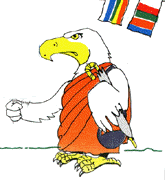 It was an essential element which Sathasivam
Krishnakumar of the Liberation Tigers of Tamil Eelam,
recognised many years before Professor Marshall Singer's
1995 statement to the US Congress Committee. It was an essential element which Sathasivam
Krishnakumar of the Liberation Tigers of Tamil Eelam,
recognised many years before Professor Marshall Singer's
1995 statement to the US Congress Committee.
''...Sinhala
Buddhist chauvinism has been institutionalised in
Sri Lanka and today it has become more powerful than
the politicians themselves. Indeed even if some Sinhala
politicians seek to settle the conflict, Sinhala
Buddhist chauvinism will seek to prevent such a
settlement. This is the political reality that those
who are aware of the Sri Lankan situation are well
aware of. This Sinhala chauvinism which was nurtured by
Sinhala politicians for their electoral advantage, has
grown into a Frankenstein monster which now has the
power to destroy and make politicians. This we
understand very well.'' (Sathasivam Krishnakumar,
Liberation Tigers of Tamil Eelam, in an interview with
Melbourne Community Radio CR3, September,
1991)
The armed resistance of the people of
Tamil Eelam did not just happen. It came after several decades of
oppression and a series of broken pacts
and evasive proposals. It was a struggle which was
legitimised by the freely
given mandate of the people of Tamil Eelam in 1977.
It was an armed struggle which was consolidated by the
enactment of the 6th Amendment in the
Sri Lanka Parliament on 4 August 1983 - an enactment
which denied the Tamil people the right to campaign
peacefully for an independent Tamil Eelam and an
enactment which violated the International Covenant of
Civil and Political Rights:
"The freedom to express political opinions, to seek
to persuade others of their merits, to seek to have
them represented in Parliament, and thereafter seek
Parliament to give effect to them, are all fundamental
to democracy itself. These are precisely the freedoms
which Article 25 (of the International Covenant of
Civil and Political Rights) recognises and guarantees -
and in respect of advocacy for the establishment of an
independent Tamil State in Sri Lanka, those which the
6th Amendment is designed to outlaw..." (Paul Sieghart: Sri
Lanka-A Mounting Tragedy of Errors - Report of a
Mission to Sri Lanka in January 1984 on behalf of the
International Commission of Jurists and its British
Section, Justice, March 1984)
Mr.Collacott expresses concern about the fate of
'moderate' Tamil leaders, but in what lay their
'moderation'?
Mr.Collacott comments:
"A particular trademark of the Tigers, and one that
reveals their true character, has been their systematic
murder of moderate Tamil leaders in an effort to ensure
that the Tigers and their extremist supporters enjoy
total dominance and control over the community."
Mr.Collacott does not name these 'moderate Tamil
leaders'. Presumably, he did not intend to refer to
the armed
Tamil groups fighting alongside the Sri Lankan security
forces in their genocidal war in Tamil Eelam. Be that
as it may, who are these 'moderate Tamil leaders' and in
what lies their 'moderation'?
Everyone of today's 'moderate
Tamil leaders' without exception subscribed to the
manifesto
of the Tamil United Liberation Front in 1977 and
proclaimed to the Tamil people, 'with the stamp of
finality and fortitude that we alone shall rule over our
land that our fore fathers ruled':
"...There is only one
alternative and that is to proclaim with the
stamp of finality and fortitude that we alone shall
rule over our land that our fore fathers ruled... The
Tamil Nation must take the decision to establish its
sovereignty in its homeland on the basis of its
right
to self-determination. The only way to announce
this decision to the Sinhalese government and to the
world is to vote for the Tamil United Liberation Front.
The Tamil speaking representative who get elected
through these votes, while being members of the
National State Assembly of Ceylon, will also form
themselves into the "NATIONAL ASSEMBLY OF TAMIL EELAM"
which will draft a constitution for the State of Tamil
Eelam and to establish the independence of the Tamil
Eelam by bringing that constitution into operation
either by peaceful means or by direct
action or struggle..."
The 'moderation' of the so called 'moderate Tamil
leaders' lay in betraying that which they had solemnly
promised the people of Tamil Eelam to do - and that, too,
after having been given a mandate to deliver on their
promises.
Their 'moderation' lay in refusing to recognise that
an armed struggle is essentially political, and that for
this reason the political cannot be counterposed to the
military; and
that an armed struggle cannot be directed from outside
but only from within, by a leadership which accepts
'its full share of the risks involved.'
Their 'moderation' lay in seeking to play the role of
'mediators' between the struggle and the Sinhala ruler -
and in this way, separating themselves from the struggle,
and at the same time, undermining it. Their 'moderation'
lay in collaborating with a Sri Lanka government
engaged in a
genocidal war against the Tamil people and, by their
actions, putting at risk the lives of those who remained
committed to the struggle for an independent Tamil
Eelam.
During World War II, there were many 'moderate
leaders' in Europe who collaborated with the German
occupying forces. During Hitler's occupation, a Norwegian
called Quisling collaborated with the Nazis - and his
name has now become a part of the English vocabulary to
describe a traitor. In the case of France, we had the
Vichy 'government'. These agents of the alien ruler, on
the one hand, dispensed favours to sections of the
populace and on the other hand, helped to identify and
eliminate those who resisted alien rule.
In Sri Lanka, the Sinhala authorities have recruited,
from time to time, Tamils to achieve similar objectives.
Some Tamils become willing channels, through whom the
Sinhala ruler dispenses favours to sections of the Tamil
populace, as the price for their support for alien
Sinhala rule - and 'peace'. At the same time, other
Tamils act as informers and identify those who continue
to resist Sinhala rule. These Tamil informers wear hoods
with slits for them to see through and shake or nod their
head as suspected Tamil supporters of the LTTE are
paraded before them. They have come to be known as
'thalayattis'.
The responses of the LTTE to the activities of some
Tamil elements who are co-operating with the Sinhala
government, suggest that it is mindful, on the one hand,
of the dangers posed by informers and collaborators, and
on the other hand, of the difficulties of responding to
such dangers, within the framework of a guerrilla
movement without a stable judicial system.
It is not that the LTTE have not on occasion
violated the humanitarian laws of armed conflict...but
Mr.Collacott may want to consider some of the Readings
on International Humanitarian Law...
But, that is not to say that the LTTE has always
succeeded in its efforts to address these issues. It is
not that the LTTE have not on occasion violated the
humanitarian laws of armed conflict. They have. It is
also true that means and ends are inseparable.
'Humanising the armed conflict' is therefore a necessary
objective (and should be honestly supported). But the
good faith of those who question some of the means
adopted by the armed resistance of the Tamil people will
be less open to question, if at the same time they do not
deny the justice of the ends that the Tamils, as a
people, are struggling to achieve.
Martin Luther
King's words in April 1963 are not without
relevance:
"Over the past few years ....I have tried to make
clear that it is wrong to use immoral means to attain
moral ends. But now I must affirm that it is just as
wrong, or perhaps even more so, to use moral means to
preserve immoral ends."
Again, Mr.Collacott may also want to consider some of
the Readings on
International Humanitarian Law:
"...American forces that tried to comply with the
spirit of the standards of the law of land warfare
found that they could not physically survive... To
avoid extinction and to survive, the American-led
guerrilla forces decided to take stringent measures.
Through official orders it was announced that spies and
informers, considered to be the main problem, would be
controlled or eliminated....
....Giving these individuals legal or procedural
rights that they might have been entitled to, was
conditioned primarily by reality and was deemed
secondary to the primary goal of simply staying alive. The action of the
guerrilla forces was consistently conditioned by the
fact that compliance with certain legal rules that
might have been considered applicable would have
resulted, from their point of view, in imminent death.
The price of success for guerrilla operations was,
simply stated, to destroy spies and informers..."
(US General Donald Blackburn, who commanded
guerrillas against the Japanese in the Philippines
during World War II in proceedings before the American
Society of International Lawyers, thirty years later,
70th Meeting, Washington, 1976 p.155)
US statement that "it is the international
community that is the arbiter of who becomes states and
who doesn't become states" underlies much of that which
Mr.Collacott has asserted...
Many Tamils will not be slow to recognise that the
views expressed by Mr.Collacott are at one with the
policy declaration made by US Under Secretary of
State, Thomas R. Pickering at a press conference in
Colombo on 29 May 2000:
"... I said tonight something I haven't said before
but which I fully believe in: that I
don't believe there is any international support that I
can find for a new separate state of Eelam here in this
island. So I think that while it is easy to dismiss
diplomatic statements by governments as not having an
effect, we are beginning to see, in fact, that it does
have an effect... I think it is quite clear that it (an
independent Tamil Eelam) will receive no recognition
from anyone.
So, I mean, you could go home tonight and declare
your house a separate state. The question of making it
effective and functioning in dealing with the Sri
Lankan authorities, should you intend to become a
government beyond your house, would have its own
problems.
So, I would say, you know, people try this from time
to time, but in effect, it is the
international community that is the arbiter of who
becomes states and who doesn't become states
through a process of recognition and establishment of
relations. At the moment, I see this as sort of
becoming a dead planet, if that's what it wants to
be..."
US Under Secretary of State, Thomas R. Pickering,
would liken an Unilateral Declaration of Independence by
Tamil Eelam to that of 'declaring your house a separate
state' and he adds somewhat patronisingly 'you know,
people try this from time to
time'.
Mr.Pickering may not have fully recognised the impact
that his remarks may have had on millions of Tamils living in many lands
without a state of their own.

He failed to recognise that the struggle for an
independent Tamil state is but a manifestation of the
growing togetherness of a people - a growing
togetherness, rooted in an ancient heritage, a rich language, a vibrant culture and given
purpose and direction by a determined aspiration to live in equality and in
freedom. After all, independent Tamil states (and in
particular, the Tamil kingdom in Jaffna) were in
existence several centuries before the US itself made its
own unilateral Declaration of Independence (yes, people,
do try it from time to time).
Mr.Pickering's further statement that "it is the
international community that is the arbiter of who
becomes states and who doesn't become states" helps to
explain where he is coming from.
During the 19th century too, the states of the then
'international community' regarded themselves as 'the
arbiters of who becomes states and who doesn't become
states'. It was against this dictat of the then
'international community' (read 'then colonial rulers')
that the freedom struggles of the colonial peoples
gathered momentum in the 20th century.
Then, as now, existing states found common cause in
resisting the struggles of peoples to free themselves
from alien rule. India's struggle for freedom did not
have the acceptance of the international community.
Neither did Indonesia's struggle for freedom. But
eventually, the 'international community' weakened by two
world wars, found that they were no longer able to bear
the cost of imposing their dictat on struggles for
freedom.
US may need to realise that self determination
is not a de stabilising concept
and that it is the refusal to recognise the right of a
people to free themselves from alien rule that will
promote instability...
Today, the earlier colonial rulers and those to whom
they ceded power, are finding common cause in the
attempt to secure the
artificial territorial boundaries bequeathed by the
colonial rulers - territorial boundaries which had
everything to do with the administrative convenience of
the colonial ruler and little to do with national
identities of those on whom colonial rule was imposed. To
secure stability by maintaining the status quo is often a
beguiling temptation.
The reasoning is not dissimilar to
that which was urged a hundred years ago against granting
universal franchise. It was said that to empower every
citizen with a vote was to threaten the stability of
existing state structures and the ruling establishment.
But the truth was that it was the refusal to grant
universal franchise which threatened stability.
Rudolph C.
Rÿser's comments in the Fourth World Eye are
timely:
"Self-determination is a right
guaranteed under international law to all peoples
seeking to freely choose their social, economic,
political and cultural future without external
interference. ..The principle is unambiguous in its
application to peoples having the collective right to
freely choose their own future. The right to choose is
what the United States and other states like France,
Britain and Canada seek to deny Fourth
World peoples..."
US Under Secretary of State's 'international
community' may eventually come to understand that
self
determination is not a de
stabilising concept and that it is the refusal to
recognise the right of a people to free themselves from
alien rule that will promote instability. Self determination and democracy go hand in
hand. If democracy means the rule of the people,
by the people, for the people, then the principle of self
determination secures that no one people may rule another
- and herein lies its enduring appeal.
Deploying the 'terrorist' tag to defame struggles
for freedom will yield diminishing returns in an
increasingly 'politically awakened' world - and at best
will drive resistance underground...
Deploying the 'terrorist' tag to defame a struggle for
freedom and to discredit it, will yield diminishing
returns in an increasingly 'politically awakened' world
- and at best, it will serve only to drive resistance
underground.
The 'terrorist' tag is already widely seen to be a
'political' tag. It is used selectively to secure
political ends. The 'terrorist' tag is not the result of
a judgment by a competent court of law, on the basis of
applying the law to judicially ascertained facts. The
categorisation made by the executive wing of the US
government, precludes the courts from themselves finding,
on the facts, whether the LTTE is a terrorist
organisation or not.
Judicial review of the action taken by the executive
wing is limited to determining whether the executive had
acted arbitrarily or wholly unreasonably. And, the courts
in the U.S.A. have always shown a great reluctance to
interfere with executive discretion in the area of
'claimed' national security.
Courts take the view that where 'national security' is
threatened, executive discretion relating to the very
life of the nation is involved and this is not a matter
where the judiciary should supplant the view of the
executive. It is said that the Constitution has empowered
the executive (and not the judiciary) to decide matters
relating to national security. Again, it is urged that
the information on which the executive acted, cannot be
made available to a court, to be tested by cross
examination and a decision made according to law -
because to do so would be to put at risk the national
security apparatus of the state, which must function in
secrecy.
Again, questions that many will ask is whether a
state or an organisation which on
occasion resorts to terror as a weapon, thereby
become a 'terrorist' state or a 'terrorist' organisation?
For instance did the USA bombing of Libya, a few years
ago, (and more recently Afghanistan and Khartoum) render
the USA a terrorist state? Or would it be necessary to
establish that the dominant
purpose for which the state or organisation exists, is
the use of terror?
Is a state which stockpiles nuclear bombs, a terrorist
state, because it seeks to use the threat of the terror of a nuclear
holocaust to secure its political goals such as the
preservation of democracy? After all, the nuclear bomb is
the ultimate weapon of terror and it makes no distinction
between combatants and non combatants. But,
significantly, at the Rome deliberations on the
International Criminal Court (in 1998),
India's attempt to include the use of nuclear weapons
as a crime against humanity failed.
There is a need for the US to adopt a more
principle centered approach to the struggle of the Tamil
people - the old style 'command - control' method of
leadership will not work...
There is a need for the US to adopt a more principle
centered approach to the struggle of the Tamil people to
establish an independent state. The old style 'command -
control' method of leadership will not work.
The US government, as a government of a country that
is regarded as the home of private enterprise, may need
to start practising some of the leadership methods which
the likes of
Stephen Covey have long promoted to successful
Fortune 500 companies.
To lead, you need to serve. To lead you need to win
trust - and be able to structure win-win answers to
conflict situations. You need to understand what 'win'
means to each of the parties to the conflict.
" If you want to influence them,
you also need to understand empathetically the power of
their point of view and to feel the emotional force
with which they believe in it. It is is not enough to
study them like beetles under a microscope; you need to
know what it feels like to be a beetle...." (Roger
Fisher & William Ury in
Getting to Yes : Negotiating Agreement Without Giving
In ,1991)
If the US aspires to world leadership, it will need to
recognise that leadership will not come by the display of
military might and economic power. The US will need to
articulate a bigger vision that encompasses the 'majority
world'. The US must be seen to address not simply its own
interests but demonstrate by its actions that it is
willing to serve the interests of all the peoples of the
world. And that includes the peoples of the fourth
world, compelled as they are to live within the patch
work states left by their previous colonial rulers.
Political wisdom is not necessarily a function of
gross national product and both Mr.Pickering and
Mr.Collacott may want to revisit the words of Tamil
Eelam leader, Velupillai
Pirabaharan...
Political wisdom is not necessarily a
function of gross national product and both
Mr.Pickering and Mr.Collacott may want to revisit
the words of Tamil Eelam
leader, Velupillai Pirabaharan:
"We launched our struggle for self
determination and political independence because of the
systematic oppression
of our people by the Sri Lankan state...
We are not chauvinists. Neither are we
lovers of violence enchanted with war. We do not regard
the Sinhala people as our opponents or as our enemies.
We recognise the Sinhala nation. We accord a place of
dignity for the culture and heritage of the Sinhala
people. We have no desire to interfere in any way with
the national life of the Sinhala people or with their
freedom and independence. We, the Tamil people, desire
to live in our own historic homeland as an independent
nation, in peace, in freedom and with dignity...
...During our long journey towards
liberation we have crossed rivers of fire. It is our
commitment to the cause that sustained us during these
violent upheavals. The cause we have charted to fight
for, the right to
self-determination of our people is right, fair and
just. From the beginning up to now, we are resolutely
committed to our cause... It is
because of our firm commitment to our cause we have our
importance, individuality and history..."
It is the firm commitment of Velupillai Pirabaharan and the
LTTE to the Tamil struggle for freedom, that has
given them their 'importance, individuality and history'.
It is not 'ruthlessness' but a stubborn willingness to
serve the cause of their people that has enabled
Velupillai Pirabaharan to command the loyalty and
dedication of the Tamil people. Velupillai Pirabaharan
did not create Tamil national togetherness. Rather, the
growing togetherness of more than 70 million Tamil
people, living in many lands, without a state of their
own, has found strength (and pride) in the fearless and directed
determination of Velupillai Pirabaharan. He has grown
to become the living symbol of the will of a people to
resist oppressive alien rule - and today, in the
felicitous words of Anita Pratap, 'the man is bigger than
the myth'. Mr.Collacott (and, for that matter
Mr.Pickering) should not be appalled.
National
Post on Line, Canada,
13 June 2000
'I'm appalled at how the
Tamil Tigers have abused our
hospitality'
Martin Collacott was the Canadian High
Commissioner to Sri Lanka and also served as ambassador
to Syria, Lebanon and Cambodia.
Support from Canadian sources has been a major factor
in nurturing the vicious and bloody campaign of
terrorism being waged by the Tamil Tigers in Sri Lanka.
What is surprising and disturbing is that some Canadian
leaders still refuse to admit that by cultivating the
Federation of Associations of Canadian Tamils -- a key
front organization for the Tigers in Canada -- they
continue to encourage funding that has in large measure
made possible the insurgency and acts of terror that
have killed tens of thousands of Sri
Lankans.
When I served as Canadian High Commissioner
to Sri Lanka from 1982 to 1986, the period in which
civil war began in earnest, I urged the Sri Lankan
government to redress Tamil grievances and worked
actively to ensure that Canadian aid (and particularly
our large-scale involvement in irrigation programs) was
used to benefit the Tamils as well as the other races.
I visited the Tamil heartland in Jaffna immediately
after the anti-Tamil riots in 1983 and again in 1986 at
a time when no other high commissioners or ambassadors
went there to demonstrate their concern for the Tamil
population.
Having said this, I now must say I am
appalled by the way in which the Tamil Tigers and their
supporters have abused and exploited Canadian
hospitality. Few recent terrorist movements have
matched the brutality and ruthlessness of the
Liberation Tigers of Tamil Eelam. Their bombs, which
have killed hundreds of innocent civilians, have been
designed to sow terror among the population as well as
try to precipitate a violent reaction against Tamils in
order to give substance to allegations that they are
being persecuted by the Sri Lankan government (a claim
which, inter alia, has enabled large numbers of Tiger
members and supporters to claim refugee status in
Canada). A particular trademark of the Tigers, and one
that reveals their true character, has been their
systematic murder of moderate Tamil leaders in an
effort to ensure that the Tigers and their extremist
supporters enjoy total dominance and control over the
community.
While the Tigers have not committed outright
acts of terrorism in Canada, they and their accomplices
have been involved in a wide range of criminal
activities in this country in addition to the extortion
of huge payments from Tamils here. These include drug
trafficking, migrant smuggling, passport forgery and
fraud. They have also been a major factor in the
spawning of Tamil street gangs in Toronto, which have
accounted for 40 shootings in the past three years and
five unsolved homicides.
A particularly sad irony of this situation is
that, while the Tigers have been successful in getting
many of their supporters into Canada, most members of
the Sri Lankan Tamil community came here to seek
peaceful lives and to benefit from our traditions of
democracy, human rights and rule of law. Instead, we
have permitted them to be intimidated and exploited by
a group whose principal interest in Canada is to use it
as a base for launching insurgency and terror on the
other side of the globe. A telling indication of just
how thoroughly the Tigers have been able to coerce and
intimidate the Sri Lankan Tamil community in Canada is
the fact that those who demonstrated last week to
express their opposition to Tiger dominance had to do
so in New York -- not in Canada, where far more live
but where there is no freedom of speech when it comes
to challenging the Tigers.
Our failure in this regard arises in large
measure from a misguided interpretation of
multiculturalism that seems to holds that, if we are to
show full respect for our newcomers, we must be
prepared to tolerate any and all views they may bring
with them, which may include bitter animosities and
plans for the resolving of differences in their former
homelands by violent means. Surely we can find a way of
receiving and, indeed, rejoicing in the richness and
diversity that newcomers bring to this country without
having to accept views that are fundamentally in
conflict with Canadian values and that suggest they
have little interest in Canada except as a convenient
place from which to settle vendettas in other parts of
the world.
An even greater failure on the part of
Canada, however, is that we have allowed ourselves at
the political level to be manipulated and exploited by
organizations such as the Tigers. While it is
encouraging to hear from Lloyd Axworthy, the Foreign
Affairs Minister, that Canada has signed an
international agreement outlawing terrorist funding,
Finance Minister Paul Martin insists it is
"anti-Canadian" to criticize his attendance at a dinner
organized by the Federation of Associations of Canadian
Tamils. Clearly government leaders are prepared to
overlook such well-documented terrorist connections for
the prospect of securing a few votes at the next
election. We owe it to the Canadian public and the many
Tamil Canadians who came here to escape violence and
intimidation to put an end to the activities and
influence of the Tigers and their supporters in
Canada.
|