From Matter to Life to Mind:
An Unfolding Consciousness
Listen, Little Man
- Only you yourself can be your liberator!
Wilhelm Reich, 1948
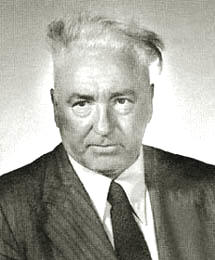 "They
call you 'Little Man', 'Common Man'; they say a new era
has begun, the 'Era of the Common Man'. It isn't you who
says so, Little Man... You let men in power assume power
'for the Little Man'. But you yourself remain silent.
You give men in power or impotent people with evil
intentions the power to represent you. Only too late do
you realize that again and again you are being
defrauded.......I have never heard you complain: "You
promote me to be the future master of myself and the
world, but
you don't
tell me how one is to be the master of oneself, and
you don't tell me the mistakes in my thinking and my
actions." "They
call you 'Little Man', 'Common Man'; they say a new era
has begun, the 'Era of the Common Man'. It isn't you who
says so, Little Man... You let men in power assume power
'for the Little Man'. But you yourself remain silent.
You give men in power or impotent people with evil
intentions the power to represent you. Only too late do
you realize that again and again you are being
defrauded.......I have never heard you complain: "You
promote me to be the future master of myself and the
world, but
you don't
tell me how one is to be the master of oneself, and
you don't tell me the mistakes in my thinking and my
actions."
"Your liberators tell you
that that your suppressors are Wilhelm, Nikolaus, Pope
Gregory the Twenty Eighth, Morgan, Krupp or Ford. And
your 'liberators' are called
Mussolini,
Napoleon,
Hitler
and
Stalin. I tell you: Only you yourself can be your
liberator!" "This sentence makes me hesitate. I contend
to be a fighter for pureness and truth. I hesitate,
because I am afraid of you and your attitude towards
truth... My intellect tells me: 'Tell the truth at any
cost.' The Little Man in me says: 'It is stupid to
expose oneself to the little man, to put oneself at his
mercy. The Little Man does not want to hear the truth
about himself... He wants to become rich, or a party
leader, or commander of a legion, or secretary of the
society for the abolition of vice. But he does not want
to assume responsibility for his work... He does not
want the great responsibility which is his. He wants to
remain a Little Man..."
[See also
Wilhelm Reich - Listen, Little Man!
at amazon.com]
Excerpts
 "They
call you 'Little Man', 'Common Man'; they say a new era has
begun, the 'Era of the Common Man'. It isn't
you who says so, Little Man. It is they, the Vice Presidents
of great nations, promoted labour leaders, repentant sons of
bourgeois families, statesman and philosophers. They give
you your future but don't ask about your past. "They
call you 'Little Man', 'Common Man'; they say a new era has
begun, the 'Era of the Common Man'. It isn't
you who says so, Little Man. It is they, the Vice Presidents
of great nations, promoted labour leaders, repentant sons of
bourgeois families, statesman and philosophers. They give
you your future but don't ask about your past.
You are heir to a dreadful past. Your heritage is a
burning diamond in your hand. that is what I tell you.
Every physician, shoemaker, mechanic or educator must
know his shortcomings if he is to do his work and make
his living. For some decades, you have begun to play a
governing role on this earth. It is on your thinking and
your actions that the future of humanity depends. But
your teachers and masters do not tell you how you really
think and are; nobody dares to voice the one criticism
of you which could make you capable of governing your
own fate. You are 'free' only in one sense: free from
education in governing your life yourself, free from
self-criticism.
I have never heard you complain: 'You
promote me to be the future master of myself and the world,
but
you
don't tell me how one is to be the master of oneself,
and you don't tell me the mistakes in my thinking and my
actions.
You let men in power assume power 'for the
Little Man'. But you yourself remain silent. You give men in
power or impotent people with evil intentions the power to
represent you. Only too late do you realize that again and
again you are being defrauded...
See yourself as you really are. Listen to what none of
your leaders and representatives dares tell you: You are a "little,
common man." Understand the double meaning of these
words: "little" and "common."
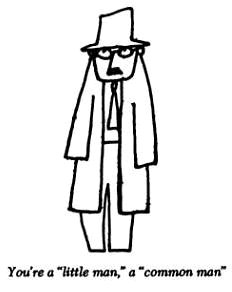 Don't run. Have the courage to look at yourself!
"What right do you have to tell me things?" I can see this
question in your apprehensive look. I hear this question
from your impertinent mouth, Little Man. You are afraid to
look at yourself, you are afraid of criticism, Little Man,
just as you are afraid of the power they promise you. You
would not know how to use this power. You dare not think
that you ever might experience your self differently: free
instead of cowed; open instead of tactical; loving openly
instead of like a thief in the night. You despise yourself
Little Man. You say: "Who am I to have an opinion of my own,
to determine my own life and to declare the world to be
mine?" You are right: Who are you to make a claim to your
life?
You are different from the really great
man in only one thing: The great man, at one time, also was
a very little man, but he developed one important ability:
he learned to see where he was small in his thinking, and
actions. Under the pressure of some task which was dear to
him he learned better and better to sense the threat that
comes from his smallness and pettiness. The great man, then,
knows when and in what he is a little man.
The Little Man does not know that he is
little, and he is afraid of knowing it. He covers up his
smallness and narrowness with illusions of strength and
greatness, of others' strength and greatness. He is proud of
his great generals but not proud of himself. He admires
thought which he did not have and not the thought he did
have. He believes in things all the more thoroughly the less
he comprehends them, and does not believe in the correctness
of those ideas which he comprehends most easily....
Your liberators tell you that that your
suppressors are Wilhelm, Nikolaus, Pope Gregory the Twenty
Eighth, Morgan, Krupp or Ford. And your 'liberators' are
called Mussolini, Napolean, Hitler and Stalin.
I tell you: Only you yourself can be your
liberator!"
This sentence makes me hesitate. I contend
to be a fighter for pureness and truth. I hesitate, because
I am afraid of you and your attitude towards truth. To say
the truth about you is dangerous to life. The truth is also
life-saving, but it becomes the loot of every gang. If that
were not so, you would not be what you are and where you
are.
My intellect tells me: 'Tell the truth at
any cost.' The Little Man in me says: 'It is stupid to
expose oneself to the little man, to put oneself at his
mercy. The Little Man does not want to hear the truth about
himself. He does not want the great responsibility which is
his. He wants to remain a Little Man. He wants to remain a
Little Man, or wants to become a little great man. He wants
to become rich, or a party leader, or commander of a legion,
or secretary of the society for the abolition of vice. But
he does not want to assume responsibility for his work...
I shall tell you who you are:
You are afflicted with the emotional plague. You are
sick, very sick, Little Man. It is not your fault. But it is
your responsibility to rid yourself of this sickness.
You confuse the right to free speech and to criticism
with irresponsible talk and poor jokes. He who has to
protect the living against the emotional plague has to learn
to use the right to free speech as we enjoy it in America at
least as well for the good as the emotional plague misuses
it for the bad. Granted equal right in the expression of
opinion, the rational finally must win out.
What is important is not individual treatment but the
prevention
of mental disorders. You have locked up the crazy people,
and the normal people manage this world. Who, then, is to
blame for all the misery?
You give impotent people with evil intentions the
power to represent you. Only too late do you realize
that again and again you are being defrauded. You must
come to realize that you make your little men your own
oppressors, and that you made martyrs out of your truly
great men.
For you are afraid of life, Little Man, deadly afraid.
You will murder it in the belief of doing it for the sake of
"socialism," or "the state," or "national honor," or "the
glory of God."
I recognized the deadly fear of the living in you, a fear
which always makes you set out correctly and end wrongly.
You had the happiness of humanity in your hands, and you
have gambled it away. You had the world in your hands, and
at the end you dropped your atom bombs on
Hiroshima and Nagasaki. Through the centuries, you will
shed blood where life should be protected, and will believe
that you achieve freedom with the help of the hangman; thus
you will find yourself again and again in the same morass.
You yourself create all your misery, hour after hour,
day after day. You think the goal justifies the means.
You are wrong: The goal is in the path on which you
arrive at it. Every step of today is your life of tomorrow.
You stand on your head and you believe yourself dancing into
the realm of freedom.
You could have long since become the master of your
existence, if only your thinking were in the
direction of
truth. You are cowardly in your thinking, Little Man,
because real thinking is accompanied by bodily feelings, and
you are afraid of your body. Many great men have told you:
Go back to your origin - listen to your inner voice - follow
your true feelings - cherish love.
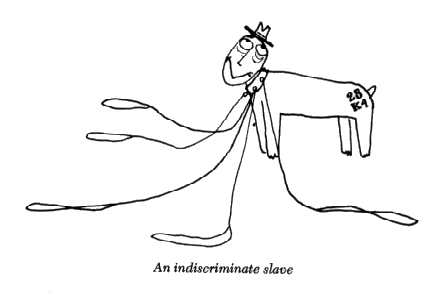 ...slowly and gropingly I found what makes you a slave: You
are your own slave driver. Nobody else - nobody except
yourself carries the responsibility for your slavery. . .
I have ceased to be willing to die for your freedom to be
anybody's slave. I tell you: Only you yourself can be
your liberator!
...slowly and gropingly I found what makes you a slave: You
are your own slave driver. Nobody else - nobody except
yourself carries the responsibility for your slavery. . .
I have ceased to be willing to die for your freedom to be
anybody's slave. I tell you: Only you yourself can be
your liberator!
The truly great man takes your freedom
deadly seriously. In order to establish it in a practical
way, he has to surround himself with many little men,
helpers and errand boys, because he cannot do the gigantic
job by himself. Furthermore, you would not understand him,
and would let him fall by the wayside, if he had not
surrounded himself with little great persons. Surrounded by
many little great persons, he conquers power for you, or a
piece of the truth, or a new, better belief.
He writes gospels, freedom laws, etc., and
counts on your help and seriousness. He pulls you out of
your social morass. In order to keep together the many
little great persons, in order not to lose your confidence,
the truly great man has to sacrifice piece after piece of
his greatness, which he was able to attain only in the
deepest intellectual loneliness, far from you and your
everyday noise, and yet in close contact with your life. In
order to be able to lead you he has to tolerate your
transforming him into an inaccessible God. You would have no
confidence in him if he had remained the simple man that he
was. . .
In this way, you yourself produce your new master.
Promoted to the role of new master, the great man loses his
greatness because this greatness consisted in his
straightforwardness, simplicity, courage, and real contact
with life....
...Those who are truly alive are kindly and unsuspecting
in their human relationships and consequently endangered
under present conditions. They assume that others think and
act generously, kindly, and helpfully, in accordance with
the laws of life. This natural attitude, fundamental to
healthy children as well as to primitive man, inevitably
represents a great danger in the struggle for a rational way
of life as long as the emotional plague subsists, because
the plague-ridden impute their own manner of thinking and
acting to their fellow men. A kindly man believes that all
men are kindly, while one infected with the plague believes
that all men lie and cheat and are hungry for power.
In such a situation the living are at an obvious
disadvantage. When they give to the plague-ridden, they are
sucked dry, then ridiculed or betrayed...
...It is high time for the living to get tough, for
toughness is indispensable in the struggle to safeguard and
develop the life-force; this will not detract from their
goodness, as long as they stand courageously by the truth. .
. . Anyone who wants to safeguard the life-force from the
emotional plague must learn to make at least as much use of
the right of free speech that we enjoy in America for good
ends as the emotional plague does for evil ones. Granted
equal opportunity for expression, rationality is bound to
win out in the end. That is our great hope...
The kindly individual believes that all people are kindly
and act accordingly. The plague individual believes that all
people lie, swindle, steal and crave power. Clearly, then,
the living is at a disadvantage and in danger.
There is only one antidote to the germs of the emotional
plague in the mass individual: his own feeling of living
life. The living does not ask for power but for its proper
role in human life. It is based on the three pillars of
love, work and knowledge.
You beg for happiness in life, but security is more
important to you, even if it costs you your spine or
your life. Your life will be good and secure when
aliveness will mean more to you than security; love more
than money; your freedom more than party line or public
opinion; when your thinking will be in harmony with your
feelings; when the teachers of your children will be
better paid than the politicians; when you will have
more respect for the love between man and woman than for
a marriage license.
You will no longer believe that you "don't count." You
will know and advocate your knowledge that you are the
bearer of human society. Don't run away. Don't be afraid. It
is not so terrible to be the responsible bearer of human
society. Inflated leaders would have no soldiers and no arms
if you clearly knew, and stood up for your knowledge, that a
field has to yield wheat and a factory furniture or shoes,
and not arms. All you have to do is to continue what you
have always done and always want to do: to do your work, to
let your children grow up happily, to love your mate.
You are Great, Little Man, when you are not small and
petty. You are great when you carry on your trade lovingly,
when you enjoy carving and building and painting and
decorating and sowing, when you enjoy the blue sky and the
deer and the dew and music and dancing, your growing
children and the beautiful body of your woman or your man,
when you learn to understand and think about life. You are
great when you hold your grandchildren on your knees and
tell them about times long past, when you look into an
uncertain future with their trusting childlike curiosity,
when you lull your newborn to sleep, when you sing the good
old folk songs.
Follow the voice of your heart, even if it leads you off
the path of timid souls. Do not become hard and embittered,
even if life tortures you at times. There is only one thing
that counts: to live one's life well and happily..."
|