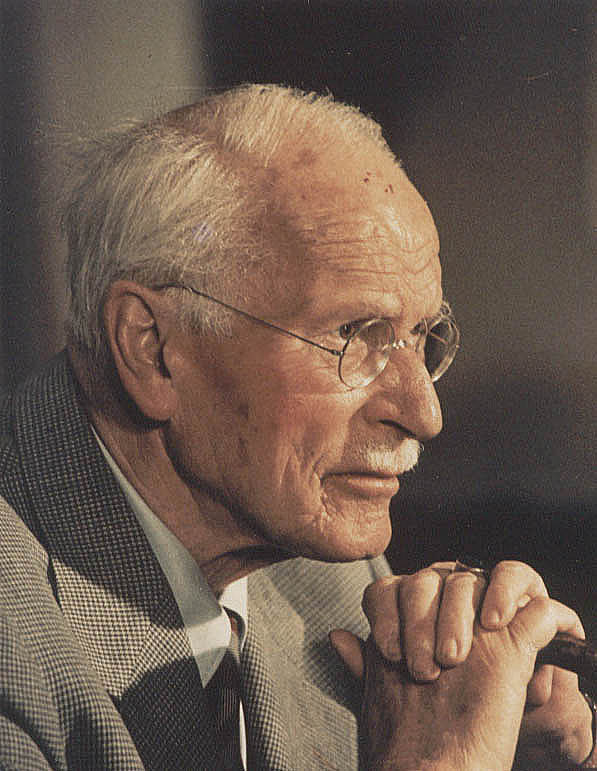
Carl Gustav Jung
"... Jung gives us three principles, beginning with the
principle of opposites. Every wish immediately suggests its opposite. If I
have a good thought, for example, I cannot help but have in me somewhere the
opposite bad thought. In fact, it is a very basic point: In order to have a
concept of good, you must have a concept of bad, just like you can't have up
without down or black without white.
This idea came home to me when I was about eleven. I occasionally tried to
help poor innocent woodland creatures who had been hurt in some way --
often, I'm afraid, killing them in the process. Once I tried to nurse a baby
robin back to health. But when I picked it up, I was so struck by how light
it was that the thought came to me that I could easily crush it in my hand.
Mind you, I didn't like the idea, but it was undeniably there.
According to Jung, it is the opposition that creates the power (or
libido) of the psyche. It is like the two poles of a battery, or the
splitting of an atom. It is the contrast that gives energy, so that a strong
contrast gives strong energy, and a weak contrast gives weak energy.
The second principle is the principle of equivalence. The energy
created from the opposition is "given" to both sides equally. So, when I
held that baby bird in my hand, there was energy to go ahead and try to help
it. But there is an equal amount of energy to go ahead and crush it. I tried
to help the bird, so that energy went into the various behaviors involved in
helping it. But what happens to the other energy?
Well, that depends on your attitude towards the wish that you didn't
fulfill. If you acknowledge it, face it, keep it available to the conscious
mind, then the energy goes towards a general improvement of your psyche. You
grow, in other words.
But if you pretend that you never had that evil wish, if you deny and
suppress it, the energy will go towards the development of a complex.
A complex is a pattern of suppressed thoughts and feelings that cluster --
constellate -- around a theme provided by some archetype. If you deny ever
having thought about crushing the little bird, you might put that idea into
the form offered by the shadow (your "dark side"). Or if a man denies his
emotional side, his emotionality might find its way into the anima
archetype. And so on...
...The final principle is the principle of entropy. This is the
tendency for oppositions to come together, and so for energy to decrease,
over a person's lifetime. Jung borrowed the idea from physics, where entropy
refers to the tendency of all physical systems to "run down," ...When we are
young, the opposites will tend to be extreme, and so we tend to have lots of
energy. ..As we get older, most of us come to be more comfortable with our
different facets. We are a bit less naively idealistic and recognize that we
are all mixtures of good and bad. We are less threatened by the opposite sex
within us and become more androgynous. Even physically, in old age, men and
women become more alike. This process of rising above our opposites, of
seeing both sides of who we are, is called transcendence..."