|
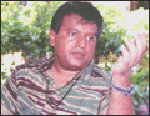
VELUPILLAI PIRABAHARAN
As others see him...
 Anita Pratap, first journalist to interview Pirabaharan
Jyotindra Dixit, India's Foreign Secretary
Professor Marshall R Singer
Lieutenant General Depinder Singh, Overall Force Commander of
the Indian Peace Keeping Force
Lieutenant General S.C. Sardesh Pande,
IPKF Divisional Commander, Jaffna
Major General Harkirat Singh,
Indian Peace Keeping Force's First Commander in Jaffna
Major General Prasanna Dahanayake,
Sri Lanka Army
M.R.Narayan Swamy, Author of Tigers of
Sri Lanka
Jane's Sentinel, World Defence & Intelligence Information Resource
 Anita Pratap, the first journalist to
interview Velupillai Pirabaharan...
Anita Pratap, the first journalist to
interview Velupillai Pirabaharan...
 "...The myth was bigger than the man. That was in the early
'80s, when I met LTTE leader Velupillai Pirabaharan for
the very first time... Today, the man is bigger than the myth...
In one of her interviews to me, (Sri Lanka) President Chandrika
Kumaratunga had said "even the best guerrillas must tire of
fighting and war". That was five years ago. Pirabaharan is
better than the best. His energy and commitment to his cause
show no signs of flagging. From a hit-and-run guerrilla fighter,
he has evolved into a mastermind of conventional battles, the
commander of a national army that forced the world's fourth
largest army to retreat and is
now giving the Sri Lankan army a run for its money.
"...The myth was bigger than the man. That was in the early
'80s, when I met LTTE leader Velupillai Pirabaharan for
the very first time... Today, the man is bigger than the myth...
In one of her interviews to me, (Sri Lanka) President Chandrika
Kumaratunga had said "even the best guerrillas must tire of
fighting and war". That was five years ago. Pirabaharan is
better than the best. His energy and commitment to his cause
show no signs of flagging. From a hit-and-run guerrilla fighter,
he has evolved into a mastermind of conventional battles, the
commander of a national army that forced the world's fourth
largest army to retreat and is
now giving the Sri Lankan army a run for its money.
The more wounded Pirabaharan is, the more
ferocious he becomes - it's not for nothing he chose the tiger
as his emblem. His stealth, timing, cunning, ambushes - all are
inspired by the tiger. And like the tiger, his courage is raw
and proud. Some time back, I had asked him what he had learned
over two decades as a guerrilla fighter. He answered, "He who
dares, wins." That was the headline given to the interview when
it was published in Time. Five months later, I happened to
travel in Europe and the US and was amazed to see the number of
Sri Lankan Tamils wearing T-shirts with that legend. Pirabaharan
has spawned a worldwide legion." (Anita Pratap reporting in
Outlook on The Best Guerrilla of All, June 2000)
Jyotindra Dixit, India's Foreign
Secretary in Assignment in Colombo...
"The LTTE's emergence as the most dominant and effective politico-military
force representing Tamil interests was due to the following factors:
 First,
the character and personality of its leader V Pirabaharan who is
disciplined, austere and passionately committed to the cause of Sri Lankan
Tamils' liberation. Whatever he may be criticised for, it cannot be denied
that the man has an inner fire and dedication and he is endowed with natural
military abilities, both strategic and tactical. He has also proved that he
is a keen observer of the nature of competitive and critical politics. He
has proved his abilities in judging political events and his adroitness in
responding to them. First,
the character and personality of its leader V Pirabaharan who is
disciplined, austere and passionately committed to the cause of Sri Lankan
Tamils' liberation. Whatever he may be criticised for, it cannot be denied
that the man has an inner fire and dedication and he is endowed with natural
military abilities, both strategic and tactical. He has also proved that he
is a keen observer of the nature of competitive and critical politics. He
has proved his abilities in judging political events and his adroitness in
responding to them.
Secondly, he has created a highly disciplined, and dedicated cadres, a
manifestation of which is inherent in what is called the 'cyanide cult.'
Each regular member of the LTTE carries a cyanide pill and is pledged to
committing suicide rather than being captured by the enemy.
The third factor is the cult and creed of honesty in the disbursement and
utilisation of resources. Despite long years spent in struggle, the LTTE
cadres were known for their simple living, lack of any tendency to exploit
the people and their operational preparedness.
The fourth factor has been the LTTE's ability to upgrade its political and
military capacities including technological inputs despite the constraints
imposed on it by Sri Lankan forces and later by India.
The fifth factor is a totally amoral and deadly violent approach in dealing
with those the LTTE considers as enemies.
The sixth factor is Pirabaharan's success in gathering around him senior
advisers with diverse political, administrative and technological
capacities, which contributed to effective training of his cadres, optimum
utilisation of the military equipment which he had, and the structuring of
an efficient command and control system.
(Assignment
Colombo, by J N Dixit, Konarak Publishers, 1998)
Marshall R Singer, Ph. D.
Professor of International and Intercultural Affairs, Graduate School of Public
and International Affairs - University of Pittsburgh...
"As far as I can tell most ordinary Tamils support the Tigers, not
necessarily because they like them, but because they like the Sri Lankan -
or Indian - armies less. The Tigers are ruthless and authoritarian
but they are not corrupt - they don't tolerate stealing, bribery or rape,
things other armies are famous for. In fact they are perceived as
being single minded in their defence of Tamils. They are so disciplined that
when captured, they swallow cyanide capsules that they carry with them at
all times, rather than risk revealing anything under torture." (Statement
before US Congress Committee on International Relations
Subcommittee on Asia and the Pacific Hearing on Sri Lanka November 14,1995)
Lieutenant General
Depinder Singh, Overall Force Commander of the Indian Peace Keeping Force...
"Numerous questions were to be asked as to why the IPKF
could not capture or kill Pirabaharan; another equally wild allegation was
that the IPKF had orders not to kill Pirabaharan. Apart from the
impossibility of singling out an individual target for destruction or
protection in such an environment, we must remember that by virtue of the
fact that the LTTE had an effective junior leadership, the loss of
Pirabaharan could never have resulted in the disintegration of the LTTE..
This (book) is a left handed salute to the LTTE whose deviousness cannot
overshadow their incredible motivation and magnificent fighting prowess, for
which the Indian armed forces will always have a healthy respect."
(Lieutenant General Depinder Singh in "The
IPKF in Sri Lanka " published in 1992)
Lieutenant
General S.C. Sardesh Pande, IPKF Divisional Commander, Jaffna...
"I have a high regard for the LTTE for its
discipline, dedication, determination, motivation and technical expertise...
I was left with the impression that the LTTE was the expression of popular
Tamil sentiment and could not be destroyed, so long as that sentiment
remained... Our unit and formation commanders too came under
the mental hypnosis of the LTTE. They would graphically explain how well
entrenched the LTTE was in the minds of the people, how ungrateful people
were to us, how elusive the LTTE was, how perfect it was in the midst of the
people and in its actions, how effective was its grip over the public and so
on - virtually admitting that it was an impossible task and all our
endeavours were pointless.
One formation commander was relating vividly how the LTTE cadres -
including their women - fought so bravely, killed our soldiers in fierce
combat and proved to be our bane in early October '87 in the Jaffna
University Campus. I thought he was doing a good PR job for the LTTE. There
was no doubt about the proportion of exaggeration in the indirect kudos
accruing to the LTTE. The Brig had to be told to make use of his
professionally critical faculties in evaluating the LTTE and not illogical
awe. A lot of such roughage which had been allowed to enter the cerebral
recesses of some of our unit and formation commanders had to be evacuated
and their thinking disabused of self-invited cant. Mentally such influence
was dangerous. I too frequently fell prey to this weakness, but made
conscious and equally frequent efforts to shake loose from this hypnotic
state; and, I think, I largely succeeded...
" (Lieutenant General S.C. Sardesh Pande in "Assignment
Jaffna", published in 1992)
Major General Harkirat Singh,
Indian Peace Keeping Force's first commander in Jaffna...
".... The Tamils have
sacrificed [a lot], the
LTTE is highly motivated and there is one aim:
Eelam. Independence. Till they get independence they are not going to
stop... They have
fought their entire lives in the jungles. I have flown over the jungles
with Mahathya, the number two man to Pirabaharan, in my helicopter. We flew
over the jungles of Vavuniya and he explained to me how they fought against
the Sri Lankans all these years. So they knew each inch of the land. We
would push them out of Jaffna, they would get into the jungles. Then you
would be fighting them for the next 10 years...
Pirabaharan learnt on television that the
[Indo Sri Lanka] Accord had been signed and they were not party to it.
It was one reason why the LTTE never accepted the Accord and India's stand.
If we had taken the LTTE into confidence, they would have known the whole
thing, their terms would have been put across to Jayewardane, and the
situation would have been different. Dixit was in a great hurry to get the
Accord signed...
Pirabaharan is not a small man.
He is the leader, a charismatic leader of the LTTE. His life is very
precious. And a very simple man. No bullshit about him. His wife
lived with three saris - one she wore, one she washed and one was ready to
wear. That is all. They never drank Coca-Cola. They offered us Coca-Cola,
but never drank it themselves. They drank that goliwala soda...
Pirabaharan spoke to me in English many a time. He appeared well-read....
they [the LTTE] were very cordial. They would take me anywhere. I
had lot of time for them...". (Rediffusion
Interview with Josy Joseph, 30 March 2000)
Major General
Prasanna Dahanayake, of the Sri Lanka Army...
"We ought to take the people into our
confidence..... just as Pirabaharan is doing. Instead of taking the people
into our confidence, we seem to be lying to the people. ... the Tiger
casualty figures given so far by the (Sri Lanka) government is equivalent to
the whole population of the north. ....The Tigers, on the other hand, take
video shots of their operations and distribute copies among their public and
recruits to gain their confidence... the army seems not to have studied too
well the capability of their main opponent - Velupillai Pirabaharan.
Pirabaharan is a 'military genius' and his political power has given him an
advantage to combat our political and military leaders. He has often
outwitted, outmanoeuvred and outclassed our military and political leaders.
Why is this so? Today after 18 years of battle, most of the victories,
sadly, belong to the Liberation Tigers of Tamil Eelam and we are continuing
to fool ourselves... the man behind the weapon is always more important than
the weapon itself and that this has been repeatedly proved by the LTTE
forces....Pirabaharan has virtually beaten our forces on land and sea...."
(Major General Prasanna Dahanayake in an interview reported in the Sinhala
owned Sunday Leader, 6 December 1998)
M.R.Narayan Swamy, Author of Tigers
of Sri Lanka...
Madurai provided Pirabaharan ample time to go through all
that he had achieved and what he had failed to since taking to
militancy almost a decade earlier. It was time for introspection
and for reading and preparing for the years to come. It also
gave him a good insight into the Indian polity; how it
functioned and how it could be subverted if one had the right
links.
Nedumaran had reasons to be impressed. He remembered seeing
Pirabaharan in Jaffna in 1981, but the latter had not revealed
his identity then. Naturally he was shocked when he came face to
face with Pirabaharan in prison. "For several reasons I did not
tell you (who I was)", Pirabaharan told him. It was a plus point
for a man who believed in secret work.
... The Tigers often went without food or sleep, but never
hesitated to heavily spend on newspapers, Indian and foreign
magazines and a wide spectrum of leftwing literature. They also
bought glossy books and journal on arms and ammunition. ..
In the meantime, Pirabaharan began experimenting with a code
language in a major way. He had tried it in other forms earlier
in Jaffna, giving each Tamil alphabet a number. "It is for
safety," he had told friends.
Now, in Tamil Nadu, with more heads put together, the code
looked a lot tougher to understand or decipher. An Indian who
witnessed the experimentation mistook the secret language to be
Chinese or Japanese.
Money remained a problem. Pirabaharan and his associates
usually managed to survive on bread and jam. It meant
Pirabaharan had to suppress his love for non-vegetarian food,
crabs in particular. Nedumaran often encountered the Tigers with
hungry looks on their faces, but they would shy away from
admitting the truth when asked if they had had food.
When Pirabaharan was not dreaming about Eelam or discussing
with Nedumaran ideas on a Tiger flag and uniforms, he would
relish Tamil literature, particularly books on and by
Subash Chandra
Bose,
Fidel Castro
and Che
Guevara. He even had a
Che book
translated from English into Tamil so that he could go
through it without help.
He was not overtly religious, but would occasionally walk up
to the historic
Meenakshi Amman temple in Madurai. He dressed crisply but
simply and expected others to do so. He shaved everyday and
scolded those who did not. His motto was talk little and
hear more. But otherwise he treated his colleagues with
respect. There was no bullying, when he talked, others listened.
(M.R.Narayan
Swamy in Tigers of Lanka - Early Beginnings to 1983)
Jane's Sentinel,
World Defence & Intelligence Information Resource...
"(LTTE's) 43-year old charismatic leader and military
commander, Velupillai Pirabaharan (whose nom de guerre is Karikalan), is a
highly disciplined, dedicated, self-taught, military genius...In the LTTE,
all members are fighting cadres and do not receive remuneration. The
exceptions, only a handful, play an advisory or supportive role...Cadres are
given responsibility not according to seniority but strictly on performance.
Cadres are not promoted to a rank but only responsibilities of command.
Cadres are ranked only posthumously by taking into account their service, as
well as the circumstances of their death..." (Jane's
Sentinel examining the success of the LTTE in resisting the Sri Lankan
forces, 4 September 2000)
|