|
Liberation Tigers of
Tamil Eelam
Tigers of Lanka - Early
Beginnings to 1983
Excerpts from *M.R.Narayan Swamy's Tigers of Lanka From Boys to
Guerrillas, 1995
* indicates link to
Amazon.com bookshop on line
M. R.
Narayan Swamy has worked with the United News of
India, Agence France-Presse and The Straits Times
in Singapore.and the Indo-Asian News Service
(IANS).
"....Velupillai Pirabaharan was born in
Jaffna hospital on November 26, 1954 when
Tamil-Sinhalese relations were inching towards a flash
point. He was the youngest of four children of
Vallipuram Parvathi and Thiruvenkatam Velupillai.
Theirs was a typical middle class family where the
youngest was the darling of all...The Tiger was the insignia of the
ancient Tamil Chola kingdom, and
Pirabaharan was visibly enthusiastic when the logo was
first shown to him... His motto was talk little and
hear more..."
As a School Boy | Interests & Friends in Younger
Days | Formation of the Tamil New Tigers |
Beginnings of the LTTE | Colloboration with EROS | TULF-LTTE Understanding | Beginnings of Uma-Pirabaharan
Rift | Anton Balsingham's Entry into
LTTE | Growing Rift | Expulsion of Uma Maheswaran | Shift to
Madras | Arrest of Uma and Pirabaharan | Release on
Bail | Attack on Chavakachcheri Police
Station | Decline of TULF | Death of
Seelan | Ambush at Tinnelveli and
Genocide'83
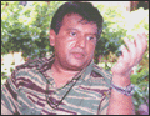 Velupillai Pirabaharan was born in Jaffna
hospital on November 26, 1954 when
Tamil-Sinhalese relations were inching towards a flash
point. He was the youngest of four children of
Vallipuram Parvathi and Thiruvenkatam Velupillai. Theirs
was a typical middle class family where the youngest was
the darling of all. Pirabaharan's mother was deeply
religious and very fond of him. His thin-lipped father
was strict and upright man who demanded absolute
discipline from his two sons and two daughters. Velupillai Pirabaharan was born in Jaffna
hospital on November 26, 1954 when
Tamil-Sinhalese relations were inching towards a flash
point. He was the youngest of four children of
Vallipuram Parvathi and Thiruvenkatam Velupillai. Theirs
was a typical middle class family where the youngest was
the darling of all. Pirabaharan's mother was deeply
religious and very fond of him. His thin-lipped father
was strict and upright man who demanded absolute
discipline from his two sons and two daughters.
He was affectionate and gave them whatever comforts
his salary as a district land officer in the Sri Lankan
government could allow. Pirabaharan was his favourite
child too, and the young boy would often cuddle up to his
father at night. The family nicknamed the young one
"durai", or master.
Pirabaharan did his first two years at school in the
eastern town of Batticaloa (Mattakalappu), where his
father was posted, and then joined the Chithambara
College in his home town of Valvettithurai, in Sri
Lanka's northern tip, after Velupillai got transfer.
He was an active, at times mischievous, student and
rated average in studies. That caused a lot of worry to
his father who, like all Tamils, valued education
immensely. At the end of his 7th standard, Velupillai
took along his son to Vavuniya, where he was posted, so
that the boy would remain under his watchful eyes. He
later brought Pirabaharan back to Valvettithurai (VVT for
short) for further schooling. The doting father also
arranged for a tutor to coach his son after school
hours.
Pirabaharan's neighbors and schoolmates remember him
fondly. "Pirabaharan would actively help out the family
during religious functions and happily run errands for
neighbours and relatives".
Pirabaharan was an able and enthusiastic assistant to
the family during the annual get-together for his
grandfather's death anniversary. When the ceremonies were
over, he would carry lunch for relatives who had failed
to make it.
VVT, where Pirabaharan spent much of his early years,
was a small and closely-knit coastal town of some 10,000
Tamils with one catholic church and 3 Hindu temples. One
of them, dedicated to Lord Shiva, was a virtual family
property of the Velupillais, and the young Pirabaharan
would land there to lend a helping hand during all major
festivals. VVT's menfolk were civil servants, traders,
fishermen or simply smugglers, thanks to the winding sea
coast and the proximity to India.
Boats would sail to Rangoon, Chittagong, Rameshwaram,
Nagapattinam and Cochin laden with both legitimate cargo
and contraband.
VVT was politically conservative and more receptive to
the relatively moderate Tamil Congress. It was among the
few places in Jaffna where the Federal Party did not
organise its "satyagragha" campaign in 1961.
Otherwise VVT shared the traits of other Tamil areas. Its
residents, like Tamils elsewhere in Sri Lanka's
northeast, were greatly influenced by India's
independence struggle, and photographs of such Indian
leaders as Mahatma Gandhi, Jawaharlal Nehru, Swami
Vivekananda and Subash Chandra Bose adorned many
homes.
August 15, India's independence day, was celebrated in
the town with pride, and Tamil newspapers and magazines
of Jaffna which would come out with a special supplements
to mark the occasion, were read with avid interest in
VVT.
Velupillai was a popular man who would hold endless
discussions with friends on the worsening
ethnic relations in the country, lamenting the fate
of Tamils. The exchange of views would be in Tamil and
English, and although he did not understand every word,
Pirabaharan was often present by his father's side and
listened attentively. This was his preliminary
introduction to politics and to the world of
Tamil-Sinhalese conflict. It was perhaps during these
discussions that Pirabaharan picked up the habit of being
a patient listener.
But school did not interest him, other things did.
Pirabaharan was fascinated by the life and times of two
Indians: Subash Chandra Bose and Bhagat Singh, in
that order. Bose's brief forays into spiritualism, his
innate militancy, his willingness to take on Mahatma
Gandhi, his carefully planned escape from India,
his fight against the British with the hastily-formed
Indian National Army and almost everything the
charismatic Bengali nationalist did made him
Pirabaharan's hero. He would return to books on Bose
repeatedly, gripped in particular by his one war like
slogan: "I shall fight for the freedom of my
land until I shed the last drop of blood".
Then there were the military exploits of Napoleon, the
teachings of Swami Vivekananda, the story
of Mahabharata, and the religious discourses of the
saintly Kirupanandha Variyar, who came to VVT once a year
from Tamil Nadu. Pirabaharan was himself quietly pious,
in line with the family, and his favourite deity was Lord
Subramania.
There were also political meetings in VVT which
Pirabaharan attended and where speakers detailed Sinhalese
atrocities and called for building up Tamil
resistance.
Someone told Pirabaharan about a Hindu priest at Panadura town who was
caught by a Sinhalese mob during the 1958 riots, tied
to the cot on which he was sleeping, doused with kerosene
and burnt to death. "Ours was a God-fearing society and
the people were religious-minded. The widespread feeling
was: when a priest like him was burnt alive, why did we
not have the capability to hit back?", Pirabaharan would
ask one day.
The future guerrilla fighter related such stories to
his school-mates. His love for the catapult, while the
other boys were more interested in sports, was legendary
and took him to the world of marksmanship.
His earliest victims were chameleons, squirrels and
birds which he felled or killed with pebbles. Some birds
which did not die were taken home. When he didn't have a
catapult, he would hang any object from a tree and shoot
rubber arrows at it - or simply throw a stone in the air
and try hitting it with another stone before it came
crashing down.
 Interests & Friends in Younger
Days Interests & Friends in Younger
Days
His father did not take kindly to Pirabaharan's many
friends dropping in at home. So Pirabaharan remained
essentially a loner in his earlier days, shy of girls and
always restless. When he was alone, he would recite
dialogues from the Tamil movie "Veerapandia Kattabomman",
imagining himself to be the legendary warrior..... He
also learnt the rudiments of judo and karate, and his
family, noticing the boy's interest for anything to do
with fighting skills, began teasing him as "veeravan", or
the brave one.
One of his friends was Sathasivam Krishnakumar (Kittu),
who would emerge as the LTTE's feared military commander
of Jaffna. Pirabaharan and Kittu would experiment filling
empty soda bottles with chemicals pilfered from school
and exploding them. Once Pirabaharan and his friends
attached a lighted incense stick to a pack of incendiary
chemicals and kept it in the school toilet. The "time
bomb" exploded just when they expected it to. " We burst
out laughing", a Chithambara school product recalled.
"The principal suspected us but none of us admitted
making it."
Simultaneously, as the 70's produced the first pangs
of militancy, Pirabaharan began preparing for the
battles that he perceived lay ahead. he would tie
himself up, get into a sack and lie under the sun the
whole day. He would also go and spread himself on
chilli bags. He even inserted pins into his nails.
As in other Tamil areas, the introduction of "Standardization" pushed the students and
youths in VVT, angry at what they thought was a brazen
attempt by the government to legitimise racial
discrimination, to reject the traditional parliamentary
politics for militancy. Pirabaharan was losing whatever
little interest he had in education and increasingly
spoke to friends about "Sinhalese oppression".
An elderly VVT resident who knew Pirabaharan and his
family closely recalled: "We advised the boys not to
protest and to keep studying. But I couldn't convince
even one person after standardisation". Pirabaharan
drifted, like many of his contemporaries, to the Tamil
Student League (TSL) and the Tamil Youth League (TYL),
which organised street protests against "standardisation"
as well as the 1972 Republican constitution.
TYL acted as the youth wing of the Tamil United Front
(TUF). Pirabaharan's earliest contacts outside of his
immediate circle were the members of the two leagues,
most of whom were elder to him. The included Thangathurai and Kuttimani, both of whom
were from VVT, and a cousin who went by the name of
"periya" Sothi.
By then, Pirabaharan had been absenting himself from
home, initially for days and then for weeks. The young
man bristled with energy as he tore around Jaffna in
shorts, meeting new people discussing Tamil politics, the
ancient Tamil kingdoms in India and Sri Lanka, and the
possibility of an armed struggle a la Bose.
"Once he began speaking, it was very difficult to stop
him. He would go on and on", a former Pirabaharan's aide
said. In 1972 he was wounded in the leg when a bomb he
was making with Thangathurai and others under a palmyrah
tree burst prematurely. It earned him the title
"Karikalan" ( man with black legs), and when police began
looking for Pirabaharan,, they made it a point to scan
young men's legs in a bid to identify the elusive
rebel.
In 1973, when the police cracked down on TYL activists
following the arrest of Sathiyaseelan, detectives visited
Pirabaharan's house looking for him. He was already under
suspicion for an assassination attempt on Jaffna Mayor
Alfred Duraiyappah at a carnival...
But Pirabaharan had bolted by then and sailed to India
with at least four others, including Kuttimani and
Thangathurai. He eventually made it to Madras with Periya
Sothi and hired a small house at Kodambakkam with the
help of T.R. Janardhanan, a local politician who had
written a book on the Sri Lankan Tamil ethnic crisis
earlier.
Janardhanan remembers Pirabaharan as a shy and quiet
young man with big piercing eyes who always appeared to
be itching for action. But the latter hardly had any
money on him and life in Madras was not easy. Janardhanan
was a bachelor willing to pay host to Sri Lankan Tamils
who dropped by, and Pirabaharan used the opportunity for
free meals and political discussions.
But Pirabaharan was restless and was soon tired of
being with Periya Sothi, who appeared content staying in
Madras. Chetti, a Jaffna youth, had by then escaped from
a prison in Sri Lanka, and he too eventually made it to
Madras and took up residence in the city's Mylapore area.
Chetti was also a man of action, and naturally he and
Pirabaharan forged an instant friendship.
Periya Sothi didn't like the new found camaraderie
between the two, and complained to any willing listener
that Pirabaharan was getting into bad company.
Pirabaharan countered that Periya Sothi was just "cooking
and eating in Madras" and that he (Prabha) was perfectly
aware of Chetti's criminal record. "But Chetti and his
people are active", he told friends. "As for me, I will
never, never lose my identity".
Thangathurai and Kuttimani also tried to dissuade
Pirabaharan from joining hands with Chetti. But he turned
down the advice, virtually snapping his relationship with
the VVT duo, and sailed back to Jaffna to be with his new
comrade-in-arms.
Formation of the Tamil New
Tigers
Pirabaharan was now completely underground, cut off
from his family although he managed to retain contacts
with select relatives. The months in India had made him a
lot tougher. In Vedaraniyam, a Tamil Nadu coastal town
and a known landing point for Sri Lankan Tamils who came
by boat, Pirabaharan and Thangathurai and the others had
led a hard life.
The group was often hungry and would eagerly look
forward to the "prasadam" distributed at the local
temple. Cheap curd rice was the only food they could
afford to buy. There were times when Pirabaharan and
others would take sleep-inducting tablets in a
desperate bid to beat the hunger.
By the time Pirabaharan landed in Jaffna, the 1974
International Tamil Conference had ended on a bloody
note. And Sivakumaran, the darling of Tamil youths, had
committed suicide, giving Pirabaharan the first practical
example of what cyanide could do. Pirabaharan had been
impressed by Sivakumaran's exploits and had wanted to
meet him.
Now he was also cut off from Thangathurai and had to
prepare new hideouts since the earlier ones were known to
the police.
In October 1974 Prime Minister Srimavo was to visit
Jaffna, and Pirabaharan and Chetti decided to give her a
hot reception. The duo went on a violence spree,
exploding bombs at half a dozen targets, including the
Kankesanthurai police station, Jaffna's main market etc.
The explosions did not cause much damage, but as
anticipated triggered panic.
Chetti was re-arrested a short while later, putting
further strain on Pirabaharan. Chetti had earlier robbed
a cooperative store in Jaffna and quietly bought a car,
and gave conflicting answers when friends asked him about
his new lifestyle.
Pirabaharan once again found himself in financial
strain after police caught Chetti, and had to go through
the process of forging new contacts and securing fresh
hideouts for the second time in less than a year. It was
a task he did admirably well, although it took him time
to realise that he had been cheated by Chetti.
Pirabaharan survived those days on wild fruits and
food that his close associates shared with him. "I used
to secretly give him helpings from our kitchen", said a
former LTTE member who was not underground then.
Pirabaharan, however, never strayed from the cause for
which he had fled his home. The constant search for
shelter and hiding places never stopped him from
preaching Tamil politics with passion.
Once he suffered an attack on jaundice, but he would
not go to a doctor; miraculously, and to his friend's
surprise, he recovered. But otherwise Pirabaharan
remained his old self.
There would be no stopping him if he began a monologue
on the Indian independence struggle and Tamil history.
And if he was desperate for money, he would request
friends to cycle up to VVT and borrow cash from
sympathisers. He himself avoided going to his home town.
But despite all the hard work, Pirabaharan remained an
unknown entity in Jaffna until Duraiyappah was gunned
down.
A day before the assassination on July 27, 1975,
Pirabaharan walked into a friend's house armed with an
unloaded and almost rusted revolver, a bundle of
matchboxes and some assorted materials. The friend
watched in amazement as Pirabaharan began collecting the
tip of the matchsticks and making pellets out of
them.
"Can you shoot with this?" the friend asked
mockingly. Pirabaharan, his mind engrossed in the art
of making bullets to kill, replied without any visible
display of emotion: "Keep quiet. See what happens
tomorrow".
The next day, Pirabaharan set out at dawn. The friend
had no idea where he was headed to. But when he heard
that Duraiyappah had been shot while visiting a temple,
the friend guessed rightly -and easily- who could have
been responsible....
Although three accomplices who took part in the
killing were arrested, Pirabaharan - like the phantom he
had adored - remained one step ahead of his pursuers. He
would never be caught, never face police torture and
never see the insides of a prison in Sri Lanka. He spoke
little and gave nothing away even by way of hints either
about his movements or future plans....
The "boys" although admired, did not enjoy many
sympathisers in Jaffna those days. Most Tamils abhorred
violence.
Pirabaharan had warned his friends not to sleep in
their houses after the killing, but they had ignored the
advice. Pirabaharan himself made no mistake on that
score. His constant companion was a revolver which he
kept under the pillow when he slept.
He also asked his friends to be constantly armed- it
did not matter even if the weapon was only a kitchen
knife or chilli powder. The Tamil New Tigers's armoury
was limited to two revolvers, one of it bought with
stolen money.
Pirabaharan's obsession with safety was such that he
would not met anyone, including possible recruits to the
militant movement, if there was anything even remotely
suspicious about them. There were others he met without
revealing his real identity.
Beginnings of the
LTTE
Pirabaharan had torn and destroyed all his photographs
in the family album before leaving the house. But there
was no guarantee that the police did not have a picture
of him.
Now Pirabaharan made new contacts, many of which
proved long-lasting. He however declined to go to India
to escape the police dragnet. Tamil politics was slowly
but inevitably moving towards a confrontation with
Colombo.
In 1976, S. Subramaniam, who then headed a small
militant group of his own, teamed up with Pirabaharan. In
subsequent years, Pirabaharan would get many more
associates, but Subramaniam alias Baby, would remain an
invaluable asset and loyal friend.
On March 5th, Pirabaharan led a raid on the People's
Bank at Putter in Jaffna and escaped with 500,000
rupees in cash and jewellery worth 200,000 rupees. The
money would into building the LTTE, which was founded
on May 5th and for its secret training camps in the
forest of Killinochi and Vavuniya.
Pirabaharan was at Vaddukoddai where the TUF transformed
itself as the TULF and declared its intention to
fight for a sovereign state of Eelam, electrifying Tamil
politics. Amirthalingam was the hero of that convention
and was referred to as the "Thalapathy" (general) of the
Tamil struggle.
Pirabaharan knew him and respected him. After the July 77 elections, which the
TULF swept in the Tamil areas, their relationship
blossomed. Although his interest in political work was
minimal, Pirabaharan used to quietly meet Amir and other
TULF leaders at their homes. Pirabaharan was slowly
coming out of the shell he had confined himself to all
these years.
The LTTE opened 1977 by gunning down a police
constable on February 14 at Maviddapuram in Jaffna. On
May 18, two more policemen were shot near Inuvil, about 4
miles from Jaffna. LTTE activists approached them on
bicycles, opened fire and went away pedalling- a method
that was to slowly become a LTTE trademark in Jaffna.
Simultaneously Pirabaharan began building the LTTE by
recruiting and training trusted young men at an out-of
the way place called Poonthottam, some two miles from
Vavuniya town. Around the same time, Thangathurai opened another training camp
in Mullaitivu district.
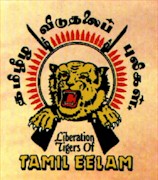 Pirabaharan had already prepared a
logo for the LTTE with the help of an artist in Madurai
during one of his clandestine visits to Tamil Nadu. It
showed the head of a roaring tiger, paws outstretched,
with two rifles and 33 bullets set against a circle
ringing the tiger's head. The Tiger was
the insignia of the ancient Tamil Chola kingdom, and
Pirabaharan was visibly enthusiastic when the logo was
first shown to him. Pirabaharan had already prepared a
logo for the LTTE with the help of an artist in Madurai
during one of his clandestine visits to Tamil Nadu. It
showed the head of a roaring tiger, paws outstretched,
with two rifles and 33 bullets set against a circle
ringing the tiger's head. The Tiger was
the insignia of the ancient Tamil Chola kingdom, and
Pirabaharan was visibly enthusiastic when the logo was
first shown to him.
He went on to form a five member central committee of
the LTTE, putting himself as a member of the leadership
council. He charted a constitution which all members were
expected to sign and accept. It called for the
establishment of a casteless Tamil society by armed
struggle, warned members against tainting their loyalty
to the LTTE with family ties or love affairs.
Training would take place either in the farm at
Poonthottam , with a huge cardboard cut-out of a man, or
in forest areas where a tree with some natural clearing
would serve as the target... the Tiger supremo was not
only a good shooter; he was also a meticulous planner. If
a bank was to raided, he would put the place under watch
for weeks, if necessary for months. The planning for the
operation would be done in a systematic way. He would
take the lead role in the discussions, but share
operational secrets only on a need-to-know basis. Before
a major operation got under way, Pirabaharan would tense
up, walking up and down with his hands clasped behind. He
did not like to or accept defeat.... His philosophy was:
Never say die.
Collaboration with EROS for
training
In 1977, he was joined by Uma Maheswaran, and suddenly
the world to open up for the Tigers. Until then almost
all entrants to the LTTE were obscure young men. Uma was
different. He was not only older to Pirabaharan by some
10 years, but he was also secretary of the TULF's Colombo
chapter and a known orator.
In London, EROS had already sent two batches to
Lebanon for learning military warfare from the PLO. The
bitter internal rivalries that were to mark the Tamil
struggle in later years were absent then. So EROS
functionaries decided to open up the training to others
as well, the LTTE included.
One of the first three Tamils to go to Lebanon was
Arul Pragasam, alias Arular. He reached Kannady, also in
Vavuniya, in 1976 with a view to settle down and
establish a base to woo the educated class into joining
the EROS. He was followed from London by Shankar Rajee,
another founder member who established the first contacts
with the LTTE.
Arular, with his Kannady farm barely 20 miles from
Pirabaharan's hideout, met the LTTE leader several times
beginning September 1976. With his degree in engineering
and newly-acquired knowledge in Lebanon, Arular passed on
to Pirabaharan ideas about making explosives. In turn,
Pirabaharan agreed to provide incendiary chemicals to
Arular.
Once a LTTE courier carrying nitric acid to the
Kannady farm was caught by the police after he could not
give credible explanation about his presence in the
Vavuniya forest. Arular, who came rushing from Jaffna on
hearing about the arrest, told the police that he had
ordered the acid to pour it into snake pits. Mercifully,
the police were convinced by the explanation and released
the courier. But Pirabaharan would not leave any
evidence; at the first opportunity he had the police
station raided and all documents related to the arrest
were taken away. The courier promptly escaped to Tamil
Nadu...
In normal times... Pirabaharan avoided handling a
rifle. He was fascinated by revolvers and possessed one
all the time. He would never miss an opportunity to
practice with that. Pirabaharan was an excellent marksman
who could repeatedly get the bull's eye. At times, the
guerrilla-in-making would even ask visitors for a
friendly shooting match.
One such request was made to Shankar Rajee, who
initially hesitated, saying he was not familiar with
Pirabaharan's .22 revolver. But Pirabaharan persisted and
asked Rajee to exhibit his skill on an empty "Milk Maid"
can placed on a mud wall some 20 feet away.
Rajee who found the LTTE training camp vastly
different from the Fatah camps he had been to in Lebanon
and Syria, fired first. The bullet grazed the can and
toppling it. Pirabaharan walked up to the fallen can,
picked it up and replaced it on the wall. He returned to
where Rajee was standing, turned, took aim and fired. It
was bulls' eye.
Rajee was naturally impressed. If he was inquisitive
about the source of Pirabaharan's marksmanship, he found
the answer: "I saw in the room a "Teach Yourself
Shooting" book published in London. It was evident that
whatever he knew, it was self-taught".
TULF - LTTE
understanding
In 1977, the Tigers were considered close, and even
sympathetic, to the TULF, much to the chagrin of the EROS
and other left-wing Tamils who thought that Amir and Co.
were nothing more than a bunch of bourgeois
politicians.
As violence by the militants continued even after the
general elections, the TULF got worried. Amir called a
meeting of the LTTE leadership at his residence at Moolai
village in November 1977. Seven of LTTE men, including
Pirabaharan, Uma and Baby attended.
Amir spoke slowly but firmly. The TULF, he reminded
the Tigers, had won the elections and should be given a
chance. The killings, he added, had gone up and should be
put on hold at least for the time being. "I am not asking
you to give up violence, but you should cool down," he
said.
Pirabaharan was silent. In fact none of the LTTE
members responded by way of argument. Amir was the
superstar of Jaffna in 1977 and no one dared to upset
him.....
3 months later, Bastiampillai and 3 other policemen
were gunned down in a stunning attack by Chellakili at a
LTTE forest hideout. Uma was there too, but played no
role in the killings, simply watching the men die from
the top of a tree where he was hiding.
A section of the LTTE decided to claim responsibility
for all that the group had done for the cause until then.
Uma had by then become chairman of a reconstructed
nine-member central committee. Pirabaharan had himself
proposed his name; although it technically meant that Uma
was the numero uno in the LTTE, the effective military
leadership remained in the hands of Pirabaharan.
The government, alarmed at the escalating
violence in Tamil areas, hurriedly issued the
Proscription of the LTTE and other similar
organisations Ordinance, outlawing all Tamil militant
groups. In May, the police issued a list of 38 "wanted"
men. Heading the names was V. Pirabaharan. He was no
more an unknown commodity.
Amir was bitter about the LTTE claim. He could not
stomach that a relatively unknown bunch of young men was
trying to overshadow the TULF. His anger was compounded
when party colleagues made their displeasure known. "You
said the boys were under your control," he was repeatedly
told. "Now see." An angry Amir called for Uma and made
his displeasure clear to him.
In the summer of 1979, the 11th World Festival of
Youth and Students was held in Havana. The LTTE came out
with a pamphlet outlining the Tamil struggle in 6
languages- English, Spanish, French, German, Portuguese
and Tamil - for distribution at the Cuban capital. The
TULF had been invited to the jamboree, and the LTTE
decided to take advantage of it. But luck ran out for the
Tigers. A London-based LTTE emissary who was to carry
them to Cuba was denied visa by the Cuban embassy at
Madrid and he returned to London, from where the
pamphlets were posted to the festival secretariat at
Havana.
Pirabaharan remained more or less aloof from this
publicity blitz. He remained content with what he thought
was more important - recruitment, training, and
collection and storage of arms and ammunition.
In 1978, the LTTE had been joined by Kittu, Mahatthaya
and Raghu. All three were from VVT. Raghu had wanted to
be a policemen, but was rejected because he hailed from
VVT.
By 1979, the Tigers had spread their fangs to eastern
province, where Charles Lucas Anthony, a young firebrand
catholic, was to prove an invaluable addition from
Trincomalee. The new members were asked to sign and
express their allegiance to the LTTE constitution.
Preliminary training got underway almost at once.
Beginnings of Uma - Pirabaharan
rift
On December 5 1979, the LTTE raided the People's bank
and decamped with 1.2 million rupees after killing two
policemen and wounding a third. The police launched a
vicious crackdown which forced scores of militants to
flee to Tamil Nadu. Pirabaharan was one of them.
The security hunt scattered the "boys" and seriously
disrupted their network. But the LTTE used the
opportunity to send trainees to Lebanon to master what
the EROS had learnt. The Tigers paid 100,000 rupees to
EROS for despatching 16 men to Lebanon; the PLO also
pressed the LTTE to send cadres for training. The LTTE
leadership council decided to send four members -
including Chellakilli and Uma - in the first batch. Uma,
in keeping with his status as the group's chairman,
decreed that Pirabaharan could travel later. None of the
four who were picked to go to Lebanon had passports. But
a sympathetic Tamil Nadu MP helped them to get Indian
passports.
The passports were taken to London to get Syrian visa
with the help of the PLO mission there; but to the LTTE's
horror, the British customs seized them after a courier
who had hidden them inside a Tamil typewriter could not
explain why he had them. The LTTE couldn't care less. It
promptly got four more passports made in Madras.
Eventually, however, only Uma and another LTTE
activist made it to Lebanon via Paris, where the Tigers
had to stay one night at a railway station because his
contact failed to turn up on time from London. The
training ended within 3 months. But the Tigers were not
happy. Pirabaharan had desired that the trainees bring
back some arms. Uma failed to do that. On top of it, Uma
complained that the training was lousy. The financial
aspect of the trip also sparked a major row between the
LTTE and EROS, in particular between Pirabaharan and
Rajee.
Pirabaharan thought that the LTTE had been cheated and
wanted Rajee to present himself before the LTTE's central
committee. Rajee refused. Amir intervened after this
dispute showed no signs of abating. The matter was
finally settled when Rajee agreed to cough back 285
pounds to the LTTE. That incident was to remain a sore
point in Pirabaharan's dealings with Rajee for a long
time.
It was around this time that Pirabaharan and Uma began
to quarrel. One of the main cause of their differences,
which was to have far-reaching consequences for the
future of Tamil militancy, centred around Urmila.
Pirabaharan suspected Uma having sex with Urmila ( a
militant cadre) , which in the LTTE's book was a serious
crime.
When Pirabaharan drew up the LTTE constitution, he had
made it very clear that he considered family life and
love affairs as impediments to revolutionary politics.
When the first word about the alleged Uma-Urmila affair
reached his ears, Pirabaharan did not believe it. But
when he did, he promptly asked Uma to quit the LTTE along
with Urmila. Uma declined.
In interviews years later, Pirabaharan never mentioned
Urmila by name and simply accused Uma of having violated
the LTTE's conduct code. "It was a problem between an
individual and the Tiger movement," he said in 1984. "I
am in no way responsible for the problem. It was Uma who
created the issue.... A leader of a revolutionary
movement should commit himself totally to the discipline
of the organisation. If a leader violates the basic rules
and principles, then there will be chaos and the
organisation will crumble."
But the break - up did not come about quickly. It was
bitter and protracted....
Anton Balasingham's Entry into the
LTTE
It was then that the London representatives of the
LTTE decided to bring into the Tiger fold a Sri Lankan
Tamil who lived in London. The man was a Marxist, had a
firm footing on ideology, was committed to the cause of
Tamil independence and was eager to play a more active
role. Until then, he was operating from his council flat,
writing Tamil and English pamphlets for any Sri Lankan
Tamil group which approached him. And almost everyone
did: the LTTE, the GUES (which was the student wing of
EROS) and the Tamil Liberation Organisation (TLO), which
claimed to be the biggest expatriate group of Tamils. The
man who the LTTE now sought was Anton Stanislaus
Balasingham.
Balasingham was a
former journalist who had worked for the "Veerakesari",
the Colombo-based Tamil newspaper which in 1978 published
the LTTE's first public statement and was noted for its
coverage of events in Sri Lanka's northeast. He had later
joined the British High Commission in Colombo as a
translator, before moving to London where he enrolled at
the South Bank Polytechnic. He was living with a young
Australian woman Adele when the LTTE approached him with
an unusual request: Would he go to Madras and take
ideological classes for LTTE members and perhaps, in the
process, help the Tigers overcome their internal
differences? Balasingham agreed.
Balasingham was
not unknown to the LTTE leadership. The first LTTE
document in Tamil, published in 1978, had been authored
by him. He had also penned the pamphlet for the Havana
summit. The LTTE would suggest to him what it
wanted; Balasingham would prepare a draft, which would be
sent to Uma for corrections and modifications, and then
published as a LTTE document.
In 1979, he had written the LTTE's first major
theoretical work, called "Towards Socialist Tamil Eelam".
It first came out in Tamil and then in English, and was
an instant hit among the Jaffna intelligentsia.
Balasingham was naturally held in high esteem. When he
flew into Madras in 1979, there was excitement and
expectancy.
Bala was effusive. He shook hands politely with
Pirabaharan, Uma and others when they were introduced at
his hotel room. He carefully examined a revolver which
Pirabaharan displayed to him, saying it had belonged to
the slain police officer Bastiampillai. Bala returned it
to Pirabaharan with a smile, and announced that he was
ready to hold classes for the LTTE.
Somehow Uma and Bala remained distant from each other,
although both shared a keen interest in Marxism. On the
other hand, Bala developed an instant rapport with the
younger Pirabaharan. And this only further fuelled the
Uma-Pirabaharan fissures, defeating one of the main
purposes of approaching Bala in the first place.
Bala was irked by Uma's questions at his classes. Uma
was no doubt well read, but he also had the habit - which
was to later cause him enormous problems with Indian
officials - of asking too many questions. If Uma was not
satisfied with what Bala said- and this happened quite
often - he would make his distaste very evident. Bala
knew that Uma had been superimposing his thoughts on
documents which he prepared in London. Pirabaharan, in
contrast, was a sound listener and asked virtually no
questions.
One reason for Pirabaharan's behaviour was his near
total disinterest in Marxist politics and ideology. He
was a practical man, solely interested in ways to build
up his militant group. If he was ill, he never
bothered; if a colleague was sick, however, he would
make umpteen requests about his health. If a friend
dropped in at the camp without notice and demanded
food, Pirabaharan would not hesitate to run out, hunt a
wild hen and cook it with pleasure.
His interest in reading - he would often request
friends to read out long articles for him - was confined
to military matters; dialectical materialism was not for
him. Occasionally, he would get immersed in Tamil novels
and magazines and , much to others' surprise, even in the
children's "Ambulimama" (chandamam) magazine.
But he would listen to Bala attentively. Bala, in
turn, was impressed by the young man's ability to put
together a group of Eelam and his determination to wage
an armed struggle. A Jaffna academic who met Pirabaharan
at Vavuniya around the same time too came to a similar
conclusion - a practical man but without any grasp of
ideology which "Towards Socialist Eelam" was seeking to
convey. "I don't know all that," Pirabaharan said of
socialism. "But I want all these caste differences to
go."
Pirabaharan was furious when the academic argued that
it was important to politicise people before taking to
the gun.... When the academic persisted, Pirabaharan
commented with undisguised contempt: "You (arm chair)
intellectuals are afraid of blood. No struggle
will take place without killings. What do you want me
to do? You people live in comfort and try to prove me
wrong. So what should I do? Take cyanide and die?"
The Growing Rift
Killings, Pirabaharan thought, were important, even
necessary, in a struggle; it also helped revolutionaries
to steel themselves. ..... He did not kill without any
reason; but if he had to kill, he would not hesitate. It
was not unnatural then that Pirabaharan finally decided
to do away with Uma.
After Bala flew back to London, Pirabaharan kept
pressing the charges against Uma. The latter presumed
that Bala was prodding him to do so.....Uma ....
maintained that his differences with Pirabaharan arose
over the LTTE's attitude towards the TULF, which Uma
thought had become ineffective after the 1977
elections.
Uma did not leave the LTTE; he was expelled by the
central committee on Pirabaharan's request. But Uma the
politician would not give up easily. He continued to pose
himself as the leader of the LTTE, further infuriating
Pirabaharan. S.Sivashanmugamurthy, a Uma confidant,
disappeared with some of the LTTE's arms. Pirabaharan
reacted fast, taking away weapons from other hideouts to
prevent them from falling into Uma's hands.
Pirabaharan was very angry. The LTTE constitution
barred splitters or ex-members from forming new groups.
Here the man who was named chairman of the LTTE by none
other than Pirabaharan was calling himself the real
LTTE....
But if Pirabaharan thought Uma's betrayal was the end
of the problem, he was wrong. Uma's exit had not been
smooth; not everyone had been happy with Pirabaharan's
insistence that Uma should be sacked ....
A new five member central committee was elected, but
Pirabaharan demanded that he be given overriding say in
the organisation. Not everyone agreed. One group decided
it had enough of underground existence and went off to
form a "Tamil Protection League". Another demanded that
the LTTE should transform itself into a mass
organisation. At one point it seemed that the only man
prepared to side with Pirabaharan was Baby
Subramaniam.
This was too much for a man who had left his house in
his teens to fight for Eelam. He was seeing the slow but
sure disintegration of a group he had formed and nursed
with great care....
Expulsion of Uma
Maheswaran
After a while, Pirabaharan, pain written large on his
face, contacted Thangathurai, Kuttimani and Nadesuthasan
of the TELO at a relative's house at Thirunelveli,
Jaffna. "I left you as a "Thambi" (younger brother). I
have come back as a thambi", he told Thangathurai, his
kinsman from VVT...
Thangathurai was willing to embrace him. But the
opinion within the TELO was divided. At least three men,
including Sri Sabaratnam, did not want Pirabaharan in the
TELO. Kuttimani suggested that Pirabaharan should be
given some arms and asked to operate independently.
Thangathurai took the final decision. Much to the chagrin
of others, he made Pirabaharan responsible for a TELO
military training that had been planned for in Tamil
Nadu. The LTTE would later describe Pirabaharan's
association with the TELO as a "working alliance" between
the two groups.
Pirabaharan went about contacting his old Tiger
buddies; his charisma brought back some of those who had
broken ranks only weeks earlier. The depleted LTTE group
which gathered around Pirabaharan was soon in possession
of more than 10 revolvers, two AK-47's, two G-3 rifles
and one 9mm pistol. It had earlier bought some used
weapons from former Indian army soldiers in Tamil
Nadu.
Armed with that, Pirabaharan and company threw in
their lot with the TELO... (In March 1981) the TELO
pulled off the Neerveli bank robbery, and at the end of
the bloody ambush, which left two policemen dead, the
group was richer by a staggering 8.1 miilion rupees. The
operation was commanded by Kuttimani.
The heist sealed Kuttimani's fate. On April 5, he,
Thangathurai and Jegan were arrested while trying to
escape to Tamil Nadu. Pirabaharan was lucky. He was to
have left them on the sea front, but the job was
entrusted to Sri Sabaratnam at the last moment. The
trio's unexpected arrest again brought out the best in
Pirabaharan. Without wasting time, he began shifting the
hidden arms to new dumps. Some of the places were raided
by the police just after the weapons were moved out.
Simultaneously, the police began cracking down on
suspected militants and their sympathisers, partly to
finish off the TELO and partly to maintain peace during
the District Development Council (DDC) elections proposed
for June 4.
But Uma had other ideas. Uma had claimed to be the
inheritor of the LTTE legacy after splitting with
Pirabaharan. But he had come under pressure from friends
both in Sri Lanka and Tamil Nadu to end the dispute with
Pirabaharan by giving up claim to the LTTE's name.
Uma had already moved in that direction, associating
himself with a Tamil magazine called Pudhiya Padai (New
Path). It was edited by Sivasanmugamurty, an ardent
leftist and his trusted lieutenant who would eventually
become the deputy in the People's Liberation Organisation
Tamil Eelam (PLOT). Uma was then bitterly opposed to the
TULF for deciding to take part in the DDC elections and
angry with Amir who, he thought, had a soft corner for
Pirabaharan.
Uma was determined to sabotage the DDC polls. On May
24, the PLOT shot a UNP candidate, A.Thiagarajah. One
week later, a PLOT gunmen - probably Uma himself - opened
fire at a TULF public meeting near Jaffna town, killing
two policemen. The killings unleashed massive anti-Tamil
riots in Jaffna and elsewhere in Sri Lanka. Police and
the military went berserk, and one of the buildings which
went up in flames in Jaffna in the violence was the
town's public library.
One of the hundreds who saw the monument of
Tamil glory burnt down with its invaluable
collections was Pirabaharan.
Shift to Madras
Now Pirabaharan's main worry was when to escape. Since
the arrest of Thangathurai and Kuttimani,
life in Jaffna had once again become nearly impossible.
He was avoiding his normal hideouts, afraid that they
might be known to the police. After the Neerveli robbery
he had trekked to the forests in Mannar, to the west of
Vavuniya, with Sri Sabaratnam and remained there for a
while. Later, back in Jaffna, he began to sleep where he
could, even in thickets and fields, and avoided moving
about during the day.
Annamalai Varatharaja Perumal offered to help and
arranged a safe house on Pirabaharan's request. Perumal
rented a house and asked his mother to stay there. The
Tigers paid the rent. Pirabaharan never stayed there, but
would frequent the place when he liked.
But the police heat continued, and on June 5
Pirabaharan sent Raghu, one of his most trusted
colloquies, to Shivaji Lingam, a TELO activist at VVT,
requesting a safe house. Shivaji arranged for one without
delay. It was located near the VVT army camp, but no one
suspected it.
Pirabaharan came that night with some 10 others, armed
with one G-3, one AK-47, one SMG and one shotgun. The
group also possessed revolvers. The house was spacious
enough to accommodate the entire lot and had its own
bath; so no one had to step out for any reason. But
Pirabaharan's intention was not to stay. He asked Shivaji
if a reliable boatman would take him and his friends to
Tamil Nadu.
Until 1983, no Tamil militant group had a boat of its
own. The "boys" were ferried by friendly and at times
unsuspecting boatmen, who were known as "Ottis". The
Ottis were masters of the Palk Strait, commanded a
thorough knowledge of both the weather and the movements
of customs and navy boats.
There were tough men and most militants feared them.
Each ride to Tamil Nadu cost about 100 - 200 rupees,
although some Ottis charged nothing. Later many Ottis
joined the militant groups.
A boat was arranged for Pirabaharan and his group on
June 6. That night, the entire lot moved out of Shivaji's
hideout. Just as they were stepping out, a rifle held by
someone who was still inside the house misfired. The
bullet got embedded in the bed.
Pirabaharan, with his penchant for secrecy, was
furious. He calmed down only after being assured that
sound could not have travelled very far.
There was another dangerous moment when the group set
out again. An army jeep cruised that way without
headlights. Everyone, Pirabaharan included, went flat
just in time until the jeep passed by. Pirabaharan got
up, looked towards the direction of the vanishing jeep
and resumed walking to the shore. Within minutes, he was
on his way to India.
Life in Tamil Nadu was no bed of roses. Pirabaharan's
men, with the booty from the Neerveli loot gone with
Kuttimani's arrest, found the going tough. But a small
group of Tamil Nadu politicians and friendly forest
guards helped Pirabaharan to open a training camp for
some 25 men after clearing a forest strip in Madurai.
A retired Indian Air Force officer imparted
training to the Sri Lankans. Only revolvers and
shotguns were used for firing sessions since the group
was low on ammunition for the automatic
weapons.
Pirabaharan and others led a low-key life, spending
the least amount of money on food. Their treasurer Iyer,
demanded and kept meticulous account for every rupee
spent. The upper limit on expenses for a single
individual for a day was 12 Sri Lankan rupees.
In Jaffna, meanwhile, the PLOT raided the Anaikottai
police station in July and the People's Bank at
Killinochi three months later.
On Oct 15, Charles Lucan Anthony, alias Seelan, who
was the most high-profile LTTE hit man in Jaffna after
Pirabaharan, ambushed an army jeep on the
Kankesanthurai road, killing two soldiers. It was the
first attack on the Sri Lankan army by Tamil
militants.
In 1982, Uma's right-hand man Sivashanmugamurthy was
shot dead by a gunman, believed to be Seelan, at the
Chitra press in Jaffna, where Pudiya Pathai was
published.
Uma sailed to Tamil Nadu a bitter man, accompanied by
two men who had sided with him during his earlier fight
with Pirabaharan: Somasundaram Jyotheeswaran alias
Kannan and Thuraiarajah Sivaneswaran alias Kaka. But
Pirabaharan was more than ready. He was not the one to
stand any opposition.
Sivashanmugamurthy's murder had already led to trouble
in Madras. Kandasamy Padmanabha, who had broken away from
EROS, had issued a statement in Madras condemning the
slaying .
Pirabaharan and Sri Sabaratnam drove in a car to
Pathmanaba's house, but the latter was not in.
Pirabaharan's men, however, insisted on checking the
house and whipped out a pistol when they were denied
entry.
Arrest of Uma and
Pirabaharan
Now if Uma wanted a fight, Pirabaharan was more than
willing to give him one. Pavalar Perum Chitranar, an
Indian Tamil who supported the Eelam campaign, tried to
patch up the differences between Uma and Pirabaharan but
failed. By the time the two came face to face,
Pirabaharan had formally renounced his links with the
TELO following a leadership tangle and become the
undisputed leader of the LTTE.
On May 19, Uma and Kannan were about to board a
motorcycle outside a restaurant at Pondy Bazar in Madras
when the latter saw Pirabaharan and one of his old hands,
Raghavan.
Both Uma and Pirabaharan whipped out their revolvers
almost at the same time, but it was the more agile Tiger
chief who fired first. Pirabaharan let go at least six
rounds. Uma, however, managed to get away. Kannan was not
as lucky; he suffered five wounds and was bleeding when
he was arrested.
Pirabaharan and Raghavan also tried to flee, but ran
into a crowd and were caught by policemen who had rushed
to the scene. Uma was tracked down near a railway station
six days later and overpowered, but not before he had
fired at the policemen who pinned him down.
All hell broke loose immediately. The Tamil Nadu
police had two of Sri Lanka's most wanted men and quickly
slapped a variety of charges against them.
It wasn't 1973 when Sri Lankan officials could fly to
Madras and take back Kuttimani in handcuffs. The arrests
of Pirabaharan and Uma, both of whom had by then
established contacts with sections of Tamil Nadu
politicians, were different.
The Sri Lankan government was, of course, delighted.
Sri Lankan Deputy Defense Minister T.B.Weerapitya
announced one million rupees as reward to the Tamil Nadu
police for making the arrests. Pirabaharan's arrest was a
major setback to the LTTE, several of whose members were
then in Tamil Nadu. For once, the Tigers were foxed.
Without consulting Subramaniam, the eldest of them, the
others - including Kittu, Pandithar, Pulendren- decided
to do something dramatic to prevent Pirabaharan's
extradition.
The plan was to get on to the roof of the LIC building
in Madras, the tallest skyscraper in the city, and
threaten mass suicide if their leader was not freed. When
Subramaniam heard of the weird scheme, he was aghast.
"Forget this idiotic idea," he said angrily. "It is my
duty to have Pirabaharan released. I'll get it done
somehow."
Baby, as Subramaniam was widely known, went about the
task methodically. Until then, he had been the LTTE's
unassuming public relations man in Tamil Nadu, meeting
contacts, educating them about the Tamil struggle in the
island and slowly building up a support network in the
state which would sustain the Tigers even when they took
on the Indian army years later.
Pirabaharan, even when he was in Tamil Nadu, stayed in
the background, not exposing himself unnecessarily. Baby
pleaded with Nedumaran to do something. The latter hardly
needed any prodding.
Nedumaran, who had split from the Congress(I) and
formed the Tamil Nadu Kamaraj Congress (TNKC), organised
an all-party meeting in Madras on June 1 which urged the
Tamil Nadu government and New Delhi not to deport Uma and
Pirabaharan. The DMK did not take part in the meeting,
but chief minister MGR sent a representative. Subramaniam
attended as an observer.
Karunanidhi was not silent, however. Only the previous
year he had organised massive street protests to denounce
the anti-Tamil riots in Sri Lanka. Now he campaigned
against the extraditions, alleging that Pirabaharan and
Uma would be executed if they were sent to Colombo.
Arch rival MGR realised the political stakes and asked
the police to cool off. His Man Friday in the police
force, K.Mohandas declared that his men were neither
interested in the prize money nor in extradition.
Release on Bail
In Jaffna, news of the arrests was received with
shock. S.C.Chandrahasan, a lawyer and son of the legendary
leader Chelvanayagam, returned home to find
Pirabaharan's father waiting for him. Veluppillai wanted
Chandrahasan to go to Madras and ensure his son's
safety.
In Madras, Chandrahasan met Karunanidhi, whose DMK was
then an ally of Prime Minister Indira Gandhi. Karunanidhi
rushed an emissary to Gandhi who promised that Uma and
Pirabaharan would not be forced back to Sri Lanka.
Sri Lankan Inspector General of Police Rudra
Rajasingham, a Tamil, had to fly back a disappointed man
after arriving in Madras with a fiat to bring home the
wanted men.
On August 6, a Madras court released the accused on
conditional bail and ordered them to stay in different
cities in Tamil Nadu and keep the police informed of
their whereabouts. Pirabaharan was assigned Madurai and
Uma Madras. All the places had sympathisers to host
them.
It was the beginning of a very fruitful period for
Pirabaharan. Madurai was not new for him. He had been
there in 1981 when he with the TELO. Most of them had
sided with him after he revived the LTTE.
He decided to stay with Nedumaran. One sub-inspector
and two constables were to guard him. But Nedumaran
wielded influence and the police were generous to turn a
blind eye when Pirabaharan stepped out of Nedumaran's
house to make new friends, renew old contacts or even
travel out of Madurai.
Madurai provided Pirabaharan ample time to go through
all that he had achieved and what he had failed to since
taking to militancy almost a decade earlier. It was time
for introspection and for reading and preparing for the
years to come. It also gave him a good insight into the
Indian polity; how it functioned and how it could be
subverted if one had the right links.
Nedumaran had reasons to be impressed. He remembered
seeing Pirabaharan in Jaffna in 1981, but the latter
had not revealed his identity then. Naturally he was
shocked when he came face to face with Pirabaharan in
prison. "For several reasons I did not tell you (who I
was)", Pirabaharan told him. It was a plus point for a
man who believed in secret work.
Some LTTE members, including Baby and
Chellakili, lived in the TNKC office in Madras and kept
in touch with Pirabaharan. The Tigers often went without
food or sleep, but never hesitated to heavily spend on
newspapers, Indian and foreign magazines and a wide
spectrum of leftwing literature. They also bought glossy
books and journal on arms and ammunition. Baby was the
most meticulous of all and acted as a father
figure.
In the meantime, Pirabaharan began experimenting
with a code language in a major way. He had tried it in
other forms earlier in Jaffna, giving each Tamil
alphabet a number. "It is for safety," he had told
friends.
Now, in Tamil Nadu, with more heads put together,
the code looked a lot tougher to understand or
decipher. An Indian who witnessed the experimentation
mistook the secret language to be Chinese or
Japanese.
Money remained a problem. Pirabaharan and his
associates usually managed to survive on bread and jam.
It meant Pirabaharan had to suppress his love for
non-vegetarian food, crabs in particular. Nedumaran often
encountered the Tigers with hungry looks on their faces,
but they would shy away from admitting the truth when
asked if they had had food.
When Pirabaharan was not dreaming about Eelam or
discussing with Nedumaran ideas on a Tiger flag and
uniforms, he would relish Tamil literature,
particularly books on and by Subash Chandra
Bose, Fidel Castro and Che
Guevara. He even had a Che book
translated from English into Tamil so that he could
go through it without help.
He was not overtly religious, but would occasionally
walk up to the historic Meenakshi Amman temple in Madurai. He
dressed crisply but simply and expected others to do so.
He shaved everyday and scolded those who did not.
His motto was talk little and hear
more.
But otherwise he treated his colleagues with respect.
There was no bullying, when he talked, others listened.
No wonder he continued to be called "thambi" (brother),
while Uma was and liked to be addressed as "thalaivar'
(leader).
Attack on Chavakachcheri Police
Station
Pirabaharan's main interest was in setting up centres
in Tamil Nadu where he could provide old and fresh
recruits training in the use of arms and teach them the
rudiments of guerrilla warfare. If the bases existed in
India, so much the better. There would be no raids from
Sri Lankan authorities, if there was trouble he could
count on friends in Tamil Nadu for help.
He opened safe houses in Sirumalai, Pollachi and
Mettur where fellow Tigers were taught about the use of
walkie-talkies and the handling of arms.
Pirabaharan confided to fellow Tigers that his earnest
desire to see at least 100 young people in LTTE uniforms
in Jaffna. But Pirabaharan was not the one to stay in
Tamil Nadu indefinitely. After seven months in Madurai,
he decided that Jaffna awaited him. He asked Nedumaran if
he could leave. When he got the consent, the LTTE leader
simply disappeared one day while travelling from Madurai
to Madras.
The police first refused to believe that the man who
was to be under surveillance had escaped to Sri Lanka.
They launched a manhunt for him in Bangalore and
Pondicherry. By then Pirabaharan was already in
Jaffna.
The Tamil peninsula hadn't changed much. Unidentified
men had shot two Tamil youths after taking them away from
their Jaffna homes barely a week after the
Uma-Pirabaharan shootout in Madras. The bullet-riddled
bodies of the two men who were considered LTTE
sympathisers were found in a rice field nearly 10 miles
from Jaffna town. The killers were widely believed to be
from the PLOT.
The killings shocked the Tamil community. Since the
murder of Sundaram in January 1982, people had been
speaking in whispers about "boys" killing "boys". The
Uma-Pirabaharan clash was bad enough. But killing two
Tamils in cold blood in Jaffna was a shocker.
The killings only fuelled Pirabaharan's anger. After
Uma and Pirabaharan were let out on bail, Perum Chitranar
had tried to bring them together again. Pirabaharan had
issued a statement through his lawyers that "hereafter
there should be no division among us. Both groups should
get together."
He and Uma also gave separate assurances to lawyer
Chandrahasan that they would not fight anymore in India.
Perum Chitranar reminded Pirabaharan about the situation
in Tamil Nadu when Dravida Kazhagam had split and the
Dravida Munnetra Kazhagam was formed. DMK leader
C.Annadurai had declared that despite the break, both
parties would be like a double barrel gun. Pirabaharan
and Uma, Perum Chitranar emphasized, should be like the
DK and DMK.
The LTTE supremo agreed to let Uma have a group of his
own, but under no circumstances should he claim himself
to be a Tiger leader. Before he left for Madurai, Perum
Chitranar extracted a promise from Pirabaharan and Uma
that they would never try killing each other. Perum
Chitranar and Pirabaharan never met again.
In Pirabaharan's absence, the LTTE had been keeping
the Sri Lankan security forces intermittently busy. On
July 2, the Tigers ambushed a police patrol at Nelliady,
a small town 16 miles from Jaffna, and shot four
Sinhalese policemen and seriously wounded three
others.
Two months later, the LTTE attempted to blow up a
naval convey at Ponnalai during a visit to Jaffna by
President J.R.Jayawardene, but the mine only damaged the
causeway.
The most daring LTTE operation came on
October 27, 1982. A group of eight Tigers led by Seelan
arrived at the Chavakachcheri police station in a
hijacked mini bus, armed with one G-3, one repeater
rifle, two revolvers, one SMG and
grenades.
The police station was well guarded and considered
impregnable. Accompanying Seelan were Aruna, Shankar,
Pulendran, Raghu, Mahathaya, Santhosam and Bashir Kaka.
This in effect was the LTTE hardcore in Jaffna at that
time.
As the bus reached the police station, Seelan and
Raghu burst into the double story building, firing at
the guards outside. One of them died instantly. The
Tigers then sprinted towards the first floor. Seelan
was at his military best, springing from room to room,
shooting one policeman hiding under a table and
destroying communication sets.
Shankar and Santhosam attacked the residential wing
at the police station's rear. Aruna and Bashir Kaka
cleaned the armoury of two SMG's, nine riffles, one
pistol, 19 repeater guns and two shot guns. In the
melee, a police suspect who went berserk after hearing
the firing was also shot. One policeman jumped out of
the balcony and broke his leg after suffering the
bullet wound. Two constables saved themselves by hiding
in a toilet.
But one policeman fired back and got three victims-
although none of them died. One bullet pierced through
Pulendran's shoulder, another hit Raghu and broke his
right hand bone, and the third went through Seelan's
knee cap, seriously wounding him. He was carried back
to the van by Aruna.
It was a serious blow to the Tigers since Seelan, the
number two in the LTTE, acted as the commander when
Pirabaharan was away. He was one of the best shooters in
the Tiger ranks and a trusted associate of Pirabaharan.
He was a tough man but fainted that day due to excessive
loss of blood. He was later sent to Tamil Nadu for
medical attention.
There was no military operation by the LTTE until
February 18, 1983 when Pirabaharan and Seelan were back
in Jaffna. That day, LTTE gunmen shot a Sinhalese police
inspector and his driver at Point Pedro.
Though the only effective group in Jaffna by the end
of 1982 was the LTTE, the police were clearly worried.
The army was assisting the police in anti-military
operations, but not a single key LTTE member had been
arrested or killed though their popular base was
negligible.
The police intelligence was paying no dividends; in
fact such was the police network that LTTE cadres
hesitated to buy more than two food packets from shops in
order not to provoke suspicion.... The army chief of
staff in Colombo Major General Tissa Weeratunga who only
three years earlier had achieved remarkable success in
Jaffna, confessed that the situation had changed
dramatically. "We are not on top," he told David
Selbourne in an interview. ".... They choose the time and
place.We can only be reactive".
The officer's predicament was understandable. Despite
the injury to Seelan, the Chavakachcheri attack had been
a complete success and proved what a small committed
group could do. After the attack, authorities closed down
16 outlying police stations in Jaffna.
One reason for the militancy was the recurring
anti-Tamil violence and the government's failure to accept demands
for regional autonomy. The TULF, the moderate Tamil
political force, was being increasingly viewed by those
who had voted for it as opportunist and willing to strike
a deal with JR while the "boys" were fighting it out.
The TULF was already split, and though the breakaway
TELF did not enjoy mass support, its formation was itself
significant. But the average Sinhalese, fed on government
propaganda, considered the TULF secessionist and
responsible for the violence in the island's north.
When JR proposed a "national government" in December
1982, one month after prolonging the life of
parliament for six more years, the TULF, with
nothing else to do, jumped on the proposal. It said the
"national government" would provide an "opportunity"
for negotiations to seek a permanent solution to the
fundamental problems of the Tamil people". Few Tamils
were impressed.
Naturally, Amir, once the darling of Tamils, was
reduced to defending his actions in Public. In October
1982, Jaffna was gripped by a stinging general strike
called by the TELF and the General Union of Eelam
Students (GUES) to protest JR's visit. "Eelam people are
very hospitable but not to invaders," said a poster stuck
on the Jaffna hospital.
On February 22, the LTTE shot at TULF MP
M.Alalasundaram at his Jaffna house for allegedly
carrying on a smear campaign against the Tigers,
provoking a strong condemnation from Amir. He did not die
at that incident. There was more violence in March,
including an ambush of two army vehicles at Killinochi
which left five soldiers wounded....
Decline of TULF
The Tigers understood the mood in Tamil areas. So when
the TULF decided to take part in the local government
elections in May 1983, the LTTE decided to confront Amir
head on.
The previous year Pirabaharan had had a meeting with
the TULF boss in Madurai over the situation in Sri Lanka.
But there was no way the guerrilla committed to Eelam was
going to let the politician get away with the laurels of
another election victory.
By then the LTTE had gone further international. In
March, the group circulated a document at the Non-Aligned
summit in New Delhi, justifying it's armed struggle. And
at home, the LTTE issued hundreds of open letters in
Jaffna in response to the TULF's election campaign,
urging the people to boycott the municipal council
polls.
On April 29, gunmen on cycles shot K.V. Ratnasingam,
the principal UNP candidate at the hustings, at Point
Pedro while he was cycling home. Two hours later, three
youths shot S.S. Muthiah also a UNP candidate. Later that
evening, gunmen stopped the van of a UNP nominee from
VVT, pulled out his guard and gunned him down.
In all cases, the assassins left behind notes saying
the victims had been sentenced to death for defying the
LTTE's call not to fight the elections.
After this all UNP and Tamil Congress nominees
withdrew from the contest. But the arrangements had
already been made by the government to have the
elections.
The Tamil voters gave a stunning verdict on the
election day. Almost 90% of the population in the north
stayed away from the ballot box. The TULF received barely
2% of votes in Point Pedro and VVT, Pirabaharan's
hometown.
The TULF got less than 10% votes. There had been 80%
polling in the DDC elections the year before.
About an hour before the balloting ended, Seelan crept
behind a wall and hurled a grenade outside a voting
center at Kandarmadam in Jaffna and also opened fire,
killing one soldier. Without wasting time, Chellakili
removed the T-56 assault riffle of the dead soldier.
Seelan then called off the attack and the Tigers, as
usual, melted away.
It was another perfect job, and the furious Sinhalese
soldiers went on a rampage, setting fire to and
destroying 64 houses, three mini buses, nine cars, three
motorcycles and three dozen bicycles in a span of three
hours.
Death of Seelan
July 1983 brought bad luck to the LTTE. On July 15, a
mini bus and two jeeps loaded with troops arrived at
Meesalai, near Chavakachcheri (10 miles from Jaffna
town), following a tip off that the much-wanted Seelan
was there. He was indeed there, enjoying the coconut
water when the soldiers reached the village.
The troops were, however, immediately spotted and two
boys ran to warn Seelan. The latter lost no time. He
stuffed his SMG into a bag and ran out of the house where
he had been camping. It was afternoon. Two other LTTE
members, Aruna and Ganesh, also set out with Seelan on
bicycles. Aruna had a gun and Ganesh carried a few
grenades.
But the soldiers spotted them and opened fire. The
three flung their bicycles and began running across rice
fields. But it was difficult for Seelan to keep pace with
the others; his knee injury, suffered during the attack
on Chavakachcheri police station, had not healed and it
pained him immensely as he tried to keep up with Aruna
and Ganesh. The bullets were already beginning to graze
him when he decided to give up the fight.
Wounded and fatigued, and unable to run any further,
Seelan asked Aruna, his childhood friend from
Trincomalee, to shoot him and escape with the SMG.
It was a bombshell for Aruna. He was being asked to
kill the LTTE's de facto number two. Aruna argued that
Seelan needed to run only a little more to get into a
village. But Seelan insisted that he could not take it
any more and ordered Aruna to kill him right there.
"Shoot! I am telling you, shoot!" screamed Seelan,
standing in a rice field and barely managing to escape
from being hit further. The soldiers were inching ahead
cautiously.
"What are you staring at?" Seelan asked, when Aruna
hesitated. "Shoot me so that I don't get into their
hands alive. This is my order. Shoot and run".
Aruna picked up his riffle and aimed at Seelan's
face. He saw tears in the eyes of the man who was
staring at death. Aruna hesitated once again.
"Shoot!" Seelan implored. "I beg you please
shoot".
Aruna placed the barrel on Seelan's forehead, just
above the center of the eyes, and fired. Seelan
collapsed dead.
Anand, who had been watching the scene with disbelief
from a distance, was himself wounded immediately
afterwards. When Aruna picked up Seelan's SMG and resumed
his run, Anand confronted him with a similar request:
shoot me and escape! This time Aruna did not waver.
Note:
Seelan's death was a terrible blow to the LTTE. Sri
Lankan security forces were jubilant when the body was
identified. In the past two years Seelan had done more
for the LTTE than perhaps anyone else. He had been
wounded twice, but had returned to the battle field. He
was a hardened Pirabaharan loyalist. Many readers might
know that Pirabaharan named his son "Charles Lucas
Anthony", Seelan's original name.
Pirabaharan was at a hideout in Neerveli with Kittu,
Chellakili and Pandithar discussing the financial
position of the LTTE when he got the news of Seelan's
death. Pirabaharan was silent for a while. "It was
impossible to make out what his feelings were. But he was
thinking hard," Kittu recalled later.
Ambush at Thirunelveli and
Genocide'83
Pirabaharan would of course wreak vengeance. There was
no way Seelan's death would go unpunished. Indeed, the
death was going to trigger a chain reaction which would
alter the very course of Tamil militancy.
On July 20, the Sri Lankan government issued a ban on
press reporting of Tamil militant activities. The TULF
declined the same day to attend an all-party meeting
called by Jayawardane on the ethnic strife, saying it was
preparing for its convention at Mannar on July 23 and
24.
TULF had no longer control the "boys" it had once
encouraged.... Chellakilli and Kittu drew up a plan to
ambush a military convoy at Thirunelveli, close to the
Jaffna University. The chosen spot was a narrow road
which had been dug up to lay communication lines.
Pirabaharan approved of the site and Chellakilli's plan
after seeing the spot for himself. Virtually the entire
LTTE brass- Pirabaharan, Kittu, Chellakilli, Iyer,
Victor, Pulendren, Santhosam and Appaiah among others-
was to take part in the carefully prepared operation.
The army was living in a world of its own. Having
succeeded in eliminating Seelan, it was looking for
Chellakilli, not realising what he was upto.
On July 23 night, an army patrol codenamed "Four Four
Bravo" and comprising 15 men moved out of the Gurunagar
camp, near Jaffna town in a jeep and a half truck. It
reported at 23.28 hrs that it was moving towards
Urumpirai and it was all very quiet.
Moments later, the patrol neared Thirunelveli, where
the Tigers lay in wait. Chellakilli, Victor and Appaiah
had placed detonators on the road and had been giving
final touches when the patrol neared the site.
No one appeared to be watching them. A few curious
residents had earlier peeped out of their windows; but
Chellakilli and Victor, who were dressed in army
uniforms, had shouted rapidly in Sinhalese. The ruse
succeeded. The fear of the army simply drove the curious
ones into their homes and the few houses which were still
lit hurriedly switched off their lights.
It was Chellakilli who set off the mine. There was a
thunderous explosion and the jeep went flying in the air
before landing with a heavy thud. The waiting Tigers
immediately opened fire from an assortment of SMG's,
G-3's and riffles, and lobbed scores of grenades and
petrol bombs.
Most soldiers were killed as they scrambled out of the
truck, firing their weapons. Pirabaharan let go his G-3
at the truck from behind a wall. But one soldier managed
to crawl beneath the truck and fired at the wall.
Pirabaharan had been assigned the task of finishing
off survivors in the truck since the mine was originally
meant to destroy it; why Chellakilli exploded it under
the jeep no one knew. The ambush was brief and bitter,
and ended with the massacre of 13 soldiers - the biggest
loss for the Sri Lankan army at the hands of Tamil
militants.
The victorious Tigers gathered around Pirabaharan
after the attack, talking excitedly. Pirabaharan
congratulated everyone for a job well done. Suddenly it
struck Kittu that Chellakilli, who had planned the ambush
and driven the attack group to the site, was missing.
Victor ran towards a shop where Chellakilli had taken up
position. Chellakilli's body lay there bleeding. A bullet
had pierced his chest.
It was the second major setback to the LTTE within a
fortnight. The group at Thirunelveli fell silent as
victory gave way to gloom. But they had to move because
one of the soldiers had managed to escape and would be
alerting the base headquarters. The soldiers' weapons
were dumped into a getaway van and so was Chellakilli's
body, which was finally laid to rest not far away as it
began drizzling.
Back at their hideout, Pirabaharan broke down. He had
been silent in the van. Now he began to wail. Seeing him,
almost everyone began crying. It was the first and last
time Kittu saw Pirabaharan cry.
After they took the bodies of the soldiers to Colombo
on July 24, 1983, and everyone knows what
happened after that.
"We are proud of the
history of our country... We were taught ... that
liberty is not begged for but won with the blade of a
machete. We were taught that ... 'The man who abides
by unjust laws and permits any man to trample and
mistreat the country in which he was born is not an
honorable man .... When there are many men without
honor, there are always others who bear in themselves
the honor of many men. These are the men who rebel
with great force against those who steal the people's
freedom, that is to say, against those who steal
honor itself. In those men thousands more are
contained, an entire people is contained, human
dignity is contained ...' All this we learned and
will never forget... " - Fidel
Castro Ruz in History will Absolve
Me
|