|
Sangam
Classics: Ettuthokai/Melkannaku -
எட்டுத்தொகை
- Eight Anthologies
| "The following works
of art and literature are among the most
remarkable contributions of the Tamil
creative genius to the world's cultural
treasure and should be familiar to the
whole world and admired and beloved by all
in the same way as the poems of Homer, the
dramas of Shakespeare, the pictures of
Rembrandt, the cathedrals of France and the
sculptures of Greece ...... The ancient Tamil lyrical poetry
compiled in 'The Eight Anthologies'; this
poetry is so unique and vigorous, full of
such vivid realism and written so
masterfully that it can be compared
probably only with some of the pieces of
ancient Greek lyrical poetry....."
(Tamil Contribution to World
Civilisation - Czech Professor Dr.
Kamil Zvelebil in Tamil Culture - Vol. V,
No. 4. October, 1956) |
|
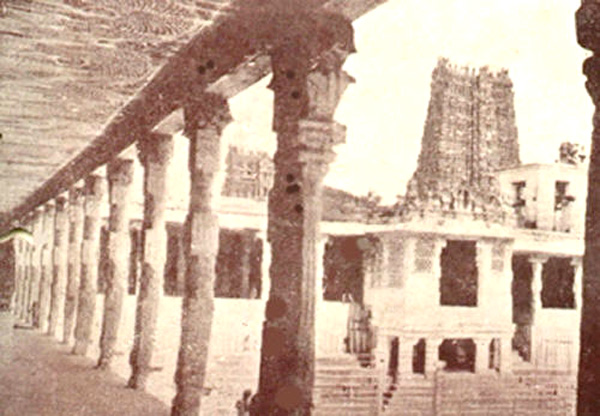
Madurai - the seat of the Tamil
Sangams
|
நற்றிணை
நல்ல குறுந்தொகை
, ஐங்குறுநூறு,
ஒத்த பதிற்றுப்பத்து
ஓங்கு பரிபாடல்,
கற்றறிந்தார்
ஏத்தும்
கலியோடு,
அகம்,
புறம்
என்று
இத்திறத்த
எட்டுத்
தொகை
Mu.Varadarajan on
Ettuthokai
at First International Conference
Seminar of Tamil Studies,
Kuala Lumpur, Malaysia, April 1966
Introduction
0.1 The eight anthologies called
Ettuthokai form part of early Tamil literature
known as Sangam literature written eighteen
centuries ago. They consist of two thousand three
hundred and seventy-one poems varying from small
stanzas of three lines in Ainkurunuru to stanzas
of forty lines in Purananuru.
There are four hundred and
seventy poets known either by their proper names
or by causal names called from their works. The
authors are unidentified in the case of a hundred
stanzas. The poets belonged to different parts of
Tamilnad and to different professions.
Some of them were very popular
like Kapilar, Nakkirar and Auvaiyar and some
others are rarely remembered by their names. Yet
a general harmony prevails throughout these eight
anthologies. The tone and temper of the age is
reflected in all their poems with a singular
likeness. They were moulded according to certain
literary conventions or traditions that prevailed
in the Sangam age. Yet they reveal the individual
genius of the poets who sang them.
0.2 The convention of the later days that
poetry should deal with the four aspects of life,
viz aram (virtue), porul, (wealth and politics),
inpam (love and pleasure) and vitu (salvation),
was not prevalent, 1 in those early days. The
poets sang either of Akam or Puram. Akam dealt
with ideal love and Puram with the rest, viz.
war, munificence, etc.
0.3 Of the eight anthologies five are on Akam,
two on Puram, and one on both. Six of them are in
'akaval' metre which is a kind of blank verse,
interspersed with alliterations and rhymes. The
poems on Akam as well as Puram theme are written
in this metre and its regulated and subtle music
adds to the poetic beauty. This metre is a simple
but wonderful instrument which causes no
impediment to the freedom of expression of the
poet. In has been found to be an appropriate and
natural medium for the expression of the valuable
experience of the poets.
The other two anthologies that are not written
in `akaval' metre are Kalittokai and Paripatal.
The poems of Kalittokai are in Kali metre which
is well known for its dramatic and lyrical
qualities and which, according to
Tolkappiyanar,2 is well suited to express
the emotions of the lovers. There is repetition
of certain lines and phrases and this, added to
the haunting music of the metre, is very
appealing.
Paripatal is a metre full of rhythm and music
and the anthology known by this name consists of
songs composed in this metre. There are religious
poems as well as those on love-themes. The
love-theme is worked against the background of
bathing festivities. These songs were sung in
different tunes as is evident from the notes on
the music at the end of these. The names of the
musicians who set tunes to these songs are also
mentioned therein.
1. 'Akam' Poetry
1.1 In the poems on Akam, the aspects of love
of a hero and a heroine are depicted. The story
of love is never conceived as a continuous whole.
A particular moment of love is captured and
described in each poem as the speech of the hero
or the lady-companion or somebody else. There are
one thousand, eight hundred and fifty poems of
this type in five anthologies, viz. Akananuru,
Narrinai, Kuruntokai, Ainkurunuru, and
Kalittokai.
One may expect a sort of monotonous repetition
in these hundreds of poems on more or less the
same aspects of ideal love. This is what one
finds in all the Indian arts, sculpture or
iconography or music. But when looked at
carefully, the individual genius of the poet is
revealed through his contribution. He gives
something which is already familiar to the
readers, something which assures them of a
continuity of the past art, but he gives it with
his fine colourings distinguished by his own rich
experience and imagination. And thus instead of
monotony we feel a surprise that so many
variations of the same theme should be
possible.
The first attempt to arrange all the contexts
of such love poetry into a series of continuous
succession of speeches giving as it were the
story of two lovers is found several centuries
later in the `kovai' species.3
1.2 Love was dealt with in five 'tinais', each
pertaining to a particular region with its own
suitable season and appropriate hour of the day
and its flora and fauna and characteristic
environment. The aspect of love is called the
uripporul or the subject matter of the `tinai ;
the region, the season and the hour are called
the `mutal porul' or the basic material; the
objects of environment are denoted as
`karupporul'. Kurinci-tinai or the clandestine
union of the lovers is characteristic of the
mountainous region; mullai-tinai or the life at
home spent in expectation of the return of the
hero is set with the background of the forest
region; maruta-tinai or the sulky life has the
agricultural tract as its background;
neytal-tinai or the life of despair is
characteristic of the sea coast; palai-tinai or
the life of desolation in separation is depicted
in arid tract.
Literary tradition in Tamil has closely
associated the sloping hills and the winding
streams with the adventures of the lover coming
to his sweetheart at midnight, the early winter
and the mullai blossoms of the forests with the
patient waiting of the wife for her husband's
return from the battlefield, the fertile paddy
fields and the roaming buffaloes with the
careless life of the hero in the company of a
harlot, the backwaters and the seashore with the
heart-rending despair of the heroine and finally
the waterless arid tract of the withered trees
and emaciated beasts and birds with the
separation of the hero from the heroine in
pursuit of wealth in a far off country.
1.3 Tolkappiyanar clarifies the relative
importance of these three components of
tinai.4 According to him
karupporul is more important than mutalporul, and
uripporul is more important than the other two.
In other words, the aspect of love is the most
important part, the objects of environment come
next and the region, the season and the hour are
less important. There are a few poems in the
anthologies which have no mutalporul but only the
other two, a few poems have neither karupporul
nor mutalporul but only uripporul or the aspect
of love.
1.4 The poems on the theme of love are all in
the form of dramatic monologues. The hero, the
heroine or the lady-companion seems to appear on
the stage and express his or her feelings and
thoughts. Appropriate natural scenery forms the
background. The poet has no place on this poetic
stage. He cannot express his own ideas or
feelings unless through the actors, the hero, the
heroine and others in the drama of love. What
have been expressed, have to be taken as the
feelings and thoughts of the characters imagined
and created by him. The poet merges himself in
the characters he creates and does not, as in
subjective poetry or in ordinary narrative,
describe or relate in his own person and from the
outside. The dramatic element commonly appears
more or less prominently in the shape of
dialogue. There might have been some
autobiographical material incorporated by the
poet in such poems, but it is not always easy to
distinguish those elements. These are dramatic
lyrics, and in spirit and method subjective
poems: but the subjective element pertains, not
to the poet himself, but to some imagined
characters into whose feelings and thoughts he
gives vicarious expression.
1.5 But there is this great difference between
the early eight anthologies and the later works
as regards the men and the women dealt with in
them. In the mediaeval epics and other literary
works, the common man and woman never attained
the status of hero and heroine, whereas in the
poems on love the ordinary man and women either
in the mountainous region or in other regions are
depicted as the hero and the heroine.
1.6 Tolkappiyanar has explained the literary
conventions of his age and stated that he based
his observations on the usages honoured by the
practice of the great poets (patalut-payinravai
natunkalai).5 He has clearly noted in a
`nurpa' that in the poems on Akam, the name of
the hero or the heroine, should never be
mentioned. In the poems on love found in
Ettuthokai, there is not a single stanza wherein
the hero or the heroine is mentioned by name. The
hero is mentioned in these poems simply as the
man of the mountain, the man of the town, the
person of the sea coast, etc. So also the heroine
is referred to as the woman of the hill tribes,
the girl of the peasants, the daughter of the
fisherman, etc.
The poets did not want the readers to identify
the hero and the heroine with historical persons.
As
Professor T. P. Meenakshisundaram puts it,
Akam poetry "expresses not something to be dated
with reference to any particular
person",6 and the aspect of love
depicted in it is intended to be universal and
common to all times. "The majority of the world's
great lyrics", says Hudson,7 "owe their place in
literature very largely to the fact that they
embody what is typically human rather than what
is merely individual and particular."
Every reader finds in the love-lyrics of the
early Tamil anthologies the expression of such
experiences and feelings in which he himself is
fully able to share. Thus, by prohibiting the
mention of the names of the hero and the heroine
in these lyrics the literary tradition in Tamil
has preserved Akam poetry pure and enabled it to
give outward forms to the inner feelings not of
the individual but of the ideal man and
woman.
1.7 Nature is used to enrich the suggestive
nature of poetry and this kind of suggestions
through some description of Nature is called
`iraicci'. When the hero has been meeting his
sweetheart at night during his pre marital
relationship, the lady-companion desires to
impress on him the necessity of hastening the
marriage and asks him to come and meet her during
daytime. She specifies a place for the meeting of
the lovers during daytime and describes it as the
place where the honeycombs hang, the trees are
full of ripe fruits and the creepers have
blossoms in abundance. She expects the hero to
understand from this description that a number of
people will frequent the spot attracted by the
honey, the ripe fruits and the fragrant flowers
and thus indirectly forbids him from coming at
daytime as well as at night and urges him to
marry and avoid such clandestine
meetings.8 Similarly when he
frequently comes at daytime, she requests him to
come during nights and describes the frontyard of
the house as adorned by the punnai trees with
fragrant blossoms and the palmyra trees with the
nests of anril birds. The suggestion herein is
that at night the anril birds are so close to the
house that they keep the heroine awake throughout
the night by their heart-rending cries ;
9
here is also the indirect urge on him to marry
early and settle himself in an inseparable
life.
1.8 In some kinds of descriptions especially
in love songs of marutatinai, Nature is used in
allegories called `ullurai uvaman' or `the
implied simile'. All the objects of Nature and
their activities stand for the hero, the heroine
and others and their activities in the drama of
love. The latter are not at all mentioned but
only suggested through the former. It is simile
incognito which leaves it to the reader to
discover it. The commentator Peraciriyar explains
it as a type resorted to make the literary
expressions more beautiful and apt. 10
An otter enters a lotus tank, scatters the
vallai creepers, seizes the valai fish amidst
them, feeds upon them and returns in the early
morning to its rattan bush. The heroine describes
this in order to blame her husband on his return
from a harlot's house. She suggests to him that
she is aware of his infidelity, of his loose
morals, of pleasing the harlot's parents and
relatives and of returning home at dawn for a
formal stay. Here the otter stands for the hero,
the `valai' fish for the harlot, the `vallai'
creepers for her parents and the `rattan bush'
for his own house.
In such descriptions, the speaker hesitates to
express certain things openly but desires to
dwell on minutely in a wordy caricature of a
familiar incident in Nature and through it more
effectively conveys to the listener all the
feelings and thoughts.
1.9 The anthologies are abounding in
apostrophes. The hero or the heroine addresses
the sea, the moon, the wind, the crow, the crab,
a tree or a creeper and expresses the grief of
the heart or requests one of them to sympathize
with him or her.
The heroine addresses the sea and enquires of
it as to why it cries aloud even at midnight and
who caused such suffering. 12 She also asks it
whether it cries aloud in sympathy with the
misery of those pining in separation just like
herself or whether it has been forsaken by
anybody as in her own case.13 She blames the
north wind as merciless and
unsympathetic.14 "Oh, chill north wind! we
never meant any harm to you. Please do not cause
further suffering to this forsaken and miserable
soul of mine." 15 She remarks that it
mercilessly blows at midnight to afflict her in
her loneliness without any pity for her utter
despair and bids it blow through the country
where the hero is so as to remind him of her and
make him return. 16 The hero in the distant
country feels the effects of the north wind but
only thinks of his sweetheart suffering lonely in
the distant village and requests it not to blow
through her village and cause her more distress."
17
2. 'Puram' Poetry
2.1 There are some `arruppatai' or guide-songs
in the two anthologies, Purananuru and
Patirruppattu. In these, the bard, either a
musician or dancer or actor (panan, virali or
kuttan) who has received gifts from a generous
patron guides another bard suffering from poverty
and directs him to the same patron for help.
Descriptions of the way to the city of the patron
and praises of his endearing qualities abound in
such guidesongs. In Purananuru, there are seven
poems as guide-songs of the musicians, four of
the women dancers, and three of the literary
artists. Patirruppattu contains one guide-song of
the musician and five of the women dancers. All
of them are in accordance with the exposition of
Tolkappiyanar regarding the form of such songs."
18
22. The elegies in Purananuru are frankly
personal and are high tributes to the dead
patrons and friends. A few of them extended to be
poems of some philosophical significance. They
are the outpourings of the emotions of the poets
who were so much attached to the patrons. In
these elegies we do not find such similitude of a
shepherd mourning for a companion as we have in
the pastoral elegies in western literature.
19
These elegies in Tamil are genuine and
spontaneous. There is no artificiality in them.
They express intimate and personal grief. They
cannot be charged of artificiality as in Milton's
Lycidas. Like Tennyson's In Memoriam the ancient
Tamil elegy speaks in its own character and calls
things by real instead of allegorical names. We
need not penetrate a disguise to feel the poet's
personal grief. The ancient Tamil elegies are
entirely free from any conventional bucolic
machinery.
2.3 There is one peculiarity to be noted in
these anthologies. Whenever the poets wanted to
express their gratitude to their royal patrons,
or their admiration of the generosity and valour
of some chieftains, they did so through their
compositions on `Puram' theme, the theme intended
for these. Besides this, they also made use of
their poems on Akam to introduce the glory of
their patrons by way of comparison or by
mentioning their mountains or forests as
background for the drama of love depicted in such
poems.
The scandal about the association of the hero
with a harlot is said to be more widespread than
the joyous uproar of the army of the Pandiya king
when it defeated and chased the armies of the two
enemy kings in the battle at Kutal.20 In an
apostrophe to the north wind, the lady companion
says that the wind which now during the
separation of the lover causes so much distress
to the heroine will disappear when the lover
returns home. Therein she mentions that the north
wind will then run away like the nine chieftains
who were defeated in a single day by the great
Cola king, Karikalan and who ran away leaving all
their nine umbrellas in the battlefield at Vakai.
21
In another stanza the lady companion consoles the
distressed heroine that there is no room for any
suffering and assures her that the hero will
never desert her to seek wealth even if it
amounts to possession of the Elil hills of
Konkana Nannan.22
Some of these poems have long and elaborate
descriptions of the achievements of partons and
give the impression that though they are on Akam
theme, the aim of the poet was only to praise the
achievements of their patrons and that the theme
of love served as a formula or means to serve
this purpose. But it is not always so. As Dr. K.
K. Pillai observes, 23 "it had become almost a
convention with the poets of that age to portray
the feelings or reactions of lovers by
instituting comparisons with prominent political
occurrences. The wide popularity which they had
attained provided the temptation for the poets to
import them into their comparisons so as to make
the descriptions impressive and realistic."
The commentators of Tolkappiyam interpret
`nurpa' No. 155 in "Porulatikaram" so as to admit
and explain such introduction of the glory and
attainments of the partons in poems on the theme
of love.
2.4 The ancient poets were well known for
their self-respect and dignity and they felt it
very delicate to approach a chieftain and
directly ask him for a gift. But they found it
agreeable to please them by singing the glory of
his ancestors or his own achievements or praising
the beauty or fertility of his mountains and
forests, and thus indirectly indicate to him
their request for his gift. They found this a
useful device to serve their purpose as direct
asking did not suit their sense of honour. This
is evident from the poem of Mocikiranar in
Purananuru, wherein he stated "It is difficult
for me to ask you for a gift. But I find it
easier to praise the Konperunkanam hills of
yours." 24
Even Kapilar, who was more a close friend than
a court poet of the great patron Pari, has
written more lines in praise of his Parampu hills
than those on the patron himself. 25
3. General
3.1 The sun, the moon, the trees, the birds,
the beasts and other objects of nature have been
artistically described in the poems of these
anthologies. But they have never been loved and
described for their own sake, as in modern
poetry. They have been described in early poetry
only to portray some aspects of life. Nature
serves only as background for or setting to the
human emotions that are depicted in Akam or Puram
poetry. They serve as frames for pictures of love
or war, munificence, etc. Though Nature is thus
made subservient to the human theme, yet there is
free play of descriptions of nature. Nature has a
prominent, though not a primary place in these
anthologies. These poems treat all outward things
as subordinate to the inner forces and problems
upon which the interest is concentrated.
26
They essentially depict mental states and are
predominantly psychological, meditative and
argumentative.
3.2 The poets of Ettutokai believed in the
unique effects of a few deft touches of
description, not in the elaborate and full
descriptions of all the parts of a beautiful
object or scene. In the later days, the poets
indulged in the descriptions of persons from head
to foot or from foot to head calling such
descriptions கேசாதி
பாத
வருணனை
and பாதாதி
கேச
வருணனை.
According to Winchester 27 the difference
between unimaginative treatment of Nature and
imaginative treatment is the difference between
trying to describe all one sees and rendering in
a few epithets or images what one feels. The
pictures of the poets of Ettuthokai consist of
only a few vivid features enough to interpret and
communicate their emotional experiences. They
drop out of their pictures all irrelevant and
unpleasant details, so that the reader's
attention is concentrated upon the few features
that give him a powerful and characteristic
impression. Through single lines, or sometimes
single epithets, the poets flash upon the
reader's imagination the whole pictures.
The picture of a hare by the poet
Tamilk-kuttanar of Madurai may be cited as an
example. 28 In one single line of
four simple Qualifiers and four small nouns -
tumayirk kuruntal netuncevik kurumuyal (the small
hare with pure fur, short legs and long ears) -
the complete picture of the animal is
impressively drawn. Such simple and direct words
have a suggestive magical power. There is no room
for exaggeration in such artistic descriptions,
which are rather interpretations of the poets'
experience. They have such an intensity of
feeling and imagination that their descriptions
do not deteriorate into exaggeration.
A Japanese painter once confessed that he had
to concentrate on the bamboo for many years and
still a certain technique for the rendering of
the tips of bamboo leaves eluded
him.29 Word-painting is no less
difficult. Many of the ancient Tamil poets have
mastered this word painting. They frequently use
simple adjectives that convey with force their
deep thought and experience regarding the
pictures they depict.
3.3 In the descriptions of the beauty of the
heroine, we find only one or two aspects of
beauty artistically touched.
வெறுத்த
ஏஎர்
வேய்புரை
பணைத்
தோள்ன
30
(the lady abounding in beauty and with
bamboo-like shoulders.)
அந்தீங்
கிளவி
ஆயிழை
மடந்தை
31
(the lady of pleasant red lips resembling the
petals of `kavir' and of sweet words, wearing
fine jewels.)
Even in the descriptions which extended to
more than six lines and which form part of the
monologues of the hero, we find that he restricts
himself to two or three aspects of the physical
beauty of his sweetheart and never transcends the
limits of decency. Therefore the hundreds of such
poems dealing with love are happily devoid of
obscenity. Even the songs on the harlots and the
hero's association with them are free from gross
bawdiness. Sexual passions have been purged of
their obscenity through dignified poetic
touches.
3.4 The early poets did not like to introduce
foreign or borrowed images in their poetry. They
always copied direct from life and Nature. Even
when they had to describe the scenes of a distant
country which they had not seen, as for example
those of the Ganges in flood, 32 or of the Yak at
the foot of the Himalayas 33 they did not
describe them in detail but restricted themselves
to the facts they knew from others and avoided
the odd mixture of any incongruous details in
them. Even while describing the scenes of their
own country, they did not extend their
descriptions beyond their own observation and
experience. For example, Kapilar, a great poet of
the age, who had left us the maximum number of
songs, had not depicted the agricultural region,
he was content to deal with the mountains and
their surroundings.
The poet Perunkatunko of the Cera family,
celebrated for his descriptions of the arid
mountains and forests, was silent about the
beauties of the coastal region. Ammuvanar and
other poets who had written so much on the
coastal region were silent about the hills and
the forests. They wrote according to the
fundamental principle stressed by Hudson, "the
principle that, whether his range of experience
and personal power be great or small, a man
should write of that which lies at his own doors,
should make it his chief business to report
faithfully of what he has lived, seen, thought,
felt, known, for himself." 34 This sincerity or
fidelity is characteristic of the poems in these
early anthologies.
1 Nannul,
10.
2
Tolkappiyam, Porulatikaram 53.
3 `Kovai' is
one of the ninety-six kinds of literary works. It
consists of 400 verses in a particular metre,
each dealing with an aspect of love, and all knit
together in such a manner, that the whole appears
to be a story of a lover and his sweetheart
depicted with continuity.
4
Tolkappiyam, Porulatikaram, 3.
5 Ibid.
6 T. P.
Meenakshisundaram A History of Tamil Literature,
Annamalai University, Annamalainagar, 1965, p.
26.
7 W. H.
Hudson, An Introduction to the Study of
Literature, 2nd edn., London, 1946, p. 97.
8 Akananuru,
18.
9 ibid.
360.
10
Tolkappiyam Porulatikaram 30.
11
Akananuru, 6.
12
Kuruntokai, 163.
13
Kalittokai, 129.
14
Akananuru, 243.
15
Narrinai, 195.
16
Akananuru, 163.
17
Kuruntokai, 235.
18
Tolkappiyam, Porulatikaram
19 Walter W
Greg in his Pastoral Poetry and Pastoral Drama
(p. 134), writes on Milton's Lycidas: The poem,
in common with the whole class of allegorical
pastorals, is undoubtedly open to the charge of
artificiality, since, in truth, the pastoral garb
can never illustrate, but only distort and
obscure subjects drawn from other orders of
civilization. . . . The dissatisfaction felt by
many with Lycidas was noticed by Dr. Johnson when
he wrote: "It is not to be considered the
effusion of real passion, for passion runs not
after remote allusions and obscure opinions ...
When there is leisure for fiction there is little
grief."
20
Akananuru, 116.
21 Ibid.
125.
22
Narrinai, 391.
23 Journal
of the Madras University, Humanities, vol. XXX,
no. 2, January, 1959.
24
Purananuru, 154.
25 Ibid.
105 - 120.
26 Cf. the
author's "The Treatment of Nature in Sangam
Literature", S.I.S. S.W.P. Society, Madras, 1957,
pp. 404 etc.
27 C. T.
Winchester, Some Principles of Literary
Criticism, New York, 1908, p. 132.
28
Purananuru, 334.
29 Ananda K
Coomaraswamy, The Transformation of Nature in
Art, Cambridge, 1935, p. 41.
30
Akananuru 2.
31 Ibid.
30.
32
Purananuru, 161.
33 lbid.
13; Patirruppattu, 1.
34
W.H.Hudson, An Introduction to the Study of
Literature, 2nd ed., London, 1946, p. 17
|