|
United States & the struggle for Tamil Eelam
"I had a wonderful lunch"
US Under Secretary of Political Affairs, Nicholas Burns
Press Briefing, Colombo 23 January 2006
- "
‘சமாதானப்பேச்சு - சமாதானப்பேச்சு’ என்று தொடர்ந்தும் இந்த உலக நாடுகள் புலம்பி
வருகின்றார்களே - இவர்கள் தயவு செய்து ஒரு விடயத்தை விளக்குவார்களா?
பேசுவதானால் எதைப்பற்றி பேசுவது? ‘ஒற்றையாட்சியின் கீழ் தீர்வா?’ ‘தமிழர்
கோட்பாட்டை ஏற்றுக் கொள்ளாத பேச்சு வார்த்தையா?’ இதன் அடிப்படைகளை உலகநாடுகள்
தெளிவாக்க வேண்டும். ஏனென்றால் முன்னர் உலக நாடுகள் ஏற்றுக் கொண்ட
கோட்பாடுகளையெல்லாம்
இப்போது சிறிலங்கா அரசு மறுதலித்து நிற்கின்றது.
இவை தெளிவாக்கப்படாமல் பேசப்போவது பயன்
தராது என்பதே எமது கருத்தாகும்."
Sanmugam Sabesan - உண்மையை மீண்டும் சொல்கின்றேன்!
Full text of the remarks by 50 year old US Under
Secretary,
Nicholas Burns: 23 January 2006
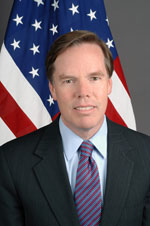 UNDER
SECRETARY BURNS: Good afternoon, ladies and gentlemen. It's a great
pleasure for me to be with you. I'm very happy to be here in Sri
Lanka to visit this country for the first time. UNDER
SECRETARY BURNS: Good afternoon, ladies and gentlemen. It's a great
pleasure for me to be with you. I'm very happy to be here in Sri
Lanka to visit this country for the first time.
I had excellent meetings today with the President and with the
Foreign Minister. I was able to meet the Opposition Leader, to see a
number of ministers and representatives of civil society, and, of
course, fellow ambassadors from friendly countries to Sri Lanka. I
had a wonderful lunch given by the Foreign Minister.
I also was able to meet Minister Eric Solheim, and we compared
notes on our mutual goal, and that is to work with the international community,
and certainly work with the government, to try to restore peace and maintain the
ceasefire here, and resume negotiations.
I want to say, first of all,
we're very proud of the efforts of the American Embassy here, of Ambassador
Lunstead, who has done such a wonderful job to represent the United States.
We are a great friend to this country. We support its
territorial integrity. We support the preservation of peace. We work very
closely with the government and we're proud of what the United States has been
able to do as a friend to Sri Lanka. I think many of you saw that in the wake of
the horrible tragedy of the tsunami. When our military came here, the U.S.
Marines gave immediate help to the people who had been affected. We are also, in
the longer term, very hopeful in 2006 we might reach an agreement with the
Government of Sri Lanka to provide a considerable amount of economic assistance,
so that reconstruction and rehabilitation of the country can continue,
especially those areas that have been so badly affected by the tsunami.
In addition to that, I must say that the United States is dedicated to peace. We
call upon the LTTE, especially, to cease and desist from the violence and
terrorism that it has inflicted upon the people of this country. The bombing
this morning, which cost two lives; the repeated attacks over the past several
weeks; and of course the attacks over many, many years upon the political
leadership and the average citizens of this country, are reprehensible and they
are condemned by the international community.
And we hope that the LTTE will understand that it will have no
relationship with my government and, indeed, no effective relationship with any
country in this world as long as it seeks to redress its own grievances through
the barrel of a gun.
Now, we understand the Tamil community here has legitimate
grievances, and legitimate issues that ought to be addressed by the government.
And there out to be a dialogue, a better dialogue, between the government and
the Tamil community.
But the responsibility here lies with the LTTE,
which has taken up terrorism and violence as its political weapon. So we hope
very much that Minister Solheim's visit here will result in a resumption of
negotiations on a date certain, and in a place certain. For those negotiations
to take place, we hope the ceasefire can be restored and we hope a final peace
can come to Sri Lanka. The United States wants that very much, and we'll support
the government in its effort to protect this country, and its territorial
integrity as these negotiations resume.
So I wanted to begin with that
very brief statement. I'm happy to take any questions that you might have.
QUESTION: You talked about Tamil Tiger violence. In your meetings with the
government, did you address the accusations leveled at the military about
violence against Tamil civilians?
UNDER SECRETARY BURNS: Yes, we did. In
fact, we raised that with the President, and the Foreign Minister, and the other
officials with whom we met. We said for sure that the activities of the
paramilitary organizations also ought to be condemned and they ought to be
stopped. And if there are allegations of military abuse of Tamil civilians, they
ought to be investigated. If there are people found responsible, of course they
ought to be dealt with in the justice system here. We raised those issues
because they are important issues, and they are important to the Tamil community
and we've heard from the Tamil community of how important they are. I must say
that the response we received from the government is that the government leaders
also believe that those attacks must stop, and they must not be carried out in
the future.
QUESTION: If the U.S. will not negotiate with Al Qaeda in its
war on terror, why does it support negotiation with the Tamil Tigers on behalf
of the government?
UNDER SECRETARY BURNS: Al Qaeda is a terrorist
organization that has no grievances whatsoever to negotiate with the United
States of America or the United Kingdom or any other country in the world. It's
a nihilistic terrorist organization that uses terrorism for reprehensible aims.
We also condemn the LTTE, and we brand it a terrorist organization. We sanction
any individuals or groups of individuals who would seek to give financial
support to that organization. But I must say that all of us who are friends with
this country understand that this long conflict is only going to come to an end
when the LTTE and the government sit down and find a way forward to end the
violence and convince the LTTE to stop using violence as a political weapon.
That has to happen.
I think any realistic observer of this country's
long struggle would say, and agree, that that kind of dialogue has to take
place. I'm not aware of any government in the world, or any significant NGO in
the world, who believes we ought to be sitting down with Al Qaeda given its
agenda.
QUESTION: Is there some kind of direct role the U.S. can play in
bringing about a final solution to Sri Lanka?
UNDER SECRETARY BURNS: We
are supporting the core role, the first and foremost role, played by Norway. I
had a very good meeting with Minister Eric Solheim this afternoon. I told him
that we support his efforts 100 percent and that he can rely on the United
States to back him up. We're also part of the Co-chairs group which meets, as
you know, regularly to try to provide diplomatic support to those who would want
to end this conflict, including the government. I am the American representative
to the Co-chairs, and I assume we will be meeting fairly soon to continue the
Co-chairs' negotiations.
If there's any weight that America can bring [it is] to try to convince the
LTTE to come in and negotiate, and to try to give advice to our friends in the
government that they ought to find a way not to respond to the obvious
provocations of the last several weeks. I think that is really what America can
do best here. We're a friend of this country. We respect its territorial
integrity and want to see it preserved. And the people of this country ought not
to have to live for another 15 or 20 years with this reprehensible terrorist
group keeping this country verged on the edge of war. What is striking about the
situation here, in Sri Lanka, is how so many people are concerned about the
possible outbreak of conflict, of armed conflict, of a civil war.
It is
incumbent upon all the friends of this country to band together, as we have in
the Co-chairs group, to send a message that we support peace, and that we'll do
whatever we can diplomatically to help prepare the road for peace. At the same
time, we are trying to show our support for the government by providing military
assistance and training for its officers, military exercises between our troops
and the government's troops, so that the government can be strong and the
government's forces can deter future attacks against the people of this country.
QUESTION: In light of the escalating violence, if conflict does break out, what
moves will the U.S. take to assist Sri Lanka in the background of the U.S.
Global War on Terrorism?
UNDER SECRETARY BURNS: We're focused not on
hypothetical questions, but on the work at hand this week -- and that is to try
to give stimulus to a diplomatic effort to do three things: To reinforce the
ceasefire; to convince the parties to agree to resume negotiations; and to see
those negotiations succeed so that peace can be restored. That's the immediate
diplomatic agenda. And our weight is behind that agenda.
I want to say
again: while we do believe that the Tamil population has legitimate grievances,
and they must be respected by the majority population, and there has to be a way
for the Tamils to be able to articulate those grievances, the full
responsibility here really lies with the LTTE. That's the organization that has
to choose peace, instead of the reprehensible policies of the past decade and
more. And so we're working for peace, and we will remain, whatever happens here,
a friend to this country, and obviously a friend to the government of this
country.
QUESTION: Mr. Under Secretary, Human Rights [Watch] in its
annual report a couple of weeks ago criticized your government for human rights
violations in pursuing the War on Terror since 2001. If the Sri Lankan
government was to pursue similar policies in prosecuting the terrorist
organizations like the LTTE, would the U.S. Government endorse such activities
or would you crack down or pressure Sri Lanka not to pursue the program that
you've been pursuing in your War on Terror?
UNDER SECRETARY BURNS: You
know we have a friendly relationship with the Sri Lankan government. It's a
responsible government, and it's a government that's dealing with enormous
challenges, from rebuilding after the tsunami to the effort to provide economic
growth, but particularly the fight against [terror], to preserve peace here, and
so we support that government. If, from time to time, there is evidence of human
rights abuses, then the United States, of course, would be concerned and would
talk as a friend to that country to try to see if that country could redress
those human rights abuses. That is normal in international politics.
But
for the most part, if I were focused on human rights in Sri Lanka, in addition
to trying to give advice to friends -- and for instance, one of the issues that
I did raise today in all of my meetings was the need for the government to make
sure that there is no official support for the paramilitary groups, that there
is no involvement by the military in attacks on Tamils. But the major part of
our concern here is not with the government. The government is democratic, the
government is composed of people who are responsible, who are good people who
want to help this country.
Our major concern is with the LTTE. There is no moral comparison, no moral
equivalency, that we see between the government and the LTTE, and we think the
major part of the burden for peace rests on that organization.
QUESTION:
Does the United States feel the LTTE is genuinely interested in peace?
UNDER SECRETARY BURNS: We don't have direct contact with the LTTE, so we have to
judge them by their actions. The actions of the last several weeks would
indicate that this is an organization bent on provoking violence, as it commits
violence, as it kills innocent people. And so, if we see that kind of terrorism
anywhere in the world I think all of us, as democratic citizens, need to reject
it and need to call upon those who perpetrate it to stand down. So that's what
the United States is saying today.
It's also the message of all the
other friends of Sri Lanka, all the other governments that are here trying to
support a process of peace in this country. We want to avoid a war, and that is
the strong wish of the government, as we [heard when we] spoke to the President
and others today. They wish to avoid war, and so all of us need to be here to
help peace prevail.
Thank you very much.
|