|
united kingdom
& the Struggle for Tamil Eelam
On the Conflict in the Island of Sri Lanka
Dr Kim Howells MP, Minister of State
Foreign and Commonwealth Office 12 June
2007
[see
also Sri Lanka accuses 'bullying' West 12 June 2007]
Comment by tamilnation.org
It is a matter for regret that the UK Government
continues to obfuscate by conflating the two words 'terrorism'
and 'violence'.
We need to repeat that which we
have already
said
elsewhere. The Cuban revolution was violent but it was not
terrorism. The war against Hitler was violent but it was not
terrorism. The question that needs to be addressed is whether
there are
any
circumstances in which a people ruled by an alien people
may
lawfully
resort to arms to resist that alien rule
and secure freedom. And if all resort to violence to secure
political ends is
not terrorism then, we may need
to address the question:
what is terrorism? We
need to address the genuine concerns expressed by
UN Special
Rapporteur, Kalliopi K. Koufa in June 2004
"The most problematic issue
relating to terrorism and armed conflict is distinguishing
terrorists from
lawful combatants"
By refusing to distinguish
between terrorism and lawful national liberation struggles the
UK government has in effect encouraged successive Sri Lanka
governments to continue to label the national liberation
struggle of the people of Tamil Eelam as 'terrorism', and on
that basis
torture,
rape
and
murder Tamils with
impunity in a sustained effort to
conquer and rule
the people of Tamil Eelam.
One result is that today Sri
Lanka's Defence Secretary is unafraid to
brazenly declare to the BBC and to the world -
"When the US does operations
they say covert operations. When something is in Sri Lanka
they call abductions. This is playing with the words. What I
am saying is, if there is a terrorist group, why can't you
do anything? It's not against a community... I'm talking
about terrorists. Anything is fair."
Sanmugam Sabesan was
right to point out on 28 May 2007 that தமிழீழ மக்களின்
அழிவுக்குச் சம்பந்தப்பட்ட மேற்குலகமே காரணம் - 'Today our people
are perishing because the international actors have failed to
demonstrate justice and integrity.'
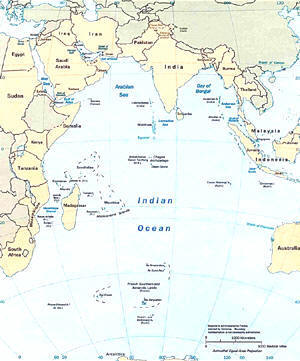
UK and the West may continue to believe
that the approach they have adopted will advance their own
strategic interests in the Indian Ocean region. Some
features of these strategic interests will appear from US
Lt.Col. Christopher J. Pehrson's analysis in
String of Pearls:Meeting the Challenge of China’s Rising Power
Across the Asian Littoral -
 "
The geopolitical strategy dubbed the “String of Pearls” is
arising as foreign oil becomes a center of gravity critical to
China’s energy needs. China’s rising maritime power is encountering
American maritime power along the sea lines of communication (SLOCs) that
connect China to vital energy resources in the Middle East and Africa. The
“String of Pearls” describes the manifestation of China’s rising
geopolitical influence through efforts to increase access to ports and
airfields, develop special diplomatic relationships, and modernize military
forces that extend from the South China Sea through the
Strait of Malacca,
across the Indian
Ocean, and on to the Arabian Gulf. .. " "
The geopolitical strategy dubbed the “String of Pearls” is
arising as foreign oil becomes a center of gravity critical to
China’s energy needs. China’s rising maritime power is encountering
American maritime power along the sea lines of communication (SLOCs) that
connect China to vital energy resources in the Middle East and Africa. The
“String of Pearls” describes the manifestation of China’s rising
geopolitical influence through efforts to increase access to ports and
airfields, develop special diplomatic relationships, and modernize military
forces that extend from the South China Sea through the
Strait of Malacca,
across the Indian
Ocean, and on to the Arabian Gulf. .. "
Other aspects of the uneasy balance of power in
the Indian Ocean region will appear from
The Indian Ocean Region - A Story Told with Pictures.
"The Indian ocean region had
become the strategic heartland of the 21st century,
dislodging Europe and North East Asia which adorned this
position in the 20th century.. the developments in the
Indian Ocean region were contributing to the advent of a
less Western centric and a more multi-polar world."
Donald L. Berlin, Head of Security Studies, Asia
Pacific Centre for Security Studies, Honolulu, Hawaii
Said that, given the Sri Lanka
government's
current belligerent tilt to Asia (and China) (encapsulated
in Defence Secretary Rajapakse's statement: "We have all the
SAARC countries, the Asian countries. Britain, or Western
countries, the EU countries, they can do whatever. We don't
depend on them. They think that they we get aid. No, they are
not giving anything."), the UK and the West may persuade
themselves that the answer lies in using the Tamil Eelam
struggle as an additional lever to get President Rajapakse to
'play ball' as it were.
Here, the Tamil people may have a
feeling of deja vu. They have been there before with India in
the 1980s and the eventual betrayal of 1987 no sooner New
Delhi's strategic interests were secured by the
Exchange of Letters annexed to the India Sri Lanka Accord. A
concerted attempt was then made to coerce Tamils into accepting
the
comic opera reforms of the 13th Amendment and the Provincial
Councils Act - as the best deal available on the table.
This time round, no sooner Western strategic interests in
the Indian Ocean region are secured, the Tamils will be called
upon to accept a version of the toothless Vitharane proposals -
as the best deal available on the table.
Again, if President Rajapakse refuses 'to play ball', the UK and
the West may persuade themselves that the answer lies in 'regime
change' in Colombo - and help bring in a more pliable Ranil
Wickremasinghe who may be amenable to secure Western interests
whilst at the same time continuing to
deny the existence of the Tamil homeland. Once again,
Sanmugam Sabesan was right to point out in
வலியப்போய் ஏமாறுபவர்களும், துணிந்து வந்து ஏமாற்றுபவர்களும்
on 15 May 2007 -
"The international community is concerned to
secure a peace in the island of Sri Lanka which will advance
their own political, economic and strategic interests. It is not
truly concerned with helping to resolve the basic issues faced
by the Tamils. The international community seeks a peace, which
even though it does not resolve the basic issues of the Tamil
struggle, is sufficient to deceive the Tamil people into
thinking that it has - this is the position of the international
community... "
But the UK and the West will be wrong in
believing that approaches such as those that they have adopted
will succeed. For one thing, they may want to remind themselves
of something which Professor Marshall Singer told the
US Congress Committee on International Relations
in 1995
"...One of the essential
elements that
must be kept in mind in understanding the Sri
Lankan ethnic conflict is that, since 1958 at least, every
time Tamil politicians negotiated some sort of power-sharing
deal with a Sinhalese government - regardless of which party
was in power - the opposition Sinhalese party always
claimed that the party in power had negotiated away too
much. In almost every case - sometimes within days - the
party in power backed down on the agreement..."
They may also want to attend to the words of
Neil Devotta in 2005...
"...Beginning in the mid-1950s Sri Lanka's
politicians from the majority Sinhalese community resorted
to ethnic outbidding as a means to attain power and in doing
so
systematically marginalised the country's minority Tamils...parties
in power seek to promote dubious conflict resolution only to
be checkmated by the respective opposition which typically
claims that the proposed solutions are bound to
eventually dismember the island"
Neil Devotta in From ethnic outbidding to
ethnic conflict: the institutional bases for Sri Lanka's
separatist war, 2005
For another thing, the UK and the
West may want to revisit the words of Dharmaretnam Sivaram in
What
is really wrong with the counter insurgency methods?
"...Sri Lanka is easily the only country
in the world to fight its insurgency with the undivided
support of the international community, the backing of all
the important nations across the global political spectrum.
It is the most advantageous external environment that any
country may have ever had in fighting an insurgency. And yet
something is obviously going wrong. There are three reasons
that may be attributed to the apparent failure of western
counter insurgency - CI - methods in Sri Lanka. (It would be
countered that nothing is wrong with western CI but with the
people who are not doing it right. This, upon closer
scrutiny, would be found untenable because less literate
armies have succeeded in quelling insurgencies in less
favourable circumstances) Firstly, the LTTE has developed
over the years a fairly sophisticated counter-counter
insurgency system. Secondly, it has consistently focused its
resources on building a conventional force and on preserving
the minimum required territory to sustain such a force. And
thirdly it never lets itself be inveigled or coerced into
the political space that is so necessary for diluting and
mystifying the basic cause fuelling the insurgency. "
Finally, the UK and the West
may want to consider whether their approach will fail, in the
same way that the New Delhi approach in 1987 failed, because it
is fundamentally unprincipled. The approaches of UK (& the
West) and New Delhi were each directed to securing each of
their separate (but undeclared) strategic interests
in the Indian Ocean region. They were mindful of the words of US
Rear Admiral Alfred Thayer Mahan quoted by
Cdr. P K Ghosh in Maritime Security Challenges in South Asia and
the Indian Ocean on 18 January 2004
"Whoever controls the Indian
Ocean dominates Asia. This ocean is the key to the seven
seas in the twenty-first century, the destiny of the world
will be decided in these waters."
But, regrettably, they were
not equally mindful of the fundamental issues that had led to
the Tamil struggle for freedom. They were not mindful of the
words of Singapore Minister Mentor Lee Kuan Yew in "Sri
Lanka - the Country will Never be Put Together Again" -
"..We have got to live with
the consequences of our actions. .. When I went to Colombo
for the first time in 1956 it was a better city than
Singapore because Singapore had three and a half years of
Japanese occupation and Colombo was the centre or HQ of
Mountbatten's Southeast Asia command. And they had sterling
reserves. They had two Universities. Before the war, a thick
layer of educated talent. So if you believe what American
liberals or British liberals used to say, then it ought to
have flourished. But it didn't.
One-man one-vote led to the domination of the Sinhalese
majority over the minority Tamils who were the active
and intelligent fellows who worked hard and got themselves
penalised. And English was out. They were educated in
English. Sinhalese was in.
They got quotas in two universities and now they have
become fanatical Tigers. And the country will never be put
together again.
Somebody should have told
them - change the system, loosen up, or break off. And
looking back, I think the Tunku was wise. (The reference is
to Tunku Abdul Rahman the Malaysian Prime Minister under
whose rule Singapore separated from Malaysia). I offered a
loosening up of the system. He said: "Clean cut, go your
way". Had we stayed in, and I look at Colombo and
Ceylon, I mean changing names, sometimes maybe you
deceive the gods, but I don't think you are deceiving the
people who live in them. It makes no great difference to
the tragedy that is being enacted. They failed because they
had weak or wrong leaders ".
Sometimes maybe you deceive the
gods, but you are not deceiving the people who live in Tamil
Eelam. Dr.Howell may want to pay attention to
the words of Professor Jeff Sluka uttered more
than 10 years ago -
"...
oppressed people are not socially stupid even when they
are poor, hungry, or uneducated. They understand only too
well the social, political, and economic conditions of their
lives, and, when the possibility to do so presents itself,
they are prepared to act to improve those conditions.
National liberation movements are one of the most
significant ways people do this...
..National liberation movements are not
the activities of small groups of isolated individuals,
though state authorities opposed to them frequently describe
them as such for propaganda purposes. They are the struggle
of rebellious nations against foreign invaders .. To
defend their nations from being annihilated, many peoples
have taken up arms and engaged in wars of national
liberation. To understand armed national liberation
movements, it is necessary to strip away the camouflage
terms and explanations that states use to hide their true
nature... Instead of identifying them as patriots or
freedom fighters battling oppression and injustice and
seeking the liberation of their people, they usually refer
to them as "terrorists."
Every nation people that has resisted state domination or
invasion has been accused of being terrorists. But armed
national self-preservation or self-defense is not
"terrorism" or "banditry". "
UK and the West may need to
recognise that state territorial boundaries are not sacrosanct.
"...Let us accept the fact
that states have lifecycles similar to those of human beings
who created them. The lifecycle of a state might last for
many generations, but hardly any Member State of the United
Nations has existed within its present borders for longer
than five generations. The attempt to freeze human evolution
has in the past been a futile undertaking and has probably
brought about more violence than if such a process had been
controlled peacefully...Restrictions on self-determination
threaten not only democracy itself but the state which seeks
its legitimation in democracy"
Self Determination & the Future of Democracy
-
Prince Hans-Adam II of
Liechtenstein, 2001
The attempt to freeze human
evolution is a futile undertaking . We would commend, yet again
to Dr. Howells, the view of Yelena Bonner (widow of Andrei
Sakharov) that "the inviolability of a country's borders against
invasion from the outside must be clearly separated from the
right to statehood of any people within a state's borders." The
strategic interests of the UK and the West in the
Indian
Ocean Region will not be furthered by trying to suppress the
freedom struggle of the people of Tamil Eelam. And here let us
be clear. The struggle of the people of Tamil Eelam is not about
securing benevolent Sinhala rule. It is about freedom from
alien
Sinhala rule. It was a freedom struggle that was
initiated, some 30 years ago, not by the LTTE, but by the
Gandhian Tamil Leader, one of Her Majesty's (Queens) Counsel,
S.J.V.Chelvanayagam -
"Throughout the ages the Sinhalese and
Tamils in the country lived as distinct sovereign people
till they were brought under foreign domination. It should
be remembered that the Tamils were in the vanguard of the
struggle for independence in the full confidence that they
also will regain their freedom.
We have for the last 25 years made every effort to secure
our political rights on the basis of equality with the
Sinhalese in a united Ceylon."
"It is a regrettable fact that successive
Sinhalese governments have used the power that flows from
independence
to deny us our fundamental rights and reduce us to the
position of a subject people. These governments have
been able to do so only by using against the Tamils the
sovereignty common to the Sinhalese and the Tamils."
"I wish to announce to my people and to
the country that I consider the verdict at this election as
a mandate that the
Tamil Eelam nation should exercise the sovereignty already
vested in the Tamil people and become free."
"I have just completed my
third visit to Sri Lanka, my second this year. I met His Excellency
the President and discussed the role of the international community
in assisting Sri Lanka resolve its conflict. As always the people
were warm and friendly and the country as beautiful as any I have
ever visited. But the clouds that hung over Sri Lanka during my last
visit have become darker and more threatening. The
effects of the conflict are being felt directly in Colombo – a
cowardly terrorist bomb during the rush hour on 28 May 2007 killing
eight people, seven of them civilians. And there was the repulsive
abduction and murder of two Red Cross volunteers, whose bodies were
discovered on 2 June 2007. There is no justification
for this terrorism and abuse of human rights. They highlight the
very real threat the people of Sri Lanka face. In recent weeks there
has been speculation that the British Government might lift its ban
on the LTTE – allowing it to resume fund raising and political
activity in Britain. This will not happen while the
LTTE continues to use terrorism. The targeting of civilians make the
case ever more strongly that our decision to proscribe the LTTE was
totally justified. Before we change our views on this, the LTTE must
renounce violence in word and deed. There are some that
believe the only way to address the LTTE’s violence is to fight fire
with fire. They are wrong. For the last twenty-four years the
front lines have moved north and south along the A9 road, but
neither side has been able to win a decisive victory. And in any
event even if the security forces were able to win - what then?
There would still need to be a political deal, otherwise resentment
will build up and there will be more violence, in twenty-five or
fifty years. This is a lesson we learnt through
bitter experience in Northern Ireland, where violence began in 1969.
While the overriding responsibility of British Governments was, like
any Government, to stop the killing and to protect the citizens of
Northern Ireland, it became increasingly and painfully clear that
there could not be an exclusively military solution to the problem.
The first Military commander in Northern Ireland was quick to point
this out. The army could contain the terrorist campaign, but it
could not address the causes. In fact a security led
response to terrorism can end up strengthening the terrorist. The
introduction of internment without trial in Northern Ireland in 1971
resulted in the IRA’s ranks being swelled by hundreds of new
recruits. I am sure that similarly, the reports of human rights
abuses and civilian deaths are being used by the LTTE to win
arguments and raise money among Tamil populations, including those
overseas. Human rights abuses not only play into the
hands of propagandists, they damage Sri Lanka’s image overseas and
make it more difficult for the international community to give the
Sri Lankan government the political support it wants. But most
importantly human rights abuses are wrong in themselves.
The Red Cross worker deaths and the constant reports of
disappearances in Colombo and Jaffna suggest that the situation is,
if anything, getting worse. There has been some concern
voiced in Sri Lanka about international attention focussing on human
rights. Some claim that comments about human rights are interference
in Sri Lanka’s internal affairs. But Human Rights are
not a purely domestic matter. Both Sri Lanka and the UK are
signatories to the United Nations human rights conventions, which
means we both have an obligation to uphold the highest standard of
human rights. If either of us is perceived to fall
below those standards we can and should expect difficult questions.
I realise I have painted a bleak picture. But I do not believe it is
a hopeless one. Most moderate people in Sri Lanka, the British and
Norwegian governments and the wider international community, want to
see Sri Lanka remain as a single country which is able to address
the legitimate demands of all its ethnic groups within its existing
borders. Other countries in the region, most notably
India and Indonesia, have been able to form prosperous and united
nations out of diverse linguistic and religious groups.
In order to guarantee stability, Sri Lanka needs a sustainable
political solution, one that allows its Tamil population to feel
they will be able to prosper within a Sri Lankan state that takes
pride in the identity of all of its people. No one
pretends this will be easy. The All Party Representative Committee
provides a clear opportunity to move the debate forward if it
publishes ambitious enough proposals. The way to
defeat terrorism is not through relentless military action, but by
winning the battle of ideas and with it the support of moderate
Tamils. Without some form of political support even the most
ruthless terrorist group will have to either come to the negotiating
table or become marginalised. The UK is ready to help
with the search for peace and the need for all parties to the
conflict to move away from the path of violence and respect human
rights. |