|
INTERNATIONAL FRAME
&
THE STRUGGLE for Tamil Eelam
US - India - China - Sri Lanka - Pakistan: Matrix
[Comment by
tamilnation.org
- The
original title of the article by Rahul Bedi was "US
marines to train Sri Lankan navy". We have changed the title to
"US - India - China - Sri Lanka - Pakistan:
Matrix" because we feel that that better reflects the uneasy balance of
power that prevails in the
Indian Ocean Region today - and which Rahul Bedi's well written article
served to bring to the surface.
"In mathematics, a
matrix (plural matrices) is a rectangular table of numbers or, more
generally, a table consisting of abstract quantities that can be added and
multiplied. Matrices can be added, multiplied, and decomposed in various
ways, making them a key concept in linear algebra and matrix theory" -
Wikipedia]
Rahul Bedi, 25 October 2006
http://www.nerve.in
"
US Marines will conduct exercises
with the Sri Lanka Navy later this month, deploying more than 1,000
personnel and support ships for amphibious and counter-insurgency manoeuvres
with the aim of 'containing' growing
Chinese presence in
the region and to test its latest theories on 'littoral battle' without
putting American soldiers at risk.... The US and India.. have long eyed with
trepidation
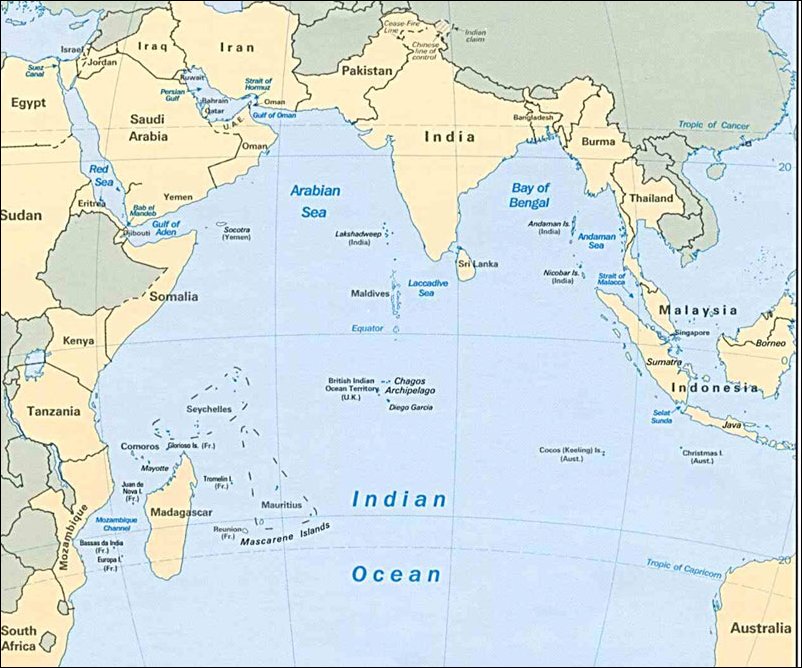
China's 'string of pearls' strategy in the Indian Ocean Region of
clinching regional defence and security agreements to secure its mounting
energy requirements, enhance its military profile from the Persian Gulf to
the South China Sea and significantly expand its presence and visibility in
the area. 'With the US now India's most coveted ally, New Delhi is unlikely
to object to Washington neatly tying up various strategic bonds to fully
dominate the Asian region,' a senior Indian security officer said. In turn,
India hopes to profit from its growing military relations with the US, he
added..."
Rahul Bedi
[Comment by
tamilnation.org
But see also
1.
India's Project
Seabird and Indian Ocean's Balance of Power, PINR, 20 July 2005 "
The dynamics of the region still call for a balance of power approach rather
than a straight alliance...Washington has often touted the "natural
alliance" between the two expansive, multi-ethnic democracies, but it is on
military issues that India would most like to develop its relationship with
the U.S... (Indian foreign policy) is to be assessed in light of two
geopolitical triangles juxtaposing on the Indian Ocean's background:
U.S.-India-China relations and China-Pakistan-India relations. In this
complicated geopolitical configuration, New Delhi is not simply a partner
of China or the United States: India is emerging as a major power
that follows its own grand strategy in order to enhance its power and
interests."
2.
LTTE Attacks Galle Naval Base & US Cancels Joint Naval Exercise with Sri
Lanka, 18 -20 October 2006]
US Marines will
conduct exercises with the Sri Lanka Navy later this month, deploying more than
1,000 personnel and support ships for amphibious and counter-insurgency
manoeuvres with the aim of 'containing' growing
Chinese presence in
the region and to test its latest theories on 'littoral battle' without
putting American soldiers at risk.
Military sources said the joint exercises involving the 15 Marine Expeditionary
Unit on the beaches in Hambantota in southern Sri Lanka are taking place where
the
Chinese plan on building oil and harbour facilities that were ravaged by the
tsunami two years ago.
'Whilst the manoeuvres will put the Tamil Tigers on notice to engage seriously
in the upcoming peace talks in Geneva, the location of the exercise clearly
indicates that India too has signed off on the venture as a subtle warning to
the Chinese not to unduly intrude upon the Indian Ocean Region (IOR),' Brigadier
Arun Sahgal of the United Service Institution of India told IANS.
For Sri Lanka, however, US Marine training in amphibious warfare will equip its
navy to counter the Sea Tigers, the world's only insurgent force with an
aggressively operational naval wing that deploys custom-built boats which were
launched in a suicide attack on the southern port of Galle Oct 18.
The US and India, however, have long eyed with trepidation
China's 'string of pearls' strategy in the IOR of clinching regional
defence and security agreements to secure its mounting energy requirements,
enhance its military profile from the Persian Gulf to the South China Sea
and significantly expand its presence and visibility in the area.
Meeting with senior Indian military officials including the
three Service Chiefs in New Delhi earlier this week, US Pacific Commander
Admiral William J. Fallon conceded as much when he expressed concern over
Beijing's military build up in the region.
But India and the US have
frequently reiterated that their new-found strategic partnership is not aimed at
countervailing China's proliferating military, especially naval expansion.
But Indian defence planners disagree.
They also claim that though India exercises limited influence in the region,
it remains the dominant, albeit 'hesitant', naval power and consequently has
been 'anointed' Washington's junior partner in the IOR.
The US along
with other members of the Sri Lankan Donors Group, which assist with the
country's post-tsunami rebuilding and in brokering peace talks between the
government and the separatist Liberation Tamil Tigers of Eelam (LTTE), have been
known to frequently consult with India on Colombo-related security matters.
Washington has also long harboured a
strategic interest in Sri Lanka, centred around eastern
Trincomalee port, which it looks upon as a staging point for its naval
assets stationed in and around its
Diego
Garcia base in the Indian Ocean.
And to gain access to the 'strategic jewel' that is
Trincomalee, one of the world's biggest natural deep-sea harbours, the US
has 'persuaded' India to step in as Washington's 'proxy' to extend its
influence over the port without overtly arousing suspicion of superpower
hegemony. Located on the
busy East-West shipping route stretching from the Suez Canal to
the Malacca Straits, Trincomalee controls the Indian Ocean.
Earlier, through a combination of diplomacy, bullying and astute
bargaining, a paranoid India had for several decades managed to prevent outside
powers - especially the US - from gaining access to Trincomalee.
During
the Cold war years, the US had wanted to station a Voice of America transmitter
in Sri Lanka as a precursor to using its warships using the harbour. But close
Soviet-ally India steadfastly opposed any such move.
One of the key
clauses of the 1987 accord that led to the deployment of the Indian Peace
Keeping Force in Sri Lanka to disarm the Tamil Tigers declared that Trincomalee
- particularly its oil tanks, located around 20 km from the Indian coast - would
not be controlled by any foreign power 'inimical' to India.
But after 9/11 things changed and even more so recently with India and the
US strategically and militarily coming closer.
The US has acknowledged
the Indian Navy as a 'stabilizing force' in IOR and wants a closer working
relationship with it that includes arrangements to patrol the sea-lanes from the
North Arabian Sea to the Malacca Straits off the Singapore coast.
Consequently, in a quiet, 35-year deal clinched with Sri Lanka - with US
approval - the state-owned Indian Oil Corp (IOC) hammered out a Rs.200 million
($4.16 million) agreement in 2002 to refurbish the voluminous oil tanks at
Trincomalee for the first time after World War II when British warships used it
for refuelling.
Providing the entire operation protection at
Trincomalee are US-trained Sri Lankan soldiers. Under Operation Balanced
Style US, Sea Air Land Forces (SEALS) specialists have trained Sri Lankan army
and navy personnel in security techniques to protect Trincomalee. Sri Lankan
police teams have also attended anti-terrorism courses in the US with emphasis
on bomb disposal and US military cooperation has also been quietly extended to
the island's air force that operates a wide range of Israeli-made combat
aircraft.
It is well known that the US Navy has long been looking for
access to a strategically located South Asian port for its Fifth Fleet,
established in 1996 for permanent deployment in the Indian Ocean to bolster the
US Middle East Force, increasing in tactical and strategic importance after the
Iraq invasion.
US missile strikes during the war in Afghanistan were executed, amongst
others, by Fifth Fleet warships, clearly demonstrating America's ability to
exercise military power against littoral states deep inland.
'With the
US now India's most coveted ally, New Delhi is unlikely to object to Washington
neatly tying up various strategic bonds to fully dominate the Asian region,' a
senior Indian security officer said. In turn, India hopes to profit from its
growing military relations with the US, he added.
|