|
The Indian Ocean Region
Declaration of the Indian Ocean as a Zone of Peace
UN General Assembly Resolution 2832 (XXVI)
16 December 1971
The item "Declaration of the
Indian Ocean as a Zone of Peace" was included in the agenda of the 26th
General Assembly in 1971 at the initiative of Sri Lanka and, subsequently,
the United Republic of Tanzania. It led to the adoption of Resolution 2832
(XXVI), by which the Indian Ocean, within limits to be determined, together
with the airspace above and the ocean floor subjacent thereto, was
designated for all times as a zone of peace. In 1972, the General Assembly
established the Ad Hoc Committee on the Indian Ocean, to study
practical measures to achieve the objectives of the Declaration. At
the
Ad Hoc Committee on Indian Ocean, 451st Meeting (PM) on 26 July 2005 the
representative of China "called for common efforts for countries inside and
outside the region to maintain peace and stability in the region and to
establish the Zone of Peace at an early date. To that end, the
major Powers outside the region should eliminate their military presence in
the Indian Ocean region."
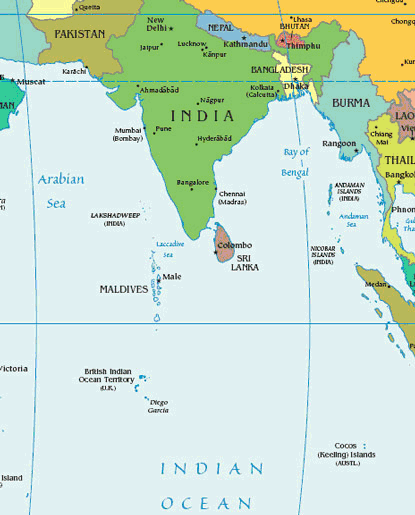
Text of Declaration The General Assembly,
Conscious of the determination of the peoples of the littoral and hinterland
States of the Indian Ocean to preserve their independence, sovereignty and
territorial integrity, and to resolve their political, economic and social
problems under conditions of peace and tranquillity,
Recalling the Declaration of the Third Conference of Heads of State or
Government of Non-Aligned Countries, held at Lusaka from 8 to 10 September 1970,
calling upon all States to consider and respect the Indian Ocean as a zone of
peace from which great Power rivalries and competition as well as bases
conceived in the context of such rivalries and competition should be excluded,
and declaring that the area should also be free of nuclear weapons,
Convinced of the desirability of ensuring the maintenance of such conditions in
the Indian Ocean area by means other than military alliances, as such alliances
entail financial and other obligations that call for the diversion of the
limited resources of the States of the area from the more compelling and
productive task of economic and social reconstruction and could further involve
them in the rivalries of power blocs in a manner prejudicial to their
independence and freedom of action, thereby increasing international tensions,
Concerned at recent developments that portend the extension of the arms race
into the Indian Ocean area, thereby posing a serious threat to the maintenance
of such conditions in the area, Convinced that the
establishment of a zone of peace in the Indian Ocean would contribute towards
arresting such developments, relaxing international tensions and strengthening
international peace and security, Convinced
further that the establishment of a zone of peace in an extensive geographical
area in one region could have a beneficial influence on the establishment of
permanent universal peace based on equal rights and justice for all, in
accordance with the purposes and principles of the Charter of the United
Nations, 1. Solemnly declares that the Indian
Ocean, within limits to be determined, together with the air space above and the
ocean floor subjacent thereto, is hereby designated for all time as a zone of
peace; 2. Calls upon the great Powers, in
conformity with this Declaration, to enter into immediate consultations with the
littoral States of the Indian Ocean with a view to:
(a) Halting the further escalation and expansion of their
military presence in the Indian Ocean; (b) Eliminating from
the Indian Ocean all bases, military installations and logistical supply
facilities, the disposition of nuclear weapons and weapons of mass
destruction and any manifestation of great Power military presence in the
Indian Ocean conceived in the context of great Power rivalry;
3. Calls upon the littoral and hinterland States
of the Indian Ocean, the permanent members of the Security Council and other
major maritime users of the Indian Ocean, in pursuit of the objective of
establishing a system of universal collective security without military
alliances and strengthening international security through regional and other
co-operation, to enter into consultations with a view to the implementation of
this Declaration and such action as may be necessary to ensure that:
(a) Warships and military aircraft may not use the Indian
Ocean for any threat or use of force against the sovereignty, territorial
integrity and independence of any littoral or hinterland State of the Indian
Ocean in contravention of the purposes and principles of the Charter of the
United Nations; (b) Subject to the foregoing and to the norms
and principles of international law, the right to free and unimpeded use of
the zone by the vessels of all nations is unaffected; (c)
Appropriate arrangements are made to give effect to any international
agreement that may ultimately be reached for the maintenance of the Indian
Ocean as a zone of peace;
4. Requests the Secretary-General to report to
the General Assembly at its twenty-seventh session on the progress that has been
made with regard to the implementation of this Declaration;
5. Decides to include in the provisional agenda of its twenty-seventh session an
item entitled "Declaration of the Indian Ocean as a zone of peace".
|
|
Ad hoc committee on Indian ocean adopts report to General
Assembly, 26 July 2005
Ad Hoc Committee on Indian Ocean, 451st Meeting (PM)
Over the years, the Ad Hoc Committee on the Indian Ocean had not been able to
reach agreement on the manner of implementation of the 1971 Declaration of the
Indian Ocean as a Zone of Peace, but the validity of the objectives and the
vision of the Declaration remained unchanged, its Chairman Prasad Kariyawasam
(Sri Lanka) told the Committee today.
The General Assembly declared the Indian Ocean a zone of peace by resolution
2832 (1971). It called upon the great Powers to enter into immediate
consultations with the littoral States of the Indian Ocean with a view to
halting the further escalation and expansion of their military presence in the
Indian Ocean. The Declaration upheld the need to preserve the
independence, sovereignty and territorial integrity of the States of the Indian
Ocean region and sought to resolve political, economic and social issues
affecting the region under conditions of peace and security.
Speaking as the Committee met to adopt its report to the Assembly, Mr.
Kariyawasam said that, since the adoption of the Declaration, the situation in
the world, particularly in the Indian Ocean, had undergone a major
transformation, including the end of super-Power rivalry which had prevailed in
the context of the cold war. Today, there were a number of cooperative
initiatives aimed at bringing about socio-economic development, such as the
Association of South-East Asian Nations (ASEAN) and the South Asian Association
for Regional Cooperation (SAARC). However, new threats, such as terrorism,
were now affecting the regional stability and security. Also, disarmament
and arms control efforts in the region had lagged behind. It was,
therefore, clear that there was still ample room to develop measures to realize
in general objectives of the Declaration.
The Ad Hoc Committee was the only United Nations body that had the capacity to
address security issues in a broader sense involving all interrelated aspects,
he continued. A possibility now existed of exploring a new approach to the
scope of the Committee’s work and it might even become necessary to consider
revision of the Declaration. There was a wide range of proposals,
including that the Ad Hoc Committee should function as a forum for littoral and
hinterland States, the permanent members of the Security Council and major
maritime users to discuss their security interests. Regrettably, three
permanent members, namely, France, United Kingdom and the United States, had not
yet changed their position on non-participation.
He said, following consultation with Committee members, there appeared to be a
general sense that further time would be needed before the Committee could
embark on any discussion on practical measures to ensure peace and stability in
the Indian Ocean. The Committee might, therefore, recommend that the
General Assembly should allow further time for consultations on how measures in
the Declaration could be considered in a more focused manner.
The representative of Indonesia said there was a need to develop a concrete and
practical framework for regional cooperation and to establish a formal and
pragmatic partnership. The tsunami tragedy had underlined the imperative
necessity for such a partnership. The Asian-African Summit Meeting held in
Jakarta in April had adopted a Declaration on Asian-African Partnership.
That partnership would create a region at peace with itself and the world at
large. The partnership was committed to strive for greater multilateralism and
would promote a culture of peace and tolerance among religions and cultures.
It would also promote cooperation in such areas as trade, industry, finance,
energy, health, tourism, agriculture and water resources. Effective
cooperation would require, among other things, capacity-building, technical
assistance and joint efforts to mitigate natural disasters.
The representative of China called for common efforts for
countries inside and outside the region to maintain peace and stability in
the region and to establish the Zone of Peace at an early date.
To that end, the major Powers outside the region should eliminate their
military presence in the Indian Ocean region. All parties should
observe principles such as non-aggression, equality and peaceful
coexistence. States in the region should not seek any armament in
excess of their legitimate national defence needs and avoid accumulation of
weapons of mass destruction.
The representative of Australia said that, regrettably, the
Committee had yet to find a productive direction for its work. The opportunity
for substantive work in the Committee remained poor. Time and resources
devoted to the Committee should remain limited, until such a time that a work
programme was agreed upon and substantive work could begin.
The Ad Hoc Committee adopted its agenda (document A/AC.159/L.135) and the draft
report to the General Assembly (document A/AC.159/L.136), which was introduced
by its Rapporteur, Modeste Randrianarivony (Madagascar). The report
recommended to the Assembly that the Chairman be requested to continue informal
consultations with the members of the Committee and to report through the
Committee to the Assembly at its sixty-second session.
In other action, the Ad Hoc Committee elected Mr. Kariyawasam (Sri Lanka) as its
Chairman, and Ben Milton (Australia) and Adam Tugio (Indonesia) as vice-chairs.
Filipe Chidumo (Mozambique) was re-elected as a vice-chair.
Current members of the Ad Hoc Committee are: Australia, Bangladesh,
Bulgaria, Canada, China, Djibouti, Egypt, Ethiopia, Germany, Greece, India,
Indonesia, Iran, Iraq, Italy, Japan, Kenya, Liberia, Madagascar, Malaysia,
Maldives, Mauritius, Mozambique, Netherlands, Norway, Oman, Pakistan, Panama,
Poland, Romania, Russian Federation, Seychelles, Singapore, Somalia, Sri Lanka,
Sudan, Thailand, Uganda, United Arab Emirates, United Republic of Tanzania,
Yemen, Zambia and Zimbabwe. Nepal, South Africa and Sweden are observers.
The Ad Hoc Committee will meet again at a time to be announced. |