|
The
Indian Ocean Region
India, China Compete in the Indian Ocean
Gavin Rabinowitz, Associated Press, 6 June 2008
Christopher Bodeen contributed to this report from Beijing.
"For decades the world relied on the powerful
U.S. Navy to protect
this vital sea lane. But as
India and China gain economic heft, they are moving to expand their control
of the waterway, sparking a new - and potentially dangerous - rivalry
between Asia's emerging giants...Encouraging India's role as a counter to
China, the U.S. has stepped up exercises with the Indian navy and last year
sold it an American warship for the first time, the 17,000-ton amphibious
transport dock USS Trenton. American defense contractors — shut out from the
lucrative Indian market during the long Cold War — have been offering
India's military everything from advanced fighter jets to anti-ship
missiles...Meanwhile, Sri Lankans — who have looked warily for centuries at
vast India to the north — welcome the Chinese investment in their country."
Comment by
tamilnation.org
Though it is
understandable that the
Associated Press writers express the
view that for decades 'the world relied on the powerful U.S. Navy to protect
this vital sea lane' the question
will arise in many minds: which world was it that relied on the powerful
U.S. Navy to protect the vital sea lanes of the Indian Ocean? For instance,
before the rise of India and China as economic powers, did that 'world'
include for instance the then Soviet Union? And if we go back even further,
did that world include the British Empire (at a time when Britannia ruled
the waves)? The truth is that the US was and is not an altruistic
disinterested protector of the sea lanes of the Indian Ocean. The truth is
that the US recognised the force of something that
US Rear
Admiral Alfred Thayer Mahan said in the 1890s -
"Whoever controls the Indian Ocean
dominates Asia. This ocean is the key to the seven seas in the
twenty-first century, the destiny of the world will be decided in these
waters."
US
Rear Admiral Alfred Thayer Mahan quoted by
Cdr. P K Ghosh in
Maritime Security Challenges in South Asia and the Indian Ocean, 18
January 2004
[see also
The Indian Ocean Region: A Story Told with Pictures
and
String of Pearls:Meeting the Challenge of China’s Rising Power Across the
Asian Littoral - Lt.Col. Christopher J. Pehrson, July, 2006
]
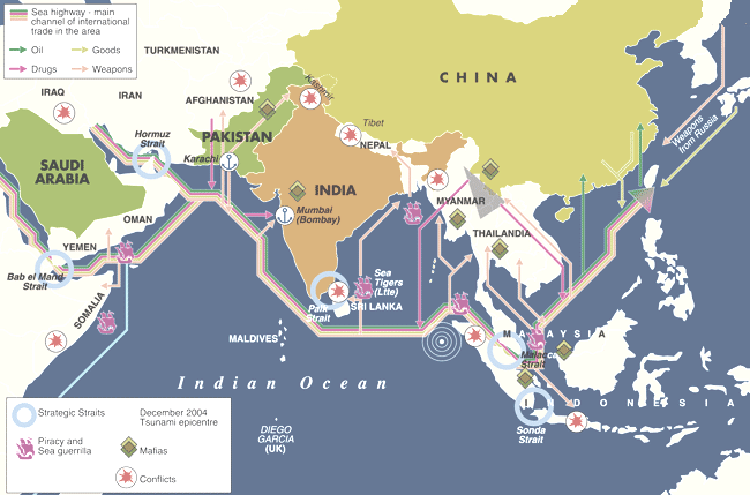
HAMBANTOTA, Sri Lanka: This battered harbor town on Sri Lanka's southern
tip, with its scrawny men selling even scrawnier fish, seems an unlikely focus
for an emerging international competition over energy supply routes that fuel
much of the global economy.
An impoverished place still recovering from
the devastation of the 2004 Indian Ocean tsunami, Hambantota has a desolate air,
a sense of nowhereness, punctuated by the realization that looking south over
the expanse of ocean, the next landfall is Antarctica.
But just over the
horizon runs one of the world's great trade arteries, the shipping lanes where
thousands of vessels carry oil from the Middle East and raw materials to Asia,
returning with television sets, toys and sneakers for European consumers.
These tankers provide 80 percent of China's oil and 65 percent of India's — fuel
desperately needed for the two countries' rapidly growing economies. Japan, too,
is almost totally dependent on energy supplies shipped through the Indian Ocean.
Any disruption - from terrorism, piracy, natural disaster or war - could
have devastating effects on these countries and, in an increasingly
interdependent world, send ripples across the globe. When an unidentified ship
attacked a Japanese oil tanker traveling through the Indian Ocean from South
Korea to Saudi Arabia in April, the news sent oil prices to record highs.
For decades the world relied on the powerful U.S. Navy to protect this vital sea
lane. But as India and China gain economic heft, they are moving to expand their
control of the waterway, sparking a new - and potentially dangerous - rivalry
between Asia's emerging giants.
China has given massive aid to Indian
Ocean nations, signing friendship pacts, building ports in Pakistan and
Bangladesh as well as Sri Lanka, and reportedly setting up a listening post on
one of Myanmar's islands near the strategic Strait of Malacca.
Now, India
is trying to parry China's moves. It beat out China for a port project in
Myanmar. And, flush with cash from its expanding economy, India is beefing up
its military, with the expansion seemingly aimed at China. Washington and, to a
lesser extent, Tokyo are encouraging India's role as a counterweight to growing
Chinese power.
Among China's latest moves is the billion dollar port its
engineers are building in Sri Lanka, an island country just off India's southern
coast.
The Chinese insist the Hambantota port is a purely commercial
move, and by all appearances, it is. But some in India see ominous designs
behind the project, while others in countries surrounding India like the idea. A
2004 Pentagon report called Beijing's effort to expand its presence in the
region China's "string of pearls."
No one wants war, and relations
between the two nations are now at their closest since a brief 1962 border war
in which China quickly routed Indian forces. Last year, trade between India and
China grew to US$37 billion (€24.8 billion) and their two armies conducted their
first-ever joint military exercise.
Still, the Indians worry about
China's growing influence.
"Each pearl in the string is a link in a chain of the Chinese maritime
presence," India's navy chief, Adm. Sureesh Mehta, said in a speech in January,
expressing concern that naval forces operating out of ports established by the
Chinese could "take control over the world energy jugular."
"It is a
pincer movement," said Rahul Bedi, a South Asia analyst with London-based Jane's
Defense Weekly. "That, together with the slap India got in 1962, keeps them
awake at night."
B. Raman, a hawkish, retired Indian intelligence
official, expressed the fears of some Indians over the Chinese-built ports,
saying he believes they'll be used as naval bases to control the area.
"We cannot take them at face value. We cannot assume their intentions are
benign," said Raman.
But Zhao Gancheng, a South Asia expert at the
Chinese government-backed Shanghai Institute for International Studies, says
ports like Hambantota are strictly commercial ventures. And Sri Lanka says the
new port will be a windfall for its impoverished southern region.
With
Sri Lanka's proximity to the shipping lane already making it a hub for
transshipping containers between Europe and Asia, the new port will boost the
country's annual cargo handling capacity from 6 million containers to some 23
million, said Priyath Wickrama, deputy director of the Sri Lankan Ports
Authority.
Wickrama said a new facility was needed since the main port in
the capital Colombo has no room to expand and Trincomalee port in the Northeast
is caught in the middle of Sri Lanka's civil war. Hambantota also will have
factories onsite producing cement and fertilizer for export, he said.
Meanwhile, India is clearly gearing its military expansion toward China rather
than its longtime foe, and India has set up listening stations in Mozambique and
Madagascar, in part to monitor Chinese movements, Bedi noted. It also has an air
base in Kazakhstan and a space monitoring post in Mongolia — both China's
neighbors.
India has announced plans to have a fleet of aircraft carriers
and nuclear submarines at sea in the next decade and recently tested
nuclear-capable missiles that put China's major cities well in range. It is also
reopening air force bases near the Chinese border.
Encouraging India's
role as a counter to China, the U.S. has stepped up exercises with the Indian
navy and last year sold it an American warship for the first time, the
17,000-ton amphibious transport dock USS Trenton. American defense contractors —
shut out from the lucrative Indian market during the long Cold War — have been
offering India's military everything from advanced fighter jets to anti-ship
missiles.
"It is in our interest to develop this relationship," U.S.
Defense Secretary Robert Gates said during a visit to New Delhi in February.
"Just as it is in the Indians' interest."
Officially, China says it's not
worried about India's military buildup or its closer ties with the U.S. However,
foreign analysts believe China is deeply concerned by the possibility of a
U.S.-Indian military alliance.
Ian Storey of the Institute of Southeast
Asian Studies in Singapore said China sent strong diplomatic messages expressing
opposition to a massive naval exercise India held last year with the U.S.,
Japan, Singapore and Australia. And Bedi, the Jane's analyst, added "those
exercises rattled the Chinese."
India's 2007 defense budget was about US$21.7 billion (€14.1 billion), up
7.8 percent from 2006. China said its 2008 military budget would jump 17.6
percent to some US$59 billion (€38.3 billion), following a similar increase last
year. The U.S. estimates China's actual defense spending may be much higher.
Like India, China is focusing heavily on its navy, building an increasingly
sophisticated submarine fleet that could eventually be one of the world's
largest.
While analysts believe China's military buildup is mostly
focused on preventing U.S. intervention in any conflict with Taiwan, India is
still likely to persist in efforts to catch up as China expands its influence in
what is essentially India's backyard. Meanwhile, Sri Lankans — who have looked
warily for centuries at vast India to the north — welcome the Chinese investment
in their country.
"Our lives are going to change," said 62-year-old Jayasena Senanayake, who
has seen business grow at his roadside food stall since construction began on
the nearby port. "What China is doing for us is very good." |