|
India & the
Struggle for Tamil Eelam
 Rajiv
Gandhi's War Crimes Rajiv
Gandhi's War Crimes
நெற்றிக்கண்
திறப்பினும் குற்றம் குற்றமே...உண்மைகள்
ஒருபோதும் உறங்குவதில்லை, உறங்கவும் கூடா...
Truth never sleeps - and it should not...
The Indian Army Launches
Attack This account was written by a Tamil resident in
London, who visited his homeland for the first time after five years and
details the happenings in Jaffna during the period 12 September 1987 to 14
November 1987
Contents
 Trip by train from
Colombo to Jaffna
Trip by train from
Colombo to Jaffna
Indian troops carrying
TV and Video sets
Thileepan's fast
Hartals and peaceful
protests
Thileepan dies and
thousands grieve
But no violent reaction
at funeral
Kumarappa, Pulendran
arrested by Sri Lanka Navy
Arrested LTTE leaders
take cyanide and die
Indian Army Launches
attack
[see also
Lt. Col. Thileepan]
Trip by train from Colombo to Jaffna
This article is written on the basis of
what I saw and heard during my visit to Sri Lanka from
12 September to 14 November 1987. My visit, along with
my family, was hurriedly planned to take advantage of
the 'peace' in Sri Lanka, immediately following the
signing of the Agreement between Prime Minister Rajiv
Gandhi and President J.R. Jayawardene on the 29th of
July 1987. My family and I wished to see our parents and
our friends back at home.
I landed in Colombo on the 12th of September 1987,
clutching in my hands the popular Sri Lankan dailies, 'The
Sun', 'The Island' and the 'Daily News'. They were full of
news about the Indo - Sri Lanka Accord. They were fulsome in
their commendations to Rajiv Gandhi and J.R. Jayawardene.
The Liberation Tigers of Tamil Eelam were also give
prominent treatment
From Colombo, we travelled by train to Jaffna. We were
told that the direct trip to Jaffna by train was only made
possible after the Accord and that even now, the full
journey to Kankesanturai (the usual last stop of the Jaffna
train) was not possible because of damage to the railway
lines between Jaffna and KKS The train was packed and I
found a good number of public servants returning to Jaffna
for the week end to visit their families.
Everything looked new and different to me after five long
years since my last visit. However, I managed to locate a
few persons from my village, whom I knew and through them I
was introduced to others in the carriage. Some of them said
that we were the lucky ones, because we could afford a home
abroad away from all the miseries in the Island. When
questioned about the situation in Jaffna, they came out with
their experiences of unspeakable horror and their feelings
of sudden relief immediately after the signing of the
Accord. They spoke about 'Operation Liberation' of the
26th of May, and 'Operation Poomalai' of the 4th of June and
the courageous and dedicated stand taken by the LTTE to
preserve their heritage. But when asked whether the
Accord would work, some sighed and gave a smile; some said,
'well'; a few said 'no comments'; one or two said, 'they
will make it work whether we like it or not'; and others
said 'enough is enough, let us not talk of the past'. None
of them were sure of the future.
Jaffna was peaceful when I arrived. As usual, the station
was noisy but with one difference - and that was my first
sight of the Indian Army (the Indian Peace Keeping Force -
IPKF) carrying SLRs and AK47 machine guns. As we moved away
from the Jaffna railway station towards Vaddukoddai we saw
more and more Indian troops carrying weapons at main cross
roads, inside the Bank of Ceylon premises opposite the
Jaffna Provincial Hospital, opposite Sivan Kovil near
Vannarponnai and so on. But I noticed that there were
practically no troops outside the Jaffna Municipality
limits.

Indian
troops carrying TV and Video sets
After arriving at home, I used to visit Jaffna town daily
to meet my friends and relations. The town was crowded with
shoppers, pedestrians and cyclists. If one had to move
about, the cheapest mode of transport was the minibus or
else, cycling which had no cost associated with it. There
was also a noticeable number of brand new Japanese cars on
the roads. These cars, I was told, emerged only after the
Accord. The shops were crowded.
Here and there, I saw Indian soldiers carrying TV and
Video sets on their shoulders to their parked trucks and
jeeps. I was told that those who sell electrical goods were
thriving in their business because of the presence of the
IPKF.
I noticed the frequent use of the terms 'development' and
'rebuilding' in discussions amongst NGOs, academics,
political activists, students, religious circles, business
people and others - development and rebuilding of schools,
industries, housing, transport, tourism, towns and cities.
There was a noticeable optimism among most people in Jaffna
following the signing of the Accord. There was a lull in the
terror and violence which had reigned over the North and
East for previous four years.
Everyday, the newspapers carried sensational investment
proposals for the North and East. There was news of foreign
missions visiting the North and East and promising aid in
millions of rupees. I heard local development planners
talking seriously of building a new town in Nallur, a new
city in Vadamaratchi, a modern capital for the Tamils in
Trincomalee, and a highway from Point Pedro to Trincomalee
by the coastline. Money was promised for every thing from
orphanages to building new cities; from rehabilitation to
resettlement.
Thileepan's fast
However reports reaching Jaffna indicated that the East
was not fully free from unrest. There were reports of
arrests, torture and killing by the Sri Lankan Security
Forces But, things were going relatively smoothly until the
15th of September, when it was announced that the LTTE
leader of the political wing in Jaffna, Thileepan, had
commenced a fast unto death campaign at 9.30 a.m. in front
of the historic Nallur Murugan Temple in protest against
- the failure to effectively implement the promises in
the Accord;
- the accelerated state aided Sinhala colonisation in
the Eastern Province;
- the continued detention of Tamil prisoners under the
Prevention of Terrorism Act;
- the failure of the Home Guards to surrender their
arms;
- the failure to close army and police camps situated
in Tamil areas; and
- the delay in setting up an interim administration
for the North and East.
Hartals and peaceful protests
The fast picked up momentum day by day and it became
the issue in everybody's mind as the days passed by. We
received reports that more and more people were joining the
fast. One lady teacher named Subashanthini Rajasundaram
started her fast in support of Thileepan's protest, sitting
next to him on the 17th of September and I was informed that
five others had joined the fast at Valvettiturai junction on
the 18th of September and so on. I later received reports
that such fasts had been spreading in the mainland as well -
in places like Chavakacheri, Mullaitivu, Batticaloa, and
Trincomalee.
There were hartals and protest marches organised by the
LTTE. The schools and colleges were closed and students
organised marches to Nallur and picketed the Indian military
camps. During the hartal all shops were closed and the
public was encouraged to attend pickets and rallies. I
saw thousands of men, women and children joining pickets and
rallies. All forms of transport, cars, vans, cycles, mini
buses, government buses, bullock carts, scooters and motor
cycles were used to move people around.
All the Tamil dailies in the North began to highlight the
fast and associated events. Surprisingly, the media in the
South (of Sri Lanka) was silent on the whole issue - the
dailies did not carry the news and the TV and radio blacked
out the fast and the protest movement. However in the North,
everybody tried to see LTTE's TV transmission named
Nitharshan which gave a day by day account of the events. As
days passed by, the deterioration in Thileepan's health
caught the headlines of the Tamil dailies. Coloured posters
began to appear in all the villages. Loudspeaker fitted cars
and vans were seen in villages making announcements on the
fast and asking public to picket IPKF camps and appeal for
justice.
I was informed that there had been a skirmish on the 16th
of September between the public and the IPKF at Neervelli
when a jeep carrying IPKF personnel had been carelessly
driven at a picket line - and two women had been knocked
down. The public gathered and surrounded the jeep and
assaulted the IPKF officers. Three of them were tied up and
thrown to the road. They were later released when a higher
ranking officer intervened and gave an assurance that an
inquiry would be held. On the same day, people who went to
picket outside the old Dutch Fort military camp, had entered
the recently opened Pannai Police Station in Jaffna,
ransacked the whole place, and tore off the uniforms of the
Police Officers. The police station was forcibly shut and
the police officers took refuge in the Fort military camp I
felt the tension mounting day by day.
Thileepan dies and thousands grieve
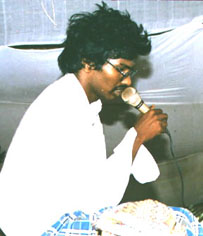 The
Citizen Committees, trade unions, students unions, teachers
associations, religious leaders, all held meetings and
discussed the issues relating to Thileepan's fast and passed
resolutions and submitted memoranda to the overall commander
of the IPKF, Lt. General Depinder Singh requesting the
Indian representatives to intervene and stop the fast and
initiate immediate efforts to set up the interim
administration in the North and East. But nothing moved
fast enough to stop Thileepan's death. Thileepan died on the
26th of September 1987. There was widespread grief in
the North. There can be little doubt that Thileepan's
martyrdom had a profound effect on every Tamil soul in Sri
Lanka. Thousands of people from the North and East poured
into Jaffna as the news of his death spread. The
Citizen Committees, trade unions, students unions, teachers
associations, religious leaders, all held meetings and
discussed the issues relating to Thileepan's fast and passed
resolutions and submitted memoranda to the overall commander
of the IPKF, Lt. General Depinder Singh requesting the
Indian representatives to intervene and stop the fast and
initiate immediate efforts to set up the interim
administration in the North and East. But nothing moved
fast enough to stop Thileepan's death. Thileepan died on the
26th of September 1987. There was widespread grief in
the North. There can be little doubt that Thileepan's
martyrdom had a profound effect on every Tamil soul in Sri
Lanka. Thousands of people from the North and East poured
into Jaffna as the news of his death spread.
But no
violent reaction at funeral
Judging by past events, everyone expected a violent
reaction in the North and East, following Thileepan's death,
but to everybody's surprise the funeral turned into a
peaceful day of mourning. The LTTE members moved in
decisively to curb any kind of violence. They moved all
state owned buses into depots and guarded them. They also
provided cover to government institutions after some
attempts had been made to set fire to them. The Tamil daily
Eelamurasu as well as the TV Nitharshan carried the LTTE
leader,
Prabakharan's appealed to the people not to destroy or
damage public property, as this was the property of Tamil
Eelam. Black flags were seen everywhere - on the roads,
in houses, churches, temples, trees, public buildings and so
on Thousands of sobbing men, women and children followed the
body covered with the red flag of the Tigers with their
emblem on it. Thileepan's body was taken on a decorated van
through the villages for the people to pay their homage and
finally taken to Suthumalai where it was kept for the people
to pay their last respects. I was later informed that his
body was donated to the medical faculty of Jaffna
University. The LTTE said that this had been his last wish.
Thileepan's death brought sadness and sorrow and also
fear to many people. Most of them had genuinely believed
that the Indians would intervene and stop the disaster. They
began to have doubts about India's conduct. They began to
say 'this could have been avoided' and 'India should have
moved fast' and 'India should not have let this happen' and
so on. The Tamil dailies began to carry articles criticising
the handling of the whole issue by the Indians. I could feel
the tension mounting.
Kumarappa and Pulendran arrested by Sri Lanka Navy
Following the death of Thileepan all other fasts were
called off.
But on the 3rd of October came the event which was
destined to trigger off the final collapse of the Indo Sri
Lanka Accord. The Sri Lanka Broadcasting Corporation and
the Tamil and English dailies announced the headline news:
two LTTE leaders, Kumarappa and Pulendran along with 12
others had been arrested by the Sri Lankan Navy and they
were being held in the Army camp at Pallali. Panic struck
Jaffna. There were rumours that the arrested leaders were
severely tortured by the Sri Lankan security forces and that
President Jayawardene had ordered their removal to Colombo
for further interrogation.
The Tamil dailies carried head lines stating that the
Indian military officers and high officials of the Indian
High Commission had recommended the release of the captives
but that this had been over ruled by the Sri Lankan
government. I saw messages appearing on the LTTE's giant
blackboards at cross roads. There were reports that
negotiations were underway for the release of the two
leaders and the others who had been captured. This issue
became the talk of the town. There was a big demand for
Eelamurasu, the Tamil daily that was published by the LTTE
in Jaffna From that which appeared in the Tamil dailies, I
gathered that much discussion and behind the scene political
moves were taking place daily for the release of the
captives.
Arrested LTTE leaders take cyanide and die
But, suddenly, on the 5th of October, there was an
announcement from local loud speaker carriers that all the
captives, including the two leaders had taken cyanide and
killed themselves. This according to the announcement, was
to avoid torture and removal to Colombo. There was
noticeable panic everywhere. I saw black flags coming up
again and people standing at their gates to listen to the
latest news from passers by. I saw the tension mounting and
I felt a sharp deterioration in the overall situation in the
peninsula.
Indian
Army attacks
On October 10th, while I was on my way to Jaffna town,
I was told that the IPKF had gone and blasted the premises
of 'Eelamurasu' and damaged the buildings of 'Murasoli' and
arrested all the employees. These attacks were reported to
have taken place at 1a.m. and 6 a.m. respectively. And at
6a.m., LTTE's TV station at Kopay was damaged by the IPKF
and the equipment and machinery was removed. These actions
by the IPKF were seen as unwarranted and they led to the
LTTE taking up arms again.
As I neared Jaffna town, I saw vehicles carrying bands of
young men in and out of the town. It was exactly 12.55 p.m.
on the 10th of October that the bloody war started near
Jaffna Central College. There was heavy firing which
continued at least for about 40 to 45 minutes. Jaffna town
was heavily crowded with people and all were taken by
surprise, not knowing what was going on and which direction
to flee. Mini vans packed with people fled from the main bus
stand. Cyclists rolled one top of another, desperately
trying to get onto the road. Pedestrians took to their heels
and ran wildly in all directions. There was total
pandemonium. I managed to get behind a crowd fleeing north
and finally reached Vannarponnai, a village in the outskirts
of Jaffna town. From there, I wasted no time in getting back
home before the violence spread.
The next day I decided to get back to Jaffna to see what
had happened. I did not know that a curfew had been
declared. Like me, there were several others who were
cycling together from Vaddukodai to go to Jaffna town.
Everything looked normal. There were people on the road and
here and there we saw vehicles moving on the road. Nothing
seemed different until we reached Oddumadam which is small
village on the outskirts of Jaffna town. We were stopped by
young Tigers and some other people living in Oddumadam and
asked to get back home. We heard loud explosions coming from
the direction of the town.
According to those who stopped us, there was continuous
shelling from the Dutch Fort by the Indian Army 'They are
blowing up the town' said the old folks. 'You can't go
in now' said the Tigers, all carrying weapons in their
hands. We saw a helicopter which appeared to be coming
from Karainagar. We ran into a nearby house and after the
helicopter disappeared we were asked to return home
immediately. We took no chances. We returned home
There was no news about the incidents in Jaffna except
that which said in the Sri Lankan government's news
bulletins relayed by the SLBC, the newscast on All India
Radio and the Manila Cheithigal (the Regional News) from
India. But, the Tigers continued to release 'Eelamurasu'
which came in a single sheet, and it was hard to obtain.
Only a few copies were available in the Vaddukodai area and
they were sold very quickly. It was sold at Rs.1/50 per copy
and people were willing to pay double to get a copy. It was
the only source available to read 'the other side of the
story'
The electricity supply was cut off and there were no
lights throughout Jaffna from 10th October until our
departure on the 14th of November. Everybody rushed to
buy batteries for their radios, but batteries were difficult
to find. We were told that the LTTE were buying batteries in
bulk. Further inquiries revealed that the batteries were
used for land mines. Without good batteries, the BBC World
Service and the BBC Tamil Osai were hard to receive. News
carried by people living in the immediate environs of Jaffna
town was the only source of information available as to what
was going on inside Jaffna. We heard frightening stories
about killings in Jaffna. We approached the LTTE sentries
for confirmation of some of the information that we had
received, but they refused to comment.
'The situation is bad and explosive. The Indians have
betrayed us. They are killing civilians and they are firing
motor shells indiscriminately into the civilian population
constantly from the Fort and other military camps', they
remarked. |