|
EUROPEAN UNION & THE TAMIL STRUGGLE
EU Contribution to the Peace Process in
Sri Lanka
Symposium in the European Parliament
Organised by the Tamil Centre for Human Rights
7 March 2006
The Paris based
Tamil Centre for Human Rights organised a symposium
on the EU Contribution to the Peace Process in Sri Lanka in
the European Parliament on 7 March 2006. The Symposium was
chaired by a Member of the European Parliament (MEP), Robert
Evans of the Labour Party from the U.K. Dr Brian Seneviratne
from Australia, Mr Gajendrakumar Ponnambalam, lawyer and
Tamil National Alliance Member of Parliament of Sri Lanka
for Jaffna and Ms. Deirdre McConnell, the International
Programme Director of the TCHR spoke. The Panel also
included Mr. Douglas Wickramasinghe, who represented a
hardline Sinhala view countering the pro-Tamil panelists.
 Deirdre
McConnell, Director – International Programme, Tamil
Centre for Human Rights - TCHR
Deirdre
McConnell, Director – International Programme, Tamil
Centre for Human Rights - TCHR
Gajendrakumar
Ponnambalam MP, Lawyer and Member of Sri Lankan
Parliament
A Sinhala
Perspective - Brian Senewiratne
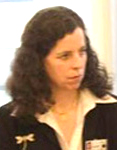 Ms.
Deirdre McConnell, Director – International Programme Ms.
Deirdre McConnell, Director – International Programme
Tamil Centre for Human Rights - TCHR
I have been been involved in Human Rights advocacy, since
the days of Anti-Apartheid campaigning. Many people,
world-wide, from diverse backgrounds worked together in that
cause for justice and human rights, in solidarity with the
oppressed. A racist regime that persecuted and vilified
those who opposed it, was eventually overcome.
It was after hearing about grave human rights violations in
Sri Lanka that I made fact-finding missions to the island.
In 1989 I was involved in highlighting the atrocities
committed against the JVP youth in the South of the island.
After that period I continued to work on the human rights
situation in the island, concerning the conflict in the
NorthEast.
During four extended visits I have covered many parts of the
island from Kankesanthurai (KKS) in the North to Galle on
the Southern tip, from Colombo to Up country, Kandy, to the
East, to Batticaloa and Trincomalee. I have had the
opportunity to meet and interview victims of human rights
violations, Human Rights Defenders and many members of civil
society.
The concern I bring to this august forum, is that whilst the
EU has shown support towards the peace process, there are
extremely important facts which do not appear to have been
taken into consideration, when the EU made its decision on
27th September last year. In fact
TCHR made an appeal listing these facts. Due to time
limitations it is not possible to refer to all of them here.
The unequivocally corroborated evidence of
systematic human rights violations; arbitrary arrests,
torture,
rape,
disappearances and extra-judicial killings of Tamils are
well-documented by the United Nations human rights
mechanisms of the UN Commission on Human Rights, the
Sub-Commission on Promotion and Protection of Human Rights,
Special Rapporteurs, Treaty body Committee meetings and so
on. To illustrate my point briefly, here are two examples.
Firstly, the UN Special Rapporteur on extrajudicial, summary
or arbitrary executions, Mr. Bacre Waly Ndiaye, visited Sri
Lanka and
stated in his report :
“Of particular concern are the emergency
regulations governing arrest and detention procedures
and those governing post-mortems and inquests when
deaths have occurred in custody or as a result of the
official action of the security forces. The regulations
still provide for indefinite preventive detention on
renewable, three monthly detention orders. Sri Lanka has
been under an almost continuous state of emergency since
May 1983…. Official emergency measures override the
safeguards contained in the normal law and have granted
sweeping powers to the security forces. In addition,
there have been repeated allegations of intimidation of
lawyers, relatives and others attempting to take
remedial action through the courts". He stated that
“This culture of impunity has led to arbitrary killings
and has contributed to the uncontrollable spiralling of
violence”. (Excerpts, CN.4/1998/68/Add.2 - 12 March 1998
para 73)
A second example is that the
UN Working Group on Disappearances stated that,
"Sri Lanka had the second highest
number of disappearances in the world, ranking next to
Iraq". Sri Lanka was the only country that the UN
Working Group on Disappearances has visited three times.
So far no proper remedies have been found for these
disappearances. It is well known in human rights
terminology that “disappearance”, is actually equivalent
to extra-judicial killing.
As far as the political killings in Sri
Lanka are concerned, the UN Special Rapporteur on
extra-judicial killings and international human rights
organisations know that killings in Sri Lanka where the
government has been suspected of involvement, have neither
been properly investigated nor have the culprits been
brought to justice.
Indeed it really does seem very bizarre that there has been
no Resolution in either the UN Commission on Human Rights or
the Sub-Commission for nearly twenty years. This is due to
the heavy lobby conducted by the Sri Lankan state.
What happens to all the facts documented in the UN system?
They do not appear in the international media, due to this
heavy lobbying. For instance, take the
Sri Lankan media, such as the English media in Colombo,
all the newspapers (except one, which also has reservations)
do not publish much on these facts and figures concerning
the reality of the conflict in Sri Lanka.
When we come to the news agencies based in Sri Lanka, and
look at the people responsible for them, the vast majority
of the international correspondents are Sinhalese. In other
words, the same as the journalists of the Colombo papers.
Therefore the international media coming from Colombo is not
independent, it is not unbiased.
Not that I am saying it is because they are Sinhalese the
media is biased, but it is a question of how the majority of
Sinhalese see the conflict in Sri Lanka – except a handful
of Sinhalese who analyse and see the root causes of the
conflict.
Many Sinhalese people see the situation in a racist manner.
We can see this, for example, in the statements by
Mr Mahinda Rajapakse the President, the
JVP and the JHU who insist that the “Unitary State”
gives no chance for any federalism or recognition of the
right to Self-determination of the Tamil people. When we
look at the voting – all over the island, except the
NorthEast, Mahinda Rajapakse won more votes than his
opponent. One needs to look at the dynamic of the Sinhala
polity, regardless of the Tamil people’s boycott. The
Sinhalese voted for the racist view.
What I want to say here, is that the facts are not coming
out of the island because of government manipulation of the
international news agencies. There is, and has been for many
years, biased reporting by Sinhalese working for these
agencies. Also we should not miss the point that Sri Lankan
Embassies and High Commissions in foreign countries carry
out heavy lobbying, spending a huge sum of money on hiring
private organisations to do their propaganda work. So-called
independent international journalists, mentioned earlier,
working with international news agencies have been hired as
“communication experts” by the High Commissions themselves,
to work with “opinion makers” and spin stories.
So what is happening? International institutions are given
misinformation which is passed off as fact, lies dressed
up as truth and because of this state-sponsored propaganda,
the misinformation is taken up very well by anyone who has
not looked deeply into the real issues. So the Sinhalese
government uses its power as a recognised state to provide
only its version of events in official places where there is
no right of reply.
In addition, as a temporary solution, nowadays the Sri
Lankan government has sponsored a few Tamil groups in
foreign countries, to distribute the government’s facts and
figures. Actually, the real information is not given to the
international institutions by the government or government
sponsored groups.
With all this, certain groups, like
Tamil Centre for Human Rights manage to distribute
information into certain international institutions and
mechanisms of human rights bodies. Even these officially
published documents are not taken up by the media, because
of the effects of the lobby of the Sri Lankan government.
This has been the case during the twenty years of the
conflict and also during the four years of the Ceasefire.
Certain things have changed but STILL the Sri Lankan
government lobby works effectively internationally.
I have been to the areas of the Tamil homeland. I know the
situation, I have seen and listened to the victims of rape,
torture and arbitrary arrest, the kith and kin of the
disappeared and extra-judicially killed. When we brought
these facts, wanting to give them to certain groups, we had
difficulty contacting them, getting appointments and giving
the information to governments and to international
institutions.
But for the Sri Lankan government which clearly wants to
hide the truth, it is easy as a recognised state to arrange
appointments, to meet with the most senior people in
international institutions. Then, during the appointment,
government representatives give exactly the opposite version
of the reality.
So this important aspect has to be taken very seriously by
all international politicians and diplomats, like yourselves
in the European Union and others.
A government perpetrating genocide on a
people, does its maximum to divert attention from the
reality of the situation and does everything in its
power to prevent other countries from intervening to
stop the genocidal onslaught. This is the dynamic we are
dealing with.
It is tragic, to have to highlight the fact
that Human Rights Defenders who attended international
forums to explain the human rights situation in Sri Lanka
are not spared by the government of Sri Lanka. Prominent
Lawyer
Mr. Kumar Ponnambalam, veteran journalists
Mylvaganam Nirmalarajan,
Aiyathurai Nadesan,
Dharmaretnam Sivaram "Taraki",
Joseph Pararajasingham MP and many others have been
brutally assassinated. Until today none of these killings
have been properly investigated nor have the culprits been
brought to justice. They continue in service unpunished.
Mr. Kumar Ponnambalam participated in the UN Commission on
Human Rights in Geneva and EU forums in Brussels and
Strasbourg. Mr. Dharmaretnam Sivaram "Taraki" was briefing
the US state department and many other international forums.
Mr. Joseph Pararajasingham who had been to Australia, New
Zealand, US, Canada, Switzerland, Britain, France and many
other countries and met with several dignitaries is the
latest victim. He was shot dead during Christmas Eve
midnight mass in his home town two months ago.
The killing of Human Rights Defenders continues with
impunity in Sri Lanka.
When the human rights violations escalated in
genocidal proportions in 1983, if the international
community had looked into the root cause of the problems,
rather than helping Sri Lanka militarily, today the island’s
history would have been very different. The international
community openly gave military equipment, training and
advice to the Sri Lanka government contributing in part to
the causes of today's violations in that island.
There is a chance now to respond in a different, more
positive way, building towards a future of peace with
justice. We urgently appeal that the
EU
decision of 27 September be immediately reconsidered and
overturned, in the interests of peace and humanity. Thank
you.
 Gajendrakumar
Ponnambalam MP, Lawyer and Member of Sri Lankan
Parliament
Gajendrakumar
Ponnambalam MP, Lawyer and Member of Sri Lankan
Parliament
- Tamil National Alliance (TNA)
* Article 1.8 of the
CFA entered into by the LTTE and the GOSL mandates
GOSL to dismantle all paramilitary forces, this did not
take place
* LTTE and the GOSL held talks in
Geneva on the 22nd and 23rd of February this year,
however, incidents targeting Tamil civilians have
continued
* The Tamil Nation is being
consistently denied meaningful access to Governance to
pursue their political, economic, social and cultural
development
* To heap the LTTE with terrorist
organizations is not only unacceptable to the Tamil
people but will also embolden an intransigent and
defaulting Sri Lankan State to continue to deny the
Tamil Nation its right to self-determination.
Article 1(2) of the UN Charter provides that one of the
purposes of the UN is “To develop friendly relations among
nations based on respect for the principles of equal rights
and self-determination of peoples”.
Article 55, concerning Economic and Social Cooperation,
instructs the UN to promote higher standards of living,
solutions to health and cultural problems, and universal
respect for human rights “with a view to the creation of
conditions of stability and well-being which are necessary
for peaceful and friendly relations among nations based on
respect for the principle of equal rights and
self-determination of peoples”.
Subsequently the
1960 Declaration on the Granting of Independence to Colonial
Countries and Peoples in Article 2 states,
“All peoples have the right to
self-determination; by virtue of that right they freely
determine their political status freely pursue their
economic, social and cultural development”.
The Declaration also adopts a functional
definition of colonialism, speaking of colonialism in “all
its forms and manifestations”. Thus, it does not limit
itself by its express terms, to the subjugation of
non-European peoples by Europeans. Rather, it undertakes a
practical approach in which the emphasis is upon the fact of
subjugation by a racially or ethnically distinct group,
which need not be European. Clearly, as long as peoples
living within independent states continue to suffer the same
ills and consequences under their new rulers that they
suffered under traditional colonialism then the principle of
self-determination retains its applicability.
By 1966, the right of peoples to self-determination had
made its appearance in the two
International Covenants on Human Rights as a free
standing maxim, beyond the confines of normative practices
on decolonization. The provision in
Article 1 of both Covenants was significant because for
the first time, the right of self determination had been
formulated within a universal document concerning human
rights, which recognized the legal obligations of the state
parties to it.
Of crucial importance to understanding
of the present status of the right to self-determination
outside of the decolonization era is the
General Assembly’s 1970 Declaration on Friendly
Relations and Co-operation among States. Paragraph 7 which
deals with the maintenance of territorial integrity, has
been interpreted to recognize the legitimacy of secession
under certain circumstances.
The first part of
paragraph 7 warns that nothing in the foregoing text should
be construed as authorizing or encouraging the dismemberment
or impairment of the territorial integrity or political
unity of sovereign and independent states. Paragraph 7,
however, implies that not all states will enjoy this
inviolability of their territorial integrity, but only those
states “conducting themselves in compliance with the
principles of equal rights and self-determination of peoples
as described above”. In a telling final clause, paragraph 7
offers a partial definition of the meaning of the compliance
provision, by stating “and thus possessed of a government
representing the whole people belonging to the territory
without distinction as to race, creed or color”.
The
notion embodied in this final clause is clearly, that the
legitimacy of government derives from the consent of the
governed and that consent cannot be forthcoming without the
enfranchisement of all segments of the population. By
placing the language at the end of the paragraph 7 in the
form of a saving clause, the Declaration affirmed the
concept of “consent of the governed”. Therefore, if a
government does not represent all of its peoples it is
illegitimate and thus in violation of the principle of
self-determination, and this illegitimate character serves
in turn to legitimate “action which would dismember or
impair, totally or in part, the territorial integrity or
political unity” of the sovereign and independent state.
So clearly, the Declaration on Principles of
International Law concerning Friendly Relations and
Co-operation among States clarified and reconciled the
different approaches to the right to self-determination, as
espoused over the preceding years in the various UN
resolutions and international instruments. It instilled the
primacy of seeking an improvement of the condition of
individuals and minority nations within multi-national
states, by subjecting those states to external international
pressure. It clearly inverted the movement to establish
self-determination as a human right along with others, such
as the establishment of a representative government, to be
observed when acting in compliance with the principle of
self-determination. And finally, it reinforced the right to
self-determination by brandishing a legitimization of
secession where the coercive force of international opinion
was insufficient to moderate a state’s internal policies.
It is also relevant to recall the decision of the Supreme
Court of Canada in the case relating to the secession of
Quebec. The Court ruled, and I quote:
“The International Law right to
self-determination only generates at best a right to
external self-determination, in situations of:
1.
former colonies,
2. where a people is oppressed as
for example under foreign military occupation, or
3.
where a definable group is denied meaningful access to
Government to pursue their political, economic, social
and cultural development.
In all three
situations the people in question are entitle to a right
to external self-determination because they have been
denied the ability to exert internally their right to
self-determination”
The Court further ruled and I quote “that
such exceptional circumstances are manifestly inapplicable
to Quebec under existing conditions” unquote.
In the
island of Sri Lanka however, unlike in Quebec, a definable
group, the Tamil Nation, is being consistently subjected to
the hegemony of the Sinhala Nation. The areas of historic
habitation of the Tamil speaking people is being oppressed
by the occupation of the Sri Lankan State’s armed forces
which is 99% Sinhala in composition. And the Tamil Nation is
being consistently denied meaningful access to Governance to
pursue their political, economic, social and cultural
development. This was the clear impact of all three
constitutions in Sri Lanka, which in the face of the demand
for power sharing arrangement as a form of satisfying the
Tamil Nation’s right to self-determination, entrenched
the unitary character of the Sri Lanka State.
The
mandate obtained by the Tamil National Alliance (TNA) has
been yet another demonstration of the consistent Will of the
Tamil Nation to exercise its right to self-determination.
The expression of this Will
has been loud and unambiguous over the last fifty years,
and remains today the bulwark of the legacy of the Tamil
National liberation struggle.
Whilst the Tamil
People have repeatedly stated that we are prepared to arrive
at a negotiated solution that gives expression to this
legacy, and at the same time not divide the country, the
systematic undermining of this Will has accentuated and
aggravated the Tamil National question into what it is
today.
Sovereignty, vests with the Peoples of each
state. By extension, it is only when the Sovereign Will of
all the Peoples of a particular state finds expression in
the structure of the state, can it be said that the state
belongs to all its Peoples. The Sri Lankan state as it
exists today, only gives expression to the Sovereign Will of
the Sinhala People, and continues to undermine and reject
the Sovereign Will of the Tamil People. And as such, the
Sovereignty of the Tamil People does not vest in the Sri
Lankan state, and accordingly the Tamil People show no
loyalty to the Sri Lankan state. Loyalty is a sentiment, not
a law. It rests on love, not on restraint. The governance of
the Tamil Nation by the Sinhala Nation rests on restraint,
and not on love; and since it demands no love, it can evoke
no loyalty.
The contradictions between the Will of
the Tamil People, and the actions of successive governments,
have continued for quite long and surely cannot continue
indefinitely. The concept of Sovereignty being vested in the
people, has no meaning as far as the Tamil people are
concerned, if their Will as expressed at successive
elections, does not give them, an effective say in
governance, in keeping with the Will expressed. The Will of
the Tamil people is that their right to self-determination
in their area of historical habitation – the Northeast, be
accorded due recognition, so that they can pursue their
political, economic, cultural and social development in
keeping with their own wish. The right to self-determination
has been consistently denied to the Tamil people. Despite
the clear expression of their Will at successive elections
they continue to be powerless in regard to the management of
their own affairs. Nothing can be more humiliating to the
Tamil psyche than the non-recognition of their collective
Will. This situation if continued will have serious
repercussions.
Whilst this be the sad reality faced
by the Tamil People for over fifty years, which led to the
cry for the establishment of a separate state in the area of
historic habitation of the Tamil speaking people in the
Northeast of the island of Sri Lanka. And despite this
National Liberation struggle led by the
Liberation Tigers of Tamil Eelam (LTTE) reaching the
position of having won over physical control of nearly 70%
of the Tamil Homeland, even in this late hour the Tamil
Nation has demonstrated its desire to find a viable
alternative to a separate state by entering into a Ceasefire
Agreement with the Sri Lankan State just over four years
ago. The reaction of the Sinhala Nation has been to elect a
President as recently as November 2005
whose express policy
for which an overwhelming majority of the Sinhala people
have voted was to:
- Uphold the Unitary structure of the
state;
- The rejection of concepts of power sharing,
federalism and self-determination;
- The refusal to
recognize the areas of historical habitation of the
Tamil speaking people.
There can be no doubt in anyone’s mind that
the cumulative effect of these policies will be to shut the
door on any possibility of finding a negotiated solution to
the Tamil National question.
Not only has the last
four years of the peace process demonstrated a complete lack
of will by the Sinhala Nation to accept the Tamil Nation’s
legitimate and just political aspirations as recognized by
International Law, but rather has been systematically been
undermining the collective will of the Tamil people not only
politically but militarily as well.
Whilst
Article 1.8 of the CFA entered into by the LTTE and the
GOSL mandates GOSL to dismantle all paramilitary forces,
this did not take place. On the contrary, the Sri Lankan
Armed Forces have been protecting and promoting new
Paramilitary Forces. This has resulted in killings and grave
incidents that are seriously jeopardizing the CFA. These
incidents continue to date.
Furthermore, over the
last few months, over 40 Tamil civilians have been killed
within the Jaffna district, around 20 Tamil civilians have
been killed in other districts in the North-East, around 50
Tamil civilians have disappeared or gone missing in the
North-East, Tamil civilians are being increasingly
manhandled and assaulted in the North-East, Tamil civilians
in the North-East are being threatened and intimidated,
Tamil civilians are being deprived of the opportunities to
carry on their occupation particularly farming and fishing
and Tamil civilians due to the above stated reasons have
begun to flee to India and to seek refuge in L.T.T.E
controlled territory and Public buildings in their
respective districts.
In particular:-
(1)
Mr. Joseph Pararajasingham a senior Member of Parliament
of the TNA was gunned down within the premises of the St.
Mary’s Roman Catholic Church at Batticaloa in the early
hours of 25th of December 2005 on Christmas night while he
was at prayer. The road leading to the church was manned by
armed forces while police personnel were on duty outside the
church. This is in Government controlled territory. It is
clear that the assailants carried out the assassination with
the involvement of some section of the security forces.
Though the identity of at least one assailant is
ascertainable, no steps have been taken to apprehend anyone.
(2) Five innocent Tamil youth, all students engaged in
higher education
were deliberately shot and killed in cold blood at
Trincomalee by an identifiable group of the security forces
sent to Trincomalee around 7.45 pm on 2nd of January 2006.
This was in Government controlled territory. On the evidence
available, both direct and circumstantial, the offenders can
be identified and brought to justice. The judicial inquest
has ruled that these young men came by their death as a
result of gun shot injuries.
(3) On the night of the
16th January at Manipay, Jaffna within Government controlled
territory members of the security forces and Tamil
paramilitary groups functioning together have shot
five members of a family, three of them fatally, while
the other two have been admitted to the Jaffna General
Hospital with grave injuries. This was an unwarranted attack
on a Tamil civilian family. The father Mr. Bojan was the
president of the Northern Region Scouts Association.
(4) On the 23rd of December 2005
four Tamil civilians were shot and killed and the bodies
burnt in their house by security forces at No: 44, Victoria
Housing Scheme at Pesalai, in Mannar. The four persons
belonged to one family, father, mother, son and daughter.
This was an unwarranted attack by the security forces
against the Tamil civilian family, within Government
controlled territory, The daughter of the family was only
four years old.
The above stated matters reveal that
the Tamil civilian population in the North-East is facing a
grave and serious situation.
Members of the Tamil
civilian population have been indiscriminately arrested in
large numbers, many females in their night clothes without
any reasonable suspicion or justifiable reason, purely on
the ground of their ethnicity, photographed in their night
clothes and released after questioning at various Police
Stations. This is a blatant violation of their fundamental
human rights. This has happened in the Colombo city. Tamils
in the up country areas have been similarly arrested.
The excessive presence of the Armed forces in Tamil civilian
inhabited areas in the North-East particularly in Jaffna and
in Trincomalee is most oppressive and humiliating to the
Tamil people. In Trincomalee this situation has continued
for more than the past eight months causing immense
inconvenience and discomfort to the Tamil civilian
population.
Even though the LTTE and the GOSL held
talks in Geneva on the 22nd and 23rd of February this year,
however, incidents targeting Tamil civilians have continued,
with several people having been killed, and several people
having disappeared. One being,
ten staff members belonging to the Tamil Rehabilitation
Organization being abducted by paramilitary forces, just
100 meters from the Government armed forces checkpoint in
Welikanda, soon after registering at the said checkpoint. Of
the ten abducted, three workers were subsequently released.
The other seven continue to be missing. There is no doubt
that paramilitary forces and sections of the armed forces
are responsible for these continuing incidents. The LTTE too
continues to be targeted by the paramilitary Forces working
in collaboration with the Government Armed Forces. As
recently as last Saturday, two LTTE cadres were killed when
an LTTE sentry situated in Vavunativu in Batticaloa was
attacked.
In this most uncertain backdrop, the international
community and the European union in particular has a very
important role to play. It is time for the world community
to live up to its obligations under International Law and
recognize that the over fifty year struggle of the Tamil
Nation has the sanction of International Law. That the Sri
Lankan State continues to be the defaulting party as far as
finding a solution to the conflict is concerned.
It is also time that the International
Community distinguishes a legitimate National Liberation
movement like the LTTE from organizations like Al-Quaeda. To
heap the LTTE with
terrorist organizations is not only unacceptable to the
Tamil people but will also embolden an intransigent and
defaulting Sri Lankan State to continue to deny the Tamil
Nation
its right to self-determination. Such a denial can only
result in one thing, and that is the serious escalation of
the conflict and nothing less.
A Sinhala Perspective -
Brian Senewiratne
MA(Camb), MBBChir(Camb), MBBS Hons(Lond)
MD(Lond), FRCP(Lond), FRACP
Consultant Physician, Brisbane, Australia
When the
Tamil Centre for Human Rights (TCHR) suggested that I
come half way round the world from Australia to Brussels to
address you for 15 minutes, I thought that they had taken
leave of their senses. They added that I should present a
“Sinhala Perspective”. This I’ll be glad to do but there is
a problem. I am sure you would have accessed the numerous
papers published by me over the past 20 years and realised
that I do not subscribe to the Sinhala ethno-religious
chauvinism that has consumed my ethnic group.
The first question is whether I am qualified to present a
“Sinhala Perspective” – even an unusual one. I must deal
with this because the Sinhala Government-controlled media
and Sinhala “patriots” have claimed that I am a “Tamil Tiger
Terrorist” – a comment made about this very meeting. Yes,
this meeting, organised by the TCHR which was officially
accredited to the UN World Summit on Information Society
(WSIS) , whish took place in November 2005 in Tunisia. This
was supported by 191 members of the UN including Sri Lanka.
1. Am I a Tamil?
No I am not. I am a Sinhalese, in fact, the cousin of the
outgoing Sri Lankan President, Chandrika Kumaratunga whose
father, S.W.R.D. Bandaranaike was my father’s first cousin
(and my tennis partner!). This can easily be checked – most
simply by contacting the former President, which you have my
permission to do.
2. Am I a Tiger?
No I am not a Tiger (Tamil or otherwise). I am neither
pro-Tiger or anti-Tiger. I am, however, unashamedly ‘Pro-
the-Tamil-minority’, in their struggle to exist with
equality, dignity, safety and without discrimination in the
country of their birth. I have opposed the Sinhala
ethno-religious chauvinism of a succession of Sinhala
governments since Independence (and even prior to that) -
this destructive attempt to turn multiethnic, multilingual,
multireligious, multicultural Sri Lanka into a Sinhala
Buddhist Nation. If a Sinhala-Buddhist Nation is the
objective, then I can see no option to the establishment of
a separate Tamil Nation. The concept of Eelam, as a separate
Tamil State is called, is not a creation of the Tamils. It
has been forced on the Tamils by
Sinhala anti-Tamil chauvinism. The concept of a separate
Tamil State was initially rejected by the Tamils when it was
floated by Tamil politicians in 1948 when the Ceylonese
Government (as it then was)
disenfranchised and decitizenised a million plantation
Tamils in one of the worst acts of political barbarism
the world has known.
This opposition to Eelam by the Tamils weakened over the
next three decades as more and more blatantly anti-Tamil
discriminatory acts were heaped on the Tamils – in the
use of their language (Tamil),
education (I was at that time a Senior Don in the Kandy
University), employment and job opportunities. I must add to
this list of anti-Tamil discriminatory acts one which is not
often mentioned. It is, by far, the most important. This is
the developmental neglect of the Tamil areas at the hands of
the Central Government in Colombo, which has been, is, and
always will be, Sinhalese. It is this
developmental neglect of the Tamil areas that made it
necessary for Tamils to come from the North (and East) to
the Sinhala South to compete, often successfully (‘too
successfully!’) with the Sinhalese for jobs in a shrinking
job market.
This is a situation that unscrupulous Sinhalese politicians
can, and did, exploit by discriminating against the Tamils.
It was (and still is) a despicable quest to play populist
politics rather than build a Sri Lankan Nation.
The British Colonial construct of 1833 of gluing together
three separate kingdoms (the Tamil Kingdom in the North, the
Kandyan Kingdom in the centre and the Kotte Kingdom in the
Sinhala South) – the Colebrooke-Cameron ‘reforms’. This is
getting unstuck because of poor quality Sinhala Governance
since Independence.
What the Tamils are asking for is not to
divide and destroy Sri Lanka but to dismantle a British
Colonial construct which has clearly failed (as similar
British colonial constructs have failed in Malaya, India and
numerous other countries). This will allow the Tamil areas
(and incidentally the Sinhalese areas) to develop and
survive. It is crucial to appreciate this since unless you
do so, you will not be able to make a positive contribution
to the peace process. I would draw your attention to the
fact that the Peace Process is necessary because of an
ethnic war that was inevitable because reasoned,
well-documented, well-presented pleas by Tamil politicians
backed by a succession of non-violent protests,
have failed. Belief in absurdities (that
multi-ethnic, multi-religious Sri Lanka will be a
Sinhala Buddhist Nation) results in
atrocities (civil war).
3. Am I a Terrorist?
No I am not. I am a doctor of medicine, committed to saving
lives, not destroying life by terror or any other means. I
have dealt with this problem of ‘terrorism’ in several
publications, a couple have been distributed to you. The
perception of ‘terrorism’ is often in the eye of the
beholder. If the beholder (an individual, population or
country) supports the goals of the rebels then those rebels
are ‘freedom fighters’, if they do not then they are
‘terrorists’.
Any government’s condemnation of terror is credible only if
it shows itself to be responsive to reasonable, closely
argued, persistent, non violent dissent. No Sinhala
government since Independence in 1948 has been responsive to
the reasonable demands of the Tamil minority. Tamil
non-violent resistance has been crushed with military might
of the Sinhala State. If that is the response that the
Tamils have had, then, by default, they have to turn to
violence. It is a sad fact, documented across the world,
that if one seeks to redress a public grievance (believe me,
the Tamil minority have had many grievances at the hands of
the ruling Sinhalese), violence is more effective that
non-violence. That is what has been happening in Sri Lanka.
Violence is highly destructive of lives, property, the
economy and the future of the country. In Sri Lanka, it has
physically decimated the Tamil areas and is (economically)
destroying the Sinhala South, indeed the whole Country. That
is why Peace talks have become necessary.
As to whether the LTTE are freedom fighters or terrorists is
discussed later in this article using criteria set out in
the Geneva Convention.
Why are we called “Tamil Tiger Terrorists”?
Why are we, irrespective or our ethnicity and even race, who
oppose Sinhala ethno-religious chauvinism called ‘Tamil
Tiger Terrorists’? How did I become a ‘Tamil Tiger
Terrorist?’ It was after the
near-genocidal massacre of Tamil civilians in the Sinhala
South in July 1983. Some 3,000 Tamil civilians were
massacred by Sinhala hoodlums with the active support of the
then President J. R. Jayawardene’s anti Tamil ‘Mafia’ under
the control of his racists Ministers. I published a booklet
‘The 1983 Massacre. Unanswered Questions’. The clear message
was that to massacre innocent Tamil civilians and terrorise
them was acceptable but to expose this to the outside world
constituted an act of terrorism! This booklet was followed
by another on Human Rights Violations in Sri Lanka,
published in the mid 1980s. This documented the serious
violations of human rights of the Tamil people and confirmed
me a ‘Tamil Tiger Terrorist’!
So is Adrian Wijemanne, a distinguished Sinhalese, now
spending his last days in Cambridge, England, who has
written extensively on the ethnic conflict. His carefully
argued papers which contains more sense than those published
by anyone, myself included, makes him a ‘Tamil Tiger
Terrorist’ – in fact, the leading one!
Justice V. R. Krishna Iyer, a distinguished Indian Supreme
Court Judge, who has addressed many international meetings
with me to expose what is going on behind the censored doors
of Sri Lanka, was another ‘Tamil Tiger Terrorist’. When
accosted by a ‘Sinhala patriot’ in New York, his quiet
response to me was, “if the concealed information we are
releasing makes us ‘Tiger Terrorists’ it must certainly be
worth releasing”.
It is a pity that there is a developing concept that to be a
patriotic Sinhalese one has to support the concept of a
Sinhala Buddhist Nation. It is similar to the declaration of
President George Bush ‘that you either with us (him) or you
are with the terrorists’.
Sri Lanka
has never had a responsible Press. The press has always
been partisan, more recently no more than a propaganda arm
of the government in power. This is why a group such as the
TCHR which is a UN accredited NGO on Information has a
crucial role to play in bringing to the attention of the
international community what the Sinhala Government and
pro-government media are trying to conceal or destroy.
The fact that the propaganda put out by the
Sri Lankan (read Sinhala) Government is so biased and often
false, is something that the International community must
recognise. The Tamils do not have anything even remotely as
powerful as the well-funded, well-organised Sinhala
Government propaganda machine. With the advent of the
internet (
www.sangam.org ,
www.tamilcanadian.com ,
www.tamilnet.com ,
www.tamilnation.org ) this imbalance is currently
been addressed. Nonetheless, the power of the government to
influence other governments by distributing anti-Tamil false
propaganda is a serious problem.
The Peace Talks
I have dealt with the issues that have to be addressed in
these Talks in two publications ‘The Peace cannot abandoned’
written in 2002, when the Peace negotiated by the GoSL and
the LTTE stalled. This was a detailed analysis which
included and identified the saboteurs of peace and why they
were doing what they were. I released another analysis
‘Talks, Talks and More Talks’ just before the Geneva talks
in February 2006. In it I set out the crucial issues that
had to be addressed if the Talks were to have any meaning.
The disappointing results of these talks were set out in yet
another publication ‘Peace
Talks that have gone no where’. In the next two weeks I
will be releasing yet another ‘The Agenda for more Talks’
which sets out yet again, the critical issues that have to
be addressed and implemented if Peace is to be maintained in
Sri Lanka.
The EU Contribution.
It is awkward for me to come to Brussels and say that the EU
has failed – but it has. This is not said lightly or with a
derogatory intention but in the hope that some of the damage
done might be reversed. It is not just the EU that has
failed, so have many Western countries with the exception of
some of the Nordic countries and Switzerland.
If these countries, in particular the US, India and Britain
(which was responsible for the Sri Lankan administrative
problems which resulted in discrimination against Tamils),
cannot make a positive contribution to Peace in Sri Lanka, I
would urge that they do not make a negative, indeed
destructive, contribution.
This is by:
1 Enhancing the military capabilities of
a country which is using this to fight it’s own people.
2 Trying to marginalise or to exclude one of the
essential parities to the negotiation – the LTTE.
1. Enhancing the military capabilities of
the Sri Lankan armed forces (nearly 100% Sinhalese) has been
dealt with in my ‘Talk, Talks, and More Talks’. This
specifically targeted the highly destructive ‘contribution’
made by the US. Other countries (the UK, India, Pakistan,
Singapore, Israel and China to mention just a few) have made
their own destructive ‘contribution’ often for their own
economic or geo-political gain.
2. Trying to marginalise the LTTE is serious, non productive
(in fact counter productive) and meaningless.
Peace talks without the LTTE is like trying clap with one
hand. Whether one loves them or hates them, their presence
and corporation in any peace deal is essential. Those who
Bellevue otherwise do not appreciate the ground realities in
Sri Lanka, especially in the Tamil areas.
Inappropriate comments in Colombo by a succession of US
Ambassadors and others from Washington who are just ‘passing
through’ and actions against the LTTE, have a disastrous
effect. It markedly strengthens the hand of the extreme
Sinhala chauvinists in Colombo to whom it is music. For
example’ after the recent visit of
Nicholas
Burns, the US Undersecretary for Political Affairs and a
comment that the US would take a hard line against the LTTE,
Colombo was plastered with anti-Tamil slogans and demands
that the LTTE be crushed however impossible this has turned
out to be in the last three decades. This in turn puts
pressure on the Sri Lankan Government to adopt an even more
hardline position in negotiations and talks with the LTTE.
It is this hardline stance that has prevented the GoSL from
coming up with any meaningful solution for power sharing
with the Tamils.
When, on
26th September, 2005, the EU Declaration stated that the
EU was, ‘actively considering formal listing of the LTTE as
a Terrorist organisation’ and in the meantime had ‘agreed
that with immediate effect, delegates from the LTTE will no
longer be received in any EU Member States until further
notice’, I thought the EU was singing from the same hymn
sheet as the US and going down the same senseless path.
What the EU was doing was opting out of the Sri Lankan Peace
Process since it is not possible to host negotiations with a
banned ‘terrorist’ organisation, as the British will confirm
in their futile action in banning the IRA which then had to
be ‘de-banned’ to enable negotiations to occur.
It is of interest that Sri Lanka, the
country most affected by the LTTE, has banned and then
‘de-banned’ them! Yet, other countries not affected by
the LTTE continue to ban them. It defies reason.
My hurriedly written piece ‘EU Credibility
on the line’ which followed this incomprehensive Declaration
is still available on the net. The EU can obviously do what
it likes but to continue with this ban is not productive,
indeed could be counter-productive. If the EU and other
countries that have banned the LTTE have concerns about
their human rights record, it makes more sense to invite
them and express whatever concerns there are and a request
made that they address these concerns to the satisfaction of
internationally credible human rights organisations.
The EU Declaration condemns the LTTE of the ‘pursuit of
political goals by such totally unacceptable methods (the
reference was to the boycott of the Presidential elections
by the Tamils in the North) only serves to damage the LTTE’s
standing and credibility as a negotiating partner’. It is
amazing that the EU cannot see the contradiction in this. A
succession of Sinhala governments have been using
even
more ‘unacceptable methods’ – violence, intimidation and
indeed terrorism against the Tamil civilian population in
the North in the ‘pursuit of political goals’ i.e., the
acceptance of a
Sinhala Buddhist Nation.
The EU Declaration goes on to state ‘and that each Member
State will where necessary, take additional measures to
check and curb illegal or undesirable activities (including
issues of funds and propaganda) of the LTTE, its’ related
organisations and individual supporters’.
May I, with respect, ask the EU about the ‘illegal and
undesirable actives’ of the Sri Lankan Government? It is
illegal even by Sri Lanka’s own Constitution, which assures
protection of all ethnic groups. The Tamils are Sri Lankans
and
to bomb and decimate the areas they live in, especially
the North, is a violation of the Constitution and is
therefore illegal. Here is the international community,
especially those who supply arms or finances which enable
the governments to free up funds for the purchase of these
weapons, enhancing this capability and becoming part of the
problem.
“Undesirable activities (including issues of funds and
propaganda…).” Western governments have markedly enhanced
these very same ‘undesirable activities’
by supplying limitless funds and even expertise to the
GoSL.. What is worse, GoSL propaganda has been accepted
without question, despite the fact that it is blatantly
false and inflammatory. EU countries have knowledgeable
embassies in Colombo. They cannot be unaware of how false
the government propaganda is and the damage done by
accepting it. It is not damage done to the LTTE but to the
Tamil people in the North and East. I cannot over emphasise
this.
As for blocking funds for the LTTE at an international
level, I must draw attention to the fact that it was the
exclusion of the LTTE from a donor conference in Washington
(because the LTTE is a banned ‘terrorist organisation’) that
resulted in them boycotting the crucial donor meeting in
Japan in 2002 and then
calling off all negotiations with the Ranil
Wickramasinghe government with which it signed the crucial
2002 Ceasefire Agreement.
Those who take these decisions in the
international arena do not realise the fallout on
negotiating a serious domestic problem in Sri Lanka. If the
LTTE could not visit Washington because they were banned, it
does not take a great deal of intelligence to work out that
another site where they were not banned e.g., Switzerland,
could have been where the donors met. This would have kept
the LTTE ‘in the loop’. It is important to appreciate that
international or other aid going to the LTTE is not
necessarily going into the purchase of weapons. With the Sri
Lankan Government opting out of looking after the people of
the vast Wanni area, it is the LTTE who have to administer
this area and look after it’s people and it is simply not
possible to do this without funds. It is not the LTTE who
will pay for this but the people of the area, 75% of whom
live below the poverty line.
As for banning fund
raising for the LTTE at an individual level it is very
simplistic to think that it will work. One could make it
more difficult for the LTTE (or any other organisation) to
raise funds but to block it, check it or even curb it is
impossible. To believe that it is possible is to live in a
dream world far removed from reality.
There are
hundreds of thousands of expatriate Tamils living in some of
the wealthiest countries in the world many employed at a
high level, who have families and extended families in the
North and East. They are aware that the government has opted
out of governing these people. They will send money to
anyone or any organisation prepared to look after them.
What is even more important, which western countries have no
concept that there is a particular ‘Tamil mind-set’ that the
Tamil North and East is ‘home’. This is especially true for
Tamils of Jaffna who constitute the vast majority of those
who come to these countries. They may have lived outside for
decades, some of the younger ones never having been to
Jaffna, but the Jaffna peninsular remains ‘home’. Having
taught several hundred medical students from this area in
the seven years that I spent in Sri Lanka, I am very well
aware of this mind-set. It cannot be changed by a ban or
whatever, it will only enhance it.
Some are well
aware of the suffering of their people who have been
subjected to violence and force by the Sinhala army on the
rampage trying to force the Tamil people into subjugation.
Some of the older expatriates have had personal experience
of this violence. They are well aware that the Sinhala
Government has no intention of resolving the conflict by
peaceful means.
Let alone settling the ethnic
conflict in a manner that will enable the Tamil areas to
survive and develop,
the recent Tsunami destruction and the glaring
discrimination that the people in this area suffered in
terms of reconstruction and rehabilitation. This blatant
discrimination has convinced them that the Sinhala
Government is not interested in the Tamil areas or the
welfare of the Tamil people. They view the rapidly expanding
Sinhala anti -Tamil political rhetoric and the demands that
the Tamils be crushed into submission, with added concern.
Whatever they think of the LTTE whether they love them or
hate them, it is blindlingly obvious that it is only the
LTTE that is prepared to challenge the anti-Tamil chauvinism
of the Sinhala Government. They see the LTTE as their sole
representatives. How the LTTE got to this position, whether
by murdering their opponents or not, is a separate issue.
But the reality is that they are there and unlikely to quit.
Expatriate Tamils may be divided in their support
(emotional, physical or financial) of the LTTE but are
realistic enough to appreciate that if the LTTE collapses,
the Tamil struggle for justice for the Tamil people will be
over. If the LTTE collapses (an unlikely scenario) or are
disarmed (an even more unlikely scenario), the Tamils will
not be at the Conference table but under it, as they have
been for the past fifty years, waiting for scraps to fall
from their Sinhala masters at the table.
With no
other Tamil military group prepared to stand up against the
Sinhala Government, almost by default expatriate Tamil
support will go to the LTTE.
This was strikingly
demonstrated after the 2002 Ceasefire when expatriates
flooded into the Wanni in the North run by the LTTE, taking
with them human and material resources’ to say nothing of
millions of dollars, to help in the reconstruction of this
area. This has been done without any great fanfare but a
de facto separate Tamil State with it’s own LTTE
administration, police force, legal system, medical delivery
systems and army have been in operation for years (and is
expanding in a spectacular manner).
The US has
declared on several occasions, more so recently, that “a
separate Tamil State is unacceptable to the US”. Frankly,
the Tamils did not ask the US for their opinion or approval.
It is their problem and they have decided, in the 1977
General Election, the last credible elections when they gave
an overwhelming mandate to the Tamil MPs from the area
to establish a separate Tamil State. It is that which has
been established, albeit de facto, but nonetheless
functioning efficiently. This de facto state is functioning
far more efficiently than the incompetent, corrupt and
chaotic State in the south run by the GoSL I might add that
the mandate of the GoSL does not run in the vast Wanni area,
run by the LTTE. These are realities, which the
international community, including the EU, must appreciate.
To simply label the LTTE as terrorists is to distance
oneself from ground realities.
If the Western world
wants to support a corrupt and incompetent regime in the
South that is their business. It is certainly not the first
time that this has been done, e.g., Suharto, Marcos and even
Saddam Hussein. However, I am quite sure that the de facto
separate state established at the cost of much bloodshed,
sweat and toil will not disappear, nor will the LTTE.
Where does that leave Karuna, the renegade from the LTTE who
is challenging the parent organisation? In a recent
interview, Karuna spelt out where he stood. Here is what he
said, “We are (a) people’s movement and respect the wishes
of our people…they have entrusted us to defend them from the
LTTE”. So, on his own admission, his aim is to crush the
LTTE. I note that he sees no need to defend his people from
the anti-Tamil racism of the Sinhala Government. It is of
interest that in the run up to the presidential elections
Ranil Wickramesinghe’s party (who signed the Peace Pact with
the LTTE) boasted that it was they (UNP) who arranged for
Karuna to split from the LTTE!.
In that same
interview, Karuna says that a ”lasting peace can be achieved
by consensus and inclusive politics”, meaning the GoSL.
Someone should whisper in his ear that this is precisely
what the elected Tamil leaders
have been doing since 1956 (and even before), that
numerous supposedly ‘inclusive’ or partially inclusive,
pacts have been signed between the GoSL of different
political persuasions with the Tamils and that not one of
these Agreements or Pacts have been implemented by the
government. The Tamils have been down the road that Mr.
Karuna advocated, many times over.
Mr. Karuna goes on to conclude that, “the partnership
between Pirabakaran (the LTTE Leader) and Anton Balasingham
(the LTTE Ideologue and Chief Negotiator) is the cause of
all the evil that is preventing a resolution of the Tamil
conflict…” He is wrong. The cause of all the ‘evil’ is
Sinhala ethno-religious extremism which declares that
Sri Lanka will be a Sinhala Buddhist Nation, a decision even
enshrined in the Constitution since 1972.
It is not for me, a Sinhalese, to get involved in
internal Tamil squabbles but I doubt if the Tamil people,
both in and outside Sri Lanka, will buy this
many-times-failed inclusive politics in Sri Lanka.
A
Solution
I have not come here to discuss solutions to
the complex Sri Lankan ethnic problem. There is a
publication coming out in the next few weeks ‘Self
Determination for the Tamils’ in which I have discussed the
options. I will only briefly summarise what I have written.
Before discussing solutions, it is important to appreciate
some basic facts in Sri Lanka and the failure of
international action.
1. Sri Lanka is a
Democracy in crisis
I have dealt with this extensively in my presentation in
London in 2001 which will be published in the not too
distant future ‘Abuse of Democracy in Sri Lanka’. Here I
will quote the
Swedish Red Cross who put this accurately in 1985 since
when the situation has deteriorated markedly.
“There was a general consensus that
within Sri Lanka today the situation has markedly
deteriorated, the Tamils do not have the protection of
the rule of Law, that the Sri Lankan Government presents
itself as a Democracy in crisis and that neither the
Government nor it’s friends abroad appreciate the
serious inroads in democracy which have been made by
legislative, administrative and military measures which
have been taken. The extreme measures which are
currently being adopted by the Government inevitably
provoke extreme reactions on the other side. The normal
life of the population of the North (and now of the
East, even more so) has been seriously affected. The
continuing colonisation of Tamil areas with Sinhalese
settlers is exacerbating the situation.’’
2. Internal Armed Conflict
In an armed conflict which takes place in the territory of a
“High Contracting Party” (the Sri Lankan Government in this
case) the test that is used to determine whether the
dissident armed forces is an “armed group” as opposed to a
“terrorist group” is set out in
Article 1 of Protocol Additional II to the Geneva Convention
of 1947. This states that in an “armed conflict… which
takes place in the territory of a High Contracting Party…
between it’s armed forces and dissident armed forces or
other organised groups which, under responsible command,
exercise such control over a part of it’s territory as to
enable them to carry out sustained and concentrated military
operations and to implement this Protocol’.
In the armed conflict that has been occurring in Sri Lanka
since at least 1983, the
Liberation Tigers of Tamil Eelam (LTTE) has met these
requirements.
i. Military operations
ii. organised
command
iii. organisational capacity
iv. control
over territory
They openly carry arms and distinguish them
from the civilian population and other requirements of
combatant forces recognised by international law.
Even the United Nations has recognised that conditions have
been met to invoke at least international armed conflict
rules – the
1987 United Nations Commission on Human Rights Resolution.
UN Human Rights Commission on Human Rights of 1987/61 dealt
almost exclusively with humanitarian law applied to the
conflict in Sri Lanka.
If the LTTE has fulfilled the requirements of an Armed Group
(cf a Terrorist Group) then it is protected by the Geneva
Conventions and other humanitarian law groups in a civil war
situation.
3. The Failure of the International Community
The international community has failed to address:
1. The existence of an armed conflict.
There has been a failure to recognise the existence of an
armed conflict which meets at least international standards
for an internal armed conflict according to human rights law
and humanitarian law principles. Increasingly this armed
conflict is dismissed as an exercise in ‘terrorism’
especially after the New York bombing on 9/11. This is, of
course, welcomed by the GoSL which is capitalising on the
readily available funds and military hardware ‘to fight
terrorism’. In reality this is to fight it’s own civilian
Tamil people.
2. The
gross violations of human rights.
There has been extensive violations of human rights,
especially of the civilian population in the Tamil North and
East by the Sri Lankan Armed Forces, the LTTE, the recently
formed anti-LTTE paramilitaries armed and supported by the
Sri Lankan Armed Forces, and Sinhalese hoodlums, criminals
and gangsters supported by Sinhalese extremists and
politically active Buddhist monks. The most seriously
affected by these human rights violations are the Tamils in
the North and East almost all of it at the hands of the Sri
Lankan Armed Forces.
However, what has been presented at human rights forums and
elsewhere, are human rights violations committed by the
LTTE. Little is heard of human rights violations committed
by others, especially by the Armed Forces on the Tamil
civilian population.
This has seriously affected the lives and human rights of
thousands of Tamil civilians over a prolonged period. The
failure of the international community to address the
problem in an impartial, constant, appropriate and timely
fashion has made the situation of the Tamil people much
worse. The Tamil people have justifiably lost all confidence
that the Sinhala dominated government will ever protect
their rights. This has will and has, markedly increased
their support for a separate Tamil State, the administration
of which must be beyond the reach of the Sinhala government
in the South.
3 The right of Self Determination
The
right of self-determination, the ability to determine a
people’s political status as well as their economic, social
and cultural development, is fundamental in protecting their
human rights. It is the first right to be identified in the
International Covenant on Civil and Political Rights and the
International Covenant on Economic, Social and Cultural
Rights which are the two main human rights documents.
The
UN special rapporteur Hector Gross Espiell
in his report on the ‘Right of Self Determination’
states ’human rights and fundamental freedoms can exist
truly and fully when self-determination also exists, such is
the fundamental importance of self-determination as a human
rights and pre-requisite for the enjoyment of all other
rights and freedoms.’
The right of self-determination was, in the post World War
II situation, originally applied to people not in control of
their traditional territory due to foreign or colonial
domination. The dominated people held the right to self
determination as long as the colonial power was present.
When the colonial power was removed, by force or peacefully,
the right of self-determination ceased to exist.
The right to self-determination also recognised that the
boundaries established by the colonial power were to be the
boundaries of the decolonised state. This is so even if, as
in the case of Sri Lanka, the colonial power had
artificially created a unitary state from territories
traditionally held by different ethnic groups, each
governing their territories independently of another group.
The underlying divisions among different ethnic groups
forced into a unitary state by the colonial power and
maintained up to Independence have lead to great strife and
separations or attempted separations, following the
departure of the colonial power. The obvious example among
many, was India which at Independence was divided into India
and Pakistan (East and West Pakistan). Later East Pakistan
severed itself from West Pakistan and became Bangladesh.
The division of Malaya about a year after independence into
Singapore and Malaysia is another example. It is of interest
that both these countries have developed strikingly after
separation and this spectacular development may not have
occurred had they not separated.
The situation in Sri Lanka has not been viewed as an
exercise in self-determination by most of the world’s
governments. This was because when the foreign power Britain
left in 1948, the unitary government was considered united
even though there were two major ethnic groups, the Tamils
and the Sinhalese,
each of which had separate kingdoms prior to colonial rule
and each of which met the international law definition of
‘peoples’. Each had it’s own language, ethnicity, religion
and culture . Serious concerns had been expressed by the
Tamils of possible discrimination at the hands of the
Sinhalese. These were ignored by the departing British who
were more interested in leaving behind a ‘Britain-friendly’
Sinhala capitalist Government than worrying about possible
ethnic problems in the future.
According to this traditional view of self-determination
(which must be challenged) neither widespread systematic
violation of human rights of an ethnic group such as the
Tamils or an armed conflict at the level of civil war,
automatically invokes the right of self-determination.
However, the international community has no remedies for
improving the Tamil rights because of the power foreign
governments that have protected Sri Lanka diplomatically. It
is obvious that this old and outdated view of
self-determination is highly detrimental to human rights.
One way to evolve a law of self-determination so that it
protects the people in the situation that the Tamils find
themselves in, is to grant the right of self-determination
to ethnic groups subjected to severe discrimination at the
hands of the ruling government.
The right of self-determination is held by ‘’peoples’’ not
governments or individuals. This was reinforced by the
International Court of Justice in it’s opinion on the
situation in Western Sahara in which the Court stated that
‘the principle of self-determination (is) a right of
peoples’.
It is the word ‘peoples’ that has caused the greatest
difficulty in the interpretation of the right of
self-determination. Many governments choose (for their own
self preservation) to interpret ‘peoples’ as all the people
in the country. Therefore, a minority such as the Tamils who
are numerically less than the majority (Sinhalese) cannot
claim to be a separate ‘’peoples’’ this will have to change
if serious human rights abuse is to stop.
For much of the above interpretation of humanitarian law I
am acknowledge the support I have had from a long time
supporter of the Tamil people, an American lawyer, Karen
Parker whom I have known for a very long time. Some of which
I have stated above comes from an outstanding paper she
presented at the ‘International Conference on Tamil
Nationhood and Search for Peace in Sri Lanka’, in Ottawa,
Canada in 1999, at which I was privileged to be present.
There is also an excellent discussion on self-determination
by the British lawyer Geoffrey Robertson in his ‘Crimes
Against Humanity’.
Possible Solutions
There are at least three possible solutions to the ethnic
problem in Sri Lanka.
1. To continue as a unitary state which
some devolution of power to the Tamil areas.
2. A
Federal or Confederal setup with two or more states.
3. Separation with the establishment of a separate Tamil
state and a separate Sinhala state.
1. The current unitary state with minimal
changes
One ‘solution’ is to continue the status quo with some
devolution of power to the Tamil areas. This is what the
Sinhala extremists are prepared to agree to at the very
most, this will not work because it will not be acceptable
to the Tamils. There has been too much bloodshed and
suffering for this to be accepted by the Tamils in the North
and East.
2. A Federal setup
A Federal setup with two states has been discussed – a
Federal Tamil State in the North and the East and a Sinhala
State in the South. It is not the words that count but the
degree of devolution and power sharing that matters. As far
as I can see, the degree of power sharing that the Sinhala
Government is prepared to consider is minimal.
Because a Federal setup into two states will create so much
hostility in the South, I did suggest a five state
devolution of power such as exists in Australia with two
states in the Tamil North and East and three states in the
Sinhala South. This has not had any attention paid to it.
For any Federal setup to work there must be trust between
the federating partners. This certainly does not exist in
Sri Lanka today. While a federal setup may have worked two
or three decades ago, the amount of blood that has been shed
and the violation of agreements entered into with the
Sinhala Government is such that I doubt whether at this
point in time for any Federal setup will work.
Since the
2002 Ceasefire, a Federal solution has been closely
studied. The Federal States that have been studied are
Switzerland, Belgium and Canada, amongst others. It is
important to appreciate that in these countries, the
federations that exist is not between parties that have been
in armed conflict with each other. Therefore, the setup in
these countries are not applicable to Sri Lanka.
A country where there has been an armed conflict and which a
Federation of sorts is being tried is Bosnia-Herzegovina,
which is a former unitary state in which an attempt has been
made to secure peace between three warring parties – Serbs,
Muslims and Croats by recourse to a Federal form.
As the EU knows very well, this has been a very costly
exercise because it has involved having a Peace
Implementation Council, a ‘High Representative’ in the
country, and a Stabilising Force – SFOR – composed of troops
from USA, NATO and several European countries. It is not a
feasible proposition to have such an arrangement in Sri
Lanka.
3. Separation
As I have said,
a de facto separate Tamil state already exists. It is
important to appreciate that whatever the Sri Lankan
government feels and whatever the pressure exerted on it by
Sinhala extremists, no country in the world has two separate
Armed Forces, separate Police forces, separate legal systems
etc., all of which exist and have existed for years in the
Wanni under the LTTE. This is the reality on the ground.
To disarm the LTTE, let alone “crush” them is not a
possibility any more than it was to disarm the separate
armies in Bosnia-Herzegovina. India with the fourth largest
army in the world and a million soldiers in uniform was
unable to disarm or “crush” the LTTE in 1988. More than a
thousand Indian troops returned in body bags and the Indian
army had to return to India after this military
(mis)adventure. There is not the remotest chance that the
Sri Lankan Armed Forces will be able to do what India could
not do. A series of devastating defeats suffered by the Sri
Lankan Armed Forces with a massive loss of men and weapons
is evidence of this, if evidence is needed.
If the Armed Forces of the LTTE and the Armed Forces of the
Sri Lankan government are to exist in an undivided country,
then a “Peace Stabilising Force” as exists in
Bosnia-Herzegovina will have to be introduced. As I have
indicated, and the EU knows full well, it will be
prohibitively expensive and not sustainable.
The separation of Sri Lanka into two independent sovereign
states, each a member of the United Nations, and bound by
the UN Charter’s provisions will be a much more attractive
and practical proposition.
A Personal note:
I will end this on a personal note. In scores of addresses I
have given across the world in the past two decades, I have
referred to the Tamils as ‘‘my Tamil people in the North and
East’’ whose hard work, particularly in the clerical and
professional sectors has made Sri Lanka what it is, to the
Plantation Tamils as ‘‘my Tamil people in the Hills’’ who
through sweat, toil and near slave labour has put Sri Lanka
on the map, to the Muslims as ‘‘my Muslim people’’ who have
been by they dedication to petty trading supplied this much
needed service across the country and to the Sinhalese as
‘‘my Sinhala people in the South’’ who are such friendly
people, when not stirred up to racist anti-Tamil hatred and
brutality by irresponsible and mischievous Sinhala
politicians for their own selfish gains
Unfortunately this ‘inclusiveness’ has been lost because of
the damnable activities of a succession of Sinhala
extremists and political opportunists who confuse patriotism
with ethno-religious chauvinism and have sabotaged the
building of a nation.
As for the future, a united Sri Lanka is possible in the
years ahead but only after each area has developed – a
separate Tamil State in the North and East and a separate
Sinhala State in the South. When this has occurred, and when
mutual respect has been achieved, the formation of a
Confederation may be possible. Attempts to persist with a
British Colonial construct which has demonstrably failed is
to put Sri Lanka into a ‘’failed-state’’ basket.
In summary
1 The four year peace in Sri Lanka is
about to come to an end. If it does, it will be the
‘end’ of Sri Lanka – not necessarily the physical end
(it may well be for the North and East) but certainly
the economic end with the country facing bankruptcy’ aid
donors notwithstanding. It will then become a
‘failed-state’.
2 There is a possibility that Sri
Lanka could be saved. This cannot be done by excluding
or marginalising a key play – the LTTE.
3 The EU
has essentially opted out of making, or being able to
make, a meaningful contribution to the rescue of Sri
Lanka. It will continue to do so unless it changes some
of the decisions it has made. Throwing millions of euro
into the hands of a corrupt and incompetent government
is not an answer.
Much of what I have said sounds
very negative. However, the very fact that the EU has
had this meeting and has enabled those of us who are
concerned with the future of Sri Lanka to present our
views is a step in the right direction. A two hour
meeting is not enough. Appropriate and sensible action
will have to be taken by the EU after consideration of
the ground realities.
|