|
 Comment by tamilnation.org -
Indian Prime
Minister Manmohan Singh is right to point out that
divisions are on the rise in India. He is also right to
say that this is not an accident. But
Mr. Manmohan Singh is wrong when he
attributes the cause to evil forces conspiring to
assault the 'composite culture' of India - a 'composite
culture' created by English speaking Indians speaking
to one another in English. Mr. Manmohan Singh flies in
the face of history when he declares - Comment by tamilnation.org -
Indian Prime
Minister Manmohan Singh is right to point out that
divisions are on the rise in India. He is also right to
say that this is not an accident. But
Mr. Manmohan Singh is wrong when he
attributes the cause to evil forces conspiring to
assault the 'composite culture' of India - a 'composite
culture' created by English speaking Indians speaking
to one another in English. Mr. Manmohan Singh flies in
the face of history when he declares -
"Ethnic and
religious communities have lived together peacefully
during the past millennium. We take pride in the fact
that people of all castes, communities, religions and
languages live together peacefully, and our culture
imbibes the best from each one of them."
It was after all the
divisions in India which enabled the foreign invaders
to conquer and rule India. Mr.Manmohan Singh may gain
by revisiting the words of Sardar K.M.Pannikar, Indian
Ambassador to China from 1948 to 1952, and later Vice
Chancellor, Mysore University in Principles and
Practice of Diplomacy, 1956 -
"The Rajah of Cochin
who in his resentment against the Zamorin permitted
the Portuguese to establish a trading station in his
territories could not foresee that thereby he had
introduced into India something which was to alter
the course of history."
|
The Stink of Untouchability
|
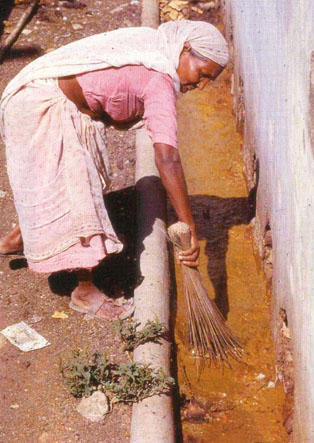
And for centuries
India has been notorious for its caste divisions and
caste murders.
"I�d say the biggest indictment
of all is that we are still a country, a culture, a
society which continues to nurture and practice the
notion of untouchability. While our economists
number-crunch and boast about the growth rate, a
million people � human scavengers
� earn their living carrying several
kilos of other people�s shit on
their heads every day. And if they
didn�t carry shit on their heads
they would starve to death. Some f***ing superpower
this." Arundhati Roy in
conversation with Shoma Chaudhury, March
2007
Mr. Manmohan Singh may
also find that
which Pramatha Chauduri wrote in Bengali in 1921
instructive -
".. No people in
Europe are as different, one from another, as our
people. There is not that much difference between
England and Holland as there is between Madras and
Bengal. Even France and Germany are not that far
apart.....
As children, we read
in the Hitopodesa that at night birds from all
directions would gather on a shimul tree on the banks
of the Godavari. Why? To cackle for a while and then
go off to sleep. Cackle in this context means to
discuss the politics of the birdworld. We, too, in
this dark, night time of India's history go to the
Congress meet to cackle for three or four days and
then snore. We can cackle together because, thanks to
the education conferred by the British, we all have
the same dialect. I am not saying that this dialect
is all that our lips utter or our minds. All I want
to suggest is that behind the Congress patriotism,
there is only one kind of mind and that mind is bred
on English text books. We all have that kind of mind,
but under it is the mind which is individual for all
nations and different from nation to nation. And our
civilisation will emerge from the depth of that
mind."
Today more than 80
years after Pramatha Chauduri, we may have an Indian
'state' but we do not have an Indian 'nation'. A state
is an institution. A nation is a togetherness - a
togetherness of a people who speak a common language
and who trace their heritage to a common origin. In
truth, that which we have in India is an 'Empire' - an
'Indian Empire' which is the successor to the old
'British Indian Empire' of
which Queen Victoria was crowned as Empress.
The Austro Hungarian
Empire and the Ottoman Empire did not survive World War
I and the British, French, Dutch and Portuguese Empires
did not survive World War II. It will be to engage in
the politics of the bird world (where we cackle to each
other in English) to suggest that the Indian Empire
will survive as an Empire. It is no accident that a
Gujerati does not stand for election in Tamil Nadu, or
a Tamil in Bengal, or a Marathi in Kashmir - and there
is a need to recognise and address this political
reality. Mr. Manmohan Singh may want to recognise that
the unity of India will not be built by bland appeals
to a non existent 'composite culture'.
There are, ofcourse,
those (including Marxists) who sometimes suggest that
conflicts amongst different national formations will be
assuaged by economic growth. But the reality is
otherwise. Nationalism is not simply a matter of
economics.
"Like religion,.. or
any other great emotive force, nationalism is
ambivalent, and can escape very completely from a
prescribed political channel. Even in its origins, it
was a complex phenomenon, deriving both from the
solidarity and from the divisions of society. It
would have astonished Marx to see socialism owing so
much to partnerships with nationalism in Afro-Asia
and in the Soviet Union during the second world
war... " - V.Kiernan - 'Nationalist Movements and
Social Classes' in Nationalist Movements,%201976%3C/em%3E%3C/font%3E%3C/p%3E%20%3Cp%3E%3Cfont%20size=) "Nationalism
has proved an uncomfortable anomaly for Marxist
theory and precisely for that reason, has been
largely elided, rather than confronted. How else to
account for the use, for over a century of the
concept of the 'national bourgeoisie' without any
serious attempt to justify theoretically the
relevance of the adjective? Why is this segmentation
of the bourgeoisie - a world class in so far as it is
defined in terms of the relations of productions -
theoretically significant? "Nationalism
has proved an uncomfortable anomaly for Marxist
theory and precisely for that reason, has been
largely elided, rather than confronted. How else to
account for the use, for over a century of the
concept of the 'national bourgeoisie' without any
serious attempt to justify theoretically the
relevance of the adjective? Why is this segmentation
of the bourgeoisie - a world class in so far as it is
defined in terms of the relations of productions -
theoretically significant?
A nation is an imagined
political community... It is imagined as a community,
because regardless of the actual inequality and
exploitation that may prevail in each, the nation is
always conceived as a deep horizontal comradeship.
Ultimately, it is this fraternity that makes it
possible, over the past two centuries, for so many
millions of people, not so much to kill, as willingly
to die for such limited imaginings."
*Benedict Anderson: Imagined Communities -
Reflections on the Origin and Spread of Nationalism,
1991
Peoples speaking
different languages, tracing their roots to different
origins, and living in relatively well defined and
separate geographical areas, do not somehow 'melt' and
disappear - and, in any case, a dependent 'third world'
economy will not provide a large enough 'pot' for the
'melting' to take place. The unity of India will not be
built by a new economic colonialism secured by easing
barriers to entry by multinationals and by creating a
consumption hungry English speaking upper/middle
class.
�The Asian
�coolies� of the
late 1800s and early 1900s came to the U.S.,
Australia, New Zealand and the West Indies as
laborers, doing the physical, backbreaking work
westerners didn�t want to do. ... In
this new century, India�s tech
workers are coming to be seen as nothing more than
glamorized coolies (rich coolies, but coolies still.)
For the global corporate sector, India is just one
large back office, not a formidable economic force
such as China or even a political nuisance such as
Pakistan... The global corporate sector
� understandably �
will not shed light on these issues. It is not in
their interest. In fact, eased barriers to entry, a
consumption hungry upper class and cheap labor are
major prizes in the new economic colonialism... "
India: The Poverty of
Progress - Chandasi Pandya, 2005
Again, Mr.Manmohan
Singh may want to pay attention to something which
Justin Podur said a couple of months ago -
"..In the background
of the Indo-US nuclear deal now going into
'overdrive', as well as the increasing economic
co-operation and (most importantly) the joint
military exercises and interoperability efforts and
acquisitions made by India, there is a geopolitical
notion: that the US is building India's military
capacity in order to counter potential rivals China
and Russia in the region... (But) Empires don't build
great powers. They build clients and dependencies..."
Empires Don't Build
Rivals - Justin Podur 5 August 2008
Given all this, it
should not surprise Mr.Manmohan Singh that a report,
released on 14 October 2008, as part of the 2008
Global Hunger Index, ranks India at 66 out 88 countries
in the Hunger Index. Twelve Indian states (including
Tamil Nadu) have "alarming" levels of hunger while the
situation is "extremely alarming" in the state of
Madhya Pradesh. -
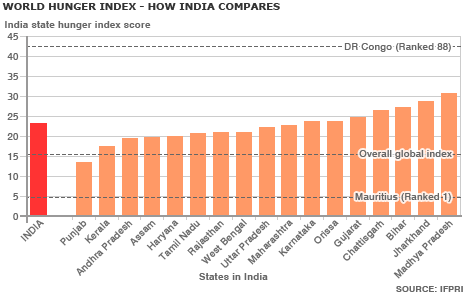
"The report, released as part of
the 2008 Global Hunger Index, ranks India at 66 out
88 countries. The hunger index has been released by
the International Food Policy Research Institute
(IFPRI) along with Welthungerhlife and the University
of California. It measures hunger on three indicators
which include child malnutrition, rates of child
mortality and the number of people who are calorie
deficient. The problem of hunger is measured in five
categories - low, moderate, serious, alarming or
extremely alarming. The survey says that not one of
the 17 states in India that were studied were in the
low or moderate hunger category. "Despite years of
robust economic growth, India scored worse than
nearly 25 sub-Saharan African countries and all of
South Asia, except Bangladesh," the report says. The
best performing state was Punjab, which has a
'serious' hunger problem and does less well than
developing countries such as Gabon, Vietnam and
Honduras. " Hunger in
India States Alarming - BBC, 14 October
2008
Indian Prime Minister
Manmohan Singh may want to pay more careful attention
to something which Arundhati Roy said an year ago in
March 2007 when she was asked by Shoma Chaudhury of
Tehelka "There is an atmosphere of growing violence
across the country. How do you read the signs? In what
context should it be read?" -
" You
don�t have to be a genius to read
the signs. We have a growing middle class, reared
on a diet of radical consumerism and aggressive
greed. Unlike industrialising Western countries,
which had colonies from which to plunder resources
and generate slave labour to feed this process, we
have to colonise ourselves, our own nether parts.
We�ve begun to eat our own limbs.
The greed that is being generated (and marketed as
a value interchangeable with nationalism) can only
be sated by grabbing land, water and resources from
the vulnerable.
What we�re
witnessing is the most successful secessionist
struggle ever waged in independent India
� the secession of the middle and
upper classes from the rest of the country.
It�s a vertical secession, not a
lateral one. They�re fighting for
the right to merge with the
world�s elite somewhere up there
in the stratosphere.
.. to equate a
resistance movement fighting against enormous
injustice with the government which enforces that
injustice is absurd. The government has slammed the
door in the face of every attempt at non-violent
resistance. When people take to arms, there is
going to be all kinds of violence
� revolutionary, lumpen and
outright criminal. The government is responsible
for the monstrous situations it creates...does this
mean that people whose dignity is being assaulted
should give up the fight because they
can�t find saints to lead them
into battle?. "
Yes, Indian Prime
Minister Manmohan Singh is right to say that the
violence that is permeating Indian society is no
accident. "You don't have to be a genius to read the
signs".
Divisions on the Rise in India -
Manmohan Singh
Addressing the National
Integration Council, 13 October 2008
We are witnessing signs of increasing
fissiparous tendencies especially in areas like the North
East, in Jammu & Kashmir, in Orissa and Karnataka, in
Assam and some other parts of our country. Sometimes the
situation is aggravated by external interests that wish
to de-rail the essential unity of India. Further, as
witnessed recently in Orissa, Karnataka, Maharashtra and
Assam we see ethnicity and religion being used as
arguments to stir divisions.
Violence seems to be permeating society to-day, across
the length and breadth of our country - whether it be
terrorist violence, whether it is violence with an
ideological veneer such as that adopted by the Left Wing
Extremists or Communal violence. We need to meet to-day's
mindless violence with the requisite amount of force, but
must also ensure that this is tempered by reason and
justice which is the normal order of governance.
The most disturbing and dangerous aspect to-day is the
assault on our composite culture. Ethnic and religious
communities have lived together peacefully during the
past millennium. We take pride in the fact that people of
all castes, communities, religions and languages live
together peacefully, and our culture imbibes the best
from each one of them. Yet to-day, we see fault-lines
developing between, and among, communities. Recent tragic
events in Orissa, Karnataka, and Assam have pained all
right thinking persons. There are clashes between Hindus,
Christians, Muslims and Tribal groups. An atmosphere of
hatred and violence is being artificially generated.
There are forces deliberately encouraging such tendencies
and also spawning militant outfits who engage in
irrational violence. These need to be firmly dealt
with.
It is not by accident that these incidents are increasing
in our society. As members of the National Integration
Council, we need to collectively consider whether
short-term narrow political ends are driving some of us
to encourage forces of divisiveness that are today
threatening the unity of our people. A country like ours
which is defined by co-existence of different ethnic
groups and religions and cemented by an acceptance of a
pluralistic and tolerant framework cannot afford the
promotion of such divisiveness for narrow partisan ends.
There is no politics that has a right to assert over the
rights of the common man or the integrity of our
nation.
|


 Copyright 1998/2009 All Rights
Reserved
Copyright 1998/2009 All Rights
Reserved