|
CONTENTS
OF THIS SECTION
|
| [Comment
by tamilnation.org
- Given the key roles played in the Struggle
for Tamil Eelam, by India , the United States and now
China (with supporting roles for the European Union,
Japan and Pakistan) it is not without importance for
the Tamil people to further their own understanding of
the foreign policy objectives of these countries - this
is more so because the record shows that states do not
have permanent friends but have only permanent
interests. And, it is these interests that they pursue,
whether overtly or covertly. Furthermore, the interests
of a state are a function of the interests of groups
which wield power within that state and 'foreign
policy is the external manifestation of domestic
institutions, ideologies and other attributes of the
polity'. In the end, the success of the struggle for
Tamil Eelam will be a function of the capacity of the
leadership of the struggle to mobilise its own people
and its own resources at the broadest and deepest level - and this means,
amongst other things, broadening and deepening the
understanding of the Tamil people of the motivations
of the international actors in relation to the struggle
for Tamil Eelam. Otherwise we will continue to
confuse our people by leading them to believe that all
that needs to be done is to wake up the international
community to the justice of our cause and all will be
well. Unfortunately, the world is not rotating on the
axis of human justice. Furthering our understanding of
the strategic interests of the international community,
will better equip us to engage in the real task of
addressing those interests - and to show that the
emergence of an independent Tamil Eelam will not pose a
threat to many of the underlying interests of the
parties concerned with the conflict in the island. On
the contrary, it is the attempt to suppress the
struggle of the Tamil people to be free from alien
Sinhala rule which will pose a threat to the stability
of the Indian Ocean region..." see also 1. From
"China fear" to "China fever" - Pallavi Aiyar, Hindu,
27 February 2006; 2. China undertakes construction of
Hambantota Port, 11 April 2005; 3. China, Sri Lanka
Joint Communique , 3 September 2005 and 4.
Sethusamudram Project ] |
|
|
International
Relations
in THE AGE OF EMPIRE
US House of
Representatives
allows export of civilian nuclear fuel to
India
BBC Report
9 December 2006
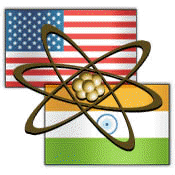
"Senior US state department
official Nicholas Burns - who is visiting India -
said he anticipated a very successful and
supportive bill, well within the parameters of an
agreement signed between India and the US"
[see also
1. US approves Indian nuclear deal, 2
October 20008
2.
Whither India? Two Views - Top Down and Bottom Up
3. US
Senate backs India nuclear deal, November 2006
"Energy-hungry India needs nuclear power. The US
Senate has overwhelmingly voted to pass a
controversial deal to share civilian nuclear
technology with India. Under the deal, which was
proposed more than a year ago, India must allow
international inspections of its nuclear
facilities. US President George W Bush hailed the
move as bringing India into the "nuclear
non-proliferation mainstream". However, the bill
still has to clear a number of hurdles before it
becomes law and is implemented. One condition
would require India to fully and actively
participate in efforts to contain Iran's nuclear
programme." more and
4.
India's Project Seabird and the Indian Ocean's
Balance of Power " On
April 11, 2005, India started a strategic
partnership with China, and, on June 29,
2005, signed a 10-year defense agreement with
the United States. Western observers,
however, have paid less attention to an ambitious
Indian move in the military field: Project
Seabird. This plan - with origins from the
mid-1980s - is to be assessed in light of two
geopolitical triangles juxtaposing on the
Indian Ocean's background: U.S.-India-China
relations and China-Pakistan-India relations. In
this complicated geopolitical configuration,
New Delhi is not simply a partner of China or
the United States: India is emerging as a
major power that follows its own grand
strategy in order to enhance its power and
interests." ]
Nuclear
Power in India
 India has 14 reactors
in commercial operation and nine under
construction India has 14 reactors
in commercial operation and nine under
construction
Nuclear power supplies
about 3% of India's electricity
By 2050, nuclear power
is expected to provide 25% of the country's
electricity
India has limited coal
and uranium reserves
Its huge thorium
reserves - about 25% of the world's total -
are expected to fuel its nuclear power
programme long-term Source: Uranium
Information Center |
Energy-hungry India needs
nuclear power
The US House of Representatives has
voted in favour of allowing the export of civilian
nuclear fuel to India. The bill, passed by 330
votes to 59, must now be approved by the Senate,
before it is sent to President George W Bush to be
signed into law.
The deal offers India US nuclear technology in
exchange for inspectors' access to Indian civilian
reactors. The accord has been hailed as historic by
some, but critics say it will damage
non-proliferation efforts. "India is a state
that should be at the very centre of our foreign
policy and our attention," Democrat congressman Tom
Lantos said.
He said a partnership with India could help
regulate the peaceful and responsible spread of
nuclear power. If the bill becomes law it will
allow the export of civilian nuclear energy and
technology to India for the first time in 30 years.
The vote followed a landmark agreement last year
between Mr Bush and the Indian Prime Minister,
Manmohan Singh, which overturned three decades of
US anti-proliferation policy. Previously the US was
opposed to Indian nuclear activities because it had
not signed the Non-Proliferation Treaty (NPT) and
has twice tested nuclear weapons in 1974 and
1998.
'Compromise bill'
The final bill was said to have been altered to
take into account some Indian concerns about the
deal, says the BBC's Shahzeb Jillani in Washington.
Supporters of the bill, backed by the White House,
are confident that the "compromise bill" will be
acceptable to Delhi, he says.
Global nuclear powers
Earlier, senior US state department official
Nicholas Burns - who is visiting India - said he
anticipated "a very successful and supportive
bill", well within the parameters of an agreement
signed between India and the US. US President
George W Bush finalised the agreement during a
landmark trip to India in March. US Senate and
House of Representatives committees backed the deal
in June. Under the deal, energy-hungry India will
get access to US civil nuclear technology and fuel,
in return for opening its civilian nuclear
facilities to inspection. But its nuclear
weapons sites will remain off-limits. Critics
of the deal say it could boost India's nuclear
arsenal and sends the wrong message to countries
like Iran, whose nuclear ambitions Washington
opposes. India has made clear that the final
agreement must not bind it to supporting the US
policy on Iran and does not prevent it from
developing its own fissile material.
|
|


 Copyright 1998/2009 All Rights
Reserved
Copyright 1998/2009 All Rights
Reserved