|
International
Relations
in THE AGE OF EMPIRE
Venezuela President Hugo Chavez
Speech to the United Nations
16 September 2006
[see also Chavez, the Devil, Chomsky, and Us - Michael
Albert]
"..The President of the United States,
yesterday, said to us, right here, in this room, and
I'm quoting, "Anywhere you look, you hear extremists
telling you can escape from poverty and recover your
dignity through violence, terror and martyrdom."
Wherever he looks, he sees extremists. And you, my
brother -- he looks at your color, and he says, oh,
there's an extremist. Evo Morales, the worthy president
of Bolivia, looks like an extremist to him. The
imperialists see extremists everywhere. It's not that
we are extremists. It's that the world is waking up.
It's waking up all over. And people are standing
up..."
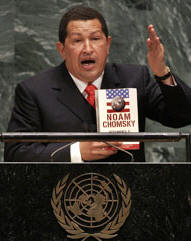
Representatives of the governments of the
world, good morning to all of you.
First of all, I would like to invite you,
very respectfully, to those who have not read this book,
to read it. Noam Chomsky, one of the most prestigious
American and world intellectuals, Noam Chomsky, and this
is one of his most recent books, Hegemony or Survival:
America's Quest for Global Dominance [Holds up book,
waves it in front of General Assembly.] It's an excellent
book to help us understand what has been happening in the
world throughout the 20th century, and what's happening
now, and the greatest threat looming over our planet.
The hegemonic pretensions of the American empire are
placing at risk the very survival of the human species.
We continue to warn you about this danger and we appeal
to the people of the United States and the world to halt
this threat, which is like a sword hanging over our
heads. I had considered reading from this book, but, for
the sake of time, [flips through the pages, which are
numerous] I will just leave it as a recommendation.
It reads easily, it is a very good book, I'm sure Madame
[President] you are familiar with it. It appears in
English, in Russian, in Arabic, in German. I think that
the first people who should read this book are our
brothers and sisters in the United States, because their
threat is right in their own house.
The devil is right at home. The devil, the devil himself,
is right in the house. And the devil came here yesterday.
Yesterday the devil came here. Right here. [crosses
himself] And it smells of sulphur still today. Yesterday,
ladies and gentlemen, from this rostrum, the president of
the United States, the gentleman to whom I refer as the
devil, came here, talking as if he owned the world.
Truly. As the owner of the world.
I think we could call a psychiatrist to analyze
yesterday's statement made by the president of the United
States. As the spokesman of imperialism, he came to share
his nostrums, to try to preserve the current pattern of
domination, exploitation and pillage of the peoples of
the world. An Alfred Hitchcock movie could use it as a
scenario. I would even propose a title: "The Devil's
Recipe."
As Chomsky says here, clearly and in depth, the American
empire is doing all it can to consolidate its system of
domination. And we cannot allow them to do that. We
cannot allow world dictatorship to be consolidated.
The world parent's statement -- cynical, hypocritical,
full of this imperial hypocrisy from the need they have
to control everything. They say they want to impose a
democratic model. But that's their democratic model. It's
the false democracy of elites, and, I would say, a very
original democracy that's imposed by weapons and bombs
and firing weapons. What a strange democracy. Aristotle
might not recognize it or others who are at the root of
democracy. What type of democracy do you impose with
marines and bombs?
The President of the United States, yesterday, said to
us, right here, in this room, and I'm quoting, "Anywhere
you look, you hear extremists telling you can escape from
poverty and recover your dignity through violence, terror
and martyrdom." Wherever he looks, he sees extremists.
And you, my brother -- he looks at your color, and he
says, oh, there's an extremist. Evo Morales, the worthy
president of Bolivia, looks like an extremist to him. The
imperialists see extremists everywhere. It's not that we
are extremists. It's that the world is waking up. It's
waking up all over. And people are standing up.
I have the feeling, dear world dictator, that you are
going to live the rest of your days as a nightmare
because the rest of us are standing up, all those who are
rising up against American imperialism, who are shouting
for equality, for respect, for the sovereignty of
nations. Yes, you can call us extremists, but we are
rising up against the empire, against the model of
domination.
The president then -- and this he said himself, he said:
"I have come to speak directly to the populations in the
Middle East, to tell them that my country wants peace."
That's true. If we walk in the streets of the Bronx, if
we walk around New York, Washington, San Diego, in any
city, San Antonio, San Francisco, and we ask individuals,
the citizens of the United States, what does this country
want? Does it want peace? They'll say yes. But the
government doesn't want peace. The government of the
United States doesn't want peace. It wants to exploit its
system of exploitation, of pillage, of hegemony through
war.
It wants peace. But what's happening in Iraq? What
happened in Lebanon? In Palestine? What's happening?
What's happened over the last 100 years in Latin America
and in the world? And now threatening Venezuela -- new
threats against Venezuela, against Iran?
He spoke to the people of Lebanon. Many of you, he said,
have seen how your homes and communities were caught in
the crossfire. How cynical can you get? What a capacity
to lie shamefacedly. The bombs in Beirut with millimetric
precision?
This is crossfire? He's thinking of a western, when
people would shoot from the hip and somebody would be
caught in the crossfire.
This is imperialist, fascist, assassin, genocidal, the
empire and Israel firing on the people of Palestine and
Lebanon. That is what happened. And now we hear, "We're
suffering because we see homes destroyed.' The president
of the United States came to talk to the peoples -- to
the peoples of the world. He came to say -- I brought
some documents with me, because this morning I was
reading some statements, and I see that he talked to the
people of Afghanistan, the people of Lebanon, the people
of Iran. And he addressed all these peoples directly.
And you can wonder, just as the president of the United
States addresses those peoples of the world, what would
those peoples of the world tell him if they were given
the floor? What would they have to say?
And I think I have some inkling of what the peoples of
the south, the oppressed people think. They would say,
"Yankee imperialist, go home." I think that is what those
people would say if they were given the microphone and if
they could speak with one voice to the American
imperialists.
And that is why, Madam President, my colleagues, my
friends, last year we came here to this same hall as we
have been doing for the past eight years, and we said
something that has now been confirmed -- fully, fully
confirmed.
I don't think anybody in this room could defend the
system. Let's accept -- let's be honest. The U.N. system,
born after the Second World War, collapsed. It's
worthless. Oh, yes, it's good to bring us together once a
year, see each other, make statements and prepare all
kinds of long documents, and listen to good speeches,
like Abel's yesterday, or President Mullah's . Yes, it's
good for that. And there are a lot of speeches, and we've
heard lots from the President of Sri Lanka, for instance,
and the president of Chile.
But we, the assembly, have been turned into a merely
deliberative organ. We have no power, no power to make
any impact on the terrible situation in the world. And
that is why Venezuela once again proposes, here, today,
20 September, that we re-establish the United
Nations.
Last year, Madam, we made four modest proposals that we
felt to be crucially important. We have to assume the
responsibility our heads of state, our ambassadors, our
representatives, and we have to discuss it.
The first is expansion, and Mullah talked about this
yesterday right here. The Security Council, both as it
has permanent and non-permanent categories, (inaudible)
developing countries and LDCs must be given access as new
permanent members. That's step one.
Second, effective methods to address and resolve world
conflicts, transparent decisions.
Point three, the immediate suppression -- and that is
something everyone's calling for -- of the
anti-democratic mechanism known as the veto, the veto on
decisions of the Security Council.
Let me give you a recent example. The immoral veto of the
United States allowed the Israelis, with impunity, to
destroy Lebanon. Right in front of all of us as we stood
there watching, a resolution in the council was
prevented.
Fourthly, we have to strengthen, as we've always said,
the role and the powers of the secretary general of the
United Nations.
Yesterday, the secretary general practically gave us his
speech of farewell. And he recognized that over the last
10 years, things have just gotten more complicated;
hunger, poverty, violence, human rights violations have
just worsened. That is the tremendous consequence of the
collapse of the United Nations system and American
hegemonistic pretensions.
Madam, Venezuela a few years ago decided to wage this
battle within the United Nations by recognizing the
United Nations, as members of it that we are, and lending
it our voice, our thinking. Our voice is an independent
voice to represent the dignity and the search for peace
and the reformulation of the international system; to
denounce persecution and aggression of hegemonistic
forces on the planet. This is how Venezuela has presented
itself. Bolivar's home has sought a non permanent seat on
the Security Council.
Let's see. Well, there's been an open attack by the U.S.
government, an immoral attack, to try and prevent
Venezuela from being freely elected to a post in the
Security Council. The imperium is afraid of truth, is
afraid of independent voices. It calls us extremists, but
they are the extremists.
And I would like to thank all the countries that have
kindly announced their support for Venezuela, even though
the ballot is a secret one and there's no need to
announce things. But since the imperium has attacked,
openly, they strengthened the convictions of many
countries. And their support strengthens us. Mercosur, as
a bloc, has expressed its support, our brothers in
Mercosur. Venezuela, with Brazil, Argentina, Paraguay,
Uruguay, is a full member of Mercosur.
And many other Latin American countries, CARICOM, Bolivia
have expressed their support for Venezuela. The Arab
League, the full Arab League has voiced its support. And
I am immensely grateful to the Arab world, to our Arab
brothers, our Caribbean brothers, the African Union.
Almost all of Africa has expressed its support for
Venezuela and countries such as Russia or China and many
others.
I thank you all warmly on behalf of Venezuela, on behalf
of our people, and on behalf of the truth, because
Venezuela, with a seat on the Security Council, will be
expressing not only Venezuela's thoughts, but it will
also be the voice of all the peoples of the world, and we
will defend dignity and truth.
Over and above all of this, Madam President, I think
there are reasons to be optimistic. A poet would have
said "helplessly optimistic," because over and above the
wars and the bombs and the aggressive and the preventive
war and the destruction of entire peoples, one can see
that a new era is dawning.
As Silvio Rodriguez says, the era is giving birth to a
heart.
There are alternative ways of thinking.
There are young people who think differently. And this
has already been seen within the space of a mere decade.
It was shown that the end of history was a totally false
assumption, and the same was shown about Pax Americana
and the establishment of the capitalist neo-liberal
world. It has been shown, this system, to generate mere
poverty. Who believes in it now?
What we now have to do is define the future of the world.
Dawn is breaking out all over. You can see it in Africa
and Europe and Latin America and Oceanea. I want to
emphasize that optimistic vision.
We have to strengthen ourselves, our will to do battle,
our awareness. We have to build a new and better
world.
Venezuela joins that struggle, and that's why we are
threatened. The U.S. has already planned, financed and
set in motion a coup in Venezuela, and it continues to
support coup attempts in Venezuela and elsewhere.
President Michelle Bachelet reminded us just a moment ago
of the horrendous assassination of the former foreign
minister, Orlando Letelier. And I would just add one
thing: Those who perpetrated this crime are free. And
that other event where an American citizen also died were
American themselves. They were CIA killers,
terrorists.
And we must recall in this room that in just a few days
there will be another anniversary. Thirty years will have
passed from this other horrendous terrorist attack on the
Cuban plane, where 73 innocents died, a Cubana de
Aviacion airliner.
And where is the biggest terrorist of this continent who
took the responsibility for blowing up the plane? He
spent a few years in jail in Venezuela. Thanks to CIA and
then government officials, he was allowed to escape, and
he lives here in this country, protected by the
government. And he was convicted. He has confessed to his
crime. But the U.S. government has double standards. It
protects terrorism when it wants to.
And this is to say that Venezuela is fully committed to
combating terrorism and violence. And we are one of the
people who are fighting for peace.
Luis Posada Carriles is the name of that terrorist who is
protected here. And other tremendously corrupt people who
escaped from Venezuela are also living here under
protection: a group that bombed various embassies, that
assassinated people during the coup. They kidnapped me
and they were going to kill me, but I think God reached
down and our people came out into the streets and the
army was too, and so I'm here today.
But these people who led that coup are here today in this
country protected by the American government. And I
accuse the American government of protecting terrorists
and of having a completely cynical discourse.
We mentioned Cuba. Yes, we were just there a few days
ago. We just came from there happily.
And there you see another era born. The Summit of the 15,
the Summit of the Nonaligned, adopted a historic
resolution. This is the outcome document. Don't worry,
I'm not going to read it. But you have a whole set of
resolutions here that were adopted after open debate in a
transparent matter -- more than 50 heads of state. Havana
was the capital of the south for a few weeks, and we have
now launched, once again, the group of the non aligned
with new momentum.
And if there is anything I could ask all of you here, my
companions, my brothers and sisters, it is to please lend
your good will to lend momentum to the Nonaligned
Movement for the birth of the new era, to prevent
hegemony and prevent further advances of imperialism.
And as you know, Fidel Castro is the president of the
nonaligned for the next three years, and we can trust him
to lead the charge very efficiently. Unfortunately they
thought, "Oh, Fidel was going to die." But they're going
to be disappointed because he didn't. And he's not only
alive, he's back in his green fatigues, and he's now
presiding the nonaligned.
So, my dear colleagues, Madam President, a new, strong
movement has been born, a movement of the south. We are
men and women of the south.
With this document, with these ideas, with these
criticisms, I'm now closing my file. I'm taking the book
with me. And, don't forget, I'm recommending it very
warmly and very humbly to all of you.
We want ideas to save our planet, to save the planet from
the imperialist threat. And hopefully in this very
century, in not too long a time, we will see this, we
will see this new era, and for our children and our
grandchildren a world of peace based on the fundamental
principles of the United Nations, but a renewed United
Nations. And maybe we have to change location. Maybe we
have to put the United Nations somewhere else; maybe a
city of the south. We've proposed Venezuela.
The only country where a person is able
to call for the assassination of a head of state is the
United States. Such was the case of a Reverend called Pat
Robertson, very close to the White House: He called for
my assassination and he is a free person. That is
international terrorism! We will fight for Venezuela, for
Latin American integration and the world. We reaffirm our
infinite faith in humankind. We are thirsty for peace and
justice in order to survive as species. Simón
Bolívar, founding father of our country and guide of
our revolution swore to never allow his hands to be idle
or his soul to rest until he had broken the shackles
which bound us to the empire. Now is the time to not
allow our hands to be idle or our souls to rest until we
save humanity.
You know that my personal doctor had to stay in the
plane. The chief of security had to be left in a locked
plane. Neither of these gentlemen was allowed to arrive
and attend the U.N. meeting. This is another abuse and
another abuse of power on the part of the Devil. It
smells of sulphur here, but God is with us and I embrace
you all.
May God bless us all. Good day to you.
|
 Chavez, the Devil, Chomsky, and Us -
Michael Albert, 26 September 2006 Chavez, the Devil, Chomsky, and Us -
Michael Albert, 26 September 2006
What can leftists learn from Chavez's UN speech and
its aftermath? That the U.S. is the world's most
egregious rogue state. We already knew that and, in fact,
so does most everyone else. That Bush and Co. engage in
repeated acts of amoral, immoral, and antimoral behavior
such as a devil would enact, if there was such a thing as
a devil. We already knew that too. That the emperor has
no morality, integrity, wisdom, or humanity. We knew that
as well. So is there anything in the episode for us? I
think there may be.
I suspect many leftists would have been happier had
Chavez torn into Bush and U.S. institutions by offering
more evidence while employing a less religious spin.
Perhaps Chavez could have called Bush Mr. War, or Mr.
Danger as he has in the past, and piled on evidence to
show how U.S. policies in the world, and grotesque
domestic imbalances as well, obstruct desirable income
distribution, democratic decision making, and mutual
interpersonal and intercommunity respect. Chavez might
have given evidence how U.S. elites and key institutions
impede living and loving and even survival, from Latin
America to Asia and back. He might have said that George
W. Bush, as the current master purveyor of the most
recent violations by the U.S., is, in effect, doing the
work of a devil - because he is the spawn of a devilish
system. And I suspect many leftists would have probably
been happier had Chavez added chapter and verse evidence
for his assertions, though I suspect time limits
precluded that.
But, hey, we can't always get exactly what we want. And
more, the dramatic "smelling of sulfur formulation" that
Chavez used may have been exactly what got the sentiment
in any form at all in front of millions of readers and
viewers. The pundits wanted to use Chavez's words to
discredit him - but, in doing so, they put his claim
before hundreds of millions of people. Perhaps without
the dramatic formulation, we would have heard nearly
nothing.
My guess is that Chavez treated the event as he does
pretty much all his encounters. He said what he thought.
He gave it a passionate, aesthetic, and humorous edge. He
calculated that forthrightness would accomplish more than
it cost. Content-wise, the speech was typical Chavez,
even if most hadn't heard him saying such things before,
due to having not heard him say anything before. Here is
Chavez commenting on Bush last March, for example, in a
televised Venezuelan address:
"You are an ignoramus, you are a burro, Mr. Danger
... or to say it to you in my bad English, you are a
donkey, Mr. Danger. You are a donkey, Mr. George W.
Bush. You are a coward, a killer, a genocider, an
alcoholic, a drunk, a liar, an immoral person, Mr.
Danger. You are the worst, Mr. Danger. The worst of
this planet."
The cost of Chavez's more recent and far more global
forthrightness about Bush is dismissal of Chavez as a
crazy lunatic by many people who already felt that way
but were restrained in saying so, and by some people
swayed by media ridicule of him, who had had no prior
opinion.
The gain of Chavez's more recent and far more global
forthrightness about Bush is establishing that one can
say the truth about the U.S. and less importantly about
George Bush, and showing that doing so is in accord not
only with truth but also with integrity. It is providing
an example for others to be inspired by and act on. What
is poison in elite eyes can be vitamins for us, and vice
versa.
In that respect, what Chavez did reminds me a little of
what Abbie Hoffman and some others did in the U.S. to the
House UnAmerican Activities Committee, known more
familiarly as HUAC, decades ago. Abbie and some others
aggressively and dismissively ridiculed HUAC as beneath
contempt and unworthy of respect. They laughed at obeying
it and via their dramatic stance they moved the prevalent
attitude toward HUAC from being primarily fear and
trembling to being primarily disdain and dissent. Chavez
tried something similar, I think. He voiced what others,
even others in the room at the UN, also knew but kept
quiet about. He hoped, I assume, that others would take
strength and begin to voice their needs and insights
too.
Bush is a vengeful, greedy, violent, but even more so,
obedient thug. Yes, obedient, as in Bush obeys the
dictates of the system he has climbed and now administers
for the rich and powerful. Bush perfectly exemplifies the
adage that in capitalism "garbage rises." My guess is
that Chavez felt that the benefits of standing up to the
U.S. and its most elite garbage outweighs the costs of
seeming to many people to be an extremist from Mars. So
was Chavez right? Did the benefits outweigh the
debits?
My country, the United States, exists beneath a blanket
of disorienting and misleading media madness. It endures
a climate of paralyzing and pervasive fear. It
encompasses a deeply inculcated hopelessness born of
educational and cultural institutions that snuff out
communication of dissenting beliefs elevating instead pap
and pablum. It suffers a life-draining anti-sociality
produced by markets that reward callousness and punish
solidarity. Garbage rises in the U.S. because nice guys
finish last. And amidst all this, for anyone to tell the
full truth, and even more so for anyone to display the
appropriate levels of passionate anger that the full
truth warrants, makes that person appear to be Martian,
appear to be psychotic, appear to be irrelevant, and
Chavez wants to reverse that context.
Did Chavez fall short of what could be accomplished on
that score with one speech? I am not at all sure he did.
But if he did, if the price of Chavez's speech in
delegitimating his own credibility in certain circles was
greater than the gain in delegitimating greed and
violence and in freeing people in very different circles
from blind and uncritical obedience and fear, whose fault
would that be?
Should we blame the one messenger who spoke up? Or should
we blame the millions of messengers who know the same
substance as Chavez, but hold their tongues?
There is a world class bully, Bush. He represents a class
of rich and powerful "masters of the universe." He
administers their system of gross inequality. He expands
the competitive market hostility they thrive on. He
fosters the mental passivity they rely on. He abets the
lifelong coercion they utilize. He epitomizes the
ubiquitous crassness and commercialism they profit off.
He lies to shield their true purposes. He throws bombs
far and wide to defend and enlarge their empire. Of
course irritating the bully and the system he shills for
can unleash nasty behavior. Of course, for a time, in the
ensuing onslaught, verbally assaulting the bully can
diminish the dissident's credibility, at least in some
circles. It might even boost the bully a bit, in some
quarters.
Likewise, when there is a climate of subservient
obedience to a bully, as we now endure in the U.S., when
the bully's climate people feel that to tell the truth
about him and his system is uncivil, and when the bully's
climate overwhelmingly castigates honesty and ridicules
passion, then of course being passionately honest will be
castigated and ridiculed and at least in part make the
truth teller look deviant.
So, if that's the risk, what is the solution? Should we
forego truth telling? Or should we tell more truth?
Should we coddle our likely enemies. Or should we
organize and empower our likely friends?
Chavez needs allies, but not ones who say, hey, Chavez is
an okay guy, even if a little over the top. Chavez needs
allies who stand up to imperialism and injustice in all
its forms be counted like him, even right up over the
top, but allies who also bring to Chavez criticisms and
ideas that run contrary to his own thinking and doing.
Chavez embracing Admadinenjad was bad news. His
suggestions, in other contexts, that the Venezuelan
constitution be amended to allow him to rule longer are
bad news. Truth to him, too. But at that UN Chavez wasn't
talking mainly to the people sitting in front of him in
the UN with his speech. He was talking to people
throughout the U.S. and throughout the world, saying, in
essence, it is okay to rebel. And it is okay. And we
ought to do it.
So that was one lesson. When you revile elites your
effectiveness depends less on your particular words than
on how many other people are willing to do as much or
more than you. Chavez thinks in terms of winning massive
change. Most people on the left think in terms of holding
off calamities. The contrast is stark and at the heart of
the recent incidents. We can learn from his attitude, I
think.
Chavez waved around Chomsky's book, Hegemony or Survival.
I think there are lessons in that, too, even for us, even
though we already know Chomsky's work. First off, a
person, even one that has great social advantages, can
humbly aid others. You can get up and say to others, hey,
this book, video, set of ideas, or organization is worthy
of your time. You can use whatever avenues exist for you,
whether it be access to your family or friends, or to
your schoolmates or workmates, or to your local media, or
even to larger mass media, or even to the whole world, to
reach out with advice and pointers that you think are
worthy. And you should do that. We all should do that.
But we generally don't. I suspect we are embarrassed to
do it. Chavez probably wouldn't even comprehend that.
Just as he had reviled Bush before, he had celebrated
Chomsky before too, over and over, with little effect.
This guy Chavez tries and tries again. He loses, he
loses, he loses, he wins.
I would guess that Chavez didn't think to himself, they
will revile me in their columns and commentaries, so I
better not rip into Bush and celebrate Chomsky. The
ensuing ridicule might reduce my stature, I better avoid
it. To rip Bush and celebrate Chomsky will look strange,
I better avoid it. If I do that I will be giving time to
elevating someone else, and not myself, and I better
avoid it. I will be displaying anger and passion, and
that will brand me as uncivil and improper, it will label
me as undignified and even juvenile, and I better avoid
it. How many of us think like that, how often, is a
question worth considering.
Instead, I suspect Chavez thought, Chomsky's work
deserves and needs to be more widely addressed. It
affected me. It needs to affect others. I will try to
push it into people's awareness using all the means at my
disposal to do so, which, indeed, he has been doing,
though with much less success, for some time now. Of
course, we can't all push an author, a book, an
organization, or an idea, and have it jump into
international, domestic, or local prominence, whether on
our first, fifth, or tenth try. We are not all heads of a
dynamic country. We don't all have a giant stage, or
often even a large stage, or even any stage at all, from
which to sing our songs. But we can still do our part,
wherever we may be. And the fact is, we who know so much
often don't do our part. We often don't point out sources
of ideas and discuss them with our workmates,
schoolmates, and families at every opportunity. If we
have audiences for our work, again we don't use our
writing, talks, and other products to promote valuable
work by others beyond ourselves. Why is that? Sometimes
we are afraid of reprisals. Sometimes we are afraid of
looking silly. Sometimes we just don't want to do it
because it isn't our thing. Cheerleading and
recommending, that's not my thing. I doubt it will work.
I won't bother trying. Then our foretelling of failure is
fulfilled. Well, we need to get over all that.
Again, I think the difference between Chavez and most
others even on the left is that Chavez is seeking to win,
and we are instead seeking, as often as not, to avoid
alienating pundits or to even appeal to them. We are
seeking to avoid annoying anyone we like, or anyone we
might like, or who might like us. We are seeking to avoid
looking odd to anyone, or to avoid making a mistake, or
to avoid seeming shrill and angry, or self serving, or
passionate. And we need to transcend all that.
I think what made Chavez seem so peculiar to so many
people is that what he did was, in fact, incredibly
peculiar. To stand up to the classist, racist, sexist,
authoritarian leader of the U.S. and to mince no words
reviling his immorality, was indeed incredibly peculiar.
So let's all stand up to power and privilege and take the
stigma out of doing so. It is part of removing the smell
of sulfur from the air.
And, at the opposite pole, Chavez celebrated and openly
and aggressively aided an anti classist, anti racist,
anti sexist, and anti authoritarian set of ideas and
their author. And that too was peculiar. And we all ought
to be doing that too, for lots of able authors and worthy
ideas. Indeed, we should do it so much that solidaritous
movement building behavior comes to be typical, rather
than seeming Martian. We should do it so much and so
openly that we move from telling the truth to feeling
about the truth the way a caring and sentient soul ought
to feel about it, and finally to acting on the truth and
on our passionate feelings in accord with wide human
interests and in pursuit of compelling and worthy aims.
To hell with the dictates of markets and pundits
alike.
|