|
  INDICTMENT AGAINST SRI LANKA INDICTMENT AGAINST SRI LANKA
The Charge is Ethnic Cleansing
SRI LANKA BOMBS JAFFNA HOSPITAL
AND TAMIL CIVILIANS - 1990
 "... You
must understand that in a war, civilians get
killed. We are fighting a war..." - Sri Lanka
Defence Minister Ranjan Wijeratne, 24 August 1990,
reported in Sri Lanka Island "... You
must understand that in a war, civilians get
killed. We are fighting a war..." - Sri Lanka
Defence Minister Ranjan Wijeratne, 24 August 1990,
reported in Sri Lanka Island
"...The Government does not, has not, and will not
wage war against the Tamil people..." - Sri
Lanka President Ranasinghe Premadasa, Press
Release, 3 January 1991 |

Aerial
bombardment of Tamil civil population
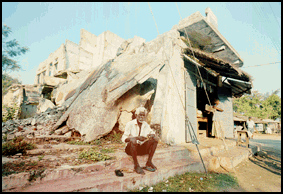 "The Sri Lankan government has begun bombing
and machine gunning civilians in Jaffna and other
cities in the Tamil dominated north after its failure
to contain the rebels from the ground. The attacks
began before dawn on Monday, a day of intensive
fighting. Bombers and Bell helicopter gunships flew
sorties of and on throught the day until 9 p.m. The
government forces have been sporadically bombing the
outskirts of the city for several days but Monday was
the first time the centre was the target "The Sri Lankan government has begun bombing
and machine gunning civilians in Jaffna and other
cities in the Tamil dominated north after its failure
to contain the rebels from the ground. The attacks
began before dawn on Monday, a day of intensive
fighting. Bombers and Bell helicopter gunships flew
sorties of and on throught the day until 9 p.m. The
government forces have been sporadically bombing the
outskirts of the city for several days but Monday was
the first time the centre was the target
The Sri Lankan media which is heavily government
controlled, has endlessly repeated the official line
that only the rebels, and not the Tamil people, are the
targets... One Red Cross hospital reported treating 85
bombing casualties... I arrived in Jaffna on Monday
afternoon... A few minutes later, we saw three
aeroplanes dive deeply and within seconds, we heard
loud explosions from about two miles away. When we
judged it safe we drove to the centre of Jaffna ...
The days bombing had destroyed dozens of shops, part
of the old market and much of the city's bus station.
Bombs had fallen only yards away from the Jaffna
Hospital... The hospital which was miraculously
undamaged had been empty for days anyway, its patients
evacuated to the outskirts where they are suppposed to
be safe. On Monday, howver, an orphanage for girls was
bombed there...
In the heart of Jaffna, vultures and crows flapped
around the ruins. "The Sri Lankan government talks
about respecting human rights" said one man outside his
wrecked shop, "But they are massacring innocent
people"...
The government is apparently using 70lb and 100lb
bombs. We also saw the case of a 'barrel-bomb' which
resembles an oil tank packed with explosive and
napalm....
The reasons for the government's bombing of its own
cities are unclear... If the intention is turn people
against the Tigers for attracting such danger, it is
failing..." (Christopher Lockwood, reporting in the
Independent, 28 June 1990)
|
"As the bullets came cracking down from the Sri
Lankan air force helicopter, the villagers of
Omantai pressed together against the walls of
their houses, silent during the firing, joking
nervously during the brief respites. Like some
monstrous sewing machine the gunfire went up
and down the road, louder and longer than
anyone thought possible...
Omantai is a Tamil village, 165 miles north
of Colombo and about eight miles behind Tamil
Tiger lines. There were no Tigers in the town
when the helicopter attacked, hovering at 2000
feet to stay out of range of any Tiger machine
guns. The helicopter let off hundreds of rounds
into the middle of the civilian population..."
(Terry McCarthy reporting in the Times, 29
June 1990)
"...in recent months the Sri Lankan
government in pursuance of the armed conflict
against the Liberation Tigers of Tamil Eelam
has engaged in aerial bombardments of the Tamil
civilian population and hundreds of Tamils have
disappeared from those areas within the control
of the Sri Lankan army. The Sri Lankan army is
also engaged in arbitrary killings of Tamil,
Sinhalese and Muslim civilians. Tamils have
been forcibly evacuated from their villages and
the Sri Lankan government plans to relocate the
entire Tamil civilian of one million from their
homes in the Jaffna peninsula to refugee
camps.' - Joint Statement of Seventeen Non
Governmental Organisations at the 42nd Sessions
of the UN Sub Commission on Prevention of
Discrimination and Protection of Minorities at
Geneva, August 1990
"...In one week, Jaffna was subjected to
what its inhabitants called 'shit bomb'
attacks. Jaffna smelt like a drain and the
city's frightened inhabitants suspected they
were being subjected to some sort of crude
experiment in biological warfare..." -
Torment of Jaffna, London Independent Magazine,
3 November 1990
|
"Sri Lankans are just killing
civilians at random" - Daily Telegraph
Report
"Barrel bombs - 210 litre cast iron barrels packed
with explosives, rubber and saw dust - rain down on
residential areas with the most devastating effect;
each bomb can destroy 20 houses. By its haphazard
bombing of civilian targets in the Northern peninsula
of Jaffna, the airforce is imposing an unofficial
blockade which is bringing some parts to
starvation. Helicopters, equipped with rockets and
machine guns hover day and night over Jaffna city and
the surrounding towns and villages, ready to strafe any
moving civilians or vehicles... 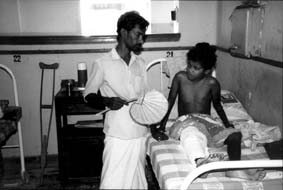
The hospital has also been bombed and three weeks ago,
a helicopter fired into the operating theatre, killing
a doctor... It is hard to sleep as the night sky is lit
up with explosions, and the vibrations from bombs can
be felt four miles away. The city centre has been
flattened, with Jaffna railway and bus stations, shops,
hotels and homes desolated... After one nights bombing
I visited areas which had been hit. Six people had been
killed, a row of houses was reduced to rubble and the
smell of burning flesh hung in the air. Clothes, family
photographs and furniture were scattered among the
ruins. 'We ran into the bunkers when we heard the
bombers coming' said a resident '...The Sri Lankans are
just killing civilians at random... In an effort to
dent civilian morale, they have also been showering the
area with human and animal excrement." - The
London Daily Telegraph, 13 September 1990
|
"Defence Minister told me it was
a pity I had not been shot" - Deanna Hodgin,
Insight
''Because I'm a journalist, some ethicists
would tell me I have no place in writing. But
because I've recently returned from covering
the war in Sri Lanka, where I was detained,
shot at by helicopters, and sent out onto mined
roads by the Sri Lankan army and have just
received news that the bombing has begun again
in the North, while the army is negotiating
with Libya for more arms - because I have seen
these things, and because many friends there
are dying while my government does nothing, I
am writing to you. I have covered the wars in
Afghanistan, Lebanon, Iran and Iraq, and Indian
Kashmir. The fighting in Sri Lanka is much
worse than the worst of any of these conflicts,
because of the underlying racial hatreds and
institutionalized discrimination.
I urge you to do anything you can, Congressman
Yatron, to convene a special hearing on Human
Rights abuses taking place in that country.
Pshaw, you say, how bad can it be ? It's so
bad, that after travelling 32 hours by boat,
bike, bus and car to return to Colombo from the
Jaffna Peninsula - where I had spent six days
following the late-August operation on Jaffna -
I attended a press conference where Defence
Minister Ranjan Wijeratne told the press that
there had been no civilian casualties despite
heavy bombing. When I volunteered that I had
seen many bomb-blasted bodies, and many
hundreds of people injured by helicopter
strafing and more, the Defence Minister told me
it was a pity I had not been shot.
That's the mentality you are dealing with -
human rights is not an idea with much currency
for the Sri Lankan government. Quiet diplomacy
is not an option for our policy in Sri Lanka.
The United States government must send a strong
message, condemning the bombing, the
30,000-60,000 disappearances of young people in
both North and South, and the continuing army
blockade of shipments of food stuffs and
medical supplies to the North. Congressman, I'm
writing to you because I am angry. You should
be, too.'' - Deanna Hodgin, Insight
Magazine, letter dated 7 November 1990 to
Congressman Gus Yatron,Subcommittee on Human
Rights,Washington
- see also the paper presented by Deanna
Hodgin on The use of Governmental
Aggression to Suppress a Minority's Quest for
Self Determination at the International
Tamil Eelam Research Conference, U.S.A.,
1991
|
Jaffna
Hospital bombed despite Red Cross markings
"The Sri Lankan Air Force bombed the Jaffna
hospital Friday two days after the Red Cross reopened
it under a safety plan, the International
Committee of the Redcross (ICRC) said. In a statement
issued here, the ICRC charged that a single airforce
aircraft dropped two bombs around 7.45 a.m. within
'the clearly defined security area'. One person was
wounded inside the ICRC protected hospital compound,
and four within the security area.
According to the ICRC, the roofs of four of the
hospital buildings were blown off by the explosion
and the windows shattered...the hospital was clearly
marked with red crosses for easy identification from
the ground and air, officials said. The rules
proscribe any military action from or against the
safety area which was devoid of any military or
political installation, the ICRC said..." - AFP News Service, 10 November 1990
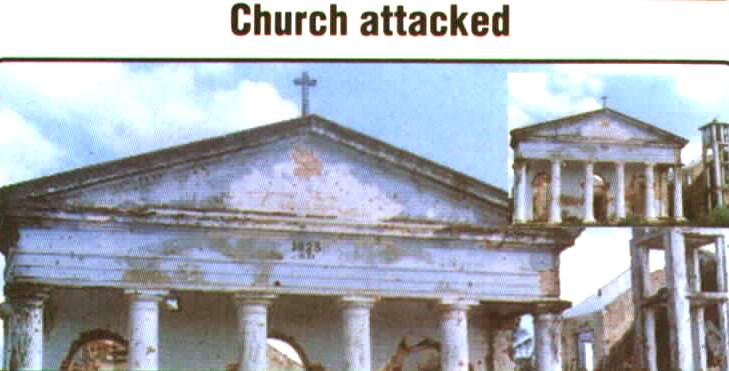
"Government
bombers have damaged schools, hospitals, churches and
temples" - Christian Aid News, March 1991
" Until June
last year, Sathan was a fisherman living in the eastern
Sri Lankan coastal town of Trincomalee. Now he, his
wife and two children sleep on a dirt floor in a room
eight feet by ten feet, more than 100 miles from home.
Like more than a million others in a country only half
the size of England, Sathan had to leave his house as
civil war, gang violence and looting erupted around
him. He and his family fled on foot, travelling only by
night for more than two months to reach a refugee camp
20 miles from the northern town of Jaffna. "There was
bombing and helicopter pilots were shooting and we were
afraid," he says. "People were attacking houses and
burning them down. My mother is old and could not walk,
so we had to leave her behind." Until June
last year, Sathan was a fisherman living in the eastern
Sri Lankan coastal town of Trincomalee. Now he, his
wife and two children sleep on a dirt floor in a room
eight feet by ten feet, more than 100 miles from home.
Like more than a million others in a country only half
the size of England, Sathan had to leave his house as
civil war, gang violence and looting erupted around
him. He and his family fled on foot, travelling only by
night for more than two months to reach a refugee camp
20 miles from the northern town of Jaffna. "There was
bombing and helicopter pilots were shooting and we were
afraid," he says. "People were attacking houses and
burning them down. My mother is old and could not walk,
so we had to leave her behind."
The main hospital in the Tiger stronghold of
Jaffna estimates that for every guerilla injured, there
are five or six civilian casualties. Government bombers
have damaged schools, hospitals, churches and temples
in air raids on northern towns. " (Tom Redfern
in Christian Aid News, March 1991)
|