|
"The IPKF were given
strict instructions not to use tactics or
weapons that could cause major casualties
among the civilian population of Jaffna,
who were hostages to the LTTE. The Indian
Army have carried out these instructions
with outstanding
discipline and courage, accepting,
in the process a high level of sacrifices
for protecting the Tamil
civilians". (Indian Prime Minister Rajiv Gandhi the Lok Sabha,
9 November 1987)
"...this massacre is
worse than My Lai. Then American troops
simply ran amok. In the Sri Lankan village,
the Indians seem to have been more
systematic; the victims being forced to lie
down, and then shot in the back..".
London Daily
Telegraph quoted by George Fernandez
M.P.
|
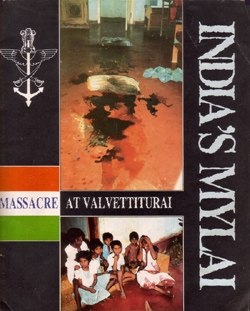
On 2 August 1989, the so called Indian Peace
Keeping Force deliberately killed 63 Tamil
civilians in Valvettiturai in the Jaffna Peninsula
in a massacre that was later described as India's
Mylai.
 David Housego in the London
Financial Times David Housego in the London
Financial Times
Rita Sebastian reported in the Indian
Express
George Fernandez M.P.
David Housego reported in the London
Financial Times on 17 August 1989:
"... On Tuesday I was the first western reporter
to visit Valvettiturai, a small coastal town near
Jaffna, where Indian troops carried out reprisals
on August 2 after the Tamil Tigers, the Tamil
guerrilla movement, ambushed one of their patrols
close to the main square, killing six Indian
soldiers and wounding several, others.
After 41/2 hours of walking around the town
and questioning many people, it becomes clear that
angered soldiers deliberately shot dead unarmed,
civilians, burnt a large number of houses, and
brutally. beat many of the boys and men they
caught.
The local Citizens Committee has identified 52
bodies and says that over 120 houses were burnt -
making it by far the worst atrocity alleged against
Indian troops in the two years they have been in
Sri Lanka.
Most of the killings took place in the hours
after the ambush, but the burning and ransacking
continued , for another two days while
Valvettiturai was under curfew and surrounded by
Indian troops.
What is also certain is that the official
Indian explanation for the deaths - that civilians
were caught in crossfire in the wake of the ambush
- has no credibility. Mr. S. Selvendra, the
president of the Citizens Committee and a chartered
accountant, is calling for a public
inquiry.
Almost a fortnight after the event, a smell of
charred remains hangs over Velvettiturai. Of the
15,000 people perhaps half have left in fear or
despair. Many who remain are distraught over the
loss of relatives or belongings, and uncertain how
to begin again or where. What seems to have
happened an August 2 is that two patrols of Indian
Peace keeping Force (IPKF) troops about 30 men in
all approached the centre of the town on foot in
parallel columns at about 11.15 in the morning.
This was market time, when the streets were most
crowded. They were ambushed by firing from the roof
and the street. Six soldiers were killed and 13
injured, including an officer...
What follows are abbreviated eyewitness'
accounts of four particular incidents that occurred
after the ambush.
Mr N Senthivadivel, 50, was in his
photographer's shop overlooking the square when the
firing began. He threw himself to the ground. Later
he was taken out and made to sit cross legged with
about 25 people on the square. From there he saw
soldiers set fire to some of the shops and throw
kerosene to add to the flames.
At about 2pm a soldier came along and said in
broken English that he was going to shoot them. Two
jeeps arrived and firing began. The soldier then
turned round to those seated and fired on them. Two
people, Mrs K Sivapackiyam, a washerwoman, and Mr K
Thangarajah were killed and 10 more
injured.
S Rajeswary, 52, is the wife of the head of the
divisional land survey office. After the firing
about 50 people sought shelter in her house well
over 200 yards from the square - because it has a
concrete roof and thus offers protection against
shelling.
About 1.30pm, four soldiers broke into the
house. She came out of the kitchen into the hall
with her husband; they were holding their hands up.
She pleaded with her husband not to step forward
but he advanced to speak to the soldiers. They shot
him. They then called for the other men and shot
four of them.
After that they sprayed bullets killing four
more people and injuring nine. Apart from her
husband, Mrs. Rajeswary also lost her eldest son,
28, who was trapped in his shop which had been set
on fire.
Mr A R Sivaguru., 68, a retired postmaster. With
some 70 other people - he took shelter in the house
of Mr Sivaganesh which also has a concrete roof.
About 4pm, some six soldiers climbed over the back
wall of the house and entered the courtyard. Women
fell it their feet crying and pleading with them
not to shoot but were kicked aside.
A sergeant then separated off the young men
ages ranging from 18-35 and told them to sit in
front of the cow shed next to the house. The
soldiers then fired on them, killing four. When one
woman screamed at her husband's death she was told
to be silent otherwise she would be killed.
Mr Nadarajah Anantharaj, principal of a local
school and secretary of the Citizen's Committee,
still bears the mark on his face of wounds he
received. This account of his treatment at the
Udupiddy IPKP camp nearby is taken from his sworn
affidavit. "There (at the camp) I saw many people
who came along with me bleeding and crying. Four
Sikh soldiers then started beating me with heavy
wooden rods and with their fists.
"One soldier dashed my head against the
wall One soldier pressed a wooden rod on my
throat and was standing on the rod which was
preventing my breathing. At that time I heard a
voice shouting "Kill him, kill him." I was almost
losing consciousness when I managed to push the
rod on my throat away, toppling the person who
was standing on it .
"The next day, the Commanding Officer of
Vadamaradchi (region), Brigadier Shankar Prasad,
the Deputy Commander, Col Aujla, and the Udupiddy
Commanding Officer, Colonel Sharma, met me and
expressed their apologies ... The Brigadier told
me I had been ill-treated by mistake . . ."
.....
.Why did the Indians respond so brutally? Part
of the answer is that their troops have been under
great strain in the Vadamaratchi region, with
isolate patrols coming under and the Tigers firing
rockets into the IPKF camp. This has left officers
and men with nerves on edge.
Were the killings and the brutality the
result of soldiers running amok or did they have
the approval of their officers? With substantial
reinforcements brought into Velvettiturai in the
wake of the ambush, officers were certainly present
in the town during the shooting and the burning of
homes. Some inhabitants believe that senior
officers gave their tacit approval to the
reprisals, if not more.
One of my informants claimed that he had heard a
senior officer say in anger not long before "I will
burn Point Pedro" (a neighbouring town where there
has also been trouble). "I will kill everybody.'
This may have been ill chosen words of intimidation
not meant literally..."

Rita Sebastian reported in the
Indian Express on 24 August 1989: [also
in PDF]
"There were many males and females in addition
to children inside the house. We confined
ourselves in a room. At about 2.30 pm somebody
knocked at the door of the h6use. The Indian
Peace Keeping soldiers who came inside the house
first shot Mr Subramaniam and ordered the males
and females to stand separately.
They shot the males and then shot the females.
I fell on the floor along with the dead and
pretended to be dead and got up after the armed
forces left. I saw my mother and brother dead,
all totalling nine people.
Later I left for the Madanthai Pillaiar
Kovilady in search of my brother and sister.
Since curfew was clamped I could not come
back.
Later, on 4.8.89 at about 2 pm curfew was
relaxed. When we went to Surveyor Subramaniam's
house, we found the dead bodies of nine people,
putrefied, with offensive smells and could not
identify them. I identified my brother and mother
from the clothes they wore. At about 5.30 pm,
with the help of the neighbours, we cremated the
dead bodies of these two together with other
seven dead bodies in a pit in the adjoining
land."
This is 18-year old Rajeswaran
Pushparaja's affidavit, sworn before the temple
priest in his capacity as a Justice of Peace.
(J.P.)
Mr Subramaniam, in whose house Rajeswaran and
his family sought refuge, was a retired
Superintendent of Surveys and a respected member of
the community.
Another affidavit, signed by Arunadathy
Sivalingam, married and 49 years of age reads:
"About 1.20 I heard gunshots coming from the
direction of the 'junction. I also heard the very
loud noise produced by the firing of shells. This
noise went on for about 25 minutes. Then there
was silence. I had cooked our lunch and was
waiting the arrival of my husband. At about 2 pm
some IPKF soldiers rushed into my house and
started damaging all the articles.
At this time there were only two males in the
house - my husband's brother, Nadarajah, aged 62,
a retired postmaster and my husband's nephew,
Arudsothy, an employee of the Kankesanturai
cement factory, both of them were shot dead by
the soldiers despite our appeal to them that they
were honorable citizens. We even showed their
national identity cards to them."
These are just two of the many affidavits
sworn eye witnesses to the massacre in
Valvettiturai, a village on Sri Lanka's northern
coastline on August 2, when the Indian Peace
Keeping Force retaliated against the killing of
six of their men in an LTTE ambush, by gunning
down over 50 defenceless civilians.
Even today, more than a month after the
incident, grief, bewilderment and a growing anger
are visible. The village is eerily silent and
deserted save for the lone cyclist riding past
the cluster of homes, shops and boutiques reduced
to rubble. Here and there you see patches of
scorched earth where the dead were cremated,
since the putrefying bodies could not be
moved.
"It was the worst crime perpetrated against
the people of Velvettiturai," says, a senior
citizen of the village. "For three days, from
August 2 to 4, a curfew imposed by the IPKF
prevented people from burning their dead. And
when the curfew was lifted, with so many of the
men dead or missing, it was women who had to burn
the bodies which traditionally no Hindu woman
would do."
Susheela Devi and Mahalakshmi were among the
women who had to do this. We came upon them behind
the bullet-riddled gate of one of the houses, where
on that August morning they were widowed within
minutes of each other. The men they were married to
were brothers. Forty-year-old Mahandraraiah was a
driver, and his brother Velummylum a labourer.
Susheeladevi weeps as she tells you her story.
"When the soldiers came into the compound they
fired at the house, set fire to the car and then
came into the kitchen, into which we had all run.
As one of the soldiers pulled my husband into the
yard, his mother and I held on to his hands and
tried to drag him back, pleading with the soldier
to let him,go. The soldier just didn't heed our
pleas, and pushing us aside shot my husband dead.
They did the same to Vellummylum. We pleaded, we
begged on our knees, even my 75-year old
mother-in-law Valliammal did so."
Valliammal was injured in the shooting because
she refusd to let go her sons. She is now in
hospital. In a neighbouring house, five sisters
watched their 31-year-old brother Nadarajah
Ravindran, being brutally gunned down.
Fourteen-year-old Umadevi was witness to yet
another scene of horror:
"The IPKF soldiers ordered the men to kneel
down and opened fire. Four died on the spot and
four were seriously wounded."
The dried bloodstains in the shed outside are
the only evidence of the killings. As we walk down
the sandy lanes of Velvettiturai, now largely
deserted since almost half of its population has
fled to neighbouring villages, we meet Leela
Soundaraiah. When she heard the firing she and her
five children jumped over the wall and sought
refuge in a home further down the lane. What she
returned to when the shooting was over was the
burnt down shell of her house. A few yards away,
the documents and money in the safe of the Rural
Bank had been burnt to cinders.
At the home of Sabaratnam Selvendra, a chartered
accountant who fled Colombo after the July 1983
communal riots and went to live in his ancestral
home in Velvettiturai, where he took over the
chairmanship of the Citizens Committee, we see
documented evidence of what really happened in
Velvettiturai, that August day:
Fifty two bodies have been identified, 12
persons are still on the missing list and presumed
dead, 43 injured, 122 houses and 45 shops burnt,
ten cars, 50 bicycles, 175 fishing nets and fishing
gear destroyed.
The Valveltiturai Citizens Committee is one of
the very few Citizens' Committees Peninsula,
although its membership has come down from the
original eleven to three. In the last three to four
months, there were no incidents in the area," says
Mr Selvendra, "one of the reasons being that with
the village identified as the home of LTTE, no
rival groups have been operating."
However, seven IPKP camps ring the village like
a noose, and that fateful day, after the LTTE
ambush of the IPKF patrol, the noose tightened with
reinforcements arriving. Once the IPKF reprisals
began there was no escape for the villagers.
"The crossfire syndrome has become the
convenient excuse for civilian casualties, but in
this case it wasn't so." says a village elder.
"
As the firing started people in the streets
rushed into the buildings and nobody was killed at
that time. It was later. when the reinforcements
arrived, that the enraged soldiers dragged people
out of the buildings in which they had sought
refuge and shot them dead. Young ,men who were
almost a kilometer away from the scene of incident
were dragged into the area and were seen being
rolled on the ground with the soldiers kicking them
with their boots and hitting them with their rifle
butts.
"They poured something on the walls of the
houses before setting them on fire," says a retired
government servant, in whose house two rooms were
completely burnt down. With the help of neighbours,
he managed to salvage a part of his house.
Sivamoneydevi Thalayasingham lost two of her sons
that day.
Twenty-one-year-old Sivakumar and 18-year-old
Jeyamohan were at the village cinema hall. from
where they were dragged out and taken by the IPKF,
she told me. They were among 35 people who were
detained that first day. Only seven of them
returned to tell their terrible tale - the rest
were doused with petrol and burnt.
Valvettiturai is not an
isolated incident of IPKF atrocities on innocent
civilians. In recent weeks, two other such
massacres took place - on July 26 and on August
21.
We go down to Pt Pedro, seven miles away. We
travel the same way as we did on most of our
journey, avoiding the main roads and IPKF sentry
points, and taking bylanes and tracks no more than
dirt roads. Most of the time, we are guided by some
helpful villager who rides ahead of us on his
bicycle.
At the base hospital in Point Pedro we are just
in time to see Dr. John Louis, anaesthetist, and
Dr. Richard Casey, surgeon, of the French team,
finish their operations for the morning. Since July
10, they tell us, they have handled 80 gunshot
cases. "Things are getting worse, not better,"
says, Dr Louis.
On July 26, following the killing of an
Indian soldier in an LTTE ambush in the area, 13
people were found dead within a radius of one mile.
"Two or three were killed in their homes, others on
the road, old men and young men."
The most recent incident was on August 21
significantly, the day after the visit of the Sri
Lankan Minister of Foreign Affairs and Defence,
Ranjan Wijeratne to Velvettiturai on a fact-finding
mission... It was after the minister left, and the
soldiers from the Point Pedro camp who had provided
security for the minister at Velvettitirai were
returning to their home bases, that a third
"massacre" took place.
Nobody seems certain what triggered it off, but
the general feeling is that an Indian soldier had
been fired upon by the LTTE, which sent the IPKF on
th' rampage again. The death toll this time was 13,
although only 11 bodies ended up at the Point Pedro
base hospital. Around 6.30 on the morning of August
21, the IPKF visited the home of 65-year-old
Murugar Sinnathurai, a retired government
servant.
He was drawing water at the well when the
IPKF surrounded the house, threw grenades and shot
at random at the (walls and the roof of the house,
say his wife and daughter. Then, they pushed him
into the compound. While his family pleaded with
the soldiers and Sinnathurai himself begged them to
let 'him go, a soldier shouted "fire" and another
fired. "The bullets went through his heart," sobs
his wife as she shows us where he fell dead. In a
nearby rubbish dump the bloodstained lungi he wore
that morning is all that remains of the man. About
a mile away, we watch the last funeral ceremonies
for 19-year-old Arulanatham Sudharan, cremated the
day before.
His mother is too distraught to talk to us. It
is his father who takes me into his son's bedroom,
his study, throws open his Cupboards points to his
books and his notes. and asks me.
"Do you call him a Tiger? My son was at his
85-year-old grandfather's for the night and had
just wheeled his bicycle out onto the road to
return home when the Indian soldiers returning to
their camp dragged him away and shot him dead just
a short distance away."
He had four bullet wounds, two in the heart and
two on his thighs, says a visitor to the house. We
drive on to another house, where another family
mourns their dead. A father, a son and a
brother-in-law shot dead while their wives looked
on. "We have had nothing to do with any kind of
militancy, and they shoot us down like dogs," says
a man in the house.. "Not even the photographs of
India's great leaders like Gandhi and Nehru and
Subbash Chandra Bose, hanging on the walls of the
homes here deter them."
Driving back to town in the late evening, I
remember what an Indian army captain said to me
some months back about army excesses: "When a
soldier is slapped by a man and he cannot find the
man who slapped him, he slaps any man who looks
like him." And that was what the IPKF massacre of
innocent civilians at Velvettiturai and Point Pedro
was all about. "
George Fernandez, Indian Opposition
M.P. and one time Cabinet Minister commented a few
months later:
"When in early August, 1987, I had said that Mr.
Rajiv Gandhi's military adventure in Sri Lanka
would be India's Viet Nam, I had not anticipated
that India's Viet Nam would also have its own My
Lai. Of course, I was aware and I had also said
repeatedly that soldiers everywhere alike, their
training and the rigours of their life, not to
speak of the brutalisation caused by war, making
them behave in the most inhuman ways when under
pressure.
That is why when in the early days of India's
military action in Sri Lanka, stories of rape and
senseless killings by Indian soldiers came to be
contradicted by the India government publicists I
joined issue with everyone who came to accept that
our soldiers were cast in the mould of boy scouts
who went around the fighting fields of Sri Lanka
looking out for opportunities to do their day's
good deeds, particularly for damsels in
distress.
Now, in Velvlettiturai, the Indian army has
enacted its My Lai. London's Daily Telegraph
commenting editorially on the barbarism exhibited
by the Indian army in Velvettiturai says that, if
anything "this massacre is worse than My Lai. Then
American troops simply ran amok. In the Sri Lankan
village, the Indians seem to have been more
systematic; the victims being forced to lie down,
and then shot in the back".
But that is not the only contrast. My Lai was
brought to the notice of the world by American
journalists. The fight against the American army's
atrocities against civilians in My Lai was led by
the American people, particularly the American
press and the youth and students.
Velvettiturai was uncovered by David Housego,
the Delhi-based correspondent of London's Financial
Times who visited the scene of the massacre 13 days
after the black deed had been done on August 2.
His report appeared in his paper on August
17, though London's Telegraph had carried on August
13 a story on the incident from its New Delhi
correspondent, Jeremy Gavron, based on the
information that was already circulating in India's
capital.
The Indian press - a miniscule section of it -
caught up with it only on September 3, with a
report by Rita Sebastian in the Indian
Express. In fact, there was a planned black out
of the news of Velvettiturai by the Indian
government, in which a large section of the Indian
press was only too happy to collude. The armed
forces are India's most sacred cow -at the best of
times, but when they indulge in atrocities, they
are more so..."
|