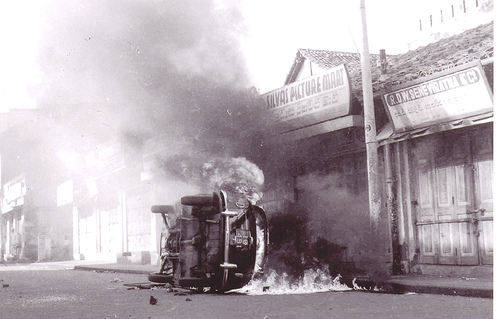
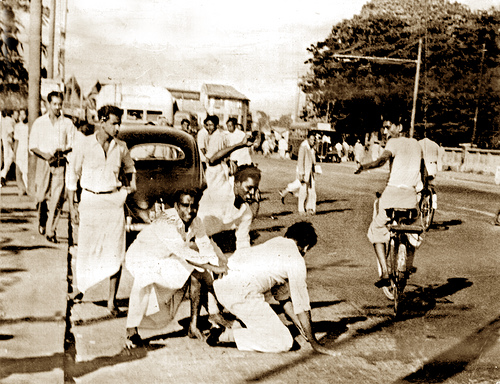
Genocide '58
"...Hon. Senators will remember how one of
the present Ministers of this Government went
round the countryside saying that the U.N.P.
Government had offered the Sinhalese man's mat
to Suppiah to lie on and allow Nalliah to pluck
his eye and Subramaniam to wring his neck. That
is the type of communal propaganda indulged in
by members of the M.E.P. and by their
Ministers. We cannot forget that...The Tamils
are the pawns in a political
game. It does not matter to anybody how we
suffer, how we feel, so long as in this game
one Sinhala party is the victor and the other
Sinhala party is the vanquished. .... if one
party said, "We will kill the Tamils", the
other party could go one better and say, "We
will eat the Tamils." In other words, it was a
competition as to who would hold down the
Tamils most. And the party which was going to
hold down the Tamils most was going to have the
support of the Sinhalese masses... That is all.
That is why I ask you not to make us pawns in
your game... We are willing to go. Every Tamil
man, woman and child is willing to go...We do
not want language rights from you. We will look after our
language..... Please have Sinhalese
only. No Tamil worthy of his name is ever
going to study the Sinhalese language. You have
stamped it out... We only want the right to
live in our areas. We want the right
to be able to walk the streets without being
molested. Those are the rights we want. The
elementary duty of a Government is to afford
protection to its subjects, and the duty of the
citizens is to be loyal to that Government. The
moment that Government fails to afford that
protection, it forfeits its right to that
loyalty and affection. This Government has
forfeited that right... "
On Genocide'58
- Senator S.Nadesan Q.C. [Speech delivered
during the course of the debate on the State of
Emergency in the Second Senate on 4 June
1958]
Excerpts from Tarzie
Vittachi: Emergency 1958
[see also full text]
"News trickled
out from Queens House that the Governor General
had announced, off the record at the press
conference, that the riots had not been
spontaneous. What he said was: 'Gentlemen, if any of you have an idea
that this was a spontaneous outburst of
communalism, you can disabuse your minds of
it. This the work of a master mind who
has been at the back of people who have planned
this carefully and knew exactly what they were
doing. It was a time bomb set about two years
ago which has now exploded.'... What are we
left with (in 1958)? A nation in ruins, some
grim lessons which we cannot afford to forget
and a momentous question: Have the Sinhalese
and Tamils reached the parting of
ways?"
Prologue
In the north and the east other voices which had
been shouted down a year before began to be heard
again. The conviction grew that Mr Bandaranaike had
never intended to implement the B-C Pact and that therefore
the Federal Party had been bamboozled into calling
off the massive satyagraha they had planned for
August 1957.
Mr Bandaranaike's sudden volte face on April 9,
when he broke up the pact
which he himself had forged, set the pendulum of
popularity swinging back in favour of the
Federalists. They appeared once more in public as
the aggrieved party. Mr Chelvanayakam was seen
again as the martyred victim of the Government's
duplicity.... It was in this atmosphere that the
Vavuniya Convention was prepared. The Federal Party
Chiefs, sensing the mood of the moment, went all
out to make the convention a key event. Special
arrangements were made in advance for the transport
of delegates and supporters from every part of the
island. Extra bogeys were attached to the train
from Batticaloa... On May 22, five hundred thugs
and hooligans invaded the Polonnaruwa station, and
smashed up the windows of the Batticaloa train in
their frantic search for Convention-bound Tamils.
The General Manager of Railways, Mr E. Black,
said:
'According to the information we have-telegraph
wires too have been cut-passengers entraining from
Batticaloa were alarmed at threats that a gang was
to attack them as they were under the impression
that most of the passengers were going to the
Federal Convention at Vavuniya. At Welikande, all
but one of the passengers got off the train in
fear. The train went on to Polonnaruwa with the one
passenger. At midnight, as the train steamed in,
the gang set about the train and the lone
passenger. The train was stopped and left for
Colombo at 7 a.m. this morning without a single
passenger. The incident occurred at midnight. The
passenger was sent to hospital by the Railway
Officers there. A Railway Official was sent from
Colombo today to hold an inquiry.'
The Observer reported this incident in more detail
on May 24:
'On Thursday night, passengers were intimidated
into getting off at Welikande as news had reached
them that a gang of men were on the way to prevent
them from making the trip as they felt that
passengers must be prevented from getting to
Vavuniya for the Federal Convention.
One passenger however continued the trip but was
severely assaulted at Polonnaruwa station. A gang
of men, alleged to have numbered nearly 5oo, got on
the train at this station, smashed windows, went
from carriage to carriage looking for passengers,
damaging railway equipment as they did so.
They found one passenger who cowered in his seat,
pleading with them to leave him alone as he did not
belong to the community they were looking for.
"You are all the same", was the reply and they
began assaulting him. He was later despatched to
hospital.
All telegraph wires had been cut and there is still
no communication between Polonnaruwa and Colombo.
The train which should have arrived in Colombo that
morning, left the station at 7 a.m. in the morning
and arrived in Colombo late last evening. Meanwhile
a Board of Inquiry has been despatched to
Polonnaruwa by the General Manager.'
On the night of the 23rd at 9.15 p.m. the
Batticaloa- Colombo train was derailed at the 215th
mile on the Batticaloa-Eravur line. Two men,
Police-Sergeant Appuhamy and railway porter Victor
Fernando, were killed in the wreck. Many others
were injured, some of them very seriously.
Hoodlums, on the watch for Vavuniya-bound
passengers, attacked the wrecked train. Fortunately
there were only forty-seven people on that train.
The wreckers had made a serious miscalculation.
There were very few Tamils on board. And it was the
Sinhalese who suffered most.
At 6 p.m. on May 24 a crowd-nearly a thousand
strong- again invaded the premises of the
Polonnaruwa railway station. They assaulted
everybody in sight, including Sinhalese travellers
and railway officials, and damaged a good deal of
railway property.
Assistant Superintendent of Police Johnpillai who
was travelling on leave to Valaichenai at the time,
was beaten up at Giritale. Timely arrival of police
patrols saved his life. Mr Johnpillai, who was in a
critical condition, was rushed to hospital together
with several others who had suffered at the hands
of the goondas.
That night police sources reported that after an
armed party had cleared the crowd out of the
railway station things were reasonably quiet. But
the Railway Department took the precaution of
cancelling, immediately, all trains which were
scheduled to run between Batticaloa and
Colombo.
Polonnaruwa Aflame
Polonnaruwa town was buzzing with people and
carefully calculated rumours. They huddled en masse
in the streets, exchanging stories of a threatened
Tamil invasion from Trincomalee and from
Batticaloa. Labourers from the Land Development
Department, the Irrigation Department and from the
Government farms who made up the Sinhala Hamudawa
were constantly on the rampage, raping, looting and
beating up Tamil labourers and public officers. The
rumours that a Tamil army was marching to destroy
Polonnaruwa gave the roughnecks a heroic stature.
More veerayas (heroes) joined in to share the glory
of saving the ancient Sinhalese capital from the
Tamil hordes as their ancestors had done a thousand
years before them.
A notable feature of these activities was that the
Sinhalese colonists who had settled in the area for
some years, and therefore had some stake in general
orderliness, took no part in the rioting. The vast
majority of the Hamudawa were imported Government
labourers and the rest were recently arrived
squatters who had no roots yet in the area.
Many of these labourers were marked 'present' on
the check-rolls while they were busy marauding in
the town area. It would have taken a brave
supervising officer to refuse to mark their
attendance. Some of these men, in fact, had their
attendance marked simultaneously in two places-on
the check roll at their work places and on the
register of the remand jail after they were
arrested.

There was some evidence of method in all this
madness-it was crudely but effectively planned. The
rioters had arranged signals-one peal of a temple
bell to signify police, two to signify army and so
on. They also had a simple system of hand signals
to give their associates in the distance such
information as which way a police patrol went. The
element of planning was even more evident in the
agent provocateur system which was widely used.
Many thugs-some of them well-known criminals -had
shaved their heads and assumed the yellow robes was
bhikku.
A taxi driver known to the police as a bad hat of a
stopped on the road. He had a shaven head. Under
the cushions of the seat they found two soiled
yellow robes. Police reports record that two
'monks' arrested for looting and arson were
car-drivers by 'occupation'. These phoney priests
went about whipping up race-hatred, spreading false
stories and taking part in the lucrative side of
this game-robbery and looting.
Whenever the police went after a looter with a
shaven head he disappeared into a house and came
back in the invulnerable robes of a monk. Monks
were ordained in Polonnaruwa in those few days
faster than ever before in the history of
Upasampada, the Buddhist ordination ceremony. They
paid no attention to the sacrilege they were
committing in the sacred robes that the Buddha
Himself had worn. This menace became so bad that
the police took a decision to arrest every man with
a shaven head. They later discovered that a few
innocent Muslims had fallen into their net.
All this went on while Polonnaruwa had no
government nor even a Government Agent of its own.
The Government Agent of Anuradhapura, Deryck
Aluwihare, had been ordered to look after both
provinces in perhaps the toughest assignment ever
given to a young Civil Servant. With the assistance
of a few civil administration officers, a small
police force under A.S.P. Bertram Weerasinghe and a
small army unit of fifty men (and with no orders
yet from Colombo), he was flying between
Anuradhapura and Polonnaruwa, trying to maintain
order. He had asked for reinforcements from Colombo
but the Government seemed reluctant to take the
situation in the North Central Province
seriously.
Community life in Polonnaruwa was completely
disorganized. The bazaar was seething with frenzied
hatred. The first task of the administration, or
what there was of it, was to provide a refuge for
the Tamils whose lives were in danger- it was quite
impossible to protect isolated people with the
meagre means at their disposal. The Government
Agent organized a refugee camp hard by the
Kachcheri. Refugees streaming into the camp soon
disorganized the rudimentary sanitary arrangements
which had been provided.
Before very long the goondas turned their spite
against the Tamil officials in the Government
offices. Government Agent Aluwihare then set up a
refugee camp for them in an isolated Irrigation
Department bungalow, stationing five policemen
there for their protection. The people, the
Government Agent and the refugees knew deep within
themselves how vulnerable they were. How could five
policemen defend this house against hundreds of
hoodlums demented by blood lust?
The situation of the refugees became worse when the
merchants, under threat of reprisals from the
goondas, refused point blank to sell foodstuffs to
the officials looking after the refugees.
A quick decision was taken. Army personnel
commandeered whatever provisions were needed under
the Government Agent's receipt.
The thugs displayed a temerity which was quite
unprecedented. They had complete assurance that the
police would never dare to open fire. The Apey
Aanduwa (The government is ours) bug had got deep
into their veins. As the situation deteriorated,
desperate measures were needed. The ringleaders of
the racial revolt and people suspected of using
their position and influence to stir up trouble
were arrested. Among them were half a dozen
chairmen of village committees and a few other
parish pump politicians. The goondas had developed
a slick technique of throwing dynamite. They
carried it in the breast pockets of their shirts,
with the fuse hanging out. As the 'enemy'
approached they struck a match, lit the fuse,
pulled out the stick of dynamite and flung it at
point-blank range.
On May 24 and 25 murder stalked the streets in
broad daylight. Fleeing Tamils, and Sinhalese who
were suspected of having given them sanctuary, had
their brains strewn about. A deaf mute scavenging
labourer was assaulted to death in the Hingurakgoda
area-just to see what had made him tick. The
goondas burnt two men alive, one at Hingurakgoda,
and the other at Minneriya.
On the night of May 25, one of the most heinous
crimes in the history of Ceylon was carried out.
Almost simultaneously, on the Government farms at
Polonnaruwa and Hingurakgoda, the thugs struck
remorselessly. The Tamil labourers in the
Polonnaruwa sugar-cane plantation fled when they
saw the enemy approaching and hid in the sugar-cane
bushes. The goondas wasted no time. They set the
sugar cane alight and flushed out the Tamils. As
they came out screaming, men, women and children
were cut down with home-made swords, grass-cutting
knives and katties, or pulped under heavy clubs.
At the Government farm at Hingurakgoda, too, the
Tamils were slaughtered that night. One woman in
sheer terror embraced her two children and jumped
into a well. The rioters were enjoying themselves
thoroughly. They ripped open the belly of a woman
eight months pregnant, and left her to bleed to
death. First estimates of the mass murders on that
night were frightening: 150-200 was a quick guess
on the basis of forty families on an average of
four each. This estimate was later pruned down to
around seventy, on the basis of bodies recovered
and the possibility that many Tamils had got away
in time.
The hoodlums were now motorized. They roamed the
district in trucks, smashing up kiosks and houses
and killing any Tamils who got in their way.
On the morning of May 26, the expected Emergency
had not yet been proclaimed. The situation in
Polonnaruwa seemed beyond hope. Government Agent
Aluwihare, ASP. Weerasinghe and their colleagues
had not had a wink of sleep or rest for four days.
They had been promised army reinforcements and Bren
guns but there were no signs of their coming.
The refugee camps were now overcrowded.
"On May 22nd, five hundred thugs and hooligans
invaded the Polonnaruwa station, and smashed up the
windows of the Batticaloa train in their frantic
search for Convention-bound Tamils." The Observer
reported this incident in more detail on May
24th:
'On Thursday night, passengers were
intimidated into getting off at Welikande as news
had reached them that a gang of men were on the
way to prevent them from making the trip as they
felt that passengers must be prevented from
getting to Vavuniya for the Federal Party
Convention.'
'A gang of men, alleged to have numbered
nearly 500, got on the train at this station,
smashed-windows, went from carriage to carriage
looking for passengers, damaging railway
equipment as they did so.'
On the night of the 23rd at 9.15 pm the
Batticaloa Colombo train was derailed at the '215th
mile post on the Batticaloa -Eravur
line� Hoodlums, on the watch for
Vavuniya bound passengers, attacked the wrecked
train.
At 6.00 pm on May 24 a crowd -nearly a thousand
strong - again invaded the premises of the
Polonnaruwa railway station�
Labourers from the Land Development Department,
the Irrigation Department and from the Government
farms who made up the Sinhala Hamudawa (armed
thugs) were constantly on the rampage, raping,
looting and beating up Tamil labourers and public
officers. The rumour that a Tamil army was marching
to destroy Polonaruwa gave the roughnecks a heroic
stature. More veerayas (heroes) joined in to share
the glory of saving the ancient Sinhalese capital
from the Tamil hordes as their ancestors had done a
thousand years before them. The vast majority of
the Hamudawa were imported Government labourers and
the rest were recently arrived squatters who had no
roots yet in the area.
"If there had been any chance whatever at this
stage of keeping Sinhalese tempers under control it
vanished completely following the Prime Minister's
broadcast call to the nation of May
26�
By a strangely inexplicable perversion of
logic, Mr Bandaranaike tried to explain away a
situation by substituting the effect for the
cause. The relevant portion of the speech
was:
"An unfortunate situation has arisen resulting
in communal tension. Certain incidents in, the.
Batticaloa District where some people lost their
lives, including Mr D.A. Seneviratne, a former
Mayor of Nuwara Eliya, have resulted in various
acts of violence and lawlessness in other
areas-for example Polonnaruwa, Dambulla,
Galawela, Kuliyapitiya and even Colombo."
"The killing of Seneviratne on May 25 was
thus officially declared to be the cause of the
uprising, although the communal riots had begun on
May 22 with the attack on the Polonnaruwa Station
and the wrecking of the Batticalos-Colombo trail
and several other minor incidents.
"No explanation was offered by the Prime
Minister for singling out (the Sinhala sounding)
Seneviratne's name for particular mention from the
scores of people who had lost their lives during
those critical days."
"�Colombo was on fire. The
goondas burnt fifteen shops in the Pettah and a row
of kiosks in Mariakaday. Looting on a massive scale
took place in Pettah, Maradana, Wellawatte
Ratmalana, Kurunegala, Panadura, Kalutara, Badulla,
Galle, Matara and Weligama.
"The cry everywhere in the Sinhalese
districts was 'avenge the murder of
Seneviratne�. Even the many
Sinhalese who had been appalled by the goonda
attacks on Tamils and Tamil owned kiosks, now began
to feel that the Tamils had put themselves beyond
the pale. Across the country, this new mood of
deep-seated racism surged. The Prime Minister's
peace call to the nation had turned into a war
cry.
"Another vicious story, fabricated by a ghoul
with a keen sense of melodrama, careered through
the country leaving a trail of arson and murder
after it. A female teacher from Panadura, the story
went, who was teaching in a school in the
Batticaloa District, had been set upon by a gang of
Tamil thugs. They had cut off her breasts and
killed her. Her body was being brought home to
Panadura for cremation."
On the morning of May 27, the Panadura townsfolk
whispered it around that the mutliated body had
been brought home. In the bazaar there was sudden
pandemonium. The goondas intensified their
depredations. They ransacked Tamil-owned shops and
beat up shopkeepers and passersby.
A gang of goondas rushed into the Hindu
temple, and attempted to set fire to it. In their
frenzy they were clumsy and failed to get the fire
going. But they had a more interesting idea. They
pulled an officiating priest out of the Kovil and
burnt him into a cinder.
The story of of the mutilation and murder of a
Panadura teacher gained such currency that the
Ministry of Education despatched a senior Inspector
of Schools to investigate. His report: there was
not an iota of truth in the story. He also
discovered when he checked through the records,
that there was no female teacher from Panadura on
the staff of any school in the Batticaloa
district.
"As panic spread, doors were closed in
Sinhalese as well as Tamil homes. The Tamils closed
their doors to escape murder, rape and pillage. The
Sinhalese closed their doors to prevent Tamils
running into their houses for
shelter�
"Yet another fiendish rumour had been circulated
to inflame the Sinhalese. This was the story of the
'Tar Baby'. In Batticaloa, it appeared, a Sinhala
baby had been snatched from its mother's arms and
immersed in a barrel of boiling tar. The atrocities
increased with alarming rapidity.
"Among the hundreds of acts of arson, rape,
pillage, murder and plain barbarity some incidents
may be recorded as examples of the kind of thuggery
at work."
"In the Colombo area the number of atrocities
swiftly piled up. The atmosphere was thick with
hate and fear. The thugs ran amok burning houses
and shops, beating-up pedestrians, holding-up
vehicles and terrorizing the entire city and the
suburbs."
"Another Tamil officer, working in the same
Government department was unfortunate. The thugs
stormed into his house and assaulted, his wife and
grown-up daughter in the presence of his little
child. His mind cracked under the shock. In the
French liner Laos which took the family away to
safety in Jaffna he insisted on reciting large
chunks of the Bhagavad Gita to the captain of the
ship. All his formal education - he is a Cambridge
scholar- had proved useless to him in the face of
disaster. His broken mind reached out for the only
solace a man has when his own ingenuity and ability
have proved futile."
"At Wellawatte junction, near the plantain
kiosk, a pregnant woman and her husband were set
upon. They clubbed him and left him an the
pavement, then they kicked, the woman repeatedly as
she hurried along at a grotesque sprint, carrying
her swollen belly."
"While the Prime Minister was telling the
citizens' delegation that it was an 'exaggeration
to call the situation an emergency' in every
village from Kalawewa to Nalanda, people's houses
were in flames.
"When an eye witness reached Dambulla it was
still intact. In a few minutes a factory-new Ceylon
Transport Board "Special' arrived, loaded with
'passengers'. They disembarked and swiftly set
about their business: in ten minutes, six houses
were blazing. And hell spread through the
bazaar."
"The rioters continued their battle in the
streets. Fresh fires broke out in Wellawatte,
Maradana and Rettah. Looting continued apace.
"Gangs of hoodlums in the Ratmalana area
appeared to be working according to a predetermined
pattern. Thugs disguised as policemen went round
Tamil houses warning the residents that the police
could no longer guarantee their safety and advising
them to take refuge in the police station. Nearly
10,000 people left their homes in terror.
Then the 'policemen' returned, some now in
mufti, others still in uniform, to ransack the
empty houses. When they had left the scene, hard on
their heels came the 'firing squads'. They came in
vehicles in twos and threes. A bottle of petrol was
flung into the house. A stick of dynamite was
dispatched after it and another house was burning.
Others less efficiently equipped, zealously
collected whatever furniture was, left behind and
used it as firewood to get the flames going.
..."News trickled out from Queens House that the
Governor General had announced, off the record at
the press conference, that the riots had not been
spontaneous. What he said was: 'Gentlemen, if any of you have an idea that
this was a spontaneous outburst of communalism, you
can disabuse your minds of it. This the work
of a master mind who has been at the back of people
who have planned this carefully and knew exactly
what they were doing. It was a time bomb set about
two years ago which has now exploded.'...
What are we left with (in 1958)? A nation in
ruins, some grim lessons which we cannot afford to
forget and a momentous question: Have the Sinhalese
and Tamils reached the parting of ways?"
|
|
Excerpts from the The Fall and Rise of the Tamil Nation by
V.Navaratnam [see also Book
Note]
"...The Convention at Vavuniya
concluded with the Federal Party girding up its
loins for a long-drawn struggle. That struggle
perforce was to be carried on in the Tamil country.
The experience of the Galle Face Green and
the City of Colombo was still fresh in the
mind, and served as a warning that however much
non-violent that Party may try to keep its campaign
the Singhalese side had no respect or appreciation
for any such restraint. But notwithstanding all the
peaceful intentions of the Party, the rabidly
nationalist forces in the SLFP Government took to
pre-emptive mob action immediately after the
Vavuniya Convention ended.
It may be well to keep in mind
again that the victory of S. W. R. D. Bandaranaike
in 1956 marked the beginning of a new era in the
political history of the country. It is the era of
the common man�.The new era
also saw the emergence of a new instrument of state
power. Ultra nationalist Members of Parliament
and political leaders among the Singhalese took to
organizing mobs into private hoodlum armies of
their own. For all intents and purposes they have
virtually become a recognized institution for well
over a quarter of a century since 1956. They were
and are being used to crush the Tamils, and they
have been used to destroy the trade union
movement.
If the non-violent civil
disobedience campaign contemplated by the
Trincomalee Resolution was rendered unnecessary by
the signing of the B-C Pact in 1957, the
Vavuniya Resolution to go ahead with the campaign
in 1958 was thwarted by the Government unleashing
mob violence and by invoking the Public Security Act to proscribe the
Federal Party and place its leaders under
preventive detention. It looked as though the
intervening period of some ten months had been
utilized to mobilize the hoodlum army and have them
ready for action.
On the day following the Vavuniya
Convention the goon squads of the Singhalese
hoodlum army took over the task of dealing with the
Tamils. They went on a rampage of senseless
destruction and wanton brutality. Starting first
with the Pettah in Colombo, where most of the Tamil
business houses and shops were concentrated, they
attacked, smashed, looted, applied the torch and
destroyed shops, houses, buildings and vehicles.
They beat up and thrashed every Tamil they could
lay their hands on. By nightfall the mob violence
spread out to every corner of the City of Colombo
and its suburbs.
The next day I noticed that the
local thugs had taken over the situation and kept
my house under observation, possibly for loot. With
the help of a Singhalese lawyer friend of mine I
escaped with the family to take shelter in a
relative's home on the other side of the Supreme
Court Building abandoning my wrecked house. The
relative's house was in the Muslim quarter of
Hulftsdorp and was therefore relatively safer.
Dr. E. M. V Naganathan came to
visit me in the evening with Balasubramaniam, a
young officer in Government service with strong
Federal Party sympathy. He insisted on going to my
wrecked house to retrieve some essential articles
without heeding my -protests. An hour later he
returned with his clothes drenched in blood that
was streaming from head injuries. His car was
smashed. A few hoodlums had attacked with burning
bricks soaked in petrol. He and Balasubramaniam had
given chase to the ruffians with hockey sticks in
their hands, but the ruffians disappeared into the
maze of the District Court Buildings.
That night a mob of about 40 or 50
thugs attacked my residence at Hulftsdorp in
Colombo although it adjoined the Ministry of
Justice and Supreme Court Buildings and entrance
had to be gained through the Court gates. They
hurled at least 25 Molotov's cocktails (petrol
bombs) calling out my name with every throw. The
front part of the house was smashed, and the
furniture, doors and frames caught fire and burned.
My wife and I and a house- aid by the name of
Muthusamya brave man of the Thevar clan of Tamils,
were the only adults in the house. We gathered our
little children, all 14 to 1 1/2 years of age, and
telling them to run wherever they could if anything
happened to us, we ourselves took our position by
the door leading into the living room ready to face
the worst. The mob, however, made no attempt to
enter the house but passed on when their ammunition
was exhausted.
I learned later from a mutual
friend that the attack on my house was planned and
organized by a Member of Parliament at a Buddhist
Temple in Maradana. I guess he had instructed his
men not to cause bodily harm to the inmates while
attacking my house. This friend, himself a
Singhalese Buddhist of the finest quality and
refinement, had made several attempts to warn me in
advance but was unable to contact me owing to my
absence in Vavuniya.
I rushed Dr. Naganathan to Dr.
Sulaiman's Private Hospital at Grandpass and had
him attended to. In that Hospital I saw sights
which God forbid any man to see. Victims of
Singhalese mob violence were writhing in agony, not
just fighting to retain life. They bore eloquent
testimony to the type of horrible brutality and
torture which some human beings could inflict on
their fellow human beings. Who can help developing
a,bitterness of feeling against those who could
inflict all this suffering for no reason except
that the victims were Tamils?
In three days the mob violence
against the Tamils engulfed all parts of the
country and was not abated by any official action.
It was not until the Prime Minister was prevailed
upon by the Governor General Sir Oliver
Goonetilleke, whom some prominent Tamil citizens of
Colombo had interviewed, that action was taken.
The Prime Minister S. W. R. D.
Bandaranaike then invoked the Public Security Act
and declared a State of Emergency under which the
Army and Naval Forces were called out to restore
law and order. An island-wide curfew was clamped
down, and eventually the situation was brought
under control by the firm and disciplined action of
the then security forces. By which time...more than
20,000 Tamils had become homeless refugees - men,
women, children and babes in arms, crowding in two
refugee camps in the City of Colombo. Their lives
were in such constant danger from the mobs that
they were evacuated by ships to their homeland in
Trincomalee and Jaffna to save their lives.
A retired senior Police officer,
who came to visit some of us later in our detention
camp, tearfully described some of the things he saw
on one of the refugee ships. In one place on the
open deck he saw a father trying to force a small
piece of dry bread down the throat of a month-old
baby for want of any other nourishment. It was a
piece from a half-loaf which the father had managed
to save in camp for more than a week. Our visitor
was so carried away by his anger against the
perpetrators of the violence which caused so much
misery that he said things which need not be
repeated in print. But these are the feelings which
gave rise to the Tamil freedom fighters one
generation later.
Curiously, under the peculiar brand
of democracy practised in Ceylon the perpetrators
of the violence, those who organized and incited
the mobs, continued to be beyond the reach of the
long arm of the law, but the heavy hand of
repression fell on the representatives of the
victims...
Under the Emergency Power which the
Government armed itself with, the Federal Party was
proscribed, publication of the Sutantiran newspaper
was banned, and Party Headquarters and the
Sutantiran Press and Office closed and sealed, and
the Party leaders were all placed under arrest. The
Members of Parliament belonging to the Party were
arrested when they were on their way home after
leaving Parliament. Chelvanayakam, Naganathan and
V. A. Kandiah, whose residences were in Colombo,
were placed under house arrest in their own homes.
Police guards were posted at their houses to guard
the places round the clock. The leaders who resided
in Mannar, Jaffna, Trincomalee and Batticaloa were
similarly placed under house arrest and their homes
guarded by the Police.
The Members of Parliament who were
arrested on the road on their way from Parliament
and whose normal residences were not in Colombo,
and one whose residence in Colombo had been wrecked
and made uninhabitable, were all held in a special
detention camp under heavy Police and military
guard. A Government bungalow at Stanmore Crescent
off Bullers Road in Colombo usually reserved as a
residence for a Supreme Court Judge was converted
into a Detention Camp for the seven of us, namely,
C. Vanniasingham (M. P, for Kopay), N. R.
Rajavarothiam (M. P. for Trincomalee), V. N.
Navaratnam (M. P for Chavakachcheri), C. Rajadurai
(First M. P. for Batticaloa), A.
Amirthalingam (M. P. for Vaddukoddai), G.
Nalliah (Senator) and me.... The house arrest and
detention lasted for three months, June, July and
August, 1958. During that time the voice of the
Federal Party was not heard in Parliament."
|