|
CONTENTS
06/08/09
|
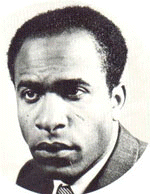 "I have no
wish to be the victim of the Fraud of a black
world. My life should not be devoted to drawing up
the balance sheet of Negro values. There is no white
world, there is no white ethic, any more than there
is a white intelligence. There are in every part of
the world men who search. I am not a prisoner of
history. I should not seek there for the meaning of
my destiny. I should constantly remind myself that
the real leap consists in introduction
invention into existence. In the world through which
I travel, I am endlessly creating myself." -
Frantz Fanon in Black Skin, White
Masks,
1952 "I have no
wish to be the victim of the Fraud of a black
world. My life should not be devoted to drawing up
the balance sheet of Negro values. There is no white
world, there is no white ethic, any more than there
is a white intelligence. There are in every part of
the world men who search. I am not a prisoner of
history. I should not seek there for the meaning of
my destiny. I should constantly remind myself that
the real leap consists in introduction
invention into existence. In the world through which
I travel, I am endlessly creating myself." -
Frantz Fanon in Black Skin, White
Masks,
1952 |
|
Comments by Anne Brace,
USA 12 December 2006
"I discovered your site by
accident. It is very interesting and well done. You
must know that Frantz Fanon is said to be descended
of African slaves, Europeans, and Tamil indentured servants. I am a
student of psychology interested in
how history and the world around us affect our
emotional/mental status. So I was looking up Fanon
and found tamilnation.org (and some
terrible and wonderful information), because you
printed his talk from 1956 to the Congress of
African writers. You didn't mention his
Tamil background, so I wanted to make sure nobody
misses that detail. Peace and solidarity. I am
with a group called News & Letters. Maybe you
can take a look at our website and see if you would
like to contribute a letter or article to our
paper. (www.newsandletters.org) "
Response by
tamilnation.org
Many thanks
for your comments. Yes, we did look at your News
& Letters website and we wish you well with
your efforts. Given the demands on our own time in
relation to tamilnation.org, we do not
know whether we will be able to contribute at the
present time but that is not to say that we do not
recognise the enduring force (and the importance)
of Fannon's
words that the building of a nation is of
necessity accompanied by the discovery and
encouragement of universalising values.
"If man is known by his acts, then we will say
that the most urgent thing today for the
intellectual is to build up his nation. If this
building up is true, that is to say if it
interprets the manifest will of the people ...
then the building of a nation is
of necessity accompanied by the discovery and
encouragement of universalising values. Far
from keeping aloof from other nations, therefore,
it is national liberation which leads the nation to
play its part on the stage of history. It is at the
heart of national consciousness that international consciousness lives and
grows. And this two-fold emerging is
ultimately the source of all culture. "
May God Bless.
|
| Frantz Fannon's
The Wretched of the Earth in Contemporary
Perspective - Professor
Halford H.Fairchild, Pitzer College, Journal of Black
Studies, Vol.25 No2, December |
|
|
Frantz Fanon -
Concerning Violence
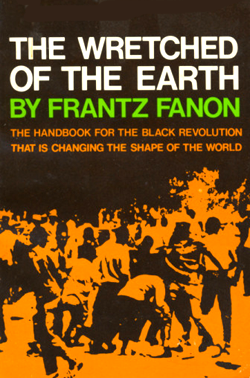  From the Preface by Jean Paul
Sartre From the Preface by Jean Paul
Sartre
Concerning
Violence
"
Decolonization is always a violent
phenomenon... Decolonization, which sets out to
change the order of the world, is, obviously, a
programme of complete disorder... In the
colonies it is the policeman and the soldier
who are the official, instituted
go-betweens...Non Violence is an attempt to
settle the colonial problem around a green
baize table.. Compromise is very important in
the phenomenon of decolonization, for it is
very far from being a simple one... In the
capitalist countries a multitude of moral
teachers, counselors and 'bewilderers' separate
the exploited and those in power. In the
colonial countries, on the contrary, the
policeman and the soldier, by their immediate
presence and their frequent and direct action,
maintain contact with the native and advise him
by means of rifle butts and napalm not to
budge"
Concluding
Chapter
"We must leave
our dreams and abandon our old beliefs and
friendships of the time before life began. Let
us waste no time in sterile litanies and
nauseating mimicry. Leave this Europe where
they are never done talking of Man, yet murder
men everywhere they find them, at the corner of
every one of their own streets, in all the
corners of the globe. For centuries they have
stifled almost the whole of humanity in the
name of a so-called spiritual experience. Look
at them today swaying between atomic and
spiritual disintegration."
Dr. Richard Clarke on
The Wretched of the Earth: Concerning
Violence
Reciprocal Bases of National
Culture and the Fight for Freedom
- Speech by Frantz
Fanon at the Congress of Black African Writers,
1959
Biography of Frantz
Fannon
|
|
 Preface to Frantz Fanon's "Wretched
of the Earth" - Jean-Paul Sartre,
1961 Preface to Frantz Fanon's "Wretched
of the Earth" - Jean-Paul Sartre,
1961
 "...The European élite
undertook to manufacture a native élite.
They picked out promising adolescents; they
branded them, as with a red-hot iron, with the
principles of western culture, they stuffed their
mouths full with high-sounding phrases, grand
glutinous words that stuck to the teeth. After a
short stay in the mother country they were sent
home, whitewashed. These walking lies had nothing
left to say to their brothers; they only echoed.
From Paris, from London, from Amsterdam we would
utter the words 'Parthenon! Brotherhood!' and
somewhere in Africa or Asia lips would open ...
thenon! ... therhood!' It was the golden age. It
came to an end; the mouths opened by themselves;
the yellow and black voices still spoke of our
humanism but only to reproach us with our
inhumanity. .." "...The European élite
undertook to manufacture a native élite.
They picked out promising adolescents; they
branded them, as with a red-hot iron, with the
principles of western culture, they stuffed their
mouths full with high-sounding phrases, grand
glutinous words that stuck to the teeth. After a
short stay in the mother country they were sent
home, whitewashed. These walking lies had nothing
left to say to their brothers; they only echoed.
From Paris, from London, from Amsterdam we would
utter the words 'Parthenon! Brotherhood!' and
somewhere in Africa or Asia lips would open ...
thenon! ... therhood!' It was the golden age. It
came to an end; the mouths opened by themselves;
the yellow and black voices still spoke of our
humanism but only to reproach us with our
inhumanity. .."
Not so very long ago, the earth numbered two
thousand million inhabitants: five hundred million
men, and one thousand five hundred million natives.
The former had the Word; the others had the use of
it. Between the two there were hired kinglets,
overlords and a bourgeoisie, sham from beginning to
end, which served as go-betweens. In the colonies
the truth stood naked, but the citizens of the
mother country preferred it with clothes on: the
native had to love them, something in the way
mothers are loved.
The European élite undertook to manufacture
a native élite. They picked out promising
adolescents; they branded them, as with a red-hot
iron, with the principles of western culture, they
stuffed their mouths full with high-sounding
phrases, grand glutinous words that stuck to the
teeth. After a short stay in the mother country
they were sent home, whitewashed. These walking
lies had nothing left to say to their brothers;
they only echoed. From Paris, from London, from
Amsterdam we would utter the words 'Parthenon!
Brotherhood!' and somewhere in Africa or Asia lips
would open ... thenon! ... therhood!' It was the
golden age.
It came to an end; the mouths opened by themselves;
the yellow and black voices still spoke of our
humanism but only to reproach us with our
inhumanity. We listened without displeasure to
these polite statements of resentment, at first
with proud amazement. What? They are able to talk
by themselves? Just look at what we have made of
them! We did not doubt but that they would accept
our ideals, since they accused us of not being
faithful to them. Then, indeed, Europe could
believe in her mission; she had hellenized the
Asians; she had created a new breed, the
Graeco-Latin Negroes. We might add, quite between
ourselves, as men of the world: 'After all, let
them bawl their heads off, it relieves their
feelings; dogs that bark don't bite.'
A new generation came on the scene, which changed
the issue. With unbelievable patience, its writers
and poets tried to explain to us that our values
and the true facts of their lives did not hang
together, and that they could neither reject them
completely nor yet assimilate them.
By and large, what they were saying was this:
'You are making us into monstrosities; your
humanism claim we are at one with the rest of
humanity but your racist methods set us apart.'
Very much at our ease, we listened to them all;
colonial administrators are not paid to read Hegel,
and for that matter they do not read much of him,
but they do not need a philosopher to tell them
that uneasy consciences are caught up in their own
contradictions. They will not get anywhere; so, let
us perpetuate their discomfort; nothing will come
of it but talk. If they were, the experts told us,
asking for anything at all precise in their
wailing, it would be integration.
Of course, there is no question of granting
that; the system, which depends on
over-exploitation, as you know, would be ruined.
But it's enough to hold the carrot in front of
their noses, they'll gallop all right. As to a
revolt, we need not worry at all; what native in
his senses would go off to massacre the fair sons
of Europe simply to become European as they are? In
short, we encouraged these disconsolate spirits and
thought it not a bad idea for once to award the
Prix Goncourt to a Negro. That was before '39.
1961. Listen: 'Let us waste no time in sterile
litanies and nauseating mimicry. Leave this Europe
where they are never done talking of Man, yet
murder men everywhere they find them, at the corner
of every one of their own streets, in all the
corners of the globe. For centuries they have
stifled almost the whole of humanity in the name of
a so-called spiritual experience.' The tone is new.
Who dares to speak thus? It is an African, a man
from the Third World, an ex-'native'. He adds:
'Europe now lives at such a mad, reckless pace that
she is running headlong into the abyss; we would do
well to keep away from it.' In other words, she's
done for. A truth which is not pleasant to state
but of which we are all convinced, are we not,
fellow-Europeans, in the marrow of our bones?
We must however make one reservation. When a
Frenchman, for example, says to other Frenchmen
'The country is done for' - which has happened, I
should think, almost every day since 1930 - it is
emotional talk; burning with love and fury, the
speaker includes himself with his
fellow-countrymen. And then, usually, he adds
'Unless ...' His meaning is clear; no more mistakes
must be made; if his instructions are not carried
out to the letter, then and only then will the
country go to pieces. In short, it is a threat
followed by a piece of advice and these remarks are
so much the less shocking in that they spring from
a national inter subjectivity.
But on the contrary when Fanon says of Europe
that she is rushing to her doom, far from sounding
the alarm he is merely setting out a diagnosis.
This doctor neither claims that she is a hopeless
case - miracles have been known to exist - nor does
he give her the means to cure herself. He certifies
that she is dying, on external evidence, founded on
symptoms that he can observe. As to curing her, no;
he has other things to think about; he does not
give a damn whether she lives or dies. Because of
this, his book is scandalous. And if you murmur,
jokingly embarrassed, 'He has it in for us!' the
true nature of the scandal escapes you; for Fanon
has nothing in for you at all; his work - red-hot
for some - in what concerns you is as cold as ice;
he speaks of you often, never to you.
The black Goncourts and the yellow Nobels are
finished; the days of colonized laureats are over.
An ex-native French-speaking, bends that language
to new requirements, makes use of it, and speaks to
the colonized only: 'Natives of an under-developed
countries, unite!' What a downfall! For the
fathers, we alone were the speakers; the sons no
longer even consider us as valid intermediaries: we
are the objects of their speeches. Of course, Fanon
mentions in passing our well-known crimes:
Sétif, Hanoi, Madagascar: but he does not
waste his time in condemning them; he uses them. If
he demonstrates the tactics of colonialism, the
complex play of relations which unite and oppose
the colonists to the people of the mother country,
it is for his brothers; his aim is to teach them to
beat us at our own game.
In short, the Third World finds itself and speaks
to itself through his voice. We know that it is not
a homogeneous world; we know too that enslaved
peoples are still to be found there, together with
some who have achieved a simulacrum of phoney
independence, others who are still fighting to
attain sovereignty and others again who have
obtained complete freedom but who live under the
constant menace of imperialist aggression.
These differences are born of colonial history,
in other words of oppression. Here, the mother
country is satisfied to keep some feudal rulers in
her pay; there, dividing and ruling she has created
a native bourgeoisie, sham from beginning to end;
elsewhere she has played a double game: the colony
is planted with settlers and exploited at the same
time.
Thus Europe has multiplied divisions and
opposing groups, has fashioned classes and
sometimes even racial prejudices, and has
endeavoured by every means to bring about and
intensify the stratification of colonized
societies. Fanon hides nothing: in order to fight
against us the former colony must fight against
itself: or, rather, the two struggles form part of
a whole. In the heat of battle, all internal
barriers break down; the puppet bourgeoisie of
businessmen and shopkeepers, the urban proletariat,
which is always in a privileged position, the
lumpen-proletariat of the shanty towns - all fall
into line with the stand made by the rural masses,
that veritable reservoir of a national
revolutionary army; for in those countries where
colonialism has deliberately held up development,
the peasantry, when it rises, quickly stands out as
the revolutionary class.
For it knows naked oppression, and suffers far
more from it than the workers in the towns, and in
order not to die of hunger, it demands no less than
a complete demolishing of all existing structures.
In order to triumph, the national revolution must
be socialist; if its career is cut short, if the
native bourgeoisie takes over power, the new State,
in spite of its formal sovereignty, remains in the
hands of the imperialists.
The example of Katanga illustrates this quite
well. Thus the unity of the Third World is not yet
achieved. It is a work in progress, which begins by
the union, in each country, after independence as
before, of the whole of the colonized under the
command of the peasant class. This is what Fanon
explains to his brothers in Africa, Asia and Latin
America: we must achieve revolutionary socialism
all together everywhere, or else one by one we will
be defeated by our former masters. He hides
nothing, neither weaknesses, nor discords, nor
mystification.
Here, the movement gets off to a bad start;
then, after a striking initial success it loses
momentum; elsewhere it has come to a standstill,
and if it is to start again, the peasants must
throw their bourgeoisie overboard. The reader is
sternly put on his guard against the most dangerous
will o' the wisps: the cult of the leader and of
personalities, Western culture, and what is equally
to be feared, the withdrawal into the twilight of
past African culture. For the only true culture is
that of the Revolution; that is to say, it is
constantly in the making. Fanon speaks out loud; we
Europeans can hear him, as the fact that you hold
this book in your hand proves; is he not then
afraid that the colonial powers may take advantage
of his sincerity?
No; he fears nothing. Our methods are out-of-date;
they can sometimes delay emancipation, but not stop
it. And do not think that we can change our ways;
neo-colonialism, that idle dream of mother
countries, is a lot of hot air; the 'Third Forces'
don't exist, or if they do they are only the
tin-pot bourgeoisies that colonialism has already
placed in the saddle. Our Machiavellianism has
little purchase on this wide-awake world that has
run our falsehoods to earth one after the other.
The settler has only recourse to one thing: brute
force, when he can command it; the native has only
one choice, between servitude or supremacy.
What does Fanon care whether you read his work
or not? It is to his brothers that he denounces our
old tricks, and he is sure we have no more up our
sleeves. It is to them he says: 'Europe has laid
her hands on our continents, and we must slash at
her fingers till she lets go. It's a good moment;
nothing can happen at Bizerta, at Elizabethville or
in the Algerian bled that the whole world does not
hear about. The rival blocks take opposite sides,
and hold each other in check; let us take advantage
of this paralysis, let us burst into history,
forcing it by our invasion into universality for
the first time. Let us start fighting; and if we've
no other arms, the waiting knife's enough.'
Europeans, you must open this book and enter into
it. After a few steps in the darkness you will see
strangers gathered around a fire; come close, and
listen, for they are talking of the destiny they
will mete out to your trading-centres and to the
hired soldiers who defend them. They will see you,
perhaps, but they will go on talking among
themselves, without even lowering their voices.
This indifference strikes home: their fathers,
shadowy creatures, your creatures, were but dead
souls; you it was who allowed them glimpses of
light, to you only did they dare speak, and you did
not bother to reply to such zombies. Their sons
ignore you; a fire warms them and sheds light
around them, and you have not lit it. Now, at a
respectful distance, it is you who will feel
furtive, nightbound and perished with cold. Turn
and turn about; in these shadows from whence a new
dawn will break, it is you who are the zombies.
In this case, you will say, let's throw away this
book. Why read it if it is not written for us? For
two reasons; the first is that Fanon explains you
to his brothers and shows them the mechanism by
which we are estranged from ourselves; take
advantage of this, and get to know yourselves seen
in the light of truth, objectively. Our victims
know us by their scars and by their chains, and it
is this that makes their evidence irrefutable. It
is enough that they show us what we have made of
them for us to realize what we have made of
ourselves. But is it any use? Yes, for Europe is at
death's door.
But, you will say, we live in the mother
country, and we disapprove of her excesses. It is
true, you are not settlers, but you are no better.
For the pioneers belonged to you; you sent them
overseas, and it was you they enriched. You warned
them that if they shed too much blood you would
disown them, or say you did, in something of the
same way as any state maintains abroad a mob of
agitators, agents provocateurs and spies whom it
disowns when they are caught. You, who are so
liberal and so humane, who have such an exaggerated
adoration of culture that it verges on affectation,
you pretend to forget that you own colonies and
that in them men are massacred in your name. Fanon
reveals to his comrades above all to some of them
who are rather too Westernized - the solidarity of
the people of the mother country and of their
representatives in the colonies.
Have the courage to read this book, for in the
first place it will make you ashamed, and shame, as
Marx said, is a revolutionary sentiment. You see,
I, too, am incapable of ridding myself of
subjective illusions; I, too, say to you: 'All is
lost, unless ...' As a European, I steal the
enemy's book, and out of it I fashion a remedy for
Europe. Make the most of it.
And here is the second reason: if you set aside
Sorel's fascist utterances, you will find that
Fanon is the first since Engels to bring the
processes of history into the clear light of day.
Moreover, you need not think that hot-headedness or
an unhappy childhood have given him some uncommon
taste for violence; he acts as the interpreter of
the situation, that's all. But this is enough to
enable him to constitute, step by step, the
dialectic which liberal hypocrisy hides from you
and which is as much responsible for our existence
as for his.
During the last century, the middle classes looked
on the workers as covetous creatures, made lawless
by their greedy desires; but they took care to
include these great brutes in our own species, or
at least they considered that they were free men -
that is to say, free to sell their labour. In
France, as in England, humanism claimed to be
universal.
In the case of forced labour, it is quite the
contrary. There is no contract; moreover, there
must be intimidation and thus oppression grows. Our
soldiers overseas, rejecting the universalism of
the mother country, apply the 'numerus clausus' to
the human race: since none may enslave, rob or kill
his fellowman without committing a crime, they lay
down the principle that the native is not one of
our fellow-men. Our striking-power has been given
the mission of changing this abstract certainty
into reality: the order is given to reduce the
inhabitants of the annexed country to the level of
superior monkeys in order to justify the settler's
treatment of them as beasts of burden.
Violence in the colonies does not only have for
its aim the keeping of these enslaved men at arm's
length; it seeks to dehumanize them. Everything
will be done to wipe out their traditions, to
substitute our language for theirs and to destroy
their culture without giving them ours. Sheer
physical fatigue win stupefy them. Starved and ill,
if they have any spirit left, fear will finish the
job; guns are levelled at the peasant; civilians
come to take over his land and force him by dint of
flogging to till the land for them. If he shows
fight, the soldiers fire and he's a dead man; if he
gives in, he degrades himself and he is no longer a
man at all; shame and fear will split up his
character and make his inmost self fall to
pieces.
The business is conducted with flying colours
and by experts: the 'psychological services'
weren't established yesterday; nor was
brain-washing. And yet, in spite of an these
efforts, their ends are nowhere achieved: neither
in the Congo, where Negroes' hands were cut off,
nor in Angola, where until very recently
malcontents' lips were pierced in order to shut
them with padlocks. I do not say that it is
impossible to change a Man into an animal I simply
say that you won't get there without weakening him
considerably. Blows will never suffice; you have to
push the starvation further, and that's the trouble
with slavery.
For when you domesticate a member of our own
species, you reduce his output, and however little
you may give him, a farmyard man finishes by
costing more than he brings in. For this reason the
settlers are obliged to stop the breaking-in
half-way; the result, neither man nor animal, is
the native. Beaten, under-nourished, ill, terrified
- but only up to a certain point - he has, whether
he's black, yellow or white, always the same traits
of character: he's a sly-boots, a lazybones and a
thief, who lives on nothing, and who understands
only violence.
Poor settler; here is his contradiction naked,
shorn of its trappings. He ought to kill those he
plunders, as they say djinns do. Now, this is not
possible, because he must exploit them as well.
Because he can't carry massacre on to genocide, and
slavery to animal-like degradation, he loses
control, the machine goes into reverse, and a
relentless logic leads him on to
decolonization.
But it does not happen immediately. At first the
European's reign continues. He has already lost the
battle, but this is not obvious; he does not yet
know that the natives are only half-native; to hear
him talk, it would seem that he ill-treats them in
order to destroy or to repress the evil that they
have rooted in them; and after three generations
their pernicious instincts will reappear no more.
What instincts does he mean? The instincts that
urge slaves on to massacre their master? Can he not
here recognize his own cruelty turned against
himself? In the savagery of these oppressed
peasants, does he not find his own settler's
savagery, which they have absorbed through every
pore and for which there is no cure?
The reason is simple; this imperious being,
crazed by his absolute power and by the fear of
losing it, no longer remembers clearly that he was
once a man; he takes himself for a horsewhip or a
gun; he has come to believe that the domestication
of the 'inferior races' will come about by the
conditioning of their reflexes. But in this he
leaves out of account the human memory and the
ineffaceable marks left upon it; and then, above
all there is something which perhaps he has never
known: we only become what we are by the radical
and deep-seated refusal of that which others have
made of us. Three generations did we say? Hardly
has the second generation opened their eyes than
from then on they've seen their fathers being
flogged. In psychiatric terms, they are
'traumatized', for life.
But these constantly renewed aggressions, far
from bringing them to submission, thrust them into
an unbearable contradiction which the European will
pay for sooner or later. After that, when it is
their turn to be broken in, when they are taught
what shame and hunger and pain are, all that is
stirred up in them is a volcanic fury whose force
is equal to that of the pressure put upon them. You
said they understand nothing but violence? Of
course; first, the only violence is the settlers;
but soon they will make it their own; that is to
say, the same violence is thrown back upon us as
when our reflection comes forward to meet us when
we go towards a mirror.
Make no mistake about it; by this mad fury, by this
bitterness and spleen, by their ever-present desire
to kill us, by the permanent tensing of powerful
muscles which are afraid to relax, they have become
men: men because of the settler, who wants to make
beasts of burden of them - because of him, and
against him. Hatred, blind hatred which is as yet
an abstraction, is their only wealth; the Master
calls it forth because he seeks to reduce them to
animals, but he fails to break it down because his
interests stop him half-way. Thus the
'half-natives' are still humans, through the power
and the weakness of the oppressor which is
transformed within them into a stubborn refusal of
the animal condition. We realize what follows;
they're lazy: of course - it's a form of sabotage.
they're sly and thieving; just imagine! But their
petty thefts mark the beginning of a resistance
which is still unorganized. That is not enough;
there are those among them who assert themselves by
throwing themselves barehanded against the guns;
these are their heroes. Others make men of
themselves by murdering Europeans, and these are
shot down; brigands or martyrs, their agony exalts
the terrified masses.
Yes, terrified; at this fresh stage, colonial
aggression turns inward in a current of terror
among the natives. By this I do not only mean the
fear that they experience when faced with our
inexhaustible means of repression but also that
which their own fury produces in them. They are
cornered between our guns pointed at them and those
terrifying compulsions, those desires for murder
which spring from the depth of their spirits and
which they do not always recognize; for at first it
is not their violence, it is ours, which turns back
on itself and rends them; and the first action of
these oppressed creatures is to bury deep down that
hidden anger which their and our moralities condemn
and which is however only the last refuge of their
humanity. Read Fanon: you will learn how, in the
period of their helplessness, their mad impulse to
murder is the expression of the natives' collective
unconscious.
If this suppressed fury fails to find an outlet, it
turns in a vacuum and devastates the oppressed
creatures themselves. In order to free themselves
they even massacre each other. The different tribes
fight between themselves since they cannot face the
real enemy - and you can count on colonial policy
to keep up their rivalries; the man who raises his
knife against his brother thinks that he has
destroyed once and for all the detested image of
their common degradation, even though these
expiatory victims don't quench their thirst for
blood.
They can only stop themselves from marching
against the machine-guns by doing our work for us;
of their own accord they will speed up the
dehumanisation that they reject. Under the amused
eye of the settler, they will take the greatest
precautions against their own kind by setting up
supernatural barriers, at times reviving old and
terrible myths, at others binding themselves by
scrupulous rites. It is in this way that an
obsessed person flees from his deepest needs - by
binding himself to certain observances which
require his attention at every turn.
They dance; that keeps them busy; it relaxes
their painfully contracted muscles; and then the
dance mimes secretly, often without their knowing,
the refusal they cannot utter and the murders they
dare not commit. In certain districts they make use
of that last resort - possession by spirits.
Formerly this was a religious experience in all its
simplicity, a certain communion of the faithful
with sacred things; now they make of it a weapon
against humiliation and despair; Mumbo-Jumbo and
all the idols of the tribe come down among them,
rule over their violence and waste it in trances
until it in exhausted.
At the same time these high-placed, personages
protect them; in other words the colonized people
protect themselves against colonial estrangement by
going one better in religious estrangement, with
the unique result that finally they add the two
estrangements together and each reinforces the
other. Thus in certain psychoses the hallucinated
person, tired of always being insulted by his
demon, one fine day starts hearing the voice of an
angel who pays him compliments; but the jeers don't
stop for all that; only from then on, they
alternate with congratulations. This is a defence,
but it is also the end of the story; the self is
disassociated, and the patient heads for
madness.
Let us add, for certain other carefully selected
unfortunates, that other witchery of which I have
already spoken: Western culture. If I were them,
you may say, I'd prefer my mumbo-jumbo to their
Acropolis. Very good: you've grasped the situation.
But not altogether, because you aren't them - or
not yet. Otherwise you would know that they can't
choose; they must have both. Two worlds: that makes
two bewitchings; they dance all night and at dawn
they crowd into the churches to hear mass; each day
the split widens. Our enemy betrays his brothers
and becomes our accomplice; his brothers do the
same thing. The status of 'native' is a nervous
condition introduced and maintained by the settler
among colonized people with their consent.
Laying claim to and denying the human condition at
the same time: the contradiction is explosive. For
that matter it does explode, you know as well as I
do; and we are living at the moment when the match
is put to the fuse. When the rising birthrate
brings wider famine in its wake, when these
newcomers have life to fear rather more than death,
the torrent of violence sweeps away all barriers.
In Algeria and Angola, Europeans are massacred at
sight. It is the moment of the boomerang; it is the
third phase of violence; it comes back on us, it
strikes us, and we do not realize any more than we
did the other times that it's we that have launched
it.
The 'liberals' are stupefied; they admit that we
were not polite enough to the natives, that it
would have been wiser and fairer to allow them
certain rights in so far as this was possible; they
ask nothing better than to admit them in batches
and without sponsors to that very exclusive club,
our species; and now this barbarous, mad outburst
doesn't spare them any more than the bad settlers.
The Left at home is embarrassed; they know the true
situation of the natives, the merciless oppression
they are submitted to; they do not condemn their
revolt, knowing full well that we have done
everything to provoke it.
But, all the same, they think to themselves,
there are limits; these guerrillas should be bent
on showing that they are chivalrous; that would be
the best way of showing they are men. Sometimes the
Left scolds them ... 'you're going too far; we
won't support you any more.' The natives don't give
a damn about their support; for all the good it
does them they might as well stuff it up their
backsides. Once their war began, they saw this hard
truth: that every single one of us has made his
bit, has got something out of them; they don't need
to call anyone to witness; they'll grant favoured
treatment to no one.
There is one duty to be done, one end to achieve:
to thrust out colonialism by every means in their
power. The more far-seeing among us will be, in the
last resort, ready to admit this duty and this end;
but we cannot help seeing in this ordeal by force
the altogether inhuman means that these
less-than-men make use of to win the concession of
a charter of humanity. Accord it to them at once,
then, and let them endeavour by peaceful
undertakings to deserve it. Our worthiest souls
contain racial prejudice.
They would do well to read Fanon; for he shows
clearly that this irrepressible violence is neither
sound and fury, nor the resurrection of savage
instincts, nor even the effect of resentment: it is
man re-creating himself. I think we understood this
truth at one time, but we have forgotten it - that
no gentleness can efface the marks of violence;
only violence itself can destroy them.
The native cures himself of colonial neurosis by
thrusting out the settler through force of arms.
When his rage boils over, he rediscovers his lost
innocence and he comes to know himself in that he
himself creates his self. Far removed from his war,
we consider it as a triumph of barbarism; but of
its own volition it achieves, slowly but surely,
the emancipation of the rebel, for bit by bit it
destroys in him and around him the colonial gloom.
Once begun, it is a war that gives no quarter. You
may fear or be feared; that is to say, abandon
yourself to the disassociations of a sham existence
or conquer your birthright of unity. When the
peasant takes a gun in his hands, the old myths
grow dim and the prohibitions are one by one
forgotten. The rebel's weapon is the proof of his
humanity.
For in the first days of the revolt you must
kill: to shoot down a European is to kill two birds
with one stone, to destroy an oppressor and the man
he oppresses at the same time: there remain a dead
man, and a free man; the survivor, for the first
time, feels a national soil under his foot. At this
moment the Nation does not shrink from him;
wherever he goes, wherever he may be, she is; she
follows, and is never lost to view, for she is one
with his liberty. But, after the first surprise,
the colonial army strikes; and then all must unite
or be slaughtered.
Tribal dissensions weaken and tend to disappear;
in the first place because they endanger the
Revolution, but for the more profound reason that
they served no other purpose before than to divert
violence against false foes. When they remain - as
in the Congo - it's because they are kept up by the
agents of colonialism. The Nation marches forward;
for each of her children she is to be found
wherever his brothers are fighting. Their feeling
for each other is the reverse of the hatred they
feel for you; they are brothers inasmuch as each of
them has killed and may at any moment have to kill
again. Fanon shows his readers the limits of
'spontaneity' and the need for and dangers of
'organization'. But however great may be the task
at each turning of the way the revolutionary
consciousness deepens. The last complexes flee
away; no one need come to us talking of the
'dependency' complex of an A.L.N. soldier.
With his blinkers off, the peasant takes account of
his real needs; before they were enough to kill
him, but he tried to ignore them; now he sees them
as infinitely great requirements. In this violence
which springs from the people, which enables them
to hold out for five years - for eight years as the
Algerians have done - the military, political and
social necessities cannot be separated. The war, by
merely setting the question of command and
responsibility, institutes new structures which
will become the first institutions of peace.
Here, then, is man even now established in new
traditions, the future children of a horrible
present; here then we see him legitimized by a law
which will be born or is born each day under fire:
once the last settler a killed, shipped home or
assimilated, the minority breed disappears, to be
replaced by socialism. And that's not enough; the
rebel does not stop there; for you can be quite
sure that he is not risking his skin to find
himself at the level of a former inhabitant of the
old mother country. Look how patient he is! Perhaps
he dreams of another Dien Bien Phu, but don't think
he's really counting on it; he's a beggar fighting,
in his poverty, against rich men powerfully armed.
While he is waiting for decisive victories, or even
without expecting them at all, he tires out his
adversaries until they are sick of him.
It will not be without fearful losses; the colonial
army becomes ferocious; the country is marked out,
there are mopping-up operations, transfers of
population, reprisal expeditions, and they massacre
women and children. He knows this; this new man
begins his life as a man at the end of it; he
considers himself as a potential corpse. He will be
killed; not only does he accept this risk, he's
sure of it. This potential dead man has lost his
wife and his children; he has seen so many dying
men that he prefers victory to survival; others,
not he, will have the fruits of victory; he is too
weary of it all. But this weariness of the heart is
the root of an unbelievable courage. We find our
humanity on this side of death and despair; he
finds it beyond torture and death. We have sown the
wind; he is the whirlwind. The child of violence,
at every moment he draws from it his humanity. We
were men at his expense, he makes himself man at
ours: a different man; of higher quality.
Here Fanon stops. He has shown the way forward: he
is the spokesman of those who are fighting and he
has called for union, that is to say the unity of
the African continent against all dissensions and
all particularisms. He has gained his end. If he
had wished to describe in all its details the
historical phenomenon of decolonization he would
have to have spoken of us; this is not at all his
intention. But, when we have closed the book, the
argument continues within us, in spite of its
author; for we feel the strength of the peoples in
revolt and we answer by force. Thus there is a
fresh moment of violence; and this time we
ourselves are involved, for by its nature this
violence is changing us, accordingly as the
'half-native' is changed. Everyone of us must think
for himself - always provided that he thinks at
all; for in Europe today, stunned as she is by the
blows received by France, Belgium or England, even
to allow your mind to be diverted, however
slightly, is as good as being the accomplice in
crime of colonialism. This book has not the
slightest need of a preface, all the less because
it is not addressed to us. Yet I have written one,
in order to bring the argument to its conclusion;
for we in Europe too are being decolonized: that is
to say that the settler which is in every one of us
is being savagely rooted out. Let us look at
ourselves, if we can bear to, and see what is
becoming of us. First, we must face that unexpected
revelation, the strip-tease of our humanism. There
you can see it, quite naked, and it's not a pretty
sight. It was nothing but an ideology of lies, a
perfect justification for pillage; its honeyed
words, its affectation of sensibility were only
alibis for our aggressions. A fine sight they are
too, the believers in non-violence, saying that
they are neither executioners nor victims. Very
well then; if you're not victims when the
government which you've voted for, when the army in
which your younger brothers are serving without
hesitation or remorse have undertaken race murder,
you are, without a shadow of doubt, executioners.
And if you chose to be victims and to risk being
put in prison for a day or two, you are simply
choosing to pull your irons out of the fire. But
you will not be able to pull them out; they'll have
to stay there till the end. Try to understand this
at any rate: if violence began this _very evening
and if exploitation and oppression had never
existed on the earth, perhaps the slogans of
non-violence might end the quarrel. But if the
whole regime, even your non-violent ideas, are
conditioned by a thousand-year-old oppression, your
passivity serves only to place you in the ranks of
the oppressors.
You know well enough that we are exploiters. You
know too that we have laid hands on first the gold
and metals, then the petroleum of the 'new
continents', and that we have brought them back to
the old countries. This was not without excellent
results, as witness our palaces, our cathedrals and
our great industrial cities; and then when there
was the threat of a slump, the colonial markets
were there to soften the blow or to divert it.
Crammed with riches, Europe accorded the human
status de jure to its inhabitants. With us, to be a
man is to be an accomplice of colonialism, since
all of us without exception have profited by
colonial exploitation. This fat, pale continent
ends by falling into what Fanon rightly calls
narcissism. Cocteau became irritated with Paris -
'that city which talks about itself the whole
time'.
Is Europe any different? And that super-European
monstrosity, North America? Chatter, chatter:
liberty, equality, fraternity, love, honour,
patriotism and what have you. All this did not
prevent us from making anti-racial speeches about
dirty niggers, dirty Jews and dirty Arabs.
High-minded people, liberal or just soft-hearted,
protest that they were shocked by such
inconsistency; but they were either mistaken or
dishonest, for with us there is nothing more
consistent than a racist humanism since the
European has only been able to become a man through
creating slaves and monsters.
While there was a native population somewhere
this imposture was not shown up; in the notion of
the human race we found an abstract assumption of
universality which served as cover for the most
realistic practices. On the other side of the ocean
there was a race of less-than-humans who, thanks to
us, might reach our status a thousand years hence,
perhaps; in short, we mistook the elite for the
genus. Today, the native populations reveal their
true nature, and at the same time our exclusive
'club' reveals its weakness - that it's neither
more nor less than a minority. Worse than that:
since the others become men in name against us, it
seems that we are the enemies of mankind; the
élite shows itself in its true colours - it is
nothing more than a gang. Our precious sets of
values begin to moult; on closer scrutiny you won't
see one that isn't stained with blood. If you are
looking for an example, remember these fine words:
'How generous France is!' Us, generous? What about
Sétif, then? And those eight years of
ferocious war which have cost the lives of over a
million Algerians? And the tortures?
But let it be understood that nobody reproaches us
with having been false to such-and-such a mission -
for the very good reason that we had no mission at
all. It is generosity itself that's in question;
this fine melodious word has only one meaning: the
granting of a statutory charter. For the folk
across the water, new men, freed men, no one has
the power nor the right to give anything to
anybody; for each of them has every right, and the
right to everything. And when one day our human
kind becomes full-grown, it will not define itself
as the sum total of the whole world's inhabitants,
but as the infinite unity of their mutual
needs.
Here I stop; you will have no trouble in
finishing the job; all you have to do is to look
our aristocratic virtues straight in the face, for
the first and last time. They are cracking up; how
could they survive the aristocracy of underlings
who brought them into being? A few years ago, a
bourgeois colonialist commentator found only this
to say in defence of the West: 'We aren't angels.
But we, at least, feel some remorse.' What a
confession! Formerly our continent was buoyed up by
other means: the Parthenon, Chartres, the Rights of
Man or the swastika. Now we know what these are
worth; and the only chance of our being saved from,
shipwreck is the very Christian sentiment of guilt.
You can see it's the end; Europe is springing leaks
everywhere. What then has happened? It simply is
that in the past we made history and now it is
being made of us. The ratio of forces has been
inverted; decolonization has begun; all that our
hired soldiers can do is to delay its
completion.
The old 'mother countries' have still to go the
whole hog, still have to engage their entire forces
in a battle which is lost before it has begun. At
the end of the adventure we again find that
colonial brutality which was Bugeaud's doubtful but
though it has been multiplied ten-fold, it's still
not enough. The national service units are sent to
Algeria, and they remain there seven years with no
result. Violence has changed its direction. When we
were victorious we practised it without its seeming
to alter us; it broke down the others, but for us
men our humanism remained intact.
United by their profits, the peoples of the
mother countries baptized their commonwealth of
crimes, calling them fraternity and love; today
violence, blocked everywhere, comes back on us
through our soldiers, comes inside and takes
possession of us. Involution starts; the native
re-creates himself, and we, settlers and Europeans,
ultras and liberals we break up. Rage and fear are
already blatant; they show themselves openly in the
nigger-hunts in Algeria. Now, which side are the
savages on? Where is barbarism?
Nothing is missing, not even the tom-toms; the
motor-horns beat out 'Al-gér-ie
fran-çaise' while the Europeans burn Moslems
alive. Fanon reminds us that not so very long ago,
a congress of psychiatrists was distressed by the
criminal propensities of the native population.
'Those people kill each other,' they said, 'that
isn't normal. The Algerian's cortex must be
under-developed.' In central Africa, others have
established that 'the African makes very little use
of his frontal lobes'. These learned men would do
well today to follow up their investigations in
Europe, and particularly with regard to the
French.
For we, too, during the last few years, must be
victims of 'frontal sluggishness' since our
patriots do quite a bit of assassinating of their
fellow-countrymen and if they're not at home, they
blow up their house and their concierge. This is
only a beginning; civil war is forecast for the
autumn, or for the spring of next year. Yet our
lobes seem to be in perfect condition; is it not
rather the case that, since we cannot crush the
natives, violence comes back on its tracks,
accumulates in the very depths of our nature and
seeks a way out?
The union of the Algerian people causes the
disunion of the French people; throughout the whole
territory of the ex-mother-country, the tribes are
dancing their war-dances. The terror has left
Africa, and is settling here; for quite obviously
there are certain furious beings who want to make
us Pay with our own blood for the shame of having
been beaten by the native. Then too, there are the
others, all the others who are equally guilty (for
after Bizerta, after the lynchings of September,
who among them came out into the streets to shout
'We've had enough'?) but less spectacular - the
liberals, and the toughs of the tender Left.
The fever is mounting amongst them too, and
resentment at the same time. And they certainly
have the wind up! They hide their rage in myths and
complicated rites; in order to stave off the day of
reckoning and the need for decision they have put
at the head of our affairs a Grand Magician whose
business it is to keep us all in the dark at all
costs. Nothing is being done; violence, proclaimed
by some, disowned by others, turns in a vacuum; one
day it bursts out at Metz, the next at Bordeaux;
it's here, there and everywhere, like in a game of
hunt the slipper. It's our turn to tread the path,
step by step, which leads down to native level. But
to become natives altogether, our soil must be
occupied by a formerly colonized people and we must
starve of hunger. This won't happen; for it's a
discredited colonialism which is taking hold on us;
this is the senile, arrogant master who will
straddle us; here he comes, our mumbo-jumbo.
And when you have read Fanon's last chapter, you
will be convinced that it would be better for you
to be a native at the uttermost depths of his
misery than to be a former settler. It is not right
for a police official to be obliged to torture for
ten hours a day; at that rate, his nerves will fall
to bits, unless the torturers are forbidden in
their own interests to work overtime. When it is
desirable that the morality of the Nation and the
Army should be protected by the rigours of the law,
it is not right that the former should
systematically demoralize the latter, nor that a
country with a Republican tradition should confide
hundreds and thousands of its young folk to the
care of putschist officers.
It is not right, my fellow-countrymen, you who
know very well all the crimes committed in our
name, it's not at all right that you do not breathe
a word about them to anyone, not even to your own
soul, for fear of having to stand in judgement on
yourself. I am willing to believe that at the
beginning you did not realize what was happening;
later, you doubted whether such things could be
true; but now you know, and still you hold your
tongues. Eight years of silence; what degradation!
And your silence is all of no avail; today, the
blinding sun of torture is at its zenith; it lights
up the whole country. Under that merciless glare,
there is not a laugh that does not ring false, not
a face that is not painted to hide fear or anger,
not a single action that does hot betray our
disgust, and our complicity. It is enough today for
two French people to meet together for there to be
a dead man between them. One dead man did I say? In
other days France was the name of a country. We
should take care that in 1961 it does not become
the name of a nervous disease.
Will we recover? Yes. For violence, like Achilles'
lance, can heal the wounds that it has inflicted.
Today, we are bound hand and foot, humiliated and
sick with fear; we cannot fall lower. Happily this
is not yet enough for the colonialist aristocracy;
it cannot complete its delaying mission in Algeria
until it has first finished colonizing the French.
Every day we retreat in front of the battle, but
you may be sure that we will not avoid it; the
killers need it; they'll go for us and hit out
blindly to left and right.
Thus the day of magicians and fetishes will end;
you will have to fight, or rot in concentration
camps. This is the end of the dialectic; you
condemn this war but do not yet dare to declare
yourselves to be on the side of the Algerian
fighters; never fear, you can count on the settlers
and the hired soldiers; they'll make you take the
plunge. Then, perhaps, when your back is to the
wall, you will let loose at last that new violence
which is raised up in you by old, oft-repeated
crimes. But, as they say, that's another story: the
history of mankind. The time is drawing near, I am
sure, when we will join the ranks of those who make
it.
|
| Frantz Fannon -
Decolonization is always a violent
phenomenon... |
" Decolonization is always a
violent phenomenon... Decolonization, which sets
out to change the order of the world, is,
obviously, a programme of complete disorder... In
the colonies it is the policeman and the soldier
who are the official, instituted
go-betweens...Non Violence is an attempt to
settle the colonial problem around a green baize
table.. Compromise is very important in the
phenomenon of decolonization, for it is very far
from being a simple one... "
"National liberation, national
renaissance, the restoration of nationhood to the
people, commonwealth: whatever may be the headings
used or the new formulas introduced, decolonization
is always a violent phenomenon.
At whatever level we study it relationships
between individuals, new names for sports clubs,
the human admixture at cocktail parties, in the
police, on the directing boards of national or
private banks - decolonization is quite simply the
replacing of a certain 'species' of men by another
' species ' of men.
Without any period of transition, there is a
total, complete and absolute substitution. It is
true that we could equally well stress the rise of
a new nation, the setting up of a new state, its
diplomatic relations, and its economic and
political trends. But we have precisely chosen to
speak of that kind of tabula rasa which
characterises at the outset all decolonization. Its
unusual importance is that it constitutes, from the
very first day, the minimum demands of the
colonised.
To tell the truth, the proof of success lies in
a whole social structure being changed from the
bottom up. The extraordinary importance of this
change is that it is willed, called for, demanded.
The need for this change exists in its crude state,
impetuous and compelling, in the consciousness and
in the lives of the men and women who are
colonised. But the possibility of this change is
equally experienced in the form of a terrifying
future in the consciousness of another ' species '
of men and women: the colonisers.
Decolonization, which sets out to
change
the order of the world, is, obviously, a
programme of complete disorder...
Decolonization, which sets out to change the
order of the world, is, obviously, a programme of
complete disorder. But it cannot come as a result
of magical practices, nor of a natural shock, nor
of a friendly understanding. Decolonization, as we
know, is a historical process: that is to say that
it cannot be understood, it cannot become
intelligible nor clear to itself except in the
exact measure that we can discern the movements
which give it historical form and content.
Decolonization is the meeting of two forces,
opposed to each other by their very nature, which
in fact owe their originality to that sort of
substantification which results from and is
nourished by the situation in the colonies.
....
Decolonization never takes place unnoticed, for
it influences individuals and modifies them
fundamentally. It transforms spectators crushed
with their inessentiality into privileged actors,
with the grandiose glare of history's floodlights
upon them. It brings a natural rhythm into
existence, introduced by new men, and with it a new
language and a new humanity. Decolonization is the
veritable creation of new men. But this creation
owes nothing of its legitimacy to any supernatural
power; the 'thing' which has been colonised becomes
man during the same process by which it frees
itself.
In decolonization, there is therefore the need
of a complete calling in question of the colonial
situation...The naked truth of decolonization
evokes for us the searing bullets and bloodstained
knives which emanate from it. ...You do not turn
any society, however primitive it may be,
upside-down with such a programme if you are not
decided from the very beginning, that is to say
from the actual formulation of that programme, to
overcome all the obstacles that you will come
across in so doing. The native who decides to put
the programme into practice, and to become its
moving force, is ready for violence at all
times....
In the colonies it is the policeman
and the soldier who are the official, instituted
go-betweens...
The colonial world is a world cut in two. The
dividing line, the frontiers are shown by barracks
and police stations. In the colonies it is the
policeman and the soldier who are the official,
instituted go-betweens, the spokesmen of the
settler and his rule of oppression.... In the
colonial countries, .... the policeman and the
soldier, by their immediate presence and their
frequent and direct action maintain contact with
the native and advise him by means of rifle-butts
and napalm not to budge. It is obvious here that
the agents of government speak the language of pure
force. The intermediary does not lighten the
oppression, nor seek to hide the domination; he
shows them up and puts them into practice with the
clear conscience of an upholder of the peace; yet
he is the bringer of violence into the home and
into the mind of the native….
….(the)exploited man sees that his
liberation implies the use of all means, and that
of force first and foremost. When in 1956, after
the capitulation of Monsieur Guy Mollet to the
settlers in Algeria, the Front de Liberation
Nationale, in a famous leaflet, stated that
colonialism only loosens its hold when the knife is
at its throat, no Algerian really found these terms
too violent. The leaflet only expressed what every
Algerian felt at heart: colonialism is not a
thinking machine, nor a body endowed with reasoning
faculties. It is violence in its natural state, and
it will only yield when confronted with greater
violence.
Non Violence is an attempt to settle
the colonial problem around a green baize
table...
At the decisive moment, the colonialist
bourgeoisie, which up till then has remained
inactive, comes into the field. It introduces that
new idea which is in proper parlance a creation of
the colonial situation: non-violence. In its
simplest form this non-violence signifies to the
intellectual and economic elite of the colonised
country that the bourgeoisie has the same interests
as them and that it is therefore urgent and
indispensable to come to terms for the public
good.
Non-violence is an attempt to settle the
colonial problem around a green baize table, before
any regrettable act has been performed or
irreparable gesture made, before any blood has been
shed. But if the masses, without waiting for the
chairs to be arranged around the baize table,
listen to their own voice and begin committing
outrages and setting fire to buildings, the elites
and the nationalist bourgeois parties will be seen
rushing to the colonialists to exclaim ' This is
very serious ! We do not know how it will end; we
must find a solution - some sort of
compromise.'
Compromise is very important in the
phenomenon of decolonization, for it is very far
from being a simple one...
This idea of compromise is very important in the
phenomenon of decolonization, for it is very far
from being a simple one. Compromise involves the
colonial system and the young nationalist
bourgeoisie at one and the same time.
The partisans of the colonial system discover
that the masses may destroy everything. Blown-up
bridges, ravaged farms, repressions and fighting
harshly disrupt the economy. Compromise is equally
attractive to the nationalist bourgeoisie, who
since they are not clearly aware of the possible
consequences of the rising storm, are genuinely
afraid of being swept away by this huge hurricane
and never stop saying to the settlers: ' we are
still capable of stopping the slaughter; the masses
still have confidence in us; act quickly if you do
not want to put everything in jeopardy.'
One step more, and the leader of the nationalist
party keeps his distance with regard to that
violence. He loudly proclaims that he has nothing
to do with these Mau-Mau, these terrorists, these
throatslitters. At best, he shuts himself off in a
no-man's-land between the terrorists and the
settlers and willingly offers his services as
go-between; that is to say, that as the settlers
cannot discuss terms with these Mau-Mau, he himself
will be quite willing to begin negotiations.
Thus it is that the rear-guard of the
national struggle, that very party of people who
have never ceased to be on the other side in the
fight, find themselves somersaulted into the
vanguard of negotiations and compromise -
precisely because that party has taken very good
care never to break contact with
colonialism.
Before negotiations have been set on foot, the
majority of nationalist parties confine themselves
for the most part to explaining and excusing this
'savagery'. They do not assert that the people have
to use physical force, and it sometimes even
happens that they go so far as to condemn, in
private, the spectacular deeds which are declared
to be hateful by the Press and public opinion in
the mother country. The legitimate excuse for this
ultra-conservative policy is the desire to see
things in an objective light; but this traditional
attitude of the native intellectual and of the
leaders of the nationalist parties is not, in
reality, in the least objective.
For in fact they are not at all convinced that
this impatient violence of the masses is the most
efficient means of defending their own interests.
Moreover, there are some individuals who are
convinced of the ineffectiveness of violent
methods; for them, there is no doubt about it,
every attempt to break colonial oppression by force
is a hopeless effort, an attempt at suicide,
because in the innermost recesses of their brains
the settler's tanks and aeroplanes occupy a huge
place.
When they are told 'Action must be taken', they
see bombs raining down on them, armoured cars
coming at them on every path, machine-gunning and
police action . . . and they sit quiet. They are
beaten from the start. There is no need to
demonstrate their incapacity to triumph by violent
methods; they take it for granted in their everyday
life and in their political manoeuvres...."
|
| Concluding Chapter - Wretched
of the Earth |
"We must leave our dreams and
abandon our old beliefs and friendships of the
time before life began. Let us waste no time in
sterile litanies and nauseating mimicry. Leave
this Europe where they are never done talking of
Man, yet murder men everywhere they find them, at
the corner of every one of their own streets, in
all the corners of the globe. For centuries they
have stifled almost the whole of humanity in the
name of a so-called spiritual experience. Look at
them today swaying between atomic and spiritual
disintegration."
Come, then, comrades; it would be as well to
decide at once to change our ways. We must shake
off the heavy darkness in which we were plunged,
and leave it behind. The new day which is already
at hand must find us firm, prudent and
resolute.
We must leave our dreams and abandon our old
beliefs and friendships of the time before life
began. Let us waste no time in sterile litanies and
nauseating mimicry. Leave this Europe where they
are never done talking of Man, yet murder men
everywhere they find them, at the corner of every
one of their own streets, in all the corners of the
globe. For centuries they have stifled almost the
whole of humanity in the name of a so-called
spiritual experience. Look at them today swaying
between atomic and spiritual disintegration.
And yet it may be said that Europe has been
successful in as much as everything that she has
attempted has succeeded.
Europe undertook the leadership of the world with
ardour, cynicism and violence. Look at how the
shadow of her palaces stretches out ever farther!
Every one of her movements has burst the bounds of
space and thought. Europe has declined all humility
and all modesty; but she has also set her face
against all solicitude and all tenderness.
She has only shown herself parsimonious and
niggardly where men are concerned; it is only men
that she has killed and devoured.
So, my brothers, how is it that we do not
understand that we have better things to do than to
follow that same Europe?
That same Europe where they were never done talking
of Man, and where they never stopped proclaiming
that they were only anxious for the welfare of Man:
today we know with what sufferings humanity has
paid for every one of their triumphs of the
mind.
Come, then, comrades, the European game has finally
ended; we must find something different. We today
can do everything, so long as we do not imitate
Europe, so long as we are not obsessed by the
desire to catch up with Europe.
Europe now lives at such a mad, reckless pace that
she has shaken off all guidance and all reason, and
she is running headlong into the abyss; we would do
well to avoid it with all possible speed.
Yet it is very true that we need a model, and that
we want blueprints and examples. For many among us
the European model is the most inspiring. We have
therefore seen in the preceding pages to what
mortifying set-backs such an imitation has led us.
European achievements, European techniques and the
European style ought no longer to tempt us and to
throw us off our balance.
When I search for Man in the technique and the
style of Europe, I see only a succession of
negations of man, and an avalanche of murders.
The human condition, plans for mankind and
collaboration between men in those tasks which
increase the sum total of humanity are new
problems, which demand true inventions.
Let us decide not to imitate Europe; let us combine
our muscles and our brains in a new direction. Let
us try to create the whole man, whom Europe has
been incapable of bringing to triumphant birth.
Two centuries ago, a former European colony decided
to catch up with Europe. It succeeded so well that
the United States of America became a monster, in
which the taints, the sickness and the inhumanity
of Europe have grown to appalling dimensions.
Comrades, have we not other work to do than to
create a third Europe? The West saw itself as a
spiritual adventure. It is in the name of the
spirit, in the name of the spirit of Europe, that
Europe has made her encroachments, that she has
justified her crimes and legitimized the slavery in
which she holds four-fifths of humanity.
Yes, the European spirit has strange roots. All
European thought has unfolded in places which were
increasingly more deserted and more encircled by
precipices; and thus it was that the custom grew up
in those places of very seldom meeting man.
A permanent dialogue with oneself and an
increasingly obscene narcissism never ceased to
prepare the way for a half delirious state, where
intellectual work became suffering and the reality
was not at all that of a living man, working and
creating himself, but rather words, different
combinations of words, and the tensions springing
from the meanings contained in words. Yet some
Europeans were found to urge the European workers
to shatter this narcissism and to break with this
un-reality.
But in general the workers of Europe have not
replied to these calls; for the workers believe,
too, that they are part of the prodigious adventure
of the European spirit.
All the elements of a solution to the great
problems of humanity have, at different times,
existed in European thought. But Europeans have not
carried out in practice the mission which fell to
them, which consisted of bringing their whole
weight to bear violently upon these elements, of
modifying their arrangement and their nature, of
changing them and, finally, of bringing the problem
of mankind to an infinitely higher plane.
Today, we are present at the stasis of Europe.
Comrades, let us flee from this motionless movement
where gradually dialectic is changing into the
logic of equilibrium. Let us reconsider the
question of mankind. Let us reconsider the question
of cerebral reality and of the cerebral mass of all
humanity, whose connexions must be increased, whose
channels must be diversified and whose messages
must be re-humanized.
Come, brothers, we have far too much work to do for
us to play the game of rear-guard. Europe has done
what she set out to do and on the whole she has
done it well; let us stop blaming her, but let us
say to her firmly that she should not make such a
song and dance about it. We have no more to fear;
so let us stop envying her.
The Third World today faces Europe like a colossal
mass whose aim should be to try to resolve the
problems to which Europe has not been able to find
the answers.
But let us be clear: what matters is to stop
talking about output, and intensification, and the
rhythm of work.
No, there is no question of a return to Nature. It
is simply a very concrete question of not dragging
men towards mutilation, of not imposing upon the
brain rhythms which very quickly obliterate it and
wreck it. The pretext of catching up must not be
used to push man around, to tear him away from
himself or from his privacy, to break and kill
him.
No, we do not want to catch up with anyone. What we
want to do is to go forward all the time, night and
day, in the company of Man, in the company of all
men. The caravan should not be stretched out, for
in that case each line will hardly see those who
precede it; and men who no longer recognize each
other meet less and less together, and talk to each
other less and less.
It is a question of the Third World starting a new
history of Man, a history which will have regard to
the sometimes prodigious theses which Europe has
put forward, but which will also not forget
Europe's crimes, of which the most horrible was
committed in the heart of man, and consisted of the
pathological tearing apart of his functions and the
crumbling away of his unity. And in the framework
of the collectivity there were the
differentiations, the stratification and the
bloodthirsty tensions fed by classes; and finally,
on the immense scale of humanity, there were racial
hatreds, slavery, exploitation and above all the
bloodless genocide which consisted in the setting
aside of fifteen thousand millions of men.
So, comrades, let us not pay tribute to Europe by
creating states, institutions and societies which
draw their inspiration from her.
Humanity is waiting for something other from us
than such an imitation, which would be almost an
obscene caricature.
If we want to turn Africa into a new Europe, and
America into a new Europe, then let us leave the
destiny of our countries to Europeans. They will
know how to do it better than the most gifted among
us.
But if we want humanity to advance a step farther,
if we want to bring it up to a different level than
that which Europe has shown it, then we must invent
and we must make discoveries.
If we wish to live up to our peoples' expectations,
we must seek the response elsewhere than in
Europe.
Moreover, if we wish to reply to the expectations
of the people of Europe, it is no good sending them
back a reflection, even an ideal reflection, of
their society and their thought with which from
time to time they feel immeasurably sickened.
For Europe, for ourselves and for humanity,
comrades, we must turn over a new leaf, we must
work out new concepts, and try to set afoot a new
man.
|
| Dr. Richard
Clarke on The Wretched of the Earth: Concerning
Violence |
|
Frantz Fanon offers in The Wretched of the Earth a
striking rethinking (or 'misreading') of Marx's
Base/superstructure model. Fanon amends Marx's
architectural metaphor and Cox's seminal
'misreading' thereof in order to stress the primacy
of race, rather than economics, within the colonial
context. He argues that it is necessary to adapt
Marx's model to the specifics of the colonial
situation: it is "neither the act of owning
factories, nor estates, nor a bank balance which
distinguishes the governing classes. The governing
race is first and foremost those who come from
elsewhere, those who are unlike the original
inhabitants, the 'others'" (31). He argues that the
originality of the colonial context is that
economic reality, inequality and the immense
difference of ways of life never come to mask the
human realities . . . what parcels out the world is
to begin with the fact of belonging to or not
belonging to a given race. . . . In the colonies
the economic substructure is also a superstructure.
The cause is the consequence; you are rich because
you are white, you are white because you are rich.
This is why Marxist analysis should always be
slightly stretched every time we have to do with
the colonial problem. (30-1)
Fanon offers a compelling portrait of the social
relations of production within European colonies.
He is of the view that the "colonial world is a
world divided into compartments . . . a world cut
into two" (29). It is, as such, a "Manichaean
world" (31).
In contrast to the material prosperity of the
settler's zone, the native zone is a "world without
spaciousness; men live there on top of each other.
. . . The native town is a hungry town, starved of
meat, of shoes, of coal, of light. . . . It is a
town of niggers and dirty Arabs" (30). The native
looks with "lust" (30) and "envy" (30) towards the
settler's quarters, a look that "expresses his
dream of possession--all manner of possession"
(30).
On this racial, economic and social base is
erected an institutional and ideological
superstructure. In the class-divided, capitalist
societies of Europe, the educational system, the
structure of moral reflexes and "all these
aesthetic expressions of respect for the
established order serve to create around the
exploited person an atmosphere of submission and
inhibition which lightens the task of policing
considerably" (29). However, in the colonies what
some contemporary Marxists call the Repressive
State Apparatuses (the army, police, etc.) play a
more important role: as Fanon puts it, here the
"agents of government speak the language of pure
force" (29). Because of the social inequity, the
European and the native quarters have to be
separated by "barracks and police stations"
(29).
Moreover, the settler paints the native as a
sort of quintessence of evil. Native society is not
simply described as a society lacking in values. It
is not enough for the colonist to affirm that those
values have disappeared from, or still, better
never existed in, the colonial world. The native is
declared insensible to ethics; he represents not
only the absence of values, but also the negation
of values. He is . . . the enemy of values . . .
the absolute evil.
He is the corrosive element, destroying all that
comes near him; he is the deforming element,
disfiguring all that has to do with beauty or
morality; he is the depository of maleficent
powers, the unconscious and irretrievable
instrument of blind forces. (32) When carried to
its logical conclusion, such Manichaeism
"dehumanizes the native . . . it turns him into an
animal" (32). It is, however, when the native
realises that "he is not an animal" (33), it is
"precisely at the moment he realizes his humanity
that he begins to sharpen the weapons with which he
secures" (33) his victory. Hence:
Superstructure --concomitant racist
ideologies --social institutions which favour
whites/colonisers
Economic Base --racially stratified social
relations of production --forces and means of
production owned by whites/colonisers
Skin Colour --the physical accident of being
born white as opposed to non-white
|
Reciprocal Bases of National
Culture and the Fight for Freedom
Speech by Frantz Fanon at the Congress of Black
African Writers, 1959 |
"The
nation is not only the condition of culture, its
fruitfulness, its continuous renewal, and its
deepening. It is also a necessity. It is the
fight for national existence which sets culture
moving and opens to it the doors of creation.
Later on it is the nation which will ensure the
conditions and framework necessary to culture.
The nation gathers together the various
indispensable elements necessary for the creation
of a culture, those elements which alone can give
it credibility, validity, life and creative
power. In the same way it is its national
character that will make such a culture open to
other cultures and which will enable it to
influence and permeate other cultures. A
non-existent culture can hardly be expected to
have bearing on reality, or to influence
reality.
If man is known by his acts,
then we will say that the most urgent thing today
for the intellectual is to build up his nation.
If this building up is true, that is to say if it
interprets the manifest will of the people ...
then the building of a nation is of necessity
accompanied by the discovery and encouragement of
universalising values. Far from keeping aloof
from other nations, therefore, it is national
liberation which leads the nation to play its
part on the stage of history. It is at the heart
of national consciousness that international
consciousness lives and grows. And this two-fold
emerging is ultimately the source of all culture.
"
Colonial domination, because it is total and
tends to over-simplify, very soon manages to
disrupt in spectacular fashion the cultural life of
a conquered people. This cultural obliteration is
made possible by the negation of national reality,
by new legal relations introduced by the occupying
power, by the banishment of the natives and their
customs to outlying districts by colonial society,
by expropriation, and by the systematic enslaving
of men and women.
Three years ago at our first congress I showed
that, in the colonial situation, dynamism is
replaced fairly quickly by a substantification of
the attitudes of the colonising power. The area of
culture is then marked off by fences and signposts.
These are in fact so many defence mechanisms of the
most elementary type, comparable for more than one
good reason to the simple instinct for
preservation. The interest of this period for us is
that the oppressor does not manage to convince
himself of the objective non-existence of the
oppressed nation and its culture. Every effort is
made to bring the colonised person to admit the
inferiority of his culture which has been
transformed into instinctive patterns of behaviour,
to recognise the unreality of his 'nation', and, in
the last extreme, the confused and imperfect
character of his own biological structure.
Vis-à-vis this state of affairs, the native's
reactions are not unanimous While the mass of the
people maintain intact traditions which are
completely different from those of the colonial
situation, and the artisan style solidifies into a
formalism which is more and more stereotyped, the
intellectual throws himself in frenzied fashion
into the frantic acquisition of the culture of the
occupying power and takes every opportunity of
unfavourably criticising his own national culture,
or else takes refuge in setting out and
substantiating the claims of that culture in a way
that is passionate but rapidly becomes
unproductive.
The common nature of these two reactions lies in
the fact that they both lead to impossible
contradictions. Whether a turncoat or a
substantialist the native is ineffectual precisely
because the analysis of the colonial situation is
not carried out on strict lines. The colonial
situation calls a halt to national culture in
almost every field. Within the framework of
colonial domination there is not and there will
never be such phenomena as new cultural departures
or changes in the national culture. Here and there
valiant attempts are sometimes made to reanimate
the cultural dynamic and to give fresh impulses to
its themes, its forms and its tonalities. The
immediate, palpable and obvious interest of such
leaps ahead is nil. But if we follow up the
consequences to the very end we see that
preparations are being thus made to brush the
cobwebs off national consciousness to question
oppression and to open up the struggle for
freedom.
A national culture under colonial domination is a
contested culture whose destruction is sought in
systematic fashion. It very quickly becomes a
culture condemned to secrecy. This idea of
clandestine culture is immediately seen in the
reactions of the occupying power which interprets
attachment to traditions as faithfulness to the
spirit of the nation and as a refusal to submit.
This persistence in following forms of culture
which are already condemned to extinction is
already a demonstration of nationality; but it is a
demonstration which is a throw-back to the laws of
inertia. There is no taking of the offensive and no
redefining of relationships. There is simply a
concentration on a hard core of culture which is
becoming more and more shrivelled up, inert and
empty.
By the time a century or two of exploitation has
passed there comes about a veritable emaciation of
the stock of national culture. It becomes a set of
automatic habits, some traditions of dress and a
few broken-down institutions. Little movement can
be discerned in such remnants of culture; there is
no real creativity and no overflowing life. The
poverty of the people, national oppression and the
inhibition of culture are one and the same thing.
After a century of colonial domination we find a
culture which is rigid in the extreme, or rather
what we find are the dregs of culture, its mineral
strata. The withering away of the reality of the
nation and the death-pangs of the national culture
are linked to each other in mutual dependences.
This is why it is of capital importance to follow
the evolution of these relations during the
struggle for national freedom.
The negation of the native's culture, the
contempt for any manifestation of culture whether
active or emotional and the placing outside the
pale of all specialised branches of organisation
contribute to breed aggressive patterns of conduct
in the native. But these patterns of conduct are of
the reflexive type; they are poorly differentiated,
anarchic and ineffective. Colonial exploitation,
poverty and endemic famine drive the native more
and more to open, organised revolt. The necessity
for an open and decisive breach is formed
progressively and imperceptibly, and comes to be
felt by the great majority of the people. Those
tensions which hitherto were non-existent come into
being. International events, the collapse of whole
sections of colonial empires and the contradictions
inherent in the colonial system strengthen and
uphold the native's combativity while promoting and
giving support to national consciousness.
These new-found tensions which are present at all
stages in the real nature of colonialism have their
repercussions on the cultural plane. In literature,
for example, there is relative over-production.
From being a reply on a minor scale to the
dominating power, the literature produced by
natives becomes differentiated and makes itself
into a will to particularism. The intelligentsia,
which during the period of repression was
essentially a consuming public, now themselves
become producers.
This literature at first chooses to confine
itself to the tragic and poetic style; but later on
novels, short stories and essays are attempted. It
is as if a kind of internal organisation or law of
expression existed which wills that poetic
expression become less frequent in proportion as
the objectives and the methods of the struggle for
liberation become more precise. Themes are
completely altered; in fact, we find less and less
of bitter, hopeless recrimination and less also of
that violent, resounding, florid writing which on
the whole serves to reassure the occupying power.
The colonialists have in former times encouraged
these modes of expression and made their existence
possible. Stinging denunciations, the exposing of
distressing conditions and passions which find
their outlet in expression are in fact assimilated
by the occupying power in a cathartic process.
To aid such processes is in a certain sense to
avoid their dramatisation and to clear the
atmosphere. But such a situation can only be
transitory. In fact, the progress of national
consciousness among the people modifies and gives
precision to the literary utterances of the native
intellectual. The continued cohesion of the people
constitutes for the intellectual an invitation to
go farther than his cry of protest. The lament
first makes the indictment; then it makes an
appeal. In the period that follows, the words of
command are heard. The crystallisation of the
national consciousness will both disrupt literary
styles and themes, and also create a completely new
public. While at the beginning the native
intellectual used to produce his work to be read
exclusively by the oppressor, whether with the
intention of charming him or of denouncing him
through ethnical or subjectivist means, now the
native writer progressively takes on the habit of
addressing his own people.
It is only from that moment that we can speak of a
national literature. Here there is, at the level of
literary creation, the taking up and clarification
of themes which are typically nationalist. This may
be properly called a literature of combat, in the
sense that it calls on the whole people to fight
for their existence as a nation. It is a literature
of combat, because it moulds the national
consciousness, giving it form and contours and
flinging open before it new and boundless horizons;
it is a literature of combat because it assumes
responsibility, and because it is the will to
liberty expressed in terms of time and space.
On another level, the oral tradition - stories,
epics and songs of the people - which formerly were
filed away as set pieces are now beginning to
change. The storytellers who used to relate inert
episodes now bring them alive and introduce into
them modifications which are increasingly
fundamental. There is a tendency to bring conflicts
up to date and to modernise the kinds of struggle
which the stories evoke, together with the names of
heroes and the types of weapons. The method of
allusion is more and more widely used. The formula
'This all happened long ago' is substituted by that
of 'What we are going to speak of happened
somewhere else, but it might well have happened
here today, and it might happen tomorrow'. The
example of Algeria is significant in this context.
From 1952-3 on, the storytellers, who were before
that time stereotyped and tedious to listen to,
completely overturned their traditional methods of
storytelling and the contents of their tales. Their
public, which was formerly scattered, became
compact. The epic, with its typified categories,
reappeared; it became an authentic form of
entertainment which took on once more a cultural
value. Colonialism made no mistake when from 1955
on it proceeded to arrest these storytellers
systematically.
The contact of the people with the new movement
gives rise to a new rhythm of life and to forgotten
muscular tensions, and develops the imagination.
Every time the storyteller relates a fresh episode
to his public, he presides over a real invocation.
The existence of a new type of man is revealed to
the public. The present is no longer turned in upon
itself but spread out for all to see. The
storyteller once more gives free rein to his
imagination; he makes innovations and he creates a
work of art. It even happens that the characters,
which are barely ready for such a transformation -
highway robbers or more or less antisocial
vagabonds - are taken up and remodelled.
The emergence of the imagination and of the
creative urge in the songs and epic stories of a
colonised country is worth following. The
storyteller replies to the expectant people by
successive approximations, and makes his way,
apparently alone but in fact helped on by his
public, towards the seeking out of new patterns,
that is to say national patterns. Comedy and farce
disappear, or lose their attraction. As for
dramatisation, it is no longer placed on the plane
of the troubled intellectual and his tormented
conscience. By losing its characteristics of
despair and revolt, the drama becomes part of the
common lot of the people and forms part of an
action in preparation or already in progress.
Where handicrafts are concerned, the forms of
expression which formerly were the dregs of art,
surviving as if in a daze, now begin to reach out.
Woodwork, for .example, which formerly turned out
certain faces and attitudes by the million, begins
to be differentiated. The inexpressive or
overwrought mask comes to life and the arms tend to
be raised from the body as if to sketch an action.
Compositions containing two, three or five figures
appear. The traditional schools are led on to
creative efforts by the rising avalanche of
amateurs or of critics. This new vigour in this
sector of cultural life very often passes unseen;
and yet its contribution to the national effort is
of capital importance. By carving figures and faces
which are full of life, and by taking as his theme
a group fixed on the same pedestal, the artist
invites participation in an organised movement.
If we study the repercussions of the awakening of
national consciousness in the domains of ceramics
and pottery-making, the same observations may be
drawn. Formalism is abandoned in the craftsman's
work. Jugs, jars and trays are modified, at first
imperceptibly, then almost savagely. The colours,
of which formerly there were but few and which
obeyed the traditional rules of harmony, increase
in number and are influenced by the repercussion of
the rising revolution. Certain ochres and blues,
which seemed forbidden to all eternity in a given
cultural area, now assert themselves without giving
rise to scandal. In the same way the stylisation of
the human face, which according to sociologists is
typical of very clearly defined regions, becomes
suddenly completely relative. The specialist coming
from the home country and the ethnologist are quick
to note these changes.
On the whole such changes are condemned in the
name of a rigid code of artistic style and of a
cultural life which grows up at the heart of the
colonial system. The colonialist specialists do not
recognise these new forms and rush to the help of
the traditions of the indigenous society. It is the
colonialists who become the defenders of the native
style. We remember perfectly, and the example took
on a certain measure of importance since the real
nature of colonialism was not involved, the
reactions of the white jazz specialists when after
the Second World War new styles such as the be-bop
took definite shape.
The fact is that in their eyes jazz should only
be the despairing, broken-down nostalgia of an old
Negro who is trapped between five glasses of
whisky, the curse of his race, and the racial
hatred of the white men. As soon as the Negro comes
to an understanding of himself, and understands the
rest of the world differently, when he gives birth
to hope and forces back the racist universe, it is
clear that his trumpet sounds more clearly and his
voice less hoarsely. The new fashions in jazz are
not simply born of economic competition. We must
without any doubt see in them one of the
consequences of the defeat, slow but sure, of the
southern world of the United States. And it is not
utopian to suppose that in fifty years' time the
type of jazz howl hiccupped by a poor misfortunate
Negro will be upheld only by the whites who believe
in it as an expression of nigger-hood, and who are
faithful to this arrested image of a type of
relationship.
We might in the same way seek and find in dancing,
singing, and traditional rites and ceremonies the
same upward-springing trend, and make out the same
changes and the same impatience in this field. Well
before the political or fighting phase of the
national movement an attentive spectator can thus
feel and see the manifestation of new vigour and
feel the approaching conflict. He will note unusual
forms of expression and themes which are fresh and
imbued with a power which is no longer that of
invocation but rather of the assembling of the
people, a summoning together for a precise purpose.
Everything works together to awaken the native's
sensibility and to make unreal and inacceptable the
contemplative attitude, or the acceptance of
defeat. The native rebuilds his perceptions because
he renews the purpose and dynamism of the
craftsmen, of dancing and music and of literature
and the oral tradition. His world comes to lose its
accursed character. The conditions necessary for
the inevitable conflict are brought together.
We have noted the appearance of the movement in
cultural forms and we have seen that this movement
and these new forms are linked to the state of
maturity of the national consciousness. Now, this
movement tends more and more to express itself
objectively, in institutions. From thence comes the
need for a national existence, whatever the
cost.
A frequent mistake, and one which is moreover
hardly justifiable is to try to find cultural
expressions for and to give new values to native
culture within the framework of colonial
domination. This is why we arrive at a proposition
which at first sight seems paradoxical: the fact
that in a colonised country the most elementary,
most savage and the most undifferentiated
nationalism is the most fervent and efficient means
of defending national culture. For culture is first
the expression of a nation, the expression of its
preferences, of its taboos and of its patterns. It
is at every stage of the whole of society that
other taboos, values and patterns are formed. A
national culture is the sum total of all these
appraisals; it is the result of internal and
external extensions exerted over society as a whole
and also at every level of that society. In the
colonial situation, culture, which is doubly
deprived of the support of the nation and of the
state, falls away and dies. The condition for its
existence is therefore national liberation and the
renaissance of the state.
The nation is not only the condition of culture,
its fruitfulness, its continuous renewal, and its
deepening. It is also a necessity. It is the fight
for national existence which sets culture moving
and opens to it the doors of creation. Later on it
is the nation which will ensure the conditions and
framework necessary to culture. The nation gathers
together the various indispensable elements
necessary for the creation of a culture, those
elements which alone can give it credibility,
validity, life and creative power. In the same way
it is its national character that will make such a
culture open to other cultures and which will
enable it to influence and permeate other cultures.
A non-existent culture can hardly be expected to
have bearing on reality, or to influence reality.
The first necessity is the re-establishment of the
nation in order to give life to national culture in
the strictly biological sense of the phrase.
Thus we have followed the break-up of the old
strata of culture, a shattering which becomes
increasingly fundamental; and we have noticed, on
the eve of the decisive conflict for national
freedom, the renewing of forms of expression and
the rebirth of the imagination. There remains one
essential question: what are the relations between
the struggle - whether political or military - and
culture? Is there a suspension of culture during
the conflict? Is the national struggle an
expression of a culture? Finally, ought one to say
that the battle for freedom, however fertile a
posteriori with regard to culture, is in itself a
negation of culture? In short is the struggle for
liberation a cultural phenomenon or not?
We believe that the conscious and organised
undertaking by a colonised people to re-establish
the sovereignty of that nation constitutes the most
complete and obvious cultural manifestation that
exists. It is not alone the success of the struggle
which afterwards gives validity and vigour to
culture; culture is not put into cold storage
during the conflict. The struggle itself in its
development and in its internal progression sends
culture along different paths and traces out
entirely new ones for it. The struggle for freedom
does not give back to the national culture its
former value and shapes; this struggle which aims
at a fundamentally different set of relations
between men cannot leave intact either the form or
the content of the people's culture. After the
conflict there is not only the disappearance of
colonialism but also the disappearance of the
colonised man.
This new humanity cannot do otherwise than define a
new humanism both for itself and for others. It is
prefigured in the objectives and methods of the
conflict. A struggle which mobilises all classes of
the people and which expresses their aims and their
impatience, which is not afraid to count almost
exclusively on the people's support, will of
necessity triumph. The value of this type of
conflict is that it supplies the maximum of
conditions necessary for the development and aims
of culture. After national freedom has been
obtained in these conditions, there is no such
painful cultural indecision which is found in
certain countries which are newly independent,
because the nation by its manner of coming into
being and in the terms of its existence exerts a
fundamental influence over culture. A nation which
is born of the people's concerted action and which
embodies the real aspirations of the people while
changing the state cannot exist save in the
expression of exceptionally rich forms of
culture.
The natives who are anxious for the culture of
their country and who wish to give to it a
universal dimension ought not therefore to place
their confidence in the single principle of
inevitable, undifferentiated independence written
into the consciousness of the people in order to
achieve their task. The liberation of the nation is
one thing; the methods and popular content of the
fight are another. It seems to me that the future
of national culture and its riches are equally also
part and parcel of the values which have ordained
the struggle for freedom.
And now it is time to denounce certain pharisees.
National claims, it is here and there stated, are a
phase that humanity has left behind. It is the day
of great concerted actions, and retarded
nationalists ought in consequence to set their
mistakes aright. We, however, consider that the
mistake, which may have very serious consequences,
lies in wishing to skip the national period. If
culture is the expression of national
consciousness, I will not hesitate to affirm that
in the case with which we are dealing it is the
national consciousness which is the most elaborate
form of culture.
The consciousness of self is not the closing of a
door to communication. Philosophic thought teaches
us, on the contrary, that it is its guarantee.
National consciousness, which is not nationalism,
is the only thing that will give us an
international dimension. This problem of national
consciousness and of national culture takes on in
Africa a special dimension. The birth of national
consciousness in Africa has a strictly
contemporaneous connexion with the African
consciousness. The responsibility of the African as
regards national culture is also a responsibility
with regard to African-Negro culture. This joint
responsibility is not the fact of a metaphysical
principle but the awareness of a simple rule which
wills that every independent nation in an Africa
where colonialism is still entrenched is an
encircled nation, a nation which is fragile and in
permanent danger.
If man is known by his acts, then we will say that
the most urgent thing today for the intellectual is
to build up his nation. If this building up is
true, that is to say if it interprets the manifest
will of the people and reveals the eager African
peoples, then the building of a nation is of
necessity accompanied by the discovery and
encouragement of universalising values. Far from
keeping aloof from other nations, therefore, it is
national liberation which leads the nation to play
its part on the stage of history. It is at the
heart of national consciousness that international
consciousness lives and grows. And this two-fold
emerging is ultimately the source of all
culture.
|
Biography on Frantz Fanon -
From Encyclopedia of World
"The Algerian political theorist Frantz Fanon
(1925-1961) analyzed the nature of racism and
colonialism and developed a theory of violent
anticolonialist struggle.
Frantz Fanon was born in the French colony of
Martinique. He volunteered for the French army during
World War II, and then, after being released from
military service, he went to France, where he studied
medicine and psychiatry from 1945 to 1950. In 1953 he
was appointed head of the psychiatric department of a
government hospital in Algeria, then a French
territory. As a black man searching for his own
identity in a white colonial culture, he experienced
racism; as a psychiatrist, he studied the dynamics of
racism and its effects on the individual.
In his first book, Black Skin, White Masks (1952),
Fanon examined the social and psychological processes
by which the white colonizers alienated the black
natives from any indigenous black culture; he showed
that blacks were made to feel inferior because of
their color and thus strove to emulate white culture
and society. Fanon hoped that the old myths of
superiority would be abandoned so that a real
equality and integration could be achieved.
Alienated from the dominant French culture, except
for that represented by such radicals as the
philosopher Jean Paul Sartre, Fanon deeply identified
with Algeria's revolutionary struggle for
independence. He had secretly aided the rebels from
1954 to 1956, when he resigned from the hospital post
to openly work for the Algerian revolutionaries'
National Liberation Front (FLN) in Tunis. He worked
on the revolutionaries' newspaper, becoming one of
the leading ideologists of the revolution, and
developed a theory of anticolonial struggle in the
"third world."
Using Marxist, psychoanalytic, and sociological
analysis, Fanon summed up his views in The Wretched
of the Earth (1961), arguing that only a thorough,
truly socialist revolution carried out by the
oppressed peasantry (the wretched of the earth) could
bring justice to the colonized. He believed that the
revolution could only be carried out by violent armed
conflict; only revolutionary violence could
completely break the psychological and physical
shackles of a racist colonialism. Violence would
regenerate and unite the population by a "collective
catharsis;" out of this violence a new, humane man
would arise and create a new culture. Through all
this Fanon stressed the need to reject Europe and its
culture and accomplish the revolution alone.
Fanon, the antiracist and revolutionary prophet,
never saw the end result of the process he described:
full independence of his adopted Algeria. In 1960 he
served as ambassador to Ghana for the Algerian
provisional government, but it was soon discovered
that he had leukemia. After treatment in the Soviet
Union, he went to the United States to seek further
treatment but died there in 1961." |
|