|
One Hundred
Tamils of the 20th Century
Who is a Tamil? & Criteria
for Selection
| "...I am not sure
whether there is any such thing as pure
anything. In human evolution, if we are to
accept the current theories by
anthropologists, and findings in the field of
DNA and human migration, there are no pure
human groups in Sri Lanka, India, or even in
the remote areas of Papua New Guinea.
Discrimination should also not be made
because a person is born
into the Brahmin or any other caste. If
we do, we are then recognising and promoting
the archaic concept of caste. This of course
opens the question, "Who is a Pure Tamil?"
More importantly, "What does purity of a
group of people mean in this day and age?" I
hope tamilnation.org and its
readers shine some light on the question of
who is a "pure Tamilian," and whether such
persons really exist..." Nagalingam Ethirveerasingham, 14
March 2000 |
From:
V.C.Vijayaraghavan, London, UK 4 July 2006
This is a reply to Dr.Wignesan's
comment of 3rd July. Dr.Wignesan says
"...let us look at his confused
and contradictory definition. 'A simplest
definition of who is a Tamil, is whoever whose
mother-tongue is Tamil or perhaps whose major
life work was communicated in Tamil.'
......................With his definition, at one
fell swoop he has managed to wipe off the slate
the vast majority of Tamils who have ever existed
or continue to exist on this earth"
I don't know how anyone can draw a
conclusion from the statement "Tamil is the
mother-tongue of X" to "X is not a Tamil". It
completely baffles me. I am a Tamil by virtue of
speaking Tamil in my family as the first language
and which I learnt as a child. This by and large
applies to most people. This is what in Tamil is
called 'tAy mozhi'. This has nothing to do with
literacy or knowledge of literature. There is no
need to complicate this simple point.
I added the second definition (with
a 'perhaps') to include people like E.V.Ramaswamy
Naicker, whose mother tongue was Kannada, but
who communicated in Tamil and made his career in
Tamil. Perhaps, I can add one more qualification:
i.e. those whose ancestors once spoke Tamil and who
consider themselves Tamil because of that. With
this , I want to include lot of Tamils in South Africa, Fiji,
Reunion and other
places.
Usually, I would not have bothered with the
question 'who is Tamil', since such a question
keeps cropping up in this forum, I responded.
Dr.Wignesan also says:
"I take it, in his confusion over
'Who is a Tamil?" and 'Who merits to be in the
list of the Hundred Most Distinguished
Tamils'...."
First, I did not take the question
of Hundred Most Distinguished Tamils. As to who is
confused, I let the readers to judge for
themselves.
Dr.Wignesan says
"After using the adjective
"Dravidan" to designate the Brahmins living in
the south and west of the sub-continent, and then
to extend it to cover those of the northeast,
..".
I did not extend the term to the
Brahmins in the north and the east. I wrote that
the traditional classification for Brahmins of
north and east of India was Pancha-Gauda. All that
is necessary is to go over what I wrote instead of
making assumptions.
He also asks
"In other words, if all Brahmins
are "Dravida" or "Dravidan", where is there a
need to designate one sub-section of it under the
same term? ".
I simply wrote what is
traditionally understood, i.e. a subsection of
Tamil iyers are called 'Dravida' as well as
Pancha-Dravida means Brahmins of south and west
India. I don't see any contradiction here. For that
matter, gauda brahmins means from Bengal, but
pancha-gauda means means more than that. This site
lists the pancha-gauda and pancha-dravida brahmins
http://en.wikipedia.org/wiki/Brahmin#Pancha-Gauda
This site gives the sub-classifications of Tamil
Iyers among whom are "Puroor Dravida" and
"Thummagunta dravida" http://en.wikipedia.org/wiki/Iyer
BTW, I am not Iyer, so there is no assumption of
trying to plug in Iyer ideas.
He also quotes Rev.Caldwell and other 19th century
works. Classical Tamil literature was only partly
known to him and he is a good example 19th century
linguists who mistook a linguistic classification
for a racial one. For example see Eugene Irschalk
"Politics and Social Conflict in South India" Ch 8
.
"Today (i.e. 1968) the term
Dravidian usually refers to a family of languages
in south India... In the first and second decades
of the 20th - the term - in south India at least-
had both a racial and linguistic
connonation."
This is what I pointed out when
Dr.Wignesan mentioned "Dravidian racial stocks" in
the first place. Dr.Wignesan says
"All languages keep adding to
their vocabulary through coining new words or by
borrowing from other languages."
True, while it must be kept in mind
that due to the cultural imperialism of the
English in the 19th/20th centuries, the word
'Dravidian' was taken out of context from Indian
culture by British academics and the Indians
slavishly followed the European meanings of those
terms, instead of following the traditional usage
of the same terms. I thank tamilnation.org, Dr.Wignesan for his replies and
other readers for their indulgence.
From: T.
Wignesan, Paris, France, 3 July 2006
Re the "comment" on my use of the
phrase "Dravidian racial stock" by
V.C.Vijayaraghavan, June 30,
2006, I should normally be concerned only with
his definition of "Who is a Tamil?", but the
alarmist and presumptuous nature of his brief
explanations merit a réplique.
To begin with, let us look at his
confused and contradictory definition. "A
simplest definition of who is a Tamil, is whoever
whose mother-tongue is Tamil or perhaps whose major
life work was communicated in Tamil."
This definition reveals a lot, even
if in three short paragraphs, the "commentator" is
unable to enunciate his thoughts in a coherent
manner. I take it, in his confusion over "Who is a
Tamil?" and "Who merits to be in the list of the
Hundred Most Distinguished Tamils", he commits the
very same "logical fallacies" (I won't go so far as
to add "monumental proportions") he's trying vainly
to impute to my universally accepted use of the
phrase.
With his definition, at one fell
swoop he has managed to wipe off the slate the vast
majority of Tamils who have ever existed or
continue to exist on this earth. Just think of the
legions of illiterate Tamils who through no fault
of their own, like the displaced "indentured"
victims of colonialism, have had to cope with, on
the one hand, either literary and/or classical
Tamil, or, on the other, other "mother" or first
tongues in other lands. I wonder if he has not in
the process erased his very own existence as a
Tamil by postulating that unless a Tamil's "major
life work" was not communicated in Tamil, he didn't
deserve to be either a Tamil or a nominee on the
list.
While bearing in mind that both
"Dravidian" and "Dravidan" are used
as epithets in both commentaries - his and mine -
it is quite evident that his objection to the use
of the adjective "Dravidian" to designate
various peoples in Tamil Nadu, Kerala, Kannada, and
Andhra (a term that has perhaps been mistakenly
assigned to Maharashtra and Gujerat as well) arises
from his dire need to arrogate the term exclusively
in the name of the Brahmin caste(s).
After using the adjective
"Dravidan" to designate the Brahmins living
in the south and west of the sub-continent, and
then to extend it to cover those of the northeast,
he falls into the trap of the "logical fallacy" he
unwittingly, no doubt, set for himself by adding
that a Tamil Iyer sub-caste goes under the very
same name.
In other words, if all Brahmins
are "Dravida" or "Dravidan", where is there a need
to designate one sub-section of it under the same
term? Or, in the same breath, to invoke its
existence in his commentary?
The introduction of the term
"Dravidian" by Robert Charles Caldwell in his A
Comparative Grammar of the Dravidian or South
Indian Family of Languages (1856) soon took on
the connotations that the major Tamil dictionaries
followed up to our times. Here are some definitions
from recognised Tamil dictionaries:
1. Tamil Lexikon, Vol. III,
Part One, p. 1887. Published under the authority of
the University of Madras, 1982:
"tiravitam: 1. The Tamil
country; 2. South India, south of Vindhya,
including the five provinces, Tiravitam, Antiram,
Kannatam, Makarattiram and Kurccaram; 3. The Tamil
language; 4. Vernacular tongues of the inhabitants
of S.India, Tamil Telegu, Kanarese, Malayalam,
Tulu, etc.
tiravita-p-piramanar:
Brahmans living south of the Vindhya range,
distinct from kauta-p-piramanar" [i.e.;
takshnateesattup paarpanar]
2. (M.)Winslow's A Comprehensive
Tamil and English Dictionary, First pub. 1862;
Repr. for Asian Educational Services in 1979, p.
585-B:
"tiravidam/tiraavidam: s. Southern
India including in its largest sense, five
provinces, and their respective languages. 1.
tiravidam, the Tamil country or Dravida proper. 2.
antiram, Telingu or Telugu. 3. kannadam, Canarese.
4. makaratiram, Maharatta. 5. kuurcaram, Gujeratta.
W. p. 429. DRAVID'A, - Note. tiravidam is applied
to the people and language of each of these
provinces, but especially to the Tamil. Some follow
a different arrangement which includes the
Malayalam and Cingalese. In Wilson's dictionary,
Dravida is defined to be the country from Madras to
Cape Comorin, a definition too limited, according
to usage in the Peninsula."
3. Dictionary of Contemporary
Tamil (Kriyavin Tarkalat Tamil Akarati),
published with financial assistance from the
Department of Education of the Government of India,
1st edn. 1992, p.544-A:
"tiravidam: n. referring to
people speaking Tamil, Telegu, Kannada, Malayalam,
etc. but refers mainly to the land which they
inhabit."
To conclude, his main objection
remains hardly veiled: he objects to Westerners or
Western academics using an exclusively Brahmin
"self-referent" term to designate "non-Brahmins".
Then follows the punch-line: "… which has
been given up by European academics themsleves; so
let us not wallow in that fallacy."
Should we slavishly follow - as
he exhorts us - Western usage now that - according
to him - the term "Dravidian" has been relinquished
by the very people who in the first place
introduced it?
All languages keep adding to their
vocabulary through coining new words or by
borrowing from other languages. It's a dynamic
process, for language is a product of
collective creative activity going
on all the time. The French language which
contributed handsomely to the British tongue in the
first fifty years after the Norman Conquest in
1066, now in turn is hurriedly absorbing English
terms in a spate of re-invigoration which provoked
the old Sorbonne's Comparative Literature Chair -
Professor Etiemble - to protest in a publication:
Parlez-vous franglais? (Français+Anglais) in
1973.
From: V.C.Vijayaraghavan, London 30 June
2006
Dr.Wignesan writes "As this is
not the case, it should appear logical to apply
birthright as a means by which to distinguish a
Tamil, say, from a Telegu, both ethnic members,
mind you, being of the same Dravidian racial
stock."
Dravidian as a western academic term refers to a
linguistic family. To read it a as a racial group
is a logical fallacy of monumental proportions.
After all, none of the classical and pre-British
colonial Tamil writers talk of of a 'Dravidian'
race; so why should we? It was a 19th century
European academic fallacy to equate a linguistic
group with a racial group and which has been given
up by European academics themselves; so let us not
wallow in that fallacy.
'Dravidan' as a term in Indian writings to refer to
a set of people - especially as a self-referent -
comes from Brahminical writings. Brahmins in South
India , Maharashtra and Gujarat were referred to a
Pancha-Dravidas in contra-distinction to
Pancha-Gaudas who were the Brahmins in Northern and
eastern India. One of the Tamil Iyer subsections is
also called 'dravida'.
A simplest definition of who is a Tamil, is whoever
whose mother-tongue is Tamil or perhaps whose major
life work was communicated in Tamil.
From: Mariam Manuel Pillai,
Matottam, Tamil Eelam, 24 May 2006
I'm intrigued by browsing the One
Hundred Tamils Comments page. I find T Wignesan's
comment most acceptable, inclusive and
convincing.
Who is a Jew? You could be speaking Yiddish,
Swahili, German, English, French, Hindi, Hebrew or
even Gibberish...as long as your mother is a Jewess
then you are a Jew indeed. I have a splendid
scholarly friend at John Hopkins, US; who considers
him to be a Tamil. Now his father is Swedish and
his father's mother is Tamil from Madras. His
mother is Danish, his mother's father is a Nadar
from KOLUMBU, Ceylon. My friend IS a TAMIL "every
bit" as he puts it even though he looks a blue-eyed
blond hair Scandinavian.
Do we have to be conversant in
Tamil to be a Tamil? I doubt it. I tell diaspora
children, don't tell others that you are Sri
Lankan. You don't know Sri Lanka do you? They reply
'NO, we've just gone there a few times for
holidays'. My advise to these children "Tell them
you are Tamil. It does not matter where you are
living currently; it does not matter whether you
are able speak the language; but you are a
Tamil".
My parents were products of Colonialism. They could
not read or write Tamil. My older brother was of
similar background. They spoke the "vernacular" as
they put it. But place them on a public platform -
their choice of language was of course English -
owing to fluency. I remember visiting the late Mr
Alagakone FP - MP of Mannar as a little boy at his
residence. My father would sit and chat for hours
about Tamil politics. It was all in English,
interspersed by Tamil remarks. Did that make them
less of a Tamil? Ouch, they'll turn in their grave.
They were every inch Tamils and they were very
proud of it. Today I meet some Tamils who are
enviably fluent in "Senthamil" but they have no
"Thamil unarvu". I see the gap...I consider that to
be a spiritual matter....Humans are essentially
spiritual beings - as much as they are rational
beings.
I'm not saying for one moment that language and
culture are not important. We must "preserve" our
ancient language, some argue. We can't however
preserve language if its living. It evolves and
grows...language and culture are dynamic...I listen
to the Tamil Radio and some times I don't
understand the language. I never said "Ahavai" for
"Vayathu". For bicycle and motor cycle and various
other things new words have been invented. I strain
to understand. And the way in which news is read is
too fast for me. Am I not a Tamil? Don't answer -
that is only a rhetorical question...
We ought to mature - out side our constrictions and
confines. Tamils need not be insecure. We know our
origins and we know our destiny. Many centuries ago
our forefathers sang "Yathum uray yavarum kerlir".
In 21st century we too must broaden our horizons
and carry that spirit... the Tamilness -- which is
larger than just being Tamil, I suppose. That is
Barathi's VIDUTHALAI...
From: Saravanamuttu Sriranjan , 17 December 2000
Most of the Tamil nominees are not suitable for
your list. Some of the nominators, like frogs in
the well, know nothing beyond their homes. I would
like to point out that most Tamils do not like to
speak in Tamil within their own community. They
prefer to speak in English, even though some of
them cannot speak that properly. One day, I was
invited to an Arangetam of Bharatha Natyam. About
70% of the audience were Tamils. All of the songs
were in Tamil. But it was unfortunate that there
were not a single word spoken in Tamil by the Chief
Guest or the Parents of the Dancer. They feel it is
a shame to speak their mother tongue But we should
appreciate MGR.. Even though he was a Malayali, he
was better known in the Tamil nation than in
Kerala. He sacrificed his whole life for the up
liftment of the Tamil nation. I remember a
proposition that if two people of the same tongue
speak to each other in English, they must be both
English or both Tamils! Finally, it is my humble
request - please speak Tamil with Tamils &
English with English.
From: T.Wignesan19 November
2000
I must say I'm somewhat taken aback
by the arguments. Please let me explain.
Since Tamils don't have a country
of their own, it seems to me that the yardstick by
which the notion of a Tamil can be circumscribed
would be the same for a Tamil national or citizen
if the opposite was the case, that is, if a Tamil
Nation existed within geographical confines. As
this is not the case, it should appear logical to
apply birthright as a means by which to distinguish
a Tamil, say, from a Telegu, both ethnic members,
mind you, being of the same Dravidian racial
stock.
Of course, the argument over purity
of racial breeding can have no validity whatsoever
almost anywhere in the world, and the Tamils
besides have always been open to miscegenation from
the times of the Aryan invasions/migrations into
the Indo-Gangetic plains, or the pre-B.C. arrival
of Mlecchas (Greeks) and Arabs as traders and the
establishment of Roman settlements (Romans served
Tamil kings as military advisers, engineers, and
bodyguards) in Southern India. Add to this the
heady colonial concoction of Portuguese, Dutch, and
British strains in the old Ceylon and the notion of
what constitutes a Sri Lankan Tamil or an Indian
Tamil becomes an anthropological enigma. One
should not forget that - in between - the Muslim
invaders sacked Madurai in the middle ages, paving
the way for other invaders from the northwest of
the sub-continent to impregnate and fertilise
longstanding reigns in such Tamil strongholds as
Tricchi and Tanjavur.
So, it would only stand to reason
to claim that a Tamil is anyone who is born of
"Tamil" parents (that is, those who claim a Tamil
"nationality", even if juridically non-existent,
speak or understand the Tamil language, and
generally subscribe to the manners and customs of
the traditional Tamil society). [For this
non-essential aspect, see, for example, Simon Casie
Chitty's The Castes, Customs, Manners, and
Literature of the Tamils, 1934.]
But then, I stress, such a
definition should remain openly flexible to
modification, at least, for the present generation,
and, in particular, with regard to the scattered
Tamil diaspora population.
The problem naturally arises as to how we may apply
such notions in each individual case. Quite
frankly, I do not think it would serve to insist on
"service to the community" - even if this might
seem a desirable quality - as a rule by which to
assess the eligibility of a Tamil in being included
in the list, for this would unnecessarily invoke
standards which might prove to be thorny, partial,
and indecisive. It should be enough that the
nominee distinguished himself in his career. You
are not going to put Professor Subramaniam
Chandrasekar, the Nobel Prize winning
astrophysician, out of the list simply because he
became an American and/or teacher at Chicago
University all his adult life. If he didn't, he
might perhaps never have distinguished himself in
the same way.
Of course, some names stand out in the list and
point to anomalies in our attempts to circumscribe
the notion or idea of Tamils. Ananda
K.Coomaraswamy is one. His father, Sir Mutu
Coomaraswamy, was perhaps the most important Tamil
political leader in the latter half of the 19th
century in Ceylon, but then his mother was an
English aristocrat, a descendant of Queen
Victoria's Lady-in-Waiting. Even if AKC was born in
Ceylon, he left the country with his mother when he
was only two. [See T.Wignesan's " Ananda
K.Coomaraswamy's Aesthetics: the Rasa theory and
the Hindu religious tradition in art - A Critique"
in The Journal of the Institute of Asian Studies,
Vol.XIV, 1 (Chennai), September 1996.] His
achievement in the realms of art, religion, and
philosophy grounded in South Asia is far too
extensive and groundbreaking to be discarded on
racial or "communal service" grounds, even if he
had willingly forsaken research in Sri Lanka after
1907. It should not be forgotten that the British
confiscated his passport in 1917 and proscribed
him from setting foot in Empire territory from then
on. He died an American citizen in 1947.
From: Arivazhagan Balasubramanian, 9 August
2000
"Who is a Tamil? There is no race in the world
which is pure." The above comment by Nagalingam
Ethirveerasingham is thought provoking, but at
the same time one should consider what the Aryan
Brahmins have done for Tamil and the Tamil people.
I have no objection to considering Bharathiyar's
name. But at the same time persons like Rajaji -
who was for Hindi instead of Tamil while he was the
C.M., Kanchi Sankarachari - who has recently said
that Brahmins are superior, and MGR (it was during his rule only
that Brahmins got hold of the administration they
lost to Dravidian movement) should not be
considered. They are for the varna or caste system
through which they want to divide and rule the
Tamil people (which they had done for centuries)
till leaders like Periyar and Anna helped Tamils to
take note of their identity. So, please consider
what a person has done for Tamils and for Tamil
before including his or her name in the one hundred
Tamils list.

From: Arul Nathan 28 June
2000
I fully agree with Abraham Judah
of Singapore. Because one speaks Tamil, he is
not a Tamilian. We are Tamil by birth and only
such people should be mentioned. Aryans were the
one who suppressed us so much down through the
centuries, created the shame called Castes, to
split us who once lived as one people, like
brothers. They are the one who misled people to
believe and worship whatever they had created for
thier livlihood. The Aryans and Brahmins have no
place in Tamil issues.
From: Nagalingam Ethirveerasingham
USA, 14 March 2000
Mr.
V. Thangavelu's (31 October 1999) objection to
the names of some nominees to the list of "100
Tamils..." may not be valid. However, his
questioning of the inclusion of my name to the list
is a valid one. The criteria given by TamilNation
and later by Messers Thanabalasingam (21 August
1999), Sachi Sri Kantha, Kumarabharathy, and others are
excellent. From those contributions, a selection
criteria and method can be formulated. Using any of
those standards I do not qualify to be nominated
for the honour.
I like to share with Tamilnation readers, my
grandmother's perspective of my athletic
achievement. On the day I returned to Jaffna from
competing in the 1952 Olympic Games in Helsinki, by
the early morning train from Colombo after a five
months sea journey, many people were gathered at
home and wanted to hear about the Olympics.
My grandmother sat on a bench and listened to my
enthusiastic tale of the Helsinki Olympics from the
opening to closing ceremonies. She seemed proud of
me and enjoyed hearing my story. Having lost my
mother to tuberculosis when I was 12, she took the
place of my mother. When I had finished my tale and
it was time for me to take a bath and get ready to
go to school, she asked me, "what did you do at the
Olympic Games?"
Her question seemed like the old question of
Rama's relationship to Sita. I told her of my
jumping at the Olympics. She had this perplexed
look on her face and asked, "You went all the way
to (Seemai) Europe for so long, missing your GCE OL
examination, to jump over a stick like you do in
the backyard?"
My ego that was reaching the sky popped and fell
to the ground. The bath at the well that morning
was a time for reflection. It is from that time
onwards that I paid attention to my studies.
To this day, a bath at the well or a shower
brings me the image of my grandmother and her
wisdom. My achievements in athletics since that day
was tempered by the memory of her observation. She
only went to school for two years. I had never seen
her read or write...
....I like to make an observation on what
Mr.
Kannan from Chennai " (10 February, 2000) and
others wrote on the nominees for 100 Tamils... Mr.
Kannan refers to himself "as a Pure Tamilian," and
questions the nomination of MGR, and Brahmins on
the basis of "Pure Tamil."
I am not sure whether there is any such thing as
pure anything. In human evolution, if we are to
accept the current theories by anthropologists, and
findings in the field of DNA and human migration,
there are no pure human groups in Sri Lanka, India,
or even in the remote areas of Papua New
Guinea.
Discrimination should also not be made
because
a person is born into the Brahmin or any other
caste. If we do, we are then recognising and
promoting the archaic concept of caste. This of
course opens the question, "Who is a Pure
Tamil?"
More importantly, "What does purity of a group
of people mean in this day and age?" I hope
"tamilnation" and its readers shine some light on
the question of who is a "pure Tamilian," and
whether such persons really exist. I am a Tamil
because I think I am.
|
Response by tamilnation.org:
Nagalingam Ethirveerasingham's thoughtful
comments will hopefully provoke further
thought on a central issue that he has
raised. Who is a Tamil? Definitions will
always create
difficulties.Every inside has an outside
and the relationship between the two is not
extrinsic but intrinsic - and it is not
static but dynamic. It seems that our
identities are formed by a dynamic
interaction with the external. The comments
in Alice in Wonderland continue to be
relevant.
"'When I use a word,' Humpty Dumpty said
in a rather scornful tone, 'it means just
what I choose it to mean, neither more nor
less'. 'The question is,' said Alice,
'whether you can make words mean so many
different things'. 'The question is,' said
Humpty Dumpty, 'which is to be master -
that's all'." (Lewis Carrol - Through
the Looking Glass, c.vi)
The circumstance that this quote was
used by Lord Justice Aitken in a well known
dissenting judgment in a House of Lords
case in England, shows perhaps, that even
lawyers have great uncertainty about the
meaning of words! Having said that, there
may be a need to discuss the question of
who is a Tamil - and an attempt will be
made to crystallise some of the elements in
the coming months.
It was kind of Mr.Ethirveerasingham, to
have shared his grandmother's response (and
her homespun wisdom) with the visitors to
the tamilnation website. Many thousands of
Tamils in Eelam in the1950s, were proud of
N.Ethirveerasingham's achievement at the
Olympics. It was an achievement that was a
source of inspiration to young Tamils and
therein lay his contribution to Tamil
togetherness. The words of Abdul
Kalam come to mind:
"I will not be presumptuous enough to
say that my life can be a role model for
anybody; but some poor child living in an
obscure place, in an underprivileged social
setting may find a little solace in the way
my destiny has been shaped. It could
perhaps help such children liberate
themselves from the bondage of their
illusory backwardness and
hopelessness?.."
When we, as a people, nominate those who
have contributed to our growing
togetherness, we honour not so much our
nominees, but ourselves, as a people.
|
From: R.Shanmugalingam US 13 March
2000
'vanhakkm anput tamizc celvangkaLE'
It pains me to note signs of fundamentalist
fanaticism in some of the comments regarding the
list of 100 Tamils of the 20th century. ... the
parameters for nominations to this august list were
defined as follows:
"tamilnation invites your nominations to a list of
100 Tamils of the 20th century who have made
significant contributions to the world and to Tamil
togetherness - whether such contributions be in
scientific thought, literature, political action,
personal sacrifice and example, spirituality or any
other area. Please e-mail a short biography of your
nominee to [email protected]"
I am glad that your webiste is an all Tamil
embracing website. Although I was born in Jaffna, I
am a Tamil at large and proud to be the Tamil
American I have become. There is nothing more
pre-occupying to me than to contribute my mite to
the survival of Tamils and their progress with
dignity and honor. It is true most Tamils all over
the world are faced with humiliations and even
threat to their existence. Racism is the catchword
for political expediency in many states. A divisive
Tamil communalism weakens the struggle against
racism and other forms of oppression.
The world has yet to learn more about the
uniqueness of the Tamil people. Prof. George Hart
in his introduction to 'puRaNAnURu', wrote,
" 'puRaNAnURu' is among the
earliest works in Tamil that we possess. It was
written before Aryan influence had penetrated the
south as thoroughly as it did later and is a
testament of pre-Aryan South India and, to a
significant extent, of pre_Aryan India."
Fortunately, Tamil communalism is
confined to only language. Let us not bring other
human issues and make a further mess of an already
messed up Tamil life.
If we want some individual or individuals to be
included, then according to the terms of the
nomination, anyone could nominate any number ....
Tamils, except for EELAVAR in Sri Lanka and another
country where things do not seem what they are, are
not persecuted for being Tamils. Therefore, 'tamiz
anparkaLE' let us look for the milk in the half
full milk bottle and not the microorganisms in the
empty space...
From: Vijay
Pillai US 26 February 2000
Am I right in pointing out what I read recently
to my utter surprise that Periyar was from Kannada
state and not a Tamil? I also was surprised that he
was supposed to have said Tamils in Tamil Nadu at
that time had no leadership qualities and it was
left for some one like him from Kannadam to take
charge? Well, it is not too late to learn. Please
correct me if I am wrong. He was supposed to have
started the Dravidian movement and not Tamilian
movement. Does that make it more broader than Tamil
Nadu? It reminds me of a film star who has won the
hearts and minds of Tamils in Tamil Nadu with his
famous, unique and often repeated quote to the
Tamils - 'ennai valavaikum theivankale'. He must be
a business genius as well.
|
Response by tamilnation.org:
*Anita Diehl in her study of
E.V.Ramasamy Naicker (Lund Studies in
International History) published by
Esseltetudium, Norway, 1977 has this to
say:
"E.V.Ramaswami Naicker (Periyar) was
born on September 17th 1879 in Erode, Tamil Nadu, into a
wealthy and orthodox Kannada Naidu family.
His father was a merchant, a business man
in the city and the family belonged to the
Naicker caste, the upper stratum of the
Sudras. The Naickers were originally Naidu
inhabitants of the Vijayanagar kingdom who
migrated to Bellari and Mysore. Those who
migrated to Mysore, now Karnataka state,
came to be known as 'Kannadika Baliyas' and
the caste name became corrupted and came to
be known as 'Naicker'....
....Tamil was Periyar's main means of
communication orally as well as in writing.
Apart from that, Canarese was spoken at his
home and Periyar had a working knowledge of
it as well Telegu... The Dravidian Movement
and Periyar's propaganda which had a
religious influence as far as opposition to
Brahmin domination goes, linked up with the
search for Dravidian, read Tamil, identity. There
are signs of a break up of traditional
Brahmin religious domination: through
Self-Respect Marriages, less respect for
the traditional socio-religious role of the
Brahmins, increased secularisation in urban
areas and the introduction of the Tamil
language in temple worship...."
Anita Diehl remarks: "Periyar's grave in
Chennai, on the campus of the Dravida
Kazham centre has become a public place,
the 'Thanthai Periyar Memorial'. Not
everybody's grave is kept as a public
memorial in Tamil Nadu."
There is no record that we have been
able to trace as to his alleged statement
about the leadership qualities of the
'Tamils' of his time. It is also useful to
remember that during British rule, the
Madras Presidency included not only present
day Tamil Nadu but also parts of what are today, Andhra Pradesh,
Karnataka and Kerala. Here, K. Nambi Arooran's analysis in
his Tamil Renaissance and
Dravidian Nationalism may be of
interest:
"...The Tamil Renaissance took
place at the same time as the (Indian)
Nationalist Movement. The outcome of this
interaction of the renaissance and the
Nationalist Movement was the genesis of a
consciousness of a separate identity
resulting in Dravidian Nationalism.... In
philology the term 'Dravidian' was used to
denote a group a group of languages mainly
spoken in South India, namely, Tamil,
Telegu, Kannada and Malayalam. Later when
the term was extended to denote a race,
again it denoted the peoples speaking these
four languages. But in South Indian
politics, as well as in general usage,
since the beginning of this century,
the term 'Dravidian' came
to denote the 'Tamils' only and
not the other
three language speaking peoples. ... Hence
it may be observed that the terms 'Tamil Nationalism' and
'Dravidian Nationalism' were
synonymous...."
Again, as for MGR, it may be useful to
remind ourselves of the love and affection
in which he was and is held by millions of
Tamils and it may be unwise to dismiss that
love and affection as the love and
affection of the gullible. The words of
C.P.Goliard in MGR - the Man from Marathur and
Malai Nadu bear repetiton
here:
"That the
admiration Tamil masses had for MGR was not
purely a 'cinema craze' was proved in
India, when movie stars of equal stature
such as Sivaji Ganesan, N.T. Rama Rao and
Amitabh Bachehan could not transfer their
popularity in movies to the political
world.... How could one explain the
extraordinary career of MGR, which began in
Kandy and ended in Madras? Though not
considered a native in the place of his
birth or in Tamil Nadu where he grew up and
called it home, he became the adored
leader, who would be envied by every local
politician... Like other great leaders and
revolutionaries, MGR also had his
weaknesses. But these do not detract from
the good deeds he did for the down-trodden
in Tamil Nadu and for Eelam Tamils who
landed in India as refugees after 1983. MGR was
neither an intellectual nor a folk
philosopher. But his life-time teaching was
short and simple; 'Fight for your
Rights'... We miss you,
Vathiyar..."
tamilnation
takes the view that, whatever
limitations that each may have had,
Periyar, C.N.Annadurai, M.Karunanithi
and MGR, have each made significant
and important contributions to the growth
of a Tamil national consciousness - a
togetherness which is rooted
in an ancient heritage,
a rich language and literature,
a vibrant culture and which is
given purpose and direction today, by a
determined aspiration to live
in equality and in freedom, in an
emerging post-modern world.
|
From: Kannan, Chennai 10
February 2000
....I've got some reservations over
the selection of Tamilians for the list of 100
Tamils. I support the view of V.Thangavelu,
Canada, 31 October 1999 fully. As a pure
Tamilian, I could not digest including the names of
Sankarachariar, Rajaji, R.Venkatraman etc..
I have no reservation concerning the selection of
any Dravidian. But I have reservations over the
selection of any Brahmin. How can you think of
including these Aryans into this list?. Then please
don't say "list of 100 Tamils". Rather you can say
"Members of Tamilnadu Kudyiruppor Sangam".
When the Chief Minister of Tamilnadu said that
Tamil archanai should be carried out in Tamil in
temples of Tamilnadu, Sankarachariar was the first
person to say "No one should tell us in what
language we should do the archanais. We know
that."
R.Venkatraman was the person who dissolved the then
Tamil rule in Tamilnadu to satisfy his
community.....Would anyone dissolve the Jayalalitha
Government before completion of 5 Years rule?. But
they dissolved the Karunanithi Government. Now they
permit the Karunanithi Government to run, just
because he supports BJP Government.
I need not tell you about others, as you know all
of them.
Still I feel, that independent Tamil Eelam could
not be achieved because these Brahmins (Subramaniam
Swami, Jayalalitha,....) raise the issue of the
murder of Rajiv Gandhi and keep Tamilians in
Tamil Nadu from speaking in support of the Eelam
Struggle...
Please consider my views. These are all issues
burning in the heart of Tamils....
From: Abraham Judah, Singapore,
13 November
1999
....We all know that Brahmins are of
Non Dravidian extract and are of foreign
origin.They are a people of Persian, Turkish
origin. Aryans ! Non Indian ethnic.Thus they should
all be excluded. We all know that for a fact that
they are against the Dravidian Tamils and that
they had always distanced themselves ... .Thus I
don't see how some of the Brahmins have slipped
in.... They have nothing to do with the antiquity
of the Dravidian civilisation and traditional
Indian culture.Their association is all with the
Aryan north...
From: Muthu
Senthil, USA 8 November 1999
Although you are democratic in
listing the leaders nominated to the one hundred
Tamils forum, it is really disheartening to see the
names like Sankaracharyas, Venkataramans and
Rajagopaplacharyas who have been acting against the
interest of Tamils.To be frank, all the
'Brahminical' Hindu institutions are historically
anti-Tamil. Even now, one can see, how the Hindu
news establishment that is blessed with
Sankaracharya Mutt is acting against the Tamil
race, literature, culture, and values.
From: Jayjude, Malaysia, 6 November 1999
Malayalees,Telugus, Karnataka,
Tamils and Orissa people are all originally Tamils.
It is only the language that is different. Do not make
this an issue and further divide
us....
From: V.Thangavelu, Canada, 31 October
1999
...C.Rajagopalachari was the high priest of the
twice-born Brahmins who as Chief Minister of Tamil
Nadu (then Madras Presidency) thought fit to
introduce compulsory Hindi ( to his credit he
reversed his stand later in life) as a subject of
education in schools in the thirties. He was also
the author of the infamous Bill on Kulak Kalvi
(traditional caste based job) meant to make the son
of a washerman to learn washing, the son of a
hairdresser to learn hairdressing etc. etc....
(Neither do I agree with the nomination of)
Sankarachariar. Sankarachariar is the
one who does not speak Tamil immediately after his
silent prayer (Mavuna Viratham) because he
considers same as 'Neeshapashai'! To him only
Sanskrit is 'Thevapashai' and he will speak only in
that language. He is also the same individual who
wants to perpetuate the Varnachratharmam and the
attendant caste system laid down in the 'holy'
Vedas. In the third volume of "Voice Divine"
authored by him this is what he says-
"Therefore, the different duties
ordained for each of the four varnas and
Ashramams such as the Brahmin, Kshatriya, Vysya
and Sudra should be strictly followed ad that
they should not perform the duty ordained for
another. Our shastras are firm in laying down
that law is not the same for all."
His counter-part Puri Jaganatham
Sankarachariar Jagatguru is still worse. He openly
advocates the continuity of the caste system and
has said that there is not enough soap in the world
to wash the 'theeddu' out of low caste people. If
this is Hinduism I will have none of it though I am
born in it...
From: Ramesh Ramanathan 19 October
1999
Vannakam. I would like to make
a note on the selection of list of the 100 Tamils
of the Century. The quest has elicited the names of
a number of people and this would have helped you
make a complete list of great Tamilians. I would
like to specify one point: people may have been
born anywhere, but our concern is how much of an
impact that these people on the growth of Tamil and
its popularity. Thanks.
From: Prabu
Deva 6 October 1999
I am a concerned Tamil and I have found that you
have listed at least 3 people who are not Tamils. I
have no objection if you want to honour Tamils who
have contributed to the well being our society
(Tamils). Under the heading Dance, Music and Drama
you have listed Kamal
Hassan and K. Balachander. Both of them are
Telegu Brahmins. ... Under Politics and Society,
you have listed M.G.Ramachandran who is a confirmed
Malayalee. ...
From: M. Thanapalasingham,
Australia, 21 August
1999
Vannakam. The search for 100
Tamils of the century has produced an interesting
array of nominations from varying fields of
endeavour, ranging from science to the arts, to
freedom fighters and philanthropists. How does one
pick the most "deserving" of the honour? How does
one use objective measures without the intrusion of
subjective judgement? What criteria does one
stipulate? Some that come to mind are:
Tamils who have made a
positive contribution:
* the worth of which
transcends time. Some may question this
too.
* that involves personal
sacrifice beyond measure
* towards a Tamil
"Rennaissance"(marumalarchi) in the arts,
cultures etc.
* by directing the 'history'
of the Tamils towards freedom and justice for all
Tamils?
* by protecting our
identities and preserving it for future
generations
It is inevitable that the
relative worth of each of these criteria would vary
enormously, depending on the subjective judgement
of the observer. Who is to decide the relative
merit of the Tamil scientist and the Tamil poet?
Who are the true "greats" and who are the merely
"distinguished? Is it really necessary to pick and
choose? It may be sufficient to recognise and let
it rest...
From: Kumar Rajendran 26
July 1999
Re Mr Manoharan's comment,
Dr MGR was born in Kandy in Sri
Lanka. He is technically a Tamil. Objection to his
nomination should be overruled.
From Manoharan Ratnam 8 July 1999
I do not agree with the nomination of the
following:
a) M.G
Ramachandran , unlike EVR and Vaiko, though non
Tamils but are technically Tamils as they were born
in Tamilnadu, MGR does not qualify to be
Tamil...
From Kumar Rajendran,
Chennai 2 July 1999
I would nominate Bharat Ratna
, Puratchi Thalivar , Ponmana Chemmal, Dr.M.G.Ramachandran who changed the
history of Tamil Nadu , who willed all his
properties worth crores of rupees for the disabled
poor people of Tamil Nadu, who fought for the
rights of the Eelam Tamils , who was a man of the
masses , who was one who came from nothing to
something due to sheer hard work and devotion to be
the greatest Tamil of this century! Please see
also http://www.aiadmk.org
From: C.Kumarabharathy, New Zealand 19 June
1999
The posting by Mr. V.Thangavelu of
Canada dated 9th June 99 brings to my mind the
cultural pressures that weighed down on Sri Lankan
Tamils during 1960-1970's. These pressures had the
widespread effect of depersonalising Tamils and
robbing them of their self esteem. I was really
skirting around this topic in my last
posting. I think I should express what I
personally feel about this, in order to put this
all behind us.
Now, the first thing I wish to
state clearly is that being a communist doesn't
imply that the individual is an "anti-Tamil" in the
sense, we usually think. In fact some of these
"communist" people had made personal sacrifices as
the price for their idealism. Some examples I know
are: A Vaithilingam (maths teacher), communist
Karthigesu,(English teacher), Mahesan master
(English teacher), Varatharajaperumal (maths
teacher). There could be many others.
They were dedicated teachers par
excellence. They could be proudly quoted by a
student as his mentor and that too even after a
long experience in life. That, I am not a communist
does not blind me to this fact. In fact, mentor is
the word here, not just a teacher. They were with
the people and shared their life. This of course
meant that they had no great ambitions in getting
lucrative jobs in government service. This would
have been fairly easy for them considering their
qualifications and communication skills. But they
were content to remain as teachers. Anyway in a
poor country, some element of communism may
actually do some good. The market forces, brand
names and the so called consumer choice are
insubstantial. Which is another issue.
The perception that leftists
were undermining the Tamils, came up in a different
way. I will come to this now. This arose as a
consequence of the latter-day leftists usurping the
elected representatives of the Tamils (who were not
co-operating with the successive governments) and
filling the power vacuum. They had become the power
brokers. The blame does not lie entirely with the
leftists. The middle class had outstanding issues
with the government machinery. Transfers, jobs,
promotion, increments, permits and so on - problems
which were crying out for a broker to intervene. So
that is 1960-70 saga. Not taking a principled stand
since 1960 on the question of the Tamil people has
cost the left movement irreparable damage. The
compromise with Sinhala parties had in the end
submerged their (left parties) separate identities.
This eased them out of the mainstream. The
otherwise potential alternative force had, thus
petered out.
Coming to another point. There
appears to be a threshold level of middle class (as
practised then) in the composition of a society,
beyond which the society plunges into mediocrity
and degeneration. The "communists" I mentioned
earlier were from an 'different stock', which
remained close to the ethos of an earlier era.
Valluvar had to say this about
evaluating greatness. No not greatness but
goodness. Because in old Tamil classics greatness
was synonymous with goodness. They are based on
moral values.

This comes in the chapter
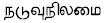 . Fitness or unfitness (in public life) of a
person can be judged by the "remnant" he leaves
behind. Remnant could be taken as the "essence" -
sum total of what one leaves behind. A legacy, a
heritage. It is for us to evaluate this in the best
sense of that word. That Prof. Kailasapathy (K) had
a following, and left behind a certain tradition in
literary criticism cannot be disputed. His and
Sivathamby's advent into the Tamil Nadu literary
circles, introduced Eelam literature to wider
readership. . Fitness or unfitness (in public life) of a
person can be judged by the "remnant" he leaves
behind. Remnant could be taken as the "essence" -
sum total of what one leaves behind. A legacy, a
heritage. It is for us to evaluate this in the best
sense of that word. That Prof. Kailasapathy (K) had
a following, and left behind a certain tradition in
literary criticism cannot be disputed. His and
Sivathamby's advent into the Tamil Nadu literary
circles, introduced Eelam literature to wider
readership.
We have to look charitably at K
and the camp followers dominating Radio Ceylon,
Sakitya Mandalam etc, as a phenomenon of an era. I
have no personal knowledge of the goings on (from
inside) except by what one gathers from the air, so
to speak. The propaganda machinery of Radio Ceylon
and Colombo journalism somehow contrived to subject
us to what I felt at that time to be a sort of
'tyranny of left rationalism'. It appeared to me as
an untimely cultural reorientation exercise. You
see, this was right in the midst of a time when
Tamils were facing physical insecurity as well. It
could be that we felt that way, by error, then saw
scapegoats in leftists or had they really acted
unwisely? Combination of factors is more likely.
Who knows !
So we have to stand apart in
certain areas but accept the original contribution
of a different way of looking at literature as the
result of K's influence. Of this I am
convinced.
This brings me to another point
which I mentioned in my earlier posting. Somasundara
Pulavar, Thalayasingham (T) are two names that I
had earlier said could be included in the list of
one hundred Tamils. I do not wish to pursue this
any further than stating a few points. Just as K's
adherents are teaching literary criticism in
universities, Pulavar's Thinnai students have been
teaching in vernacular schools and Thotta Pallis
(estate schools) and had made a quite contribution.
A person does what is appropriate in the
circumstances.
A person engaged in a spiritual
quest like T cannot be evaluated in terms of
failure or success - the quest may have its own
life, which we may not recognise now. There is no
scientific theory to back my last statement. Call
it old fashioned belief, if you like. But I still
go along with it. Bear in mind, all social and
political sciences have within them seeds of
heavily implied beliefs, which slip across quietly,
masquerading as common sense. We have to be aware
of this as well. This posting defines my framework
of viewing, which is also my prejudice.
From: C.Kumarabharathy, New Zealand 12 June
1999
I had initially participated in this forum
in mid 1998. I did not have 'any second
thoughts' about this list at that time. Now I do
have. Let me explain. When people we honour are far
away in time to current affairs we accept them on
'a general acceptance criteria' . This acceptance
makes unanimity easy to reach. But when we come
closer to our times, we know more about these
people and the mass media image of them built over
years still lingers. Then as I said second thoughts
enter. Particularly when they are alive- you never
know what they might do to upset this acceptance!
The dead cannot do further damage is the
presumption here! However, I accept we have to
cross this bridge. Without taking issues personally
with the sponsors, I would question a few names. It
is not that I mean disrespect to the dead or alive.
And with malice towards none, I make these
comments.
Kalki Krishnamoorthy was a
colossus striding in Tamil journalistic field at a
time when much was expected from a new India. These
were euphoric times, though it all evaporated
quickly. I have been and still am his admirer. His
Ponniyin Selvan introduced the grandiose empire of
the Cholas - though it appears somewhat exaggerated
when I read it now. Nevertheless it was a need of
the time. However, I consider Puthumai Pithan (PP)
as a creative writer who deserves better
recognition than Kalki. If we are looking for a
creative writer of that era my endorsement is for
PP.
Another name that deserves
serious consideration is Ashokamitran, a very sensitive
and (rare writer) not very well known because he
was not in the pop magazine circuit. A list without
him would not be whole. Obviously this is my
judgement. He may outlive many others because of
the genuine interest in life that he shares with
his readers. He looks at people more
compassionately than others - that is without
judgement. This is a rare quality in Tamil
fiction.
I have some hesitation about
names being proposed mainly by Sri Lankan
sponsors. The reason being that this category of
persons have been out of touch with recent
developments. They have been out of main stream
events for a period so that they idolise names
known when they were young and impressionable.
The perceptions that they have about
socio-political life of Tamil Nadu is antiquated.
I say this in all humility. Anyway we have to
allow for this possibility, if due recognition
were to be obtained for this project. If this is
a trans national venture we should have this
caution. I do not claim any better qualifications
either.
Some times I wonder, whether
there is a large gap between the perception of the
Tamilian in Tamil Nadu as to how he identifies as a
Tamil or Indian as against how a Sri Lankan Tamil
consider the image of his Tamilian counterpart in
Tamil Nadu. I have seen this too often. Our ideas
are fairly frozen in time, commencing when we
started excursions into the magazine and film
world. This of course is not a rule, but it often
happens. It is good to know this. Would it be
difficult to get the list checked out by few Tamil
Nadu intellectuals, to see if it holds water. The
names of La sa Ramamirtham, Janakiraman and
Jeyakanthan come to my mind but let me not digress
too much. I think I have stated my point.
Similar doubts cross my mind re
Maramalai Adigal and Bharathidasan. Kannadasan was
more prolific (though given to a bit of sensuality
). He brought life into otherwise drab Tamil cinema
lyrics. Pre Kannadasan lyrics were virtually
painful in the majority. But by itself what
upliftment these flamboyant lyrics did other than
titillating may remain a question. But I will pass
this as a personal judgement. We could for this
purpose of finding 100 Tamils, say tentatively that
there is a creative stream of excellence and a
stream of popular appeal. We should recognise both,
I suppose. In which case we could accept Kannadasan
on this account.
Bharathidasan appears to be
overrated by his association with Dravidian
movement. But remember, we have already recognised
its stalwarts. You see, the Madras media, builds up
names and sustains it for propping itself up, in
the process both are in win win situation. Kalki
had his cronies, Vasan his, and Hindu had its pets.
This has been a self erecting crane. Having gone
through some much in life, we should use our
changed perceptions in these matters. Many of us
have this, but we don't express them. It has been
acquired at a cost and we should not hesitate to
trust our intuition.
I have no qualms with MS. She
lives for music of a kind that is rare and her life
is an inspiration. Mahakavi Rudramoorthy and
Thalayasingham are two names that come up for
scrutiny. The latter lived for what he wrote, he
was experimenting boldly with living a certain kind
of life- of practical spiritualism and encountered
difficulties in the process. His social
consciousness was good. He needs to be taken up for
review. I am not sure whether Arumuga Navalar was
considered in this process. He recognised the
challenges of his time even when English was not
widely spoken in peninsula. Navalar had to be a
controversial figure, as he was living in
challenging times when the fabric of Tamil culture
was under direct threat. He has to be evaluated in
the context of his time.
I was really happy to note the
name of Dr P S Subramaniam, in this list. It
assures me that there are people who could see the
greatness in a modest man going quietly in life
healing others. He belongs to an era in Jaffna,
when modesty was a norm.
In this period two scholars
lived and worked quietly, but making deep
impression on society. I am referring to
Pandithamani Kanapathypillai and Navaliyoor Somasundara
Pulavar. The latter was an icon of mid century
Jaffna. He was not known in India. His poems for
children had wide popularity and had attained
status of folk songs, in the sense people know nut
do not remember the author kind of situation. What
impressed me about PS, Pulavar and Pandithamani is
that they lived close to people and their life was
simple. But they had profound effect on society.
But their era faded quietly into forgotten history.
Why they were not taken up later is another
question.
Post 1958 saw a crop of western
educated (essentially middle class conditioned)
intellectuals filling the Tamil departments and
journalism. They wielded much clout in public life.
They were capable and had trans Palk Strait scope.
They had left leanings. They had visions of a
society, which did not find a place for old guards
like Pulavar, or a spiritualist like
Thalayasingham. But their era too has passed after
a brief sprout. The gap between words and actual
life has been growing rapidly in modern times, and
it is for us to re-evaluate history, taking these
into account. It is in this context that the name
of Mu Thalayasingham comes to my mind. He was a
different person in difficult times. After saying
this I should state that Dr Kailasapathy deserves a
place among 100 Tamils along with Prof Thurairajah.
Probably the only other candidate in this category
would be Dr Sivathamby.
I am sure Tamil Nation readers will have
something to say about all these. When we are close
to events it is not easy to get an objective
agreement. I do not persist in what I am saying, I
am sure Tamils already selected lend credibility to
the title but I wanted to evoke discussion. Also
feel that I should bring up what I feel about all
this. I feel that Thalayasingham, Navalar and
Ashokamitran would be very likely candidates
without which the list will not be complete.
Response by
tamilnation: Many thanks
for your thoughtful, and thought provoking
contribution. By examining some of the deeper
layers of a quest for a Hundred Tamils of the
20th Century, you have helped to focus minds.
Incidentally, the reason for excluding Arumuga
Navalar was that he passed away during the 19th
century. Mikka Nanri.
From V.Thangavelu , Canada
9 June
1999
I strongly object to your inclusion of
K.Kailasapathy and S.Ponnudurai in the above list.
Kailasapathy was a pseudo communist whose writings
were mostly translations of Russian writers like
Gorki and others. So is Ponnuthurai though he broke
away from Kailasapathy and Co - but his
contribution to Tamil literature is minimal. Both
names are unfamiliar to the Tamil public. On the
other hand the name of Kasi Anandan should be
included. So is that of Puthuvai Ratnadurai. There
are other scholars like Arumuga Navalar, Mu.Va. Thiru Vi.Ka;
Kalki
Krishnamurthy whose names deserve to be
included.
From Nagalingam Ethirveerasingham, U.S.A
2
April 1999
I agree that Tamil Entrepreneur's should be very
special. Criteria for togetherness can be
philanthropic work in the Tamil
community, pioneer in an enterprise in the Tamil
community and other such outstanding qualities. Dr.
P.S.
Subramaniam is a philanthropist who also
provided Health service to the community like
Albert Shweitzer and was a pioneer in such service.
I like to nominate him in the field of Medicine.
Thank you for getting the Tamils start thinking in
terms of individuals who have contributed to the
Tamil community. Right now I am thinking of Fr
Weber.His contribution to the Tamil community in
sports and education even in times of tragedy is
immeasurable. I knew him since 1951. Should we not
nominate him, though he is an American. It is
something the Panel could consider.
Response
bytamilnation:
Many thanks for your response. As you have
rightly pointed out, non Tamils have also
contributed to the growing togetherness of the
Tamil people - names such as Caldwell, Ellis and
Pope come to mind. However, on balance, it may be
that we have a large enough task as it is, and it
may therefore be necessary for us confine our
efforts, at this stage, to the quest for 'One
Hundred Tamils of the 20th Century'.
On the question of including a section on Tamil
Enterprenuers, on further reflection, (and in the
light of the criteria that you have suggested) it
may be that those enterpreneurs who may have made a
contribution to Tamil togetherness can be included
in the broad Politics and *Society* category. For
the time being Dr.Subramaniam's name has been
included in this latter category. It may be best to
wait to hear other views that may be expressed in
this connection. There is ofcourse the further
point, and that is, at the end, after the 100 names
are selected, it may *not* be necessary to have
them separated into categories at all - indeed,
some names may fall into more than one category. As
you pointed out in your earlier mail, the panel
will, no doubt, have a difficult time!
From Nagalingam Ethirveerasingham, U.S.A
January 1999
I like to make some comments on the exercise to
select the "One Hundred Tamils." I do not envy
those who will be in the Panel who will decide on
the "One Hundred." I also feel timid to make
comments, as my name appears in the nomination
list. I observe that the category of
"Entrepreneurs" is not included yet. It is
important for TamilNation Panel to make a
comprehensive list of categories of human
activities that takes us from one stage to a higher
stage.
In the category of sports, I would like to
nominate Mr. Navaratnasamy. He is the first person
to swim the Palk Strait from Jaffna to India at the
age of 40, in 1955 I think. He was also the first
to swim both ways non-stop. He was an agriculture
instructor. I do not know any other information
about him. He was our hero whom we looked up to
then and now. May be your readers could provide
more information about him. The news papers of that
time carried pictures and information about the
swim. When your Panel has picked the final one
hundred, I hope you could print small biographical
and inspirational booklets for the primary and
secondary level students to read. We lack such
texts in schools.
It is disappointing to note that Muthiah
Muralitharan's name was taken off the list of the
One Hundred after the protest by one of your readers. It
appears that the reason was that Muralitharan's
achievement did not bring about cohesiveness of the
Tamils. I have never met Muralee. I have seen him
play on Television when I was living in Kilinochchi
from 1994 to 1996. The students and others who were
with me and watched him play admired Muralee for
his bowling and his personality. To them, and to
me, he was the ideal of a sportsman even under
duress because of the controversy of his
bowling.
He, with his performance, brought into focus the
attention of Tamils and the cricketing community
the world over. He and his performance have given a
togetherness in spirit. The Sri Lanka cricket team
is the only stage available to him when no other
stage exists for him to perform. The black American
Arthur Ashe had the Wimbledon and the U.S. Open
championships to show what a black man can do. He
went to South Africa to defy the apartheid by
playing there and showed the black people in South
Africa what they can aspire to. Nelson Mandela and
Desmond Tutu admired Arthur Ashe for going to South
Africa to play.
I find it difficult to understand the comparison
of Foreign Minister Kadirgamar with Muralitharan. I
have yet to meet a Tamil who has anything good to
say about Kadirgamar's actions and for being part
of actions of the SLG that is causing death and
destruction of the Tamils. Muralitharan has not
consciously done or said anything to hurt or divide
the Tamils or anyone else. He had not let himself
to be used by the SLG for propaganda. He is making
his statement as a Tamil in the cricket field by
action for the whole world to see.
Words are not the only means of communication. I
do hope that TamilNation would let the original
nomination stand for the Panel to make the final
decision. Just because Muralitharan does not do
what some Tamils want him to do, it does not make
his achievement any less nor his person less
admirable. It is the value of a person's action
that defines the person, not his/her non-action or
what others thought of the person. At a time the
Western Cricket world is out to crucify him for his
deformity, we Tamils should not add to Muralee's
misery.
Response
bytamilnation:
Yes, the panel will have difficulty - and that
is to be expected. The point you make about the
absence of an 'Entrepreneur' category is an
important one and will need to be rectified. Here,
a difficulty that will have to be addressed is the
extent to which a successful entrepreneur has
contributed to Tamil togetherness. Rajah Sir
Annamalai Chettiar was a successful businessman and
at the same time furthered Tamil togetherness by
founding the Annamalai University and promoting
the Tamil Isai Sangam. Or is it enough simply to be
a succesful enterpreneur? As for Muralitharan, in
all fairness, (as you suggest) it is perhaps best,
that his name remains on the 'nomination' list for
eventual consideration by the Panel.
From Vamanan
Sundar 23 January 1999.
"One hundred Tamils of the 20th century" is one of
the items I really enjoy. I certainly disagree with
your selection of Muttiah Muralitharan as one of
them. I am still trying to determine in what way he
has contributed to the growth of the Tamil
togetherness. I think, actually, he is insulting
the Tamils' struggle by being a member in the
chauvinistic Sri Lankan cricket team at this
crucial time of our independent struggle.
I have no doubt he is a super star in cricket. I am
also a cricket fan since I was young. I have seen
so many talented cricket players in Jaffna and they
have become only a local cricket players in history
only because they are Tamils by birth.
Some people might argue his position in sports and
the Tamils' struggle for independence are two
different things. I disagree with that. What the
world did to the South African cricket team when
the apparthied were in power is a good example. At
this point in time Sri Lanka is using their
national team to build up its image in the world
and to entertain
the high class Sinhalese people while soldiers from
the poor families are loosing their precious lives
in the battle field for no reason.
The Tamils and others should boycott Sri Lanka in
all the possible way. A good example is the action
of the Tamils in Australia showed to the Tamils in
the rest of the world it is time to boycott Sri
Lanka. They created the slogan, "Sri Lanka, Stop
Killing the Tamils" in the air during the cricket
match between Sri Lanka and Australia. The
message
has reached thousands of Australians and a few
Tamils in the stadium.
My strong opinion is that all the Tamils have to
boycott the Sri Lankan cricket team. Some people
might say that Muralitharan is an Indian Origin
Tamil, and thus his actions does not affect the
Tamils' struggle. In reality, Indian origin Tamils
are also subject to similar actions experienced by
the Tamils. We have nothing to be proud of
Muralitharan
unless he quits from the Sri Lankan cricket team to
show the world that he is an "unarchi ulla
Tamilan."
Muraltitharan may want to play for his own personal
reasons but I don't think we have to honour him. It
may also be argued that we can honour, along the
same lines, the Sri Lankan Foreign Minister
Kadirgamar since he is a Tamil and he is achieving
his goals even though his activities affect the
Tamils in a negative way.
Response
bytamilnation:
The point that you make that Muralitharan 'is
insulting the Tamils' struggle by being a member
in the chauvinistic Sri Lankan cricket team at
this crucial time of our independent
struggle' is a compelling one. The names
included in the list were for 'consideration'
and to prompt 'discussion' - and perhaps, this
should have been made more clear.
The criteria for eventual selection are the
broad ones that appear in the Hundred Tamils
webpage: Tamils who have made significant
contributions to the world and to Tamil
togetherness - whether such contributions be in
scientific thought, literature, political action,
personal sacrifice and example, spirituality or
any other area.
Your view that personal excellence alone is
not enough, and that a Tamil should be included
only if he has also made an important
contribution to 'Tamil togetherness' is a
persuasive one. Any attempt to name a 'Hundred
Tamils' will of course meet with difficulties
even where appropriate criteria are set - but
that is not to say that discussions about
criteria will not help to clarify the issues
involved and suggestions about possible criteria
will always be very welcome. As I have mentioned in an earlier posting:
"In the end there may be a need to have a
panel which may actually discuss names with a
view to achieving a broad consensus.... All this
ofcourse will take time and much effort. What I
have tried to do is to make a small
beginning."
From U.S.A.: - An Anonymous
Observer December 1998
I looked at the proposals, suggestions and
responses... After some deliberations in my mind, I
decided to write this note... I only have some
observations on the project parameters...
1) The broad definition refers to contributions
"to the world and Tamil togetherness". I feel that
the definition should include "the Tamils" and
therefore read " to the world, to the Tamils and
Tamil togetherness". I think the... contribution to
the economic, social, cultural, political
aspirations of the Tamils should receive proper
consideration in the selection.
2) To me, whether they are described as "great"
or "prominent" is not as material as the kind of
people who are in the list. There are people who
have been/are very "prominent", "influential" etc
but have been disruptive, made lives and livelihood
of their community a misery. As Sachi Sri Kantha
points out, suggestions for the list may also be
conditioned by people's "tastes". I feel that
whatever final list emerges, it should be one that
does not attract ridicule, controversy etc, because
it would be a slur on the other revered persons
given a rightful place in the list.
3) People may have their reasons for not
remembering Chellappa Swamy of Nallur, Dr. (P.S.)
Subramaniam, Senator Nadesan or Prof Eliezer either
because they fall out of the broader definition or
they do not meet the criteria that the various
respondents are focussing on. Whatever that may be,
it would be very sad indeed to have Pirabaharan's
name included in a list with Thondaman, Karunanithy
and other lesser known persons in the list as
suggested.
4) I also notice mention of names in the
Guinness Book of Records and an attraction to
modern and popular sports. Caution may be called
for before getting carried away by the fascination
of affluent Tamils, living in the industrialised
world, who in their day to day work are bombarded
with the "Best Film", "Best Actor", "Most Valuable
Player" polls and million dollar names in film and
the sports world broadcast all the time. It is
important to settle on the vital parameters for the
selection so that the list itself would be
considered a valuable reference document in the
Tamil archives.
5) I have noticed "Role Model" being mentioned
as a criteria. I am not certain that this
characteristic would be a practical one. I respect
Kuttimuni
and Thileepan for their ultimate sacrifice for a
great cause - their nation. .. (But) They are not
my role models, because what they wanted and what
they sacrificed is beyond my comprehension. I
cannot aspire to be either of them or Ramasamy
Naicker. The most I can aspire is to accept their
leadership and guidance. If that is what is meant
by "role model", I have no qualms.
6) The venerable names that finally get posted
in the Hundred list should be of persons who have
made noteworthy contributions in the context of
their times, the gift they gave to the world, and
to the Tamils in the 20th century and the impact
their dedication will have in the coming century. I
may be an odd ball but great cinema and cricket
figures would be the last ones I can think of in
this connection.
From Japan: Sachi Sri
Kantha, Japan 2 December
1998
I did read the contributions to the 100
Tamils of the 20th Century page. Then I compiled
my
selections - this is just a first draft. I have
defined my criteria of selection and
chosen 70 individuals in ten categories
(legislators, social activists, literati,
artists/entertainers, entrepreneurs,
commentators/critics, natural scientists, social
scientists, religious dignitaries and sportsmen).
Ofcourse some have stamped their influence in more
than one category (like Annadurai and
MGR).
I hope my criteria for selections will
give some food for thought, so that only worthy
nominees are brought to the front, and list is not
diluted with names nominated for self serving,
PR-seeking purposes.
'100 Influential Tamils of the 20th
Century' - The word 'influential' is the
appropriate one I think, because the use of other
terms such as 'great' or 'important' or 'notable',
may make it difficult to make an assessment.
Selections of individuals also can be influenced by
time (the period they lived) and taste (political,
regional and cultural) of different Tamilians. What
I mean by the word 'influential' is really about
'contributions influential in the international
arena, across the prevailing national
borders.
Criteria of
selection:-
The persons should have influenced the
minds of Tamils and/or non-Tamils by their thoughts
and deeds. For example, the influence of Tamil
legislators, writers and artists (with a few
exceptions) is largely felt by the fellow Tamils
only. But the influence of Tamil scientists and
sportsmen is largely experienced by
non-Tamils.
Ideally, the influential Tamils of the
20th century should qualify for selection by virtue
of satisfying one of the following
criteria:-
(1) They were recipients of coveted
international prizes (such as the Nobel prize,
World Food Prize).
(2) They have received critical
recognition in international mass media (for
example, featured in cover stories of news
magazines).
(3) Their achievements noted in
international reference sources (encyclopaedias,
dictionaries, text books, academic
journals).
(4) They made eponymous discoveries
(such as Raman effect, Ramanujan numbers,
Chandrasekhar limit).
(5) Their creations were critically
acclaimed by international standards (such as the
fictional Malgudi village of
R.K.Narayan)
(6) Their records in their chosen field
of expertise, accepted as exemplary and trend
setting among the non-Tamil peers of their times
(such as musical talent of M. S. Subbhulakshmi,
the fielding skill of cricketer Venkatraghavan,
the military brilliance of Prabhakaran, the spin
bowling of Muralitharan, the chess wizardry of
Vishwanathan Anand).
From: C.Kumarabharathy, New
Zealand, July 1998
The initial list can be considered as an
exercise in consolidating opinion on the nominees
and arriving at a consensus. Thereafter a
finalisation could be made on a representative
basis. But the list upto now I see will gain very
wide acceptance. This is really an exercise in
getting to the roots. If the process is
articulated/elaborated it could have educational
value for future. We must bear in mind that this is
being carried out at a time when Tamil society is
in a state of search on many fronts, perhaps the
most appropriate time for evaluating history. The
lack of well set ways and security spurs
earnestness.
What the future generations will need in time
are role models. Being in some sort of contact with
people who could appeal to them as behavioural role
models is probably the only way a " middle class"
can shed its self centeredness in stages. The
bottom line really is this and then culture can
look after itself. In fact then 're culturing' will
happen as a matter of course. This is not likely to
happen in any dramatic fashion but a certain
movement away from the main stream of consumerism
etc is the most crucial for expats. As it is it is
difficult to have objective discussions on issues
simply because we are not used to it. Being
honestly aware of the fact that we are
materialistic will help to great extent.
From:
C.R.Selvakumar, Canada, 1
July 1998
I would like to suggest that you please collect
names of Tamils who are to be considered for the
inclusion in the list of 100 Tamils, rather than
accepting them based on a few write-ups and mere
popularity of the names (I'm not
implying this is how you select!).
I've genuine trouble in visualising a few in the
already published names as 'one of the 100'. I
don't want to single out the names at this point in
time, but I can when it is appropriate.
Of course all lists are in some way
'subjective', but considering TamilNation's mission
and goals, I think it would be nice if only those
who *really*contributed to Tamil, Tamil culture,
Tamil awareness and Tamils' life are included.Most
certainly there were and are many who affect us in
many ways, influence us in many ways, but I would
like to know the criteria based on which the names
are proposed. May be you had articulated it already
somewhere which I had missed.
Among those who contributed to Tamil language
and Tamil awareness I would recommend considering
PaavaaNar DevanEyan and MaRaimalai
AdikaL and Perunchitranaar. I don't know
approximately how many from each field (how many
fields?) is to be selected. When we have Dr. S.
Chandrasekar, we should also have Dr. C.V
Raman.
|
Response from
tamilnation:
Many thanks for your thoughtful
comments. Yes, it would be better to
'collect names of Tamils who are to be
considered for the inclusion in the list of
100 Tamils, rather than accepting them
based on a few write-ups and mere
popularity of the names'. The selection can
eventually be made from the names included
in the Hundred Tamils page - this will be
made clear at the next update.
The criteria suggested are the broad ones
that appear in the 100 Tamils webpage:
Tamils who have made significant
contributions to the world and to Tamil
togetherness - whether such contributions
be in scientific thought, literature,
political action, personal sacrifice and
example, spirituality or any other
area.
A friend from New Zealand put
one criteria rather well - those who "by
their commitment and personal example ...
have imparted a sense of confidence and a
shift ...in consciousness of the people.
Such a shift should be an upward movement.
In doing this they should have put
themselves to the test as well."
Any attempt to name a 'hundred Tamils' will
of course meet with difficulties even where
appropriate criteria are set - but that is
not to say that discussions about criteria
will not help to clarify the issues
involved and suggestions about possible
criteria would be very welcome.
I have not attempted at this stage to set a
fixed number of fields or for that matter
the numbers of persons for each field. As
the names are suggested, the fields or
categories may become clearer and
eventually it will be possible to make a
balanced selection.
In the end there may be a need
to have a panel which may actually discuss
names with a view to achieving a broad
consensus - and reduce the subjective
element ( though, ofcourse, subjectivity
will always remain). All this ofcourse will
take time and much effort. What I have
tried to do is to make a small
beginning.
|
From: C.Kumarabharathy, New
Zealand, 2 June
1998
"My response to the quest (for
hundred Tamils) is as follows. In such a quest it
is easy to be swept off the ground according to the
immediate environment and the current consciousness
in vogue. The nominees have to stand the test of
time in our assessment of their work and a vision
that surpasses current pressures. The hundred, by
their commitment and personal example should have
imparted a sense of confidence and a shift in
paradigm or consciousness of the people. Such a
shift should be an upward movement. In doing this,
they should have put themselves to the test as
well. This leads me to people who have cleared the
way for better understanding of human nature and
will be and are releasing untapped
potential....
The other problem is "how much
of a Tamil, these gentle persons should be?" and
then if we go back to texts that form the fountain
of Tamil culture, we may be surprised to find that
most of the sources have deep origins beyond an
identity that we have now formed and call Tamil.
What will be Tamil togetherness over the next 10
years?
May I suggest that a criteria
be drawn up if this list is to be widely respected
over a period of time.?... The history of a bigger
Tamil nation in the late last century and present
century and how the historical challenges were met
by the community may be the underlying theme here.
In the context of these issues, how these
individuals grappled to resolve them with integrity
and commitment may be a good common factor to
introducing their work. This way, the readers can
be walked through the history at many
levels.
From this point of view,
EVR Periyar for social justice is
a valid candidate. The movement was a historical
necessity. Similarly the name of a staunch Tamilian
Congressman would be in order. This could be
C.Rajagopalachariar. EVR & Rajaji
were complimentary really. S.J.V Chelvanayakam for Sri
Lankan Tamil political awakening. The leader of the
estate Tamils who stood for their emancipation is
required .... I think Thondaman may be suggested here.
Rudramoorthy (Mahakavi) is the
representative voice of middle class, who had known
its short comings but could only voice
it....
We live on many levels and
should acknowledge this. I accept that a change of
perception of Tamil politics took place with the
armed movement. They stood for something for which
they were prepared to die. This is a definite
turning point in attitude. No history will be
complete without the foremost leaders of this
calibre.
In dealing with Indian names
we have to be and we can be more objective. That is
understanding the necessity of the DMK movement and
also realising its shortcomings. It has reached a
philosophical cul-de sac after 35 years in power.
It would be a good thing to steer away from the
classic Brahmin-non Brahmin divide. Just as much as
EVR was a tireless atheist, Kanchi Sankarachariyar was a versatile and
revered figure on the other side so to speak. His
writ was running independently and unhampered
throughout Tamil Nadu at all levels...
Among literary figures,
T.
Jayakanthan deserves mention. There are other
stalwarts (some of them better creative artistes)
but he stood for something in the conscience of the
middle class.... Other names are Ramana
Maharishi, Yogaswamy,
U V Swaminatha
Iyer, Maha Kavi
Bharathiyar, Sir CV Raman,
Ramanujan, C. S.
Chandrasehkar"
|