|
One Hundred
Tamils of the 20th Century
Thiagi Subramania
Sivam
4 October 1884 - 23 July 1925
''நான்
ஒரு
சந்யாசி.
முக்தியடையும்
வழியைப்
பிரச்சாரம்
செய்வதே
என்
வேலை.
அதன்
தத்துவங்களை
எடுத்து
விளக்கி
அதை
அடையும்
மார்க்கத்தை
போதிப்பதே
என்
வேலை.
சகலவிதமான
வெளி
பந்தங்களினின்றும்
விடுவித்துக்
கொள்வதே
ஆத்மாவிற்கு
முக்தியாகும்.
இதே
போன்று
ஒரு
தேசத்தில்
முக்கியாவது
- அந்நிய
நாடுகளின்
பிடிப்பினின்றும்
விடுவித்துக்
கொள்வது;
பரிபூர்ண
சுதந்திரம்
அடைவது.
அதையே
இந்நாட்டு
மக்களுக்கு
நான்
போதிக்கிறேன்.
அதாவது,
சுதந்திர
லட்சியம்
அதை
அடையும்
மார்க்கம்.
புறக்கணிப்பது
-
சுதந்திரப்
பாதையில்
குறுக்கே
நிற்கும்
எதையும்
-
சாத்வீக
முறையில்
எதிர்ப்பது,
சுதேச
கல்வி
இவையேயாகும்.''
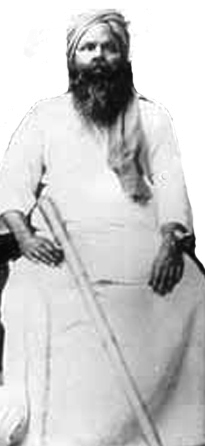 M.P.Sivagnanam
in History of
the growth of Tamil during the Indian war of
independence .... M.P.Sivagnanam
in History of
the growth of Tamil during the Indian war of
independence ....
"....Many persons who lived in the time of
Bharathiar and became his friends
did also great service to the Tamil language.
Important among them is Subramania Sivam. He joined
wholeheartedly in the war of Independence and
laboured hard for destroying the poison-tree of
British Imperialism. Justice Tinhay condemned him
to 10 year's imprisonment. In the prison and
outside it afterwards he wrote a number of works,
composed dramas, and ran , a magazine called
"Gnanabanu". He took a share in the work of
promoting his mother tongue, Tamil, by talking on
political, literary and religious platforms and by
writing poems. In the jail he fell a victim to a
kind of leprosy and, unable to bear its ravages, he
died in the year 1925.
Many degree-holding men of the time of
Subramania Sivanar did not have either any love for
their mother tongue, Tamil, or a desire to learn it
and they lived as a burden to their land. Addres
ing such people Bharathiar sang: "You would study
many other languages. But since you wouldn't learn
your home language, get away, get away". Thiagi
Sivanar expresses the same feeling a little
strongly in the following passage:
"The life of a country is to be found in its
language. Those who give up their mother tongue
can be said to be committing suicide because of
foolishness or of madness. If committing suicide
is a crime against the state, he who begins to
kill himself and his society by neglecting his
state language is a person who commits crimes a
thousand fold. Though the law of the country does
not include these murderers in the list of
criminals, they are culprits according to the
laws of creation followed by that All-Powerful
Deity who rules over the whole universe as the
sole Empress" (Gnanabanu -September 1915).
Thiagi Sivam was a spotless patriot and
politician. He had love for Sanskrit and a decent
amount of knowledge of the language. Regarding the
whole Bharat as his mother, he had even tried to
build a temple at Papparapatti for that Mother. In
short, he was a man who would not accept any dogma
that went against the national creed and would even
oppose it if necessary. Even he had an unlimited
love and respect for his mother tongue, Tamil. He
was of the view that, ideologically, the love of
Tamil was not in any way opposed to love of one's
own country. Let us see another passage in his
magazine in which he lays emphasis on the love of
Tamil.
"O, you Tamil Pandits and you great men of
Tamilnadu, be careful, be careful! Protect your
language. Remember that the life of a society
lies in its language. If the Tamil tongue gets
destroyed, the Tamil people themselves will lose
their name and fame. Teach those citizens of
Bharat, who say unhesitatingly that Tamil does
not possess a sufficient number of necessary
words, that it is not so by searching for and
finding out those words in the language.
"Let your tongue speak only Tamil. Let the
quill that you use write only Tamil. Let your
heart long for only Tamil. May Mother Tamil
mercifully protect you from any danger,"
(Gnanabanu, November 1915).
Thiruvalluvar has written one
chapter on "just government" and another on
"tyrannical rule". Sivanar mentioned the British
Government as the best example for the tyrannical
rule mentioned by Thiruvalluvar. Even that he said
with the heroism of a patriot, while standing in
the prisoner's box in the judicial court. He also
recited there those stanzas from Kural which
analyse the characteristics of tyrannical rule,
knowing that it was in such a place that they would
bring great fame to Valluvar. His `Tamil heart' did
not fear the anger of the English judge and the
possible increase in the punishment that might
follow. The following is that part of his long
witnessing in the court in which he uses quotations
from Thirukkural.
"Many laws were passed granting more
privileges and rights to the Whites who came here
to earn a living than to those children of the
soil who were born and bred up in this land. The
life and blood of our people were sucked by the
foreigners with the help of all kinds of taxes.
Famine and cruel diseases and internal disorders
made their permanent abode in this country.
"All these inhuman and dictatorial activities
joined together and made people realise the
irresponsible cruelties of the Government and the
need for its change. It was natural that people
developed that kind of feeling.
"Thiruvalluvar, the great wise man, has said
that a man of justice will labour hard only to
drive out injustice and to establish Dharma
(justice) in its place. This idea finds a place
in the following prose rendering of two verses of
his :
"That ruler who, or the sake of money, does
unjust things and thus tortures his subjects is a
more cruel man than a person who kills another on
account of hatred.
"That ruler who puts his subjects to a lot of
pain for the sake of money is equal to a thief
who threatens to kill a traveller with a spear
and takes his money from him".
Every man of justice, therefore, will labour
hard to remove injustice and establish the rule
of law in its place. In the same way the people
of India are labouring hard to put an end to
foreign rule and to form their own
government."
Judge Binhay ordered 10 years rigorous
imprisonment for Sivanar after listening to his
words in the witness box.
Tamil has the pride of growing within the four
walls of the prison also. There is a story that
`Thirumurukatruppadai" was composed and sung by
Nakkirar Peruman when, having been shut up in a
cave by a spirit, he worshipped and prayed to
Murugapperumal to get free from that cave.
Perhaps this is a story cooked up by some
unknown person, But it is not a story when we are
told that patriots of Tamilnadu who got imprisoned
in the war against British dictatorship, worked
hard for the growth of Tamil ; it is history.
The English Imperial power began the unjust
practice of imprisoning Indian patriots battalion
after battalion and torturing them only in the
Thilagar era. Because of that, those among the
prisoners, who got the first chance in the Thilagar
era to work hard for the development of Tamil, were
the patriots of the Thilagar era. Siva was one of
them.
When Siva was in prison, some of the authorities
there extracted hard work from him. The rooms in
jails, where patriots were shut up in those days,
had no lights at night for reading and writing. The
day was spent in hard labour. But though they were
compelled to take rest after dusk, there were no
facilities for doing any service to Tamil. Even
under such circumstances, Siva somehow made great
contributions to Tamil. It is just impossible to
describe the love for Tamil which Siva cherished in
his heart.
Siva was a religious man. He composed the
valuable religious work entitled "Sachithanandha
Sivam" when he was in prison. It must have been his
first work. The reason for his writing that work is
to be found in a pathetic event. He mentions it
himself in the introduction to that book.
"The chief disciple of the great Jesus Christ,
Peter, was once entering the door of the Temple
called "The Beautiful". Just then a man without
both his legs, a born lame man, begged for alms.
Seeing him Peter said, "Silver and gold have I
none ; but such as I have give I thee". So saying
he raised him up by the hand. Immediately both
his legs began to grow and he jumped up with
great joy and went away. This account is found in
the Christian Scriptures. So also, when my wife
saw me in the jail and asked me to suggest to her
a way of getting out of the poverty from which
she was suffering greatly, I said, "Silver and
gold have I none, but such as I have give I
thee", and gave her a Book which I wrote out of
what I heard, knew and experienced from the face
of my `Satguru'. (my holy teacher).
"I pay my respects to the Inspector General of
prisons who gave me permission to write this book
during my spare time and to the Superintendent of
my jail." Central Jail, Salem - Subramania
Sivam. 15-3-1911
When Siva was imprisoned for the second time, he
revised it and published the third edition of this
book. The introduction to that edition is as
follows.
"I am happy that with the grace of Mahasakthi
this book is seeing its third edition. On account
of my devotion to my country the District judge
sentenced me for the second time to two years
rigorous imprisonment and 500 rupees fine. I
spent this period in the jail at Tiruchirapalli
and got out on the 12th of this month. But since
then I am completely bed-ridden on account of my
illness. Because of that I was not able to add a
number of details and publish an enlarged
edition. I am very sorry for that. That this was
written when I was in a kind of hell can be
understood by all those religious scholars who
read this. This book contains only all those
happy feelings that welled up in me when I was
shut up alone in a prison room. Besides, all
these have been acquired by me from what I heard
from the lips of my Guru (teacher). May God
Almighty grant that this book proves useful to
many and helps all to attain a state of bliss.
Kumbakonam Subramania Sivam.
21-1-1922.
Sivanar involved himself in the service of Tamil
to forget his sufferings caused by the cruel
repressive activities of the foreigners. The same
service helped him to remove the 'disease' of
poverty from his wife.
Though `Thiagi Siva' wrote the philosophic
treatise 'Sachithanandha Sivam' in order to reduce
his wife's sufferings, she might not have got more
than some ten rupees on selling the book. Who would
buy a religious book in Tamil in those days ?
Perhaps a few would have bought the book thinking
of giving some respect to the sacrifice made by
Sivanar or sympathising with his wife.
There were many thousand Faithful women who died
a premature death during the freedom struggle
fighting against hunger and disease just because
they happened to be the wives of extremist
patriots. O, you independent Bharat ! What return
are you going to make for these great devoted
women?
Between 1908 and 1922, Thiagi Subramania Sivam
was condemned to imprisonment four times, was shut
up in different jailes and suffered a lot. During
all those times, he wrote a number of religious
books.
Books written by him inside prison and outside
it number more than thirty. Among them the
following are the most important. (1)
Sachithanandha Sivam (2) Yoga Sadhana Rahasyam (The
Secret of Yoga practice) (3) Ramaniya Vijayam (4)
The life and teachings of Ramakrishna Paramahamsa
(5) The life of Vivekanandha (6) Sermons
(Upathesangal) (7) Sankarar Vijayam.
Besides the above, he has written in simple and
sweet Tamil stories like 'Netaji' and `Veera Ratna
Baji Prabhu', plays like `Vira Sivaji' and `Senji
Desingu' and the novel called `NalinaSundari or
`Nagareeka Thadapudal'.
He has also translated into Tamil some religious
works of Swami Vivakanandha in English. Important
among them are: (1) Athmagnanaratnam, (2)
Arulmozhikal, (3) Ethirolikal and (4) Tharkala
India (India today).
Thiagi Sivanar did not write any book either as
a corollary to or based on any pieces of Sangam
literature or Aymperumkappiangal (The five Great
epics) or Padhinenkeelkanakkukal or Purana Ithi
kasangal.
It is true that he did not write any book
explaining the greatness and beauties of the Tamil
language. But we can say that he did his best to
eliminate the dearth of books in the religious
field in his mother tongue, Tamil.
When Sivanar was alive, the religious drums of
Swami Vivekanandha sounded in all the eight corners
of the world. Chiefly he shone as a bridge in India
synthesising devotion to God and elevation to one's
motherland. We can even say that he helped to
dispel the darkness of slavery with the light of
religion.
It was Swami Vivekanandhar who
showed the way for the revolutionary effort made to
bring into the current regional languages all the
religious treatises lying imprisoned in the
Sanskrit language which had become a dead language.
Following his footsteps, Sivanar created in Tamil a
number of books blending in them both fear of God
and love of one's land. We have to take this as a
very valuable contribution to the progress of
Tamil.
If we are to study carefully under what
circumstances Siva wrote his religius literature,
we will feel it our duty to worship and praise
heartily that great man who is now no more.
Sivanar, who is now gone to heaven, is an extreme
patriot. He did not believe in non-violence and was
a great believer in the use of arms to compel
people to do things. The police, therefore, hunted
him from place to place.
We know already that Sivanar fell a victim to
leprosy when he was condemned to imprisonment for
10 years in 1908 and was sent to Salem jail.
Since leprosy was regarded as a contagious disease,
the British government ordered him not to travel by
rail. Therefore, Siva went round the whole
Tamilnadu on foot though his whole body was covered
with sores. On account of poverty he had often to
suffer from hunger and starvation.
In certain towns, even patriots of his own
category kept away from welcoming and entertaining
Sivanar simply because he was suffering from a
contagious disease. On such occasions, there were
days when he had to sleep in open places using the
hedge of a field as his pillow and the canal bed as
his cushioned bed.
In those days, moneyed people were beyond the
pale of the National army camp. Since many of them
were devoted to the British regime, they were
inimical towards the nationalists. Men of small
wealth were either lovers of their country or
friends to such lovers. Even they did not have
courage enough to help those extremists like Siva
who were hunted by the police. Thiagi Sivam had
great love for Sanskrit and had a decent knowledge
of it also. He had some knowledge of English too.
Still he did not like Sanskrit and English
dominating in places where Tamil, our mother
tongue, should hold sway. He even worked hard to
free the Tamil language from the power of these two
tongues.
In those days of his, even scholars in Tamil
language and literature wrote in Tamil mixing with
it a large number of words from Sanskrit. They also
thought that writing in such a way was a special
gift. Sivanar too wrote only in the manipravala
style blending Sanskrit with Tamil. Still he could
not but feel that it was a weakness and therefore
tried to protect the purity of his mother
tongue.
In his monthly magazine 'Gnanabanu' he put up an
advertisement. It was as follows:
Five Rupees ! Can you write pure or chaste
Tamil? If you can, come forward. An admirer of
Tamil has offered a reward of five rupees to the
person who will contribute an article to our
`Gnanabanu' in pure Tamil without using words
from Sanskrit or any other language and in not
less than eight pages, on either the greatness of
Tamil or the history of Thiruvalluva Nayanar.
Such words "Kayam' which is merely another
version in Tamil of the Sanskrit word 'Kajam'
also should be avoided. In short only pure Tamil
words, without any connection with the foreign
languages alone should be used.
The articles should be sent to our `Gnanabanu`
office within the 15th of Avani. That article
which wins the prize will be pub lished in our
magazine. Those who want any further information
on the suject may write to the following
address." Secretary "Gnanabanu" Mylapore,
Madras. (Gnanabanu, July, 1915)
It is worthy of note that in this advertisement
Sivanar speaks of words from foreign languages like
Sanskrit. By birth Sivanar was a Brahmin. In
spirit, he was a philospher. by way of life he was
an ascetic.
It surprises us, therefore, that, in spite of
his being a member of the Brahmin community which
patronises Sanskrit, he refers to that language as
a foreign language.
In the cultural field, Sanskrit is the common
language that unites all the Indian languages and
all those who speak those languages. It was so in
the past; it is so today also. Those who have an
attachment to religion and show an enthusiasm for
religious phiiosophy, whether they are Brahmins or
Non-Bramins, regard the Sanskrit language as their
own from the cultural point of view at least.
Subramania Siva was one of those people who had the
same opinion. Still, outside the pale of religion,
in this material life, Tamil is his only mother
tongue, Therefore it was not a mistake if he
regarded any language other than Tamil as a foreign
language from the worldly point of view.
In the days of Subramania Sivam, Tamil did not
have the first place, not only in the religious
sphere but also in the political. It was not a
mistake on the part of Tamils when they showed no
dislike for but willingly accepted such words as
"Vandemadharam", `Desiyam', `Swadhantram',
`Swayarajyam' and `Bharadha Madha. which had taken
possession of all the hearts of the sons of India.
However, Sanskrit words dominated, more than
necessary, the field of Tamil literature,
especially in the study of Sangam literature. Only
because of that Sivam notified that the pure Tamil
articles he liked to get must deal with the
greatness of the Tamil language and the history of
Valluvar.
Subramania Sivam sent his advertisement aiming
at the promotion of Tamil to the "Hindu Nesan" that
was in circulation in those days and to
Swadesamitran, another daily, which was current
then and is so even today. But those magazines did
not publish the advertisement, Would Sivam remain
quiet? Was he not a man with an iron will and never
afraid of anybody? He wrote attacking those
magazine which refused to put up his
advertisements. A part of what he wrote is as
follows:
"We asked many papers to publish our
advertisements about this affair. A few complied
with our request and put them up. But the two
daily papers printed in Madras refused to publish
them.
"The daily, `Hindu Nesan', proudly announced
under the heading: Report for our friends that it
had politely refused to print our advertisement
and the articles written by a few other
writers.
"Where is the doubt about a paper which uses a
singular predicate for a plural subject,
promoting only a lack of true knowledge in our
land? How will the `Hindu Nesan' publish our
advertisement when it tortures Tamil literature
with foreign words and with nobody to question it
and when it tortures Tamil grammar by making no
distinction between singular and plural?
"Is not `Swadesamitran' a paper which follows
the style and manner of the Europeans? Whether
things are written in pure Tamil or adulterated
Tamil it does not matter. What it wants is
money;
The editor of Swadesamitran wrote to me saying
that he would publish our advertisement only if
he was paid a certain sum every month.
"In 'Swadesamitran', expressions like "His
Excellency the Governor" and "your Ma jestry's
obedient Servant" find a place. What is it that
this paper is doing? Is it spreading general
knowledge or a knowledge of the English Language?
"It is really deplorable that these two papers,
having beautiful names, do not act in a way,
appropriate to those names. I cannot understand
how papers, which do not support their own
language, are going to promote the welfare of
their own country. But we do not have for
ourselves any other dailies than these two; Is
not our younger brother all in all, goes the
proverb, if there is nobody to question him?"
The war of ideas between Gnanabanu and
"Swadesamitran' continued. In the course of it
V.O.
Chidambaranar contributed an article to the
monthly called Bharathi, supporting the pure Tamil
of `Gnanabanu' and opposing the mixed Tamil of
Swadesamitran. V.O.C. sent an appeal to all papers
when this war of ideas went on for months together.
The misunderstanding between these two went so far
as to prevent the sending of Swadesarnitran in the
place of Gnanabanu. Even the magazine called
`Lokopakari' run by Parali S. Nellaippar joined the
side of `Gnanabanu' in this war of ideas. The
following is a note written by Siva in "Gnanabanu"
in reply to Swadesamitran:
"The society has now awakened from its sleep.
Everywhere love of one's country and of one's
language is growing fast. The thought of "our
country, our language" has made its appearance in
all parts of our land. Therefore the nature and
style of "Swadesamitran" must be changed for the
better. Instead of that, if `Swadesamitran'
continues to support the nature and style of a
foreign language with a blind obstinacy (as is
implied in the proverb "The hare I caught has
only three legs") then I will have to say sadly
that it has done whatever it has to do and that
it has no place in our Tamil nadu hereafter."
(Gnanabanu, November, 1915).
....Thiagi Sivam fell upon those who were
devoted to the British. He made enemies of some of
his friends in his enthusiasm for freeing his
mother tongue, Tamil from any domination by
English. Instead of getting publicity as a
Government pleader with the help of newspapers, he
made enemies of powerful editors of papers and
magazines. Though he fought a war of ideas against
the love of English betrayed by `Swadesamitran' he
did not give up the daily paper called 'The
Hindu'.
In the year 1915 a few people, who has studied
English and who had no deep scholarship in Tamil,
gathered together and started an association called
"Tamil Kazhakam". The following is she note written
by Sivam in his `Gnanabanu' on behalf of this
Kazhakam:
"It seems that some of the "big" men of Madras
have joined together and started a Tamil
Kazhakam. It also seems that the members of this
Kazhakam are prepared to present gold medals to
those who can contribute essays containing a
critical study of the lives and works of great
authors in Tamil for the sake of protecting and
promoting the Tamil language.
"It was written under a small heading in the
paper called `Hindu' that this Kazhakam was doing
its work silently during the the last few years.
Can the Kazhakam work so, silently as not to be
within the knowledge of Tamil Pandits who have
been supporting and protecting the Tamil language
for generations together,
"It is really surprising that this matter was
published only in English papers and only for
English knowing people. Did the Kazhakam think
that nobody, among those who knew only Tamil, had
a knowledge of Tamil writers, their histories and
works?
"The announcement referred to above does not
mention by whom or by which group of scholars
will the articles written for getting the gold
medals be judged. But in the leading column of
`The Hindu' it was written that the articles will
be examined by proper scholars. Since "The Hindu"
knew what was not found in the announcement, we
are tempted to think that `The Hindu' also must
have itself been on the side of the Kazhakam.
Whatever it is, our request is that this
above Kazhakam should raise the Tamil language to
a high position.
"However, the members of this Kazhakam will be
offering a real proof of their love for the Tamil
language if they take a vow, before doing all the
above things, to use only pure Tamil in their
homes and in their daily conversation with their
friends, not allowing a single foreign word to
enter their language. Big men should not play
like children, they should act only"
(Gnanabanu, May 1915).
Siva, who was born in Bathlagundu, Madurai
District, left his wife, Meenakshiammal and his
mother alone and was madly engaged in the freedom
fight. If even in that state, he did not give up or
forget Tamil and worked for its growth, how can we
praise him adequately? He never made a distinction
between the domination of the British Imperial
government and that of the English language. He
wished to drive out the British Government along
with its language; he deeply longed for it and
sincerely worked for it. Long live the fame of
Siva...
... Thiagi Subramania Sivanar did not leave
behind him any work of poetic literature. He has,
however, composed two poems. One deals with his
prayer to Parasakthi, while worshipping Her with
tears because of his inability to bear the cruelty
of the disease of leprosy he was suffering from.
Beginning with the words "Amma Thaye" (O my mother,
my lady) this song is capable of melting even a
heart of stone. The other poem celebrates the
ancient fame of Bharat, bemoans the poor condition
into which it had fallen during his days and prays
to god for a bright future for it when it would
shine as a great and flourishing free country. Both
these poems of Sivanar show the great eagerness
felt by Sivanar to promote Tamil poetry in the
country.
When we study carefully the two Sangam
Literature compilations "Pathuppattu" and ``Ettuthokai" we
can see how Kanian Poongundranar, the author of
only two poems in them, has won through them world
fame as a great teacher. Yes, the first line of one
of those two songs "Yathum Oore Yavarum Kelir"
{Every place is my home town; Everyone my kith and
kin) is spreading the fame of the Tamil people
throughout the world. The fame of a poet does not
depend upon the number of poems he has written. It
depends upon the greatness of the contents of what
he has composed.
The two songs of Sivanar bring out the value and
worth of patriotism and sacrifice..."
|