|
One Hundred
Tamils of the 20th Century
R.K.Narayan
Nominated by Sachi Sri
Kantha
[see also R.K.Narayan - a Tribute]
| "I'd be
quite happy if no more is claimed from me
than being just a story-teller. Only the
story matters, that is all. If readers read
more significance into my stories than was
meant originally, then that's the reader's
understanding of things. But if a story is in
tune completely with the truth of life, truth
as I perceive it, then it will be
automatically significant." |
 R.K.Narayan -
A Profile by Anoop Sarkar R.K.Narayan -
A Profile by Anoop Sarkar
V.S.Naipaul on
R.K.Narayan
Malgudi - A sketch by Anoop
Sarkar
Booknotes

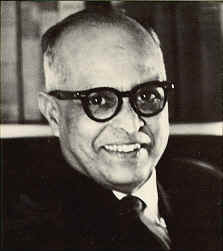
from R. K. Narayan: a Profile by
Anoop Sarkar
R. K. Narayan was born in Madras in 1906 and
educated there and at Maharajah's College in
Mysore. He has lived in India ever since, apart
from his travels. Most of his work, starting from
his first novel Swami and Friends (1935) is set in
the fictional town of Malgudi which at the same time
captures everything Indian while having a unique
identity of its own. After having read only a few
of his books it is difficult to shake off the
feeling that you have vicariously lived in this
town. Malgudi is perhaps the single most endearing
"character" R. K. Narayan has ever created.
He has published numerous novels, five
collections of short stories (A Horse and Two
Goats, An Astrologer's Day, Lawley Road, Malgudi
Days, and The Grandmother's Tale), two travel books
(My Dateless Diary and The Emerald
Route), four collections of essays (Next Sunday,
Reluctant Guru, A Writer's Nightmare, and
A Story-Teller's World), a memoir
(My
Days), and some translations of Indian epics
and myths (The Ramayana, The Mahabharata, and Gods,
Demons and Others).
In 1980, R. K. Narayan was awarded the A.C.
Benson award by the Royal Society of Literature and
was made an Honorary Member of the American Academy
and Institute of Arts and Letters. In 1989 he was
made a member of the Rajya Sabha (the non-elective
House of Parliament in India). He received the
Sahitya Akademi Award for The Guide (1958).
R. K. Narayan's full name is Rasipuram
Krishnaswami Ayyar Naranayanaswami. In his early
years he signed his name as R. K. Narayanaswami,
but apparently at the time of the publication of
Swami and Friends, he shortened it to R. K. Narayan
on Graham Greene's suggestion. Apart from
shortening his name, Graham Greene had other
effects on R. K. Narayan's career. Upon reading a
manuscript of Swami and Friends, which was
Narayan's first novel, Greene was sufficiently
impressed to recommend it to Hamish Hamilton for
publication, and one could argue that it was this
that launched Narayan's career in the West."
An excerpt from "The Writer and
India" by V.S. Naipaul. New York Review of Books,
March 4, 1999
"Forty to fifty years ago, when Indian writers
were not so well considered, the writer R.K.
Narayan was a comfort and example to those of us
(I include my father and myself) who wished to
write. Narayan wrote in English about Indian
life. This is actually a difficult thing to do,
and Narayan solved the problems by appearing to
ignore them. He wrote lightly, directly, with
little social explanation. His English was so
personal and easy, so without English social
associations, that there was no feeling of
oddity; he always appeared to be writing from
within his culture.
He wrote about people in a small town in South
India: small people, big talk, small doings. That
was where he began; that was where he was fifty
years later. To some extent that reflected
Narayan's own life. He never moved far from his
origins. When I met him in London in 1961-he had
been traveling, and was about to go back to
India-he told me he needed to be back home, to do
his walks (with an umbrella for the sun) and to
be among his characters.
He truly possessed his world. It was complete
and always there, waiting for him; and it was far
enough away from the center of things for outside
disturbances to die down before they could get to
it. Even the independence movement, in the heated
1930s and 1940s, was far away, and the British
presence was marked mainly by the names of
buildings and places.
This was an India that appeared to mock the
vainglorious and went on in its own way.
Dynasties rose and fell. Palaces and mansions
appeared and disappeared. The entire country went
down under the fire and sword of the invader, and
was washed clean when Sarayu [the local river]
overflowed its bounds. But it always had its
rebirth and growth. In this view (from one of the
more mystical of Narayan's books) the fire and
sword of defeat are like abstractions. There is
no true suffering, and rebirth is almost magical.
These small people of Narayan's books, earning
petty sums from petty jobs, and comforted and
ruled by ritual, seem oddly insulated from
history. They seem to have been breathed into
being; and on examination they don't appear to
have an ancestry. They have only a father and
perhaps a grandfather; they cannot reach back
further into the past. They go to ancient
temples; but they do not have the confidence of
those ancient builders; they themselves can build
nothing that will last. But the land is sacred,
and it has a past.
A character in that same mystical novel is
granted a simple vision of that Indian past, and
it comes in simple tableaux. The first is from
the Ramayana (about 1000 BC); the second is of
the Buddha, from the sixth century BC; the third
is of the ninth-century philosopher
Shankaracharya; the fourth is of the arrival a
thousand years later of the British, ending with
Mr. Shilling, the local bank manager. What the
tableaux leave out are the centuries of the
Muslim invasions and Muslim rule.
Narayan spent part of his childhood in the
state of Mysore. Mysore had a Hindu maharajah.
The British put him on the throne after they had
defeated the Muslim ruler. The maharajah was of
an illustrious family; his ancestors had been
satraps of the last great Hindu kingdom of the
south. That kingdom was defeated by the Muslims
in 1565, and its enormous capital city (with the
accumulated human talent that had sustained it)
almost totally destroyed, leaving a land so
impoverished, so nearly without creative human
resource, that it is hard now to see how a great
empire could have arisen on that spot. The
terrible ruins of the capital-still speaking four
centuries later of loot and hate and blood and
Hindu defeat, a whole world destroyed-were
perhaps a day's journey from Mysore City.
Narayan's world is not, after all, as rooted
and complete as it appears. His small people
dream simply of what they think has gone before,
but they are without personal ancestry; there is
a great blank in their past. Their lives are
small, as they have to be: this smallness is what
has been allowed to come up in the ruins, with
the simple new structures of British colonial
order (school, road, bank, courts).
In Narayan's books, when the history is known,
there is less the life of a wise and enduring
Hindu India than a celebration of the redeeming
British peace. So in India the borrowed form of
the English or European novel, even when it has
learned to deal well with the externals of
things, can sometimes miss their terrible
essence."
Malgudi (courtesy Anoop
Sarkar)
Malgudi, a small South Indian town provides
the setting for almost all of Narayan's novels
and short stories. Malgudi, of course, does not
exist. It is for Narayan, just as Wessex is for
Thomas Hardy or Yoknapatawpha for William
Faulkner, an imaginary landscape inhabited by the
unique characters of his stories. It frees
Narayan to his humanistic enterprise.
R. K. Narayan describes his conception of
Malgudi (6)
"Malgudi was an earth-shaking discovery for
me, because I had no mind for facts and things
like that, which would be necessary in writing
about Lalgudi or any real place. I first
pictured not my town but just the railway
station, which was a small platform with a
banyan tree, a station master, and two trains a
day, one coming and one going. On Vijayadasami
I sat down and wrote the first sentence about
my town: The train had just arrived in Malgudi
Station.''
Vijayadasami is the day on which the
initiation of learning for a child is celebrated.
The above anecdote must have occurred around
September 1930.
From 'The World of Malgudi' by A. Hariprasanna
(1):
"Various critics have attempted to identify
the original of this mythical town. Iyengar
speculates that it might be Lalgudi on the
River Cauvery or Yadavagiri in Mydore. Others
of the opinion that Narayan's Malgudi is
Coimbatore which has many of the landmarks - a
river on one side, forests on the other, the
Mission School and College, and all the
extensions mentioned in the novels. However,
one is not likely to arrive at any definite
answer as to its geographical locations, even
if one shifts all the references to the town in
the novels, such specific allusions as that
"Malgudi is almost a day's journey from
Madras." The simple reason is that Narayan has
not drawn any map of framework for his Malgudi
as Faulkner for example, did for his
Yoknapatawpha or Hardy had in mind for his
Wessex novels. ... But all efforts to identify
Malgudi have remained futile, for it a pure
country of the mind. ...
The recurrence of the same landmarks serves to
put together the various novels into an organic
whole. They may be rightly called Malgudi novels
just as Hardy's novels are called Wessex novels.
...
Narayan creates his fictional world of Malgudi
as an essentially Indian society or town. The
Indianness and Indian sensibility pervaded the
whole place. Narayan's Malgudi is also a
microcosm of India. It grows and develops and
expands and changes, and is full of humanity,
drawing its sustenance from the human drama that
is enacted in it.
Like Hardy, Arnold Bennett too writes about
Five Towns, also famous as fictional places. For
Bennett the Five Towns were provincial. His
attitude towards them is always expository in the
sense that he explains and exhibits them to an
outside world. But for Narayan Malgudi is
anything but provincial.''
Narayan in an interview (4) discusses some of the reasons
why Malgudi had to be a South Indian town:
"I must be absolutely certain about the
psychology of the character I am writing about,
and I must be equally sure of the background. I
know the Tamil and Kannada speaking people
most. I know their background. I know how their
minds work and almost as if it is happening to
me, I know exactly what will happen to them in
certain circumstances. And I know how they will
react.''
Although Narayan never attempted to spell out
the landscape to Malgudi, it has been done for
him: M. K. Naik (2) has appended a map of Malgudi
in his book 'The Ironic Vision' based on the
various descriptions of the town to be found in
all his stories.
Graham Greene in his introduction to the
Financial Expert described Malgudi as a place
where you could go
"into those loved and shabby streets and see
with excitement and a certainty of pleasure a
stranger approaching past the bank, the cinema,
the haircutting saloon, a stranger who will
greet us, we know, with some unexpected and
revealing phrase that will open the door to yet
another human existence.''
References
[1] A. Hariprasanna. The World of
Malgudi. 1994. Prestige Books, New Delhi.
[2] M. K.
Naik. The Ironic Vision. 1983. Sterling
Publishers, New Delhi.
[3] K. R.
Srinivasa Iyengar. Indian Writing in English.
1985. Sterling Publishers, New Delhi.
[4] R. K.
Narayan, in an interview given to S. Krishna,
quoted by Hilda Pontes in R. K. Narayan, ed.
Nissim Ezekiel. 1983. Concept Publishers, New
Delhi.
[5] Graham
Greene. Introduction to The Financial
Expert.
[6] Ved
Mehta. The Train had just arrived at Malgudi
Station in John in Easy to Please, p.55. 1971.
Secker and Warburg, London.
Booknotes (courtesy Anoop
Sarkar)
*My
Dateless Diary : An American Journey
(1964)
A loosely strung story of his travels through
America in the 60s. He travels from New York
City, through the Mid-West, through the Grand
Canyon, to Los Angeles and back. Inspite of all
the changing background the text, apart from the
various incidents he puts down dutifully, is
mostly about India, Indians and himself, and not
about America itself. Except for the Grand
Canyon.
* A
Writer's Nightmare : Selected Essays,
1958-1988 (1988)
The title says it all. A collection of essays,
although if you have already spent money buying
another collection of essays called "Next Sunday"
you might want to give this collection a miss,
since most of the essays are taken from that book
along with a few later essays.
* A
Story-Teller's World : Stories, Essays,
Sketches (1989)
Around forty small essays distributed into
three main sections called "The Fiction-Writer",
which is mostly about the tools of his trade,
"Short Essays", a miscellaneous collection of
pieces written for newspaper columns and
magazines, and "Malgudi Sketches and Stories",
which is the most interesting part of this book,
has various character sketches and also
descriptions of actual places which he has folded
into his various Malgudi stories
* My Days - A
Memoir (1974)
His autobiography, written when he was 67
years old, after he had won most of his awards
and accolades. For someone who has written so
much and done quite a bit in his life, the size
of his autobiography is less than 200 pages,
which perhaps says more about him as an author
than anything in the book.
* Swami
and Friends (Phoenix Fiction Series)
(1935)
A collection of short stories about a
impetuous child named Swami. The stories, while
making entertaining children's fiction also have
a more general appeal. This book, R. K. Narayan's
first, introduces the town of Malgudi which forms
the background for most of his other novels and
short stories.
|