Enduring Music:
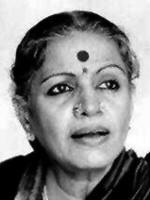
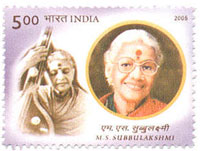
M.S.Subbulakshsmi 1916 - 2004 "The morning
mist has cleared and the sudden thin drizzle
has the small congregation outside
"Sivam-Subham" on Kotturpuram First Main Road
in Chennai, casting a puzzled glance skywards,
seeking to interpret Nature's shower as a
blessing to the departed soul of Madurai
Shanmukhavadivu Subbulakshmi (fondly called
M.S.); her body, draped in a rust-brown shawl,
lay in a freezer-box in the porch of the house.
The end came at 11-30 p.m. on 11 December
2004..."
"Once we regard the Divinity within us
with devotional fervor" she says, "we are
bound to develop the same affection
towards everything outside. When the
devotee has attained this state, service
to the world becomes his creed."
Kurai Onrum Illai -
Ragamalikai
A Tribute
Excerpts from a profile written
on the occasion of the 1974 Ramon Magsaysay Award
for Public Service:
Madurai
Subramaniya Iyer (styled simply as M. S. in keeping
with Tamil usage) Subbulakshmi was born on
September 16, 1916 in the city of Madurai in South
India. Madurai is located in the center of the
Tamil-speaking state of Madras and has been for
over 2,000 years the center of culture of the
Dravidians, the earliest inhabitants of India who
were pushed south by the Aryan invaders of the
north. ...
...Besides being born into the center of southern
Hindu culture, Subbulakshmi was further blessed by
being born into a home "where music was valued and
where votaries of music gathered." Her parents were
Subramanya Iyer and Veena Vidushi Shanmukavadivu, a
renowned singer and player of the veena - a plucked
instrument popular in the south. Her younger
brother and sister also shared their mother's love
of music; her brother played the mridangam - an
ancient barrel-shaped drum with goatskin ends used
for keeping time and rhythm - and her sister became
a singer. By the age of 10, Kunjamma, as
Subbulakshmi was affectionately known, was
accompanying her mother at concerts (as her two
stepdaughters accompany her today). She still
remembers when Dhanammal, a celebrated musician who
heard her sing at this age, predicted for her "a
bright future."
..... As a young girl she studied under Srinuvasa
Iyengar of Madurai who taught her up to the varnam
stage (the center piece of the sequence of dances
in a Bharata Natyam court). "After that," she has
said, "as I was unable to go to a music teacher for
advanced tutoring, I continued to learn from my
mother." In later years she "had the good fortune
of learning from several great musicians and among
them were Musiri Subrahmanya Iyer and Semmangudi
Srinvasa Iyer."
By age 17, Subbulakshmi was giving concerts on her
own, including major performances at the Madras
Music Academy, the prestigious center for the study
and promotion of Karnatic music. At the age of 24,
she married T. (Thyagarajan) Sadasivam who has
devoted himself to advancing her career. People who
know her well say that without her husband she
would not have achieved the artistic stature she
enjoys and that "it is a sight to see her
unceasingly acknowledging the gratitude she owes to
him for everything she has." Recently she said, "he
is my mentor and preceptor and he gave artistic
shape and definition to my ideas of music which
were almost running wild." Sadasivam, now publisher
and managing director of Kalki, the widely
circulated and highly respected Tamil weekly, was a
film director and thus particularly well situated
to assist her career through that medium.
Two fortuitous events brought Subbulakshmi early
into national prominence. The first was her
participation in the All-India Dance Conference in
Bombay, organized under the Vikramaditya
Celebrations, in 1944. Every Indian musician of
importance was present and her performance created
a sensation.
The second was her appearance in the title role of
the Hindi-language film Meera, produced by her
husband. Meera was a singer saint, an 18th century
Rajput princess who gave up court life and wandered
the countryside singing the praises of the Lord
Krishna. The film was produced in 1946-47 in
Rajputana and the villagers in the area saw
Subbulakshmi as a "new Meera. ' They sought
occasions to hear her sing and embarrassed her by
lining the road to pay her homage when she walked
the streets.
In this film she sang the bhajans of north India.
Bhajans are folk music of a devotional nature,
simple and compelling enough to be known,
understood and loved by all. Already recognized as
a distinguished singer of Carnatic classical ragas
- which in general demand a musically sophisticated
audience - Subbulakshmi suddenly found herself the
idol of the common people throughout the length and
breadth of the land. Sarojini Naidu, a poet and
leader of the nationalist movement in India, dubbed
her the "Nightingale of India," and added:
"Every child in India has heard
about Subbulakshmi for the beauty of her voice,
the magic of her personality, and the gracious
charity of her heart . . . . I want my living
words to go to the utmost corners of the world so
that people may realize how one great woman
artist in India has been able to move the hearts
of millions and millions of men and women by her
songs. I believe the feelings roused in me will
be roused in everyone who hears the enchanting
voice of this enchanting singer who is abundantly
gifted."
Subbulakshmi herself concluded that
"if one sings with sincerity and devotion, such
music has the capacity to move the audience to
divine experience, irrespective of their religious
beliefs, their language and the countries to which
they may belong."
Although Meera was her first and only Hindi film,
she has played in Tamil films both before and
since, including a Tamil version of Meera.
In 1941 Subbulakshmi and her husband visited
Mahatma Gandhi at his religious
retreat in Nagpur. Thereafter whenever she and he
were in the same city she sang at his prayer
meetings. Gandhi loved her rendition of north
Indian bhajans and requested that she sing some for
his 78th birthday, October 2, 1947. As she couldn't
appear in person, All India Radio suggested she
record some discs and have them sent to Delhi where
he was in residence. Gandhi particularly wanted to
hear "Hari Tuma Haro" whose haunting refrain
translates, "Oh Lord, take away the pain from
mankind." Not knowing this bhajan she suggested
another singer, but he refused, saying he would
rather hear her speak the words than another sing
them.
Subbulakshmi learned and recorded the song the
night of September 30th, finishing at 2 a.m. The
disc, sent off by plane, was played on what was to
be Gandhi's last birthday. Three months later he
was dead by an assassin's bullet. When the
announcement of his death was reported over the
radio, it was followed by the playing of
Subbulakshmi�s recording of "Hari
Tuma Haro." Hearing her own voice singing his
favorite bhajan was unnerving and Subbulakshmi
finds to this day that "Hari Tuma Haro" brings a
flood of memories of that tragic time.
Gandhi was not the only major Indian political
figure who enjoyed Subbulakshmi�s
singing. Prime Minister Jawaharlal Nehru seldom
missed a concert of hers in Delhi and referred to
her as "the Queen of Song."
The other phase of the career that has endeared
Subbulakshmi to her countrymen is that of using her
voice to raise money for good causes. Subbulakshmi
herself regards public service as a natural
outgrowth of the devotion to God which, she feels,
is the essence of music.
"Once we regard the Divinity
within us with devotional fervor [bhakti]," she
says, "we are bound to develop the same affection
towards everything outside . . . .When the
devotee has attained this state, service to the
world becomes his creed."
The first occasion in which she
sang in a cause was in 1944 in connection with the
Memorial Fund for Kasturba, the wife of Gandhi.
Rajagopalacharia, Chief Minister of Madras State,
asked for her cooperation in this effort and, as
the "result of strong convictions and much
thought," she consented. Her five concerts
throughout South India raised 80,000 rupees
(US$24,500).
During the following three decades Subbulakshmi has
given more than 200 benefit performances and raised
well over Rs. 10,000,000 for various Indian
charities. Two causes close to her heart have been
the Gandhi Memorial Fund and the fund in honor of
the 100th anniversary of the death of Tyagaraja,
one of the three great composers of Karnatic songs.
Other beneficiaries have been various hospital,
religious and educational institutions such as the
Sevoor T. B. Sanatorium, the Kamala Nehru Hospital,
the Ramkrishna Mission, the South Indian Education
Society, the Indraprastha College for Women and the
Madras Music Academy's Building Fund.
In recognition of her efforts Subbulakshmi received
the Padma Bhushan (lit. With Lotus Flowers or
Jewels Bedecked) from the Government of India in
1955, the first musician to be so honored. In
making the presentation the President of India
commented, "her music is a gift of the gods which
she has placed at the service of the nation."
In 1956 she received the
President's National Award for Classical Karnatic
Music and the same year was nominated to membership
in the Sangeet Natak Akademi (National Academy of
Music, Dance and Drama), a high honor for a
performing artist.
In 1963 Subbulakshmi was invited to participate in
the Edinburgh Festival and traveled to Europe for
the first time. Unexpectedly - since, contrary to
popular clich�, music is not an
international language but the deepest expression
of a specific culture - she found there an
enthusiastic reception. The Times of London
commented:
"The vocal music of another
culture is often felt to be harder to understand
than its instrumental music, but this feeling is
not always justified, and Subbulakshmi is an
excellent introducer of the beauties and
intricacies of Karnatic song."
The Scotsman added:
"We listen to a superb artist
singing in her native improvisatory style. The
barriers become academic, and similarities become
obvious."
Subbulakshmi herself concluded that
"if one sings with sincerity and devotion, such
music has the capacity to move the audience to
divine experience, irrespective of their religious
beliefs, their language and the countries to which
they may belong."
Finishing in Edinburgh she went back to London
where she gave a recital and made a number of
recordings for the British Broadcasting
Corporation. These performances were followed by
informal recitals in several European cities and
were climaxed by a concert in Cairo where she met
the premier singer of the Middle East, Om Kalsum.
This meeting was particularly meaningful because
Subbulakshmi's popularity in India is often likened
to that of Om Kalsum's in the Arab world. The music
of both women cuts across national boundaries and
appeals to pundits and the masses alike.
In October 1966 Subbulakshmi flew to the United
States to sing as her country's representative at
the United Nations in connection with United
Nations Day observances. Her reputation had
preceded her and she received an ovation even
before she came on stage. During the next seven
weeks she performed across the United States from
Boston to San Francisco and back. One critic wrote:
"A more educated and pedigreed
singing art would be hard to imagine. The
listener may well find himself under something
close to a hypnotic spell."
The San Francisco Chronicle greeted
her singing as "a series of miracles." The reviewer
exclaimed:
"Her elaborate vocal filigree,
sometimes sung in unison or octaves with her
daughter Radha Viswanathan, were unbelievable in
their poised ease and constancy of flow... She
sings with a reedy yet dark voice and the most
extraordinary flexibility. Like sleight-of-hand
she throws out embellishments almost too fast to
hear."
Her other stepdaughter Vijaya also
accompanied her on the tour, playing the tambura, a
four or five stringed instrument that provides
essential background harmony.
The Madras Music Academy in 1968 elected
Subbulakshmi to preside over its Annual Conference,
the first woman so honored. As Krishnaswamy noted,
"the credit for elevating the status of lady
artists to a place of equality with men goes to
Srimati Subbulakshmi."
On the concluding day of the
session, January 2, 1969, the Minister for Civil
Education conferred on her the highly coveted
title, Sangita Kalanidhi (Master of Musical Arts).
The citation recognized that she was:
"endowed with a voice of unique
sweetness and richness and an ability to
harmonize strict standards and popular appeal and
to do justice to the music of the South as well
as the North. She has been the most beloved idol
of the public in the recent annals of Indian
music."
Subbulakshmi is often questioned
concerning the training of singers today. Dealing
with techniques, she advises students to train
their voices to "traverse the three octaves with
felicity, curbing the tendency to branch into
falsetto," make the veena their teacher and adhere
to tradition, at the same time mastering
pronunciation, proper intonation and knowledge of
the libretto. "Only hard work can qualify [one] for
the task and there is no short cut," she
emphasizes.
She feels that the gurukala system
- the teacher-disciple relationship - is of great
importance and bemoans the fact that it is seldom
practical today for a student to live with a guru
during his formative years. The guru's role, she
notes, is not to teach by rote or foster his own
style, but to acquaint the student with
traditionally accepted norms of beauty, thus
exposing him to the fullness of the past. Students
who study in colleges of music, she says, should at
least "apprentice themselves under an experienced
musician for two or three years thereafter, and
attempt to learn the finer points of the art which
that musician only will be in a position to
teach."
Subbulakshmi always reminds students that technique
is not all. Ragas and bhajans, she points out, have
been composed for the "purpose of directing the
minds of the listeners towards God and his
manifestations," and that "one's singing comes
through one's own experience and it is this depth
of feeling that enables one to communicate with the
audience." In fact, expression is more highly
sought and judged than quality of voice.
Subbulakshmi fervently believes that in an age when
young people are chaffing at the "controls and
restraints imposed by various religious and ancient
scriptures," music can lend a helping hand in
bringing about peace of mind, harmonious relations
and good behavior "When we negotiate starry
scintillations . . . and when the percussion
instruments accompany with gusto, a divine
exhilaration steals over the audience . . . . This
joy helps toward good conduct. That was why our
ancients wove music into the very fabric of our
daily lives." To have this effect on an audience,
the singer must be virtuous, for "in the mind of a
good person, bhakti is an instinctive growth. God
himself makes his home in such a mind."
By the same token, Subbulakshmi advocates the
compulsory teaching of music at all levels of
education, from primary through university. "This
does not mean that all [students] should be able to
give concerts on the platform," she says. "Just as
the study of science leads to the growth of
knowledge, the study of music will bring serenity
of mind."
Of her own training she says that she frequently
sang one practice session, blending her voice with
the tambura, the next without accompaniment. When
she used the instrument again in the third session
she found "there was invariably a perfect harmony
between the two." This identity of voice and
instrument is highly valued in Indian music. One
votary of north Indian song once compared
Subbulakshmi's voice to the shehnai, the
double-reed wood wind of his area, noting that "it
has the same richness of tone�its
smoothness, vibrancy and above all its hypnotic
quality."
Although she is noted for her extraordinary vocal
range, Subbulakshmi "never exceeds the demand of
the composition." She goes to the core of the song
and shows restraint, rather than "gilding the lily"
with virtuoso appurtenances. Restraint also extends
to her private life. She is "simple, humble and
almost childlike," those who know her report. She
dresses quietly, her manner is demure, and although
she is now matronly in appearance, her expression
is often described as "innocent."
Not unexpectedly, "she talks, sings and lives music
twenty-four hours a day," and is deeply religious.
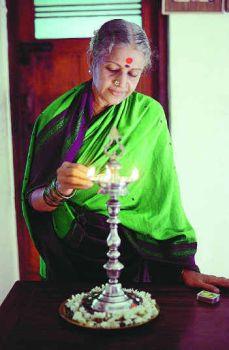
The puja (prayer) room in her house has three
life-size portraits of Sri Chandrasekharendra
Saraswathi Sankaracharya, the saint whom she calls
"divinity in flesh and blood," and who has "been
instrumental in restoring the faith and religious
temperament of the people of Madras and reclaiming
many to the path of God" in recent years. As her
guru, he selected the verses for the highly popular
record she made in 1970 of the Bhajagovindam (some
30 verses composed by the poet-philosopher Sankara
in praise of Lord Krishna, which are both musical
and of much philosophical content) and Vishnu
Sahasranamam (a musical chant of the 1,000 names of
Vishnu, one of the three main gods of the Hindu
pantheon).
Wherever Indian cultural communities
exist�India, Pakistan, Ceylon,
Nepal, Malaysia, Burma, South Africa, East Africa
and Mauritius, Fiji and the West Indies -
Subbulakshmi's music touches a responsive chord.
Her popularity and success are due, according to
critic Narayana Menon, to her unusual combination
of characteristics:
"Good looks, intelligence,
versatility, character, the humility to learn at
all times and from all people. Finally, there is
that elusive indefinable gift which few possess
and which alone can transform a song into a thing
of magic."
The President of the National
Academy of Music, Dance and Drama of India adds:
"Her music is unique in that it has universal
appeal; it appeals to the connoisseur, the vidwan
who revels in intricate technique, and it appeals
equally to the masses of people by its melody and
sweetness . . . . In addition to its technical
perfection, it is full of the fervour of devotion
to God."
As the poet Dharam Bharati says, "If there is
radiance in the heart, there will be radiance in
the voice."
References
Hariharan, N. "Art Knows No Barriers," unidentified
newspaper clipping, N.d.
"Indian Music," Encyclopedia Britannica. Chicago,
Illinois: Encyclopedia Britannica Vol. 12,
1970.
Jagannathan, Maithily. "Queen of Song," Hindustan
Times Weekly. Delhi. November 22, 1970.
Joshi Baburao. Understanding Indian Music. New
York: Asia Publishing House. 1968.
Menon, V. K. Narayana. M. S. Subbulakshmi. Booklet.
Madras, India: Kalki Press. N.d. 8 p.
______."M S. Subbulakshmi," Illustrated Weekly of
India. Delhi. November 13, 1955.
______. "A Note on the Music of India," Edinburgh
International Festival, Indian Music Events
(Program). August 20-September 4, 1963.
"Miracle Indian Music," San Francisco Chronicle.
November 7, 1966.
Narasimhan, C. V. Music Recital by Smt. M, S.
Subbulakshmi at the United Nations on Sunday. 23
October 1966, in Connection with the Observance of
United Nations Day 1966 (Program). 11 p.
______. "She Came, She Sang, She Conquered," from
The Subbulakshmi Story, reprinted by The Hindu.
Madras, India. Leaflet. N.d. 4 p.
Parthasarathy, T. S. "M. S. Subbulakshmi: Four
Decades of Virtuosity," Indian & Foreign
Review. Delhi June 15, 1972.
Rangarayan S. Indian Express. Bombay. October 18,
1967.
"Sangita Kalanidhi Title for M. S.," Times of
India. Bombay. January 2, 1969.
Sastry, B.V.K. "M. S. Subbulakshmi" Illustrated
Weekly of India. Delhi. July 7, 1963.
Subbulakshmi M. S. "Bhakti is the Essence of Music"
(Presidential Address). Translated from Tamil by V.
T. Sreenivasan and reproduced from Bhavan's
Journal. Bombay. August 10 and November 2,
1969.
Letters from and interviews with persons
knowledgeable about the work and contributions of
M. S. Subbulakshmi.
1974 Ramon Magsaysay Award for
Public Service - Citation
Exacting purists acknowledge Srimati M. S.
Subbulakshmi as the leading exponent of classical
and semi-classical songs in the Karnataka tradition
of South India. They and ordinary people alike find
in the compelling melody and sweetness of her
bhajans, or folk spirituals, "a deep, pure and
abstract emotional appeal," transporting them to a
sense of unity with the supreme deity. Rooted in
millenia of Indian culture and mythology, her
bhajans are a means of prayer and solace in the
villages where bhakti marg, or the way of devotion,
supersedes more intellectual philosophies.
The gift of song that reaches the hearts of her
countrymen results from a passionate pursuit of
artistic excellence. As a girl of 10, in the South
Indian cultural center of Madurai where she was
born in 1916, Subbulakshmi began accompanying her
celebrated mother's singing and veena playing. An
enchanting voice, hard work, exacting discipline,
character, humility and willingness to learn from
everyone, made her at the age of 17 a soloist in
her own right. When, at the age of 24, she married
T. Sadasivam�now publisher of the
prestigious Tamil weekly, Kalki, in
Madras�she gained also her
"friend, philosopher and guide."
As, with maturing years, Subbulakshmi's versatility
encompassed Hindustani classics of North India and
folk songs of many regions, her following grew far
beyond the South; wider audiences first heard her
in the film Meera. Mahatma Gandhi asked only to
hear her sing "Hari Tuma Haro," or "Thou God," on
his 78th birthday, which proved tragically to be
his last. Jawaharlal Nehru, after hearing her sing,
said, "Who am I, a mere Prime Minister, before a
Queen of Song?"
On tours abroad Subbulakshmi sang at the Edinburgh
International Music Festival and before the United
Nations. Her vocal "filigree," traversing three
octaves, and fidelity to tone and rhythm reached
through to listeners unfamiliar with melodic Indian
music that neither needs nor implies harmony.
In April 1944, after five successful benefit
performances given for the Memorial Fund honoring
Gandhi's wife, Kasturba, Subbulakshmi 's voice
became an instrument for public causes. Receipts of
concert halls - filled to overflowing - and open
amphitheaters - often packed with tens of thousands
paying only four annas each (three U.S. cents) so
as to deny no one the joy of her songs - have been
given to constructive works. Equivalent to over one
million U.S. dollars, her contributions have
benefited foundations for the poor, hospitals,
orphanages, schools, and music and journalism
institutes. While becoming the idol of millions,
this lady has remained deeply religious,
unpretentious and almost childlike in her
simplicity.
In electing Srimati M. S. Subbulakshmi to receive
the 1974 Ramon Magsaysay Award for Public Service,
the Board of Trustees recognizes her exalting
rendition of devotional song and magnanimous
support of numerous public causes in India over
four decades.
1974 Ramon Magsaysay Award for
Public Service - Response by M. S. Subbulakshmi
I feel deeply honored to be receiving this Award
and I accept the honor in all humility. I am
extremely happy to have come to this beautiful
country. I find the landscape enchanting with its
beach, green lawns and avenues, and the people
cheerful, friendly and hospitable. I feel not only
quite at home but that we are of one family.
Your great President Ramon Magsaysay was a shining
personality and leader who had arisen in our midst
in this part of Asia. We knew of the ideals of
personal integrity, the sense of truth and justice,
that he strove to establish in the short time he
was your president. I offer my salutations to him.
I also offer my salutations to your national hero
Dr. Jos� P. Rizal.
Naturally my reverential memory now hovers around
Mahatma Gandhi who was the apostle of Peace on
Earth, beloved Sri Jawaharlal Nehru, the first
Prime Minister of the Indian Republic, and
Chakravarti Rajagopalachari, affectionately called
Rajaji. It was my singular good fortune to have
come under the loving spell of all three. I offer
my deepest homage to this trinity.
My all I owe to my husband, Sri T. Sadasivam. By
his loving care he is my parent; by his unerring
guidance he is my preceptor.
Indian music is orientated solely to the end of
divine communion. If I have done something in this
respect, it is entirely due to the Grace of the
Almighty who has chosen my humble self as a tool.
But He is beyond my gratitude. Yet, in a way, I
take Him to have come within my reach in the benign
personality of the Sage of Kanchi, His Holiness Sri
Chandrasekharendra Saraswathi Sankaracharya, who is
divinity in flesh and blood, now in his 81st year.
I offer my obeisance to the Sage from the core of
my being, and pray that he bless me to deserve the
honor done to me.
Once again, I wish to express to you all my deep
sense of gratitude for honoring me with this Award.
Genuis of Song - Dr. Gowri
Ramnarayan,
Frontline, 31 December1993 from a posting in
rec.music.indian.classical.
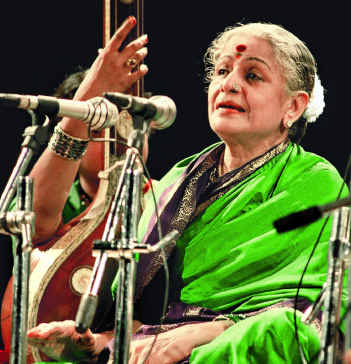
"We walked 30
miles to hear you today but arrived only at the
very end. We waited in the hope of offering our
respects to you before returning to our
village."
The speakers were a dust-streaked couple in
crumpled sari and dhoti in remote Ayalur in Tamil
Nadu's Thanjavur district - where Carnatic vocalist
M.S. Subbulakshmi had given a concert as the finale
of a week-long temple festival. Her name had drawn
from villages miles around, thousands who were at
that time returning with no thought or word beyond
the exhilaration her vocal music had wrought.
Drained by the two-and-a-half hour performance and
passage through the adulation of the packed crowds,
the (then) 70-year-old musician had no thought but
of rest during the early journey of the next day.
But she would not, could not, send the couple away
disappointed. "Let us sing at least one song for
them." The younger accompanist to whom she said
this asked, "Do you know it is midnight now?" With
a smile MS began to sing with the same earnestness
and attention she had shown earlier on the stage.
For her, music was ever a matter of reverence.
Another instance illustrates her appeal to the
cognoscenti: It was with more than the usual
trepidation that M.S. Subbulakshmi faced a
distinguished audience of needle-sharp rasikas and
fellow musicians at the Music Academy in Madras
one evening in the 1950s. She was about to present
a pallavi in Raga Begada, "Kailasapate, pasupate,
umapate, namostute," across the Adi tala cycle.
This was a challenge to her virtuosity in
rhythm-charged ragam-tanam-pallavi techniques.
Star-singer though she already was, she was not
particularly known for pallavi pyrotechnics. What
followed was no different from the typical
Subbulakshmi concert -
thunderous applause greeted her at every stage of
the unfolding.
The pallavi piece had been the idea of a musician
friend and mentor Musiri Subramania Iyer. MS had
enthusiastically rehearsed it with the active
encouragement of violinist Tiruvalangadu Sundaresa
Iyer, whose tuft-waving shouts of "bhesh, bhesh!"
had punctuated the practice sessions.
The Alathur brothers, known to be masters of laya
and pallavi exposition, were to call on MS the next
day and offer their congratulations. "We have no
words to describe the beauty and balance of your
presentation. What anchored every part firmly to a
finished whole was the accent on the Raga and the
bhava you brought to it. This is what makes your
music so enchanting, so durable. This is what the
great Dakshinamurthi Pillai found to be special in
your singing years ago." With that the mists parted
and MS was back in shy girlhood.
Kunjamma (as she was known to those close to her),
brought up with all the rigorous strictness that
her mother could impose upon her training in art as
in life, had sung at a wedding in the household of
Dakshinamurthi Pillai, the venerable percussionist
from Pudukkottai. The event had drawn a galaxy of
artists - including the upcoming Semmangudi
Srinivasa Iyer, Musiri Subramania Iyer, Chembai
Vaidyanatha Bhagavathar, Rajamanickam Pillai,
Rajaratnam Pillai, Palghat Mani Iyer, G.N.
Balasubramaniam and the Alathur brothers.
The next day, in the midst of this starry assembly,
Dakshinamurthi Pillai suddenly smote his head with
vehemence. "Andavane! (oh God!) How will you save
your throats for a lifetime if you engage in vocal
gymnastics? Leave all that to us drummers. Singers
must emphasize the raga and the bhava so that you
preserve your voice and let it gain in timbre. That
little girl there, she knows this already. Didn't
we hear her yesterday? Wasn't it satisfying? Touch
our hearts?" At that public praise, Kunjamma shrank
even more behind her mother in the corner.
Lost in memories, Subbulakshmi's narrative
trembles. Those were times to recall with tears.
She was blessed by every senior musician who came
home to sing and play before or listen to her
musician mother Shanmukhavadivu playing the veena.
Some were legendary firgures like Tirukkodikaval
Krishna Iyer, Veena Seshanna of Mysore, Ponuswami
Pillai, Naina Pillai, Chittoor Subramaniam Pillai,
Venkataramana Dass of Vizianagaram. Invariably,
Kunjamma would be jerked forward to sing. "Though I
would always be encouraged and appreciated by them,
I never lost my timidity." She recalls that some of
them would teach her a song or two - as did the
great Ariyakudi Ramanuja Iyenger.
"What were you like in those days?" brings a change
in mood. "You can see it in the old pictures," she
laughs. "A side parting in thick curls pressed down
with lots of oil, a huge dot covering most of my
forehead, the half- saree pinned to the
puff-sleeved blouse with long brooch and longer
safety pin, eardrops, nose-rings and bangles of
imitation gold...Oh I forgot. The long plait was
tied up with a banana stem strip! Or a ribbon which
never matched." Getting ready for the stage meant
also the addition of a row of medals on the
shoulder.
MS has been sheltered and protected through 78
years now. Like everybody else, she has had ups and
downs, faced hurdles and setbacks, known heart-
break. As an artist in India, she has scaled
unrivalled peaks of fame. Through these public and
personal happenings, she continues to radiate the
childlike innocence of the old portraits. Yet what
lingers on her face is not the look of naivete, or
inexperience. It is a sense of inner peace and
timeless faith lining her gentleness.
A perceptive profile of Subbulakshmi states:
"Success and fame bring in their train friends and
adulation, as well as jealousy and carping critics.
She has been paid the most extravagant tributes by
musicians, scholars, high dignitaries of State...I
have also heard others dismiss her as a pretty
singer with a pretty voice who has built up a
reputation on false values. She herself takes all
this in her stride." It ends with a tribute to the
beauty and grace of her music and looks to its
maturing into greatness. The year was 1955.
That she has reached this greatness will hardly be
challenged, even by critics of her style - or
those who play the devil's advocate. She has been
the recipient of the highest awards and honours the
nation could bestow upon an artist short of the
Bharat Ratna, and of significant
international recognition.
But the impressive list of distinctions can hardly
explain the MS mystique. Certainly it has to do
with her extraordinary voice, which continues to
ring in the mind with vibrant power and clarity,
whether heard from near or far or any angle. That
her music is not diminished by the absence of
instrumental accompaniment is knowledge treasured
by those privileged to hear her in private. It was
realised by the multitudes on occasions when her
devotional songs were telecast by Doordarshan, as
at the time of Indira Gandhi's assassination.
A whole range of explanations are offered for the
primeval resonance of her voice - from the
metaphysical to the physical. There are pious
devotees who believe it to be a gift as a result of
oblations of honey through her previous births! An
ENT specialist, on the other hand, declares it has
to do with the unusual arrangement of her vocal
chords. To hear her is to be spellbound - the
experience of more than three generations of men
and women in many parts of the world. Over the
years, the voice and charisma have melded to
irresistibility nonpareil. Admirers range from
old-timers, hep youngsters, fellow artists,
householders, ascetics, religious and political
leaders, atheists, scientists and fact-finders and
pundits, to philistines.
Princes and heads of state have bowed to her music,
as when the (then) Maharana of Udaipur said to MS
and husband T. Sadasivam: "In the old days I would
have exchanged my whole kingdom for this Kalyani
raga. Now I shall give you whatever help you need
by way of horses and elephants in location
shooting." The occasion was the filming of Meera,
produced by Sadasivam with MS in the lead.
Jawaharlal Nehru's tribute to her, "Who am I before
the queen of song?" has been publicised widely as
has been Mahatma Gandhi's request, shortly before
he was gunned down by a Hindu fanatic on January
30, 1948.
A message had been sent to Madras that Gandhiji
wished MS to render his favourite bhajan, "Hari tum
haro," and a response had gone from husband
Sadasivam to the effect that she did not know how
to sing this particular bhajan, somebody else could
sing "Hari tum haro", and she could sing another
bhajan. A reply had promptly come back on behalf of
the Mahatma: "I should prefer to hear it SPOKEN by
Subbulakshmi than SUNG by others."
Nearly half a century after this incident, MS
and Sadasivam recall that she heard the news of
Gandhiji's assassination when she was listening to
a relay of the Thyagaraja Utsavam (festival) and
immediately her own singing of "Hari tum haro" came
on the air. She swooned from the shock. Had not
Gandhiji called upon her at a prayer meeting in
1947 at Birla House in Bombay, "Subbulakshmi,
Ramdhun tum gao" (You sing the Ramdhun)? His
choice of songs and his manner of recognition show
that the Mahatma was thinking beyond music.
It was that special quality she invokes of
peace and bliss, not just with her voice, but from
the depths of her own character - simple, devout
and spirituelle. Often lay persons with no liking
of classical music still play her devotional verses
as an every morning ritual. The suprabhatams on the
deities of Tirupati, Kasi, Rameshwaram and Kamakshi
of Kanchi thrill pilgrims at dawn in temples from
Kedarnath to Kanyakumari. In the midst of roadside
blasts of film songs, if an occasional "Kaatrinile
varum geetham" of "Chaakar rakho ji" come on, the
pedestrian is arrested into paused listening. There
are others who swear that listening to her recorded
music helped them tide over troubled times, even
traumas and tragedies.
In this writer's personal experience, there was
the instance of a dear friend, a Hyderabadi girl,
who repeatedly asked for "any MS music" as she
bravely faced death from third degree burns. More
remarkable is her popularity outside the Carnatic
belt. According to traditional stereotype, the
North Indian is supposed to be indifferent to
Carnatic music, but MS concerts draw large
audiences in Jalandhar and Jaipur, Kanpur and
Bhopal, Pune and Baroda, notwithstanding the
predominance of the heavy pieces in Telugu,
Sanskrit and Kannada by composers ranging from
Thyagaraja to Yoganarasimham.
The initial recognition, of course, came through
the bhajans in Hindi that she rendered for the film
Meera in 1944. Delightedly surrendering her title
"The Nightingale of India" to MS, Sarojini Naidu
introduced her in the film's first reel. A slender
MS with downcast eyes, corkscrew curls blowing,
hands twisting her pallav, is overwhelmed as Naidu
heaps tributes with this prophecy to her
countrymen, "You will be proud that India in this
generation has produced so supreme an artist."
Since then, MS recitals have always included
bhajans - of Meera first and later Tulsidas, Kabir,
Surdas, Nanak and abhangs of Tukaram. A few have
heard her sing chhote khayals and thumris ("Na
manoongi, Mishra Khamaj); "Neer bharan kaise
jaaon," Tilakamod; "Mano mano kanhaiyya," Jonpuri),
that she learnt in the 1930s from Dwijenderlal Roy
in Calcutta and later from Siddheshwari Devi of
Benares. The latter spent some months in Madras
teaching MS thumris and tappas.
It was a lesson in assiduity to see the two
great women seated on the mat, facing each other
and practising with intense interest the Yaman
scales over and over again, with Siddheshwari Devi
rolling the beads to keep the 108 count. To many
North Indian business barons, an MS recital at a
family wedding is not a status symbol but a
blessing on the young couple. With excellent
singers in Bombay who can sing bhajans with the
greater ease of mother tongue spontaneity, why did
they insist on a bhajan concert by MS? A
Bombay-based industrialist's reply to the naive
question was, "True! We can listen to good music by
others. But no one else can create this feeling
which takes us straight to heaven."
Hindustani musicians themselves have never
stinted praise. Veteran Alladiya Khan was charmed
by her Pantuvarali (Puriya Dhanashri); Bade Ghulam
Ali Khan had announced she was "Suswaralakshmi
Subbulakshmi," and Roshanara Begum had been
ecstatic over her full-length concert. Others from
Ravi Shankar to Pandit Jasraj and Amjad Ali Khan
have been unfailing admirers. Vilayat Khan folds
both his hands and closes his eyes as he speaks her
name.
This recognition first came in the 1930s in a
Calcutta studio when MS played Narada in Savithri.
(This film launched the nationalist Tamil weekly
Kalki, a joint venture of husband Sadasivam and
writer R. Krishnamurthi). The MS recordings would
gather other distinguished artists, K.L. Saigal,
Pahari Sanyal, Kananbala, Keskar and Pannalal Ghosh
(later to play Krishna's flute in Meera).
Dilipkumar Roy was another admirer who was later to
teach her bhajans and Rabindra Sangeet.
"They would make me sing again and again,
especially the song 'Bruhi mukundeti,` with its
lightning sangati in the end," MS recalls happily
(in Tamil). "In those days we had no sense of
competition or oneupmanship. We enjoyed good music
wherever we found it." Old-timers remember that in
the film too, as Narada descended from the sky in
jerks, but still singing that enthralling song,
the theatre resounded to applause. In the Bombay
studio where the Meera score was recorded, it was
the same story. Artists who came for other
recordings would stop by and become rapt listeners.
A thin newcomer, two long plaits dangling behind,
refused to record her song after the MS session.
"Not now, not after THAT!" She went on to become a
legend in her own right as Lata Mangeshkar, while
continuing to remain a devoted MS fan.
Another MS achievement was that, virtually for
the first time, she astonished the Westerner into
an appreciation of Carnatic music. In the 1960s,
the few Indian musicians known outside the country
were Hindustani instrumentalists. In the Western
world, hardly anyone knew of the complex Carnatic
system, which was deemed inexportable. Why, even
North Indians found it indigestible. In a
conversation with Jawaharlal Nehru, Sadasivam
remarked that the West might prefer instrumental to
vocal music. "Yes," said Panditji, tapping his
fingers. Then looking straight at MS he broke into
a smile, "But not in YOUR case!" MS always adds,
"By God's grace, what he said came true when I sang
at the Edinburgh Festival, at the United Nations
and at Carnegie Hall."
On the eve of a public concert in New York, U.N.
Chef de Cabinet and Carnatic music expert C.V.
Narasimhan was disquieted at the prospect of
rejection by the redoubtable critic of the New York
Times. He was to call ecstatically the next
morning. "You have won. The press overflows with
praise." So it did after everyone of the string of
concerts that MS gave in the US and in some parts
of Europe before all-white audiences, most of whom
were strangers to any music from India.
The New York Times said: "Subbulakshmi's vocal
communication trancends words. The cliche of 'the
voice used as an instrument` never seemed more
appropriate. It could fly flutteringly or carry on
a lively dialogue with the accompanists.
Subbulakshmi and her ensemble are a revelation to
Western ears. Their return can be awaited with only
eagerness." Dr. W. Adriaansz, Professor of Music,
University of Washington, wrote: "For many, the
concert by Mrs. Subbulakshmi meant their first
encounter with the music of South India and it was
extremely gratifying that in her the necessary
factors for the basis of a successful contact
between her music and a new audience - highly
developed artistry as well as stage presence - were
so convincingly present...without any doubt (she)
belongs to the best representants of this
music."
This writer witnessed that kind of wondrous
rapture in Moscow when MS performed before a
select group of Russian musicians and musicologists
in 1988. Midway through the singing a woman came up
with flowers. She touched her eyes first and then
her heart to communicate her bursting feelings.
That this was a shared experience became evident
when the applause and the audience followed MS as
she left the hall, down the staircase, to the car
on the street, until she drove away.
The question still remains unanswered: What is
this almost transcendental quality behind the
unfailing rapture? In the West, such responses are
not unknown to the music from great composers like
Mozart and Beethoven. Many would attribute it to
the Indian bhakti tradition of poetry and song to
which the singer belongs. The 6th-7th century cult
of the Nayanmars and the Alwars, spread through
Chaitanya and Jayadeva, as the people's movement of
Basavanna and Mahadeviyakka, inspired Namdev and
Tukaram, Surdas, Tulsidas and that extraordinary
woman saint Meerabai, who spurned queenship and
wifehood in her restless quest of the Lord. The
bhakti polarities of seeking and finding, loss and
conquest, desire and fulfilment are realised in
their verses.
Precisely these aspects mark Subbulakshmi's
singing. This is true of those portions without
verbal elements, like the raga alapana. Just as the
devotee individuates the deity through incantation
and description - detailing every limb, look and
ornamentation - the singer shapes the raga, always
starting with clear strokes to pedestal its
identity and going on to breathe it to form and
life. The enunciation of the antara gandhara
(Sankarabharanam, Khambhoji, Pantuvarali,
Kedaragowla) in the upper register - as a long-held
note, as the end-point of embellishments, or the
pivot of note clusters, mounts to fever pitch.
Hands sculpt the air, face turns upwards, eyes gaze
at the beyond, and suddenly there comes the
madhyama/panchama climax and the rounded process of
conclusion, all accomplished with seemingly
effortless grace. After plumbing the depths and
soaring to the heights, the listener emerges into
quietude. That is how the Meera archtype gets
superimposed in this Tamil daughter of the 20th
century.
What is MS like in real life? The answer would
be: except for the taut- nerved hypersensitivity of
all great artists, no different from any other
South Indian housewife, mother and grandmother of
her generation. Fame, the approbation of the
world's haut monde and glitterati, the adoration of
hundreds of thousands, have left her transparently
untouched. Home needs and little chores are given
the same attention that she gives momentous
affairs. She is meticulous and neat in personal
life, even in the delicate lines of the kolam she
draws everyday. She excels at putting all kinds of
visitors at ease, with a genuine interest in what
they have to say of themselves. Gifts which please
her most are strings of jasmine and mild French
perfumes.
In appearance and lifestyle, she remains
conservative: the long pallav of her handloom
cottons or silks tucked round the waist,
flower-wreathed "kondai", diamond nose and ear
rings, glass bangles between gold, not to forget
the row of kumkum and vibhuti from many temples
dotting the turmeric-washed forehead. regular in
the performance of puja and shloka-recitation, she
is a strict follower of all the prescribed rituals
of the sumangali householder. "My mother-in-law
told me before she left for Kasi" would precede
these observances.
Owning no jewels beyond what she wears and quick
to give away the silk sarees gifted to her by
admirers, she has never tried to appear younger
than she is. Thousands see her as the embodiment of
grace and ancient tradition of Indian womanhood -
kind, considerate, compassionate, soft- spoken,
self-sacrificing and somewhat unworldly. She
breathes the tenderness of the mother to the
child, the bhakta to the god.
Looking at her self-effacing deportment, one has
to remind oneself forcefully that she is a
world-travelled artist, a globally-acclaimed career
person who has changed the definition and image of
Carnatic music in the 20th century. A first-time
foreign listener at her concert was quick to note
the ethereality of the MS image. "It is not right
to describe her as the Maria Callas of India.
Callas has fans, frenzied legions of them. But not
devotees! MS does not sing, she makes divinity
manifest."
How did MS train this voice, develop grasping
power, and learn to refract emotional colours
thorugh it? How did she absorb the aesthetics and
techniques of a hoary musical tradition?
Born in the temple town of Madurai on September
16, 1916, to veena player Shanmukhavadivu (her
initial M.S. record the birthplace and mother's
name), little Kunjamma, brother Saktivel and sister
Vadivambal grew up surrounded and filled by music.
Grandmother Akkammal had been a violinist. Their
tiny home in the narrow, cattle-lounging
Hanumantharayan lane was close to Meenakshi temple.
Whenever the deity was taken in procession through
the main streets, the nadaswaram players would stop
where this lane branched off and play their best
for Shanmukhavadivu's approval. "My earliest
interest in music was focussed on the raga. I
would try to reproduce the pipers as well as I
could. My mother played and rehearsed constantly.
No formal lessons, but I absorbed a whole wealth by
listening and humming along with the veena." Much
later, experts were to wonder at the way in which
MS vocally rendered some of the rare and singular
gamakas and prayogas of both veena and
nadaswaram.
The family was rich only in music. Otherwise,
for mother and children, and for the numerous
uncles and aunts who crowded their home, it was a
frugal existence. For the two girls it was
confinement within the home, while the brother
enjoyed a little more freedom.
Vadivambal died too early to fulfil her promise
as a veena player. But for Subbulakshmi it was to
be vocal music. The coconut was broken and
offerings were made to god and guru Madurai
Srinivasa Iyengar. But the lessons could not go
beyond the foundations because the guru passed
away. "I also learnt Hindustani music for a short
spell from Pandit Narayan Rao Vyas. 'Syama Sundara`
which I sang in the film Seva Sadan was one of the
pieces he taught me. I listened to a lot of good
music on the radio (the neighbours'; we didn't own
one!) from the window sill above the staircase. I
loved to hear Abdul Kareem Khan and Bade Ghulam Ali
Khan in the silence of the night."
Her formal schooling was stopped in class 5 when
a teacher's beating brought on an attack of
whooping cough. But she practiced music for long
hours, lost in the vibrations of the tambura which
she would tune reverently. The MS hallmark of sruti
suddham can be traced to a game she evolved in her
childhood. As she sang, she would stop playing the
drone at intervals and check if she continued to
maintain the pitch with and without it. Throughout
the day she would sound the shadja panchama notes
and pluck the strings to see if she was still
aligned to them.
This natural ability, consciously developed
through a kind of yoga, is responsible for the
electrifying effect her opening syllables have on
the audience, whether she plumbs the depths
(mandara sanchara) or scales the heights (tara
sanchara) of a fantastic voice range. Another
little known fact of her early life was her
fascination for the mridangam which she learnt to
play from brother Saktivel.
Intrigued by the gramophone records, Kunjamma
would roll a piece of paper for the "speaker" (as
in the logo of His Master's Voice) and sing into it
for hours. This game became real when she
accompanied her mother to Madras and cut her first
disc at the age of 10. The songs were "Marakat
vadivu" and "Oothukuzhiyinile" in an impossibly
high pitch. In fact, it was through the Columbia
Gramophone Company records that she was first
noticed in the city - before she was 15 years
old.
To balance and leaven maternal stringency, there
was lawyer-father Subramania Iyer who lived a few
streets away. In the faded photograph which hangs
in her home today, his soft look and sensitive
features bear an unmistakable resemblance to his
"Rajathippa" (princess darling). That is how he
called his pet daughter. He was wont to saying that
he would arrange her marriage with a 'good boy` who
would love and cherish her music. Not a singer
himself, he was a true rasika and bhakta. In the
early Ramanavami festivals he organised, there
would be puja, music and procession each day. How
wonderful it felt to the little girl when his
strong loving hands picked her up and placed her
next to the picture of Rama taken round the streets
on a chariot! The recollection of such scenes from
her childhood brings real happiness to her
today.
The first stage appearance? "When it heppened, I
felt only annoyance at being yanked from my
favourite game - making mud pies. Someone picked me
up, dusted my hands and skirt, carried me to the
nearby Sethupati School where my mother was playing
before 50 to 100 people. In those days that was the
usual concert attendance. At mother's bidding I
sang a couple of songs. I was too young for the
smiles and the claps to mean much. I was thinking
more of returning to the mud."
From regular vocal accompaniment in
Shanmukhavadivu's veena concerts, MS graduated to
solo performances. Of her debut at the Madras Music
Academy when she was 17, a connoisseur wrote: "When
she, with her mother by her side (who played the
tambura for the daughter), as a winsome girl in her
teens, ascended the dais in 1934 and burst into
classical songs, experienced musicians of the top
rank vied with one another in expressing their
delight in this new find." Chembai Vaidyanatha
Bhagavatar came forward with loud hyperboles. Tiger
Varadachariar nodded approval. Karaikudi Sambavisa
Iyer was to say later, "Child, you carry the veena
in your throat."
At this time Thiagarajan Sadasivam entered her
life as a dashing suitor. He became her husband in
1940. Kasturi Srinivasan, Editor, The Hindu, was
instrumental in arranging their marriage at
Tiruneermalai. He insisted on registering it and
also witnessed it. He remained a lifelong friend
and guide. With that began Subbulakshmi's ascent
from being a south Indian celebrity to a national,
even world, figure; and from a brilliant young
virtuoso to the consummate artist she is today.
Her image, the course of her career, the
direction of her music - they were all carefully
fashioned by Sadasivam who, from the earliest
stage, had a clear vision of what she was one day
to attain. This freedom fighter, who sang
nationalist songs himself in public while courting
lathicharge and arrest, introduced MS to the great
Congress leaders - Rajaji, Nehru and Gandhiji.
Sadasivam, who made an early mark in the
advertising field and in publishing, has always
been the organiser.
To Sadasivam and MS the means have always been
as important as the end. And therefore, though he
persuaded her to act in a few movies with specific
financial objectives in mind, they were on
idealistic and chaste themes, with the accent on
music. Sakuntalai featured songs still remembered
today, by MS and G.N. Balasubramaniam - "Anandamen
solvene", "Premaiyil" and the sparkling
"Manamohananga." Sadasivam also inspired MS to sing
lyrics steeped in patriotism such as those of
Subramania Bharati ("Oli padaitha kanninai") and
Bankimchandra Chatterji ("Bande mataram"). Their
ardour was such that they prepared to walk out of
the then Corporation Radio, Madras, when refused
permission to include one of these songs in the
programme.
If MS is today regarded as a symbol of national
integration, one reason is the inclusion in her
repertoire of compositions in languages from many
parts of India. This catholicity was consciously
developed at the insistence of Sadasuvam who sees
music not as an aesthetic exercise, but as a
vehicle for spreading spirituality among the
populace. For this reason he has insisted on her
giving predominance to bhava and bhakti in alapana,
kriti and niraval, while minimising technical
displays in pallavi rendition and kalpnaswara.
Though MS had learnt pallavis from the old stalwart
Mazaha- varayanendal Subburama Bhagavatar, she
readily followed her husband's instructions.
Believing that his wife's wealth of voice should
not be used for personal gain, Sadasivam chanelled
the proceeds of the concerts into charitable
endowments. Starting in 1944 with five concerts for
the Kasturba Memorial Fund, this has grown into a
public service contribution of major proportions.
Many causes and institutions (medical, scientific,
research, educational, religious and charitable)
have benefited from MS raising over Rs. 2 crore
thus far from singing.
What is responsible for the flawless
presentation of an MS 'Concert`? Un- doubtedly it
is the shrewd programming masterminded by Sadasivam
to suit each place and event. While this strategist
designs the format and all the numbers from varnam
to the lighter tukkadas, the combination of
composers and languages, the main and ancillary
ragas of the evening, he also allots the duration
for each individual piece. MS herself lays out and
embellishes the major pieces mentally, rehearsing
constantly, even if outwardly engaged in other
activities. She says: "We can only bring out a
fraction of the thousand ideas we get at home. The
stage is a constant examination ground." From his
seat in front, Sadasivam signals changes likely to
please the day's audience. But the couple have also
made experiments, propagated lesser known/unknown
composers, or flouted hidebound conservatism by
championing the Tamil Isai cause of the 1940s.
Recognising sahitya as an integral part of
Carnatic music, MS has cultivated impeccable
diction in the different languages of the lyrics
she sings. She is known for attention to every
detail such as breath control, pauses in the right
places, voice modulation, changes in emphasis and
breaking phrases in to their proper components.
These techniques highlight the meaning. Here her
knowledge of Tamil, Telugu, Malayalam, Sanskrit and
Hindi is of immense help.
To watch her learn a new composition is an
experience in itself. For the Annamacharya kritis
(five cassettes produced for the Tirumala Tirupati
Devasthanam), the lyrics were read repeatedly with
an expert in Telugu to explicate the sense as also
methods of splitting the words and syllables for
the musical score; the whole rehearsed until
neither text nor notation was required at the
recording session. Even, more awesome was her
mastery of that magnificent edifice, the mela
ragamalika by Maha Vaidyanatha Sivan, a string of
72 ragas mostly rare, with hair's breadth variation
between them. The Sanskrit libretto was equally
taxing. But the finished product had natural ease
and flow. When he heard it the Paramacharya of
Kanchi pronounced his blessing: "This will last as
long as the sun and the moon stand in the
skies."
The MS classical repertoire in several languages
is a formidable one, representing composers from
the ancient to the contemporaneous. She acquired
this from several musicians and scholars over the
years, from guru Semmangudi Srinivasa Iyer, Seithur
Sundaresa Bhattar, Musiri Subramania Iyer,
Papanasam Sivan, T.L Venkatarama Iyer, Turaiyur
Rajagopala Sarma, Mayavaram Krishna Iyer, K.V.
Narayanaswami, S. Ramanathan, Nedunuri Krishnamurti
et al. She learnt a few padams from dancer
Balasaraswati as well as from T. Brinda, both
scions of the Dhanammal family renowned for this
music. With a voice particularly suited for these
delicate and quintessential depictions of
ragabhava, MS soon shed them from her repertoire,
perhaps because of their sensuous content.
In the architectonics of kriti rendition, MS is
inimitable, whether in simple structures or in the
careful tier-by-tier build-up of "Giripai"
(Sahana), "Dasarathe" (Todi), "Chakkani Raja"
(Kharaharapriya) or "Sri Subrahmanyaya namaste"
(Khambhoji). She is meticulous in maintaining the
authenticity of pathantara as taught to her,
drawing this a clear line between rachita
(composed) and kalpita (improvised) sangita.
However, the songs do get modulated and inflected
according to her personal genius. That is why
"Durusuga" (Saveri) sung by MS and Musiri (from
whom she learnt it) become different experiences
for the listener. When she sang his composition
"Brochevarevarura" in Khamas, eminent musician
Mysore Vasudevachar said, "the daughter had only
black beads and glass bangles when she got married.
I feel like her father when she visits him now in
a dazzle of jewel and silks." Her understanding of
the texts and the distinct flavours infused into
the score by each composer make for variations in
the same raga when she sings different kritis in
it. Her "Needu charana," "Talli ninni," "Nidhitsala
sukhama," "Birana brova yite" and "Bhajare chita,"
all in Kalyani, reflect different moods and facets
of bhakti.
The universality of her appeal owes in large
measure to the vast collection of songs in several
languages over and above the impressive range of
classical compositions. Whether Hindi, Gujarati
bhajan, Marathi abhang, Rabindra sangeet, Sanskrit
sloka or Tamil Tiruppugazh, they are all marked by
lyrical allure, poignant feeling and philosophic
content. Thus the lighter numbers acquire a
seriousness of their own. As critic and admirer Dr.
V.K. Narayana Menon saw it: "She is, no doubt,
constrained to sing music she would rather not. But
that is the price one has to pay for being a
celebrity. A musician is at once an artist and a
public entertainer and it is not easy to set aside
the wishes of large sections of one's audience.
This is not succumbing to popular acclamation. It
is a kind of invested responsibility."
MS does not flinch from self-criticism. What
seems satisfactory while in the emotion-charged
stage ambience is reviewed for improvements. She
tells you that she had to work on varja ragas for
easier control. At 78 one finds her still learning,
rehearsing new pieces, with notebooks balanced on
sruti box.
Though she had the maturity and wisdom to
transcend showmanship and mere technical
virtuosity, a critique noted, "She was the earliest
to compete with male vidwans in the form and
substance of the concert, including niraval, swara
and pallavi singing, a fact hardly noticed in her
early years because it was accomplished with a
quiet innocence and humility which have
characterised her eventful life."
Guru Semmangudi also singles out three aspects
of technical perfection as special to the MS style.
"No other woman can sing the tanam like her. For me
her reach in the lower octave, rare among women, is
as impressive as her obvious essays in the higher.
Thirdly I would rate her niraval singing among the
best I have heard from women."
Particularly in the niraval the listener can
perceive her vidwat - in the permutations of
rhythm, in the spacing of syllables, in the perfect
anuswaras connecting the curves, the sangati
blitzes at crucial spots, the remarkable length of
phrasing and the karvai balam (strength in dwelling
on a single note). Through these technical feats,
she retains and enhances the qualities of raga and
the sahitya, seeing them as inseparable.
"Kadambavana nilaye" (Sri Kamakoti; Saveri); "Rama,
rama, rama yanutsu" (Ennaganu; Pantuvarali) and
those wordy lines in "Tiruvadicharanam" (Khambhoji)
where the devotee begs the Lord to save him from
countless rebirths - these have long been lingering
niraval experiences.
There is a school of thought that Subbulakshmi
is a natural genius, that her music is not so much
cerebral as inspired. However, the discerning
listener knows how her music is crafted and
polished; how the conscious and the unconscious
elements are balanced. On those rare occasions when
she is introduced to talk about her approach she
says: "The ragaswarupa must be established at once.
Don't keep the listener in suspense as to whether
it is Purvikalyani or Pantuvarali. This difference
must come through in the way you dwell on the notes
common to both ragas, even before the introduction
of dissimilar notes. In Sankarabharanam stress the
rishabha, but in Kalyani accent the gandhara
quickly."
She goes on to sing differences in treatment
between Durbar and Nayaki, Saurashtram and
Chakravakam, Devgandhari and Arabhi. At a crowded
wedding she can suddenly call your attention to the
distant nadaswaram's mishandling of Sriranjini to
sound those phrases exclusive to Ritigowla. She can
fascinate with her demonstration of tonal levels
of every note in Bhairavi, their
inter-relationships, permissible degrees of
oscillation. "Much of this I kept discovering as I
listened and sang. Learning the veena from Vidwan
K.S. Nayaranaswami later in life was very
beneficial in this search to understand raga
intricacies."
Yet, popular rather than critical acclaim has
more often not been the outcome of the MS efforts.
She arouses devotion more than analytical scrutiny,
despite her undoubted musicianship. In a nation
quick to canonise and deify, she was first
transformed into a saint, then to a veena-holding
Saraswati - the goddess of learning and the arts.
The golden voice is a divine gift which cannot
fail the possessor, who remains a stranger to the
struggles and labours of the less gifted. However,
a 1968 commendation by T.T. Krishnamachari (Ananda
Vikatan) recognises the truth. "She has the
maturity to keep on learning. Training, feeling,
and grasping power, she has them all. God has given
her a good voice. She has made excellent use of
that voice through practice. No one can become an
expert without labour. A good voice by itself will
not make for great art, though, as far as I know,
no one (but MS) has been blessed with a voice of
such sweetness."
Through her long career MS had drawn strength
both on and off the stage from Radha (Viswanathan).
Radha trained herself from childhood to vocally
accompany MS in concerts. A major illness has
curtailed her supportive role for the last 12
years, a loss which MS feels deeply.
The miracle of her performing full-length
concerts at her age she attributes to the two gurus
the Sadasivams have revered all their lives: the
sage of Kanchi and the Sai Baba of Puttuparthi.
For, at 78, MS continues to increase in mellow
artistry. Her commitment is evident in the ways in
which she manages to overcome the handicaps of old
age and physical frailty.
The warbles and trills of youth - the fine
careless rapture of the careless bird in springtime
- gave way in course of time to richness of timbre,
to chiselled, polished execution. The brika flashes
and organised raga edifices with high note
crescendos were replaced by longer journeys into
less-trodden ways in the middle and lower
registers. These explorations are now undertaken in
the freedom and ripeness of an autumn majesty.
Retaining the sonorous sweetness and vitality
through all these years of upward growth, "MS
music" now makes an even more ravishing impact on
the mind. "As I grow older, I feel more and more
overwhelmed by the music." One sees this happening
at times on the stage. Then she has to exercise
great control just to go on singing.
Not the least of her achievements in over six
decades of singing is the development of style of
her own. This is not based on identifiable
techniques of execution, but on the communication
of a mood, of an ecstasy of emotion. What the
ancient theoreticians called rasadhvani, when art
became an experience of that ultimate bliss within
and without, both immanent and transcendent. This
was accomplished through auchitya - a wide term
which embraces contextual appropriateness,
adaptation of parts to one another and to the
whole, a fitness of things, and poetic harmony. And
MS exemplifies them all in her choice of raga and
sahitya, balance of mood and technique, in her
"mike sense" and timing, in the consonance she
establishes with her accompanists and audience.
Towards the end of each recital MS sounds the
cymbals in eyes-closed concentration for the Rajaji
hymn "Kurai onrum illai " (I have no regrets). It
becomes obvious that for all the splendour of her
music, it is her image as a saintly person which
will probably endure long after this century, just
as in the case of Meerabai. For, in the highest
tradition of the Indian way of life, Subbulakshmi
links her art with the spiritual quest, where
humility and perseverance assure the sadhaka of
grace.



 Madurai
Subramaniya Iyer (styled simply as M. S. in keeping
with Tamil usage) Subbulakshmi was born on
September 16, 1916 in the city of Madurai in South
India. Madurai is located in the center of the
Tamil-speaking state of Madras and has been for
over 2,000 years the center of culture of the
Dravidians, the earliest inhabitants of India who
were pushed south by the Aryan invaders of the
north. ...
Madurai
Subramaniya Iyer (styled simply as M. S. in keeping
with Tamil usage) Subbulakshmi was born on
September 16, 1916 in the city of Madurai in South
India. Madurai is located in the center of the
Tamil-speaking state of Madras and has been for
over 2,000 years the center of culture of the
Dravidians, the earliest inhabitants of India who
were pushed south by the Aryan invaders of the
north. ...
 "We walked 30
miles to hear you today but arrived only at the
very end. We waited in the hope of offering our
respects to you before returning to our
village."
"We walked 30
miles to hear you today but arrived only at the
very end. We waited in the hope of offering our
respects to you before returning to our
village."