|
Kumaraswamy Kamaraj - Karma
Veerar
15 July 1903 - 2 October
1975
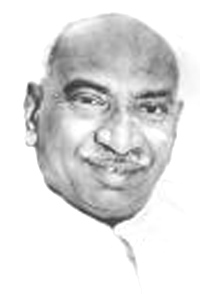 "Mr Kamaraj was not rich and has not
grown rich; he is a bachelor and has no family
ties. He has been and is a whole-time politician
and has laboured to acquire personal knowledge of
men and things all over the Tamil country and he
knows all the leaders of his party from every
part of India. He has also acquired facility in
English and very considerable knowledge of world
affairs. He is immensely popular for all these
reasons and especially because he has no vices
and leads a simple life. Above all he is the
'representative' Tamil as most Tamils imagine
that figure. His ways of speaking, walking,
eating and dress commend themselves to the many
millions to whom these are familiar ways with
nothing outlandish about them" "Mr Kamaraj was not rich and has not
grown rich; he is a bachelor and has no family
ties. He has been and is a whole-time politician
and has laboured to acquire personal knowledge of
men and things all over the Tamil country and he
knows all the leaders of his party from every
part of India. He has also acquired facility in
English and very considerable knowledge of world
affairs. He is immensely popular for all these
reasons and especially because he has no vices
and leads a simple life. Above all he is the
'representative' Tamil as most Tamils imagine
that figure. His ways of speaking, walking,
eating and dress commend themselves to the many
millions to whom these are familiar ways with
nothing outlandish about them"
"
சொத்து
சுகம்
நாடார்,
சொந்தந்தனை
நாடார்
பொன்னென்றும்
நாடார்,
பொருள்
நாடார்,
தான்பிறந்த
அன்னையையும்
நாடார்,
ஆசைதனை
நாடார்,
நாடொன்றே
நாடித்தன்
நலமொன்றும்
நாடாதநாடாரை
நாடென்றார்."
KaNNa
DhAsan on KAmarAja n^AdAr
(காமராஜ
நாடார்)
From the Economics &
Political Weekly Commentary by Y Vincent
Kumaradoss - April 24, 2004:
The political career of Kumaraswamy Kamaraj
(1903-1975) spanning about 50 years, cutting across
the colonial and post-independent phases, of Indian
history, is indeed an enviable record. Representing
a novel political culture neither bordering on
Gandhian thought and action nor possessing the
anglicised sophistication and cosmopolitanism of
the Nehruvian vision, Kamaraj, rose from an
underprivileged background, stood forth as a sober
and robust figure winning the confidence and
respect of the common people.
He showed a rare political acumen
and the uncanny ability to grasp social and
political realities from the grass roots level
upwards. A hard core political realist, his
political life was never governed by any high
theories or fancy jargon. Accredited with the
capacity to be at ease with cliques, groups,
factions and castes, Kamaraj applied his energies
in favour of common people. Endowed with an
extraordinary memory, his minimal formal schooling
was never a serious impediment. In fact rarely
could a man from such a humble origin possess such
knowledge about Tamil Nadu, be it geography or
ethnography, which is beyond most intellectuals and
academicians.
Kamaraj rose from the lowest Congress ranks
during the freedom struggle to become the president
of the Tamil Nadu Congress Party for over 20 years
(1940-1963) interspersed by short intervals, the
chief minister of Madras (1954-1963) for nine
years; and, as the president of the Indian National
Congress (1964-1967), he assumed the crucial role
of 'kingmaker'. Kamaraj's ascendancy is all the
more significant because he belonged to the low
caste Nadar community,1 which had a long history of
struggle against social oppression and economic
deprivation.
The Nadars, originally known as
Shanars, were found principally in the two southern
districts of Tirunelveli and Kanyakumari. Palmyra
climbing and toddy tapping were their traditional
occupations. In the Hindu caste hierarchy the
Nadars were ranked very low just above the
untouchables and were forbidden entry into temples
because of their association with alcohol.
Mercantilism and Christianity played crucial roles
in facilitating their upward mobility. Within a
span of two centuries, they rose from near
untouchability to a position of social and economic
power. Though Kamaraj typified the Nadar success
story he never was a leader of his
community2 and transcended the bounds
of Nadar caste identity3
dropping the caste title early in his political
career.
Hailing from Virudhupatti (now Virudhunagar),
one of the early settlements of migrant Nadars,
Kamaraj, born in 1903 into an ordinary small scale
Nadar business family, was a school dropout at the
age of 11 and for a number of years never had
steady and proper employment. Kumaraswamy Kamaraj
evinced interest in politics at the age of 15 when
the news of the Jallianwala Bagh massacre reached
his ears. Responding to the call of Gandhiji's
Non-Cooperation Movement, Kamaraj entered the
freedom struggle as a Congress volunteer organising
meetings, processions and demonstrations. He soon
found an abiding place for himself in the Congress
ranks as a gritty grass roots level, full-time
worker and mass leader of the Congress; and he was
imprisoned a number of times for actively
participating in the freedom struggle. He spent a
total of eight years in British Indian jails during
six spells of imprisonment.
When the Brahmin dominance in the Tamil Nadu
Congress leadership4 was
firmly entrenched and the rivalry between the two
key Brahmin leaders, C Rajagopalachari and S
Satyamurthi, was brewing, Kamaraj wove his way into
the top echelons of the Tamil Nadu Congress
organisation as the representative of the
non-Brahmin enclave. The 'Brahmin
image'5 of
the Congress found its affirmation at the hands of
Rajaji when he introduced compulsory Hindi in
schools in 1938 when he was the chief minister.
This move was met with resentment
and brought about an open confrontation between him
and E V Ramasamy in 1938. A massive anti-Hindi
agitation was launched by E V Ramasamy unleashing a
vehement onslaught on the nexus between Rajaji, the
Brahmin and Hindi, the 'Aryan language of
oppression'.6 The
statewide anti-Hindi campaign involved picketing
schools, picketing in front of Rajaji's residence
and hunger strikes. E V Ramasamy was arrested in
December 1938 and imprisoned for a year.
This confrontation sharpened the
conflict between the non-Brahmins and Brahmins
within the Congress organisation. The agitation was
continued till Rajaji had to opt for making Hindi
an optional subject in schools in February 1940. At
this crucial moment, Rajaji's candidate, C P
Subbiah, was defeated by K Kamaraj with the support
of the Brahmin leader, Satyamurthi. Kamaraj was
elected as the president of the Tamil Nadu Congress
in 1940, the post which he held till he became the
chief minister of Tamil Nadu in 1954.
The advent of Kamaraj as the party boss from a
low caste non-Brahmin background made a "powerful
appeal to the vast non-Brahmin majority" and
attracted the non-Brahmin elites and the
political-minded elements "who had long resented
the power and privileges" of the Brahmins, and
broadened the social base of the
Congress.7 The
non-Brahmin presence in the Congress gained ground,
rallying around Kamaraj, a 'rustic' leader who
transformed the Congress into a people's party
championing the causes of the lower castes. Kamaraj
grew steadily from strength to strength displaying
his organising skills to control men and matters.
During these years his contact with the people and
the respect he commanded made his position
unassailable. The untimely death of Satyamurti in
1943 improved his position and gave him a further
lease of power. With the Congress machinery under
his control, he overshadowed his party men and
effectively reduced the Brahmin dominance in the
party.
As the party chief, Kamaraj commenced his active
role in the successive elections of the Congress
legislative party of Madras and was the prime
author of installing three chief ministers between
1946 and 1952: T Prakasam, Omandur Ramaswamy
Reddiar and Kumaraswamy Raja. The next successor
Rajaji was certainly not Kamaraj's choice but was
appointed by the Congress high command. The
re-entry of Rajaji as chief minister8 without even an election
could have derailed Kamaraj's emerging equations
with non-Brahmins. The die was cast when Rajaji,
flaunting his authority, introduced a vocational
educational scheme based on hereditary calling,
which met with stiff opposition not only from the
Dravida Kazhagam and Dravida Munnetra Kazhagam, but
also from a large number of non-Brahmins in the
Congress quarters. This educational pattern, aimed
at imparting to school children the traditional
caste occupation of their parents, came to be
condemned by E V! Ramasamy as kula kalvi thittam,
devised to perpetuate varnashrama dharma. Rajaji
also took the drastic step of closing down nearly
6,000 schools, citing financial
constraints.9
E V Ramasamy campaigned against the new
educational policy much to the chagrin of Rajaji.
The Dravida Munnetra Kazhagam (DMK), formed in 1949
by breaking away from the Dravida Kazhagam, also
joined the crusade against Rajaji's scheme. E V
Ramasamy did not rest on his oars till the scheme
was dropped. This second confrontation between them
proved too costly for Rajaji. Rajaji, the statesman
of Brahmin hagiography, had to bow out ingloriously
tendering his resignation in 1954. Rajaji's
political vagaries in 1938 and 1953 meant the
passing of Brahmins as the controllers of Tamil
Nadu's political destiny till the next four
decades. With the resignation of Rajaji, Kamaraj
was perhaps the natural and logical choice. At the
meeting of the Congress legislature party on March
31, 1954, with Rajaji presiding, his arch rival and
the target of his ridicule10 Kamaraj was elected as
the leader, securing 93 votes as against 41
received by C Subramaniam who was propped up by
Rajaji.11
Kamaraj as Chief Minister
Kamaraj was 'reluctant to accept' the chief
ministership but the circumstance prevailed upon
him as there was no 'alternative to the kingmaker
himself ascending the throne.'12 Kamaraj took the mantle
from Rajaji, and formed his first cabinet, which
did not contain a single Brahmin contrary to
Rajaji's first ministry in 1937, 'dominated by
Brahmins'.13
The elevation of Kamaraj as the chief minister on
the wave of opposition to the Rajaji scheme of
education, led to the development of closer ties
between Kamaraj and E V Ramasamy. The Congress
gained the support of E V Ramasamy and Kamaraj's
equation with the non-Brahmins was kept intact. E V
Ramasamy was all set to endorse his solidarity with
Kamaraj on the grounds that in all these years he
was the first and only non-Brahmin with Tamil as
his mother tongue to become the chief minister; and
for the first time a full-fledged ministry had been
formed without a single Brahmin headed! by
Kamaraj.
According to E V Ramasamy all credit
should go to Kamaraj for dropping Rajaji's
educational scheme despite opposition from upper
castes led by C Subramaniam and Bakthavatchalam who
were in favour of it.14
Extolling Kamaraj as the pacchai Tamilan he urged
his followers to extend every support to sustain
the Kamaraj rule and prevent it from being ousted,
as the interests of Tamils were safe in his
hands.15
However, Kamaraj did not follow the exclusion of
Brahmins as a deliberate policy. In fact, Brahmins
were incorporated into his ministry at a later
stage, one of the prominent gainers being R
Venkataraman.
For Kamaraj, E V Ramasamy's open proclamation of
support was a great source of strength, arriving
precisely at the right moment when he himself was
under pressure since doubts were being echoed in
certain circles whether Kamaraj, a low caste man
without formal education, would be able to cope
with the administrative exigencies of the office of
chief minister.16
For Kamaraj, seasoned for the occasion, E V
Ramasamy's endorsement was an unmistakable
political gain and he saw its usefulness in
countering his critics. Soon Kamaraj proved his
capabilities as one of best chief ministers
silencing the critics and sceptics. Kamaraj
silently used the non-Brahmin movement in his
favour though he did not 'share Periyar's
anti-Brahmanism'.17 E
V Ramasamy's crusade against brahmanism, religion
and the threat of imposition of Hindi from Delhi
would continue unabated under Kamaraj's rule only
so long as it did not weaken Kamaraj's ministerial
governance. Kamaraj distanced himself from Ramasamy
and his followers when the mode of agitation
culminated in a call for burning the national flag
(August 1, 1955), maps of India and copies of the
Constitution.18
One of the first political acts of Kamaraj
during his tenure as chief minister was to widen
representation of the rising non-Brahmins in the
cabinet. Ministerial berths were given to the
non-Brahmin caste-based parties, Tamil Nadu Toilers
Party and Commonweal Party. Both the parties were
subsequently 'subsumed' by the
Congress.19 In
a move to counter Tamil cultural politics espoused
by the DMK, Kamaraj made conscious attempts to
partake in the linguistic cultural matters. In
order to placate Tamil aspirations, Kamaraj
effected some measures.20
The efforts towards introducing Tamil language as a
medium of instruction in schools and colleges was
accompanied by the publication of textbooks on
'scientific and technical subjects' in
Tamil.21 In
1960 the state education minister took steps to
introduce Tamil in government arts colleges as a
medium of instruction.
The introduction of the Tamil
typewriter in government offices was another effort
to change the language of administration
gradually.22
Similarly the usage of Tamil in the courts received
encouragement. To affirm his role in the linguistic
politics of the state, Kamaraj did introduce a bill
in February 1962 in the legislative assembly for
changing the name of Madras to 'Tamilnad' for
'intra-state communication', the bill also
proposing Madurai as the capital.23 But no decision was taken
on it. However these moves were on a low key and
inadequate to woo the masses. The DMK made capital
out of this, routing Congress in the 1967 elections
four years after Kamaraj relinquished his office as
chief minister in accordance with the Kamaraj Plan
to concentrate on Congress organisational work.
Committed to his version of 'socialism' meaning
that "those who are backward should progress",
Kamaraj remained truthful to the simple dictum of
his 'socialism', providing 'what is essential for
man's living' such as 'dwelling, job, food and
education'.24
The great feature of Kamaraj rule was the ending of
the retrogressive educational policies and setting
the stage for universal and free schooling. Six
thousand schools closed down by Rajagopalachari
were revived and 12,000 schools added.25 The percentage of school
going children in the age group between 6 and 11
increased from 45 per cent to 75 per cent within a
span of seven years after he became the chief
minister.26
Almost every village within a
radius of one mile with a population of 300 and
above inhabitants was provided with a
school.27
With a view to encouraging and attracting the rural
poor children to the schools Kamaraj pioneered a
scheme of free mid-day meals for primary school
children in panchayat and government
institutions.28
This scheme, aided by the American voluntary
organisation CARE, was launched in
1957.29 In
addition the government came forward to supply
school uniforms to poor students.30 To make the education
easily accessible to children from various
backgrounds, full exemption from school fees was
introduced. Public enthusiasm and participation in
raising funds and procuring equipment for the
schools were entertained through different schemes
making education a social
responsibility.31
Such measures made education affordable for many
who were denied basic educational opportunities for
centuries.
Kamaraj's other major feat was his role in
facilitating developmental programmes chiefly
electrification and industrial development.
Thousands of villages were electrified. Rural
electrification led to the large-scale use of
pumpsets for irrigational purposes and
agriculture-received impetus. Large and small-scale
industries were flagged off generating employment
opportunities. Kamaraj made the best use of the
funds available through the Five-Year Plans and
guided Tamil Nadu in deriving the maximum
benefit.
His efforts in these directions not
only enhanced the profile of Tamil Nadu as one of
the best-administered states in the
post-independent era, but it also raised it high in
social and economic rankings compared to other
states.32 As
chief minister for nine years Kamaraj headed a
stable administration and managed two elections
successfully and his reputation soared high as
'shrewd and competent' and "one of the most
effective chief min! isters in India."33 He proved himself more
than equal to the task and his detractors retracted
the statements made about this 'village-green
trundler'34
and his capacity to govern the state when he took
the mantle from Rajaji.
His competent ministerial colleagues and the
excellent set of senior state officials saw in
Kamaraj 'a man with a mission' who could set aside
any stricture in order to serve the common people.
He was able to invoke cooperation, dedication and
willingness ungrudgingly. Importantly his approach
to governance and party control was never tainted
with religious overtones and a secular commitment
was natural and integral to his mission in life.
Among his cherished political mentors, Kamaraj held
George Joseph, a Kerala Christian nationalist who
chose Madurai as his base for practising law and
for his political activities, in high
esteem.35
Kamaraj's association with George
Joseph began early and grew in strength from the
days when Kamaraj frequented political meetings
addressed by George Joseph in
Virudhunagar.36 It
continued through the period of his involvement in
the Vaikom Satyagraha then led by George Joseph, to
the organising of demonstrations against the Simon
Commission along with Joseph. It was George Joseph
who defended Kamaraj and got him released when he
was accused of making bombs and implicated in the
Virudhunagar Conspiracy case. Profoundly fond of
George Joseph and his family, Kamaraj continued to
pay visits to the Joseph family especially his wife
Susannah, even with his busy itinerary as chief
minister.
His lifestyle never changed; power and position
failed to dislocate his simplicity. His illustrious
career as the chief minister of Tamil Nadu ended in
1963 and he commenced his political life in Delhi
as the president of the All India Congress Party.
Explicating Kamaraj's long stint and stature in
Tamil Nadu politics, reputed political scientist, R
Bhaskaran, observed:
"Mr Kamaraj was not rich and has
not grown rich; he is a bachelor and has no
family ties. He has been and is a whole-time
politician and has laboured to acquire personal
knowledge of men and things all over the Tamil
country and he knows all the leaders of his party
from every part of India. He has also acquired
facility in English and very considerable
knowledge of world affairs. He is immensely
popular for all these reasons and especially
because he has no vices and leads a simple life.
Above all he is the 'representative' Tamil as
most Tamils imagine that figure. His ways of
speaking, walking, eating and dress commend
themselves to the many millions to whom these are
familiar ways with nothing outlandish about
them."37
Bhaskaran's judgment is indeed
right. That is certainly the reason why the
beleaguered Congress in Tamil Nadu is wooing the
Tamils today with the promise of 'Kamaraj
Rule.'
Most know why it cannot promise a 'Rajaji
Rule'.
Notes
1 Lloyd I
Rudolph and Susanne Hoeber Rudolph, The Modernity
of Tradition: Political Development in India, The
University of Chicago Press, Chicago and London,
1972, (Third Impression), pp 36-49.
2 Duncan B Forrester, ' Kamaraj: A
Study in Percolation of Style,' Modern Asian
Studies, 4, 1, 1970, p 47.
3 Dennis Templeman, The Northern
Nadars of Tamil Nadu: An Indian Caste in the
Process of Change, Oxford University Press,
Delhi, 1996, p 262.
4 Ibid, p 48.
5 Karat Prakash, Language and
Nationality in Tamil Nadu Politics, Orient
Longman, Madras, 1973, p 78.
6 Ibid, p 78f.
7 J Anthony Lukas, 'Political
Python of India', New York Times, February 20,
1966.
8 Rajaji was out of Congress
between 1942 and 1946, disapproving Congress
Party's Quit India Movement and its initial
opposition to the demand for Pakistan.
9 Era Rathina Giri, Thanthai
PeriyarVazhvum Thondum, National Book Trust, New
Delhi, 1997, p 70.
10 Prabhanjan, 'Kamaraj Engira
Acharyam', Inthiya Today, July 30, 2003, p
46.
11 Rajmohan Gandhi, The Rajaji
Story 1937-1972, Bharatiya Vidya Bhavan, Bombay,
1984, p 252
12 Duncan B Forrester, 'Kamaraj: A
Study', p 53.
13 Ibid, p 54.
14 'Kamarasar Atharipu Ean?,'
Viduthalai May 15, 1954, in Periyar EVR
Sinthanaigal, p 829.
15 'Kamarasar Atharipu Ean?,'
Viduthalai June 1, 1954, in Periyar EVR
Sinthanaigal, pp 832-35.
16 Chinna Kuthusi Thiyagarajan,
'Ainthanduth Thittangal Kalamum Kamarajin Porkala
Atchyum', Thittam, Vol 33, No 11, July 2003, p
2.
17 Anita Diehl, Periyar E V
Ramaswami: A Study of the Influence of a
Personality in Contemporary South India, B I
Publications, Madras, 1978, p 73f.
18 Mohan Ram, Hindi against India:
The Meaning of DMK, Rachna Prakashan, New Delhi,
1968, p 92f.
19 Lloyd I Rudolph and Susanne
Hoeber Rudolph, The Modernity of Tradition, p
88f.
20 Karat Prakash, Language and
Nationality, p 80.
21 Narendra Subramanian, Ethnicity
and Populist Mobilisation: Political Parties,
Citizens and Democracy in South India, UP,
New-Delhi, 1999, p 16.
22 Ibid.
23 Robert L Hardgrave Jr, 'The DMK
and the Politics of Tamil Nationalism', Pacific
Affairs, 1965, p 409.
24 J Antony Lucas, 'Political
Python', p 52.
25 Chinna Kuthusi Thiyagarajan,
'Ainthanduth Thittangal', p 2.
26 Ibid, p 3.
27 Ibid, p 2.
28 The Hindu, August 8, 2003, p
10.
29 P S Subbaraman, Kamaraj: Symbol
of Indian Democracy, Popular Prakashan,
New-Delhi, 1966, p 23.
30 Ibid.
31 Chinna Kuthusi Thiyagarajan,
'Ainthanduth Thittangal', p 3f
32 P S Subbaraman, Kamaraj:
Symbol, p 19f.
33 Duncan B Forrester, Kamaraj: A
Study, p 53.
34 Rajmohan Gandhi, The Rajaji
Story, p 251.
35 George Gheverghese Joseph,
George Joseph: the Life and Times of a Kerala
Christian Nationalist, Orient Longman, New Delhi,
2003, p 224f.
36 John Asirvatham, Ganthiya
Perunthalaivar Kamarasar, International Institute
of Tamil Studies, Madras, 1991, p 5.
37 R Bhaskaran, 'Aspects of
Political Leadership in Madras Politics',
Sociology of Politics: Tradition and Politics in
India, Asia Publishing House, Bombay, 1967, p
50.
|