|
One Hundred
Tamils of the 20th Century
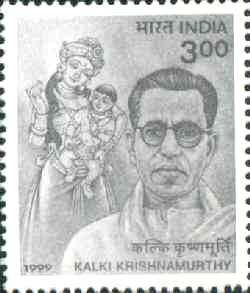
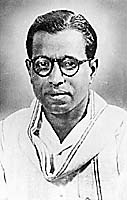
Kalki -
R.Krishnamurthy
1899 - 1954
 "...Kalki
Krishnamurthy was a colossus striding the
Tamil journalistic field at a time when
much was expected from a new India. Those
were euphoric times, though it all
evaporated quickly. I have been and still
am his admirer. His Ponniyin
Selvan introduced the grandiose
empire of the Cholas - though it appears
somewhat exaggerated when I read it now.
Nevertheless it was a need of the
time..." Nominated by C.Kumarabharathy, New
Zealand "...Kalki
Krishnamurthy was a colossus striding the
Tamil journalistic field at a time when
much was expected from a new India. Those
were euphoric times, though it all
evaporated quickly. I have been and still
am his admirer. His Ponniyin
Selvan introduced the grandiose
empire of the Cholas - though it appears
somewhat exaggerated when I read it now.
Nevertheless it was a need of the
time..." Nominated by C.Kumarabharathy, New
Zealand
"Kalki may
be regarded as a pioneer in the field of
historical novels in Thamizh literature.
With his inimitable descriptive style
reminiscent of the English author, Walter
Scott, Kalki had a tremendous capacity to
take the readers back into the point and
time in history when the story is
supposed to have taken
place..."Kalki
in Thamizh Literature Through the Ages -
Professor
C.R.Krishnamurti
"...Using the
historical romance as a lens with which
to examine erstwhile formulations of
Tamil identity (Indian nationalist and
colonial rhetoric; Dravidian political
separatism and anti-Brahmanism; the
tanitamil (separate Tamil) language
purity and suya mariyatei (self-respect)
movements; the resurgence of Saiva
Siddhanta religious tenets; the advent of
theosophy in Tamilnadu; and Tamil
marumalarcci or cultural renaissance), I
argue that Krsnamurti's novelistic
writing sketched a cultural and political
canvas against which competing and
complementary ideals of a new regionalist
consciousness could emerge, signalling a
new kind of interventionist literature in
the Tamil instance..." Dwelling in Futures Past: Place,
Region and Tamil Nation in Ra.
Krsnamurti's Civakamiyin Capatam - Akhila
Ramnarayan
"One of the easiest
questions in Indian literature would be:
Which is the best historical novel
written by an Indian?�
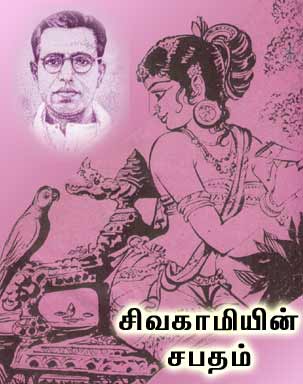
The answer is Sivakamiyin
Sabatham (The oath of Sivakami),
authored by Kalki Krishnamurthy.
Serialised in the magazine founded and
named after him, the novel had been
praised all over for its authenticity,
descriptive power, emotional appeal and
characterisation..."A novelist whose genius
remains unmatched - V. Gangadhar,
1999
Special Features of
Kalki�s Novels
R. Dhandayudham,
First International
Conference Seminar of Tamil
Studies,
Kuala Lumpur, Malaysia, 1966
|
Introduction
Sri R. Krishnamurthi (1899-1954), popularly
known as Kalki, is the author of thirty-five
volumes of short stories, novels, essays,
travelogues, and biographies. Though his eminent
scholarship was found expressed in all types of
literature still he is recognized and appreciated
more as a writer of social and historical
novels.
Novel as a new literary genre in Tamil had its
beginning in the later part of the 19th century and
there were a few works of originality and high
quality in that century.
But the dawn of the twentieth century witnessed
only poor imitations of Western detective fiction.
It was an era of translated and adapted novels
first from Bengali and then from English and
Marathi. The flowers that blossomed were of foreign
origin and did not display the colour and fragrance
of this soil. The novels of J. W. M. Reynolds
rambled in the garb of this country and their
influence was so great that even a scholar like
Maraimalai
Adigal had adapted a story of Reynolds for his
Kumudavalli or Naganttrasi.
With the appearance of Kalki in the literary
scene Tamil novels had entered another era. His
first novel Kalvanin Katali, when serialized in
Ananta Vikatan, stole the hearts of the readers by
its features of realism and description. It echoed
the vox populi of this country and blazoned the
colour and quality of this soil. These qualities
raised the standard of the Tamil novel and
increased the number of novel readers with literary
taste.
Three reasons can be cited for the phenomenal
success of Kalki's novels. First of all, he
possessed in abundance the gift of story-telling.
Secondly, he introduced healthy humour in his
writings. And lastly, he threw light upon the
cultural and social aspects of this country as well
as the current time. "Like the great European
novelists of the 19th century, Kalki was a master
of striking scenes and episodes. With something of
the burning patriotic fervour too of the humour of
Dickens and the gift of portraiture of a Thackeray
Kalki spread out his novels in impressive
sequence."1
Almost all of Kalki's novels appeared first in the
serial form and only then in the book form. So they
had both the advantages and disadvantages of
serialization.
Thiaga Boomi (1937), Solaimalai
Ilavarasi (1947),
Magudapathi (1942), Apalaiyin Kannir (1947)
Alai
Osai (1948), Devakiyin Kanavan (1950),
Poiman Karadu (1950),
Punnaivanattupuli (1952), Parthiban
Kanavu (1941-42), and Amara Valvu are his other
novels.
 Kalki and Historical Novels
In a broad sense, novels may be classified into
historical and social novels. Historical novels
deal with the society of the past while social
novels, with that of the present.
The historical novel is `one in which the
characters, setting and events are drawn from the
past".2
It is a hybrid combination of history and fiction
which like opera springs from music and
dance.3
There are many difficulties in writing a
historical novel. As Brander Mathews says, "a tale
of the past is not necessarily a true historical
novel: it is a true historical novel only when the
historical events are woven into a texture of the
story."4 It depends upon the historical
personages depicted, its setting, description of
the past and the presentation of historical
events,
"In a perfect historical novel nothing should be
written against the facts of history. It should
only state what can be proved from history, though
it might also state what cannot be disproved by
history."5
The major incidents must be true to history, the
life of the major characters must be agreeable to
historians and the novelist has no liberty either
to alter or add events contrary to historical
facts. With his super-abundance of imagination he
can only create a few causes for the events and
raise emotions with the literature of the period,
inscriptions and other sources. He has also the
freedom to create a few non-historical characters,
but they should not in any way affect the
historical facts. So, the result of the process of
history becoming art with the literary and
non-literary sources of the age, is a historical
novel. Fact and fiction intermingle here and the
successful outcome lies in dramatization of
historical events.
As Ernest E. Leisy says in his work, The
American Historical Novel, the historical novel
offers instruction in patriotism6 and it "is an excellent
introduction to history, biography, and travel. It
is an enrichment of our experience, an enlargement
of our interests. We feel at one with all that has
happened."7
Like Walter Scott, who in theory
and practice laid the foundation of the English
historical novel, Kalki laid the foundation for the
historical novel in Tamil. It is true that the
Tamil novel had its evolution with Vedanayakam Pillai's
Prathapamudaliar Charitram in 1876, but the
historical novel started only with Kalki's
Parthiban
Kanavu which appeared on the 16th of October
1941, Kalki number and ended on the 10th February
1943. With its appearance `a star of the first
magnitude had appeared in the firmament of
historical fiction'. The success of this novel made
him write two or more novels Sivakamiyin
Sabadam and Ponniyin
Selvan.
Kalki loved his country, her scenery and her
people and this love widened his imagination of the
past. The social set up under the great Cholas and
Pallavas made him admire the past and in his
attempt to glorify and glamorize it, he began to
write historial novels. His power of giving life to
historical movements and characters helped him to
erect these remarkable literary monuments. He
mingled history with imagination and painted it
with the touch of emotion too.
There are two more reasons for the rise of
historical novels during this period. They are the
urge to free the country from foreign bondage and
the literary revival. Through his novels, he
instructed that we too had a historic past and
stressed the need for freedom. In short, he taught
history to his countrymen in an entertaining form
and prepared the ground for the freedom fight.
Parthiban
Kanavu and Sivakamiyin
Sabadam give a picture of the great Pallava Age
of the seventh century A.D., while Ponniyin Selvan
paints the age of the glorious Cholas. Both the
periods are a mixture of many aspects of the
history of Tamil Nad such as that of religions,
literature, art and architecture and also of
administration. Kalki had been a keen student of
these aspects which he learnt through epigraphic,
inscriptional and numismatic sources and he
enriched his novels with all these facts of
history.
Kalki got inspiration to write Parthibara Kanavu
and Sivakamiyin Sabadam on the seashore of Mahabalipuram, when he was accompanied
by Rasikamani T. K. C. and where he saw thousands
and thousands of ships and boats carrying warriors
on one side, and other people, architects, Ayanar,
Sivakami, Mahendravarmar and Mamallar on the other
side in his mental vision. They left a deep and
lasting impression upon his heart and only after
finishing Sivakamiyin Sabadam, twelve years later,
they bade adieu to the novelist.8
Kalki had also the genius to classify the
historical and non-historical events, historical
and non-historical characters and how much the
novel owes to history. In his introduction to
Sivakamiyin Sabadam and conclusion to Ponniyin
Selvan, he explains the percentage of fact and
fiction. Really speaking, Kalki's interest in
history, the features of his historical novels and
the popularity they gained, made others enter this
vast and new field and contribute. works of
merit.
Kalki and Social Novels
The great English novelist, Walter Scott, is
remembered only for his historical novels and no
novel was written by him with the period in which
he lived, as background. In this respect, Kalki
excels him and his social novels are in a way the
social history of his time.
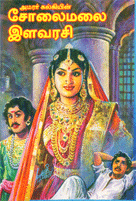
Among them, Solaimalai
Ilavarasi needs special reference. It is the
bridge that connects Kalki's social and historical
novels. On one side, it throws light upon his
contemporary life and on the other it enlivens the
early nineteenth century. In it, he compares India
of 1842 and of 1942 side by side and explains how
the Britishers were able to establish and expand
their rule and the epic struggle for freedom.
Alai
Osai also has the national events as its
background and in the preface Kalki states clearly
:
". . . The work of the author is to paint the
eighteen years of national history as the
background of this story. Between 1930 and 1947
many wonderful incidents happened in the history
of our Motherland. The readers will find them
continuing as the background to this `Noise of
the Waves'."
Kalki himself was a real patriot. While he was a
student in the National College, Tiruchirappalli,
he took part in the non-cooperation movement and
was arrested (1921). Again he was incarcerated
twice, in 1931 and in 1940 for participating in the
freedom movement. His political experiences during
this period made him portray excellently and thus
his novels are true to life.
Many national and international events are
revealed in his masterpiece, Alai
Osai and in other novels. The Sepoy Mutiny (1857), Gandhi Irwin Pact (March 1931),
Civil Disobedience Campaign (1929), Salt Satyagraha
(6-4-1930, its failure, and the imprisonment of
Mahathma Gandhi and Nehru, Congress
Party's decision to continue Civil Disobedience,
Satyagraha at Coimbatore (6-6-1931), the `Quit
India' movement (1934), the Second World War
(1939-45) and its impact on England, Japan's
invasion of Malaya, the fear of bombardment in the
city of Madras, the dropping of atom bombs on
Hiroshima and Nagasaki (1945), the great August
movement of 1942, the announcement of the Prime
Minister of England to send three members of the
cabinet to study the Indian opinion, the formation
of Interim Government, the proceedings of Karachi
and Haripura Congresses, the Socialists' Conference
in Lahore, the radio speech of Subash Chandra Bose
from Berlin, the forming of the Indian National
Army, the birth of the Muslim League, India's
Independence (15-8-1947), the Independence-day
celebrations in Delhi, the separation of Pakistan,
the cruelties of Razakars and Communists in
Hyderabad, the integration of Indian States, the
Hindu-Muslim tumult and Gandhiji's fast to stop it
are recorded with rare understanding and skill in
his novels. From the entrance of Gandhiji into the
political field to his tragic end (on 30-1-1948),
many important incidents are delineated with great
understanding.
His novels also picture with faith the social
life of his time. Love, marriage, family life,
social set-up, administration and even corruption
and the black-market, the act of prohibition are
vividly described. In brief, "the Gandhian Age in
our national history has been fittingly described
as our modern Heroic Age and Tamil Nad found in
`Kalki' a writer of genius and fully equal to the
task of recording both the outer happenings and the
inner movements of the heart and mind of that
Age."9
According to W. H. Hudson, the study of
literature is a form of travel in one
way10
and while we glide through Kalki's novels we become
acquainted not only with the great Pallavas and the
glorious Cholas of the middle period but also with
the Gandhian era. This sort of communication of
experience is an important characteristic of his
novels.
Structure
"Structure will simply mean
interconnection between elements or qualities"
11 or
it is the "sum total of the elements that make up a
work".12 The way in which the elements
are interwoven is called the structure of a
novel.
Story is the fundamental aspect of all prose
fiction. As said earlier, Kalki's novels are based
upon the past or contemporary events. The
structures of Kalki's novels, except Ponniyin
Selvan, are good because the stories are under the
control of the novelist during construction. In
Ponniyin Selvan, the story is as vast and wide as
the Chola Kingdom itself so that it develops beyond
the control of the novelist and seems to be rather
loose in structure.
The beginnings and endings of Kalki's novels
reveal some special features. Besides the
conventional beginnings and endings in Alai Osai,
Kalvanin Katali, Sivakamiyin Sabadam and Ponniyin
Selvan, some of his novels begin with a
conversation between the author himself and a
character of the novel. Apalaiyin Kannir begins
with such a conversation and its ending is also
striking. The hero of the novel, all through his
life, fights against the black-market, but alas!
the author makes him buy sugar from a
blackmarketeer in the end. Poiman Karadu also
begins with the novelist's experience at a
tea-party. This sort of beginnings and endings
provide his novels with flesh and blood.
In fact, Poiman Karadu develops without any
major incident. In this novel, there happens one
horrible murder but nobody dies and a fire accident
with nobody injured. Even then the story is
interesting and the structure good.
Kalki has also introduced some psychological
effects into his novels. Sita's hearing of the
noise of the waves in Alai Osai is one such. It is
an indicator of the forecoming joy or sorrow and
Surya describes it as
a divine power. Alai Osai utilizes this device
fully and its influence upon the author is so great
that he names his novel Alai Osai or `Noise of the
Waves'.
Another feature of structure is the novelist's
direct intervention into his novels. When Abirami
is waiting for her brother in Kalvanin Katali,
Kalki interferes and comments like this:
"Abirami ! Oh poor Abirami ! Don't think that
your brother will return within a minute. He will
not come back. Hereafter God alone is your
Companion."13
At times, he leaves his characters at a critical
juncture and diverts the reader's mind for some
time. Muttaiyan, in Kalvanin Katali enters
Kalyani's house through the roof in order to take
revenge but suddenly and unexpectedly he meets her
there. Kalki leaves them there looking at each
other and goes about explaining some past events.
In the same way, he pushes Magudapathi before
Karkkodakkavandar's rifle and turns to describe the
heroine's sorrows leaving them to remain in the
same helpless position in Magudapati. There are
many instances in Ponniyin Selvan and Alai Osai
where the novelist enters directly and comments
upon the events.
Of all, the structure of Solaimalai Illavarasi
is the most complex one. The author combines two
stories, one that happened in the early nineteenth
century and the other in the year 1942 and narrates
them side by side skilfully. The characters of the
two stories are the same but with different names,
the incidents are not the same but similar. With
these two stories in one novel, Kalki manages to
picture two periods. This type of structure
exhibits Kalki's power in combining two stories of
different periods into one.
Characterisation
The creation of character is the foundation of
good fiction and in fact, the events of a novel
flow logically from the nature of the characters.
14
Kalki's success lies in the creation of
impressive characters in his novels and most of his
characters are true to life. In a period where
there were only detectives, his Kalvanin Katali
sowed the seed for revolution in characterization.
The hero of the novel is a thief and with unusual
individuality and powerful imagination, he makes
the readers sympathize with the hero. The
descriptions of his affection for his sister
Abirami and his love for Kalyani move the readers
and compel them to take part in their joys and
sorrows. It is no exaggeration to say that this
characterization of a thief successfully
inaugurated the change in the taste of the readers
from detective novels to social novels.
Yet, another feature of charactization is his
intermingling of fictional and non-fictional
characters. In his historical novels, there are not
only the great Mahendravarma Pallavar,
Narasimhavarma Pallavar, Paran jothi, Pulikesin,
Maravarman of Ceylon, Hieum-t-sang, the poet
Bharavi, Raja Cholan, Rajendra Cholan, Kundavai and
Vanama Devi but also Naganandhi, Ayanar, Nandhini
and Sivakami.
All the four non-historical characters figure
from the commencement till the end of the novels.
Even in his social novels the imaginary characters
are familiar with Gandhiji's personality, Nethaji's
heroism and Nehru's vision.
Another feature is that Kalki makes his
imaginary characters take part in the actual events
of the day. Kumaralingam, Magudappathi, Sivaraj,
Surya, Tarini and Pattabi are connected with the
political movements of the day and among them
Kumaralingam and Magudapathi participate in the
famous August 1942 movement. In Solaimalai
Ilavarasi he mixes the experiences of a patriot
with an imaginary prince and paints on the canvas,
the political history of a hundred years in myriad
hues and shades.
The other thing to be mentioned is the number of
characters in Alai Osai, which is the story of a
generation like Tolstoy's War and Peace
15 and
in Ponniyin Selvan. They are several in number and
Kalki gives due importance to all the characters.
This feature of introducing numerous characters is
rare in Tamil novels.
In addition, there is more than one heroine in Alai
Osai and Kalki leaves to his readers to decide as
to who is the heroine, Sita or Tarini or
Lalitha.l6
Like Walter Scott, Kalki is fond of describing
his characters in disguise. The story of The
Talisman by Scott, develops upon the disguise of
Sultan Saladin. In the same way, Parthibara Kanavu
develops
upon the disguise of Narasimhavarma Pallavan. In
fact, the whole interest lies in the disguise of
Narasimhavarman. King Narasimha Pallava also meets
Sivakami at Vatapi in disguise and Surya in Alai
Osai escapes from the police in the disguise of an
ascetic.
Like Alexander Dumas, Kalki utilized the device
of creating original and duplicate in his novels.
Naganandhi - Pulikesin in Sivakamiyin Sabadam.
Maduranthakar - Sendan Amudan in Ponniyin Selvan
and Tarini - Sita in Alai Osai exhibit the success
of this device.
Another feature is that Kalki's villains in the
sociological novels are not so clever and charming
as his villains in the historical novels. The
creations of Naganandhi Adigal and Nandhini are in
no way inferior to other villains of the world
whereas the villains of his sociological novels are
dull and drab. The freedom in creating characters
in social novels is more restricted than in
historical novels and this may be the reason for
this shortcoming.
Some of his characters are created in such a way
that they live for ever in the hearts of the
readers. Naganandhi, 5ivakami, Sita, Rashia Beham,
Sundara Cholan, Raja Raja Cholan, Mahendravarman,
Mamallan and Nandhini have the unique charm of
literary immortality.
Humour
Kalki introduced healthy humour as against the
dull and the vulgar. His humour does not hurt
anybody and so makes everybody laugh. "A story is
considered poor if it makes some person blush with
embarassment, if it makes something sacred appear
common if it makes a man's weakness the cause for
laughter, if it has to have profanity or vulgarity
to be funny, or if everyone cannot join in the
enjoyment of the joke."17 Kalki's humour is free from
all these maladies. Sengodan's first experience in
seeing a cinema in Poiman Karadu, Alwarkkadiyan's
witty utterances in Ponniyin Selvan and the
humorous disputes between Rao Bahadur Padmalochana
Sastrigal and Professor Pavi Rajaka Sarma in Alai
Osai will be ever remembered by the seekers of wit
and humour.
Conclusion
These are the special features found in Kalki's
novels in their background, theme, subject matter,
structure and characterization and these features
certainly pushed the Tamil novel forward. These
features also weaned the readers from detective
novels to sociological and historical novels and
gained more readers for literary novels. In fact, a
new era is ushered in with Ka1ki's Kalvanin Katali
in the history of Tamil novel, and Parthiban Kanavu
heralds the birth of a p_ asture new, the
historical novel, in Tamil.
Notes
1 K.R.
Srinivasa Iyangar, "Kalki", The Indian PEN, vol.
xxi no. 3, Bombay, March, 1965, p. 78
2 Joseph
T.Shipley, ed., Dictionary of World Literature,
Criticism - Forms - Technique, The Philosophical
Library, New York, 1943, pp. 407-8.
3 Ernest E.Leisy,
The American Historical Novel, University of
Oklahoma Press, Norman, 1950, p. 5.
4 Brander
Mathews, The Historical Novel, Charles Scibner's
Sons, New York. 1914, p. 21.
5 K. V.Rangaswamy
Iyangar, Introduction, Sivakamiyin Sabadam,
Mangala Noolakam, Madras, 1951, p.iii.
6 Ernest E.Leisy,
Introduction, The American Historical Novel,
University of Oklahoma Press, November, 1950, p.
vii.
7 Ibid., p. 4.
8 Kalki,
Introduction, Sivakamiyin Sabadam, Kalki
Publications, Madras, 1948, pp. 2-3.
9 K.R. Srinivasa
Iyangar, "Kalki", The Indian PEN, vol. xxi, no.
3, Bombay, March, 1965, p. 78.
10 William Henry
Hudson, An Introduction to the Study of
Literature, Harraps, London, March, 1960, p.
10.
11 Brent
Stirbing, Unity in Shakespearian Tragedy,
Columbia University Press, New York, 1957, p.
3.
12 Joseph
T.Shipley ed., Dictionary of World Literature,
The Philosophical Library, New York, 1943, p.
553.
13 Kalki,
Kalvanin Katali, p. 52.
14 Arnold Bennet,
quoted in Dictionary of World Literature, ed. by
Joseph T. Shipley, The Philosophical Library, New
York, 1943, p. 89.
15 T. P.
Meenakshisundaram, A History of Tamil Literature,
Annamalai University Publications, p. 182,
Annamalai Nagar, 1965.
16 Alaiosai -
Kalki, A note to readers, Kalki, vol. 7, no. 33.
(14-3-1948.)
17 M. Jacob
Brande, The World Book Encyclopaedia, vol. VIII,
Field Enterprises Educational Corporation,
Chicago, 1960, p. 389.
|