|
CONTENTS OF
THIS SECTION
19/09/09
|
| Anton Balasingham
memorial in London,
December 2007 |
| Anton Balasingham:
Chief negotiator for the Tamil Tigers - Barry Gardiner,
2 January 2007 |
| Memories Of Voice of
the Nation - Video Presentation 1 - Video Presentation 2 |
| Times Obituary, 15 December
2006 |
| Tamil Writers Guild -
'Voice
of the Nation of Thamil Eelam' Dr. Anton Balasingham
takes final Journey, 20
December 2006 |
| Thousands throng
Balasingham�s funeral held in London,
20 December 2006 also in
Video |
| Solheim extols Balasingham's
integrity, 20 December 2006 |
| Karunanidhi praised
for message on Balasingham |
| Vanni pays homage to
'Voice of the Nation'
Balasingham |
|
பாலாண்ணைக்கு
"தேசத்தின்
குரல்"
கௌரவம்:
தமிழீழத்
தேசியத்
தலைவர்
அறிவிப்பு
[together with English Translation "Bala
Annai has a permanent historic place in the growth and
the spread of our movement. He was its elder member,
its ideologue, its philosopher and, above all, my best
friend who gave me encouragement and
energy."] |
 எங்கே
சென்றீர்
தேசத்தின்
குரலே...
வெளியீடு:
கனடா
தமிழர்
கலை
பண்பாட்டுக்
கழகம்,
எழுதி
இசை
யமைத்து
பாடியவர்:
வர்ண
இராமேஸ்வரன்; எங்கே
சென்றீர்
தேசத்தின்
குரலே...
வெளியீடு:
கனடா
தமிழர்
கலை
பண்பாட்டுக்
கழகம்,
எழுதி
இசை
யமைத்து
பாடியவர்:
வர்ண
இராமேஸ்வரன்; |
| கண்ணீர்
வரவில்லை
ஐயா...
எழுதி
இசையமைத்து
பாடியவர்:
முல்லை
சாந்தன்; |
| கனடா
தமிழ்ச்சோலை
வானொலியில்
நேயர்
ஒருவர்
பாடிய
பாடல் |
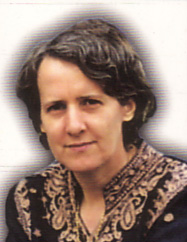 Adele Ann on Meeting Anton
Balasingham - in Will to Freedom
"...It all began when I married a
Tamil man, Anton Balasingham, from the island of Sri
Lanka, in 1978. In that union, I married the collective
consciousness and history of a people: a man who
embodied the Tamil psyche with all its strengths and
weaknesses. greatness and failings. " Adele Ann on Meeting Anton
Balasingham - in Will to Freedom
"...It all began when I married a
Tamil man, Anton Balasingham, from the island of Sri
Lanka, in 1978. In that union, I married the collective
consciousness and history of a people: a man who
embodied the Tamil psyche with all its strengths and
weaknesses. greatness and failings. " |
| தேசத்தின்
குரல்
பாலா
அண்ணா
நினைவாக -
M.Thanapalasingham |
| Anton Balasingham: the Articulate
Bandmaster - Sachi Sri Kantha |
| Ana
Parajasingham, Chairman Australasian Federation of
Tamil Associations: A Tribute to Anton
Balasingham |
| தேசத்தின்
குரல்
தொடர்ந்தும்
ஒலிக்கும்!
Sanmgam Sabesan |
| We've lost a
friend, says Norway "Norwegian special envoy for the peace
process in Sri Lanka Jon Hansen-Bauer praised late
Anton Balasingam for his invaluable contribution to the
peace efforts, and said Norway will miss a much valued
friend. Speaking at a memorial meeting in Oslo arranged
at the Tamil Resource and Consultation Centre in Oslo
Friday, 15 December 2006 the Norwegian Special Envoy
said that it is through Mr. Balasingham he learned much
about the plight of the Tamils in Sri
Lanka." |
| London Times Obituary -
Anton Balasingham, 15 December 2006
"Journalist who became the
chief strategist and negotiator of the Tamil Tigers in
their struggle for autonomy" |
|
நோர்வே
தமிழர்
ஒருங்கிணைப்புக்
குழுவின்
வீரவணக்கம்
|
|
பாலா
அண்ணா! - Nathan, Geneva,
14 December 2006
"மூன்று
தசாப்தங்களாக
எங்களின்
இலக்குக்கும்
சர்வதேச
செல்நெறிக்கும்
இடையேயான
இடைவெளியில்
போர்புரிந்த
போர்
வீரன்" |
| Balasingham Death a
setback to Sri Lanka peace - Eric Solheim, IANS, 15
December 2006 |
| On The Demise
Of Mr.Balasingham - International Federation of Tamils,
15 December 2006 |
| Anton Balasingham: The Early
Years of Life - D.B.S. Jeyaraj |
|
தமிழீழ
விடுதலைப்
போராட்டக்
களத்தில்
ஒரு மலை
சரிந்தது:
தமிழ்ப்
படைப்பாளிகள்
கழகம்
|
|
வல்வை
சகாறா -
காத்தாடி
இவரல்ல
காலா! நீ
கற்றறிவாய்!
|
| Tamil Nation Loses One Of Its
Greatest Sons - Bala Annai Passes Away - 14
December 2006 "Tamil Insight joins thousands and
thousands of Tamils across the world in grieving at the
irreparable loss of the Tamil Nation in the death of
one of its worthiest sons, Dr Anton Balasingham. Bala
Annai passed away at 1.45pm, Thursday in London at the
age of 68. Bala Annai as he was popularly addressed,
remained a shining political guide and philosopher,
standing steadfast by his Leader's side throughout the
freedom struggle, valiantly defending the Tamil cause
on international platforms, craving the recognition it
rightly deserves. He represented the Tamil Nation at
all Peace Talks till he was found too ill to travel.
His journey in the Freedom Struggle started in the
1980s when he renounced all comforts in London and
identified himself with the struggle for the
emancipation of the rights-denied Tamils. He was the
chief negotiator at the recent round of Norwegian
facilitated Peace Talks." |
Priyath
Liyanage
Editor, BBC Sinhala service on
Implications of Balasingham's Death, 14 December
2006 "..Many commentators believe Balasingham was
the moderating force - always on the search for a
political solution - within one of the most belligerent
rebel organisations in the world. He is known for his
relentless attempts to bring the Tigers to the
international negotiating arena. It was mainly due to
his perseverance that the Tigers acquired a reputation
as a progressive organisation among certain liberals in
the west. He was able to live in Britain even though
his organisation is proscribed by the UK government.
" |
Anton Balasingham passes way -
Tamilnet, 14 December 2006 "Anton Balasingham, theoretician and political
advisor of the Liberation Tigers of Tamil Eelam (LTTE),
has passed away in London Thursday, 14 December 2006.
Mr. Balasingham has been associated with the Tamil
liberation struggle for more than 30 years and
participated as chief negotiator on behalf of the
Liberation Tigers in almost all political negotiations.
He was diagnosed with bile duct cancer (cholangio
carcinoma), a rare and aggressive malignancy of the
biliary system, in the middle of November. Mr. Anton
Balasingham, 68, passed away at his home in south
London where he has been resting since his diagnosis
last month, being cared for by his wife Adele and
specialist cancer medical staff. Balasingham had
diabetes for 35 years and in the late nineties
developed renal disease, for which he underwent kidney
transplant.
Three weeks ago, commenting on his illness to TamilNet,
Mr Balasingham said that, �it is an
unfortunate personal tragedy. However, when compared to
the vast ocean of the collective tragedy faced by my
people, my illness is merely a pebble. I am deeply sad
that I am crippled by this illness, unable to
contribute anything substantial towards the alleviation
of the immense suffering and oppression of my
people."[see also
Top Tiger negotiator Anton Balasingham
dead - PTI and
S.Lanka rebel negotiator Balasingham dies of cancer
- Reuters] |
| Anton Balsingham on the Birth of the Tiger
Movement -
விடுதலை
புலிகள்
இயக்கம்,
1983 |
| Sorrowful departure and
joyful arrival - D. B.
S. Jeyaraj in The Sunday Leader, April 2002 |
| Rajiv Gandhi assassination
�a monumental historical
tragedy� �
Balasingham, 27 July 2006 |
| EU ban �will
radically transform� Sri
Lanka�s conflict, 4 June
2006 |
| Anton Balasingham responds to US
Ambassador, 25 April 2003 |
| Balasingham Statement at Oslo
Conference, 25 November 2002 |
| Anton Balasingham Speech
at Inaugral Session of
Peace Talks, Thailand, 16
September 2002 |
| Negotiated Settlement Only
Choice, 1 December 2002 |
| Anton Balasingham on Ceasefires,
Memorandum of Understanding, Facilitation, 18 April
2001 |
| Sri Lanka Determined to Prosecute War
- Anton Balasingham, 2 December 2000 |
|
We need India - Anton Balasingham, 6 July
2000 |
| Tamils will
determine their own destiny - Balasingham
, 1 July 2000 |
| Anton
Balasingham addresses London Heroes Day,
1999 |
| Anton Balsingham
Quotes |
|
Balasingham�s Interview with Amarnath
Menon in 1991 |
|
Balasingham�s Interview with Jon Lee
Anderson in 1987 |
| A Cheer for Dr.Balasingham - Dayan
Jayatilleka (sometime advisor to Sri Lanka
President Premadasa) in the Sinhala owned Weekend
Express, 16 July 2000 |
|
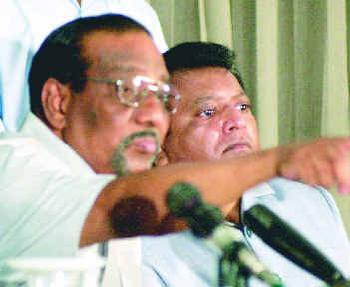
Velupillai Prabakaran (right) and Anton S.
Balasingham at a press conference in Kilinochchi on
10 April 2002
|
|
Books
|
| Politics of
Duplicity : Re-visiting the Jaffna Talks,
Anton Balasingham,
2000 |
| War and Peace: Armed
Struggle and Peace Efforts of Liberation
Tigers, Anton Balasingham,
2004 - from the back cover - "The author of this
book is the political advisor, theoretician and the
chief negotiator of the Liberation Tigers of Tamil
Eelam, the national linberation organisation
spearheading the struggle for self determination of the
Tamil nation in the island of Sri Lanka. Mr.Balasingham
has been actively involved in the politics of the LTTE
for twenty six years and is widely regarded as the
authoritative commentator on the politico-military
struggle of the organisation."" |
|
|
One Hundred
Tamils of the 20th Century
Anton S.Balasingham
"மூன்று
தசாப்தங்களாக
எங்களின்
இலக்குக்கும்
சர்வதேச
செல்நெறிக்கும்
இடையேயான
இடைவெளியில்
போர்புரிந்த
போர்
வீரன்"
பாலா
அண்ணா! - Nathan,
Geneva, 14 December 2006
|
| பாலாண்ணைக்கு
"தேசத்தின்
குரல்"
கௌரவம்:
தமிழீழத்
தேசியத்
தலைவர்
அறிவிப்பு,
14 December 2006... |
|
|
|
உலகத்
தமிழ்
மக்களை
உலுக்கி
காலமாகிவிட்ட
தமிழீழத்தின்
மதியுரைஞர்
பாலா
அண்ணைக்கு
"தேசத்தின்
குரல்"
எனும்
மாபெரும்
கௌரவத்தை
தமிழீழத்
தேசியத்
தலைவர்
மேதகு
வேலுப்பிள்ளை
பிரபாகரன்
அறிவித்துள்ளார்.
தமிழீழ
விடுதலைப்
புலிகளின்
தலைமைச்
செயலகம்
வெளியிட்ட
அறிக்கை:
தலைமைச்செயலகம்,
தமிழீழ
விடுதலைப்
புலிகள்,
தமிழீழம்
2006-12-14
எமது
சுதந்திர
இயக்கத்தின்
அரசியல்
இராஜதந்திர
நகர்வுகளில்
எனக்குப்
பக்கபலமாக
இருந்து
செயற்பட்ட
எமது
தேசத்தின்
ஒளிவிளக்கு
இன்று
அணைந்துவிட்டது.
ஆலோசனை
வேண்டி,
ஆறுதல்
தேடி
ஓடுவதற்கு
பாலாண்ணை
இன்று
என்னுடன்
இல்லை.
இவரது
மறைவு
எனக்கு
மாத்திரமல்ல
தமிழீழ
தேசத்திற்கே
இட்டுநிரப்பமுடியாத
பேரிழப்பு.
பிறப்பிற்கும்
இறப்பிற்கும்
இடையே
விரியும்
காலமாக
மனிதவாழ்வு
நிலைக்கிறது.
இந்த
வாழ்வுக்காலம்
எல்லா
மனிதர்களுக்கும்
ஒரேமாதிரியாக,
ஒத்ததாக,
ஒருசீராக
அமைவதில்லை.
காலச்சீரற்றதாக
ஒருவருக்குக்
கூடி,
மற்றவருக்குக்
குறுகி,
இன்னொருவருக்கு
அதிகம்
நெடுத்து
கூடிக்குறைந்து
செல்கிறது.
துரதிஸ்டவசமாக,
பாலாண்ணையினது
வாழ்வு
இடைநடுவில்
நின்றுபோய்விட்டது.
தீவிரம்பெற்றுள்ள
எமது
விடுதலைப்போருக்கு
அவர்
நிறையப்
பணிகளை
ஆற்றவேண்டியிருக்கின்ற
தருணத்தில்
அவருக்கு
மரணம்
சம்பவித்திருக்கிறது.
இதனை
என்னால்
ஏற்றுக்கொள்ளமுடியவில்லை.
துயரத்தின்
சுமை என்
ஆன்மாவை
அழுத்துகிறது.
என்
உள்ளத்தை
உடைத்து,
நெஞ்சத்தைப்
பிளக்கிறது.
கட்டுக்கடங்காத
காட்டாறு
போல
சீறிப்பாயும்
உணர்ச்சிப்
பெருவெள்ளத்தை
என்னால்
வார்த்தைகளால்
கொட்டமுடியாது.
மனித
மொழியில்
இதற்கு
இடமுமில்லை.
பழக
ஆரம்பித்த
நாள்
முதலே
எமக்கிடையே
ஒரு
இனம்புரியாத
புரிந்துணர்வு
ஏற்பட்டது.
அந்தப்
புரிந்துணர்வால்
எழும்
பற்றுறவால்
பிணைந்துகொண்டு,
எமது
உறவு
நல்லுறவாக
வளர்ந்து
நட்புறவாகப்
பரிணமித்தது.
சிந்தனையாலும்
செயலாலும்
ஒன்றுபட்ட
மனிதர்களின்
சங்கமமாக
அந்த
உறவு
மலர்ந்தது.
தினம்தினம்
நாம்
பகிர்ந்துகொண்ட
வாழ்பனுபவத்தில்
வலிமைபெற்று
வளர்ந்தது.
சாதாரண
மனித
உறவுகளிலிருந்து
இது
முற்றிலும்
வேறுபட்டது.
காலத்தால்
கனிந்து,
வரலாற்றால்
வடிவம்
பெற்ற
ஒரு
அலாதியான
இலட்சிய
உறவு
அது.
பாலாண்ணையை
நான்
ஆழமாக
நேசித்தேன்.
விடுதலை
இயக்கம்
என்ற
மாபெரும்
குடும்பத்தில்
ஒரு
மூத்த
தலைமகனாக
பிதாமகனாக
மூன்று
தசாப்தங்கள்
வாழ்ந்தவர்
அவர்.
நானும்
அவரை
அப்படித்தான்
நோக்கினேன்.
ஒரு
குடும்பமாக
ஒன்றுசேர்ந்து
ஒத்திசைவாக
ஒன்றித்திருந்த
நாட்களில்
அவர் ஒரு
சாதாரண
மனிதப்பிறவி
அல்ல
என்பதைக்
கண்டுகொண்டேன்.
மோசமாகச்
சுகவீனமுற்று
தினம்தினம்
சாவோடு
போராடியபோதும்,
தாங்கமுடியாத
உடல்உபாதைகளால்
வருந்தியபோதும்,
தளர்ந்துபோகாத
உறுதிப்பாடு
அவரிடம்
இருந்தது.
அவரின்
இந்த
இலட்சிய
உறுதி
எனது
நெஞ்சத்தைத்
தொட்டுநின்றது.
அவர்
துன்பத்தால்
துவண்டபோதெல்லாம்
எனது
ஆன்மாவும்
கலங்கியழுதது.
எமது
இயக்கத்தின்
வளர்ச்சியிலும்
அதன்
இன்றைய
விரிவாக்கத்திலும்
பாலாண்ணைக்கு
ஒரு
நிரந்தரமான
இடம்
இருக்கிறது.
ஒரு
மூத்த
அரசியல்
போராளியாக,
ஒரு
மதியுரைஞராக,
ஒரு
தத்துவாசிரியராக
எல்லாவற்றுக்கும்
மேலாக
எனது
உற்ற
நண்பனாக
இருந்து
எனக்கு
ஊக்கமும்
உத்வேகமும்
அளித்தவர்.
ஆலோசனையும்
ஆறுதலும்
தந்தவர்.
எனது
உணர்வுகளைப்
பகிர்ந்துகொண்டு,
எனது
பழுக்களையும்
பங்கிட்டுக்கொண்டவர்.
எமது
விடுதலை
இயக்கம்
தோற்றம்பெற்ற
ஆரம்பகாலம்
முதல்
என்னோடு
இருந்து,
எல்லாச்
சோதனைகளையும்
வேதனைகளையும்
சவால்களையும்
சங்கடங்களையும்
தாங்கிக்கொண்டவர்.
எமது
அரசியல்
இராஜதந்திர
முன்னெடுப்புக்களுக்கு
மூலாதாரமாக,
முன்னால்
நின்று
செயற்பட்டவர்.
ஈழத்தமிழினம்
பெருமைகொள்ளும்
வகையில்
அரசியல்
உலகிலும்
இராஜதந்திர
உலகிலும்
அளப்பெரும்
சாதனைகள்
புரிந்து,
எமது
தேசசுதந்திரப்
போராட்டத்தை
உலக
அரங்கில்
முன்னிறுத்திய
பாலாண்ணையின்
மாபெரும்
போராட்டப்பணிக்கு
மதிப்பளித்து
"தேசத்தின்
குரல்"
என்ற
மாபெரும்
கௌரவப்பட்டத்தை
அவருக்கு
வழங்குவதில்
நான்
பெருமையடைகிறேன்.
பாலாண்ணை
உண்மையில்
எம்மைவிட்டுப்
போகவில்லை.
அவர்
எமது
நினைவலைகளில்
என்றும்
நீங்காத
நினைவுகளாக
நிலைத்து
நிற்பார்.
புலிகளின்
தாகம்
தமிழீழத்
தாயகம்
வே.
பிரபாகரன்
தலைவர்
தமிழீழ
விடுதலைப்
புலிகள்
|
English Translation
Head Quarters
Liberation Tigers of Tamil Eelam
Tamil Eelam
A source of unwavering strength in the political and
diplomatic efforts of our freedom movement, and the
light of our nation is extinguished. Bala Annai, from
whom I sought advice and solace, is no more with us. It
is an irreplaceable loss for our entire nation and for
me.
Bala Annai�s life has been much too
short. His death comes at a time when we needed him
most, as our freedom struggle intensifies. I cannot
find words to express my grief and loss.
From the beginning of our struggle, when we first met,
there was a deep mutual understanding. The fondness
that rose from that understanding developed into a rare
friendship. We thought and acted in unison. Our
friendship grew in strength through our shared
day-to-day experiences. This friendship stands apart
from ordinary human relationships. It matured with time
and was shaped by our shared history.
I was deeply fond of Bala Annai. In the great family
that is our movement he was its eldest son and its
guiding star for three decades. That is how I looked up
to him. During the time we lived together as one
family, I came to realize that he was no ordinary human
being. He was strong and unshakable even during the
illness that threatened to take his life and the severe
pain that illness brought him. The strength of his soul
was inspirational. I grieve for him.
Bala Annai has a permanent historic place in the growth
and the spread of our movement. He was its elder
member, its ideologue, its philosopher and, above all,
my best friend who gave me encouragement and energy. He
shared my sorrows, my anxieties and my travails. He was
with me from the very beginning of our movement,
sharing its challenges and hardships. He was the
central figure in all our diplomatic efforts.
Saluting the immeasurable service he rendered our
nation in the political and diplomatic arenas and the
efforts by which he put our national freedom movement
on the world stage, allowing our nation to stand with
dignity, I am proud to bestow the title of
�Voice of the Nation�
on Bala Annai.
Bala Annai has not left us. He will live permanently in
our thoughts.
The yearning of the Tigers is Tamileelam!
V.
Pirapaharan
Leader
Liberation Tigers of Tamil Eelam
|
 Adele Ann on Meeting Anton Balasingham -
in Will to Freedom Adele Ann on Meeting Anton Balasingham -
in Will to Freedom |
|
"...It all
began when I married a Tamil man, Anton Balasingham,
from the island of Sri Lanka, in 1978. In that union,
I married the collective consciousness and history of
a people: a man who embodied the Tamil psyche with
all its strengths and weaknesses. greatness and
failings. That history took me to live in the society
and culture of one of the world's oldest Eastern
civilisations: in the land of the ancient historical
origins of his people, Tamil Nadu, the Southern
Dravidian state of India.
For many years too I lived in his birthplace,
Jaffna, the cultural capital of the Tamil people in
tile Northeastern part of Sri Lanka, otherwise known
as Tamil Eelam. I became immersed in the trials and
tribulations, joys and celebrations of a people in
the throes of a struggle to survive against a
sophisticated manifestation of genocide.
Subsequently, for the past twenty-three years of my
life I have been exposed to extraordinary and unique
experiences. In the first place.
I am the only foreign person who has lived with
shared and witnessed the people's horrendous
experience of' state oppression and attempted
genocide, and the complex domains of their heroic,
sustained and astoundingly ingenious resistance
against what would appear to be insurmountable, will
breaking odds. More than two decades of my life with
the Tamil people has been an honour also, for two
reasons.
Firstly, to be witness to the growth and
development of the organisation spearheading the
struggle for the freedom of a people - the Liberation
Tigers of Tamil Eelam - and to share in and witness
the phenomenal historical struggle and the incredible
sacrifices made by the organisation's cadres.
Secondly, and more importantly, this liberation
movement. and the people as a whole trusted me,
respected me and revealed to an 'outsider' their
inner soul. That my experience with the Tamil people
has been profound was probably best conveyed by a
Tamil lady friend, who, in conversation under the
coolness of the graceful limbs of a mango tree on her
farm in Visvamadu, Vanni, suddenly referred to me as
`the white Tamil'.
When I met Balasingham and fell in love with him more
than two decades ago, I could not even begin to
imagine my life would unfold the way it did.
Undeniably the very act of marrying a man from a
socio-cultural environment, which is in virtual
contradiction to my own, prescribed at least a
different `ordinary' marriage. So how did it come
about that two people from two different cultures
could meet on a common ground of marriage? It could
not have been simply physical attraction: if that
were so the relationship would not have been so
intense and intimate. So what was it that united us
and took me down such an extraordinary path with
him?
Although Balasingham remains, in essence, the man I
married all those years ago, time and circumstances
have worked on him to make him the thinker and
personality he is today. A quarter of a century ago,
the man I married was what I would call a 'religious
man'; a 'religious' man not in the sense of adhering
to institutionalised religions and observing what he
viewed as their primitive rituals and practices, but
rather a man concerned with righteousness, goodness
and humanism.
Bala, thirty six years of age when we first met, had
read widely on Eastern philosophical thought, in
particular Indian Vedanta philosophy, and he had
taken a special interest in the teachings of the
Buddha. Indecd, Buddhist philosophy fascinated him so
much in his younger days that he visitcd Buddhist
scholars in Sri Lanka for exploratory philosophical
elucidations. He has also given talks on Buddhism in
public forums. As a serious student of Buddhist
philosophy, he became deeply disillusioned with the
Sri Lankan brand of Buddhism, which, according to
him, has been polluted and perverted by racist and
chauvinist ideology. But it was his experience of
personal tragedy which evoked tremendous reflection,
and brought him into confrontation with himself and
the philosophies he had so passionately pursued.
His concern for righteousness and goodness was
literally put to the test when his first wife became
extremely ill with chronic renal failure, ending with
her requiring life sustaining haemodialysis. The
emotional and mental strain of observing and caring
for his beautiful young wife teetering on the brink
of death by chronic disease invoked in Bala profound
philosophical introspection about the self and the
human world.
The disintegration and transformation of the human
form as a consequence of serious physical illness.
and, most importantly, the constant confrontation
with death made him reflect deeply on the meaning
behind human existence. Unique experiences, and
reflections on those experiences, made him a wise man
and rooted him in the real world as n
rationalist.
Furthermore, this "as a morally challenging period in
Bala's life and a test of his strength of character
as he struggled to cope with severe economic hardship
and meet the emotional and health needs of his
terminally ill partner. The many socio-economic
problems he faced and overcame throughout this
chapter of his life stretched all dimensions of his
being to capacity, and he ultimately came to view
goodness and righteousness not as words culled from
the pages of books or something indoctrinated into
us, but rather, as a harmonised faculty of mind and
action emanating from our essential being. Sadly, his
wife succumbed to her illness after five years of
haemodialysis: much of it carried out at home. It was
during this highly demanding period his own mortality
stared him in the face - diabetes was diagnosed.
Subsequently, out of this exploration and reflection
of the dynamics of the personal self came this rather
unique personality which I could only describe as
`religious'. And it was this `religious' type of
personality I knew I had been hoping to find in a
partner.
But I prefer to use a different term and describe the
man I met and who became my husband as what I called
a `real' human being. Bala was, when I met him, most
things I hoped the man I married would be; mature,
wise, mentally strong and most importantly, caring.
By wise I did not mean an intellectual and by
mentally strong I did not mean 'macho', overbearing
or aggressive. I was hoping to meet that exceptional
human being who is humble but not weak: who is simple
but yet deep; who is assertive but not egoic; who is
confident but not arrogant; who was generous; who is
proud but not vain; a person who is not selfish and
thoughtless. That was the man I met all those years
ago, and I knew Balasingham was for me within a few
weeks of our first meeting.
A dimension of his `religious' bent was a lack of
concern for conventional lifestyles, saving, and all
those other things that ordinary folks are supposed
to do. This lack of concern for material security
did, of course, put us into financial bankruptcy, but
somehow or other Bala always managed what little
money we had so that we lived to love and enjoy
another day.
In his search for answers about life and truth,
Bala also consumed volumes of works in the Western
philosophical tradition. But one of the major
influences which counter balanced his `religious'
leanings was Marxism and neo-Marxist thought, which
he was well versed in, and about which he formulated
his own many reservations and criticisms. That philosophy should `change the
world' was one of the aspects of Marxism which
did appeal to him as opposed to philosophy as the
stuff of ivory tower intellects or as thought systems
incomprehensible or unrealisable within the `normal'
human potential.
Bala, I would say, was walking the fine line
between these two apparently contradictory
philosophical conceptions concerning the way
forward to an elevated humanity. On the one hand
Eastern philosophy prioritised individual subjective
transformation as an essential condition for the
redemption of human beings, which he knew to be
idealistic, and on the other hand, socialist thought,
with its emphasis on political praxis through
collective action, appeared to offer greater
potential for real transformation in the human
condition.
In the interlude prior to his total immersion into
revolutionary politics he attempted to marry this
apparent division between subjective and objective
approaches to human development by embarking on a
difficult doctorate of philosophy thesis that
involved a theoretical marriage between Marx and
Freud.
But the demands of the revolutionary politics of the
national liberation struggle of his people constantly
intervened in his research and teaching. A time came
when he was compelled to choose between an academic
life and revolutionary politics. He chose the latter
for he viewed the cause of his people as just and to
serve that cause was meaningful.
So it was this progressive and mature personality I
loved. It was able to cope with and was instrumental
in 'filling out' my somewhat immature and unrealised
personality.
Retrospectively one of the most crucial contributions
Bala made to the growth of my personality was to help
me to learn to put my subtle feelings and emotions
into precise words. Bala's wider intelligence and
personal experience, including his psychoanalytic
knowledge, teased out my inarticulated 'feelings'
stifled by inhibitions and brought them into
cognition.
Subsequently, for the first time in my life I was
able to reveal the deeper `secret' side of myself and
relate on an intensely intimate, uninhibited level.
This improved ability to manage language inevitably
widened my potential and scope for relationships,
writing and conversation.
And so my relationship with Bala deepened and
generated happiness and contentment in me. Just being
with him seemed to be all that was necessary and the
restless, discontented person, immersed in a mundane
world characterised by consumerism and materialism
faded away to the priority of an enduring, intimate
relationship with another human being.
Our wedding on 1st September 1978 was a simple,
uncomplicated, formal affair with the five-minute
ceremony officiated by a bureaucrat at the registry
office in Brixton, South London. This social
obligation had been delayed by one week. We decided
to marry and hoped to complete the formalities the
following day but we didn't have the required amount
of money for a 24 hours notice service, we did have
enough for the next best thing: a one week booking.
Apart from informing a few close friends and
relatives, we didn't mention our forthcoming wedding
to anyone.
As far as I was concerned, the wedding was a
private commitment between us. Nevertheless, in a
community where nothing remains secret for very long,
the story leaked and in the evening a crowd gathered,
cooked a wedding dinner of hot goat meat curry with
plenty of whisky to wash it down and kicked up their
heels at a fairly rowdy party. My 'bridal' outfit
constituted a brown corduroy skirt and printed
blouse, which I rushed to purchase just two hours
before the ceremony. In this marriage I was lucky
enough to enter into a partnership with - for want of
a better cliche - my `soulmate'. I suppose it was
this fundamental profound relationship which smoothed
over the inevitable bumpy times in our
relationship.
But marrying Balasingham is one thing: getting
involved in a revolutionary struggle is another. 1
could have, had I been inclined after marriage, taken
a different path and attempted to sway Bala in
another direction. But I didn't. So why did I opt for
the political path and involvement in the Tamil
people's struggle? While it is true that in our early
relationship Bala helped to `stabilise' or ground me
in a more serious world, I will never countenance any
suggestion that I was simply a tabula rasa upon which
ideas were neatly and indelibly scribed. Nor did I
simply jump from London into India or Sri Lanka into
circumstances beyond my comprehension, moved like a
naive nymph who danced to the sweet chords plucked
from the strings of her lover's serenading harp; nor
did I plunge from one mindset to another.
My involvement in politics and the liberation
struggle of the Tamil people involved a process of
mental and emotional development and a transformation
of ideas and thinking or, to be more precise, a
process of personal growth. The burgeoning of my
personality was certainly facilitated when I left the
sheltered life behind me on the shores of Australia
and entered into the 'big' world of England and
Europe.
Or, as far as I am concerned, when my mind started
to break down its parochial resistance. Exposure to
global humanity - which one finds in England -
challenged my socialised self, fed me with new
perceptions, lifestyles and thoughts and ultimately
radicalised my views and my perception of the world.
My husband contributed to this process, anchored me
in unconventionality and provided me with an
unfettered emotional security in a way that enriched
my life more than I could possibly have imagined or
expected.
|
| London Times
Obituary - Anton Balasingham, 15 December
2006 |
Anton Balasingham 1938 - December 14, 2006
Journalist who became the chief strategist and
negotiator of the Tamil Tigers in their struggle for
autonomy
Anton Balasingham provided the intellectual framework
for the violence of the Liberation Tigers of Tamil
Eelam. He was the brains behind the brawn, someone the
leadership could turn to for ideological guidance,
philosophical justification and political explanation
while the killing went on.
A forlorn-faced man, ill with a transplanted kidney, he
travelled to devastated northern Sri Lanka in 2002 to
act as the rebels� negotiator in peace
talks brokered by Norway. The Tigers vainly asked India
to host the encounter so that Balasingham could be near
a hospital in case of an emergency. Everybody feared
that he would die before the best chance of peace in
more than two decades could be seized.
The difficulty was how to get him to Sri Lanka without
his being assassinated. So, accompanied by his
Australian wife, Adele, he flew in from London to the
Maldives and transferred to a privately chartered De
Havilland DHC-6 Twin Otter seaplane, which landed on a
reservoir in a rebel-controlled area south of
Kilinochechi. The Colombo Government had ordered the
airspace above northeast Sri Lanka to be kept clear of
all aircraft, and the seaplane maintained radio silence
throughout its journey lest hostile forces picked up
the signal, revealing its whereabouts and mission.
The First Secretary of the Norwegian Embassy in Colombo
was aboard. Immediately after it landed a Sea Tiger
craft moved in to provide security. On the shore, the
plump figure of Velupillai Prabhakaran, leader of the
Tigers, could be made out standing with his wife
Mathivathany, and other Tigers leaders. They were
awaiting �Bala Annai�
and �Auntie�, as
young Tigers cadres called the Balasinghams. A house
had been constructed for their stay.
This elaborate journey was a measure of the importance
the Tigers placed in the one man they could trust with
their destiny in what looked like being a breakthrough
in talks with the Sri Lankan Government of Ranil
Wickremesinghe.
Everybody underestimated, however, the determination of
hardcore Sinhalese organisations like the JVP and
hardline Buddhist clergy to scuttle any deal that gave
the Tamils even a hint of autonomy. The peace deal
failed, and Balasingham had made a life-threatening
journey with no more to show for it than the
continuation of a shaky ceasefire.
Under his guidance the Tigers had entered several
rounds of successful talks with the Government, all
brokered by Norway, watched suspiciously from the
sidelines by President Chandrika Kumaratunga. In the
end she used her presidential powers to scupper the
deal.
Her successor, President Mahinda Rajapakse, also
rejected the concepts of a Tamil homeland and Tamil
nationhood. The JVP, in a previous incarnation a
fanatically violent organisation but by now the third
biggest political party in the country, had threatened
�undiplomatic�
consequences if the peace deal went through. All of
this, Balasingham said with uncharacteristic
understatement, represented an obstacle.
In taking the Tigers to the brink of peace, Balasingham
had steered the rebels away from their earlier demand
for a fully fledged independent state called Eelam.
What the Tamils wanted, he said, was
�a homeland and
self-determination�. If that demand
were rejected and the
�oppression�
continued, there would be no option but to fight for
full statehood. Those words signalled the collapse of
peace hopes.
Balasingham, who gained a PhD from South Bank
Polytechnic in London (his dissertation was on the
psychology of Marxism), had been the
Tigers� theoretician since the early
1990s and clearly had the full confidence of
Prabhakaran. He had a British passport and in 1999,
much to the Sri Lanka Government�s
anger, was allowed to settle in London with his wife,
Adele Wilby, an Australian citizen and former nurse he
had married in 1978. She lived with him for years in
Jaffna, the Tamils� heartland, and
became a leader of the Tigers�
women�s section. Australia sought her
arrest for violating a law that prohibits participation
in foreign wars.
By the time he moved to London, Balasingham, known
among activist Tamils simply as
�Bala,� was seriously
ill with kidney trouble. The Tigers released a large
number of Sri Lankan Army prisoners as a goodwill
gesture in return for the Colombo Government ensuring
his safe passage abroad. The gesture failed, and so the
Tigers took Balasingham aboard one of their ships to
Thailand, and from there he travelled to Singapore and
on to London. No one expected to see him back in Sri
Lanka.
When he did return for the 2002 peace talks the reunion
with Prabhakaran was emotional. His influence over
Prabhakaran was embarrassingly obvious at a packed
press conference in Sri Lanka during the 2002 peace
process. Balasingham knew about journalists, having
been one himself for a Colombo newspaper before working
as a translator at the British High Commission.
He was doubtless responsible for the image makeover of
the Tigers leader. Eschewing his customary military
fatigues and sidearm Prabhakaran attended the press
conference in a safari suit and had even shaved off his
moustache. After almost every question he would lean
towards Balasingham to be primed with the reply, and
for the most part Balasingham would do the replying for
him. Which led one commentator to ask:
�So who is the real leader of the
Tamil Tigers?�
Balasingham died of cancer. He is survived by his
wife.
Anton Balasingham, chief strategist of the Tamil
Tigers, was born in 1938. He died on December 14, 2006,
aged 68 |
| பாலா
அண்ணா! -
Nathan, Geneva, 14 December 2006 |
|
பாலா
அண்ணா!
மூன்று
தசாப்தங்களாக
எங்களின்
இலக்குக்கும்
சர்வதேச
செல்நெறிக்கும்
இடையேயான
இடைவெளியில்
போர்புரிந்த
போர்
வீரன்
பாலா
அண்ணா
போய்விட்டார்!
தமிழீழ
விடுதலைப்
போரின்
மொழிக்கும்
- சர்வதேச
உறவாடலுக்கும்
வடிவம்
கொடுத்த
தேசியதலைவர்
பிரபாகரனின்
மூத்த
தோழன்
பாலா
அண்ணாவை
சாவு
பிரித்துவிட்டது!
தன்னுடலால்
அழிந்து -
அழியாத
தமிழீழ
விடுதலை
வரலாற்றில்
பாலா
அண்ணா
இடம்பிடித்துவிட்டார்.
சாவும் -
இழப்பும்
தமிழீழ
மக்களின்
சமகால
வரலாற்றில்
செறிவான
தினசரி
நிகழ்வாகியுள்ள
போதும்
இந்த
மனிதரின்
சாவு
இதயத்தினுள்
ஒரு
இடைவெளியினை
ஏற்படுத்துகின்றது.
மூன்று
தசாப்தங்களாக
எங்கள்
தேசிய
விடுதலை
இலட்சியத்திற்கு
உழைத்தவர்!
மூன்று
தசாப்தங்களாக
எங்கள்
தேசியத்தின்
குரலாகப்
பேசியவர்!
மூன்று
தசாப்தங்களாக
எங்கள்
தலைவரின்
சகாவாக
வாழ்ந்தவர்!
மூன்று
தசாப்தங்களாக
எங்களின்
இலக்குக்கும்
சர்வதேச
செல்நெறிக்கும்
இடையேயான
இடைவெளியில்
போர்புரிந்தவர்!
மூன்று
தசாப்தங்களாக
எழுத்தால்
எங்களை
புதுப்பித்தவர்!
மூன்று
தசாப்தங்களாக
பேச்சால்
எங்களை
உயிர்ப்பித்தவர்!
இந்தகைய
மூன்று
தாசாப்த
சரித்திரத்தின்
வரலாற்றுப்
பாத்திரத்தை
எங்களிமிருந்து
இயற்கை
பறித்த
உண்மையை
ஏற்றுக்
கொள்ள
இதயம்
தயங்குகின்றது.
தமிழர்
விடுதலைப்
போரிற்கு
பாலா
அண்ணரின்
பங்களிப்பு
என்ன
என்ற
கேள்வி
அர்த்தமற்றது.
ஏனெனில்
அவர்
விடுதலைப்
போரிற்குள்
முழுமையாக
வாழந்தவர்
என்பதில்
அனைத்துமே
அடங்கிவிடுகின்றது.
ஆனாலும்;,
பாலா
அண்ணா
என்றால்
அவரது
ஆழமான
எழுத்தும்
- நிறைவான
பேச்சுமே
எங்கள்
நினைவில்
பதிவாகியுள்ளது.
தமிழர்
விடுதலை
இயக்கத்தின்
தத்துவப்
பேராசானாக
அனைவராலும்
அவர்
மதிக்கப்பட்டார்.
தமிழீழ
தேசிய
விடுதலை
தொடர்பாக
1970களில்
எழுத
ஆரம்பித்தார்.
தேசிய
சுயநிர்ணய
உரிமை
தொடர்பான
அனைத்துலக
விவாதப்
தேடலுக்குள்
தமிழீழ
விடுதலையின்
நியாயங்களை
இணைத்து
விவாதித்தார்.
தமிழீழ
விடுதலைப்
போரின்
நியாயங்களுக்குள்
நிலவிய
உலக
முற்போக்கு
விசையின்
கூறுகளை
எடுத்து
விளக்கினார்
சிங்கள
அடக்குமுறையினுள்
பொதிந்து
கிடந்த
வெறுக்கத்தக்க
பெருந்தேசியவாத
இருளை
சுட்டிக்காட்டினார்.
தனது
இயல்பான -
செழுமையான
அரசியல்
மொழியூடாக
போராளிகளையும்,
மக்களையும்
தேசத்தையும்
அரசியல்
வழியில்
பயிற்றுவித்தார்.
தேசிய
மாவீரர்
நாளில்
தேசிய
தலைவர்
ஆற்றும்
உரையின்
விரிவாக்கவுரையை
சுமார் 5
வருடங்களாக
தொடர்ந்து
இலண்டனில்
மேற்கொண்ட
போது
மற்றுமொரு
புதிய
தளத்திற்கு
புலிகள்
இயக்கத்தின்
புலத்து
அரசியல்
தொடர்பாடலை
நகர்த்தினாhர்.
விடுதலைப்
போராட்ட
அரசியலும்,
சர்வதேச
இராஐதந்திரத்திற்கும்
இடையேயுள்ள
இடைவெளியினை
அளந்து -
அளந்து
கடந்து
செல்ல
பாலா
அண்ணா
கடுமையாக
உழைத்தார்.
அமெரிக்க
வெளிவிவகார
பிரதியமைச்சர்
றிச்சட்
ஆமிர்ரெஐ;,
பிரித்தானிய
சர்வதேச
உதவிகளுக்கான
அமைச்சர்
உட்பட
பலர்
முன்னே
நோர்வே
ஒஸ்லோ
கொடைவழங்கும்
நாடுகளுக்கான
சிறப்பு
மாநாட்டில்
பாலா
அண்ணாவின்
இந்த
சூட்சுமத்தின்
அளவீடு
வெளிப்படையாவே
இருந்தது.
சிங்களம்
எங்களுக்கு
ஏற்படுத்திய
பேரழிவை
அவர்
பட்டியலிட்டு,
விடுதலைப்
போரின்
நியாயங்களையும்,
தர்க்க
விளக்கங்களையும்
இராஐதந்திர
வரம்புகளை
மீறாது
பாலா
அண்ணா
வெளிப்படுத்திய
போது அது
வரலாற்றில்
எமக்கான
குரலாகவும்
-
மைல்கல்லாக
அமைந்தது.
பாலா
அண்ணாவின்
பயணத்தில்
எதிர்ப்பட்ட
முக்கிய
பதிவுகள்
தமிழீழ
விடுதலையின்
முக்கிய
பதிவுகளாகவும்
உள்ளன.
திம்புவில்
இந்தியா
தனது
நலன்களை
மட்டும்
பேச
முயன்ற
போது
எதிர்த்து
நின்று
தமிழீழ
மக்களின்
நியாயத்தினைப்
பேசிய
குற்றத்திற்காகப்
புலிகளை
தண்டிக்க
விரும்பிய
இந்திய
மத்தியஅரசு
1985ல் பாலா
அண்ணரை
நாடு
கடத்தியது.
இந்தியா
இராணுவத்தின்
கோரப்
பிடியில்
தமிழீழ
தேசம்
தள்ளாடிய
போது
சிறீலங்காவுடன்
புலிகள்
மேற்கொண்ட
சாதுரியமான
இராஐதந்திர
ஆட்டத்தினை
நேர்த்தியாக
முன்னெடுத்து
- 1990ல்
இந்தியாவினை
நேரடியான
இராணுவ
முரண்பாட்டிலிருந்து
விலக்கிய
நுட்பமான
நடவடிக்கையிலும்
பாலா
அண்ணார்
இருந்தார்.
பின்னர்
சந்திரிகா
அம்மையார்
சர்வதேச
சக்திகளின்
ஆதரவுடன்
நடாத்திய
போர்
தோற்ற
போது,
தமிழர்கள்
ஈட்டிய
வெற்றியிலிருந்து
அதே
சர்வதேச
சக்திகளுடனான
தொடர்பாடலை
பாலா
அண்ணா 2002
முதல்
மேற்கொண்டார்.
கட்டுப்பாட்டுப்
பகுதிகளை
ஏற்றுக்கொள்ளும்
சர்வதேச
ஏற்றுக்கொள்கையுடன்
கூடிய
போர்நிறுத்த
உடன்பாட்டினை
புலிகள்
தரப்பில்
நின்று
வரைவதில்
பாலா
அண்ணாவின்
பங்கே
முக்கியமாகவிருந்தது
இருந்தது
என
முன்னாள்
சனதிபதி
சந்திரிகா
முதல்
விமல்வீரவம்ச
வரை
குத்திமுழங்கும்
போது
பாலா
அண்ணரின்
இயல்பான
நக்கல்
சிரிப்பில்
ஒரு
வியூக
சிந்தனை
இருந்தது.
பாலா
அண்ணா
வெறுமனே
அரசியல்
சிந்தனைகளை
மட்டும்
கொண்ட
விடுதலைப்
போரளியல்ல.
அவர்
மனித
வாழ்வின்
பல்வேறு
வி;டயங்களையும்
அலசிப்
பேசும்
அலாதியான
சிந்தனையாளன்.
இந்திய
சிந்தனையாளர்
கிருஸ்ணமூர்த்தி
தொட்டு
பலவித
வாழ்வியல்
சிந்தனையாளர்களைப்
பற்றிப்
பேசினார்
-
எழுதினார்.
சிறந்த
இலக்கியங்களைப்
வாசித்தார்
-
விவாதித்தார்.
கவிதைகளை
இரசித்தார்.
நிறைய
புதியபுதிய
எழுத்துக்களை
வாசித்து
காலத்துடன்
தன்னைப்
புதுப்பித்து
- நடைபயில
வைத்தார்.
தனக்கு
சாவு
நிச்சயம்
என்பதை
உணர்ந்த
காலத்தில்
கூட அவர்
மக்களிற்கு
இன்னமும்
விடிவு
கிட்டவில்லையே
என்கின்ற
ஏக்கத்துடன்தான்
நாள்களை
கடத்தினார்.
இறப்பதற்கு
முன்னர்
பாலா
அண்ணர்
தனது
மரணத்தை
பின்வருமாறு
வர்ணித்தார்:
��18000
மேற்பட்ட
போராளிகளினை
சந்திக்கும்
பயணத்தில்
உள்ளேன்��
இன்று
எங்கள்
மாவீரர்கள்
பாலா
அண்ணரை
ஆரத்தழுவி
வரவேற்று
அவரது
சிந்தனை
அனுபவங்களை
அவருக்கேயுரிய
செழுமையான
மொழியில்
கேட்கையில்
நாங்கள்
அவரது
மரணம்
தந்த
துன்பத்தினுள்
வெறுமையாகி
நிற்கின்றோம்.
பாலா
அண்ணாவின்
வாழ்வும்
- தேடலும்
சத்தியவேட்கை
நிரம்பியது.
மக்களையும்
-
மண்ணையும்
நேசித்த
மனிதனின்
தேடலாகவும்
வாழ்வாகவும்
அது
இருந்தது.
அந்த
மக்களின்
வாழ்வை
மீட்பதும்
வாழ்விப்பதுதே
பாலா
அண்ணரின்
இறுதி
நினைவுக்கு
நாங்கள்
செய்யும்
நினைவு
வணக்கமாக
இருக்கட்டும்.
|
| Balasingham death a setback to
Sri Lanka peace - Eric Solheim, IANS, 15 December
2006 |
Norwegian minister Erik Solheim, who last met Tamil
Tigers ideologue Anton Balasingham only a week ago,
says his death is a setback to Sri Lanka's tottering
peace process.
"He was such a towering figure in the peace process. So
it will now become more difficult without him," Solheim
told IANS in a telephonic interview from Oslo, saying
he was deeply saddened by Balasingham's death in London
Thursday.
"I feel very sad," said Solheim, who enjoyed a close
rapport with Balasingham and had more than 100 meetings
with him, mostly in London, since Norway began taking
interest in Sri Lanka some six years ago, leading to
the 2002 ceasefire between Colombo and the Liberation
Tigers of Tamil Eelam (LTTE).
Solheim, who for years was Norway's special envoy to
Sri Lanka and still oversees the peace process, said
Balasingham believed that only a negotiated settlement
would end the violence in the island nation.
"He wanted to make peace. He saw the formula in Oslo in
2002 (agreement between LTTE and Colombo), exploring a
federal solution, as the only way out in Sri Lanka,"
said the Norwegian minister.
"He was very, very sad to see that the situation in Sri
Lanka had become more negative compared to three or
four years ago. He was also confident that ultimately
there would be a negotiated settlement.
"His wish would be that we should keep on where he
left. I am clear about that. We need to remember
this."
Solheim described Balasingham, who was a confidant of
LTTE chief Velupillai Prabhakaran, as someone who was
"very dedicated to the Tamil struggle" although "he was
very much looking forward to a negotiated
settlement".
Solheim added: "He was one of the persons in the peace
process who never lied to me. He always spoke the truth
as he saw it. I had great amount of respect for him...
He was a very tall figure."
While Norwegian leaders kept in touch with their Sri
Lankan counterparts, Solheim remain in contact with the
LTTE primarily through Balasingham, a British citizen
living in London with his Australia-born wife
Adele.
Solheim last met Balasingham a week ago at his London
home. By then, Balasingham, who for years has suffered
from diabetes and resultant complications and had
became a patient of cancer, had stopped eating and knew
that his death was not far off.
Solheim said: "He told me: 'It will be a matter of
weeks (for me to die)'."
Eventually he died Thursday. |
| On
The Demise Of Mr.Balasingham - International
Federation of Tamils |
|
The demise today of Mr.Anton Balasingham, the mentor
of the Liberation Tigers of Tamil Eelam, has immersed
the Tamil diaspora into deep sorrow and pain. For
thirty long years he dedicated himself to the Tamil
liberation struggle against the cruel genocidal
intent of Sinhala chauvinism. His death at a crucial
juncture of the struggle gives us an unbearable
shock.
An exponent of the Tamil liberation struggle, he
has debated the Tamil cause on various international
forums and led the peace negotiation team. He served
as the guide that led the team to the Thimpu talks
facilitated by India in 1985, a participant in the
negotiations with Sri Lanka in 1989 and 1994, and as
leader of the Tamil team that took part in the peace
talks facilitated by Norway from 2002 onwards. The
parting of this political and diplomatic expert who
clearly understood how the Sinhala governments have
been deceiving the Tamil people in a deliberate and
planned manner, fills us with sorrow beyond words,
particularly in view of the untold hardships imposed
on us today by the brutal military offensives
launched by the Sri Lankan armed forces.
It is widely known that he was the most important
architect of the philosophical base of the Tamil
freedom struggle and toiled with unquenchable
yearning that it should be recognized by the
international community, bridging the gap between the
just prerogatives of the Tamil Eelam struggle and the
expectations of the international community.
As a philosopher he was a humanist, and a lover of
literature. We recall here that as a member of the
Tamil diaspora this great man gave his best to the
freedom struggle and has inspired thousands of Tamils
abroad to follow his footsteps in contributing
towards its success.
Till he breathed his last he held on to the lesson
he had learnt from experience that the political
freedom and security of the Tamils can be ensured
only when the sovereignty of the Tamil nation is
recognized by the Sinhala state and International
community. The Tamil diaspora spread over countries
like Europe, North America, Australasia and Africa
esteem him as their voice and believe that their
tribute to him is a genuine endeavour to make his
dream come true.At this time of bereavement, we
express our heart-felt condolences to his wife Adel
Balasingham.
For Further Contacts: [email protected]
(IFT is a confederation of Tamil Diaspora
Organisations)
|
| Anton Balasingham: The Early
Years of Life - D.B.S. Jeyaraj 15 December 2006 |
Anton Stanislaus Balasingham was born in 1938. He
was a blend of many strands. His father was from the
East and Mother from the North. His mother was a
Christian and father a Hindu. His parents were also of
different castes.Though raised as a Catholic
Balasingham soon became a rationalist and agnostic. Yet
he was deeply moved and inspired by the teachings of
Lord Buddha. Balasingham�s first wife
was a Jaffna Tamil protestant. His second wife was an
Australian woman of anglo - saxon extraction. He was a
British citizen but yearned for his homeland - Tamil
Eelam - which he believed was a state in formation.
Balasingham�s grandfather was a
�saiva kurukkal� (non
- brahmin priest) from Mandur in Batticaloa district.
His father was an electrical foreman at the Batticaloa
hospital. Bala annai�s mother was from
Jaffna town and a former resident of Martins road. She
was a midwife by profession and was working at the
Batticaloa hospital when she met. loved and married
Bala annai�s father.
She was later separated and then widowed at an early
age. Balasingham along with mother and elder sister
moved to the North as a child. They settled down at
Karaveddy in the Vadamaratchy sector. Bala
Annai�s mother worked as midwife at
the �Ambam clinic� in
Karaveddy near the Athulu water tank. They rented out a
house near the clinic which belonged to former Palaly
Training College Principal , Kandasamy.
In his childhood and early youth Balasingham was known
as AB Stanislaus. He attended Sacred Heart College in
Karaveddy and Nelliaddy Central College (later MMV) in
Nelliaddy. Karaveddy - Nelliaddy was a leftist bastion
those days. The legendary Pon. Kandiah and many other
�communists� hailed
from there.Young Stanny as he was known then was also
subscribed to leftist ideologies. Another of his
favourite pastimes was to sip tea and play cards at the
tea boutique at Nelliaddy junction run by
�Sangunni� who was a
Malayalee from India.
One man who profoundly influenced Stanislaus those days
was the doyen of Tamil cartoonists Sivagnanasundaram
who ran the reputed magazine
�Sirithiran�later.
Cartoonist �Sundar�
as he was known was famous for his
�Savari
Thambar�strip. He too was from
Karaveddy.It was due to
Sivagnasundaram�s efforts that
Stanislaus was apponted sub - editor at the Colombo
Tamil newspaper
�Virakesari� in the
early sixties.
Stanny stayed in a grandpass chummery close to the
�Virakesari� those
days.Former colleagues at the
�Virakesari� speak of
him as a man engrossed in reading most of the time. He
was not concerned about his appearance and not very
particular about clothes. Meals too were not at regular
times. At the
�Virakesari�
Stanislaus was soon put in charge of foreign news. This
entailed translation of Reuters copy and other articles
on foreign affairs. Balasingham however was keenly
interested in philosophy and psychology. He also
dabbled in hypnotism.Ex - colleagues describe him as
Spiritual but not religious.
Things changed soon as Stanislaus got a job as
Translator at the British High Commission. There was a
transformation in his appearance as he opted for smart
clothes now. This was not entirely due to the new job
alone. Cupid too had struck. He was enamoured of a
beautiful Tamil woman at the Britiish Council adjacent
then to the HC. There was a romance . They married
.
But their happiness was short - lived test when his
first wife became extremely ill requiring advanced
treatment abroad. British authorities were very
sympathetic and generous . Both were allowed to go to
England. Balasingham continued his higher education in
England. But his wife�s condition
deteriorated. She had chronic renal failure, ending
with her requiring life sustaining haemodialysis.
Balasingham discovered in London that he too had
diabetes.
It was a life of hardship and sacrifice then with
Balasingham having to work, study and care for his
ailing wife. After six years she died. By this time
Balasingham had become acquainted with a trained
hospital staff nurse who also a
�stranger� in Britain
as she was from Australia. A second romance flourished
between the young widower Anton and the nurse Adele
Anne. They married very simply at the
registrar�s office in Brixton , South
London on 1 September 1978.
Balasingham�s MA dissertation at the
South Bank London Polytechnic was on the psychology of
marxism. Later he began reading for his PhD on
alienation under John Taylor.He never completed his Ph
D. But the media generally refer to him as
�Dr� Balasingham.Why
did he not complete his Ph D? Adele says in her book
�The will to Freedom�
thus - "But the demands of the revolutionary politics
of the national liberation struggle of
his(Balasingham�s) people constantly
intervened in his research and teaching. A time came
when he was compelled to choose between an academic
life and revolutionary politics. He chose the latter
for he viewed the cause of his people as just and to
serve that cause was meaningful�.
Both Adele and Anton Balasingham served the Tamil
people to the best of their ability. While he was
called Bala annai she was called
�Anty� (Aunty). In
her book Adele speaks of her life with Anton in the
following manner -
��It all began when I
married a Tamil man, Anton Balasingham, from the island
of Sri Lanka, in 1978. In that union, I married the
collective consciousness and history of a people: a man
who embodied the Tamil psyche with all its strengths
and weaknesses. greatness and failings. That history
took me to live in the society and culture of one of
the world�s oldest Eastern
civilisations: in the land of the ancient historical
origins of his people, Tamil Nadu, the Southern
Dravidian state of India.
For many years too I lived in his birthplace, Jaffna,
the cultural capital of the Tamil people in tile
Northeastern part of Sri Lanka, otherwise known as
Tamil Eelam. I became immersed in the trials and
tribulations, joys and celebrations of a people in the
throes of a struggle to survive against a sophisticated
manifestation of genocide. Subsequently, for the past
twenty-three years of my life I have been exposed to
extraordinary and unique experiences."
|
| Sorrowful departure and joyful
arrival - D. B. S. Jeyaraj in The Sunday Leader,
April 2002 |
|
The joyful return of Anton
Balasingham and wife Adele Anne to the northern
mainland of the Wanni is another triumphant indicator
of the human spirit prevailing over adverse
circumstances.
The publicly acclaimed arrival of the Balasinghams on
March 25, contrasts sharply with their clandestine
departure three years and sixty one days ago amidst
sorrowful circumstances. Balasingham left the shores
of the island in a deteriorating health conditions
with flimsy chances of survival. The situation was
further compounded by the callous insensitivity
displayed by President Chandrika Bandaranaike
Kumaratunga to his plight. His recovery and return
therefore is of immense satisfaction to both the
Liberation Tigers of Tamil Eelam (LTTE) as well as
its leader Velupillai Pirapaharan.
It was on August 27, 1998 that a doctor 'Suri'
attached to the LTTE medical corps opined to Adele
Balasingham that her husband could be suffering from
acute renal afflictions caused by thirty years of
diabetes.
The occasion was the wedding of a woman Tiger cadre
in the Mullaitheevu district. Mrs. Balasingham a
trained nurse herself had noticed certain vital signs
of deteriorating health in her husband and discussed
them with Dr. Suri at the wedding. A worried Adele
Balasingham thereafter lost no time in getting her
husband checked medically.
A major problem in LTTE controlled regions is the
lack of adequate medical facilities due to the
embargo imposed by the state in violation of Geneva
protocols. Balasingham, a diabetic on insulin had
also been deprived of sufficient quantities because
of drug shortages in the Wanni.
Preliminary tests through comparatively primitive
methods like heating up a test tube of urine samples
for instance revealed unusual presence of protein.
BalasinghamOs blood and urine samples were sent under
a false identity to Colombo for further tests that
revealed a crisis of acute renal failure was at
hand.
Meanwhile, Balasingham's health began steadily
deteriorating. A troubled LTTE leader got his cadres
to acquire some insulin from India for his trusted
political adviser. This helped to some extent but it
was clear that unless serious medical care was
provided the Tiger theoretician and political
strategist was a goner.
Senior LTTE members and their families hearing of
Balasingham's state were now visiting him regularly.
Pirapaharan and wife Mathivathani were also
attentive. Doctors in the Wanni made a collective
examination and advised Pirapaharan that Balasingham
had to be evacuated away from the Wanni for advanced
treatment if he was to live.
The closest and most suitable place for treatment
seemed to be Tamil Nadu in India. Some Tiger
sympathisers invited Balasingham to come over
clandestinely. But with the LTTE being proscribed in
India and several political parties and media
organisations adopting a hostile attitude Pirapaharan
was unwilling to take a risk.
The Tiger leader instructed the international
secretariat of the LTTE in London to explore avenues
of getting Balasingham abroad for treatment. This
resulted in Norway being willing to accommodate
Balasingham.
One reason for this was that Oslo desirous of playing
peacemaker to several conflicts around the world was
aware of Balasingham's importance in any possible
peace process. Norwegian Ambassador in Colombo Jon
Westborg had been informed of Balasingham's crucial
value by none other than former United National Party
Minister A. C. S. Hameed. The ex-foreign minister who
functioned as a government emissary to the LTTE in
1989 - 1990 had struck up a personal relationship
with Balasingham. Hameed had in fact met Balasingham
in London a few weeks before his sad demise.
With Norway being prepared to render assistance,
Westborg was authorised by Oslo to authenticate
reports of Balasingham's condition. An International
Committee of Red Cross (ICRC) delegation consisting
of medical personnel led by Max Hadorn visited
Balasingham in Puthukkudiyiruppu and examined him
thoroughly. The verdict was that he had to be moved
as soon as possible.
LTTE leader Pirapaharan thereafter initiated an
uncharacteristic move. He enlisted the services of
the ICRC, sections of the Catholic Clergy and Norway
to make a direct appeal to his arch enemy Chandrika
Kumaratunga on humanitarian grounds.
The proud and unbending Tiger supremo is not one to
seek favours from the other side but in this case his
concern for Balasingham was so great that he opted to
do so. Kumaratunga was requested to grant permission
for Balasingham to travel abroad through Colombo for
medical treatment.
Kumaratunga's initial response was positive. Westborg
briefed her of the importance of Balasingham in any
future peace process. The Norwegians informed the
LTTE through the Tiger representative in Oslo that
Colombo's response was favourable and that
Kumaratunga was discussing the logistics of getting
Balasingham out. When this news was conveyed to
Pirapaharan he was overjoyed. In a gesture of
goodwill aimed at reciprocating Kumaratunga's
magnanimity he ordered the release of nine prisoners
from the south in Tiger custody.
The course of events altered drastically after former
Foreign Affairs Minister Lakshman Kadirgamar was also
consulted by Kumaratunga on the issue. The first sign
of things to come was when Kadirgamar vetoed a role
for the ICRC in this enterprise on the grounds that
the it was not to be trusted.
While the LTTE awaited a favourable concrete response
from Kumaratunga, Balasingham's situation got worse.
Finally, Norway informed the LTTE that the
Kumaratunga - Kadirgamar duo had worked out a list of
demands titled 'significant reciprocal humanitarian
gestures' that were to be fulfilled by the LTTE if
Balasingham was to be sent abroad with Sri Lankan
governmental assistance. These conditions were of a
military nature.
The LTTE hierarchy was required to guarantee the
following: government administration in the north -
east should not be impeded or disrupted; Government
property in Tamil areas should not be attacked or
destroyed; Sea and air transport of supplies to the
north - east should not be threatened or attacked;
Public property throughout the country should not be
attacked; All persons in LTTE custody should be
released; this included according to the Kumaratunga
regime a charge that more than 250 persons were being
allegedly held by the Tigers without ICRC knowledge;
all cadres under 18 years of age were to be released
also.
It was clear that Kumaratunga was seeking to exploit
Balasingham's vulnerability and trying to extract
major concessions in return. The Balasinghams told
Pirapaharan to reject the demands outright.
Balasingham reportedly stated that he was 'prepared
to die with honour and self-respect rather than
acceding to these humiliating demands.' Pirapaharan
was furious at the demands stipulated by Kumaratunga
and Kadirgamar.
Pirapaharan assured Mrs. Balasingham that he would do
everything possible to send Balasingham abroad for
medical treatment. A new option was pursued.
Balasingham and wife were taken on January 23, 1999
by a Sea Tiger boat personally driven by Sea Tiger
Commander Soosai to a LTTE ship at mid sea.
Thereafter, the ship proceeded to Phukhet in
Thailand. After recovering from the strenuous journey
that itself could have been fatal, Balasingham was
admitted to a hospital in Bangkok for examination and
treatment. This indicated that an enlarged kidney had
to be removed soon.
Thereafter, the Balasinghams contacted authorities in
Britain and obtained proper travel documents. They
moved to Singapore and proceeded to London. After
interacting with Norwegian officials, Balasingham
relocated to Oslo for surgery and kidney
transplant.
A young Sri Lankan Tamil in Norway 'Donald'
volunteered to donate one. After recuperation and
recovery Balasingham plunged in zestfully into
promoting the peace process. His first public
appearance in London was on December 2, at the Arena
in London docklands of the Maaveerar Naal
observances. He represented the LTTE in all
discussions with Norway while communicating regularly
with Pirapaharan.
Balasingham was primarily responsible on the LTTE
side for getting the ceasefire adopted. This has
caused immense satisfaction in Tiger ranks. This is
illustrated by the welcome given the returning
political strategist and chief negotiator. Given the
sorrowfully clandestine manner in which Balasingham
departed the triumphant mode of his arrival is
certainly a jubilant event for the LTTE. There is no
doubt that his return will be a boost to the peace
process.
Almost every senior LTTE leader who bade farewell to
Balasingham three years ago in Mullaitheevu was now
in Kilinochchi to bid welcome. The Balasinghams,
particularly Adele Anne, would miss one absent being
their pet dog of fifteen years. Although a female,
the puppy obtained at Chennai in 1984 was called
Jimmy. It was left behind in 1999 when the
Balasinghams left the Wanni. After three weeks of
woeful pining for its friends the canine buddy simply
died.
|
| A Cheer for Dr.Balasingham - Dayan
Jayatilleka (sometime advisor to Sri Lanka President
Premadasa) n the Sinhala owned Weekend Express, 16 July
2000 |
|
"Everything I do is inevitable.
Can we agree on that?"
- Tommy Lee Jones in 'Under Siege'
It was in their Brixton flat that I met Anton and
Adele Balasingham. The year was 1983, before Black July, perhaps June, and I was on
my way back to Colombo from a Student Pugwash
conference at the University of Michigan, Ann Arbor.
We had some things in common. Balasingham had
published his mechanistic Leninist tract on the Tamil
National Question in 1980, a year after I had
serialised my mechanistic Leninist tract on the same
subject in the Lanka Guardian under the pseudonym
Chintaka.
He pulled down from his bookcase a pile of LGs and
showed me the annotations he's made in my essay on
neo-colonialism, actually the transcript of a lecture
delivered at a Karl Marx Centenary celebration in
March '83. Balasingham was working on his PhD thesis
on alienation under John Taylor, who was to write an
important book on modes of production. I preferred
Samir Amin. Adele had started her study on women in
armed liberation struggles, which was to turn into
her notorious pamphlet. In those days, Pirabaharan
used to phone Anton Balasingham from Jaffna.
Balasingham maintained his familiarity with
Pirabaharan while the latter was in exile in Madras
after July '83, even to the extent of criticising the
first executions. But he got wise fairly soon to the
new historical reality and learned to guard his
tongue, making the transition from aspirant
theoretician and ideologue to superb
spokesperson.
As the struggle began its spiral descent into
barbarism and fascism, he made a Faustian bargain,
trading in his intellectual conscience and his soul
to the Tamil Mephistopheles, Pirabaharan, for a small
space in history.
Others would follow, even from the
rival ranks of the PLOT/DUPLE. Bit players at the big
table, adopting Alice's axiom: "I don't mind being a
pawn so long as I'm in the game".
The tragedy of the Tamil
intelligentsia is that the committed intellectuals of
the 'romantic-heroic' decade 1975-'85 have long
divided into two camps: the fellow travellers of
Tiger fascism and the burnt out drop-outs; with the
UTHR-Jaffna and the Tamil Times as brave and
distinguished exceptions.
Thus the tapestry of torment that is
the Eelam struggle has not featured a single
compendium of critical reflection by erstwhile
Movement intellectuals and leading cadres, which
attempts to set the record straight and make some
sense of what happened, when and why. That is a basic
duty the intellectuals owe the dead, the devastated,
the dispersed and the dislocated. It is also a duty
they owe the science of history.
Why then raise a cheer for Dr. Anton Balasingham? I
do so, because his June 29th interview in the Tamil
Guardian has cut through the crap (which passes for
informed discussion and sophisticated analysis) in
this town.
He has stated in clear, logical and unequivocal
terms, the LTTE stand on the military situation, the
constitutional process and the interim council
proposal. The Tigers rejected the 1995 draft (and, I
might add, actually went to war), so how could anyone
even think that they would accept a constitutional
draft which involves (an inevitable) trimming of the
1995 package? Not just the new version but the
original set of proposals are non-starters in the eye
of the tiger. Never mind the intrinsic merits or
demerits of their position.
What is important is that it is a fact and has to be
taken as axiomatic. It is truly amazing that so many
people, some very significantly placed, others very
expensively educated and impressively lettered; some
local, others foreign, expended so much time and
newsprint arguing that "the reform package should be
offered to the LTTE", that "the Tigers must be
brought into the process." Read Bala anna's lips.
"You must be joking!" is what he's saying.
As for the interim administration, Dr. Balasingham is
both rude and threatening. Perhaps most pertinently
of all, while he finesses the question of Indo-US
policy preferences, he states that no talks are
possible until the Sri Lankan army is withdrawn from
Jaffna and that the Tigers fully intend to resume the
offensive with a view to retaking the peninsula.
Of course Dr.Balasingham is being wildly optimistic
if he thinks that his admirably crystalline choice of
words will put an end to the ludicrous, speculative
musings of Colombo's chattering classes and their
foreign patrons. If Mr. Pirabaharan ever were to take
a bite out of his cyanide capsule, it will be due to
the angst of the middle aged male in mind-life
crisis: nobody really understands him. The nation
that is his designated enemy, as well as the world at
large, simply refuse to understand and believe him,
despite his very best efforts - such as blowing up
Rajiv Gandhi. It seems that nobody has figured out
that there is absolutely no discrepancy between what
Mr. Pirabaharan wants and what he is willing to
accept. Strangely there is a 'consensus of false
consciousness' that stretches from Colombo to
Washington, DC.
The Sinhala chauvinists think that Pirabaharan wants
Federalism - because it is "tantamount to a separate
state" and anyway it's what Chelvanayagam, the First
Separatist, always wanted for Christmas. (He was a
Christian).
The Western liberals (like former Ambassador Teresita
Schaeffer) also think that Pirabaharan wants a
federal or confederal set-up, because it is not a
separate state- which he knows the world community
will not let him have for Christmas. Of course
they're both wrong, and whatever the utility to
Pirabaharan of such gross misperceptions, it's really
going to get to him one of these days. And then it's
going to be "good-bye cruel world!"
Meanwhile, is this place weirding out or what?
Whatever was wrong with our society, it's only
getting worse, and there is no evidence that it's
going to get better after it gets worse. The Cricket
Board elections necessitated the kind of security
arrangement that only a visiting minor dignitary
would require in a civilized society. A tense,
ethnically-charged atmosphere prevails at Katubedde
University. 2,500 Buddhist monks camp outside the
BMICH awaiting the results of the Annual General
Meeting of a private bank! Paranoia rules, OK?
Liberals hold that if one gets on with the job of
strengthening and expanding markets, the prospect and
pursuit of economic prosperity will cause ethnicity
to be displaced and diminished.
Economic Man will replace Ethnic Animal. Nuts. Not in
L.A., not in Indonesia. Not every multi-ethnic
society is an ethnically polarized one, but in one
that is, all economics wind up, becoming
ethnoeconomics. When Marxian radicalism was
widespread, the word was that 'the bourgeoisie is a
minority'. (As Toronto based Lankan poet Krishantha
Sri Bhaggayadatta once wrote: "the only minority is
the bourgeoisie"). Those days are gone with the Wall
and what's blowing in the wind these days is an
ethnic populism that inverts the Marxist thesis,
holding instead that "the minority is the
bourgeoisie!"
Sinhala Urumaya may not get many seats. 'SINHALA
chauvinists of the world unite. You have nothing to
lose but your deposits!" is the motto they may well
have to inscribe on their banner after the election -
that is if we are very luck. However, they have
already made their impact; the damage has been done;
they have released their poison into the bloodstream
of the body politic. Social consciousness has been
infected. Ethnic consciousness has (re) assumed
antagonistic, hostile forms.
The mainstream media are on the ethnic bandwagon. A
read-through of Tarzie Vittachi's Emergency '58
and the back issues of the Lanka Guardian would
remind us that our society has been here before: in
1955-58 and 1983-88. It is a blessing that unlike in
'58 we are not in a post-electoral situation, and as
distinct from 1983 we are not (yet?) in a situation
where the electoral option has been choked off. Today
we are in a pre- electoral context and the opening up
of the safety valves will allow much of the
chauvinist steam to dissipate. But things are not
quite so simple either.
The history of this island's politics in the early
20th century shows that jockeying for votes causes
the whip of ethnic consciousness to be used most
frequently. The predicament of the Ehud Barak
administration also shows how the advance of a
process of reconciliation can be vulnerable to the
clout of small, zealot parties in parliament. If the
next Lankan legislature contains a sufficient number
of Sinhala Urumaya (and JVP) members, the entire
reform process aimed at managing the ethnic crisis
may come unstuck. On the other hand (as the Fiddler
on the Roof used to say) delay the holding of
elections and the rising tide of Sinhala chauvinism
will take an armed form.
We will go the Algerian route. And we do not have a
Abdelaziz Bouteflika to turn it around in the final
reel. Perhaps we never will.
|
Anton Balasingham:
Chief negotiator for the Tamil Tigers
- Barry Gardiner, Tuesday January 2,
2007, The
Guardian
Anton "Bala" Balasingham,
who has died of cancer aged 68, was the negotiating
voice of the people of Tamil Eelam in the north and
east of Sri Lanka, leading almost every delegation
for peace talks from Thimpu in 1985 to Geneva in
2006. But to understand how this unprepossessing
figure of 5ft 7in became the "collective
consciousness and history of a people", as his
second wife once described him, requires an
understanding of life as a young Tamil in 1950s
Ceylon - independent since 1948, it changed its
name to Sri Lanka in 1972.
Bala was 18 when Solomon
Bandaranayake became prime minister in 1956, with a
Sinhalese nationalist agenda. Born in Jaffna, in
the Northern Province, Bala went from the Sacred
Heart college, Karanreddy, to the leftist Nelliady
Central College - where he watched civil rights
legislation being dismantled as the new prime
minister promised to make Sinhala the only language
of administration, government and education. Riots
flared up and the country experienced its first
post-independence period of violence. This
continued until 1959, when Bandaranayke was
assassinated.
By the early 1960s, Bala was a
sub-editor on Virakesari, the Colombo Tamil
newspaper - and more bookish than revolutionary. He
read extensively about Vedanta philosophy and
Buddhism, deciding that Sri Lankan Buddhism had
been polluted by racism and chauvinism.
Becoming a translator for the
British high commission was a turning point. He met
his first wife, a Tamil working there. Her illness
brought them to London for dialysis, and six years
of nursing his dying wife left its mark and
deepened Bala's character.
In 1978 he remarried in London.
Adele Wilby became his intellectual sounding board
and "Anty" to the liberation movement. They
returned to Jaffna to join the struggle as Sri
Lanka erupted in rounds of mob violence,
culminating in the anti-Tamil pogroms of 1983.
The Tamil liberation movement had
been divided, but with the death of charismatic
Tamil United Liberation Front leader SJV
Chelvanayakam in 1977, the radical separatist
Liberation Tamil Tigers of Eelam (LTTE), founded in
1972 by Velupillai Pribhakaran, emerged as the
dominant force. Bala became its voice and political
strategist. For the next 15 years he provided the
intellectual justification for an increasingly
gruesome civil war.
His importance to Pirabhakaran and
the LTTE was evident from the extraordinary lengths
they went to in 1999 to smuggle him out of the
country for treatment when he suffered acute renal
failure. After a kidney transplant in Oslo, Bala
and Adele settled in London.
From there, Bala was much freer to
conduct negotiations through Norwegian mediators,
and the ground was prepared for peace talks
culminating in the full-blown agreement of 2002
negotiated by the new Sri Lankan prime minister,
Ranil Wickremasinghe.
I recall telling Bala a year before
of Wickremasinghe's boast to me: "They want
government? I'll bog them down with government."
But he considered Wickremasinghe someone he could
do business with. Bala had moved the LTTE from
demanding statehood to insisting on
self-determination in their homeland.
Wickremasinghe saw the peace accord as a way of
tying them up in administration while the economy
benefited from a ceasefire. Eventually President
Chandrika Kumaratunga, as much through her dislike
of Wickremasinghe as her opposition to any
devolution, used her powers to scupper the deal and
the faltering ceasefire stumbled on. More than
70,000 people have died since 1983.
Without Bala, Sri Lanka's president
Mahinda Rajepakse will find negotiating with the
LTTE much more difficult. For 30 years Bala
provided an intellectual constancy that clarified
disagreement to the extent that agreement became
possible. Norwegian minister Erik Solheim said of
him: "He never lied to me, he always spoke the
truth as he saw it."
Bala is survived by his wife.
� Anton
Balasingham, political activist, born March 4 1938;
died December 14 2006
|
|