|
CONTENTS
OF THIS SECTION
19/08/09
|
|
|
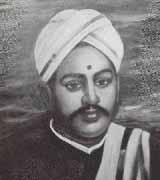
| V.O. Chidambaram Pillai
(VOC) Kappalottiya Tamilan |
| Early Tamil
Cultural Influences in South East Asia -
S.J.Gunasegaram, 1985 |
| The Periplus of the
Erythraean Sea: Travel and Trade in the Indian Ocean by
a Merchant of the First Century - W.H. Schoff (tr.
& ed.), 1912 |
| Some
aspects of South Indian cultural contacts with Thailand
- Historical Background. -
S.Singaravelu, 1966 |
| Tiru-p-pavai, Tiruvempavai in South East
Asia - T.P.Meenakshisundaram, 1966 |
| Tamil Studies: Research in South East
Asia and in the Far East - Jean Filliozat,
1966 |
Ancient Ports and
Maritime Trade Centres in Tamilnadu and their
Significance Slide
Presentation by
T.S.Sridhar, IAS
Special Commissioner,
Department of Archaeology,
Government of Tamil Nadu - 6 October 2005 |
Ancient anchors
off Tamil Nadu coast and ship tonnage analysis
N. Athiyaman and P. Jayakumar, 10 May
2004 |
| The Indian
Ocean Region - A Story Told with
Pictures |
| |
|
|
TAMIL HERITAGE...
the Tamils are an ancient people
Kappal Ottiya
Thamilan:
The Overseas Exploits of the
Thamils & the Tragedy of Sri Lanka
G.K.Rajasuriyar
27 March 2002, Australia
Dedicated to all those who love
Freedom and Peace
' These things shall be- a
loftier race Than e'er the world has known shall
rise, With flame of freedom in their souls, And
light of knowledge in their eyes'. John Addington
Symonds
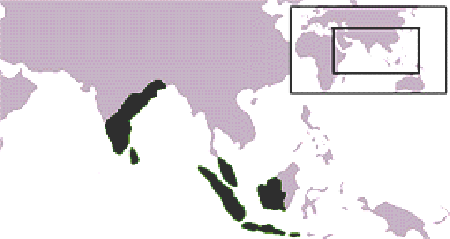
Chola Empire at the height of its Power circa 1050
AD
 செந்தமிழ்
நாடெனும்
போதினிலே
- செந்தமிழ்
நாடெனும்
போதினிலே
-
இன்பத்
தேன்வந்து
பாயுது
காதினிலே
சிங்களம்
புட்பகம்
சாவக -
மாதிய
தீவு
பலவினுஞ்
சென்றேறி
- அங்கு
தங்கள்
புலிக்கொடி
மீன்கொடியும்
-
நின்று
சால்புறக்
கண்டவர்
தாய்நாடு
(செந்தமிழ்)
Subramaniya
Bharathy
|
Contents
Foreword - Ranee
Eliezer
Preface
1.
Tamils & their Trade Exploits a)
King Solomon's Mines
b) The Sangam Age c)
The Imperial Cholas
2.The
Tragedy of Sri Lanka - Parangi
Piracy (1505-1658 AD)
3.The Kingdom
of Jaffna
4.Western
Connections of Jaffnapattinam - The
Portuguese
5.Tamil
Sea Ports of the West Coast of Sri Lanka -
Of Gay Kings &
Priests
6.
Dispersion of Tamils from Tamil Nadu to the West
Coast of Sri Lanka a) Sangili The Valiant b) Our Lady
of Victory-Jaffna c) Betrayal of the
Portuguese d) Tamil-Muslims
7. Dutch Invasion (1658-1795
AD) - Manipay & The
Madappalis
8. Vanni-The
Adanka-Pattu
9. Fall of Colombo & Dutch
Plakkaat
10.Tamil
from Puttalam to Galle
11.British
Occupation (1795-1948 AD)
12.'Yellow Robes' & The
Temples of Doom
13.The Backyard of Mother
India
Addendum
Bibiliography
About
the Author
Copyrights
|
 Foreword - Ranee Eliezer
Christy Rajasuriar's "Kappal Oddiya Thamilan -
is timely for today's children and people in
Eelam, for each of us who have been dispersed and displaced through out
the Diaspora, when the genocide of Tamils
worsened after Black July in 1983. - it is timely
for the millions who were forced to leave the
Tamil countries since 1830's in search of jobs as
administrators, railway men and plantation
labourers in the mosquito-ridden equatorial
jungles infested with wild animals, wherever the
colonial rulers sent them.
History taught in schools was biased,
naturally, depending on who the conquerors were.
Tamils have a continuous 10,000 year old history
which will require 20 volumes of research and
scholarship. Some of these have been attempted by
the International Tamil Alliance of Research -
new data keeps pouring in the Internet and
electronic mail from 58 Chairs of Tamil Studies
throughout the world.
From their earliest origins in Crete, the
first Sea People or Thirai Aavidar (Dravidians)
crossed the Mediterranean Sea, the great
Eupharates and Tigris rivers of Mesopotamia, the
Arabian Seas and the Indus Rivers to create the
world's third oldest civilisation of the
Dravidian Indus valley of 3,000 BC. The Tamil
Merchant Princes traded with Sumer and Egypt as
verified by their 2,000 famous seals discovered
in the archaeological cites, that continues to
the present day.
Christy highlights the first Eastern Colonial
empire of Tamil Pandyas, Cheras, Cholas and
Pallavas. The first sailors to cross the unknown
perilous Indian ocean in 300 BC and controlled
the shipping lanes of the mighty Indian ocean.
Their role in the Indianization of South East
Asia till 1500 AD is well documented by western
scholars like George Coedes, Sir Ananda Cumarasamy and Chinese
Buddhist pilgrims like Fah -Hian. By the 10th
century AD the Imperial Cholas were well
established in the 14 Ports of Sumatra, Malaya,
Java, Celebes, Bali, the rest of the East Indies,
Philippines, Indo-China right up to Southern
China. Their excellent harbours, customs and port
facilities make fascinating reading in the
Silappadiharam 'The Epic of
the Lay of the Anklets'. The Chola Empire lost
out with the arrival of the Portuguese with their
gun-ships and cannons.
Christy follows up the decline of the Chola
Empire by the 500 years of colonisation by the
Portuguese, Dutch and British in Ceylon (Sri
Lanka). His emphasis on the Portuguese era in the
15th century is illuminating. The Portuguese were
the first and greatest sailors from the West, in
search for the gold and spices of India, they
also took their missionary zeal of Roman
Catholicism to save the "paganism" of the
indigenous inhabitants, wherever they sailed.
Some of their sadism rivalled that of the Spanish
Inquisition. However, their strong faith of a
loving, forgiving, personal God, has remained a
bulwark among their converts.
Sailors and fishermen, their wives and
children are the most fearless around the globe.
I would like to pay a special tribute to our
Tamil Roman Catholic wives and mothers in Ceylon
who have stood up to any injustices by the
Establishment. One memorable event was outside
the Jaffna Kachcheri (Government Offices)
in 1961. There was a weeklong silent vigil
(Satyagraha) against an arrogant Sinhalese Army
of Occupation sent by the Prime Minister Srimavo
Bandaranayake. The young, restless and impulsive
among the Tamil victimised began needling the
gun-toting soldiers. A senseless blood-shed was
averted by 20 white-clad Roman Catholic mothers,
quietly going in front, kneeling and saying their
rosaries. This inspired the rest of the terrified
assembly to sing their hymns, lyrics and
bajanais, to calm down the seething tempers. The
courage of those white-clad mothers will live in
my memory as long as I live.
The heroines of the Mothers' Front who had the
temerity to stand up to the repressive IPKF (Indian Peace Keeping
Forces) were mostly the Roman Catholic mums
who lashed out at the fearsome IPKF commandos
about some of their unspeakable crimes against
defenceless, unarmed civilians. A few of the
Indian hierarchy have remarked that they feared
these mothers more than they did the Guerilla
Freedom Fighters!
In the first half of this book, Christy
confirms the many reliable sources of the Tamil
population living for millenniums. Some Karava
Tamils on the West coast of the Island through
religious and political expediencies now try to
pass off as Araya Singhalese and Kshatriyas
(Warrior cast) from the North Western State of
Rajastan, in India. Sinhalese majority
Governments have deliberately changed those once
Tamil areas into Singhalese Provinces. Christy's
research indicates that the Land Titles of these
Provinces are in the Tamil language.
The second half, deals with the "Tragedy of
Sri Lanka". It is the usual story of intruders
and invaders throughout history who use
repressive regimes to stay in power with programs
of genocide. Pretending to be Democratic; they
perpetuate autocratic, dictatorial and repressive
feudalism. The Capitalistic West had aided these
corrupt regimes with profiteering arms deals. A
15% commission on each deal is the norm that the
Presidents to the peons and the Security Forces
share in the trillions of dollars. It is this
very lot, trying to sabotage the current peace process.
Who need peace, when it is more profitable to be
at war?
We need to up-date our nautical skills and
expertise and firmly believe in our motto 'Thirai
Kadal Odiyum Thiraiviam Thedu' in the new Eelam
being born. The rest of us in the Diaspora have
had to cross many Seas and Oceans for survival.
The Tamil Psyche will cross and re-cross these
very waters but this time over head by the faster
air-ships in our efforts to help in the
reconstruction and rehabilitation of the Mother
land. We need,too, the support of an enlightened
South who have suffered under self-serving
leaders.
Thank you, Christy for your tribute to the
'Kappal Oddiya Thamilan'.
Ranee Eliezer
|
Preface
Since publishing 'The History of the Tamils
& the Sinhalese of Sri Lanka' in 1998, I
decided to write the history of the overseas
trade exploits undertaken by early Tamils which
earned them the epithet, 'Kappal Oddiya
Thamilan'-the Tamils who sailed ships. With this
in view, I collated data to include the tragedy
of the foreign connections with special reference
to the Kingdom of Jaffna.
In the present work is enshrined records of
the commercial exploits of the Tamils, which was
captured by the Tamil poetess Avaiyar who wrote
in the 1st century 'Thirai Kadal Odiyum
Theraiviam Therdu'- ride the rough seas in quest
of treasure. Historians agree that there would
not have been a Greater India, if not for the
enterprising spirit of the Tamils.
The greed of the conquerors of India,
specially Sri Lanka and elsewhere in the East and
the tragic impact that had encompassed these
countries have been documented in the archives
and libraries in Rome, Lisbon Goa, Hague, Colombo
etc. Material has been taken from relevant
publications and recorded herein with special
reference to the tragedy which overcame the
kingdoms of Jaffna , Kotte and Kandy.
A short reflection on the present conflict is
also discussed with reference to the part played
by the Maha Sangha to escalate the ethnic
conflict.
I am grateful to Dr.Rajagopal Rajaratnam and
S.Ganashemoorthy for presenting recent works of
Fr.V.Pemiola S.J., of The History of the Catholic
Church in Sri Lanka during the Portuguese, Dutch
and British periods.(1505 to 1855 AD). These
publications contain translations of original
official documents from the Archives and
Libraries of Rome, Lisbon, Hague, Goa and
Colombo, pertaining not only to the Catholic
Church but also historical material hitherto
unavailable.
My thanks are due to Mrs. Ranee Eliezer for
the foreword and for her valuable suggestions, to
Dr.Thedore Brito Babapulle for editing the script
, to Stanley N. Rajasooriyar for supplying me
with books from various libraries, to Scan
Brito-Babapulle for obtaining a picture of the
temple of Angkor-Vat of Cambodia and to many
others who helped me in this project .
Lastly, my thanks are due to Ms.Shereen
Reginald for processing the material and to my
wife Celine, for her support and encouragement
without which ' Kappal OOdiya Thamilan', could
not have sailed.
G.K.Rajasuriar
|
|
Chapter 1 - The Tamils and their
Trade Exploits
Far from the distant past, long before the
sea-route was discovered by the western mariner,
the carriage of goods for trade between East and
West was by long hazardous desert and mountain
routes which is popularly referred to as the
'Silk Route'.
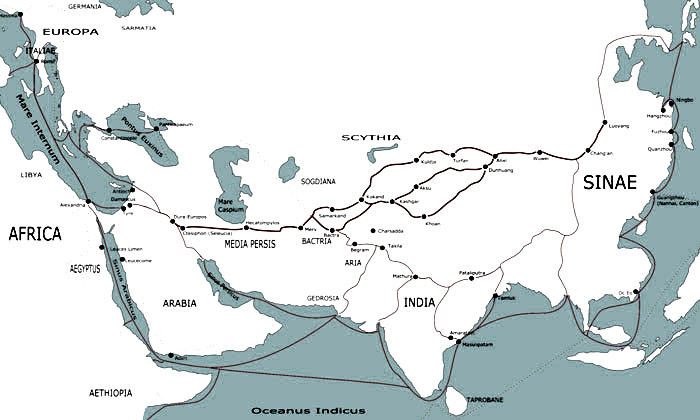
The Silk Route - First Century
AD
This overland journey entailed confrontation
with roaming bandits who were adept in the art of
ambushing the passage of caravans specially through
Central Asia. Although there was an element of risk
the caravans moved freight with armed escorts. As a
result of this, the cost of merchandise began to
rise no sooner it reached it's destination.
Long before the 'Silk Route' was used, the
enterprising Dravidian merchants were sailing
around the Indian coast and to the Persian Gulf as
early as 3500 BC. The Dravidians of Mohenjo-Daro
and Harappa had their harbour in the bay of Cambay
and disposed of their merchandise in Mesopotamia.
The merchandise in turn was carried in caravans
overland to the port of Tyre and thence to Egypt.
After the conquest of Egypt by Alexander the Great,
the port of Alexandria became the entrepot of the
ancient western world. It was in the Gulf of Aden
that the Egyptian, Greek, Arab, Indian etc., met to
exchange their merchandise.
According to Srinivasa Iyengar he states
that,
' Indian teak was found in the ruins of Ur
(Mugheir), which was the capital of Sumeria in
4000 BC and the SINDHU or muslin is mentioned in
an ancient Babylonian list of clothing. The
occurrence of ' s' in the word proves that this
muslin did not go to Mesopotamia via Persia, for
then 's' would have become 'h' in Persian months,
as the name of this country, derived from the
name of the river Sind, became Hind. I therefore
conclude that muslin went direct by sea from the
Tamil coast to the Persian coast and the
Babylonian word Sindhu for muslin is not derived
the river (as supposed so), but from the old
Dravidian word, SINDI, which is still found in
Tulu and Canares, and means a piece of cloth' and
is represented by the Tamil word SINDU, a flag'.
(ZHT,pp 39 &
39).
There is some evidence that the trade of south
India extended to Egypt in the 3rd millennium BC.
W.H. Schoff says, thousands of years before the
emergence of the Greeks from savagery Egypt and the
nations of Ancient India came into being, and a
commercial system was developed for the interchange
of products within those limits, having its centre
of exchange near the head of the Persian Gulf. The
people of that region, the various Arab tribes and
more specially those ancestors of the Phoenicians,
the mysterious Red Men, were active carriers or
intermediaries.
The growth of civilisation in India created an
active merchant marine, trading to the Euphrates
and Africa, and eastwards we know not wither. The
Arab merchants, apparently tolerated the presence
of Indian traders in Africa but reserved for
themselves the commerce within the Red Sea, that
lucrative commerce which supplied precious stones
and spices and incense to the ever increasing
service of the gods of Egypt. This was their
prerogative, jealously guarded, and upon this they
lived and prospered accordingly to the prosperity
of the Pharaohs. The muslins and spices of India
they fetched themselves or received from Indian
traders in their ports on either side of the gulf
of Aden, carrying them in turn over the highlands
to the upper Nile, or through the Red Sea and
across the desert to Tebus or Memphis'. (Periplus,
p 3, ZHT,pp 39 &
39).
Hebrew Scriptures of the Jews have it that
during the reign of King Solomon (970-930 BC), he
sent ships which returned after three years
bringing in ' gold from Ophir and from there they
brought great cargoes of almugwood and precious
stones. The king used the algumwood to make
supports for the temple of the Lord and for the
royal palace, and to make harps and lyres for the
musicians:( 1 King ch.10,11-12-ZNIV). Algumwood is identified
with sandalwood which is a native tree of south
India and the duration of three years of the return
of king Solomon's ships points to distant lands,
perhaps, on the west coast of south India of
present Crananore (Musiri).
The precious stones would have been of Indian
and Ceylon origin. It is also stated Queen of Sheba
presented to King Solomon, 120 talents of gold
large quantities of spices and precious
stones'.(ZNIV-2
chronicles ch:9 verse 9). The kingdom of Somalia of
Queen of Sheba, is identified with the mercantile
kingdom that flourished in southwest Arabia during
900-450 BC. It profited from the sea trade of India
and east Africa by transporting luxury commodities
north to Damascus and Gaza on caravan routes
through the Arabian desert' (see notes ZNIV, p485).
The Roman Emperor Nero ruled from Rome between
54-29AD. During the latter part of his reign Paul
the apostle was taken prisoner during his fourth
missionary journey. Long before he was put to death
in Rome, St. Paul wrote the 1st epistle to Timothy.
In this epistle he exhorts the church in charge of
Timothy saying; they also want women to dress
modestly, with decency and propriety not with
braided hair or gold or pearls or expensive
clothes, but with good deeds appropriate for women
who profess to worship God' (ZNIV-1 Timothy ch;2 verse 9). Here
again as late as 69 AD, we find affluent ladies in
the Roman empire adorned with pearls fished by the
Parava Tamils of the fishery-coast of Tamil Nadu
and Mannar. The Roman emperor lamented, due to the
vanity of the ladies, the coffers of Rome was
running dry as a result of the import of pearls and
diaphanous textiles from south India.(ZHT).
It was the Indians (Tamils), in about the 1st
century BC, who discovered and harnessed the trade
winds (north east & south west monsoons), to
reach the ports in the Arabian Gulf and the
countries in the Far-East, long before the Roman
sea-captain, Hippalus discovered the secret to sail
to the country of the Indians. This secret was
revealed to the Arabs in due course. This they kept
it a secret, until the Roman mariner learnt of the
sea-route to the East..
The Periplus mentions three sea ports from which
Kolandia were accustomed to set sail for Chryse.
They were the ports of Kaveripatinam, Pondichery
and Markanum. The Jatakas also mentions three ports
in the west coast of India. They were Broach, Sopra
and Cranganore (Musiri) and Tamluk in connection
with voyages to Suvamabhumi. (ZHS,p 20). The Kolandia was a sea
going vessel of the Tamils with two masts and
capable of carrying large numbers of men and cargo.
According to Hall, it is stated that, The
Karo-Bataks of Sumatra have such names as Cholas,
Pandya, Pallava, and Malayala, all of which come
from Dravidian India. The dynastic tradition of the
kings of Funan (Cambodiya), hark back to that of
the Pallavas and Cholas of south India, when they
ascribe their origins to the marriage of the
legendary Brahman Kaundinya with the naga
princess'. (ZHS,p
20).
From ancient times, we learn that the fortunes
of South East Asia have been greatly influenced by
two of the most populated countries of the world,
India and China. From ancient times, these two
countries living at two extremities vied to obtain
the monopoly in the supply of the trade in spices,
sometimes with clever exchange of embassies and
most of the time with gun-boat diplomacy. The stake
of India in the spice cauldron of the Far East, was
more of trade and adventure than spreading of
religion or culture.
Perhaps, they went hand in hand in spreading
their popular religious persuasion of Buddhism to
Tibet and eventually to China. Hence we see that
during the last few centuries before Christ, India
and China had a common religion and this led to
cultural and trade links in the era of the Silk
Route' and more so during the discovery of the sea
routes. Along with the Buddhist faith the Indians
carried their art and culture to the lands of
Malaya, Burma, Thailand, Sumatra, Java, Bali,
Timor, Borneo, Cambodia etc.
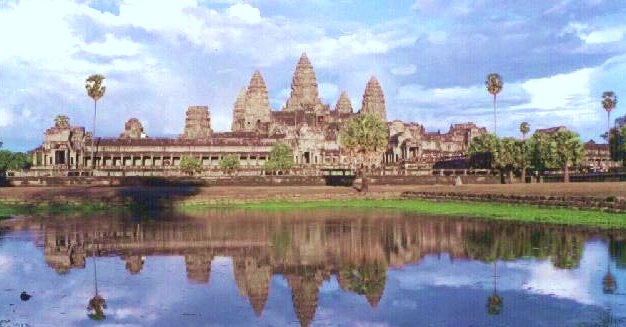
The Great Vaishnavite temple of
Angkor-Wat built by Suryavarman in 12 century
Cambodia
The epics of India of the Ramayana and
Mahabharata compiled in Sanskrit, went hand in hand
in the propagation of Buddhism and its tenets were
recorded in Sanskrit, although the said epics were
a legend of Hindu India. According to Hall who
states, 'But notwithstanding the importance of
Buddhism, as demonstrated by the prevalence of its
art, it is an inescapable fact that most of the
Indianized states speedily adopted the Saivite
conception of royalty, with Brahmans as masters of
ceremonies presiding over the cult of the royal
linga; Siva, says Coedes, 'became the guardian of
the state and a Brahman the royal chaplain'
(ZHS, p19). This
was without doubt the first stage of
Indianization.
It consisted of individual or corporate
enterprises, peaceful in nature, without a
preconceived plan, rather than massive immigration
which would have resulted in greater modification
of the physical type of the Austro-Asiatic and
Indonesian peoples than has occurred'. In the wake
of the merchants ' came the cultivated elements,
belonging to the first two castes.
We must assign a large role to these elements,
without which we could not understand the birth of
the civilisations of Father India, so profoundly
impregnated with Indian religion and Sanskrit
literature'. (ZIS, p 23). As in India, the Brahman
successfully infiltrated into palaces of kings and
rulers with their powers of magic. The impact of
these powers on the rulers resulted in the Brahman
being 'summoned by the native chiefs to augment
their power and prestige'.(ZIS p 23). This has been referred to as
an 'hypothesis' by Codes.(ZIS p 23). This hypothesis has no basis
in view of the fact, It will be seen that Buddhism
works mentioned above were all texts on ritual and
magic'. (ZCC p
71). This endeared the Brahman to the rulers of
South East Asia to an extent that Indianization had
begun aiding the much needed impetus in trade.
There is a saying in Tamil, `Thirai Kadal
Odiyum Thiraviam Thedu'- ride the mighty sea in
quest of treasure. The Tamil spirit of that age and
captured in verse compiled by Avaiyar reflected the Tamil spirit
of adventure that brought glory to King and
country. The huge vessels of the Pallava Kings of
Southern India struck East-Wards on the monsoon and
by 100 BC, Indians met Chinese in the Straits of
Malacca. The Tamils plotted the course to the
Straits of Malacca never to be forgotten. They
found it easy thereafter to bead towards the rising
sun from Kanchipuram in a direct course to the
Straits of Malacca. Their return journey with the
change of the monsoon they sailed with the setting
sun on the Bay of Bengal. It is stated by
historians, that 'the Bay of Bengal was a
playground of the Tamil sailors'.
a) King Solomon's Mines
The Malay peninsula, referred to as the ' Golden
Khersonese' by Hall, was a prime target for the
enterprising Tamil adventurer specially for its
abundant gold from Mt. Ophir thirty miles from
Malacca. Was this then the same 'Ophir' which is
recorded in ancient Biblical Scriptures and which
supplied gold to King Solomon of Israel?( 2
Chronicles,chp:8 verse 17). It is stated that the
two of the most important Indianised states of
Malaya were Langkasuka on the east coast, and Kedah
on the west coast. `Langkasuka is a kingdom whose
memory has been kept green in Malayan folklore as a
kind of fairy country or Never, Never Land, and a
traditions long associated with Kedah'.(HM).
The Sinhalese chronicle Mahavamsa has it that
during the reign of Duttugamani (101-70 BC), about
a shipment of silver which was sent to Malaya from
Ceylon. The silver was discovered by a merchant
north-east of Kurunegala where the present
Ridivihare (silver monastery) is located.
(MV,p 188). The
Mahavamsa reads as follows: In a southerly
direction from the city, at a distance of eight
yojanas, silver appeared in the Ambatthakola-cave.
A merchant from the city, taking many waggons with
him, in order to bring ginger and so forth from
Malaya, he set out to Malaya'.(MV p 188). This attests to the fact
that trade with Malaya was in vogue in the first
century before Christ. Obviously the silver would
have been on its first leg of the voyage to the
port on the river Kaveri in the Coromandel coast,
perhaps Puhar, before being transhipped on boats of
the Tamils to Malaya.
During the 3rd century AD Kedah of Malaysia was
the most important port of call of Tamil sailors
who soon had a colony to protect their trade
interests, for the collection of merchandise,
storage and export to Tamil country. The find of
Hindu and Buddhist shrines and artefacts prove
their settlements, even long after they have been
vandalised by the Malayans who were converts to
Islam. That this was a great port of call for the
Tamils in the 3rd and 4th centuries is also
mentioned in Tamil poem Pattinappalai of the Sangam Age.
That this port was in constant trade with
Kaverippumpattinam of the great Chola Kings cannot
be disputed.
Duarte_Barbosa Duarte
Barbosa, a Portuguese traveller of the early
16th century states of Malacca thus, 'Many Moorish
merchants reside in it, and also Gentiles
particularly Chetis, who are natives of Cholmendal
(Coromandel) and they are very rich and have many
large ships, which they call jungos'. He states
that merchants from different countries meet at
Malacca with their goods for trade. He refers to
the ships of other countries specially of China,
but do not refer to them as 'large ships' of the
Tamils. The Tamils navigated their ships to the
numerous islands which are scattered around and to
Timor for the white sandal and they carry for them,
iron, hatchets, knives, swords, cloth of Palacate
and Cambay, copper, quicksilver, vermilion, tin and
lead, little beads from Cambay of all sorts'.
The foot-prints of the Tamils in far-flung
countries of the East, has been documented by the
countries where they have left indelible marks in
the sky-line, of imposing Hindu and Buddhist
temples, culture, religion and in certain places
contributed in the development of their language,
from ancient times. Dr.Hultzch, has published of a
Tamil inscription which was found on a rock at
TAKOPA WAT NAMUANG, in the Malayan peninsula, of
present Malaysia at Manigavamam (old place name),
which speaks of a temple of Vishnu built by the
Tamils on the west coast.
This inscription also refers to the presence of
a colony of men and Hindu colonists along with
bow-men, apparently soldiers placed there for the
protection of their trade with Malaysia, (JRAS 1931
p.337;1914 p 397).This was discovered by Jameslow,
a civil officer of Province Wellesley in the state
of Kedah in 1827 AD. This period has been
identified as the 8th century AD and may refer to
the present Penang in Malaysia. An inscription in a
temple near Tanjore of Tamil Nadu records a gift
made to a temple in Malacca by the Queen of the
Pallava Nirpalinga confirming that Tanjore was
under the influence of the Pallavas in 855 AD. 'It
is stated that Kamaejra and Sopatama on the
Coromandel coast was important, so is Puhar, the
port of the Chola Kings who during the 2nd and 3rd
centuries AD controlled the carrying trade between
the Malaya Peninsula and India:
This inscription found at Takuapa close to a
Vishnuite temple and written in Tamil stating that
an artificial lake named Avaninaranam was
constructed by Nangur -Udaiyan an individual who
possessed a fief at Nangur, a village in Tanjore.
The inscription is dated 1088 AD when Tanjore was
the capital of Raja Raja the Cholan. The other
inscription found during the same period was at
Laby Tuwa in Sumatra. These two inscriptions
alluding to the commercial activities of guilds
known in Southern India provide an interesting
indication of the nature and geographic origin of
the relations between India and Southeast Asia
'.(Z1S, p 107).
b) The Sangam Age
The overseas trade which was in vogue in the 6th
century BC and spilling into the Sangam Age of the
Cholas, has been clearly outlined from a few lines
of the Pattinappalai of the city of Puhar where a
large colony of foreign merchants were present from
different parts of the world:-
Like the large crowd gathered in a city of
ancient renown on a festival day when people
from many different places betake -themselves
to it with their relatives; persons from many
good countries speaking different tongues, had
left their homes and come to reside (in Puhar)
on terms of mutual friendship'.
From the same source we gather the articles of
foreign trade in the following description:-
Under the guardianship of the gods of enduring
glory, horses of noble gait had come by the sea;
bags full of blackpepper had been brought in
carts; gems and gold born of the northern
mountains the pearl of the southern sea, the
coral of the western sea; the products of the
Ganges valley; the yield of the Kaveri,
food-stuffs from Ceylon and goods from Kalagam
(Malaysia). All these materials, precious and
bulky alike, were heaped together in the broad
streets overflowing with their riches'.
This was the scene in other ports of the Tamil
country of Sera and Pandya, where guards of
'Yavanas'(Roman and Greek foreigners) stand guard
in the Kings palaces. The Perumbabarruppadai, a
poem of the Sangam Age, has it that there were tall
lighthouses on the coast summoning ships to their
harbours for the night.
The early stages of the Christian era and the
Sangam Age seem so close to each other in time and
age in history. The author of the Periplus says
that Roman merchants procured every year beautiful
maidens for the harems of Indian Kings. The
presence of large quantities of Roman coins
found in Tamil lands in Tamil Nadu and in places in
Kantherodai and Mantota of Mannar of Sri Lanka
proves the presence of these Roman merchants and
settlers in Tamil country.
As for India a new and possibly dangerous sea
power had arisen in the South, viz., the Cholas who
by the middle of the 9th century had defeated the
PaIlavas and made themselves the masters of
Southern India. Friendly relations were established
with this power also, as is proved by the
establishment by a Sri Vijayan King of a Buddhist
temple in Nagapatnam, for the support of which the
Chola King granted the revenues of an entire
village'. (HM,p.81).It is stated that the pilot
vessel of the Chola fleet was named `KADEL PURAR',
which spearheaded their exploits into the countries
of the near and far east.
c) The Imperial Cholas
During the reign of Rajaraja the Great, the
Chola King waged war in 1001 AD against Ceylon (Sri
Lanka), ruled by Mahinda V and conquered the island
and renamed it, '
Mummadi-Chola-Mandalam'.(HI.p,57). By this conquest
Rajaraja was able to grant Sinhalese villages to
light oil lamps and the upkeep of his temple named
Rajarajeswari' in his capital Tanjore .(TS).
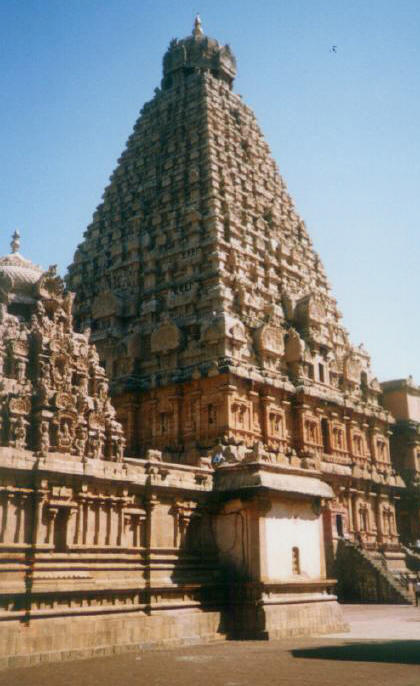
'Raja Rajweswari' temple,
Tanjore built by Raja Raja Cholan - 10th Century
AD
It was after this conquest that specially from
the Chola country more Tamils swamped the island of
Ceylon. (Sri Lanka). In the year 1005 AD, the large
Leyden grant mentions that in 21st year of
Rajaraja's reign he permitted the Lord of Kedah in
Malaya Peninsula and Palembang, a village near
Nagapatnam for the support of the Buddhist temple
at that place, which had been constructed by former
Lord of Kedah, Srimava Vijayottunga. (VR.ii Tanjore
890-A; I.A. xxii.45,vii.224; T& S.I.p 204; see
HI).
In 1007 AD Rajaraja in an inscription in south
Mysore, mentions his victory over 1200 ancient
islands (Maldive Islands). It was during his reign
that trade in the East intensified in countries in
the Bay of Bengal, Sumatra. Malaya etc. The
expansion of the trade in the East was carried out
by his son Rajendra 1,who had taken many ancient
islands. These lands taken over had colonies of
Tamil soldiers stationed for protection of their
trade. An important source of pepper was the '
pepper island' (Pulau Lada ),of Langkawi where the
Cholas capitalised in the trade of spices.
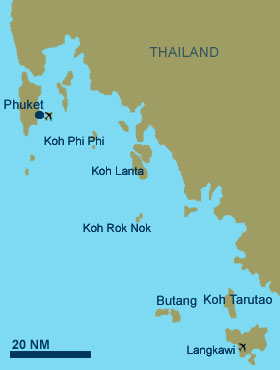
Langkawi (Pulau Lada) Pepper
Island - Malaysia, presently a Tourist
Resort
Most Malay states had a growing Tamil population
many of whom were Tamil Moslem traders from the
Coromandel coast.. As recorded in the Misa Melayu,
the Tamil trader had one wife in India and one in
Perak. It is stated that in several states,
specially Kedah, the wealthy Indian community
formed a powerful faction whose interests were not
always in accord with those of the ruled.
In the year 1024 AD, Rajendra Chola 1, sent an
overseas expedition to Malaya to strengthen the
military occupation in the garrisons built for the
protection of their trade; . 'In the Leyden grant
of Rajaraja Chola 1, speaks that a village was
granted for the support of the Buddhist temple of
Nagapatnam on the east coast of Tanjore
district.The donor owner presumably by purchase,
was the 'Lord of Kataha' also called 'Lord of Sri
Vishaya country' Srimara Vijayottunga, son of
Chudamani of the Sailendra family. Sri Vishaya was
the kingdom of Palembang .A inscription of AD 775
found at Vien-sa in the south bay of Bandon
confirms that the King belonged to the Saliendra
family. In Chinese annals of Song, Palembang is
called 'San-to-tsi'. In 1003 and 1008 AD two
embassies sent by Chulamani Sri Mara VI
(Jayattounga) to China.(HI).
This shows that the reason Rajendra 1, about
1024 AD-1025 AD, quarreled with the ruler of Kedah
and sent an expedition which defeated Samgrama -
Vijayattounga's successor and perhaps son of
Srimara Vijajattounga.He was captured and his city
seized; his treasure the (Vidyadhara) `taranam' at
the Gate of his city and two other doors with
jewels were carried off'. This Chola King extended
his trade protectorates to 'Madamalingam (said to
be Jaya in the Malaya Peninsula), Mappapalam
`defended by the water'. Talai-Takkolam on the
isthmus of Kra, Panna watered by the river on the
east coast of Sumatra, Mayirvdingam by the sea a
state dependent on Palembang,llangasokam
(Langasuka) a Malaya state tributary of Kedah.
Ilamurideram (Lamuri) called by Marco Polo 'Lambri'
in the far north of Sumatra where there are many
places whose names begin with 'Lam, eg., Lam
Djamoe, Lam Baroe etc., and Mariekkaysurtm the
Nicobar Islands and one or two other places:(4Lp 66
). The dispute Rajendra Chola 1, had with the ruler
of Kedah, was due to the dispute Of the carriage of
goods by sea through the Malacca straits.
The Maharajah Samgrarna Vijayattounga who styled
himself King of the Ocean Lands, was short
circuited by the Tamil kings expedition where he
was captured and lost his kingdom of Sri
Vijaya.(Z/S, pp 142 & 143).George Coedes,
akKles to the raid by Rajentha Chola thus, Perhaps
this raid has (left some traces in the memory of
tha Malays of the penkisula, for their annals tell
how the king Raja Chaim (Suran) destroyed
Ganganagara on the Dinding river, as well as a fort
on the Lengiu, a tributary of the Johora River, and
finally occupied Turnasik, the site of the future
Singapore'. (ZIS, p 143).
The place Kadaram or Kidram or kt another for
Lalagam, alt refers to the same place and it has
been suWeeted by scholars that it is identified
with Keever Mersa In the east coast of Sumatra not
far from the powerful kingdom of Sri Vijaya at
Pakernbang. The Chinese knew of it at that time by
two. names San-fo-Tsi, equivalent of Sri Bhoja and
Santu -Sai, the equivalent of Sri Vijaya. Hence the
kingdom of Palembang has been known by two names
viz., Sri Mu* or Sri Vljayain 1033 A0 Rajendra
1,sent an embassy to China which is noted in the
Chinese tumais where his name is referred as
Lo-ch-into4o.chu4o. By this mission trade ties with
the Chinese were on a firm footing. This mission
would have entailed a convoy of shams carrying
Tamil officials and presents to the Emperor of
China in ships with two masts flying the Twit
emblem of the Cholas at it's masthead.
During the reign of Chola King Kullottunga 1, an
inscription belonging to the year 1010 AD in Tamil
characters was found at Loboe Toewa, Baros, in the
island of Sumatra. It records a gift to a temple in
that country by a body of persons who are referred
to as `Fifteen-hundred', perhaps a military
garrison of Chola Tamils stationed for protection
of trade interests.)JRAS.1931 April).(ZHS, p55
& TC, pp 318,319).
The Chola King Virarajendra sent an expedition
to Kadaram (Sri Vijaya) in 1068 AD and conquered
the country on behalf of one of its rulers. Having
come to the throne he sought Chola protection. The
King of Sri Vijaya sent an embassy to Kulottunga 1,
1090 AD and requested him to issue a copper-plate
grant containing the names of the villagers granted
by the Chola King as 'pallic-candarn to two vihares
built by the king of Kadaram at
SolaKulavalli-pattinam, evidently another name for
Nagapatnam.ln the Smaller Leyden Grant, for it is
by this name that Kulottunga's grant made on this
occasion is generally known, the two vihares are
called Rajendra-sola-perumballi and
Rajarajap-perum-balli, Me latter having also Me
alternative of Sri Sailendra-Cudamanivaram-Vihara'
(Cholas). The parasasti of Kulottunga's
inscriptions mentions the fact that 'at the gate of
his palace stood rows of elephants showering jewels
sent as tribute from the island kingdom of the wide
ocean'.(TC, p 318).
In the travels of Far-hian and Sung-Yun,
Buddhist pilgrims from China to India in the years
400 AD and 518 AD had this to say of the country of
Java, in this country heretics and Brahamans
flourish, but the law of the Buddha is not much
known'.(TFH). The earliest of the all lndianised
settlements in Java was the kingdom of TARUMA in
the west, a place well situated for the control of
the Sunda straits and within easy reach of the
lndianised states of southern Sumatra. Its ruler
was a Brahamanist King Puranvarman of whom little
is known apart from the fact that he built the two
canals named after two Indian rivers, seven miles
long in 21 days'.(HM).
This attests to the fact that the said ruler was
a Hindu and a Tamil and had settled in an strategic
position on the shores of TAIRUMA to control the
Sunda straits. It is obvious he built the two
canals 7 miles long to anchor all his merchant
vessels as the northern tip of Sunda is affected by
both the North -West and South-West monsoons. The
first kingdom of Java was ruled by a
Hindu-Indonesian court, which was the kingdom of
Matram under King Sahjaya in 732 AD. The Hindu
religion adopted by the court was `Sivaistic'.
Hindu temples were built in the central town and
commercial state like Sri Vijaya evolved due to the
power wielded by the Hindu court over the Javanese
farmers. From the 7th century AD, Sri Vijaya
developed into the greatest maritime empire in
South East Asia, straddling the cross-roads of sea
traffic between Middle East, the Indian
sub-continent and China. It exerted firm maritime
control over the straits of Malacca and south China
sea, the whole western part of Indonesia, the
greater part of Malay Peninsula and West Java and
put claims on Sri Lanka.
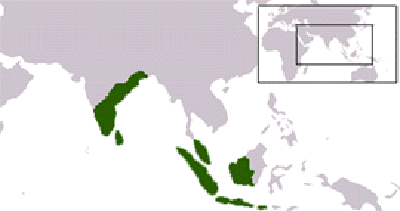
Chola Empire at the height of
its Power circa 1050 AD
This maritime power started to wane. King
Chandrabhanu decided to resolve the claims of Sri
Vijaya on the island of Sri Lanka. The Sri Lankan
chronicle Mahavamsa (MV:83.38 Geiger), states that
in 1251 AD the Javanese army under him landed on
the island of Sri Lanka during the reign of
Parakramabahu II, and occupied and plundered the
island. He was however repulsed. A few years later
King Chandrabahnu returned this time with South
Indian allies. He established his headquarters on
the Subha and demanded the relics of the Buddha as
well as recognition of his authority. After a
battle he was defeated and had to flee leaving
behind his harem and riches. Records from South
India reveal that the King of Sri Vijaya was killed
by one of his own allies, King Jatavarman Sundara
Pandya from South India.(Pandya - Tamil).After the
defeat in Sri Lanka, Sri Vijaya disappeared from
the pages of history in 1273 AD under King
Sukhodaya of Java.
About 1025 AD the Hindu Chola Dynasty of
Southern India took over most of Java. This was the
period of the reign of Rajendra Chola-1012 to 1044
AD. In South Indian inscriptions by Robert Sewell,
Jatavana Sundra Pandya in 1256 AD conquered Sri
Lanka with the aid of Chandrabahnu. It is possible
that he was killed by Sundra Pandya after the
conquest.
Hindu India affected the people of Java in
various ways. Brahmanism and Buddhism, the greatest
two religions of the world nurtured in India
flourished side by side in Java due to religious
tolerance. Although there are many Hindu temples
especially at Parambanam which were considered to
be the greatest Hindu monuments of Java, the famous
monument is the Buddhist stupa of Borobudur. 'We
talk of Sanchi as one of the most finished
architectural achievements of Buddhist India, but
in fact the Sanchi stupas are to be considered
primitive in comparison with the shrine of
Borobudur.
The Borobudur is purely a Hindu Buddhist
enterprise. It is amazing to find that away from
their native land our ancestors could give such
fine expression to their fancy and aesthetic
culture. This beautiful and huge edifice stands
today as a mark of the highest level of
architectural perfection, reached by Hindu Buddhist
genius'. (AC). It is said that to comprehend Indian
art in India alone is half the a story. To
comprehend it fully one must follow in the wake of
Buddhism to Central Asia, China and Japan. It
blooms like a lotus as it spread over Tibet, Burma,
Thailand and watch with awe its creations in
Cambodia and Java. As a scholar put it, 'the
Indians started with mountains, but finished off
like jewellers'.
The island of Bali in the far-flung archipelago
of the present country of Indonesia, still carries
the indelible hallmark of Hindu culture to a great
extent even to this day. It is claimed that there
are about 2,000 temples on an island only 87 by 56
miles.
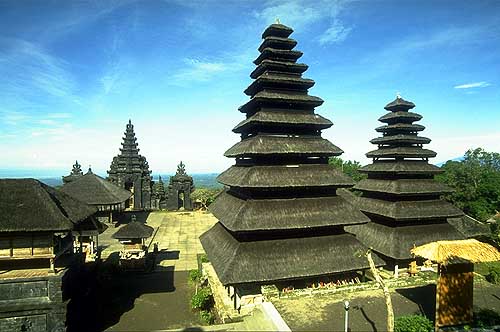
Hindu temple of Bali, Indonesia
'Pura Besakih' of Mt. Agung
Bali had become, by fact the most sought out
destination for tourists today. In the conducted
tours of the Balinese, tourists are shown Hindu
temples, the drama of the legends of Rama and Sita
and of the epic Mahabaratha war. Although Indonesia
proper came under the sway of Islam, it failed to
take root in the island of Bali.
The writer was surprised to witness the drama of
the legends of the Hindus, dramatised in this small
island far away from the land of its birth. Even
the names of the hotels bear the names of Rama and
Sita-legendary names of Hindu India.
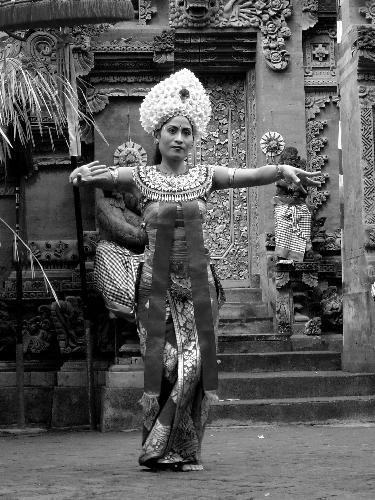
Epic of the Ramayana staged in
Bali - Indonesia
The people are proud of their Hindu connection
and worship in the many Hindu temples in the
island, which were built by the Tamils between 4th
and 9th century AD. The caste system, which is
inextricably interwoven into the Hindu religion, is
most profound in the island, where Brahmins are
held in high esteem as next to the gods they
worship.
Although Saivaism held sway in Java, its decline
came with the dominance of the Buddhist Sailendras
over central Java. This change caused Saivaism to
seek refuge in the eastern parts of the island with
its centre in Malang and which subsequently formed
the kingdom of Singosari. The monuments erected
were dedicated to the cult of Agastya, the sage who
Hinduized South India from about the 4th - 1st
century BC.
A Sanskrit inscription dated 760 AD records the
foundation at Dinaya as a sanctuary of Agastya by a
king named Gajayana. The decline of the Satiendra
power over central Java has been relegated to the
return of Saivism. During the rule of Rajendra the
Cholan of South India who crippled the power of Sri
Vijaya and its threat to the East Java kingdom.
Siva temples were built in Matram with its
galleries of reliefs illustrating the stories of
the Ramayana of Hindu India. (ZHS,pp 58,59
&60).During this period the ports in the bay of
Surabaya came into prominence with merchants of the
East and also the resort of merchants from the
West-Tamils, Sinhalese, Malabar, Chams, Mons,
Khmers and Achinese.
The Indianisation of Cambodia commenced at the
beginning of the Christian era and the Sangam Age.
Elements of Indian (Tamil) culture was interwoven
with Cambodian culture that lasted for over a 1000
years. Brahamanical Hinduism found its way into the
palace, courts and into the lives of ordinary
people. This resulted in Cambodia to be a
Tamil-seeming country. 'In the 19th century, for
example Cambodian peasants still wore recognisable
Indian costumes and in many ways behaved like
Indians than they did like their closest neighbours
the Vietnamese. Cambodians ate with spoons and
fingers for-example, and carried goods on their
heads; they wore turbans rather than straw hats,
and skirts rather than trousers. Musical
instruments, jewellery and manuscripts were also
Indian style.
It is possible also that cattle-raising in
Cambodia had been introduced by Indians at a
relatively early date. It is unknown to a great
extent in the rest of the mainland of South East
Asia. During the first five hundred years of the
Christian era, India provided Cambodia with a
counting system, a pantheon, meters for poetry, a
language (Sanskrit) to write'.(HC). According to
Cambodian inscriptions of the 9th century, there is
a smattering of TAMIL words among the Sanskrit
script. In Angkor Wat, there is a 12th century
temple dedicated to Vishnu and said to be the
largest religious building in the world. In the
photograph on page 51 of Chandler's book, hitherto
mentioned earlier, are seen a few PALMYRA trees
adjoining the temple, obviously planted by Tamils
for their sustenance.
Trade between prehistoric India and Cambodia
probably began long before India itself was
sanskritized. In fact as Paul Mns has suggested,
Cambodia and Southern India, as well as what is now
Bengal, probably shared the culture of 'Moon Asia',
which emphasised the role played by ancestral,
tutelary deities in the agricultural cycle. These
were often located for ritual purposes in stones
that naturally resembled phalluses or carved to
look like them. Sacrifice to the stones, it was
thought ensured the fertility of the soil'(HC).
The myth of FUNAN, was found recorded in the
first few centuries of the pre-Sangam Age, which is
supplemented by archaeological findings of an
ancient trading city near the modem Vietnamese
village of Oc-Eo in the Mekong delta, which was
excavated in the 20th century by Louis Mallevet.
There were also found Roman coins of the 3rd
century, Indian artifacts, including seals and
jewellery. It is said that this was used by
pilgrims and traders travelling between India and
China in the 1st century AD. Hence Oc-Eo may have
been the main gateway through which Indian
influence extended into the heart of Cambodia. The
people of Oc-Eo, were essentially a rice growing
nation, who worshipped Siva. According to Chinese
myth, Oc-Eo was governed by a Brahman called
Kaundinya, who was crowned King, who changed all
the rules according to the customs of India. He
showed them the way to improve cultivation by
building reservoirs and by sinking wells. In the
chronicles of the Mahavamsa of the Sinhalese in Sri
Lanka, it was the Brahmins too who were responsible
in the irrigation works of the country.
George Coedes says , 'According to a Cambodiyan
dynastic legend preserved in an inscription of the
10th century (Inscription of Baksei Chamkrong), the
origins of the kings of Cambodia go back to the
union of the hermit Kambu Svayambhura, eponymic
ancestor of the Kambujas, with the celestial nymph
Mera, who was given to him by Siva. Her name was
perhaps invented to explain that of the Khmers.
This legend, entirely different from that of the
Nagi, shows a certain kinship with a genealogical
myth of the Pallavas of Kanchi. (ZIS,p 66).
According to ancient Tamil literature the 'Pallavas
were originally connected with Ceylon. A critical
study of the Tamil poems, Manimekalai and
Silappathikaram reveals that the destruction of the
Chola capital, Phuar or Kaveipumpattinam by sea
must have occurred before the close of the third
quarter of the second century AD, and Killi Valavan
or Nedumkilli the Chola king, then moved his
capital to Uraiyur. According to Mudaliyar
C.Rasanayagam, this Chola king had married a. Naga
Princess daughter of Valaivanam, the Naga king of
Manipallavan. Out of this union a son was born
known as Tondaiman Ilantirayan.His father Killi
Valavan, the king of Thondaimandalam had his
capital at Kanchi. The new dynasty founded by him
took its title from the second half of the word
Manipallavan, the home of his Naga mother.
Thus the Pallavas who were a dynasty rather than
a tribe or clan, were descended on one side of the
Chola family and on the other from the Naga rulers
of what is now Jaffna peninsular in Ceylon'.(AC, pp
704 & 705). A later Pallava Prince married the
Naga Princess of Kantharodai of the Jaffna
Peninsular in North Ceylon.There are other theories
of the Telugu origins of the Pallavas. The
Mahavamsa has it that many monks from Pallava Bogga
attended the consecration of king Duttugamani of
Ceylon.( MV, p 194). The Pallavas came into
ascendence about the 4th century AD with Kanchi as
their capital and their dominion extended from the
river Krishna to the South Penner.(river).They were
master builders and sculptors of their age and
their imprint and influence still lingers in the
countries of the East. The Mahayana Buddhism they
propagated in the East percolated into the very
fabric of the culture and the indigenous religious
beliefs of kings and commoner alike.
During the reign of Bhavarman 1 , in the year
598 AD, he commanded the erection of a linga of
Phnom Bantray Neang in Borth. He was responsible
for a short Sanskrit inscription engraved telling
the erection of other lingams along the Mekong
river. His successor Mahendravarman speaks of
erection of ' lingas of the "mountain" Siva
(Girisa), and erection of the images of the bull
Nandin'.(ZIS,pp 67,68,69). According to Coedes the
major Hindu sects co-existed together in Cambodia
as in India. The cult of Siva, especially in the
form of a linga, which enjoyed royal favour and
almost elevated to the position of a state
religion.(ZIS,p 73). By this time Buddhism took a
back seat in the 5th and 6th century. The structure
of the social fabric was matriarchal a system
widespread in and around Indonesia. In Cambodia it
may have imported from India where it is apparent
in the Sera kingdom among the Nayars and the
Nambutiri Brahamans.
Inscriptions in Cambodia speak eloquently of the
irrigated rice fields in the Mekong delta adjacent
to Hindu temples. Funan's culture however came
specially from the Tamil country of South India.
This was formed in the 1st century AD by Mon-Khmer
peoples. OcEo in the gulf of Thailand, was a major
trade link between China and India. In the reign of
Jayavarman ii ( this shows even the kings of
Cambodia took on Tamil names), 802 to 850 AD in
Angkor, he rejected Javanese suzerainty and
instituted the cult of god-king. 'He and his
successors, Rudravarman, Bharavarman, lsanavarman,
came under the influence of Tamil Kings of South
India. During this period they built temples known
as 'great temples of Angkor era', to house their
royal lingam and phallic emblems of the Hindu god
Shiva. King Suryavarman II was a worshipper of
Vishnu. He built the great Vaisunavite temple of
ANGKOR WAT in the 12th century. This temple is the
most beautiful of all Khmer monuments with it's
magnificent architecture.
From the 8th to the 12th century there was a
surplus wealth as a result of the bumper harvest in
agricultural produce, This was possible due to the
expertise of the Tamils who were adept in the art
of irrigation and building of reservoirs to supply
water to the fields. This was so even in Sri Lanka
where the Tamils built the ' Giant's tank' for
irrigation in the Mannar district. 'However, in the
12th century, due to the neglect of the irrigation
systems, plague, malaria and internal rebellion and
the introduction of Theravada Buddhism which
preached that one could hope for spiritual
development through meditation, made the people to
loose their drive and thereby weakened the Angkor
empire'. In any event, the cultural heritage of the
Khmer dynasties remain intact in contemporary
Cambodia. Many buildings like the royal palace in
Phnom Penh, are decorated in the Khmer
architectural style and used motifs as the garuda,
a mythical bird in the Hindu religion. Their
classical drama betrays vestiges of Indian
traditional style and reflects the legendary times
of ancient deities of Hinduism.
'There is a popular legend in Cambodia, even
to this day, of Pereak Ko, Preak Kaev', which was
first published by a Frenchman in 1860 AD and a
seven volume version in verse was published in
Phnom Penh in 1952 AD. The legend has it that the
town Lovek was so large that no horse could
gallop round it. Inside the town were two statues
Preahko' (sacred cow), and 'Preah Kaev' (sacred
precious stones), and inside the bellies of these
statues were sacred texts, in gold, where one
could learn the secrets of knowledge of anything
in the world. It is stated that the King of Siam
wanted the statues. Hence he raised an army and
advanced to fight the Cambodian King. According
to legend, the Thai soldiers fired cannons
charged with silver coins into the bamboo hedges
grown as fortifications. Thereafter, the Thai
army retreated and the Cambodians had to cut down
the bamboo hedges to collect the silver coins.
The Thai King returned one year later and as
there were no bamboo fortifications they were
able to carry away the statues to Siam. The
legend concluded in attributing superior
knowledge of the Thais after having access to the
contents of the books of knowledge found in the
statues. Apart from the legend, the basic fact
lingers that Indian heritage of the 'sacred -cow'
and 'precious-stone lingam', had a lasting
impression in the lives and culture of the
Cambodian people'. (MP).
Tamil Sangam literature mentions the names of
the earliest Chola (Cola) Kings. Scholars are now
agreed that this literature belongs to the first
centuries of the Christian era. The Sangam
literature reveals the names of Kings, princes and
the poets who extolled them. We also learn about
the life and works of the people. Some of the Kings
mentioned were men of distinction and acquired fame
and the poets of that age were able to capture the
truth in the manner of their expression in poetry.
Two names of the Chola Kings stand out prominently
from among them and their memories cherished in
song and legend by posterity, with much reverence.
The names of KARIKALAN and KOCCENGANAN, have been
written into ancient history by the Tamils as the
earliest known Kings who carved out a kingdom for
the Cholas in Southern India.
It was during the period of the Sangam Age that
rituals of Brahmanism had percolated into Hindu
religion in this early period and consequent to
this intrusion the Chloa Kings practised costly
sacrifices. The daily rituals of the Brahmans in
mentioned in the epic Manimekalai and a song by
Avur Mual-kilar in the 'Purananuru', which
eulogises the Brahman Vinnandayan of
Kaundinya-gottra' who lived in Punjarrur in the
Chola country, and gave an idea of the high
position held in society by the prominent Srotriya
families. Puram 166:
' Oh Scion of the celebrated race of wise men
who laid low the strength of those that opposed
Siva's ancient lore, who saw through the
sophistry of the false doctrines, and performing
the truth and shunning error, completed the
twenty-one ways of Vedic sacrifices! Worn by you
on the occasion of the sacrifice, the skin of the
grass-eating stag of the forest shines over the
sacred cord on your shoulder. Your wives, suited
to the station, gentle and of rare virtue,
wearing the net-like garment laid down in the
Sastra, (for such occasions) sparing of speech,
with small foreheads, large hips, abundant
tresses, are carrying out the duties set for
them. From the forest and from the town, having
seven pasus in their proper places, supplying
ghee more freely than water, making offerings
which numbers cannot reckon and spreading your
fame to make the whole world jealous, at the rare
culmination of the sacrifice, your exalted
station gains a new splendour. May we ever
witness it so. 1, for my part, shall go, eat,
drink, ride and enjoy myself in my village by the
cool Kaveri, which gets it's flowery freshnes
when the thunder clouds roar on the golden peaks
of the western mountains: may you, for your part,
stand thus, stable without change, like the
Himalaya which towers above the clouds and whose
sides are covered with bamboo'.
This ode shows the dominance of Vedic ritualism
and alludes to disputes with other religions like
Buddhism and Jainism. It was this Brahamanical
Hinduism which was carried with the Tamils wherever
they sailed in quest for treasure, to enrich king
and country. This infusion of Hinduism was
complemented by the stories of the Ramayana,
Mahabharata and legendary episodes to the people of
Burma, Thailand Sumatara, Malaysia, Cambodia and
specially to the island of Bali.So much so these
countries even in the 21st century betray vestiges
of Tamil Hindu culture in their drama, names,
habits and the temples built to their Hindu
gods.
During the reign of Augustus, the Roman Empire
was trading partners with India in luxury
goods.
'The growth of trade, though confined to land
routs expanded to maritime trade of Egypt with
Arabia. The Arabian connection in trade with
India, soon led to trade with the Egyptians,
which expanded in process of time to the
Far-East. The discovery of the monsoons by
Hipparachus of Alexandria led to the direct sea
routes to India ousting the Arabs in their
monopoly. The trade with India gradually
developed into a barter of different goods
between Egypt, Arabia and India. The most
important commodity being cotton, (Periplus
-p.59), and other silk.
It is stated that cotton was first introduced
to the then known world by the Indians, which
found its way to the distant Americas in the West
and to the countries of Oceania. Ptolemy's
account shows that the Roman trade reached beyond
India to Indo- China and Sumatra, and that the
trade with India and China was highly developed.
It was the Tamil sailors who taught the Romans
the sea route to the East. Southern India
obviously acted intermediary in the trade between
China and the West. The carrying trade between
the Malay peninsula and Sumatra in the East and
the Malabar coast in the West was largely in the
hands of the Tamils'. (Warmington pp,128 to
131).
Carrying of freight in the Indian ocean and the
Arabian sea was carried in sea going vessels of the
Cholas and they held an important share in the
movement of goods. They controlled 'the largest and
most extensive Indian shipping of the Coromandel
coast. In the harbours of the Chola country, says
the author of the Periplus, are ships of several
kinds which could carry goods to countries beyond
the seas. It is stated that the Chola ship called
'Colandia' of the 1st century was a two masted ship
which was used for the carriage of goods to distant
lands'.
The poet Rudrangannanar described the ships
moored in the harbour of Puhar (Pattinappalai
11.29-34), and larger ships which carried flags at
their mast-heads which compares to big elephants.
Navigation in the high seas and the dangers
attendant on its foul weather are picturesquely
described in the Manimekalai in a forcible simile
in which the mad progress of Udayahumara in search
Manimekalai is compared to that of a ship caught in
a storm on the high seas:
'The captain trembling, the tall mast in the
centre broken at its base, the strong knots
unloosed and the rope cut asunder by the wind,
the hull damaged and the sails are noisy, like
the ship caught in a great storm and dashed about
in all directions by the surging of the waves of
the ocean'. (TC). 'This coincidence of testimony
drawn from the early literature of the Tamil
country and the Periplus on the conditions of
maritime trade in the Indian seas in the early
centuries of the Christian era is indeed very
remarkable in itself. When one considers this in
the light of other evidence from Indo-China and
the islands of the archipelago on the permeation
of Indian influence in those lands from very
early times, one can hardly fail to be struck by
the correctness of the conclusions reached'.
(Periplus.p.261).
'The numerous migration from India into
Indo-China, both before and after the Christian
era, gave ample ground for the belief that ports of
South India and Ceylon were in truth as the
Periplus states, the centre of an active trade with
the Far-East, employing large ships and in great
numbers, than those coming from Egypt'. The Cholas
sea-faring instinct's echoed down the corridors of
time from beyond the 1st century where they
attempted voyages more daring in and around the 9th
to the 12th century AD. It is stated that, there
would not have been a greater India, if not for the
enterprising spirit of the sailors of the Tamil
country of Southern India.
|
|
Chapter 2 - The Tragedy of Sri
Lanka
There are historical records gathering dust in
the archives of many countries, where evidence of
cruelty, treachery, torture, rape and slaughter had
been perpetrated on a people and much blood shed on
the soil of such a small island which is known as
the 'Island-Paradise' and the 'Pearl of the Indian
Ocean', specially with the advent of the Europeans
to Ceylon.
They came from distant lands from the West in
sail boats by the hundreds, in quest of that
elusive commodity called spices - of pepper and
cinnamon - and the lure of pearls, gold and the
gems of Ceylon. They called it adventure, but the
abject greed that overtook their good intentions
made them commit the most heinous crimes against
the people they came in contact with, all in the
name of the wealth of the East and attended with
such barbarity contrary to Christian teachings they
set sail to propagate.
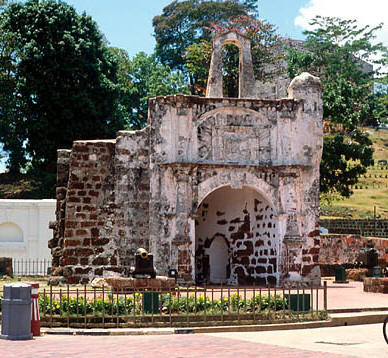
`Santiago Gate' of Malacca
built by the Portugese in the 16th
century
Before the 15th century, the supply of these
hard-to-get goods was the absolute monopoly of the
Moors and the Tamils, who dished out gruesome
stories of the hazards in obtaining the goods. The
Moors of the Middle-East, as middle-men, were
fabulously wealthy from the trade in the east, as
they were aware of the sea-routes to the very
source and supply of the merchandise, This, they
kept a secret.
Parangi Piracy
Vascoda Gama, the Portuguese adventurer, with
three sailing vessels, rounded the Cape in the year
1497 AD and discovered the open sea-route from
Europe to India, Ceylon and subsequently to the
Far-East.
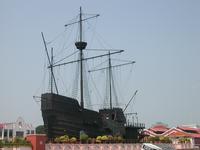
Replica of a Portugese vessel
of the 16th century
On August 26th 1498, he sailed into the port of
Calicut on the West coast of India. This successful
intrusion into the maritime domain of the Tamils
and the Moors, triggered of bloodcurdling battles
on the high seas and on land between the Arabs,
Tamils and the Portuguese. The atrocities committed
by the Portuguese were well documented in the
'Tohofut-ul-mujahideen' written by Sheik
Zeen-ud-deen, which gives an account of the war
with the Portuguese from 1498 to 1583 AD. The
Portuguese too had their fair share where hundreds
of their countrymen were slaughtered by the
Sinhalese and Tamils, some thrown to be trampled by
elephants, some beheaded, others impaled, and yet
others drowned or tortured to death. Philip
Baladaeus, a Dutch Missionary, records an incident
where King Vimaladhrama I, meted out punishment as
follows:
' The Sinhalese having got notice of their
flight pursued them so closely, that many of them
fell into their hands, specially of those
detachments sent to Goa,and Halalwia, for
provisions, fifty whereof they sent back with their
ears, noses and privy parts cut-off in revenge for
the ravishments committed upon their wives and
daughters'.
Accordingly Faria Y Souza states: 'We had not
grown odious to the Cingelas (Sinhalese) had we not
proved them by our infamous proceedings. Not only
the poor soldiers went out to rob, by those
Portuguese, who were Lords of villages, added rape
and adulteries which obliged the people to seek the
company of beasts in the mountains, better than be
subject to the more beastly villainies of men'. And
then again the atrocities of Sri Vickrama
Rajasinghe, the last King of Kandy 'A thrill of
horror has been imparted to all who have read the
story of the atrocities perpetrated on the wife of
Ehelapola the minister of the King of Kandy, who,
on the occasion of her husband's revolt in 1814 AD,
compelled her to kill her own children by pounding
them in a rice-mortar. But it ought to be known
that this inhuman practice was taught to the
Kandyans by the Portuguese'.
According to. Robert Knox : 'When he got any
victory over the Cingalese, he did exercise great
cruelty. He would make the women beat their own
children in mortars wherein they used to beat their
corn'. The Portuguese in times of siege having
drunk wine would partake of the salted-human
remains of their own soldiers, due to the scarcity
of food in their fortresses. Knox further adds:
'His cruelty appear both in tortures and the
painful deaths he inflicts, and in the extent of
his punishments, viz., upon whole families for the
miscarriage of one of them.
And this is done by cutting and pulling away the
flesh by pincers, burning them with hot irons,
sometimes he commands them hang their own hands
abut their necks, and to make them eat their own
flesh, and mothers to eat their own children; and
so lead them through the city in public view to
terrify all, to the place of execution, the dogs
following to eat them. For the dogs are so
accustomed to it, that they, seeing a prisoner led
away, follow after'. When Don Juan seized the
throne of Kandy, he ascended the throne under the
title of Wimaladharma Suriya I .
To secure the support of the Buddhist priests he
abjured Christianity and produced a tooth-relic
alleged to be the original tooth-relic, and gained
the support of the people. The Portuguese took
measures to depose him and sent one Jerome Azavada
who was famous for his cruelty. It is recorded
that: 'He beheaded mothers, after forcing them to
cast their babes betwixt mill-stones punning on the
name of the tribe of Gallas or Chalias, and it's
resemblance to the Portuguese word for cocks,
gallos, he caused his soldiers to take up children
on the point of their spears, and bade them hark
how the young cocks crow! He caused many men to be
cast off the bridge at Malwane for the troops to
see the crocodiles devour them, and these creatures
grew so used to the food, that at a whistle they
would lift their heads above the water'.
Whenever the Moors sailed, the Portuguese
followed their course and accidentally put into the
port of Galle in 1505, when Lorenzo de Almeyda was
pursuing the vessels of the Moors off the coast of
the islands of the Maldives. The Moors, to shake
off such hot pursuits used alternate sea routes via
the Maldive Islands to Malacca and Sumatra. Twelve
years later, Lopo Soarez Albergario appeared in
person before Colombo in the year 1527 with a
convoy of seventeen vessels. Their entry into the
East changed the atmosphere of maritime commerce
and plunged the history of the countries they set
foot with slaughter, torture and misery which the
East had never seen the likes of it before. The
instructions from Lisbon was, `to begin by
preaching, but, that failing, to proceed to the
decision of the sword. When the Portuguese set foot
on the island of Ceylon and saw the spices of
pepper and cinnamon, pearls and beautiful gems of
all colours, they were astonished at the magnitude
of their discovery that they soon forgot the
crucifix they were Carrying and used the sword to
fill their pockets.
As D.G.Hall Professor Emeritus of the History of
South-EastAsia, University of London had this to
say, '...and as the ideas of commerce and
colonisation gained ground, so the medieval
crusading ideal weakened', then again,' Happily it
was possible to serve God and Mammon at the same
time, for by striking at Arab trade in the Indian
ocean Portugal aimed a blow at the Ottoman empire,
which drew the major part of its revenues from the
spice monopoly'.( ZHS, p 197).
They filled their pockets, but that was not so
easy as they had to contend with the ruling Kings
and the people. When subtle diplomacy failed, they
took to the sword and the musket as they were
determined to exploit the natural wealth of the
island, first for the betterment of themselves and
for their country. History has recorded the fact
that it was the greed of the Portuguese soldiers
who siphoned off much of the wealth into their
pockets, so much so, the finances of Lisbon were
ruined and hence they lost the monopoly of the
wealth of the East. It is said,
'Astonished at the magnitude of their
enterprise, and the glory of their discoveries
and conquests in India, the rapidity and success
of which secured for Portugal an unprecedented
renown, we are ill-prepared to hear of the
rapacity, bigotry and cruelty which characterised
every stage of their progress in the East'.
The second wave of misfortune to visit the
island came in the year 1602 AD, with the coming of
the first Dutch ship' La Brebis', commanded by
Admiral Spillberg who put into the port of
Batticaloa. This intrusion by another European
power led to a triangular battle with the
Portuguese on the one hand and with King
Wimaladhrama Suriya I , alias Kunappo Bandara,
alias Don Juan Dharmapala, King of Kandy.
The first casualty was an officer of Spillberg,
Sibalt de Weert, over the release of goods seized
from the Portuguese at Galle and the insult against
the Empress Dona Catherina. The King having
resented at this wanted the officer arrested, but
the attendant of the King clove the head of the
officer and massacred the crew of the boat on the
beach. The King proceeded to Kandy and anticipating
a breach with the Dutch sent a message to the ships
of de Weert:, ' He who drinks wine, comes to
mischief. God is just. If you seek peace, let it be
peace, if war, war be it'.
|
|
Chapter 3 - The Kingdom of
Jaffna
The island of Sri Lanka (Ceylon), was infested
with the influx of foreigners, and the Indian Ocean
made a happy hunting ground to marauding merchants
of fortune, missionaries, swashbuckling pirates and
free lance adventurers. These were the dark clouds
hanging over the island in the 16th century.
Although Ceylon was plunged into protracted wars
with the Tamils of the Cholas, Chera and Pandya
dynasties before the 16th century, the political
position of Ceylon at the time of the first
European visitation by the Portuguese in 1517 AD,
was clearly marked and documented by the Portuguese
as recorded by Sir James Emerson Tennent in his
book, Ceylon an account of the island Physical
& Topographical- Longmans & Robertson-1859
AD. Referring to the political condition of Ceylon
he states: 'Seaports on all parts of the country
were virtually in the hands of the Moors.
I. The North was in possession of the Malabars
(Tamils), whose seat of government was at
Jaffna-patanam.
II And the great regions (since known as the
Vanni), and Neurerakalawa were formed into petty
fiefs, each governed by a Vanniya, calling
himself a vassal but virtually uncontrolled by
any paramount authority.
III In the South, the nominal sovereign,
Dharma Parakrama Bahu IX had his capital at
Cotte, near Colombo whilst minor Kings held mimic
courts at Badulla, Gampola, Peradeniya, Kandy and
Mahagama and caused repeated commotions by their
intrigues and insurrections'.
Hence the position Of Ceylon politically when
the Portuguese conquered the island in 1517 AD were
as follows:
1. The North, Jaffna-pattanam ruled by King
Sangili alias Segarajasegeram from 1478 to 1519
AD.
2. Kotte ruled by Dharma Parakramabahu IX from
1506 to 1528 AD.
3. Kandian kingdom ruled by King Jayavira from
1511 to 1552 AD.
The Portuguese Captain Joao Riberio came to
Ceylon as a soldier and remained in the island till
1658 AD. In that year the last of the possessions
of Ceylon were surrendered to the Dutch. Captain
Joao Riberio wrote in his book, 'The Historic
Tragedy of the island of CEILAO' and translated by
P E. Pieris thus :
'In his will Don Joao Paria Pandar, he
declared that he had no son to succeed him in his
kingdoms, and therefore he appointed the King of
Portugal his universal heir to all of them and
thus he became absolute lord of all the
territories situated within the island, only the
kingdom of Candia and Uva belonging to Dona
Catherina, while the Kingdom of Jaffnapatnam
had its own native King .(p 23- AES-1999 New
Delhi.
It is interesting to note that King Senaratne of
Kandy summoned all the rulers of the country to an
assembly in the year 1612 AD, to Kandy, and it is
stated that King Edirmanasingha alias
Pararajasekeram of Jaffnapatnam sent his ambassador
on 8th of March 1612 ( EMC,p 687-Philip Baldaeus).
This was repeated in the following year on 18th of
August 1613 during the occasion of the death of
Queen Dona Catherina, where an ambassador of the
King of Jaffna was present as recorded by Philip
Baldaeus. Further this missionary cum historian
states, 'Mannar derives it's name from the Malabar
(Tamil) language, from the word MAN, ie., SAND, and
AARU a river, signifying as much as a ' sand-river;
it being observable, that both Cingalese and
Malabar languages are spoke in the isle of Ceylon.
The first is used beyond Negombo, viz., at Colombo,
Cathure, Barberyn, Alican, Gale, Beligama, Mature,
Dondra. But in all other parts of this island
opposite to the coast of Coromandel, and all along
the bay, they speak the Malabar Tongue (Tamil);
whence it seems very probably that the tract of
land ( as the inhabitants of Jafffnapatanam
themselves believe), was first of all peopled by
those of COROMANDEL; who brought their language
along with them; it being certain that in the
island countries about Kandy, Vintane, Ballaney
etc.,they speak only Cingalese'(Sinhala).(EMC, p
792 ).
It was only in the year 1617 AD, that the
Portuguese took forcible possession of Jaffnapatnam
having deposed King Sangili Kumara, as he
slaughtered 600 of the new converts to
Christianity. It is stated that his eldest son
embraced the new faith and was put to death and the
second fled to Goa to escape his father's
resentment. In consequence of the slaughter and the
subsequent assistance given to the Sinhalese Chiefs
in their opposition to the Portuguese, the city was
sacked and the King Sangili Kumara captured and
carried to Goa and executed. As stated by
Tennent:
'True to their hereditary instincts, the
Malabars in 1622 AD, fitted out an expedition to
recover their ancient possession of Jaffnapatanam
and the peninsula, but the vigour of the
Portuguese governor Oliveria, defeated the
attempt'.(p.13).
With the granting of independence , to
Ceylon.,(Sri Lanka), by the British in 1948, the
Sinhalese and Tamil politicians presumed that they
had gained freedom from foreign rule after 431
years. Consequent to the granting of independence
it was seen that freedom was only for the Sinhalese
and not for the Tamils. The majority Sinhalese saw
to it at every turn to suppress the hopes and
aspirations of the Tamils. This finally culminated
in ethnic hatred which was festering in the minds
of the Sinhalese, to burst its communal ranks with
the calculated, sinister and pr-meditated communal riots of July
1983.
Since 1983 over 70,000 lost their lives which
culminated in Tamils being reduced to refugees in
their own country. The cloak and dagger treachery
adopted by the Sinhala government with the advice of the Buddhist clergy, since
so-called independence, forced the Tamils to take up to
arms. The grave error made by the Tamil leaders
prior to granting of Independence, for a utopian
dream of a unitary state, with the Sinhalese
politicians and chartered by the sinister designs
of the Maha Sanga will not be made by the Tamils
again, where some have chosen to sell their
birthright for a mess of pottage in sharing with
the affairs of state with the Sinhalese government
.
Even as late as 1788 AD, in respect of a demand
for a separate state for the Tamils, Sir Hugh
Cleghorn a British administrator in the Colonial
Office said:
"TWO DIFFERENT NATIONS, from the very ancient
period have divided the island, first the
Sinhalese, with the SOUTHERN and WESTERN parts
from the river Wallouve to that of CHILLAW; and
secondly the Malabars, (Tamils), in the NORTHERN
and EASTERN districts which extend from the west
coast of the island, from PUTTALAM to MANNAR in
the west, southwards up to the limits of KUMANA
or the river KUKBUKKAN OYA, that separated
Batticaloa from the southern Sinhalese districts
of Matara'(p,49-Sri Lanka, the Fractured
Island-Mohan Ram)."
In this connection it is interesting to read
page 229 of CCB,Vol:III,containing a report by
Roman Catholic Bishop C.Bonnand dated 20th July
1854 AD addressed to Pope Pius IX arising of the
dispute that had arisen about the boundaries of the
two Vicariates of North and South of Ceylon. This
reads as follows,
'... while the conversion of the inhabitants
of the Vicariates of Jaffnapatnam is difficult
because from the Mission of Chilaw as far as
Jaffnapatnam the inhabitants are Tamils by race
and Hindu by religion'.Hence it would be seen
that the division of the country for Catholic
administration was based 'according to people and
languages instead according to territory'.(CCB,p
168,VoLIII). The division was, The Sacred
congregation may propose that Colombo be in one
part, and Kandy and Negombo in the other, that
is, drawing the line of division from Negombo in
the West to Batticaloa in the East, both towns
included in the Northern region. It would be seen
according to the above report there were Tamil
Catholics in Marawila, Bolawatte, Katuneriya,
Ninamaddama and Sindatri in the year
1854'.(CCB,p236,Vol:111). This does not include
the Tamil Hindus who were domiciled in the said
area.
' A garden situated at Charlieparmundel in the
district of Calpentyn belonging to the society of
the Roman Catholic Missionaries and surveyed by
me on the request of the Reverend Constancio
Gomes.
Bounded on the North by the garden and
Wasti(waste) Ground of Nachemutto Motayen and by
the garden of Nayacadoo Police Vidane Manoel
Pille, on the South by the garden wasti ground
and Paddi fulo of Sinnrambi Cangani Thinavepille.
On the east by the lake and on the west the sand
wasti ground. Containing 38 acres, 3 roods and 20
20/25 sq.perches.
Surveyed 15 December 1829
signed R. Vare Gruster, District Surveyor
Surveyor Generals office, Colombo, 20th Jan:1830
('CCB,p267, Vol:iii).
The above testifies to the fact that Tamils were
domiciled in the said areas and that the instrument
of the title-deeds of the estate of Charleparmundel
is in Tamil and was read in 27 May 1854'.(CCB,pp
267 & 268, Vol:lll). There is also proof that
properties in Chilaw, Mundel and further down south
at Kalalgoda, north of Hendala, in the western
province have there title-deeds written in Tamil by
Tamil Notaries, which proves that the civil
administration of these areas were by the Kings of
Jaffnapattinam.
This is only the tip of the iceberg. There are
many such properties where the title-deeds have
been written in Tamil which proves that these lands
were ruled by the Tamils from ancient times. A
diligent search of the Land Registry offices would
unearth this fact much to the embarrassment to the
Government in power. The above known facts justify
the position that these were the lands of the
Tamils and their homeland which have been
subsequently colonised by governments on the west
coast from time to time by foisting draconian laws
and forced the Tamils to the Sinhala way of life.
These Tamils now speak Sinhala and have adopted the
customs, dress of the Sinhalese, but nothing has
changed the fact that the title-deeds to their
properties and those of the Sinhalese are in
Tamil.
There is no way that the Tamils and Sinhalese
could ever live in harmony. Perhaps, only by
levitation! The die has been cast, the honey-moon
has ended, and the twain shall never meet. What we
need today, is the return to the status quo of the
political position of the Tamil kingdom of 1617 AD,
when it was ruled by King Sangili Kumara from
Jaffnapatnam. Hence, all that land North of
Kelaniya to Anuradhapura to Polonnaruwa and the to
Mahiyangana and further down the southern coastal
belt to Kataragama, is the land of the Tamils. To
this end the struggle would continue to retain what
rightfully belongs to the Tamils.
|
|
Chapter 4 - Western Connections
of Jaffna Pattinam
The Portuguese
Portugal is like a sparkling gem set upon the
western facet of neighbouring Spain and washed by
the blue Atlantic ocean. Its geographical location
is ideal, with 550 klm of coast line and hemmed
between Spain and the ocean. It had no hope beyond
the Pyrenees mountains except the mysterious ocean
for its succour and aspirations. Portugal was the
gate-way, to the new-world of the Americas, the
Caribbean and to the distant lands of Africa, the
Malabar and the Coramandel coasts of India, Ceylon
and the countries of the Far-East.
The Portuguese were daring seafarers and
explorers nonpareil. History is replete with the
adventures of their sailors who brought fame to
their God and country. In the 15th and 16th
centuries they reached the highest pinnacle of
world fame by their skilful navigation. During this
period when the rest of Europe was busy developing
their borders, Portugal was importing spices from
Malabar and Coromandel coasts (India), silver from
Japan, pearls from Persia, Kayalpattinam (South
India), pearls and gems from Ceylon.
In 1434 AD, inspired by Henry the Navigator,
expedition of the West Coast of Africa was
undertaken, where they were met by their arch
rivals the Moors in bloody battles in the Atlantic
Ocean. These confrontations with the Moors led the
Portuguese to discover many strategic positions
down the west coast of Africa. Vasco da Gama
rounded the Cape of Good Hope and eventually sailed
and landed in Calicut on the West Coast of India in
the year 1498. Here too they found that the Moors
held the monopoly of trade in the Indian Ocean.
In 1505 AD, Lawrence de Almedia set off from
Cochin having heard that the Moors were taking a
alternate course via the Maldive Islands to carry
their goods to the Red sea and Europe, thus
avoiding confrontation with the Portuguese. While
heading towards the Maldive Islands, the Portuguese
fleet ran into rough weather and was driven towards
Galle in the island of Ceylon. Having obtained
fresh provisions they sailed up to Colombo and
anchored off Colombo on the 15th day of November
1505 AD. Lawrence de Almedia had the opportunity to
be presented before Vira Parakarama Bahu VIII, the
Sinhalese King of Kotte who entertained the
foreigners in a cordial manner. A Catholic chapel
was built at the bay of Colombo and dedicated to
St. Lawrence and the arms of Portugal engraved on a
rock close to the chapel.
When Don Lawrence de Almedia returned to Cochin
there was much rejoicing and jubilation at the
chance discovery of the island of Ceylon, which
they believed was a veritable ' King Solomon's
mines'. This was mildly reflected in a
communication dated 25th September 1507 AD, sent by
the King Manoel of Portugal to Pope Julius ii as
follows. ' There was a large hall, at the end of
which the king's throne shaped like an altar, was
set in great splendour. On that throne the king
according to the fashion of the country, sat
wearing on his head horns resembling a diadem, and
adorned with most precious stones, as are found in
the island.... p5 Vol: i, by Fr.V.Pemiola S.J)
The Sinhalese king, Bhuvenaka Bahu VII, ruled
from Kotte from 1521 to 1550 AD, while his arch
rival brother Mayadunne ruled the kingdom of
Sittavaca. In the letter written by the former to
King Joao III, king of Portugal dated `Kotte 1541'
refers to a Brahman who he was sending as his
ambassador with a letter explaining his plight as a
result of internecine wars with his brother
Mayadunne which precludes him from sending his
yearly tribute of 52,363 kgs of cinnamon. It is
interesting to note that the said Brahman was Sri
Radaraksa Pandita or Panditer, who was a Tamil, and
signed in Grantha Tamil the language in vogue in
South India preceding the arrival of the
Portuguese.(CC,p15 Vol:i). According to G.C.Mendis
in his 'The Early History of Ceylon' states at page
73 as follows.
' The influence of Hinduism also grew at this
time. Some of the Sinhalese kings not only
supported Brahman priests, but also employed a
special 'purohita'(priests assistant) to carry
out the various religious rites in the
palace'
It is recorded that the said Brahman priest
subsequently came under the influence of the
Catholic religion and that at his baptism in 1551
at the college of St.Paul in Goa, took the name of
the then Viceroy, Dom Alfonso de Noronha.
|
|
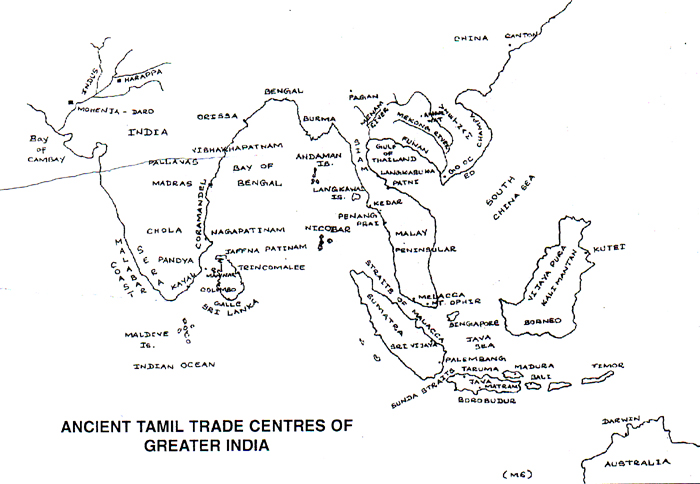
|
|
Chapter 5 - The Tamil Seaports of
the West Coast of Sri Lanka
King Bhuvanaka Bahu VII ruled the kingdom of
Kotte. There were nine ports of call for the import
and export trade. These ports were all situated on
the western sea board of his kingdom. The nine
ports of his kingdom were Kalpitiya, Chilaw,
Kammala, Negombo, Colombo, Beruwela, Galle,
Weligama and Matara. During his reign there was
smuggling in boys and girls, among other goods, to
the Malabar coast. On a complaint made by the king,
the King of Portugal Joao III, in a directive dated
13th March 1543 AD made the following decree.
To all who will see this document of mine, I
make known that I have been informed that many
ships and `champanas'(small boats), which leave
Ceilao, carry many boys and girls kidnapped in the
country from their parents, and many slaves
snatched from their owners, and much cinnamon, and
other goods smuggled out. Desirous to remedy this
as demanded by the service of God and mine own, I
order that in future all the ships and `champanas',
which are ready to set out from those ports, shall
first notify the King of Ceilao so that he may
arrange to have them searched to see if they are
taking any of the things stated above; and they
shall obtain a certificate from the king or
official appointed by him, stating that the search
has taken place. If they do not obtain such
certificate, they shall forfeit all the cargo in
favour of the 'Misericordia' of
Cochin'.(CC,p29,Vol:l). This proves that Sinhalese
boys and girls have been kidnapped and smuggled
across to Cochin, a sea port in the Tamil kingdom
of Sera.
At the time the Portuguese first visited Ceylon,
the north of Ceylon contained the kingdom of
Jaffnapattinam ruled by Sangili alias
Segarajasegaram, illegitimate son of King
Pararajasekeran,and a usurper to the throne. He
ruled the kingdom from 1519 to 1561 AD. According
to the Yalpana Vipava Malai, a Tamil chronicle, the
massacre of the Christians in the village of
Pattim, Mannar took place in the month of Adi
(July-August) of the cyclic year Khara which falls
in 1513-1532 AD. This appears to be incorrect. King
Manoel was king of Portugal till about 1539 AD.
There after King Joao III, was king. If the
massacre took place during their reign, it would
have been conveyed to them.
According to Father V.Perniola, who had access
to original documents from the archives and
libraries of Rome, Lisbon and Goa, states in his
book at the foot note at page 51, Vol: i of his
book The Catholic Church in Sri Lanka-The
Portuguese Period'is as follows:
' King Chekarasa Sekaran or Sangili had put to
death the Christians of Mannar. The inhabitants of
Mannar seem to have been baptised in October 1544
and put to death in November of the same year.
Xavier alludes to this killing in such a matter of
fact way as to imply that by the beginning of
December 1544 every one knew about it'.
St.Francis Xavier, who was responsible for the
conversions of the Kadeas in the village of Pattim,
Mannar, by his letter dated Cochin 18th December
1544 states that he was proceeding to meet Governor
Martin Afonso de Soyza of Goa to urge him to punish
King Sangili of Jaffnapattinam, for the massacre of
the Christians.(CC,p51,Vol: l).
The rightful heir to the throne,
Paranirupasingham fled to the opposite coast of
Kayalpattinam of South India with his retinue for
fear of his half brother Sangili who had murdered
two other princes to wrest the throne from his
father.(CC,p 54,Vol: i). In the meantime Sangili
had murdered the first converts to the Catholic
religion in Mannar which was part of his kingdom in
the year 1544 AD. Father Francis Xavier SJ returned
to Mannar and thence to Neduntivu (Delft) and
proceeded to Nagapatinam to take an expedition
against King Sangili. In the meantime a Portuguese
vessel coming from Pegu (Burma) laden with rich
cargo ran aground off the coast of Jaffnapattinam.
Sangili seized all the cargo on board.
In a letter written from Sao Thome (Madras)
dated 28th March 1546 AD by Miguel Ferreira to Loao
de Castro Governor of India informing him that he
met heir apparent to the throne of Jaffnapattinam
in Kayalpattinam (South India), and that the prince
together with his children, grandchildren and his
kith and kin would be baptised as Catholics if he
was made king.(CC,p 150,vol: i). The prince also
stated that Joao Fernandez Corea, Captain of the
fishery-coast (see map) had invited him to go on
board a vessel but had done nothing even after
receiving from him a diamond as a gift. The prince
also informed him that Martin Alfonso de Souza had
also invited him to go on board a ship and had
taken him up to Neduntievu and from there he sent
him back, after taking from him some pearls and
that now he had nothing else to offer. He also
alleged that Souza had taken a tribute of 5000
silver coins from Sangili and this prevented him
from putting him on the throne.(CC,p 147 Vol:
i).
Of Gay Kings & Priests
It is rather a matter of historical fact that
King Bhuvanaka Bahu III of Kotte wrote several
letters, which were in Portuguese ending as
follows: Please accept as true this document which
I have written-Svasti Sri'. This last sentence was
written in Tamil. This points to the fact that the
language of the court in Kotte was
Tamil.(CC,pp,185,186,251,260,262, Vol: i) In a
letter by the Portuguese of Ceylon to Joao de Casto
dated Ceylon, 27th November 1547 AD the Governor of
Goa speaks of the ' abominable crime' of the king
of Ceylon. The sin of sodomy is so prevalent in
this kingdom of Cota that it almost frightens us to
live here. And if one of the prominent men of the
kingdom is reproached for not being ashamed of such
an ugly vice, they reply that they do everything
that-they see their king doing, for this is the
custom'.(CC,p 239, Vol: i). A more direct
accusation is found against King Bhunanaka
Bahu viii on page 38, para 3 (CC,p 38,vol: i),
which reads as follows: For, this king was by
nature courteous, benign, affable, dutiful and
liberal and endowed with every other moral virtue,
with the exception of chastity, since he was a
slave to the unspeakable and abominable crime which
had been introduced into the island by his
predecessors , the Jangatres.' This according to
the foot note is referred to, elder in the
community of the monks'.(CC.p.38,vol: i).
Incidentally, this king was assassinated by his
Portuguese guard and it is alleged that Mayadunne,
king of Sitavaka was responsible for the
killing.(CC,p 294 pars 11,vol: i). After the death
of Bhuvanaka Bahu his nephew Dharmapala came on the
throne of Kotte. The triangular struggle for
supremacy among Dharmapala, Mayadunne and Vidiya
Bandara forced the hands of King Dharmapala to seek
the assistance of the Portuguese. Dharmapala and
his household received baptism and embraced the
Catholic faith. At the time of his baptism he took
the name of Dom Joao Parea Pandar in 1556 AD.
|
|
Chapter 6 - Dispersion of Tamils
to the West Coast of Sri Lanka
The Parava community of the fishery-coast in and
around Punnaikayal, of Tamil Nadu (see map), were
baptised by St. Francis Xavier and subsequently
they were shipped to Colombo and dispersed among
the Catholic community of the coastal regions from
Puttalam to Galle. The king of Madampe, Vidiya
Bandara ordered the Parava community living in his
kingdom to ' shave their beards and apply ashes on
their foreheads and become pagans again. They
courageously replied that they were ready to have
their heads cut off but that they would never
consent to do what they were asked. Then the king
agreed not to kill them, but imposed on them a fine
of about three hundred `pardaos' as a penalty for
their not complying with his orders'.(CC,p 346,vol:
i). The Paravas (Tamil) community of the
fishery-coast of South India and situated in and
around the Punney Kayal , were fishermen by
caste.
They were adept in fishing for pearl oysters and
chanks off the fishery-coast and during the season
converged in and around the village of Murungan, in
the Mannar district of Sri Lanka for the pearl
fisheries. The Careas or Karavas also of the
fishing caste community in South India,
subsequently found their way to the coastal regions
of the island of Ceylon and came under the
religious spell of the Catholic priests of the
Franciscans, Jesuits etc. In the year 1556 AD no
less than 70,000 of these Karavas living in the sea
ports of the island embraced the Catholic faith.
These Tamil Karavas or fishermen were living in
Kalpitiya,Chilaw, Kammala, Negombo, Colombo,
Beruwela, Galle, Welligama, and Matara.(CC,p 18
vol: i). ' The first to receive baptism was their
Captain, whom they call Patangati, which means that
he is, as it were their king .(CC,p 347,vol: i). It
is interesting to read the translation of the
original Portuguese document concerning the PARAVAS
(TAMILS) in Moratuwa in 1613 AD.
13. The Fathers left Colombo for Moroto, which
is a town in the direction of Galle, three Chingala
leagues, which are six Portuguese leagues, from the
city. There we have a church, which stands among
cool and dense woods. They arrived on a Saturday ,
and on a Sunday they said mass, all the people
coming to it with great devotion.
14. All here are Pareas (Paravas), which is the
same as fishermen, among whom I saw a wedding, the
ceremonies of which being novel, I shall describe
them. The company consists of all the friends and
relations, and to decline is the greatest affront.
The wedded pair come walking on white cloths, with
which the ground is successively carpeted. The
nearest relatives hold above them cloths of the
same kinds in the fashion of a canopy, thus
protecting them from the sun. The bride is carried
in the arms of the nearest relative, and, when this
one tires, another takes his place. The symbols
that they carry are the white discs and candles
lighted in the daytime, and certain shell which
they keep playing on in place of bagpipes. All
these are royal symbols, which the former kings
conceded to this race of people, that being
strangers they should inhabit the coasts of Ceilao
(Ceylon), and one but they or those to whom they
give leave can use them. They fish only in the
ocean, and not in the river, although it is nearer
than the sea. And not even in winter, inspite of
the pressing need in which they maybe, do they fish
in the river as they consider it a degradation. And
certainly , what causes wonder in this and in other
people of this kind is, that however wretched,
miserable and poor they may be, they have some
points of honour that they would rather die than go
contrary to'. (CC,p 375 & 376, vol: ii).
They say that comment is free but facts are
sacred, is true in the lives of these Tamil Karavas
who were domiciled by Sinhala kings from the time
of Parakramabahu VI (1410 AD), and more so during
the Portuguese occupation, where 70,000 Tamil
Karawas living on the nine sea ports from Puttalam
to Matara were baptised as Catholics.(CC,p 347 vol:
i). These Karavas who are numerous still carry on
the nuptial ceremonies as described above, with
variations, The only apparent factor that has
changed is that they now speak in Sinhala, their
adopted language, instead of their original mother
tongue Tamil. The Karavas (Tamils), who are now a
multitude, and perhaps 20% of the total Scintilla
population, could claim Tamil lineage if by some
quirk of fate Tamil language emerges as a
predominant factor in the politics of the
country.(Sir Lanka). It is an accepted fact , that
history repeats itself in the affairs of a country
from age to age and, it appears that the way has
been paved by the power hungry politicians to
hasten the process of political change of musical
chairs!
Karavas were also brought into the island by the
Singhalese King Parakramabahu VI, in the year 1410
AD to fight the Mukuwas in Chilaw over fishing
rights. The Karavas hailed from the eastern sea
board of the Tamil kingdom of the Cholas and
reputed to be good fighters. They too were settled
by the said king on the western coast of Ceylon
from Puttalam to Matara. These Karavas hailed from
the Coramandel coast of the south east coast of
Tamil Nadu. After defeating the Mukuvas in the sea
port of Puttalam, these Karavas were settled by the
king on the west coast of Ceylon at Puttalam,
Chilaw, Negombo, Mutuwal, Moratuwa, Panadura,
Kalutara and further down south. He gave them gems
and married them to Sinhalese goigama maidens to
secure their permanent services.(see map),(TS, p
108).These Karavas belong to three main
classes:
Kurukulasuriyas, Arasa or Mahinda
Kurukulasuriya and Varna Kurukulasuriyas
These are the house-names of the three different
classes. The Sinhalese never mention their
house-name (ge-names) e.g., Kingsley Mendis. It may
well be Kurukulasuriya Aratchilage Kingsley Mendis.
This would reveal the true Tamil Hindu extraction.
(Karavas of Ceylon Society & Culture
-M.D.Ragahvan, K.V.G.de Silva, Colombo).
Over the last five centuries these Tamil Karavas
living on the west coast of Sri Lanka would have
multiplied into about three million souls who are
now Sinhala, their adopted language, but carry the
'house-names' surreptitiously which would otherwise
betray their Tamil connections.
a) Sangili, the Valiant
In September 1560 AD an expedition to capture
Jaffna and dethrone King Sangili, left Goa under
the command of Dom Constantino de Braganza, viceroy
of Goa and was joined by bishop D.Jorge Themudo, of
Cochin under whose jurisdiction the Catholics of
Ceylon came under. On the 20th of November of the
said year the fleet anchored in front of Jaffna. An
altar was set up on an islet that was there and a
very devout mass to Our Lady was said, and a
general absolution was given to the soldiers before
the battle of Jaffna. Having landed on the mainland
the soldiers went on a rampage among the villagers
seeking food and treating them as if they were a
conquered people. On the same day there descended a
huge army of Sangili, King of Jaffnapattinam, and
all the soldiers were put to the sword and five
Franciscans killed while Bishop Don Jorge Temudo
miraculously escaped on foot and boarded a
Portuguese vessel. Two of the Fathers who were
preaching in the neighbouring villages were led
before king Sangili who got them stripped and
whipped with canes till they were bathed in
blood.
The king, though he acknowledged that they were
good men .Yet he ordered the heads of both of them
to be cut off because they spoke against the
pagodas.(Hindu temples). ' The place where these
servants of God were martyred and where formerly
stood the royal palace, is called COPAI'
(Kopay).(CC,p 367, vol: i) . All those who escaped
the wrath of Sangili escaped in their boats to the
island of Mannar, where there was already a church
dedicated to the mother of God by the earlier
converts. In Mannar they built a strong fort which
housed the priests and soldiers. As the Naique of
Tanjore of South India was constantly attacking the
Christian converts of the fishery-coast they too
escaped to the island of Mannar, which was occupied
by the Portuguese, in August 1560 AD. These
Christians belonged to the castes of the Paravas
and of the Kadeyars, Both belong to the fishing
community.
A few days later the Viceroy came with a fleet
from Mannar and attacked the capital Jaffnapattinam
and captured it with a loss of about ten Portuguese
soldiers. They could not hold the capital Jaffna as
the people turned against them and Sangili attacked
with an army and chased the Portuguese from their
capital.Some fled to their vessels and sailed back
to Mannar. Subsequently, the Portuguese entered
Jaffnapattinam as traders and after some time with
the permission of the king to build some houses
they surreptitiously built a fortress in the
jungle. While king Sangili, was hunting in the
jungle he was astonished to see a fortress. This
led to all out war where the inmates of the fort
were all massacred. According to the Yaripana
Vipava Malai, the king fell into a trap sprung by
Paranirupasingham the lawful heir to the throne who
sided the Portuguese and entrapped Sangili with the
assistance of Kaka Vannian. The King Sangili was
decapitated at the threshold of the Nallur
Kandasamy temple. This battle was fought in Nallur
the capital of the king.(YVM,p 45).
In the fishery-coast of Punniyerkayal the
Christians were constantly attacked by Viswanathan
of the Vijayanagar empire, who burnt the churches
and killed the Christians. In retaliation the
Portuguese sacked the Hindu temple at Truchendur a
place holy to the Hindus. Anticipating a massive
reprisal, the Portuguese summoned the Christian
Paravas and put to sea in 400 boats.(CC,p 119 &
120,vol: ii). These refugees after a difficult sea
journey arrived in Mannar. Hardly as these
Christians left the shores of the fisher-coast, the
Vijayanagar army finding the village empty went on
a spree in burning the houses and destroying all
Christian places of worship. The mass exodus to
Mannar took place in September 1591 AD.
After the death of Sangili Kumara, the
Portuguese put one Puviraja Pandaram alias
Pararajasekeran on the throne as their vassal. He,
like his predecessor, was scheming to overthrow the
foreign yoke. King Puviraja Pandaram chose to
attack Mannar during the season of the pearl
fisheries where all the Portuguese would be
supervising the pearl fisheries on the mainland
from Mantota, Aripu, Ponparepoemalle all the way to
Calpentyn island.
The king came with an army and landed at
Erukkilampiddy, on the east coast of Mannar before
sunrise, Seeing the Portuguese close by, he gave
orders to attack the fort, while he was having his
morning meals in a hut. The Portuguese on seeing
the enemy on both flanks attacked them with fury.
During the course of the battle the Tamil soldiers
found themselves in a position where they were
attacking their own men from either sides. The
Portuguese started to beat their drums and
reinforcements arrived and the Tamil soldiers were
pushed back towards the coast and they had no other
alternative but to jump into their boats and made
their escape inspite of the high tide. As the sea
was rough some of their boats sank and the men
stranded on the shores were killed. They had even
to rescue king Puviraja Pandaram from the coast of
Erukkilampiddy. It is stated that the king lost two
thousand men in the war which they had to abort due
to bad planning.(CC,120,121,vol: ii).
Soon after the attack of Mannar the Portuguese
obtained fresh reinforcements from Goa and Cochin
and invaded Jaffna under the command of Andre
Furtado de Medonca. The occupying Portuguese forces
then put on the throne prince Edirmanasinghe who
took on the name of Pararasekeran. Although a
stooge of the Portuguese, he carried on an
undercover campaign against the Catholic
missionaries and did not look with favour on
converts. In the days of this king the Portuguese
commenced to build Christian communities and
churches. Although the king was a Hindu he had no
other alternative but to allow conversions as they
were responsible in putting him on the throne.
b) Our Lady of Victory
A native Christian named Antino Fernandez
erected a straw hut on the spot where the invading
forces landed when they conquered the Jaffna
kingdom in 1591 AD. This hut became a church with
Father Fra Pedro de Christo in charge. He dedicated
the church in the name of Our Lady of Victory, as
memorial to the conquest of Jaffna. This church was
built about 1553 AD. In 1602 AD with the blessings
of the king the church was burnt to the ground when
Father Fra Francisco de Orient was away in Kayts to
build St. John's church. When the Father complained
to the king about the destruction of the church he
showed grief and the day after he accompanied his
men and appeared at the burnt church and supervised
the rebuilding of a new church, fearing reprisals
from the Viceroy of India. After twelve years the
Portuguese built a church of stone and lime and
named it Our Lady of Miracles, on account of the
many miracles wrought when the statue was being
made in the house of the craftsman.
The church was erected by Father Fra Pedro
Betancor. The new church was built on the spot
where a mosque was situated. The Portuguese saw
that the location of the mosque was an ideal place
for a church and burnt it down. When the Moors
complained to the King he pacified the Moors, who
then built a mosque elsewhere. Father Fra Pedro was
friendly with the king who helped him in his work.
The king even gave funds to their work and promised
them assistance when needed.'
In fulfilment of this promise, besides other
arms, the king gave them the island of Tanadiva
(Kayts), which he had donated to Father Fra Niculu
de Cruz, for the support of the same church and for
the upkeep of the boys school we have there. Father
Pedro was helped not only by the king but also by
other native chiefs, his friends, such as Sangili
Kumara, who for the same purpose donated the
village of Visavil and Laur (Ilaur), which formed
part of his patrimony.The Naique of Tanjore, gave
him another village on the gulf. With this royal
help the church and other buildings were built with
solid enclosures. The foundation stone to this
church of Our Lady of Miracles was laid on the 8th
day of May 1614 AD, on which day was the feast of
the glorious Ascension of Christ . This church is
situated down Bankshall street, Jaffna,(CC,p313
vol: II), even to this day.
c) Betrayal of Portuguese
' On the 2nd of August 1622, two queens, both
sisters and wives of the deceased King Para Raxa
Sagra (Pararajasekeran) were baptised, also one of
his daughters about twelve years old, and a large
number of people. They were received at our church
of Our Lady of Miracles when Father Fra Antonio de
S.Maria was rector there . The two queens and
daughter were baptised and were given the names of
Dona Clara da Silva and Don Antonio; the child was
called Dona Catherina. Their godfather was Filipe
de Oliveria'.(CC,p 59 vol:lll).
About April 1617 AD, Sangili Kumara a nephew of
King Pararajasekeran, usurphed the throne of
Jaffna, by killing the governor and many other
aspirants of the royal house. The rightful heir to
the throne a son of Pararajasekeran became a
catholic in Goa in the year 1633 AD, and took the
name of Fra Constantino de Christo, and he
renounced his claims to the kingdom of Jaffna. King
Sangili Kumara did not get the support of the
Portuguese . He then sought the assistance from his
kindred from the Naique of Tanjore,(South India),
but this too ended in failure. Eventually, the
Portuguese invaded Jaffna and annexed it in 1619
AD. With the fall of Jaffna the Portuguese removed
the children of Sangili Kumara and their kinsmen
and sent them to Goa.
The boys are being educated in the seminary of
the Three Kings. One of the daughters is staying in
the convent of Serra (St.Thomas, Madras) and
receives a pension. She would like to become a nun
in the convent of Santa Monica (Goa), for which the
king gave his permission and also authorised that
she be given a dowry so that the nuns may receive
her. The same should be done to the second daughter
as soon as she comes of age, for not only is the
embracing of this life more respectable since she
is of royal blood, but also because the King would
be free if she were not to marry, lest her
descendants should claim a right to the throne of
Jaffnapatao'. .The above is a letter sent by the
Viceroy of Goa to King Philip iii of Lisbon dated
'Goa, 13 December 1634'.(CC,p 223,224, vol: Ill).
Sister Maria da Visitacao, daughter of the King of
Jaffna, was elected the thirty third prioress of
the monastery of St. Monica in Goa in January 1682,
she died in April of the same year.
During the reign of king Sangili Kumara all
descendants of the royal families of Jaffna through
fear of the king and the designs of the Portuguese
, took refuge in the jungles of the Vanni.
d) Tamil- Muslims
The anti-Muslim riots of 1915 of Mawanella, the
riots of Hultsdorf, Galle, Beruwela and now a
repeat performance at Mawavnella has been labelled
as a 'Muslim ethnic problem'. This is far from the
truth. If one traces the history of the Muslims in
Sri Lanka it would be seen that they all hailed
from Keelaikarai, Kayalpattinam etc., of the
'fishery-coast' of South India.(Tamil Nadu).They
were all Tamils and Hindus and belonged to the
'Parava' community in the fishing industry diving
for chanks and pearls off the coast of
Kayalpattinam in South India and also involved in
the pearl fisheries in the Gulf of Mannar of Sri
Lanka.
' It cannot be denied that the Surfis were
responsible for the spread of Muslim culture among
the masses in various parts of India. The concept
of equality and brotherhood of men preached by the
Surfis attracted the lower classes of the Hindus
who were not allowed to read the scriptures or
enter the temples.'(p 423,History of
India-V.D.Mahajan). These Tamil Muslims,
subsequently embraced Islam and migrated as traders
to Puttalam, Chilaw, Mannar, Mawavanella etc., in
quest of greener pastures in Ceylon. The attacks on
the Muslims by the Sinhalese is based on 'the
have's and the have nots' and not that they are
Muslims. Like the Jews who were hounded and
massacred by Hitler's Germany as they had the
economy of the country in their hands, so also the
Sinhala government of Sri Lanka continues a
systematic attack on the Tamil-Muslims, from time
to time, to de-stabilise the economy of the
Tamil-Muslims with the sinister purpose of shifting
their trade to the Sinhalese.
The Mawanella debacle against the Tamil-Muslims,
and often engineered by the state, should come as a
'wake-up-call' for the Tamil-Muslims of Sri Lanka.
Let there be no mistake about this. They should
realise that they are first Tamils by nationality
and that their ploy by taking shelter under
'Muslims' as a thin veil to save their skins when
there is anti-Tamil riots in the country has been
exposed.
The Muslims in Sri Lanka are Tamils both by
virtue of their ethnicity and also by the language
they speak. The Muslims here should realise that
they are distinct from the Tamils only because of
their religion and should throw in their lot with
the Tamils wherein their future prosperity and
their survival hinges. There is no salvation for
the Muslims in Sri Lanka outside the pale of Tamil
Eelam.
|
|
Chapter 7 - Dutch Invasion (1658
- 1795 AD)
Rajasinghe II (1635-1687 AD), King of Kandy by
his letter to the Governor Charles Reynier dated
9th September 1636, addressed to his headquarters
at Paliacotta ,North of modern Madras, imploring
the Dutch to assist him in expelling the Portuguese
out of the island. The King promised in return to
permit the Dutch to erect a fortress either at
Kottiar or Trincomalee. This letter was handed over
to a Brahman, a Tamil Hindu, who lived in secret
for six months among the Portuguese at Jaffna till
an opportunity arose to cross over to the coast on
the opposite side of the Coromandel coast. After
crossing by boat he travelled by road to
Paliacotta, where he delivered the letter to the
Governor Charles Reyniers. In reply to the King's
letter the governor by his letter dated 20th
October 1637, stated that he was delighted by the
king's letter and that he was prepared to render
all assistance against their common enemy. He
requested to allow the Dutch to export cinnamon for
the exchange of muskets, gunpowder, ammunitions and
other arms.
King Rajasinghe by his letter dated 23rd
November 1637 and written from Binntenne, in the
Uva district, to Adam Westerworld the Dutch Admiral
of the East Indies, promising the Dutch all the
cinnamon that can be had and to hasten the attack
on the Portuguese fort at Batticoloa.
On 2nd of April 1638, commander Koster sailed
into Trincomalee harbour with three vessels, the
Texel, Amsterdam and Dolphin and anchored in the
harbour.
On 22nd of April 1638, Admiral Adam Westerworld
left Goa for Batticoloa with the ships Maestricht,
Harderwick, Rotterdam,Vere and the yacht Enchuyfen
with 800 men on board. On 10th of May of the same
year, the vessels sailed into Batticoloa and the
day following the men landed ashore and built
fortifications to lay siege on the Portuguese fort.
On the 18th of May 1638, the Dutch pounded the
Portuguese with their cannons. The Portuguese
finding the attack too much to their liking hoisted
the white flag and sertt two envoys to surrender.
Having surrendered the fort the entire Portuguese
force were all transported in a Dutch vessel to
Nagapatnam of South India. On 23rd May 1638 a
treaty was signed between King Rajasinghe II and
Admiral Westerworld of the Dutch East Indies.
Subsequent to signing the treaty the king delivered
400 bales of cinnamon, 87 quintals of wax and 3059
pounds of pepper to the Admiral. The king also sent
two of his men as ambassadors to Batavia in the
company of the Admiral.
On 22nd of February 1658, the island of Mannar
was surrendered to the Dutch. The Dutch army
marched through the Vanni and reached the banks of
the river at Elephant Pass. Having crossed the
river they marched through Chavakacheri, Navatkuli
and at a castle near a church at Chundikuli met
with resistance . Having defeated the Portuguese
the army advanced towards the fort, fighting from
street to street. The fort was besieged and due to
lack of water and provisions the Portuguese
surrendered after three and a half months with a
loss of 1600 men. On 23rd of June, Philip
Baladaeus, the Dutch missionary had a thanksgiving
service which was continued every year.
Soon after, while Baladaeus was preaching in
the church in the city of Jaffna the natives ( not
without the consent of king Rajasinghe) plotted the
murder of all Dutch officers in the castle. The
Dutch officers who were outside the church noticed
some Portuguese soldiers who had surrendered when
the city was captured, on the other side of the
church with their hands on their swords. The Dutch
soldiers suspecting an insurrection arrested the
Portuguese soldiers. The traitors were all rounded
up and confessed to the plot, some were hanged,
others were beheaded and some were laid upon the
wheel. The chief conspirators, a certain inhabitant
of Mannar, one Don Louys and another Portuguese,
these three were laid upon the wheel or cross, and
after they had received a stroke with an axe in the
neck and on the breast, had the entrails taken out
and the heart laid upon the mouth'.(EMC,p 798). The
heads of the ringleaders were fixed upon poles and
exhibited in the market place. According to Philip
Baladaeus, 'not long after most of the traitors
having confessed their crimes, some were condemned
to be hanged and some to be beheaded'.(EMC, vol: p
798 & 803).
Manipay and the Madappalis
Some of the conspirators hailed from the village
of Manipay of Jaffna and Baladaeus states,
' This place (Manipay), is inhabited by
several of the family of Madappalis who were
concerned in the plot with Don Louys'.(EMC,
vol:iii,p803). These Madappalis are descendants
of the Kings of Jaffna some of whom were baptised
into the Roman Catholic religion by the
missionaries and hence owed allegiance to the
Portuguese. According to the Yalpana Vipava
Malai, a Tamil chronicle, the title 'Madappalis'
was originally conferred to the stepbrother of
Sangili the usurper, to appease the disappointed
heir to the throne of Jaffna. This title connotes
that they were the rulers of 500 villages, a
settlement enforced on the legitimate aspirant to
the throne, by Sangili.(YVM,p 47).
The seven sons of Prince Paranirupasingham alias
Pararajasekeran, the legitimate heir apparent to
the throne of Jaffna, were given the title of
'Raja' or 'Kumara' Madapallis and made chiefs of
seven districts in Jaffna. During the Dutch period
certain persons purchased the title of `Madappalis'
for large sums of money from the Dutch, and these
persons were known as' Sangu Madapallis'. Mudaliyar
C.Rasanayagam in his book' Ancient Jaffna' states,
' The Vaiyapadel says that Madapallis were migrants
and colonists. As the Kings of Jaffna were
Kalingas, their dscendents too were called
Madapallis and given the epithet 'Raja' or Kumara'
in order to distinguish them from the rest.
Although the princes of Jaffna took their wives
from Vellala families and their daughters too were
often married among the Vellalas, the Madapallis on
account of their royal origins considered
themselves higher than the Vellalas'. The Dutch
Governor Van Rhee of Ceylon, had this to say in
1697 of the Madapallis. ' I think it necessary to
state that a bitter and irreconcilable hatred has
always existed in Jaffnapattinam between the caste
of the Vellalas and the Madapallis so that they may
not be elevated in rank and the offices of honour
one above the other. For these reasons the two
writers of the commander are taken from these two
castes so that one of them is a Vellala and the
other a Madapalli'.(AJ,p 390).
According to J.P.Lewis (ex Ceylon Civil
Service), in his book, A Manual of the Vanni
Districts, Ceylon' states, 'It will be seen from
the list that some castes have quite disappeared
since 1817, and others have much diminished in
numbers. The Madapalli people, though they numbered
150 in 1817, are now only represented by one
solitary person'.(MVD,p 83). His computation of the
Madapallis is that in 1817 there were 92 Madapallis
while in 1890, only one remained in Vavuniya, in
1817 there were 60 Madapallis and in 1890 there
were none in Mullaitivu. There is no record to
substantiate as to when and how many of the
Madapallis migrated to the Vanni. But according to
the census taken by the British government there
were 152 Madapallis in the Vanni..(see EMC, vol: p
798 & 803).
During the Portuguese occupation the Madapallis
fled Manipay to the Vanni in fear of persecution by
the Dutch who were governing Ceylon at that time,
due to their collusion with the Portuguese to
overthrow the Dutch in the kingdom of
Jaffnapattinam, in 1658. However, it would appear
in 1890 according to the census there was only one
Madapalli in Vavuniya and none in Muffaitevu. The
only logical inference is that the Dutch government
of Ceylon would have softened its stance where they
were concerned and hence the Madapallis trekked
back to their original home in Manipay. During the
Dutch period a few of the Madapallis renounced
Hinduism and embraced the Dutch Reformed religion
and became Christians. The publication of the book,
'Maniampathier Santhathimurai- A Genealogy of the
Residents of Manipay & Related Inhabitancies'
by Srimath T.Vinasithamby, (MS), compiled in 1902
AD, contains the genealogy of over seventy families
some of whom were the descendents of the Kings of
Jaffna, known as Madappali, and referred to by
Philip Baladaeus, the Dutch missionary of 1672
AD.(EMC).
|
|
Chapter 8 - Vanni: the Adanka
Pattu
The chequered history of the Vanni during the
ancient Kings of Ceylon and the period of foreign
occupation could be better understood in the words
of Tennent. Of its history no satisfactory record
survives, beyond the ascertained fact that, after
the withdrawal of the Sinhalese sovereigns from
their Northern Capitals in the fourteenth century,
and the abandonment of their deserted country to
the Malabars, the latter disorganised and
distracted in turn by the ruin they themselves had
made, were broken up into small principalities
under semi-independent chiefs, and of these the
Vanni was one of the last that survived the general
decay.'
Be that as it may, the wilds of the Vanni were
never tamed by either the Tamil or Sinhalese Kings.
It was a buffer-state to both these kingdoms from
time immemorial and it was referred to as the '
ADANKAPATTU', the rebellious state. The Vanni was
colonised by Tamil colonists from Southern India by
the Kings of Jaffnapattinam. They consisted of all
castes from Vellalas. During times of war, whether
caused by internal dissension or external threats,
the Kings of Jaffna found the Vanni as a safe haven
of refuge. They hid their crown jewels in the wilds
of the Vanni when there were any signs of war. A
relic of the past has been recorded by Lewis as
follows:
The division of" Cheddikulam' is said to have
been colonised previous to this in Kaliyuga 3348 by
a Chetty from Madura, who with some Parava pearl
fishers had been wrecked on the coast of
Ceylon'.(MVD,p 12). It is also stated that the
Portuguese occupied Cheddikulam and that some of
the old maps has-the place marked as
'Parangicheddikulam'. According to the Yalpana
Vaipava Malai, Kulakkodan Maharajah of Kaveri came
to Ceylon in 436 AD, on a pilgrimage to Trincomalee
and Tampalakaman and repaired the temple at the
latter place.
He then cultivated seven large tracts of land
and planted all kinds of fruits and established
fertile fields. Having done this he got down
Vanniyas from the coast of South India and placed
them in charge of these cultivations to upkeep the
temples from the income from these fields and the
fruit groves. As waring Turkey was the 'sick-man of
Europe',so too were the Vanniyars a thorn on the
side of the Kings of Jaffna and Kandy. During the
reign of Varotaya Singhai Ariyan alias
Segarajasegaren (1302 AD), as the Vanniyars were
inciting the Sinhalese subjects in the
Jaffnapattinam to rise in revolt, the Tamil King
Segarajasekeran succeeded in reducing them to
subjection 'rapine and plunder'.The Sinhalese King
declined to assist the Vanniyars in their campaign
against the King of Jaffnapattinam. The Vannis then
made peace with their neighbours but had to pay
tribute to the King of Jaffnapattinam.
With the capture of the kingdom by the
Portuguese, the Vanni was under their control and
'Parangichetticulam' of the Vanni may have been the
fort of the Portuguese. With the arrival of the
Dutch on the scene they were only able to exact
yearly tribute of 42 elephants. About the year 1782
the continued conflicts came to an end when the
Dutch once and for all defeated the Vanniyars.
Every foreign power found the Vanniyars a
formidable foe and this could be explained in the
words of Lewi, It is characteristic of the spirit
of this people that the Dutch met nowhere a more
determined resistance than from one of the native
princesses, the Vannichi Maria Sembatte, whom they
were obliged to carry away as prisoner, and to
detain in captivity in the fort of Co/ombo'.(MVD,p
17 & 18 ).
The Vanniyars, thence commenced to live a wild
and marauding life and carried on a predatory
warfare against the Dutch in Mannar and Trincomalee
and even penetrated to the Jaffna Peninsula. The
Dutch had to build forts along the river to keep
them at bay. Even with the advent of the British
Pandara Vanniyan started a revolt to expel them
from his district with the assistance of the
Kandyans. He attacked the government house in
Mullaitevu and drove out the garrison which was
under the command of one Captain Drieberg and
seized the fort. The victory of the Vanniyars was
short lived. Three detachments from Jaffna , Mannar
and Trincomalee were despatched and the Vanniyars
were defeated in the Mannar district.. Although
Pandara Vanniyan was active again his grandiose
scheme to rule the Vanni faded away.
Even today the spirit of the Vanniyars is more
apparent in the fight for freedom of the Tamil
people. Here again one sees that the Vanni has
answered the call of the Tamil people in their
quest for liberty and freedom from the Sinhalese.
It is also stated that the Vanniyars had sent some
of their people to the French at Pondichery in
South India promising to assist their missionaries
and the Christians to overthrow the Dutch.
|
|
Chapter 9 - Fall of Colombo and
Dutch Plakkart
The Dutch forces captured Colombo on the 12th of
May 1656 and consolidated their positions on the
maritime provinces of the western sea board of
Ceylon. The fort of Jaffna fell to the Dutch when
the Portuguese were virtually starved into
submission on the 22nd of May 1658.
With the fall of Jaffna, the Catholic priests
fled to Puttalam which was in the territory of the
King of Kandy, Rajasinghe II. During this period
the Catholics were without priests and the practice
of the rituals of the church was unheard of and
there was a proclivity of the faithful to fall to
the inroads of the new Dutch Reformed religion It
was during this period Father Joseph Vaz fired with
religious zeal left Mangalore to Jaffna. His
journey was fraught with many a mishap.
He eventually landed in Mannar and dressed like
a beggar entered Jaffna, where he was fed by devout
Catholics. Sick unto death due to lack of food and
the inherent danger of falling into the hands of
the Dutch, he was secretly shifted to the village
of Sillalai, 10 miles from Jaffna where in a chapel
built by the Portuguese he instructed the villagers
in the Christian doctrine of the Roman Catholic
Church.. To counter the work of the Catholics, the
Dutch appointed one Hendrick Adrian ven Rheede as
High Commissioner of Bengal, Coromandel, Ceylon
etc.
He ordered all Catholics priests to leave his
domain, but this fell on deaf ears. Infuriated by
the temerity of the priests , Rheede ordered all
Catholics attending Christmas mass to be dealt
severely. 'Those infernal wolves, divided into
three squads, made for the houses where the flock
of Christ was gathered in adoration before the Lamb
in the cave called Bethlehem. They came upon them
by surprise and gave vent to their greed and anger.
Without any consideration they stripped naked all,
even the women who had put on their best dresses
for the feast. They seized and flogged them without
regard to age or sex'.(CCD, p 56, vol: i). Father
Vaz escaped the onslaught and fled to Puttalam in
1692. He was followed by Father Braganza ,who too,
could not withstand the persecution by the
Dutch.
They both began to do mission work with renewed
zeal among the inhabitants of whom the majority
were 'Mukuvas' who were of low caste and hailed
from South India.(Malabar). With the issue of the
'Plakkaat' by Ryclof van Goens in 1659 enforcing
that the Dutch language be used instead of
Portuguese, and the subsequent order of 1682
prohibiting the practice and preaching of the
Catholic religion Father Vaz entered Kandy to
perform his missionary work. Here he was captured
and put into prison. An influential person in the
court of Kandy saw to it that he was released from
prison and allowed to practice his religion south
of the Mahaveli ganga, on the orders of King
Rajasinhe II. Father Joseph Vaz, (Brahmin), was
appointed Vicar General for Ceylon for his devoted
work in propagating the faith for ten years in the
realm of the Kandyan kingdom that included
Trincomalee, Batticolao. Kottiar, Vanny and
Puttalam. Sixty years later the Dutch predators put
a stop to the Portuguese missionary work.
' During the reign of Sri Vijaya Rajasinghe of
Kandy in 1746 he seized the missionaries,
confiscated their property, ill-treated them in
various ways, and finally expelled them from his
realms with orders under pain of death not to
return to his domains'.(CCD, p 4 vol: III). The
Dutch were behind the actions of the King having
bribed his ministers and the Buddhist clergy. The
missionaries sought shelter in the land of the
Vanny. With the death of the King, his brother
Kirti Sri Rajasinghe came on the throne. The
Portuguese missionaries saw a ray of hope with the
new king. A Moor physician, Gopala Mudaliyar was
bribed with ten gold coins who spoke to the king
and obtained permission for Fathers Mathias
Rodrigues and Alexander Manuel to enter his
territories and carry on with their work of the
mission. The gold coins that were mentioned by the
Dutch had a name of a South Indian temple on one
side of the coin and a image of God Vishnu on the
other weighing 3.4 grams.(CCD, p 10,vol:111).
Having entered Kandy they obtained the services of
the King's father NARENAPPA NAYAKKAR, having bribed
him with thirty gold coins, to speak to the son to
obtain permission to preach in the Kandyan
kingdom.
During this period the Christians in Vanny were
persecuted by the ruler of the Vanny. He issued an
order that the Catholics should confine their
religious practices only in the village of MADHU,
where Father Pedro Eerrao had built a church. Madhu
church has been a sanctuary to all refugees from
that time onwards.This shrine is considered the
Lourdes of Sri Lanka.
|
|
Chapter 10 - Tamil from Putalam to
Galle
It is interesting to note that Tamil was taught
from Puttalam to Galle. The foregoing is taken from
page 131, vol: iii of CCD. ' Some country
schoolmasters and the 'tomboy register of births
& deaths) holders reported that the following
Church members had gone over to the Roman Catholic
church and had their marriages solemnised by Roman
Catholic priest, ie., Joseph Pieris 'Pattangatyn'
namely Joan Fernando, Simon Fernando, Lourenz
Fernando, Anthony Pieris, Julian Fernando, Johanna
Fernando, Manuel Zoysa (all of Negombo), Francisco
Pieris, and Don Diego (both of Hunupitiya),
Sattabigey Saloman Fernando(former assistant master
of Maggona), and Angela Fernando'. The above
persons are all Karava Tamils who hailed from the
fishery-coast of Kayalpattinam of South India and
migrated from time to time by the ingenuity of the
Portuguese to propagate Tamils of Catholic
persuasion in the western coastal regions of
Ceylon.
The Dutch by a special order dated 9th April
1774 of Colombo, made the Catholic priests by a
deed of allegiance to the Dutch Company, before the
Commander or the Chief of their respective
districts or before the `dessave' in Colombo and
this declaration was preserved in at the Colombo
secretariat.(CCD, pp 302,303 vol: III). Thirty nine
Catholic priests of Jaffna and Kalpitiya down the
coast to Galle made the declaration in Tamil. On
5th October 1767, on a complaint lodged by Joan de
Silva, the Tamil Roman Catholic schoolmaster at
Colombo said that he was obstructed in his teaching
duties by those of the Reformed religion.(CCD, p
328,vol:III).
By a `Plakkaat, the Dutch published in the 1778
in Tamil, conditions under which persons could
marry whether they belonged to the Catholic church
or the Reformed Church and attaching certain
penalties for failure to abide by the order. This
was a general restriction for marriages and birth
of persons in so far as the issue of a certificate
was concerned at baptism, and solemnisation of
weddings as stipulated in the order.
|
|
Chapter 11 - British Occupation
(1793 - 1948 AD)
With the fall of
Trincomalee;Mannar,Galle,Colombo and Jaffna to the
British, Governor Sir Robert Brownrigg declared war
on the Kandyan kingdom on January 10th, 1815 AD.
The Kandyan kingdom was ruled by a Tamil from
Pandya, of Tamil Nadu, by the name of Kannusamy
alias Sri Wickrama Rajasinghe. When John D'Oyle
entered the city of Kandy with the British troops,
Kandy was in flames. The city was deserted except
for a few stray dogs who greeted the
conquerors.
With the fall of the Kandyan kingdom and the
subsequent capture of Sri Wickrama Rajasinghe,
Britain became the undisputed owners of the island
of Ceylon.
On 2nd of March 1815 AD, the Kandyan Convention
was held and a treaty was signed whereby the said
kingdom was surrendered to the British Crown. This
unique treaty was not signed by the deposed King.
Sri Wickrama Rajasinghe but by members of his court
and other dignitaries of the Kandyan kingdom.
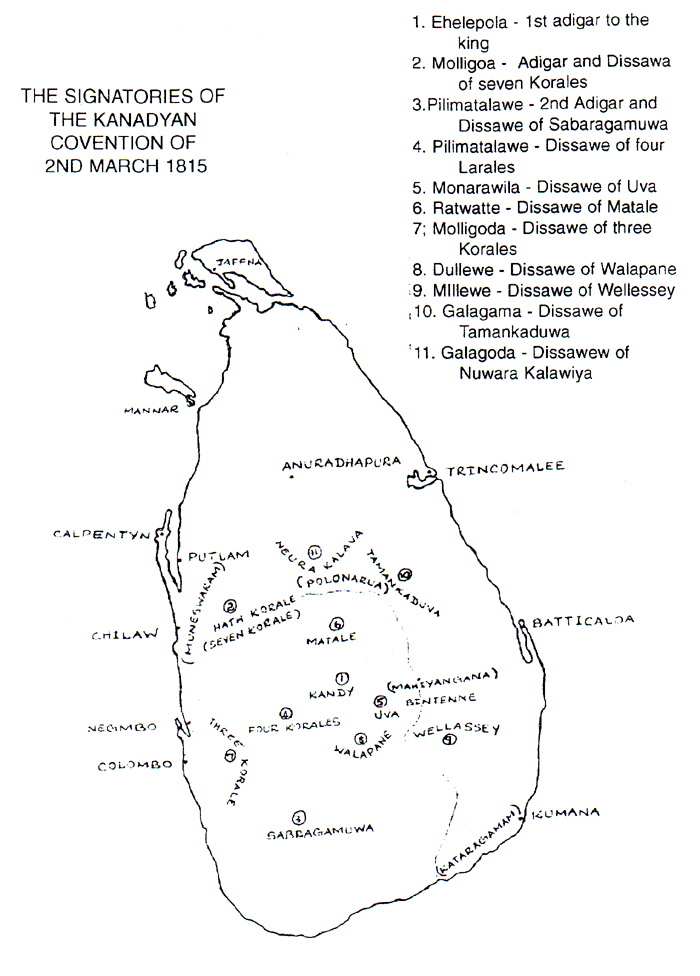
As it was reported that the treaty was signed in
Tamil, I was eager to obtain a copy of the treaty.
The Public Record Office of The National Archives
of U.K. was contacted, who in return requested me
to contact the Director of National Archives of Sri
Lanka. Through a personal friend of mine, the
archives were contacted but they refused to give a
copy, perhaps due to obvious reasons. However, I
obtained a paper cutting from a Sri Lankan
newspaper where K.D.G.Wimalaratne, the then
Assistant Director of the Sri Lankan Archives had
published an article under the heading, 'When we
signed away our sovreginity.The relevant para is
re-produced as follows:
Who were the signatories to the Convention?
Governor Brownrigg signed first on behalf of the
King of Britain. On behalf of the people the
following chiefs signed in the order mentioned
below.
1. EHELEPOLA in Tamil
2. MOLLIGODA,first Adigar and Dissawe of seven
Korales in Sinhalese.
3. PILIMATALAWE,second Adigar and Dissawe of
Sabragamuwa in Tamil.
4. PILIMATALAWE, Dissawe of four Korales in
Tamil
5. MONORAWILA, Dissawe of Uva in Sinhalese
6. RATWATTE,Dissawe of Matale in Tamil
7. MOLLIGODA, Dissawe of the three Korales in
Sinhalese and Tamil
8. DULL EWE, Dissawe of Walpane in Sinhalese
and Tamil
9. MILLEWE, Dissawe of Wellesse and Bintenne
in Sinhalese and Tamil
10. GALAGAMA,Dissawe of Tamankaduwa in
Sinhalese
11. GALAGODA,Dissawe of Nuwara-Kalawiya in
Sinhalese'.
There were 12 signatories to the Kandyan
Convention of 2nd March 1815 AD and signed in the
following languages:
a. One signature in English (Brownrigg -
Governor).
b. Four signed in Tamil.
c. Three signed in Tamil and Sinhalese.
d. Four signed in Sinhalese.
Of the four who signed in Tamil one was RATWATTE
Disawe of Matale. To subscribe a signature to such
an important document in Tamil would give one an
impression that either he was a Portuguese married
to a Tamil, a Tamil or of Tamil extraction. The
Ratwatte's of Sri Lanka are well known by their
fair complexion, perhaps the mingling of foreign
blood. The present President Chandrika
Bandraranaike belongs to the Ratwatte clan. As
reported in the Sunday Leader newspaper of 18.10.98
the present Bandaranaikes trace their ancestry to a
SUSANNE SCHARFF daughter of Lieutenant Jan
Christoffel Scharff, who served in the Dutch East
India Company and hailed from Sangerhausen, Upper
Saxony Thuringia, Germany. He married one Elizabeth
de Saram in Colombo on 21st March 1734. An extract
of the said Newspaper is given below:
'Our prime minister's (S.W.R.D. Bandaranaike)
direct male ancestor, of whose connection some
members of his family used to take pride (see
Twentieth Century Impressions of Ceylon edited by
Arnold Wright, (1907) p,525) was NILAPERUMAL, a
Tamil from south India who arrived in Ceylon in the
late fifteenth or early sixteenth century. He was
described as a 'high priest' of a temple in Ceylon.
He was the first kapurala in his family of the
Nawagomuwe dewale, with the fortunes of which the
Bandaranayakes were long associated. Kalukapuge was
a name which the family used to effect in the past.
It is the Sinhalese version of the Nilaperumalge,
the ge name of the Bandaranayakes'.
The Kandyan treaty or the Kandyan Convention
consisted of 12 articles transferring the
sovereignty of the Kandyan kingdom to Britian. It
guaranteed to preserve the political and religious
institutions of the island of Ceylon.
It is rather intriguing to note at page 392 of
Pundit Dr.Nandasena Wijesekera's book, 'The
Sinhalese' the following is recorded. '.... TIGER
flag represented the WELLASSEY DISSAWE and also
HATH KORALE' (ZS). It is not a coincidence that the
districts of Welassey and Hath Korales flew the
'Tiger' flag as the residents were Tamils and owed
their allegiance to their original home of the
Cholas of South India. The fact that Tamils lived
in the said districts cannot be disputed. No
Sinhalese will ever dare fly the Tiger flag, unless
he is a Tamil. The residents of 'Wellassey' and
'Hath Korales' flew the Tiger flag during the reign
of the Tamil King Sri Wickrama Rajasinghe in 1815
AD, were undoubtedly Tamils. Since 1815 due to
political expediency and compulsion of successive
Sinhala governments by draconian laws, these Tamils
adopted the Sinhala language.This pattern was seen
in the west coast of the island from Puttalam right
down to the southern extremity of the country. A
search in the land registry of these districts
would reveal that the title deeds have been written
in Tamil. This goes to prove that the civil
administration of these districts was in Tamil and
ruled by Tamil kings.
It is a trajedy that cloning of ' Nilaperumal'
of Malabar (Tamil) with ' Sussane Scharf ' of
Germany has resulted in the massacre of thousands
of Tamils in Sri Lanka. This unholy alliance which
has come to us like the 'hound of the
Baskervilles', in a vicious circle, and spawned by
the abject greed of the ' Pandaram Nayakers'
(Bandaranaikes), to cling on to political power at
the cost of human life. Sacrificing birds, animals
and human life is a national trait of the Sinhala
Buddhists to achieve their diabolical ends. The
practice of magic came into the teachings of
Buddhism during the reign of King Sena 1, in 887
AD.(CV, ch;84;7-17). According to B.C.Law, on the
chronicles of Ceylon states, Paritta Texts were
also works on ritual and magic'.(ZCC,9 71). They
say that old habits die hard!
The Sri Lankan map on the opposite page, shows
the location of the eleven signatories to the
Kandyan Convention. They were rulers of the revenue
districts for the sole purpose of maintaining law
and order and for collecting revenue for the king.
These appointments were made at the express command
of king Sri Wickrama Rajasinghe alias Kannusamy.
The two districts viz Hath Korale on the west of
the country and the other Wellassey on the south
east of the country was a strategically important
to the King of Kandy. Through these districts the
king had access to the sea ports of Batticola on
the east coast and Chilaw on the west coast for
trade and commerce.
During the reign of Tamil King Elara (145 BC),
of Ceylon who ruled from Polnnaruwa, Maiyangane was
his military outpost. King Elara was a prince from
the house of the Imperial Cholas of South India.
During his reign he settled men from the kingdom of
the Cholas in and around Polnnaruwa, Anuradhapura
etc. These Tamils went on pilgrimages to the Hindu
kovil at Katargamam on the Southern extremity of
the country. There were Tamil Brahmans officiating
as priests at this temple. They livid with their
families and a whole colony of Tamils sprang up at
Katargamam. Katargamam was and is part of the Tamil
homeland and the southern boundary of the district
of Wellassey. On the west coast of the country is
the famous Muneswaram Hindi Temple and its environ
which also became a strong hold of the Tamils. This
was home for hodes of Tamils from south India. This
falls within the district of 'Hath Korale' which
was under the control of the king of Kandy.Both
districts 'Hath Korale' and 'Wellassay' flew the
TIGER flag an emblem of the Imperial Cholas and now
of the Liberation Tigers of Tamil Eelam.The Dutch
in a campaign of internal persecution and saw to it
that the Catholic church and its adherents and
priests were given a hard time with a view to
giving it a body blow so that their faith was
obliterated from the island. All this was not to
be.
A glimmer of hope was seen in the intrusion of
another foreign country which had the same greed to
convert the riches of the island to itself. With
the fall of Trincomalee on 20th of August 1795 and
Colombo on 16th February 1796 to the British, the
Catholic church was given freedom of worship by a
proclamation dated 3rd August 1796. This freedom of
worship was extended to all other religions
practised in the island whether Christian or
pagan.
The Portuguese were directly responsible for the
mass exodus of Tamils of the Karava and Parava
castes from the fishery-coast of Punniyakayal, of
South India to the west coast of Ceylon.(CC, p
346,347,vol:l). They were all Catholics by
conversion. Their intention was to have a Catholic
community living on the fringe of the location
where there were spices. Their intentions was that
this would expose them to learn the methods adapted
by the natives in their cultivation and harvesting.
They felt that these expatriates were under their
power and more amenable to their control to obtain
optimum benefit in financial returns and a bulwark
against the pagans.
The Roman Catholic Portuguese did more damage to
the country by the destruction of many places of
worship revered by those of the Hindu and Buddhist
fraternity, whom they called pagans. The cruelty
and torture perpetrated by them have been well
documented . One cannot comprehend how nations
professing Christ as their Saviour, who taught all
men to 'love his neighbour', killed each other and
the local population which such impunity at the
sight of the treasures of the island. They came
with the sword in one hand and the Bible in the
other, and when they saw the riches of the island
they jettisoned the Bible to fill their pockets
with the aid of the sword. Even in this day and
age, we find them following the age old practise of
fostering those who have taken up the sword to kill
his neighbour rather than loving his fellowmen.
They have all contravened God's first commandment
Thou shall not kill'.
|
Chapter 12 - 'Yellow Robes' and
the Temples of Doom
'The first panacea for a mismanaged Nation is
inflation of the currency; the second is WAR.
Both bring temporary prosperity, both bring
permanent RUIN. But both are the refuge of
political and economic opportunists' - Ernest
Hemingway
The Sinhala chronicles of the Mahavamsa,
Culavamsa, Dipawansa etc., record among other
things, primarily financial assistance bestowed by
the monarchy to the Buddhist Sangha from time to
time. With the inception of the Sangha in the
island of Ceylon, the Buddhist priests who were
mendicants in so far as their food and garments
were concerned relied on the benevolence first on
the ruling King and the people at large, in keeping
with the teachings of the Hindu philosopher and
teacher called Siddhartha Gautama who became the
renowned Buddha.
In the epigraphical survey undertaken by Dr.
Muller, Professor of Oriental Philology at the
University of Berne, H.C.P.Bell Archaeological
Commissioner of Ceylon, etc., there is evidence
even to this day that the alms, caves, lands etc.,
were bestowed by the Kings of Ceylon on the Sangha.
This has been engraved on rock stones which were
lying scattered at Jetavanarama in Anuradhapura,
Vessagiri inscriptions, slab-inscriptions of
Kassapa v, Mihintale rock-inscriptions of Mahinda
iv etc. (EZ). This was the plight of the Buddhist
clergy from the beginning of Buddhism in the
island.
The Sangha was surviving on the acts of charity
both by king and people. They were dedicated men
with a mission of preaching to mankind the path to
nirvana or enlightenment, as preached by Buddha .
Hence they were mendicants when it came to food and
clothing. As for shelter, the country was replete
with stone caves which they found adequate to carry
on their meditation without impinging on the
comfort and riches of the villages or towns. This
was in keeping with the volt-face of Gautama
Buddha, who abandoned the palace, his wife and
child to seek an end to suffering and pain in the
woods of Uruwela.
King Devanampiyatissa is credited with the
receipt of envoys also with the gift of the true
doctrine' from Dharma Asoka of Pataliputta in the
year 247 BC,(MV, p 78 & 79). From 247 BC upto
568 AD of the inception of the reign of King
Aggabodhi, the Sangha were pampered by a total of
79 ruling kings with lands to build temples and
lands, to obtain produce for the upkeep of the
temples and monasteries for a period of 815
years.
It was during the reign of Aggabodhi I (568-601
AD), to the present era where the King allowed his
Chief Buddhist Priest Dathasiva to run the country
by influencing the reigning
Monarch.(CV,cht:42,line22 & cht:57,lines 23
& 39) This is the beginning of the political
influence of the Bhikkus'. A positive reference to
the political influence appears in chapter 57 of
the Sinhala chronicle Culavamsa as follows. Since
the time of King Mana (676-711 AD), the sovereigns
of Lanka act according to the counsel of the
Bhikkus, who hold the leading position'.
(CV,cht:57,p23-39). Since the 7th century the
Bhikkus have become landed proprietors and affluent
enough to dole out the necessities of life to the
villagers in and around their temple dwellings.
From mendicants to feudal lords, they have imposed
their power on the masses of the Buddhist people
living around them. Hence there was a subtle shift
of the balance of power from loyalties to the King
to the Bhikkus. This had political ramifications to
the ruling King and this shift had flowed like a
fount since the 7th century to this day.
The Senior High Priests of the Malwatte and
Asgiriya Chapters jointly control about 15,000
Buddhist temples in Sri Lanka comprising of about
14 million Sinhala Buddhists. These High Priests
vehemently object to any proposals brought forward
by any political party to grant any concessions to
the minority Tamils. Instead, they have challenged
the incumbent President of the country that they
would supply 20,000 youth to intensify the war
against the Tamil Tigers. It is apparent that there
is not a single person belonging to the families of
the parliamentarians of Sri Lanka or any Buddhist
Priest in the war front to fight the so-called
'Tamil Tigers'. These war mongers in 'yellow robes'
instead of exploring peaceful means, as their Lord
Buddha expounded, are instrumental for the death of
hundreds by sending smoke signals from their
temples. The rest of the Buddhist world who
attribute mildness and meekness to Buddhism, are
shocked and appalled at the Sri Lankan Buddhist
priests who are openly desecrating the Triple Gem'
of the Buddha, Dhamma, and the Sangha.
Today, in Sri Lanka religion has become the
'opium of the people' .The Bhikkus are seen leading
political rallies and demonstrations and meddling
in the governance of the country. The Bhikkus have
become Priest-Kings' in the country and dictate to
the ruling government of the day of how the country
should be run, specially where the minority Tamils
are concerned. This unBuddhistic attitude of the
Bhikkus towards the Tamils comes down to us from
the time before the Sinhala chronicles were written
down from the so called 'atha kathas'(true
stories). It is alleged that Buddhist temples have
become 'temples-of -doom', where they are used as
mustering points for cajoling sons of poor
villagers in the South of the country, to serve in
the armed services to fight the Tamil Tigers of
Tamil Eelam. Instead of preaching the way of peace
and advocating against hurting or killing fellow
human beings, as their Lord Buddha professed, the
National Sangha Council are sounding war drums and
sacrificing innocent village youth as cannon fodder
to achieve the unachievable. The history of the
present conflict has shown that soldiers are being
returned to their villages in body-bags, others
missing in action and thousands sans hands, sans
legs and sans everything.
This is reminiscent of the role played by Kings
and priests in the history of the western world,
where the masses suffered as a result of the power
struggle between priests and kings where murder and
mayhem was the order of the day. In the spirit of
it's times Denis Diderot wrote, 'Men will never be
free until the last king is strangled with the
entrails of the last priest'. This sadly captures
the tragedy of our times.
Does this not mean anything to those who have
propagated this war, whether Priests,Press or
People in high places? Perhaps they are thinking in
terms of 'Billeta Thenava'-human sacrifice, to
achieve their evil designs. Billions of dollars
loaned by the World Banks for irrigation works have
been channelled to prosecute the war efforts and
that too on their very own people.(BD, p 68 &
69).
Dr. Olga Mendis (OAM),in her book, 'The story of
the Sri Lankans (SS,p472), states,' 'The Indian
High Commissioner had informed Delhi that the
Mossad was training in Sri Lanka. This is
incorrect. Training was by Shin Bet the Israeli
Internal Security Services. Israel sold
sophisticated fire arms such as Uzis, mini Uzis ,
and Dvroa Fast Attack craft to the Navy'. The
Doctor should read the book ' By Way of Deception'
by Victor Ostrovsky where he writes his foreword,
'Revealing the facts as I know them from my vantage
point of four years inside Mossad was by no means
an easy task'. Here is a Mossad Officer who had
defected to Canada speaking the truth about the
working system of the Mossad. He says, I was elated
when I was chosen and granted the privilege to join
what I considered to be the elite team of the
Mossad'. But he further adds, out of love for
Israel as a free and just country that I am laying
my life on the line by so doing, facing up to those
who took upon themselves to turn the Zionist dream
into the present-day nightmare'.(SS).
The Tamil Tigers and the Sri Lankan Security
forces have found a place in his book. Victor says
at page 67, 'Amy Yaar made the connection then tied
the country in militarily by supplying it with
substantial equipment including PT.boats for
coastal patrol. At the same time, Yaar and company
were supplying the warring Tamils with anti-P.T.,
boat equipment to use in fighting the government
forces. The Israelis also train elite forces for
both sides, without either side knowing about the
other, and helped Sri Lanka cheat the World Bank
and other investors out of millions of dollars to
pay for all the arms they were buying from them'.
He states that it was Mossad's man "Amy Yaar" ,
'who dreamed up the great "Mahaveli Project" to
divert the Mahaveli river from it's natural course
to dry areas on the other side of the country. The
claim was that this would double the country's
hydro-electric power and open up 750,000 acres of
newly irrigated land. Besides the World Bank,
Sweden, Japan, Germany, the European Economic
community and the United States all invested in the
$2.5 Billion (US) project'. Victor the Mossad
Officer states that he 'was assigned to escort
J.R.Jayawardene's daughter-in-law a woman named
Penny- on a secret visit to Israel. She knew me as
"Simon". We took her wherever she wanted to go. We
were talking in general terms, but she insisted on
telling me about the project and how money for it
was financing equipment for the army. She was
complaining they weren't getting on with it. The
project was invented to get money from the World
Bank to pay for those weapons'. Really, Doctor,
heal the nation of Sri Lanka 'by way of
deception'.
The common man is none the wiser to the fact
that aid sent for the social upliftment by the
world has been frittered away on the war by the
jingoism of the government of the day. They do not
hear the sound of distant guns nor the blitzkrieg
by air and sea to decimate a people across the
Vanni, but they see and hear the whining sound of
ambulances all day long bringing the dead and dying
and the injured from the theatres of war, which
should have never been enacted. Perhaps, they hear
the cry of those who are howling to high heavens on
the loss of their dear ones swelling the numbers in
the 'Association of Relatives of Servicemen Missing
in Action'. They just don't care, as they have not
lost any one of their OWN in the battle front but
console themselves that it is a necessary evil to
offer as sacrifice those who are expendable in the
diabolical misadventure which has petered out to be
a damp squib. No wonder as Alex Perry of Travel
Watch, Time Asia put it, 'Sri Lanka offers BEACHES,
BUDDHAS AND BOMBS :(Tuesday, May 15,2001,vol:157
No:20).
History reminds that when there is conflict of
interest between religion and the state, in so far
as power over the people, has brought those
countries concerned to decay and destruction. It is
harkening to reflect on what has been said by
J.Gerson Da Chuna in his book ' Memoir on the
history of the tooth-relic of Ceylon', that"
Notwithstanding the sublimity of his doctrine,
however, the religion of Buddha is vague after all,
and could not be better symbolised by it's
followers than by the Chakra or wheel; for Gautama
ignored the beginning and was equally uncertain of
the future. Fair, humane and lovely as may be it's
outward forms, it's inherent principles confessing
no supreme God, it's moral code void of all
authorities, denying the true dignity and freedom
of the human agent, and investing moral sentiments
and relations with a kind of physical outsidedness,
it has left the countries it has overrun a prey at
once to superstition, political misrule, and
spiritual lethargy.
|
|
Chapter 13 - The Backyard of
India
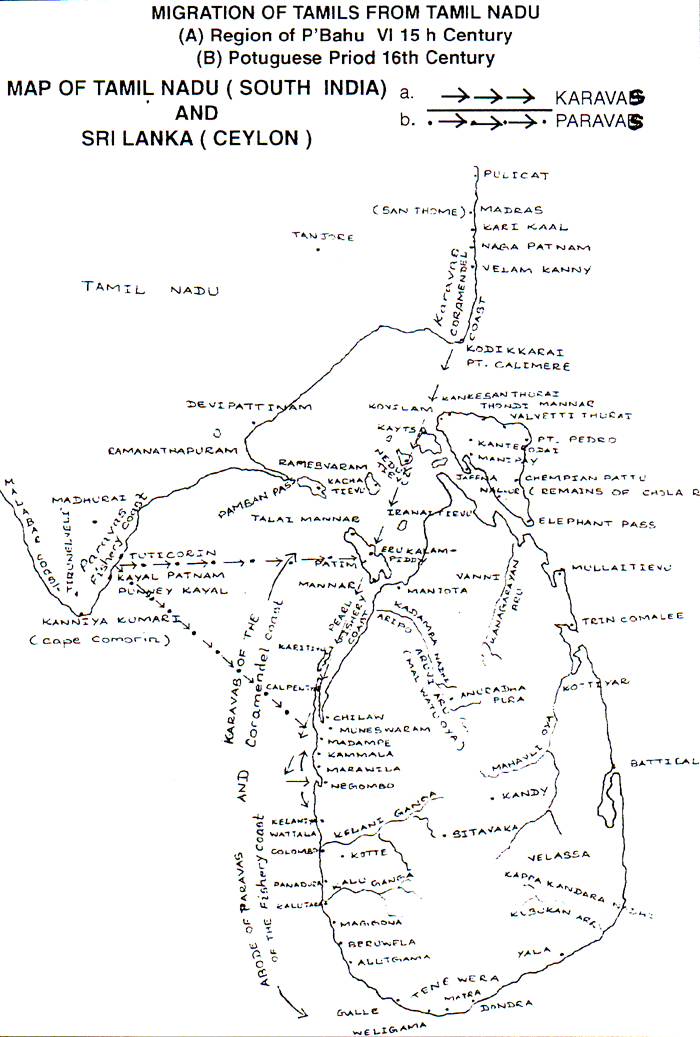
If those who are steering the affairs of Lanka
have an ounce of political wisdom they could
perceive the clouds of war fast approaching from
China which is playing Russian roulette patiently
on the political chess-board in the Indian Ocean.
One could see China which has for many years wormed
its way into the body politics of countries in and
around this region in Pakistan, Bangladesh etc. It
is known by western security analysts that China is
dredging a port in the Pakistani coastal city of
Gwadar at the mouth of the Persian Gulf, to enable
larger vessels to be anchored. This project has
given China unique docking facilities for her naval
vessels and a ring-side presence in the Indian
Ocean.
The presence of China in the ports of Bangladesh
and their recent 'war-games' in the Bay of Bengal
will come as a wake-up call for India. It will be,
not before long when the Indian presence in Sri
Lanka will be more felt to neutralise the move of
China. This may affect their position regarding the
internal conflict in Sri Lanka.
China's presence in the Indian
Ocean would put her arch enemy India in a
quandary. Sri Lanka is China's ideal
choice to encompass the Indian sub-continent
and hence she has done everything possible to have
Lanka her closest ally by supplying military
hardware and personnel to prosecute the present war
in Lanka. Right now India has played her cards well
by allowing Uncle Sam to invest in her country to
such an extent where the former President of the
United States, Bill Clinton had declared that India
is its best ally in the East. It has to be so, as
she is a bulwark against Chinese expansionism and a
lucrative partner in trade. As far as Lanka is
concerned, Uncle Sam is aware that India would
clean up her backyard.
The suicidal attacks on the American pride of
the 'Twin Towers' and the Pentagon by alleged
cohorts of the Taliban on Black-September, has
changed the course of world history with far flung
economic consequences not only to America but also
to the rest of the free world. Consequent to the
terrorist attacks, America has taken a stern
attitude towards the Taliban, centred around the
elusive Osama Bin Laden and his second in Command
Dr. Ayman al Zavahiri, an Egyptian by nationality
who had been condemned to death in absentia for the
mass murders of foreign tourists in Egypt. Both men
and their associates, derelicts and renegades, are
now on the run from impending justice. The latter
has been reported to have been killed by the
bombings of Kandhar. Only time could tell whether
America and her allies could match the strategies
of Osama Bin Ladan and his associates to evade
being captured . Even if they are eventually
brought to justice, the ghost of Osama Bin Ladan
and his Al Qaeda bases would haunt the world for
many years to come.
Notwithstanding American political and trade
ties with India, affairs in Lanka are a different
kettle of fish involving Tamil Nadu's 65 million
Tamils who have their brethren specially in the
North, and East. Kandy the one-time hill capital of
Sri Lanka, and the tea plantations of the country.
Their blood bonds are strong coming down from many
centuries to present times. It is not beyond the
realms of possibility or prophecy to foretell that
a tragic situation would befall Lanka once again,
as recorded in the Culawamsa (Cpt;80:58 to 80 ),
where Magha alias Ariya Chakravathi alias
Kulasekera Singai Ariyan, a prince of the Chola
dynasty ruled Ceylon for 21 years in the 13th
century from the kingdom of Jaffnapattinam, if a
solution is not found to the present conflict.
The grandiose scheme of the 'Sethu Samuthram' of India
would be a reality soon judging from the mood of
the parliament. This was thought of half a century
ago whereby India stands to gain from shortening
the sea voyage from Vishakapattinam, their naval
base, to her seaports on the south and west of the
the country, specially with the ongoing conflict
with Pakistan and the increase of a Chinese naval
presence in Pakistan. At present her merchant navy
circumnavigates Sri Lanka to reach her seaports on
the south and west of her country.
The scheme to build a bridge across the Gulf of
Mannar over the legendary Adams-bridge to connect
the north eastern town of Talaimannar to
Rameswaram, a distance of 18 nautical miles, is
apparently to counter the Indian vision of the '
Sethu Samuithram' project to deepen the Pamban
-Pass at the western sea board of Rameswaram. The
scheme thought of by the present Prime Minister of
Sri Lanka, Ranil Wickremasinghe, is that South
India could use a land route to Sri Lanka to make
use of the sea port of Colombo to haul container
cargo consigned to south India. Although the scheme
was thought of with all good intentions, it appears
rather a negative proposal as South India (Tamil
Nadu), has a up-to date container handling
facilities in the port of Tuticorin barely 180 km
south of Rameswaram. With the completion of the
Sethu Samuthram project the port of Tuticorin would
become prominent and container cargo destined to
Colombo would be discharged in the port of
Tuticorin as transhipment cargo .
The scheme would generate a robust tourist
industry specially to the reputed temples, churches
and other places of worship of both countries.
Whether India would like to have an umbilical road
link to Sri Lanka is much in doubt due to political
ramifications. India may like to have the sea
between the two countries rather than to bridge the
Gulf of Mannar. The Central government of India
would like to see Tamil Nadu a dormant partner
rather than play a dominant part which would alter
the balance of power in the body politics of the
subcontinent.
However, if India has other designs in the
region and agrees to the scheme then one could see
the sky line of the towns of Talaimannar and Mannar
change from obscurity to boom towns. They say that
history repeats itself, where Mantota (Mahattitha),
of the Mahavamsa and Silappadhigaram, would become
an entrepot as in the days of the kings of
Jaffna.
If India is to play an effective role in the
Indian Ocean, she has to increase her naval
deployment in the region. To achieve this she has
to safeguard her long coast line, especially the
south, to effectively neutralise any foreign
invasions. At present her security is hampered
due to the inability to patrol her southern and
western territorial waters caused by the shallow
waters of the Pamban-Pass. To reach the southern
and western regions, her navy has to skirt around
Sri Lanka and thereby lose valuable time in a
given emergency. The dredging of the sea bed of
the Pamban -Pass 'Sethu Samuthiram', will enable
her navy and merchant navy to ply via Pt.Calimere
on her east coast to Cape Comarin and other ports
of the west. This will also enhance the cargo
handling capacity of the ports of Tuticorin and
Cochin where the former would become the world's
largest container terminal of South East Asia.
The previous Sri Lankan Government has
communicated her objection to the project because
the threat to marine life in the territorial
waters along the Pamban -Pass to the Gulf of
Mannar.
When the scheme comes into reality, perhaps in
the not too distant future the seaports of the
north, north west and east of Sri Lanka would rise
into prominence as during the rule of the King's of
Jaffna pattinam. This would make the rest of the
ports in Lanka a 'backwater' in the backyard of
Mother India.
There is concurrence, specially among certain
members in the parliament of Tamil Nadu and some
stalwarts in the Centre, that her problems in her
backyard could be solved like a hen tucking a
wayward chick under her wings. This thought may be
in the 'RAW', yet it may take place in an ultimate
scenario.
It is said that it rains both on the good and
evil. The evil that has been galvanised by the
Sinhala government against the Tamils has turned
into showers of blessings. Although the Tamils have
been swamped by tears, torture, massacre and loss
of lives they have now risen to prominence like a
meteor from the obscurity of the rustling palmyra
palms of Jaffna to be world's greatest Freedom
Fighters. They have been driven to the sea for
survival, which in years gone by earned them the
epithet, 'KAPPAL ODDIYA THAMILAN' . It is said that
their merchant navy is more in numerical strength
than any other shipping organisation in Lanka and
their sea-tiger fast attack crafts deadlier than
those of the Lankan navy.
Although it has not been admitted by the Sinhala
government, 30% of the foreign earnings come from
expatriate Tamils living all over the world, thanks
to the powers that be. Like the Jews, the Tamils
will return to their homeland with much wealth and
technology to build Tamil Eelam from the ashes of
those who have sacrificed their lives for
freedom.
'Where every prospect pleaseth, but man alone is
vile'. This was written by a foreigner about Sri
Lanka, who did not want to mince his words. How
true his words have proved even to this day and age
where thousands of men, women and children are
being slaughtered in the name of Sinhala jingoism
riding on the backs of 'yellow robes'. That serene
and enchanted island which we knew Lanka to be,
today is far from being the 'Island Paradise' and
'Pearl of the Indian Ocean', and has become the
'Sickman' of the Indian Ocean, and an eternal thorn
in the side of India. Let those who persist in
prolonging and sustaining the cruel war hearken to
the words engraved on rock stones by Buddhist Kings
of Lanka, 'become a crow or dog and will be boiled
in the eight great hells'. (EZ,p 82,vol:iv).
If peace is to prevail in Lanka, the
intransigence of the Maha Sangha should be tempered
down by the state so that their ambit of power does
not impinge on the affairs of governing the
country. The Maha Sangha should meditate on matters
pertaining to the 'triple Gem' of the Buddha,
Dhamma and Sangha. If the swan song of the Buddha
'Let all beings be happy', then let the Sangha take
the initiative in calling upon the government to
solve the ethnic problem, where the hope and
aspirations of the Tamils are secured and
guaranteed for 'as long as the Moon and Stars
endure'.(EZ).
The Maha Sangha and majority of the Sinhalese
are of the deluded notion that granting concessions
to the Tamils would put them in a compromising
position in so far as governing the country. In
this regard they are inclined to be bordering the
realms of hysteria, in that the Tamils would join
their blood brothers across the Palk -Strait and
thereby render their religion exposed to Hinduism,
which was responsible for booting out Buddhism from
the land of its birth, and leave their language in
dire straits and the Sinhalese reduced to a
minority. Their slogan is 'Sri Lanka for the
Sinhalese only and the Tamils should be driven to
Tamil Nadu'.
The Press, Priests and People are invoking a
mythical story of a battle between an old Tamil
King Elara and a Sinhalese King Dutugamunu, spun
into the Sinhala chronicles, recorded by designing
Buddhist priests of ancient times from 'atha
kathas"(true-stories),to whip up feelings and
bolster the flagellant Sinhala psyche.
The unholy alliance of the National Sangha
Council by its actions is hastening the achievement
of a Tamil State of Eelam. It is an irony, that the
very people who are fighting against a negotiated
settlement in the present crisis and by their
militancy, are unwittingly paving the way for the
Tamils to govern.
With the dawn of 5th December 2001, a ray of
hope has warmed the hearts of many in Lanka,
whether Tamils or Sinhalese, with the welcome
change in the political horizon of the country. The
United National Party under the wing of Ranil
Wickremasinghe has come to power after a lapse
about a decade of despotic rule under the so called
Sri Lanka Freedom Party which offered FREEDOM only
to the Sinhalese and brickbats, bullets and death
for the minority Tamils. The UNP has taken up the
challenge to bring a peaceful solution to the much
vexed problem of the hopes and aspirations of the
Tamils, with the blessings of the Liberation Tigers
of Tamil Eelam, is the only panacea for the
immediate future. This is a golden opportunity for
the government to extricate itself from the
quagmire of narrow politics and embrace the cause
of the Tamils and live in harmony for the
prosperity of the country.
The historical agreement reached between the Sri
Lankan Government and the Liberation Tigers of
Tamil Eelam of 22nd February,2002 is another golden
mile-stone in the persistent pursuit for that
elusive peace necessary to find a negotiable
solution to the ongoing ethnic conflict. There are
some against the peace deal and are howling at the
caravan of peace. Be that as it may, the dogs of
war will bark but the caravan must move on. .
However, it takes no prophet to tell, and is
also the candid opinion of some sane Sinhalese with
the pronouncement in the Tamil Nadu State Assembly
that eventually the Sun will rise on Tamil Eelam.
Whether the Sangha or the Sinhala state like it or
not, the handwriting is on the wall' of the
liberation of the Tamil people from oppression,
tyranny and carnage.
|
|
Addendum
Since writing ' Kappal Oddiya Thamilan', I was
fortunate to receive a photocopy of the signatories
to the `Kandyan convention' of 2nd March 1815 AD
which is carried overleaf. This is mentioned in
chapter 11 of the book. The photocopy should be
read in conjunction with pars 5 of page 49 of the
book.
It is not surprising that majority of the eleven
signatories to the convention, were against the
rule of Sri Vickrama Rajasinghe alias Kannusamy the
last king of the kingdom of Kandy, covertly or
openly conspired in the downfall and the subsequent
capture of the monarch chose to subscribe their
signature in Tamil. There were a few who opted to
sign both .in Tamil and Sinhalese. Yet a few
contended to sign only in Sinhalese.
The dignitaries who placed their signature to
the convention only in Tamil were Ehelepola,
Pilimatalawe second Adigar and Dissawe of
Sabergamuwa, Pilimatalawe Dissawe of the four
Korales and Ratwatte Dissawe of Matale. It is seen
that Ratwatte Dissawe of Matale has signed as
'RAVATHAI' in Tamil in 1815 AD.(see photocopy).If
the Ratwatte of today claim ancestry to the
'RAVATHAI' the change is due to political
expediency to a Sinhala phonetic Ratwatte.
It is an accepted historical fact that the
language of the court of Kandy was Tamil. But it is
intriguing to note that even after the King was
deposed they chose to subscribe their signature in
Tamil as they were Tamils.
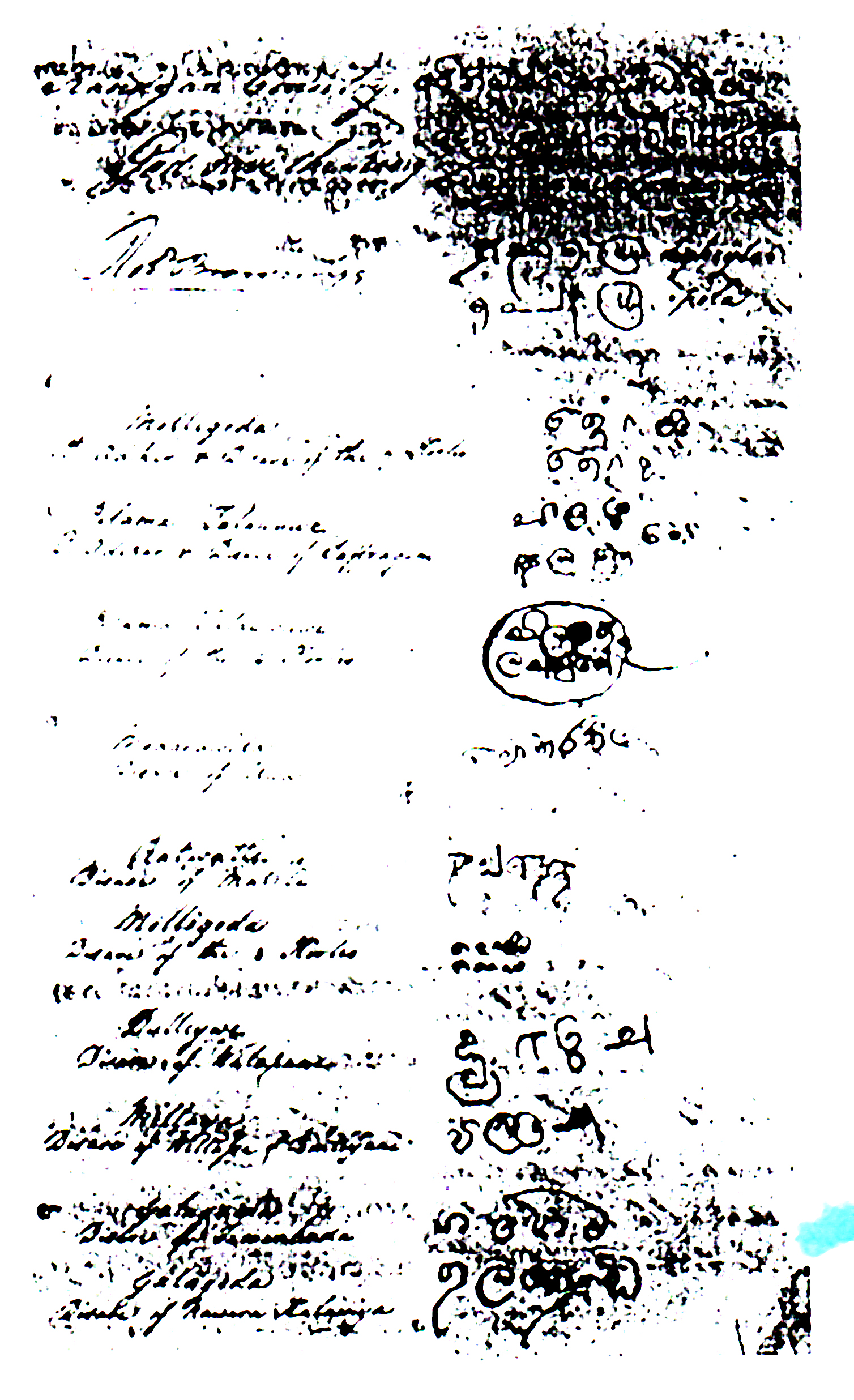
|
Bibiliography
Abbreviations & References used in this
book
1. AC-
Ancient India, V.D.Mahajan,S.C.Chand & Co,New
Delhi-1993
2. AJ-
Ancient Jaffna, Mudaliyar C.Rasanayagam, AES,New
Delhi-1993
3. BD-By
Way of Deception, Clare Hoy & Victor
Ostrovsky, Stoddart, 1990
4. CC -The
Catholic Church in Sri Lanka, Vol: & iii
-Fr.V.Perniola S.J.,Colombo1989
5. CCD
-The Catholic Church in Sri Lanka,Vol: &
Fr.V.Perniola S.J.,Colombo-1983
6. CCB-The
Catholic Church in Sri Lanka,Vol: &
Fr.V.Perniola S.J.,Colombo-1992
7. CT-Ceylon an Account of the Island
Physical & Topographical, Longmans &
Robertson-1859, Sir James Tennent,
K.C.S.,LLD.
8. CV-Culavamsa, Wilhelm
Geiger,AES,New Delhi-1992.
9. EHC-The
Early History of Ceylon, G.C.Mendis, AES, New
Delhi-1992
10. EMC -A
Description of East India Coasts of Malabar &
Coromandel - Ceylon, Philip Baladeus, AES New
Delhi-1996
11. EZ
-Epigraphia Zeylanica, D.M.de Silva
Wickremasinghe, Vol: i, iii, iv, AES, New
Delhi-1994
12. FI -Sri
Lanka the Fractured Island, Mohan Ram
13. HC
-History of Cambodia, David Chandler
14. HI-The
Historical Inscriptions of South India, Robert
Sewel, AES, New Delhi -1983
15. HM-The
History of Malaysia & Her
ghbours,F.J.Moorehead-1952
16. HT-The
Historical Tragedy of the Island of Ceylon,
P.E.Pieris, AES, New Delhi-1999
17. KC -
Khymer, Lost Empire of Cambodiya, T.Zephir,
Thames & Hudson, London, 1998
18. MP-Manuel Pratique Pour
Cambodignes,Saigon-1876
19. MVD-A
Manual of the Vanni Districts, Ceylon, J.P.Lewis,
C.C.S., Navrang1993
20. MS-Maniampathier Santhathimurai,
Srimath T.Vinasithamby, Lake HouseCbo-1991
21. MV-The
Mahavamsa, Wilhelm Geiger, AES, New
Delhi-1993
22. TC-The
Colas, K.S.Nila Kanta Sastri University,
Madras-1984
23. TFH-Travels of Fah Hian, Samuel
Beale, AES, New Delhi-1996
24. TR-Memoir on the History of the
Tooth-relic of Ceylon, J.Gerson Da Cunha,
London-1875; AES, New Delhi-1996
25. TS-The
History of the Tamils & the Sinhalese of Sri
Lanka, G.K.Rajasuriar, Australia-1998
26. YVM-
The Yalpana Vaipava Malai or The history of
the Kingdom of Jaffna,C.Britto,Colombo-1879
27. ZCC-On
the Chronicles of Ceylon by
B.C.Law-Aes.Delhi,1947/94
28. ZS-The
Sinhalese-Nanda Wijesekera-Gunasena-
Colombo,1990
29. ZNIV-The NIV study
Bible-Zonderman-USA-1995
30. ZHT-
History of the Tamils
-P.T.Srinivasa lyengar-AES,1995
31. ZIS-
The Indianized States of South East Asia- by
George Coedes-Hawaii1962
32. ZHS- A
History of South East Asia by
D.G.E.Hall-London,1961
|
About the Author
G.K.Rajasuriar (Christy),
hails from Manipay, a one time sanctuary of the
`Madappalis', where the descendants of the Kings
of Jaffna found a safe haven from the botched
attempts to re-capture power first from the
Portuguese and then from the Dutch, since the
fall of the kingdom of Jaffna.
He had his initial education
in several Colleges south of the country and
finishing up at Hartley College, Point Pedro and
Alexandra College of Colombo 7. An excellent
sportsman having won the Senior Athletic
Championship Cup in 1948 while at Hartley. He was
awarded College colours for his performance in
athletics. He represented his alma mater,
Hartley, in soccer and in cricket.
He joined the Customs
Department as a Customs Officer, in the then Her
Majesty's Customs of Ceylon in 1951, and served
in various sections of the service. In 1982 he
was sent to the Royal Customs Training College of
Malacca, sponsored by the Division of Narcotic
Drugs Control of the United Nations, for training
in rummaging of ocean going vessels, motor
vehicles, aircraft's etc, for drugs, narcotics
and smuggled goods. Subsequently, he obtained
further specialised training in the Customs of
Hongkong, Singapore and Australia in sea
surveillance to combat smuggling. He rose to the
position of Assistant Collector of Customs of the
Customs Marine Division, which he set up for the
Sri Lanka Customs in the year 1979. He was
reputed in the art of combating smuggling
activities in the country, specially off-shore
and high sea operations. He was a recipient of a
record number of high commendations for his
detection's on land and sea. He was appointed a
Justice of the Peace in 1979 for the district of
Colombo.
Due to political instability
in the country he migrated with his family to
Australia in 1988. In his retirement he published
his first book 'Smugglers' World' in 1991 which
contains his memoirs as a Customs Officer. As
President of the Tamil Senior Citizens Fellowship
of Victoria in 1996, he was instrumental in
publishing the `Yalpana Vaipava Malai', a Tamil
chronicle of the history of Jaffna, into
English.
As a student of Sri Lankan
and Tamil Nadu history he travelled to Tamil Nadu
and Kerala and visited the Saraswathy Mahal
Library and Art Centre of Tanjore and the Museum
in Chennai to learn the ancient history of the
Tamils. Subsequently, he published the book The
History of the Tamils and the Sinhalese of Sri
Lanka' in 1998. The present volume `Kappal Oddiya
Thamilan', potrays the adventurous spirit of the
master sailors of the Tamils in quest for trade
by peaceful methods rather than by the sword.
This volume is a result of the writer's
dedication to the Tamil community to which he
belongs.
|
Copyright - G. K. Rajasuriar
All Rights Reserved without
limiting the rights under copyright reserved
above, no part of this publication may be
reproduced, stored in, or introduced to a
retrieval system, or transmitted in any form or
by any means (electronic, mechanical
photocopying, recording or otherwise ),without
the prior written permission of the copyright
owner of this book.]
|
|