|
|
"To us
all towns are one, all men our kin. |

| Home | Whats New | Trans State Nation | One World | Unfolding Consciousness | Comments | Search |
|
|
"To us
all towns are one, all men our kin. |
| Home | Whats New | Trans State Nation | One World | Unfolding Consciousness | Comments | Search |
Home > Tamil National Forum > Selected Writings - V.Thangavelu > Tamil New Year - Response to those few who oppose Thai first
|
Selected
Writings
V.Thangavelu, Canada Tamil New Year - Response to those few who oppose Thai first 17 April 2008
[see also Sanmugam Sabesan - சித்திரையில் தமிழ்ப் புத்தாண்டா? ] Opposition has been voiced by a small number of individuals
against the change in the birth of Thamil New Year. They claim the change is
against tradition and borders on blasphemy. Such people are superficial and
naïve in many ways.
The accusation that the TN government has arbitrarily and suddenly made the change in regard to the New Year is not supported by facts... Thamils need a continuous year count. They need to discard foreign culture and beliefs imposed on them under the guise of religion.
In order to have a continuous year count the birth day of Thiruvalluvar was taken as falling on Thai (Suravam) first. This was given effect by the TN government in 1971 in official calendars, from 1972 in gazettes and from 1981 in all departments. Later it was extended to non-governmental departments as well. In the Indian civil calendar, the initial epoch is the Saka Era,
a traditional era of Indian chronology that is said to have begun with King
Salivahana's accession to the throne and is also the reference for most
astronomical works in Sanskrit literature written after 500 AD. In the Saka
calendar, the year 2002 AD is 1925. The Calendar Reform Committee set up India’s present day national calendar in 1957. It is a lunisolar calendar, which has leap years coinciding with the leap years of the Gregorian calendar. The months in the calendar have been named after the conventional Indian months. This calendar came into effect with the Saka Era in Chaitra 1, 1879 (March 22, 1957). Although we don’t have direct evidence of Thiruvalluvar’s birth day, this day has been chosen with reference to available (indirect data) from Sangam and post-Sangam Thamil literature. The opposition to the change in the Thamil New Year from Chiththirai to Thai mostly emanates due to a lack of proper understanding of astronomy. Added is the natural tendency to resist change.
The second type of motion is the rotation of the Earth
around the Sun in 365 days to complete one revolution in an elliptical
orbit. Using modern instruments for exact observations of the
universe, the Earth takes 365 days, 6 hours, 9 minutes and 9.50
seconds to complete one revolution with respect to the stars (sidereal
year). With respect to the orbit, it takes 365 days, 5 hours, 48 minutes and
45.50 seconds to complete one revolution (tropical year). The difference in
time is 20 minutes and 24.00 seconds as follows:
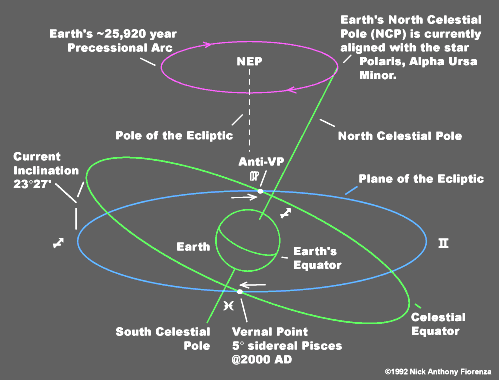
This difference is caused by the third type of motion of Earth, the wobbling of its axis, which astronomers call processional movement (precession of equinoxes) of the pole or axis of the Earth.
The ancient Thamils lived in close touch with nature. Astronomy and astrology very much influenced their lives. With regard to the year, the Thamils started it with the Vernal Equinox. Astronomers have determined the Sun transiting Aries at 0 degree as the Vernal Equinox, that is the day when the Sun rose exactly in the east, coincided. This was about the year 285AD. With the lapse of centuries, the New Year falls now, about three weeks after the Vernal Equinox. The Hindu solar year is sidereal, and since it is in excess of the tropical year by 20 minutes and 24.00 seconds, it does not keep step with the seasons. The seasons fall back one and half days for every hundred years or one day every 71.6 years. It is not correct to say that Chiththirai has always been the beginning of Thamil New Year. Nachchinarkiniyar who wrote a commentary to Tholkaappiyam says Thamil New Year started in August (Aavani) and ended in July (Aadi). This demonstrates the fact that Aeries (Medam) is not the start of the reference point in the Zodiac during Tholkappiyar’s time. The Thamils/Hindus divided the year into "Uttarayanam" the first six months after the winter solstice and "Dhadshanyam" the second six months after the summer solstice. The former was considered health-giving, bright period for man and animals for during that period the days became longer and longer. Thus "Uttarayanam" was celebrated by Thaipongal and Paddippongal (the cattle festival). Most of the temple festivals in the Thamil country were also fixed for this bright period. The beginning of the "Dhadshanayam" was marked by "Adipirapoo" (July 1- Hindu calendar). These six months were considered not a very bright period for men and animals because the days became shorter and shorter. One of the major drawbacks in counting Chiththirai is that it is not a continuous year. Its cycle consists of 60 years. This cycle of years is useless to record historical events. And their (so are some of the months) names are not Thamil. They are in Sanskrit. The mythological story attached to the birth of the years is extremely vulgar and obscene. A close look at the six seasons given in Thamil literature reveals that they are out of sync with the actual seasons experienced at the equator.
Definitely mid June to mid-August is not the rainy season in Northeast of Ceylon or Thamil Nadu. They are in fact hot and humid months. The rainy season is from October to November (Iyppasi to Kaarthikai) and not from mid August to mid October. The coolest months are December - January (Maarkali - Thai). It is in January (Thai) the farmer harvests the first sheaves of a harvest. They are ground and mixed with old rice and used for Pongal. The actual harvest season does not take place in January. It takes place in February and March. This is due to the change in seasons due to precession. January 14th too has astronomical significance, in that, the Sun (Earth) commences its Northerly transit. In fact there are four transits of significance by the Sun in its journey from south to north and north to south. They are -
Equinoxes are days in
which day and night are of equal duration. The two yearly equinoxes occur when
the Sun crosses the celestial equator. The above is true only in regard to the Northern hemisphere. It will be the exact opposite to those living in the Southern hemisphere. When it is summer in the Northern hemisphere, it is winter in the Southern hemisphere. So in regard to spring and autumn. As already mentioned, the arrivals of the seasons have been changing at the rate of 1 degree per 71.6 years. Westerners found spring coming earlier (March 10) than the Julian calendar showed viz March 21. To adjust the extra days Pope Gregory ordered the deletion of 10 days i.e. October 5th was followed up with October 15th. The Gregorian calendar still has a few seconds difference. But the calendar can hold good fairly accurately for the next 1000 years. Due to the precession of the equinoxes, the Sun will be at the 1st degree of Libra at the spring equinox in 11,232 years. Those who think that almanacs and calendars are cast in iron should mark their calendars. The zodiac of the two systems (Tropical and Sidereal) will be exactly opposite one another. Ayanamsha will be 180 degrees 0 minutes.. It would be interesting to those who oppose Thamil New Year shifted to Thai first to incarnate at that time just to join in the debate. In Vedic or Sidereal astrology the calculation of the Sun passing through the 1st degree of Aries is marked by the Sun actually passing through the observable fixed stars making up the constellation Aries and has nothing to do with the seasons. Because of the precession of equinoxes at a rate of 50.26 seconds per year, .difference between the tropical zodiac and sidereal zodiac increases every 10 years by 8 minutes 22 arc seconds. The Thamil/Hindu calendar has gone awry and no correction was made for precession of equinoxes. This is the reason why the real seasons are not synchronizing with months mentioned above. Poet Subramanian Bharathiyar has pointed out this discrepancy in one of his essays. Those who claim that Chiththirai New Year ushers in Spring (Venil) have to re-think. It really falls on March 21st. A good 24 days earlier. So are all the Hindu auspices festival and ceremonial days. The "wobble" and the precession of the equinoxes were known to the Ancient Egyptians, although the first official "discovery" of it was made by an Ancient Greek astronomer, Hipparchus, who was born sometime around 190 B.C. It was noted that the Sun was in a slightly earlier position at the time of the Spring Equinox each year (as measured against the fixed stars). Because the movement slips backwards (Westwards) through the zodiac, it is called precession (as opposed to a forward-movement which would be called progression). Now 1° every 71.6 years doesn't sound like too much, but it certainly adds up over 2,000 years or so, and this is where we get into the different Zodiac systems. The determination of Thai first as Thamil New Year is now a fait accompali. One cannot unscramble a scrambled egg. History is heavily stacked against intellectually discreditable individuals for they live in the past. The change of Thamil New Year has not altered or modified the Panchangam or Thamil Almanac as some foolishly think or argue. What has changed is the reference point (in a circle any point could be considered the reference point) in the Zodiac. Instead of Aeries 0 degree being considered the birth of Thamil New Year, the reference point has been shifted to Makaram 0 degree the birth of Thamil New Year. There is reference in Thamil Sangam literature to the celebration of Thai Neeradal, but there is absolutely no reference to Chiththirai New Year in ancient literature. The shifting of Thamil New Year from Chiththirai first to Thai first is a mile stone in the history of Thamils. |
||||||||||||||||||||||||||||||||||||
 The
opposition can be seen as an ad hominem argument – you cannot fault an argument,
so you fault the person advancing it. In this instance
The
opposition can be seen as an ad hominem argument – you cannot fault an argument,
so you fault the person advancing it. In this instance
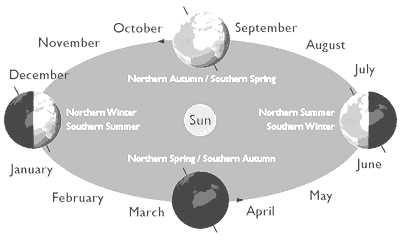 The
Earth has three types of motions: motion around its axis, motion around the
Sun, and motion of its axis due to wobbling of Earth. The Earth rotates
around its axis in 24 hours, which causes day and night. In the Northern
Hemisphere we see that all but one of the stars and planets rise in the east
and set in the west. The one star that does not rise or set is the polar
star (Dhruv Nadchchathiram or Polaris), which is located directly above the
Earth's North Pole. The Earth’s axis is tilted from perpendicular to the
plane of the ecliptic by 23.45°. It is this tilting that causes the four
seasons of the year - spring, summer, autumn (fall) and winter. Since the
axis is tilted, different parts of the globe are oriented towards the Sun at
different times of the year.
The
Earth has three types of motions: motion around its axis, motion around the
Sun, and motion of its axis due to wobbling of Earth. The Earth rotates
around its axis in 24 hours, which causes day and night. In the Northern
Hemisphere we see that all but one of the stars and planets rise in the east
and set in the west. The one star that does not rise or set is the polar
star (Dhruv Nadchchathiram or Polaris), which is located directly above the
Earth's North Pole. The Earth’s axis is tilted from perpendicular to the
plane of the ecliptic by 23.45°. It is this tilting that causes the four
seasons of the year - spring, summer, autumn (fall) and winter. Since the
axis is tilted, different parts of the globe are oriented towards the Sun at
different times of the year.