|
Selected Writings
Ana Pararajasingham, Australia
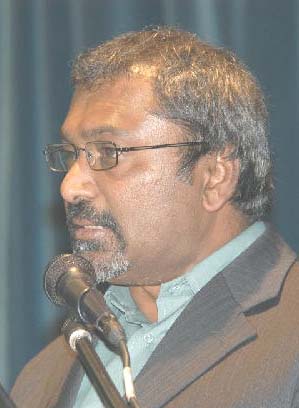 Ana
Pararajasingham has a master’s degree in management from the University of
Technology, Sydney, and works as a Management Consultant. He is also a
Fellow Member of the Australian Society of Certified Practising Accountants
(FCPA) and Associate Member of the Chartered Institute of Management
Accountants (ACMAUK). He worked with the World Bank (as a Consultant) to
assess the needs of the war torn NorthEast on behalf of multilateral donor
agencies in 2003 and to help assess the needs arising from the damage caused
by the tsunami in 2005. He appeared before the Australian Parliament’s Joint
Parliamentary Committee on Foreign Affairs, Trade and Defence on several
occasions to present the case for international action in the conflict in
the island of Sri Lanka. In 2002/03 he developed and delivered a course on
Project Management for personnel working for Non Governmental Organizations
(NGOs) in the North East of Sri Lanka, a project funded by UNICEF. He has
served on the Editorial Board of the ‘Tamil Nation’ fortnightly and has
written extensively on the conflict in the island of Sri Lanka and on
related human rights issues, and has presented papers and participated at
several conferences. He is the Chairman of the Australasian Federation of
Tamil Associations - an umbrella organisation of Tamil Associations in the
Australasian region. [see also
Heard in
Internet Circles] Ana
Pararajasingham has a master’s degree in management from the University of
Technology, Sydney, and works as a Management Consultant. He is also a
Fellow Member of the Australian Society of Certified Practising Accountants
(FCPA) and Associate Member of the Chartered Institute of Management
Accountants (ACMAUK). He worked with the World Bank (as a Consultant) to
assess the needs of the war torn NorthEast on behalf of multilateral donor
agencies in 2003 and to help assess the needs arising from the damage caused
by the tsunami in 2005. He appeared before the Australian Parliament’s Joint
Parliamentary Committee on Foreign Affairs, Trade and Defence on several
occasions to present the case for international action in the conflict in
the island of Sri Lanka. In 2002/03 he developed and delivered a course on
Project Management for personnel working for Non Governmental Organizations
(NGOs) in the North East of Sri Lanka, a project funded by UNICEF. He has
served on the Editorial Board of the ‘Tamil Nation’ fortnightly and has
written extensively on the conflict in the island of Sri Lanka and on
related human rights issues, and has presented papers and participated at
several conferences. He is the Chairman of the Australasian Federation of
Tamil Associations - an umbrella organisation of Tamil Associations in the
Australasian region. [see also
Heard in
Internet Circles]
|
| 30
March 2007 |
நண்பர் மாமனிதர் ஜெயக்குமாருக்கு வீரவணக்கம்
|
| 17
December 2006 |
A Tribute
to Anton Balasingham |
| 14
October 2006 |
The Strategy of 'Containment' |
| 17
September 2006 |
A
Tribute to Adrian Wijemanne |
| 23
July 2006 |
Remembering Black July 1983 - Address at a public meeting in Sydney
attended by Australian Parliamentarians |
| 18
March 2006 |
A Response
to Human Rights Watch |
| 11
December 2005 |
Required: Paradigm Shifts
"..It is vital that the
Tamils seek a deeper understanding of the factors which drive
this (Sinhala) intransigence. A clue to this is to be found in a
speech by S W R D Bandaranaike, the founder of the Sinhala Maha
Saba and the architect of the Sinhala Only policy of 1956 which
marked the beginning of the Tamil struggle for
self-rule. According to the Daily News of 8, November
1955, Bandaranaike made the case for the Sinhala Only bill by
arguing that "With their
books
and
culture
and
the will
and strength
characteristic of their race, the Tamils (if parity were
granted) would soon rise to exert their dominant power
over us” It was not just the Mahavamsa inspired
notions of 'primacy' that have been the impetus, but also
something else-the fear of domination. .".
|
| 24
October 2005 |
The EU Ban:
Impact on the Peace Process
|
| 17
September 2005 |
Dhanapala: Defending the Indefensible |
| 21
July 2005 |
The
Failure of the Joint Mechanism: Lessons to be Learnt |
| 20
July 2005 |
A Review:
Portrayal of a President: Sri Lanka’s Chandrika Kumaratunge
First Broadcast on 12th July on ABC TV’s Foreign Correspondent
Program
"...Michael Maher, the
interviewer, had little trouble drawing the Sri Lankan President
into revealing her personality. Maher’s intention was to
enlighten rather than sensationalize. His approach was
friendly, polite to the point of being deferent but probing. The
Sri Lankan President obliged by speaking her mind out..."
|
| 13
December 2004 |
India’s
Sri Lanka Policy: Need For A Review
“It appears evident, then, that that the
Indian State failed to take the political force and mass appeal
of Tamil nationalism seriously If the violence and perfidy of
the Sri Lankan State had given rise to Tamil nationalism in the
first place, the popular commitment to Eelam was cemented and
solidified by the Tamils bitter experience with the Indian
State. The current policy of supporting the unity and integrity
of Sri Lanka while not addressing the spectre of Tamil
nationalism will therefore have to be construed as a policy not
much different from that which resulted in the physical
intervention by India in support of Colombo. The question that
needs to be asked is how realistic is it for the Indian
Government to persist with such a policy when ground realities
have changed significantly during the intervening period."
|
| 23
September 2004 |
International Community Can Help Forge Peace
"Given the credentials of both writers,
(Sathananthan is a political scientist with a Ph.D. from
Cambridge and a visiting research Scholar at the Jawaharlal
Nehru University of International Studies; Taraki is the
pseudonym of Sivaram who has written extensively on the armed
struggle of the Tamil people for well over a decade), one needs
to give serious consideration to the essential thrust of this
argument, i.e. that the international community is pursuing a
plan to weaken the LTTE and prop up Colombo. .."
more
|
| 23
July 2000 |
State
Terror - Black July'83 Revisited
"....July 2000 marks the 17th
anniversary of the worst anti-Tamil pogrom. While it was the
years of
discriminatory administrative and legislative measures that
drove
the Tamils people into staking a political claim for a federal
form of government and
subsequently independence, the main impetus for
the armed struggle is the direct consequence of these state
assisted/orchestrated pogroms during the first twenty-five years
of Sinhala rule.. It was
state terror that finally drove the Tamil people into taking
up arms. The war is the result of the Sri Lankan political
establishment's policy of seeking to beat the Tamil people into
submission. Perhaps it is time the
international community is reminded of those events which
took place seventeen years ago..."
more
|
|
September 1999 |
East Timor & Tamil Eelam |
| 28
March 1997 |
Militarisation of Sri Lanka
"The growth in the Sri Lankan Government’s
military expenditure between 1983 and 1996 could only be
described as astronomical. In 1983, the Sri Lankan Government’s
military expenditure was US $74 million In 1996 it was well over
US $842 million¾ a eleven fold increase! Not surprisingly, this
exponential growth in the military expenditure of the Sri Lankan
Government was accompanied by a growth in the size of its armed
forces. The combined armed forces (army, navy and airforce) of
the Sri Lankan Government which stood at 15,000 in 1983 now
stands at well over 106,000 - a seven fold increase..."
more
|
| 6
December 1995 |
Sri Lanka's Military
Solution |
| 15
February 1992 |
On Mannikalingam's "A critique of Tigers Claims" |
| 30
April 1988 |
Expatriates & the Eelam Tamil Liberation Struggle |
| |
|