|
|
"To us
all towns are one, all men our kin. |


| Home | Whats New | Trans State Nation | One World | Unfolding Consciousness | Comments | Search |
|
|
"To us
all towns are one, all men our kin. |
| Home | Whats New | Trans State Nation | One World | Unfolding Consciousness | Comments | Search |
Home > Tamil Digital Renaissance > Tamil Fonts & Software > Tamil Internet 2000 > Internationalisation of the Domain Name System: The Next Big Step in a Multilingual Internet
Singapore 22-24 July 2000
Internationalisation of the Domain Name System:
The Next Big Step in a Multilingual Internet
(A Tribute to the
Late Naa Govindasamy
Pioneer in Tamil Computing and Tamil Internet)
Tan Tin
Wee (National University of Singapore, Singapore 1192601)
James Seng and S.Maniam ( 2i-DNS.net International Inc. Palo Alto, CA, USA)
| Abstract Every machine on the Internet has an Internet address (IP address). The Internet domain name provides a meaningful and easy-to-remember handle for an IP address. The task of mapping domain names to IP addresses for all the Internet addresses is performed by the world's most extensive and scaleable database system, the Domain Name System (DNS). Almost every common Internet application calds on the DNS to resolve a domain name into an IP address. Limitations in the DNS and its operation by convention restrict the characters used in domain names to A-Z, a-z, 0-9 and (-) of the ASCII latin set. Multilingual characters are not supported.
Therefore, even though the content of a webpage or an email may be in a
native script of an non-English language, the address cannot be rendered in
that native script. This process, first initiated in 1998 by a Chairman's Commission of the Asia Pacific Networking Group (APNG), has now led to a standards working group in the Internet Engineering Task Force (IETF) and an international consortium comprising industry, academia and regulatory authorities called the Multilingual Internet Names Consortium (MINC). Meanwhile, more than a dozen alternative multilingual DNS technologies have emerged, some of which are implemented by commercial entities. Among the first languages with multilingual script supported in the DNS are Chinese, Japanese, Korean, and first among the Indian languages, is Tamil. |
|

1.
Multilingual Limitations of the current DNS system
The Internet Domain Name System (DNS) was developed over time to facilitate easy
recall of Internet addresses. It achieved this via the matching of easily
remembered alphanumeric strings such as www.yahoo.com to the string of numbers
of Internet Protocol (IP) addresses (version 4) eg. 137.132.19.1. Unfortunately,
in the pursuit of universality, only ASCII alphanumeric characters plus the (-)
(hyphen) were acceptable characters in the domain name strings. Subsequently,
because of the replacement of meaningless numbers with meaningful memorable
words, this DNS Convention was universally adopted as the global standard for
all hostnames, email addresses, Web addresses, e-mail addresses and other
Internet addressing formats. For instance, until now, no provision has ever been
made to allow input for domain names in Web addresses in a non-ASCII non-English
script.
This meant that any user of the Internet had to 8 have some basic knowledge
of ASCII characters (i.e. English language and languages which use basic latin
characters).
While this does not pose a problem to the scientific, technical or business user
who is able to understand English as an international language of science,
technology, business and politics, it is a major stumbling block especially in
countries where English is not widely spoken.
This hindrance contributes significantly to the digital divide as the Internet is becomes the standard way for doing business, and slows the popular adoption of the Internet in the business community, particularly in countries struggling to keep up with the pace of development in developed countries.
What was meant to be a memorable way of reaching a website to the English-speaker, has now turned out to be a linguistic barrier to the Internet. In many instances, it may even be easier for a non English-speaking person, say, in village in China, to remember a string of numbers rather than a series of unfamiliar and unintelligible Roman alphabets.
In countries such as these, understanding English has become a daunting
prerequisite to performing such basic activities as posting e-mail or accessing
Web pages that are otherwise composed in the local language. The irony is that
most software applications today already support a robust local language
environment, but access to the Internet, whether email or websites, invariably
requires use of the ASCII alphabet.
The Internet already encompasses a network of communities representing a global
mosaic of languages and cultures. The increasing volume of modern business,
research, and interpersonal communications in non-English languages is a
testament to this fact. Clearly, the existing DNS has become an anachronism in
an already multilingual Internet world.
2.
Internationalisation of the Domain Names System
In response to the multilingual demands created by the natural evolution of the
Internet, the process of internationalization of the the Domain Name System
(iDNS) has begun.
The task to upgrade the DNS is very complex. The DNS protocol impacts on many
Internet protocols. Common protocols such as those supporting the web and email
all involve the DNS. Client applications such as Web browsers and email clients
have to be changed. The server software in DNS servers throughout the world has
to be modified as the DNS system is arguably the world's most extensive,
hierarchical, distributed and scaleable database.
In early 1998, the first author (TTW) initiated research at the Internet
Research and Development Unit, National University of Singapore, into tackling
this the possibility of setting up a DNS which is as backward compatible as
possible, future extensible, and does not involve too much client application or
server-side modification. The iDNS proxy server was developed which intercepts
multilingual characters send from client applications and converts them into an
ASCII compatible encoding (ACE), and forwards them to conventional DNS servers
for IP address resolution. This early experiment used the Unicode Transformation
Forrnat UTF5 by Martin Doerst as the ACE.
Based on this success, as the Chairman of the Asia Pacific Networking Group
(APNG), the first author initiated a Chairman's commission in July 1998 to look
into the challenge of formally internationalising the Internet DNS protocol. An
Asia Pacific development team to create a more robust multilingual domain name
server iDNS, and to implement a multilingual domain name space - iDOMAIN as an
international test bed beginning in the Asia-Pacific.
From August to December 1998, the Chairman visited Hong Kong, India, Korea and
China, demonstrating the pre-prototype system and managed to gather
international interest in this project.
In December 1998, the Chairman managed to recruit the participation of an
industry partner, Bioinformatrix Pte Ltd (BIX Pte Ltd), as an early pioneer
entrant, willing to risk being an early player and to sponsor servers and
technical expertise.
Meanwhile, a grant application by APNG jointly with the CIR, to the
International Development Research Center (IDRC), a Canadian Governement funded
international organisation, met with success. This APNG Project is funded under
the Pan Asia R&D Grant administered on behalf of IDRC by the Canadian Committee
on Occupational Health and Safety (CCOHS).
By the end of 1999, the early technologies created by BIX Pte Ltd. a University spin-off company, was incorporated into the comtsany, i-DNS.net International Inc.
Meanwhile, in the IETF, work started with the formation of an Internationalised Domain Name IDN Working Group, beginning with the task of identifying the basic requirements of an iDNS.
This working group has now developed into a Standards Track working group,
aiming for an iDNS protocol standard that can be universally adopted. This WG is
chaired by James Seng (second author) and Marc Blanchett.
By early 2000, lead by the Chairman of the Asia Pacific Top Level Domain APTLD
forum Professor Kilnam Chon, the Multilingual Internet Names Consortium (MINC)
task force was formed to spearhead the formation of MINC.
By June 2000, MINC was launched with an Interim Board and 11 Founding members
and more to come. The consortium draws membership from industry, academia,
regulators and government bodies. Its aims are to promote, facilitate and
coordinate the development of multilingual Internet names, especially
multilingual Internet domain names.
Since early 2000, there has been numerous attempts to offer alternative
technical solutions to iDNS, and to commercialise multilingual domain names. At
least a dozen such solutions are currently available. The IETF and the MINC are
likely to cooperate on coordinating these efforts. They will aim to unite the
process of achieving a backward compatible system that preserves the global DNS
so that the solution can be universally adopted without breaking down the
existing framework that has served the Internet so well in the past.
3. Some technical
considerations
How the Current DNS System Resolves Domain Name Queries:
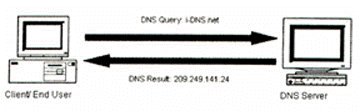
For example, we input typically "i-DNS.net" instead of "209.249.141.242 whether
it be for a website address or an email address.
Upon receipt of a query via a client/end user's browser, the DNS server checks
its cache to see whether there is any way to resolve the name, and returns the
IP to the client if successful.
If it cannot resolve from the data that is within its own server cache, it will
send a request to a DNS root server. The latter will determine which Top Level
Domain (TLD) or Country Code Top Level Domain (ccTLD) the domain name belongs
to. The TLD or ccTLD domain server will then determine which server it should
forward the data to for further resolving.
Once this particular domain is found, the IP is sent back via to the client
(end-user browser). The client can now access the desired information from the
IP of choice.
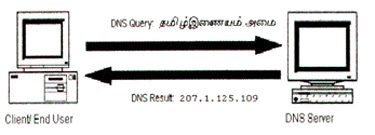
In the same way, with multilingual domain names technology, and
a revision of the Internet standards governing the domain name system, a Tamil
language domain name can be supported.
The direct implication of deploying this kind of technology is that users can
finally enjoy a truly internationalised Internet experience. From input of
identity, Web address or domain name, to the authoring, scripting, processing
and viewing of content, users can go through the entire process seamlessly in
their language of choice. On a larger scale, iDNS is an enabling technology.
Vast new e-commerce markets will be opened as the power of the Internet is
unleashed in countries where knowledge of English is not widespread
4. Conclusion
The Internationalisation of the Internet Domain Name System is well on the way.
The protocol standardisation will help bring in an orderly transition from the
old system to the new. Many multilingual registrars will be able to offer
multilingual domain names registration to organisatiions, e-commerce companies
and individuals. This will facilitate the adoption of the Internet in places
where English is not generally understood.
The newly formed
Multilingual Internet Names Consortium (MINC) will have a
Tamil Domain Names Working Group to discuss DNS internationalization issues
of Tamil.
