Tamil pride and
Prabhakaran at India-Myanmar
border
Hindol Sengupta, Indo-Asian News Service,
29 November 2004
from Moreh (India-Myanmar border post)
-
His six-year-old son is a fighter, says
G. Kalaivannan, and so he has named him
Prabhakaran.
This naming, after the leader of Sri
Lanka's Tamil Tigers Velupillai Prabhakaran
fighting for a Tamil homeland in the island
nation, says Kalaivannan, reminds him of
his own home - found and lost.
"My grandfather went to Burma many, many
years ago, I don't even know how long ago,"
says Kalaivannan, who is among the more
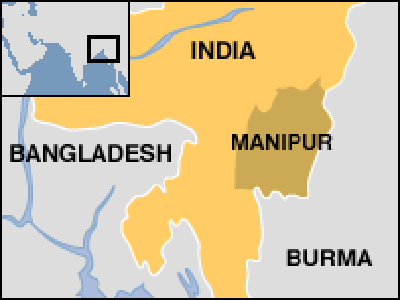
than 500 Tamil families in Moreh in the
northeastern state of Manipur, calling
Myanmar by its old name. "My father was a
boy then. I was born in Burma but then we
were all thrown out. My father decided we
cannot go back to Tamil Nadu, we needed to
be near Burma, so if not inside Burma we'd
be just across the border," says the man
who runs a shop selling cotton pillows and
blankets.
And so like many others, Kalaivannan's
family settled in this small border town
around 110 km from Manipur capital after
Myanmar's military government threw
foreigners out in the 1960s.
Today, the Tamils of Moreh -- about 5,000
of the 10-15,000 population of the town --
dominates trade in this bustling hamlet
made almost entirely of huts on two sides
of the main road that leads to the
India-Myanmar border.
They keep alive their identity by among
other things a big club and a common love
for Prabhakaran.
"He is a pillar of strength," says Tulsi
Raj of the guerrilla leader who rules over
his Liberation Tigers of Tamil Eelam (LTTE)
from jungle hideouts in Sri Lanka.
"We draw inspiration from him," adds Raj,
the father of two daughters who runs a
grocery shop.
"Of course that does not mean we fight and
kill like him but it means we remain close
to our home - Burma."
Sitting at the Sunrise Club, a dizzying
kitschy maze of peacock green cushions
embroidered in cheap golden thread against
sky blue walls, 51-year-old Arullpa talks
of how Moreh's Tamils maintained a twin
identity.
"We are Indians now but we cannot forget
our Burma days. We are proud to be Tamils,
even prouder that we grew up in Burma, that
beautiful, beautiful land."
That's why Arullpa is teaching his
granddaughter Rita her first words of
Burmese (now called Myanmarese like in the
name of the country).
"The older generation all speak fluent
Burmese and we want to pass on that
tradition," says Arullpa, sitting beneath a
row of photographs from Mahatma Gandhi to
Stalin, the Hindu goddess Durga and an
image of a roaring tiger, the LTTE
insignia.
"They should never forget that the
wonderful land that their fathers and
mothers once lived in, lies just a stone's
throw away."
That's why, as India's engagement grows
with Myanmar, Moreh's Tamil are cheering
the efforts every step of the way. India
recently laid out the red carpet for
Myanmar head of state General Than Shwe and
is one of the country's biggest trading
partners.
Bilateral trade between the countries has
grown from $287 million in 1999-2000 to
$428 million in 2001-02. The amount was
$424 million in 2002-03.
"It's the coming together of the two
countries most dear to us," says
Kalaivannan. "Who knows one day we might
even be able to return to Burma."
|