[to
read the Tamil text you may need to download &
install a Tamil Unicode font from here - for detailed
instructions please also see Tamil Fonts &
Software]
Giuseppe
Mazzini on the Unity of Italy, 1890 "...The
nation never has existed, said they; therefore it
can never exist. But we, viewing the question from
the height of our ruling synthesis, declare: The
nation has not as yet existed; therefore, it must
exist in the future. A people destined to achieve
great things for the welfare of humanity must one
day or other be constituted a nation..."
Tamil Rules the Airwaves "BBC
broadcasts daily to Tamils worldwide, offering global
news, in-depth coverage of events in Sri Lanka and
Tamil Nadu.
The service is available in shortwave in Sri Lanka,
India, Burma, Singapore, Malaysia and the Gulf, and
via subscription services in other continents.
Independent audience research has shown that the
Tamil Service has more than one million listeners in
India alone..."
Immigrant 'Transnationalism' Reconsidered
- Roger Waldinger et al, February 2003 "...At
the turn of the 21st century, the view that
nation-state and society normally converge has waned.
Instead,
�globalization� is
the order of the day, with international migration
bringing the alien
�other� from third
world to first, and worldwide trade and
communications amplifying and accelerating the
feedbacks traveling in the opposite direction.
Consequently, social scientists are looking for new
ways to think about the connections between
�here� and
�there,� as
evidenced by the interest in the many things called
�transnational�..."
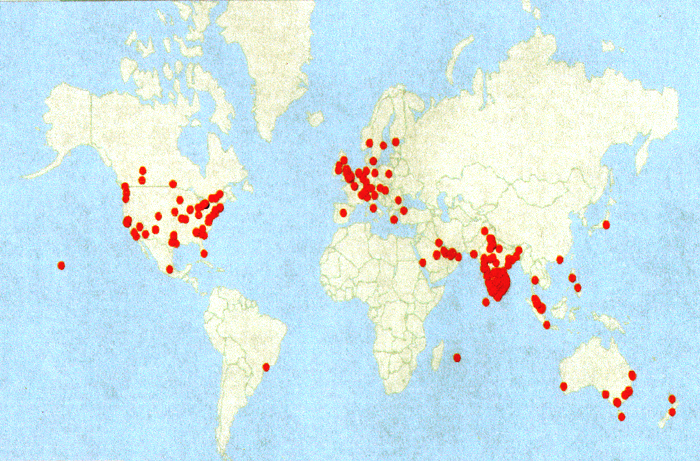
Today, more than 80 million
Tamil people live in many lands across distant
seas.
கடல்
கடந்தான்
எங்கள்
தமிழன் -
அங்கும்
கற்பூர
தீபம்
கண்டான்
இறைவன்
உடலுக்குப்
பொருள்
தேடி
உள்ளத்தில்
இறை
நாடி
தமிழுக்கும்
பணி
செய்து
தன்மானத்துடன்
வாழ.. - from a lyric by Kavi Arasu Kannadasan
It is true that the genocidal attack on the Tamil people
in 1983 in the island of Sri Lanka and the
heightened conflict led to the large numbers of
Tamil asylum seekers in the 1980s and 1990s. In
the 1980s, for instance, during the period of
the Cold War and Germany's relatively liberal
asylum policies, many Tamils entered Europe via
Germany.
However, as far back as the
1950s, the enactment of the Sinhala
Only act in 1956in Ceylon (as the island of
Sri Lanka was then known), the genocidal attacks on the Tamil
people in 1958, as well as discriminatory
employment policies in the state sector led
many Tamil professionals including doctors and
engineers, to seek employment in Great Britain,
USA, Australia and New Zealand. Later, in 1972,
discrimination in respect to
University admissions in Sri Lanka, saw a
second wave of Tamil professionals leaving the
island, to secure not only a future for
themselves but also to provide an adequate
education for their children.
But, again, the Tamil disapora
is not simply the result of oppressive Sinhala rule in the
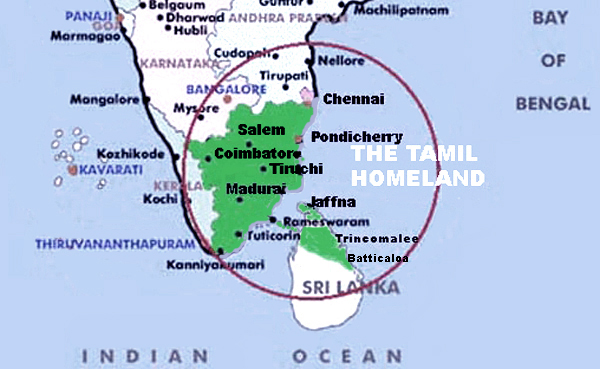
island of Sri Lanka. British colonial rule also
dispersed Tamils from their homeland in South
India and the North-East of the island of
Ceylon (as it was then known ) to many
lands.
The abolition of slavery
between 1834 and 1873, was followed by the
system of indentured labour. The
servant 'agreed' to work for a fixed number of
years in exchange for a meager wage, plus room
and board. The British enacted laws in the
colonies to render the breach of the employment
'contract' by the 'servant' a criminal offence
punishable with a prison sentence.
In the 1840's Tamils went to
Trinidad in the Caribbean,
Guyana in South America, and Mauritius
off the coast of Africa; in the 1860's to the
British colony of Natal in South
Africa; in the 1870's to the Dutch colony
of Surinam; in the 1880's to Fiji. Others migrated to
the French colony of Reunion. Some migrated to
Burma now known as Mynmar (and which until
1937 was a province of British India) to work
on the plantations or to work as clerks and
book keepers. Tamils from Tamil
Nadu went to work on the plantations in
central Ceylon and in Malaysia. Tamils who had
resided in the North of the island of Sri
Lanka, went to Malaya and Singapore
in search of white collar employment.
"...The results from the
study of Kurdish refugees suggest that
refugees sustain transnational social
networks and have a diasporic
consciousness... The diasporic relations in
the refugee communities mean that theories of
ethnic relations are difficult to apply to
refugee studies. For example, the Kurds did
not regard themselves as an ethnic minority
within the context of the country of exile;
instead their ethnicity was defined within
social relations in the country of origin.
The label
�diaspora�
is, perhaps, especially appropriate in the
case of the Kurdish refugees because of the
influence of Kurdish nationalism, which
commits many Kurdish refugees to the
restoration of their homeland.
However, this paper suggests
that the concept of diaspora can also be a
useful analytical tool in the study of other
refugee communities. This is because the
concept can, at the same time, relate to both
the country of settlement and the country of
origin. In this way, it can also describe the
transnationalism of refugee communities in
general.
The dual orientation
towards both the country of origin and the
country of resettlement is not as
contradictory and paradoxical as it seems. In
the refugees� own
experiences their country of origin and their
country of exile, as well as the time before
and the time after migration, constitute a
continuous and coherent lived
experience.
The separation between
before and after migration, as well as the
separation between the country of origin and
country of exile, is largely forced on the
refugees� experiences by the
outside observer.
The concept of diaspora can
help the researcher to rethink these issues
and to understand the transnational reality in
which the refugees are forced to live. Thus,
the notion of diaspora can bridge the
artificial duality in which the refugee
experience is conceptualised..."
"...Diaspora groups link
processes of globalization to conflicts over
identity and territory. Globalization has
increased cross-border migration and
decreased communication and travel costs,
thereby making it easier for migrants to
build and sustain links between the original
homeland and current place of residence.
Those forced across borders by war commonly
have a specific set of traumatic memories and
create specific types of
�conflict-generated
diasporas� that sustain and
sometimes amplify their strong sense of
symbolic attachment to the homeland. They
build new identities that stress their links
to the homeland and often profess an
intention to return, once their homeland is
�free...�
"...Transnationalism refers
to sustained ties of persons, networks, and
organizations across nation-state borders,
arising out of international migration
patterns and refugee flows (Faist, 2000). The
recent global transformations in economic
relations, ethnic conflicts, and
communication technology have led to the
creation of new transnational kinship groups,
transnational social circuits, and
transnational communities. By expanding
borders across nations and creating new
social ties, the concepts pertaining to
cultural spheres, acculturation, cultural
retention, and citizenship are started to
change drastically. People and their ideas
are moving more freely back and forth across
global borders than ever before. This ebb and
flow, through easy travel and growing
communications technology, may be reshaping
the traditional concept of a nation. In fact,
some people with homes in two countries are
showing an amazing capacity to maintain dual
identities -- with strong cultural ties and
contributions to both places .."
"..Groups of people are
solidifying their identities outside of the
state, and the twenty-first century will see
new configurations of non governmental, inter
governmental, and UN structures.."
The digital revolution in which we
live is helping to advance Tamil togetherness.
Globalisation and localisation are taking place
at the same time.
Tamils living in many lands and across distant
seas are communicating with one another through
internet newsgroups and mailing lists. Tamil
web sites continue to multiply. And so do Tamil
newspapers, periodicals and radio broadcasts on
the web.
"
Two decades ago, people moving from home
countries to other countries would not have
had the opportunity to remain actively
engaged or even adequately informed of events
in their home countries. Policy makers and
scholars had a somewhat limited understanding
of diasporic communities and their
importance. Today, with the diminished
saliency of the nation-state, the impact of globalization and
the growing number of transnational migrants, this
has changed. Diasporic groups, capable of
maintaining and investing in social, economic
and political networks that span the globe,
are of increasing relevance and interest to
policy makers in home countries as well as
host countries..." Diaspora Circulation &
Transnationalism as Agents for Change in the
Post Conflict Zones of Sri Lanka - R.Cheran,
University of Toronto, September
2003
When the Soc.Culture.Tamil
newsgroup was founded about a decade ago, its
Charter declared:
"What would be the role of
Tamil language for the next millennium?
Tamils around the world have a strong desire
to establish a newsgroup on the Usenet to
share their views on Tamil history, ancient
and modern literature, ancient Tamil
civilization, Tamil culture, religion, art,
drama, philosophy and related topics. The
proposed newsgroup is intended to serve as a
niche for the Tamil language and culture in
the electronic communication network."
"..the Internet is fast
becoming a major medium for the
consolidation, strengthening and definition
of collective identities, especially in the
absence of a firm territorial and
institutional base. Some of the nationalist
groups that appear to be most active on the
Internet are Sri Lankan Tamils, Kurds,
Palestinians... The most important
transnational voice for Tamil independence
may be the websites TamilNet (www.tamilnet.com ) and
Tamilnation (www.tamilnation.org ), which
are updated frequently..."
"...The task of
intellectuals in nations without states
involves the constant actualization of the
nationalist ideology to respond to the
community's needs. His or her job is one of
service to society..."
Again, all this, is not to say
that a people should not at
the same time, work toward the
ideal of a 'one world' where the separate
national identities of the world are
transcended by a
greater unity. However, that unity will not
come by the suppression of one nation of people
by another. It will come from truly
understanding the timeless force of that which
Kanniyan Poongundran said in the
Purananuru, some 2500 years ago -
"To us all towns are one, all men our
kin.
Life's good comes not from others' gift, nor
ill
Man's pains and pains' relief are from
within.
Death's no new thing; nor do our bosoms
thrill
When Joyous life seems like a luscious
draught.
When grieved, we patient suffer; for, we
deem
This much - praised life of ours a fragile
raft
Borne down the waters of some mountain
stream
That o'er huge boulders roaring seeks the
plain
Tho' storms with lightnings' flash from
darken'd skies
Descend, the raft goes on as fates ordain.
Thus have we seen in visions of the wise !
-
We marvel not at greatness of the great;
Still less despise we men of low estate."