|
Tamils - a
Nation without a State

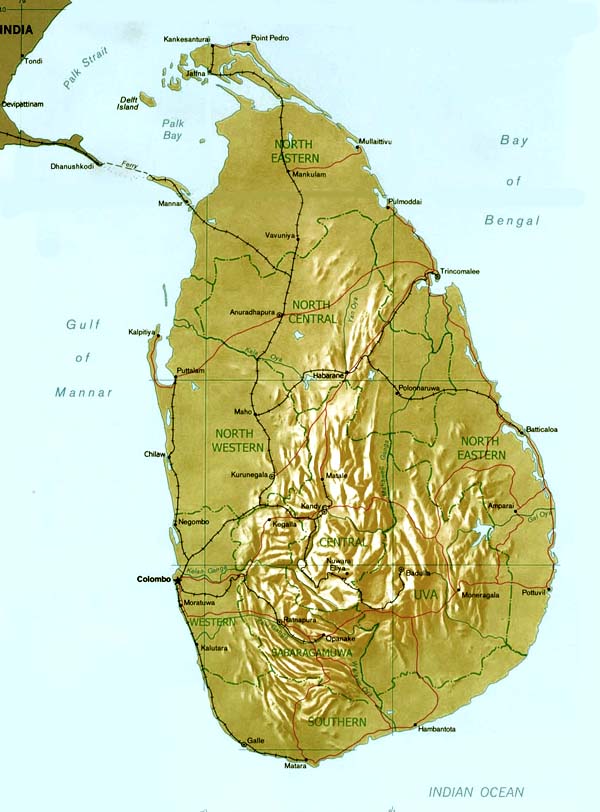
Eelam (Sri Lanka)
இலங்கை
(சிறீ
லங்கா)
- an estimated 3-4 million Tamils live in Eelam
-
Journey Down Memory Lane To Reach
'tamiz Izam'
Ramalingam Shanmugalingam
Chapter
1 | Chapter 2 | Chapter 3 | Chapter 4 | Chapter 5 | Chapter 6 | Chapter 7 | Chapter 8 | Chapter 9 | Chapter 10 | Chapter 11 | Chapter 12 | Chapter 13 | Chapter 14 | Chapter 15 | Chapter 16 | Chapter 17 | Chapter 18 | Chapter 19 | Chapter 20 | Chapter 21 | Chapter 22 | Chapter 23 | Chapter 24 | Chapter 25 | Chapter 26 | Chapter 27 | Chapter 28 | Chapter 29 | Chapter 30 | Chapter 31 | Chapter 32 | Chapter 33 | Chapter 34 | Chapter 35 | Chapter 36 | Chapter 37 | Chapter 38 | Chapter 39 | Chapter 40 | Chapter 41 | Chapter 42 | Chapter 43 | Chapter 44 | Chapter 45 | Chapter 46 | Chapter 47 | Chapter 48 | Chapter 49 | Chapter
50
"Some friends
have welcomed the idea of my reminiscences -
reminiscences that stir in their memory their
own wonderful experiences in 'tamiz Izam.' I am
simply putting my thoughts in words as they
open up, without due consideration to style,
grammar,and chronology. The whole idea is to
go down memory lane to the wonderful places,
beautiful people, festivals, cultural events,
and other soul satisfying matters we miss. My
experiences may move some to nostalgia, and in
others they may whet their appetite to know
more about the land we hold dear." - Ramalingam
Shanmugalingam
Chapter 1
'pORRi jen vAz mutalAkija poruLE',
'போற்றி
என்
வாழ்
முதலாகிக
பொருளே'
It is 4.00 a.m. and the loudspeakers on the
Nallur Belfry after the Chime blurts out
Piththukkuli Murugathas's resonating metallic
voice, and it is time to get up, and face another
day of Nallur festival. "arOkarA, nallUr
kaNtanukku arOkarA." "அரோகரா,
நல்லூர்
கந்தனுக்கு
அரோகரா"
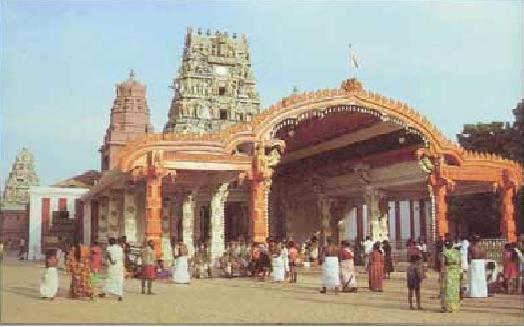
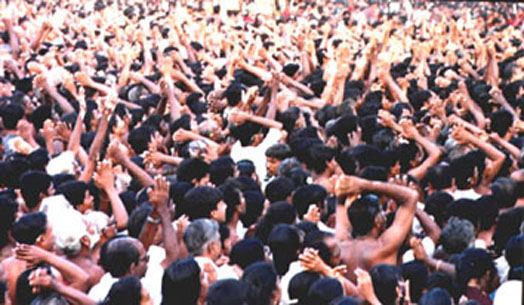
This chanting still echoes in my ears. The
deity passes the 'madappaLLi' we decorate in
front of the entrance to the house that came with
the mother of our three children.
This house had a patio, that was used by weary
worshippers, on the western boundary of Nallur
Kanthaswamy temple, adjoining the 'piLLajAr'
temple and Mankayarkkarasi Vidhyalayam. The house
itself was built long before, but there is '1835'
edged on one of the cross beams.
Probably one of the oldest dwelling houses
built with coral stone, lime mortar, olive
timber, etc., in Jaffna. The walls are about 42"
in width and the main door cannot be opened and
closed by the children. The house was a fortress,
a requirement of the times. I know that we may
have lost the roof, but I am sure Sinhala shells
could not have damaged the structure.
The procession is led by groups of singers,
'tavil and NAtacuvaram' and some prominent
citizens of Nallur, Jaffna and neighboring areas.
The 'Car Festival' is the climax and the
precision with which the 'AcAriyAr' steers the
CAR without independent suspension, nor a
differential, weighing more than four Sherman
tanks decked one on top of the other and reaching
that height, is something to think about.
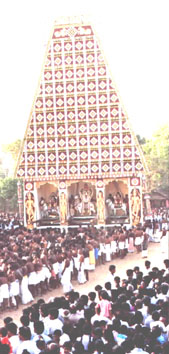
The ropes used to pull the CAR gives the
picture of anacondas carried by a couple of
thousand legitimate heirs to the right to pull
the divine CAR. No new comer or outsider is
allowed to touch the ropes.
The smashing of thousands of coconuts and the
exposure of the snowy white kernel is a way of
exposing 'tamiz' inner purity and perhaps what
made Albert Einstein write in his diaries,
'nobility of the Ceylon Hindus.'
Parading of St. John's Ambulance by the ever
vigilant and amiable E.P. Rasiah, and the score
of Police officers in mufti, The Radio Ceylon
mobile platform following the procession with
commentators like Suntharalingam,
Kunchithapatham, Nadaraja and a host of others
perched atop and giving a word by word
description of the procession. The Late Inspector
Ponnuthurai sometimes in his Police uniform and
at others in the customary 'vEddi and cAlvy'. and
the rolling devotees with their 'arOkarA'
accompanied by women doing the 'adi aLakkiRatu'
and their chanting.
This diverse noise level beats the noise
called music we hear sometimes today. The finale
of the 26 day program is the Festival of
Flowers-'pUngkAvanam', and at the end of these
festivities, the winding down of the various
kiosks opened only for the season and their
bargain sale and the typical market place
atmosphere is an experience by itself.
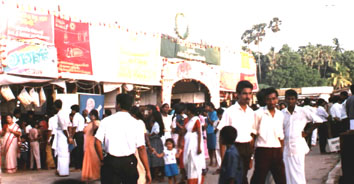
Devotees wait to go home to partake of their
first and perhaps last meal for the day. This in
itself is a ritual and a rich cultural and
culinary experience. Man was wise enough to
design these festivals at a time in the climate
almanac that gives him time to get away from his
daily chores in the field and yet cultivate more
than sufficient produce to meet the high
vegetarian demand and for export to other parts
of the country where the 'jAzppAnham' fruits and
vegetables are a connoisseur's delight.
They say it is the soil, may be, but I would
add that it is the 'jAzppAnhattAn' toil and
devotion to his vocation-'cejjum tozilE tejvam.'.
That, for the farmers and the people of the land.
We the nomadic, who had to take residence outside
'jAzppAnham,' who do not want to miss the
festivities, with the greatest of efforts try to
join the families for more or less a week, any
exigencies of service mean the refusal of leave
of absence and that is the reward for progress!
So far it was a case of raising the temple flag.
Next time let me tell you about another
flag raising in the hot summer months of March to
July. The 'pany marak kodijERRam.' The
season of that palmyrah nectar-'panang
kaLLU.'
|
|
About
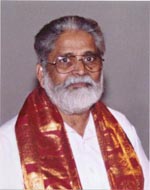
Ramalingam Shanmugalingam
1934 - 2004
[see also 1. US Tamil Activist Dies ;
2. 'ciRpi cetukkAta cintany' -
Unsculptured Thought by R.Shanmugalingam
;
3.
Selected Writings -
R.Shanmugalingam]
Ramalingam Kichi Yazhan
Shanmugalingam was born on September 29th 1934 to
Ramalingam Karthiravel and Pakiam, in Jaffna Sri
Lanka. He was lovingly known as Kichi by his
family and friends. Kichi was blessed with a
wonderful family, his living brothers
Mahendralingam, Suntharalingam, Ganeshalingam and
Panchalingam. He also had a sister Thenmozhi, who
passed away . One cardinal guideline Kichi
believed in was if you can t do good at least do
not harm others . What is harmful and what is not
is a matter of judgment dictated by those
particular circumstances. He illustrates with one
of his stipulations to his intended and later his
wife of over 43 years. If my mother and only
sister let her beautiful soul return within my
family as I, during my life will nurture her
substitute even better than I did to her from a
different place and time, had no saree to wear, I
would rather buy three cotton sarees than one
Kanchipuram saree for my wife. There is no
physical hurt to my wife except perhaps a
challenge to her ego. Her subsequent actions to
outdo me with deeds to others prove that I did
fair by her and others .
Kichi s childhood was wonderful with great
adventures and accomplishments.
He graduated from Jaffna College and went on to
receive his engineering degree from Allahabad
University, India. He flourished academically,
serving as a tutor for many of his classmates. He
worked for many years at Collets and Massey
Ferguson in Sri Lanka. In 1960, he met Susila
Devi Ratnasabapathy, an accomplished Indian
Classical
dancer- Bharathanatyam. He fell in love with her
the minute his eyes saw her. Her beauty, demeanor
and poise led to their marriage on May 15
1960.
From his early childhood, the oppression of the
Tamils in Sri Lanka was the precursor of his life
long struggle for the liberation of Tamil Eelam.
In 1970 s he realized that he did not want to
bring his children up under an oppressive
government that discriminated against Tamils. So,
in 1972, Kichi moved his family to Zambia,
Africa, where he was the Chief Agricultural
Engineer for the government of Zambia. In Zambia,
he progressed and developed a close relationship
with his roots. His exemplary work and integrity
took him to higher positions in the government
sector. The admiration and love that was bestowed
on him was realized when the ex-president of
Zambia, Dr. Kenneth Kaunda, talking about aids in
Africa at UCSD, made a point to visit his friend
at his home in San Diego last year. He travelled
extensively all over the world for his work and
he was the type of man that took his work very
seriously. In 1980 he got an opportunity to move
to the USA with his family. Kichi had an enormous
appetite for music and was an excellent singer
and loved to sing. He was an avid reader and an
exceptionally a powerful writer both in Tamil and
English.
When he turned 55 years old, he retired and took
on a more active role to educate the world on
Tamil heritage and promote pride in being a
Tamil, which was his true passion in life. In the
last few years, he met some of his goals, he
helped develop a Tamil font language software,
called Yazhan Tamil font. He also formed the
World Wide Tamils Coalition which served as an
umbrella group to bring together Tamils from all
over the world in solidarity to promote Tamil
language and culture. Kichi was also instrumental
in publishing his poetic works and wrote the book
Sitpi Sethukkatha Sinthanai . He was in the
process of translating the book Sitpi Sethukkatha
Sinthanai in English and publishing his next book
Journey down the Memory Lane .
Kitchi leaves behind to treasure
his memory, his wife, Susila Devi, children,
Dhayalan, Sudhamathy and Sivamathy.
Children-in-laws, Goulai Khoo, Thabenthiran and
Sean Coffey. Grandchildren, Chaminie, Janon and
Tena. Brothers, Mahendralingam, Suntharalingam,
Ganeshalingam and Panchalingam. Brother-in Laws,
late Thirunavakkarasu, Vivekananthan,
Mahenthiran, Manoharan, Pathmanathan
Farewell to Shan - Alex Doss writes on
Ramalingam Shanmugalingam's death, 8 November
2004
"...To those of you who do not
know who this man is, he is a Tamil , a Scholar
who has done a lot for Tamil and the Tamil cause.
To those of , you who might have met him at the
Cross Cultural Center, he is the one you have
met. To those who were interested in learning
Tamil, he, was the one who was willing to teach
you. To those who were , interested in going to
Sri Lanka with VISIONS and to learn Tamil, he,
was the one who wanted to teach you Tamil to
prepare yourself. I was, with my family today
visiting the Shans. We had lunch together and ,
everything was fine until Mr. Shan then started
to have chest pains. He asked me for his medicine
and I gave it to him. When it didn't work, he
told me that he needs to go to the hospital. We
then called 911. His wife Mrs. Susheela cried out
and told me that he was having a heart attack. I
tried the best I could to revive him and to give
him CPR. The paramedics then arrived and gave him
CPR and used the fribulator on him. He was then
taken to the ER. We all went to the Scripps
Medical Emergency Room in La Jolla. Around 5:30
pm today (7 November 2004), he passed away. I
will never forget this man for the rest of my
life. He was not only my guru, but like a second
father to me. When his daughter arrived at the ER
from L.A. she had told me that just today she and
her husband were planning to have a ceremony for
her father's book which he had just released in
India earlier last month. He has treated
everybody with dignity and respect. Even when he
could not afford to host people, he made sure
that they were treated like kings and queens. He
was also the first person to teach me how to
write in Tamil. Before he had the attack which
was roughly around 3:30 pm he was showing my
brothers some of his poems. I remember the last
one he showed was about his wife and his father.
His death will never be forgotten, and his works
shall live on for ever. He will live always in
our hearts...."
continued
|