|
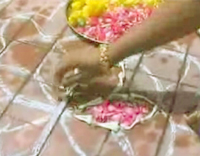 Thanksgiving
is an important aspect of Thamil culture and tradition, as is the case with
many other civilisations. Most thanksgiving ceremonies are religious in
nature, as people of each culture thank their chosen deity for the favours
granted to them, though this is not always the case. Thanksgiving
is an important aspect of Thamil culture and tradition, as is the case with
many other civilisations. Most thanksgiving ceremonies are religious in
nature, as people of each culture thank their chosen deity for the favours
granted to them, though this is not always the case. The Thamil
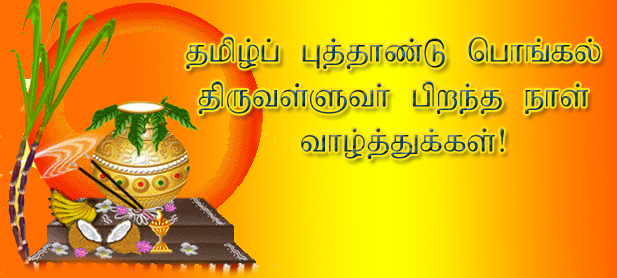
festival of Thai Pongal is such a thanks-giving ceremony. It is the equivalent
of Canada’s Thanks Giving Day. Pongal is a four-days-long harvest festival
celebrated by Thamils living all around the world. Pongal day and the dat
following are national holidays in Thamil Nadu. For so long as people have been
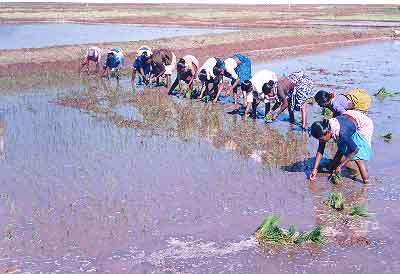
planting and gathering food, there has been some form of harvest festival.
Pongal, one of the most important popular festivals of the year. This four-day
festival of thanksgiving to nature takes its name from the Tamil word meaning
"to boil" and is held on the first day of the month of Thai (January -February)
when rice and other cereals, sugar-cane, and turmeric (an essential ingredient
in Tamil cooking) are harvested. Mid-January is an important time in the
Tamil calendar. The harvest festival, Pongal, falls typically on the 14th or the
15th of January and is the quintessential 'Tamil Festival'. Pongal is a harvest
festival, a traditional occasion for giving thanks to nature, for celebrating
the life cycles that give us grain. Tamilians say 'Thai pirandhaal vazhi
pirakkum', and believe that knotty family problems will be solved with the
advent of the Tamil month Thai that begins on Pongal day. This is traditionally
the month of weddings. This is not a surprise in a largely agricultural
community - the riches gained from a good harvest form the economic basis for
expensive family occasions like weddings. Thamils refer to Pongal as "Tamizhar
Thirunal" (meaning "the festival of Tamils"). This festival originated in Tamil
Nadu. The saying "Thai Pirandhal Vazhi Pirakkum" meaning "the birth of the month
of Thai will pave the way for new opportunities" often is quoted regarding the
Pongal festival. Thamil farmers celebrate the event to thank gift of nature
like the Sun and the farm cattle for their assistance in reaping a bountiful
harvest. Thamil New Year and Pongal festival falls on the first day of
the month of Thai of the Thamil calendar (On the 14th or 15th of the month of
January according to Christian calendar). Thai (January) is the harvest season
in both Thamil Nadu and Thamil Eelam. Interestingly in Japan too, the
harvesting day is celebrated on January 15 of every year and is called "Kosho
Katsu". In 1969
Kalaignar M. Karunanidhi,, Chief Minister of Thamil Nadu, ordered that the
day after Pongal should be celebrated as
Thiruvalluvar
Day all over Thamilnadu. He also declared the day as a government holiday. The
second day of Thai (Thai thingaL) is celebrated as Thiruvalluvar Day since 1974.
Thamilnadu Government also adopted the Thamil Calendar based on the birth of
Thiruvalluvar in 1971, in government gazette since 1972 and in all government
offices from 1981. In 2008 the Thamil Nadu government passed into law
legislation declaring Thai 01 (January 14) as the birth of Thamil New Year and
Thai Pongal Vizha. Pngal day and the following day have also been declared
statury holidays. In the solar calendar, January 13/14 has astronomical
significance. It is the day the sun after making a complete circle is seen going
on its ’ northward journey’ and observed from the earth the sun enters one of
the 12 imaginary zodiac sign of Magara Raasi from Dhanu Raasi. In ancient
times, the solar calendar was not followed in celebrating festivals. There is
historical evidence to show that Thai Pongal was celebrated on the day when the
new moon was sighted. This was because in ancient times the calendar was drawn
up on the basis of the changing phases of the moon. The celebration of Thai
1st goes back to the latter part of the Sangam age. According to the Sangam
literary work
Paripaadal, this day is related to the Thiruvaathirai festival. Having spent
the entire month of Maarkazhi praying to god and observing ritual fasting, young
virgins celebrated the last day, Thai 1, with the Thai Bathing. According to the
work
Kaliththokai, the rituals during the month of Maarkazhi are observed in the
hope that it will lead to wedlock with a good-hearted husband. It also mentions
the worship of Sun as a deity. According to the stone carvings [kalvettu] at
Thiruvotriyoor, Pongal was celebrated during the time of the great king
Raajaraaja Chozhan 1. This festival was known as the “Puthiyeedu” festival.
Puthiyeedu meant the first harvest of the year. Both the Maarkazhi month
rituals and the Thai 1st bathing rituals are practiced even today. It was these
secular rituals that inspired the immortal hymns of
Thiruppaavai
and
Thiruvempaavai by
Saint Aandaal and
Saint Maanikkavaasakar
respectively in the 9th century. Pongal refers to rice cooked in milk and
sweetened with jaggery. On a full scale it is a three-day festival of
nature-worship. On the second day thanks are offered to the cattle, Mattu Pongal
or Paddip Pongal, which helped farmers to plough the fields, transport goods and
provide milk to drink. On this day the cattle is bathed, decorated and given
special gruel. Turmeric, kunkumam are applied to the horns of the cattle,
garlands, small bells and bundles of vadai are hung around their necks and they
are paraded in the streets. The cooked Pongal is given to the cattle to eat. In
Thamil Nadu, a kind of bullfight called the ‘Jallikattu’ is staged by young men
on the 3rd day of Thai Pongal celebrations. In short, people, houses, and
cows all take on an air of freshness and radiance during Thamil New Year and
Pongal. There is also the hope that “When Thai is born, a way will be
born.”(Thai piRanthaal, vazhi piRakkum). Thai is considered an auspicious month
to hold weddings. On Thai Pongal day members of the family wake up early in
the morning, take special baths, puts on new clothes and gather in the front of
the garden (muttram) to cook the traditional Pongal (rice pudding). Before
Thai Pongal day courtyards are cleaned, old wares are discarded and replaced
with new things, homes colour-washed and decorated. On the morning of Pongal day
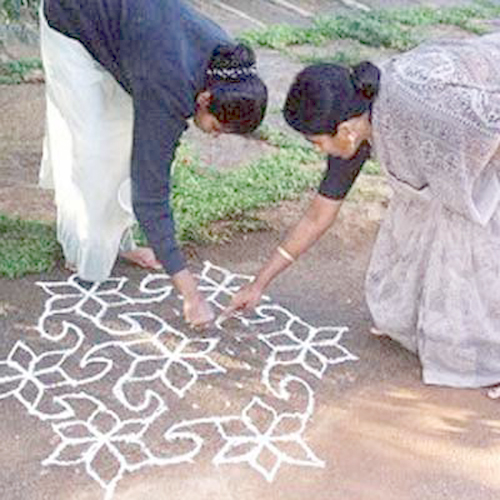
the front garden is pre-prepared for the ceremonious cooking. A flat square
pitch is made and decorated with kolam drawings, and it is exposed to the direct
sun light. A fire wood hearth will be set up using three bricks. . The cooking
begins by putting a clay pot with water on the hearth. A senior member of the
family will conduct the cooking and the rest of the family dutifully assists him
or her or watches the event. The moment of climax is the spill over of the
Pongal during cooking. The spillover of milk is a propitious symbol of abundance
and good omen and shouts of “ Pongalo Pongal". Thereafter, a member of the
family ceremoniously puts three handful of new rice inside the boiling pot.
The
other ingredients of this special dish are chakkarai (brown cane sugar) or
katkandu (sugar candy), milk (cow's milk or coconut milk), roasted green gram
(payaru), raisins, cashew nuts and few pods of cardamom. When the meal is
ready it is first put on a banana leaf and the family pray for a few minutes to
thank nature, sun and farmers. Then the meal (Pongal) is served with fruits
(banana and mango) among the family. Later it will be shared with neighbours,
friends and relatives. The richness of Thamil culture and historical
traditions is symbolized in the Thamil New Year and Thai Pongal festival. It
is a joyous and happy occasion when the poor, the rich, the farmer, the villager
all celebrate the harvest festival together irrespective of their individual
faith. By celebrating this festival the
Thamils in the Diaspora help to perpetuate our rich culture, traditions,
literary opulence, sublime philosophy and socio-economic aspirations. Also to
give an emotional link to our kith and kin at home who for the first time in two
decades are celebrating Pongal in an atmosphere of relative peace. On this
Pongal festive day, we should banish superstitious beliefs, darkness of
ignorance and egoistic arrogance. Instead lit the light of knowledge and the
warmth of human love and compassion among all people.
|