|
Reciprocal
Bases of National Culture and the Fight for
Freedom
Frantz Fanon
at the Congress of Black African Writers, 1959
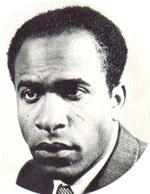 "The
nation is not only the condition of culture, its
fruitfulness, its continuous renewal, and its
deepening. It is also a necessity. It is the fight for
national existence which sets culture moving and opens
to it the doors of creation. Later on it is the nation
which will ensure the conditions and framework
necessary to culture. The nation gathers together the
various indispensable elements necessary for the
creation of a culture, those elements which alone can
give it credibility, validity, life and creative power.
In the same way it is its national character that will
make such a culture open to other cultures and which
will enable it to influence and permeate other
cultures. A non-existent culture can hardly be expected
to have bearing on reality, or to influence
reality. "The
nation is not only the condition of culture, its
fruitfulness, its continuous renewal, and its
deepening. It is also a necessity. It is the fight for
national existence which sets culture moving and opens
to it the doors of creation. Later on it is the nation
which will ensure the conditions and framework
necessary to culture. The nation gathers together the
various indispensable elements necessary for the
creation of a culture, those elements which alone can
give it credibility, validity, life and creative power.
In the same way it is its national character that will
make such a culture open to other cultures and which
will enable it to influence and permeate other
cultures. A non-existent culture can hardly be expected
to have bearing on reality, or to influence
reality.
If man is known by his acts, then
we will say that the most urgent thing today for the
intellectual is to build up his nation. If this
building up is true, that is to say if it interprets
the manifest will of the people ... then the building
of a nation is of necessity accompanied by the
discovery and encouragement of universalising values.
Far from keeping aloof from other nations, therefore,
it is national liberation which leads the nation to
play its part on the stage of history. It is at the
heart of national consciousness that international
consciousness lives and grows. And this two-fold
emerging is ultimately the source of all culture.
"
Colonial domination, because it is total and tends to
over-simplify, very soon manages to disrupt in
spectacular fashion the cultural life of a conquered
people. This cultural obliteration is made possible by
the negation of national reality, by new legal relations
introduced by the occupying power, by the banishment of
the natives and their customs to outlying districts by
colonial society, by expropriation, and by the systematic
enslaving of men and women.
Three years ago at our first congress I showed that, in
the colonial situation, dynamism is replaced fairly
quickly by a substantification of the attitudes of the
colonising power. The area of culture is then marked off
by fences and signposts. These are in fact so many
defence mechanisms of the most elementary type,
comparable for more than one good reason to the simple
instinct for preservation. The interest of this period
for us is that the oppressor does not manage to convince
himself of the objective non-existence of the oppressed
nation and its culture. Every effort is made to bring the
colonised person to admit the inferiority of his culture
which has been transformed into instinctive patterns of
behaviour, to recognise the unreality of his 'nation',
and, in the last extreme, the confused and imperfect
character of his own biological structure.
Vis-à-vis this state of affairs, the native's
reactions are not unanimous While the mass of the people
maintain intact traditions which are completely different
from those of the colonial situation, and the artisan
style solidifies into a formalism which is more and more
stereotyped, the intellectual throws himself in frenzied
fashion into the frantic acquisition of the culture of
the occupying power and takes every opportunity of
unfavourably criticising his own national culture, or
else takes refuge in setting out and substantiating the
claims of that culture in a way that is passionate but
rapidly becomes unproductive.
The common nature of these two reactions lies in the fact
that they both lead to impossible contradictions. Whether
a turncoat or a substantialist the native is ineffectual
precisely because the analysis of the colonial situation
is not carried out on strict lines. The colonial
situation calls a halt to national culture in almost
every field. Within the framework of colonial domination
there is not and there will never be such phenomena as
new cultural departures or changes in the national
culture. Here and there valiant attempts are sometimes
made to reanimate the cultural dynamic and to give fresh
impulses to its themes, its forms and its tonalities. The
immediate, palpable and obvious interest of such leaps
ahead is nil. But if we follow up the consequences to the
very end we see that preparations are being thus made to
brush the cobwebs off national consciousness to question
oppression and to open up the struggle for freedom.
A national culture under colonial domination is a
contested culture whose destruction is sought in
systematic fashion. It very quickly becomes a culture
condemned to secrecy. This idea of clandestine culture is
immediately seen in the reactions of the occupying power
which interprets attachment to traditions as faithfulness
to the spirit of the nation and as a refusal to submit.
This persistence in following forms of culture which are
already condemned to extinction is already a
demonstration of nationality; but it is a demonstration
which is a throw-back to the laws of inertia. There is no
taking of the offensive and no redefining of
relationships. There is simply a concentration on a hard
core of culture which is becoming more and more
shrivelled up, inert and empty.
By the time a century or two of exploitation has passed
there comes about a veritable emaciation of the stock of
national culture. It becomes a set of automatic habits,
some traditions of dress and a few broken-down
institutions. Little movement can be discerned in such
remnants of culture; there is no real creativity and no
overflowing life. The poverty of the people, national
oppression and the inhibition of culture are one and the
same thing. After a century of colonial domination we
find a culture which is rigid in the extreme, or rather
what we find are the dregs of culture, its mineral
strata. The withering away of the reality of the nation
and the death-pangs of the national culture are linked to
each other in mutual dependences. This is why it is of
capital importance to follow the evolution of these
relations during the struggle for national freedom.
The negation of the native's culture, the contempt for
any manifestation of culture whether active or emotional
and the placing outside the pale of all specialised
branches of organisation contribute to breed aggressive
patterns of conduct in the native. But these patterns of
conduct are of the reflexive type; they are poorly
differentiated, anarchic and ineffective. Colonial
exploitation, poverty and endemic famine drive the native
more and more to open, organised revolt. The necessity
for an open and decisive breach is formed progressively
and imperceptibly, and comes to be felt by the great
majority of the people. Those tensions which hitherto
were non-existent come into being. International events,
the collapse of whole sections of colonial empires and
the contradictions inherent in the colonial system
strengthen and uphold the native's combativity while
promoting and giving support to national
consciousness.
These new-found tensions which are present at all stages
in the real nature of colonialism have their
repercussions on the cultural plane. In literature, for
example, there is relative over-production. From being a
reply on a minor scale to the dominating power, the
literature produced by natives becomes differentiated and
makes itself into a will to particularism. The
intelligentsia, which during the period of repression was
essentially a consuming public, now themselves become
producers.
This literature at first chooses to confine itself to
the tragic and poetic style; but later on novels, short
stories and essays are attempted. It is as if a kind of
internal organisation or law of expression existed which
wills that poetic expression become less frequent in
proportion as the objectives and the methods of the
struggle for liberation become more precise. Themes are
completely altered; in fact, we find less and less of
bitter, hopeless recrimination and less also of that
violent, resounding, florid writing which on the whole
serves to reassure the occupying power. The colonialists
have in former times encouraged these modes of expression
and made their existence possible. Stinging
denunciations, the exposing of distressing conditions and
passions which find their outlet in expression are in
fact assimilated by the occupying power in a cathartic
process.
To aid such processes is in a certain sense to avoid
their dramatisation and to clear the atmosphere. But such
a situation can only be transitory. In fact, the progress
of national consciousness among the people modifies and
gives precision to the literary utterances of the native
intellectual. The continued cohesion of the people
constitutes for the intellectual an invitation to go
farther than his cry of protest. The lament first makes
the indictment; then it makes an appeal. In the period
that follows, the words of command are heard. The
crystallisation of the national consciousness will both
disrupt literary styles and themes, and also create a
completely new public. While at the beginning the native
intellectual used to produce his work to be read
exclusively by the oppressor, whether with the intention
of charming him or of denouncing him through ethnical or
subjectivist means, now the native writer progressively
takes on the habit of addressing his own people.
It is only from that moment that we can speak of a
national literature. Here there is, at the level of
literary creation, the taking up and clarification of
themes which are typically nationalist. This may be
properly called a literature of combat, in the sense that
it calls on the whole people to fight for their existence
as a nation. It is a literature of combat, because it
moulds the national consciousness, giving it form and
contours and flinging open before it new and boundless
horizons; it is a literature of combat because it assumes
responsibility, and because it is the will to liberty
expressed in terms of time and space.
On another level, the oral tradition - stories, epics and
songs of the people - which formerly were filed away as
set pieces are now beginning to change. The storytellers
who used to relate inert episodes now bring them alive
and introduce into them modifications which are
increasingly fundamental. There is a tendency to bring
conflicts up to date and to modernise the kinds of
struggle which the stories evoke, together with the names
of heroes and the types of weapons. The method of
allusion is more and more widely used. The formula 'This
all happened long ago' is substituted by that of 'What we
are going to speak of happened somewhere else, but it
might well have happened here today, and it might happen
tomorrow'. The example of Algeria is significant in this
context. From 1952-3 on, the storytellers, who were
before that time stereotyped and tedious to listen to,
completely overturned their traditional methods of
storytelling and the contents of their tales. Their
public, which was formerly scattered, became compact. The
epic, with its typified categories, reappeared; it became
an authentic form of entertainment which took on once
more a cultural value. Colonialism made no mistake when
from 1955 on it proceeded to arrest these storytellers
systematically.
The contact of the people with the new movement gives
rise to a new rhythm of life and to forgotten muscular
tensions, and develops the imagination. Every time the
storyteller relates a fresh episode to his public, he
presides over a real invocation. The existence of a new
type of man is revealed to the public. The present is no
longer turned in upon itself but spread out for all to
see. The storyteller once more gives free rein to his
imagination; he makes innovations and he creates a work
of art. It even happens that the characters, which are
barely ready for such a transformation - highway robbers
or more or less antisocial vagabonds - are taken up and
remodelled.
The emergence of the imagination and of the creative
urge in the songs and epic stories of a colonised country
is worth following. The storyteller replies to the
expectant people by successive approximations, and makes
his way, apparently alone but in fact helped on by his
public, towards the seeking out of new patterns, that is
to say national patterns. Comedy and farce disappear, or
lose their attraction. As for dramatisation, it is no
longer placed on the plane of the troubled intellectual
and his tormented conscience. By losing its
characteristics of despair and revolt, the drama becomes
part of the common lot of the people and forms part of an
action in preparation or already in progress.
Where handicrafts are concerned, the forms of expression
which formerly were the dregs of art, surviving as if in
a daze, now begin to reach out. Woodwork, for .example,
which formerly turned out certain faces and attitudes by
the million, begins to be differentiated. The
inexpressive or overwrought mask comes to life and the
arms tend to be raised from the body as if to sketch an
action. Compositions containing two, three or five
figures appear. The traditional schools are led on to
creative efforts by the rising avalanche of amateurs or
of critics. This new vigour in this sector of cultural
life very often passes unseen; and yet its contribution
to the national effort is of capital importance. By
carving figures and faces which are full of life, and by
taking as his theme a group fixed on the same pedestal,
the artist invites participation in an organised
movement.
If we study the repercussions of the awakening of
national consciousness in the domains of ceramics and
pottery-making, the same observations may be drawn.
Formalism is abandoned in the craftsman's work. Jugs,
jars and trays are modified, at first imperceptibly, then
almost savagely. The colours, of which formerly there
were but few and which obeyed the traditional rules of
harmony, increase in number and are influenced by the
repercussion of the rising revolution. Certain ochres and
blues, which seemed forbidden to all eternity in a given
cultural area, now assert themselves without giving rise
to scandal. In the same way the stylisation of the human
face, which according to sociologists is typical of very
clearly defined regions, becomes suddenly completely
relative. The specialist coming from the home country and
the ethnologist are quick to note these changes.
On the whole such changes are condemned in the name of
a rigid code of artistic style and of a cultural life
which grows up at the heart of the colonial system. The
colonialist specialists do not recognise these new forms
and rush to the help of the traditions of the indigenous
society. It is the colonialists who become the defenders
of the native style. We remember perfectly, and the
example took on a certain measure of importance since the
real nature of colonialism was not involved, the
reactions of the white jazz specialists when after the
Second World War new styles such as the be-bop took
definite shape.
The fact is that in their eyes jazz should only be the
despairing, broken-down nostalgia of an old Negro who is
trapped between five glasses of whisky, the curse of his
race, and the racial hatred of the white men. As soon as
the Negro comes to an understanding of himself, and
understands the rest of the world differently, when he
gives birth to hope and forces back the racist universe,
it is clear that his trumpet sounds more clearly and his
voice less hoarsely. The new fashions in jazz are not
simply born of economic competition. We must without any
doubt see in them one of the consequences of the defeat,
slow but sure, of the southern world of the United
States. And it is not utopian to suppose that in fifty
years' time the type of jazz howl hiccupped by a poor
misfortunate Negro will be upheld only by the whites who
believe in it as an expression of nigger-hood, and who
are faithful to this arrested image of a type of
relationship.
We might in the same way seek and find in dancing,
singing, and traditional rites and ceremonies the same
upward-springing trend, and make out the same changes and
the same impatience in this field. Well before the
political or fighting phase of the national movement an
attentive spectator can thus feel and see the
manifestation of new vigour and feel the approaching
conflict. He will note unusual forms of expression and
themes which are fresh and imbued with a power which is
no longer that of invocation but rather of the assembling
of the people, a summoning together for a precise
purpose. Everything works together to awaken the native's
sensibility and to make unreal and inacceptable the
contemplative attitude, or the acceptance of defeat. The
native rebuilds his perceptions because he renews the
purpose and dynamism of the craftsmen, of dancing and
music and of literature and the oral tradition. His world
comes to lose its accursed character. The conditions
necessary for the inevitable conflict are brought
together.
We have noted the appearance of the movement in cultural
forms and we have seen that this movement and these new
forms are linked to the state of maturity of the national
consciousness. Now, this movement tends more and more to
express itself objectively, in institutions. From thence
comes the need for a national existence, whatever the
cost.
A frequent mistake, and one which is moreover hardly
justifiable is to try to find cultural expressions for
and to give new values to native culture within the
framework of colonial domination. This is why we arrive
at a proposition which at first sight seems paradoxical:
the fact that in a colonised country the most elementary,
most savage and the most undifferentiated nationalism is
the most fervent and efficient means of defending
national culture. For culture is first the expression of
a nation, the expression of its preferences, of its
taboos and of its patterns. It is at every stage of the
whole of society that other taboos, values and patterns
are formed. A national culture is the sum total of all
these appraisals; it is the result of internal and
external extensions exerted over society as a whole and
also at every level of that society. In the colonial
situation, culture, which is doubly deprived of the
support of the nation and of the state, falls away and
dies. The condition for its existence is therefore
national liberation and the renaissance of the state.
The nation is not only the condition of culture, its
fruitfulness, its continuous renewal, and its deepening.
It is also a necessity. It is the fight for national
existence which sets culture moving and opens to it the
doors of creation. Later on it is the nation which will
ensure the conditions and framework necessary to culture.
The nation gathers together the various indispensable
elements necessary for the creation of a culture, those
elements which alone can give it credibility, validity,
life and creative power. In the same way it is its
national character that will make such a culture open to
other cultures and which will enable it to influence and
permeate other cultures. A non-existent culture can
hardly be expected to have bearing on reality, or to
influence reality. The first necessity is the
re-establishment of the nation in order to give life to
national culture in the strictly biological sense of the
phrase.
Thus we have followed the break-up of the old strata of
culture, a shattering which becomes increasingly
fundamental; and we have noticed, on the eve of the
decisive conflict for national freedom, the renewing of
forms of expression and the rebirth of the imagination.
There remains one essential question: what are the
relations between the struggle - whether political or
military - and culture? Is there a suspension of culture
during the conflict? Is the national struggle an
expression of a culture? Finally, ought one to say that
the battle for freedom, however fertile a posteriori with
regard to culture, is in itself a negation of culture? In
short is the struggle for liberation a cultural
phenomenon or not?
We believe that the conscious and organised undertaking
by a colonised people to re-establish the sovereignty of
that nation constitutes the most complete and obvious
cultural manifestation that exists. It is not alone the
success of the struggle which afterwards gives validity
and vigour to culture; culture is not put into cold
storage during the conflict. The struggle itself in its
development and in its internal progression sends culture
along different paths and traces out entirely new ones
for it. The struggle for freedom does not give back to
the national culture its former value and shapes; this
struggle which aims at a fundamentally different set of
relations between men cannot leave intact either the form
or the content of the people's culture. After the
conflict there is not only the disappearance of
colonialism but also the disappearance of the colonised
man.
This new humanity cannot do otherwise than define a new
humanism both for itself and for others. It is prefigured
in the objectives and methods of the conflict. A struggle
which mobilises all classes of the people and which
expresses their aims and their impatience, which is not
afraid to count almost exclusively on the people's
support, will of necessity triumph. The value of this
type of conflict is that it supplies the maximum of
conditions necessary for the development and aims of
culture. After national freedom has been obtained in
these conditions, there is no such painful cultural
indecision which is found in certain countries which are
newly independent, because the nation by its manner of
coming into being and in the terms of its existence
exerts a fundamental influence over culture. A nation
which is born of the people's concerted action and which
embodies the real aspirations of the people while
changing the state cannot exist save in the expression of
exceptionally rich forms of culture.
The natives who are anxious for the culture of their
country and who wish to give to it a universal dimension
ought not therefore to place their confidence in the
single principle of inevitable, undifferentiated
independence written into the consciousness of the people
in order to achieve their task. The liberation of the
nation is one thing; the methods and popular content of
the fight are another. It seems to me that the future of
national culture and its riches are equally also part and
parcel of the values which have ordained the struggle for
freedom.
And now it is time to denounce certain pharisees.
National claims, it is here and there stated, are a phase
that humanity has left behind. It is the day of great
concerted actions, and retarded nationalists ought in
consequence to set their mistakes aright. We, however,
consider that the mistake, which may have very serious
consequences, lies in wishing to skip the national
period. If culture is the expression of national
consciousness, I will not hesitate to affirm that in the
case with which we are dealing it is the national
consciousness which is the most elaborate form of
culture.
The consciousness of self is not the closing of a door to
communication. Philosophic thought teaches us, on the
contrary, that it is its guarantee. National
consciousness, which is not nationalism, is the only
thing that will give us an international dimension. This
problem of national consciousness and of national culture
takes on in Africa a special dimension. The birth of
national consciousness in Africa has a strictly
contemporaneous connexion with the African consciousness.
The responsibility of the African as regards national
culture is also a responsibility with regard to
African-Negro culture. This joint responsibility is not
the fact of a metaphysical principle but the awareness of
a simple rule which wills that every independent nation
in an Africa where colonialism is still entrenched is an
encircled nation, a nation which is fragile and in
permanent danger.
If man is known by his acts, then we will say that the
most urgent thing today for the intellectual is to build
up his nation. If this building up is true, that is to
say if it interprets the manifest will of the people and
reveals the eager African peoples, then the building of a
nation is of necessity accompanied by the discovery and
encouragement of universalising values. Far from keeping
aloof from other nations, therefore, it is national
liberation which leads the nation to play its part on the
stage of history. It is at the heart of national
consciousness that international consciousness lives and
grows. And this two-fold emerging is ultimately the
source of all culture.
|