|
|
|
DRAVIDIAN
TEMPLE ARCHITECTURE
Srirangam Temple,
Tiruchi
Chola Period (9th - 13th century) with later
additions
"...This is the foremost of the 108 shrines
glorified by the Alwars; all of the Alwars with the exception of
Madhurakavi Alwar have sung of its glory... Undoubtedly the
largest temple in India, and one among the grandest, it is a
treasure house of art freezing various architectural styles over
a period of time. It boasts of the tallest temple tower in
India.."
Renganathar Temple - Srirangam

"Srirangam, surrounded by the waters of river
Kaveri, is a 600 acre island-town enclosed within the seven
walls of the gigantic Sri Ranganathaswami Temple. There are 21
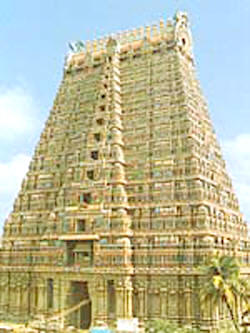
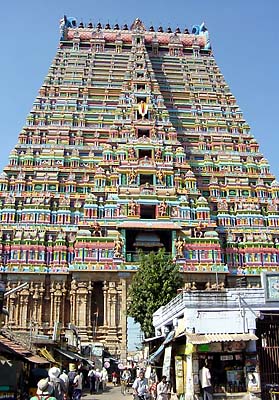
gopurams, among which the Rajagopuram (on the left) is the
largest in South India - it is 72m (about 220 feet) in
height, and dates from the 17th century, although it was
completed only in 1987.
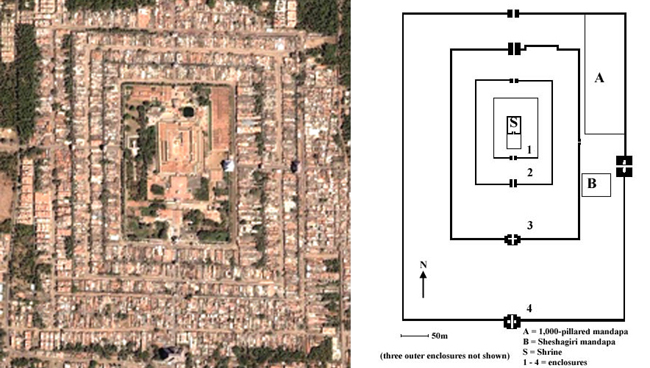
The temple complex measures 950m by 816m
(about a half-mile square) along its outer perimeter. "It
consists of seven nested enclosures (plan), whose walls are
pierced by towered gates (gopuras) along the four cardinal axes
leading from the shrine. Visitors approach from the south, and
the shrine faces in this direction. The temple's outer three
enclosures contain an entire town, with streets, houses, and
shops. The inner four enclosures define the religious zone. The
temple is dedicated to Vishnu Ranganatha (i.e., Vishnu sleeping
on the cosmic serpent)."
A Brief History of the Srirangam Temple - Professor.
V.S. Seshadri, Srirangam, from ``Sri Nrusimha Priya''
"Srirangam, the premier Vaishnava temple in South India is the first
and foremost among the 108 Vaishnava divyadesas.
All the Alvars have sung in praise of the deity enshrined in the
huge temple in the center of the town. The Sri Vaishnava Acharyas
from Nathamuni are found to have taken an active and abiding
interest in the management of the temple. During Ramanuja's time,
far reaching reforms were introduced both in the religious and
secular management. Thus Srirangam has an eventful history, both
secular and religious, as the great Vaishnava Acharyas made it the
headquarters of the wider Vaishnava movement. Here is an attempt to
present its eventful history in a nutshell - both the traditional
and historical.
In the Vaishnava parlance, the term "Koil" signifies the Srirangam
temple only. The temple is enormous in size. The temple complex is
156 acres in extent. It has seven Prakaras or enclosures or Tiru
Veedhis. These enclosures are formed by thick and huge rampart walls
which run round the sanctum. The total length of these seven walls
is 32,592 feet or over six miles. There are magnificent towers in
all Prakaras providing a unique sight to any visitor. The latest
addition is the 236 feet high stupendous thirteen tiered Rajagopuram
built at the southern rampart by the late 44th Jeeyar of the Sri
Ahobila Mutt and consecrated in 1987 with great fanfare and
religious piety. The grandeur of the towers decrease as one moves
away from, them towards the sanctum signifying that the devotee has
to move away from the lofty earthly attachments in his spiritual
quest... With the rise of Buddhism and Jainism in the Tamil
country, there arose a strong reaction against their growing
influence. This found expression in a wide movement among the
worshippers of Vishnu and Siva. The Vaishnava resurgent movement was
spearheaded by the Alvars who brought religion to the heart of the
people. They employed Tamil (the local language) as the medium of
expression and composed the exuberant devotional songs - celebrated
as the "Nalayira Divya Prabandham".
The shrines visited and
glorified by them became holy places (Divya Desas). The temple at
Srirangam and the Deity enshrined therein have been sung by all of
them.
A total of 247 hymns in the
Nalayiram is found to be dedicated to the Lord of Srirangam as
shown below:
Periyalvar 35
Andal 10
Kulasekhara Alvar 31
Tirumalisai Alvar 14
Tondaradippodi Alvar 55
Tirruppanalvar 10
Tirumangai Alvar 73
Poygai Alvar 1
Bhoothatalvar 4
Peyalvar 2
Nammalvar 12 ..
... Numerous inscriptions appear on the walls and other places.
They exceed over 600. They furnish us with a variety of information
about the benefactions made by the ruling classes from time to time
and also about the social, economic and political conditions..." |
 Architecture
of Srirangam
Architecture
of Srirangam
"Architecturally the temple of Srirangam is unique among the
great temples of South India. The Sculptures found in the temple are
some of the finest.
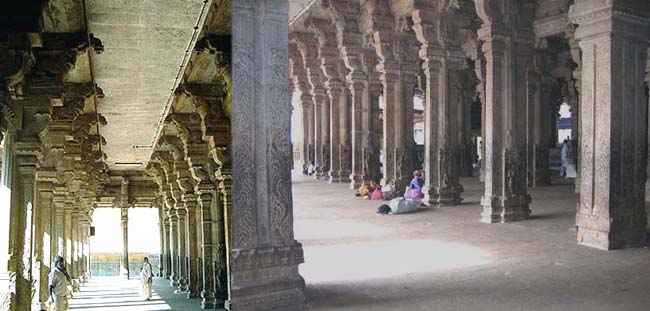
1000 Pillar Mandapam
The 1000 pillared mantapa, Horse Court, Garuda Mantapa, Ranga
Vilasam, Vasantha Mantapa, the mirror room are worth seeing. Sri
Ranganatha in the Sanctum - Sanctorum in the lying posture is a
charming idol of great beauty and grace."
Srirangam
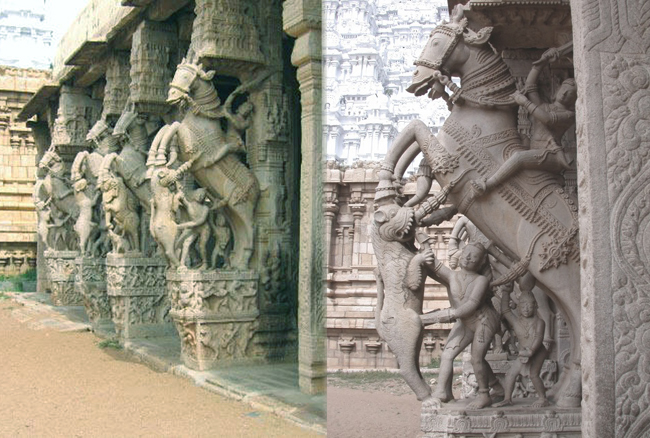
Horse Court
|
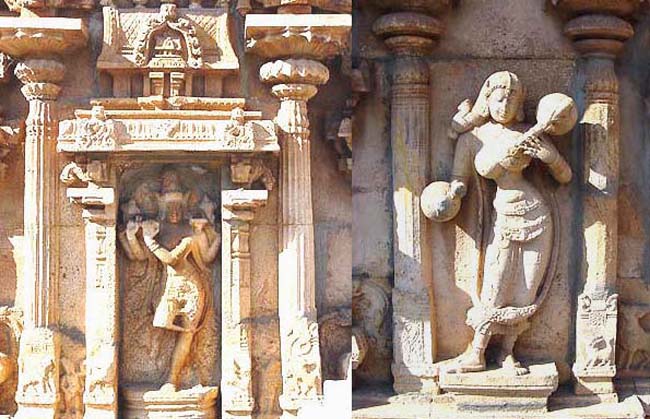 |
Krishna playing the
flute |
Veena |
|
|
Attraction of Sri Rangam
- Gita
Aravamudan, 1997 "No one really knows when the Srirangam
temple came into being. The actual shrine is supposed to have risen
out of the Paarkadal (Ocean) itself as a result of Brahma's penance.
According to legend, Ikshvaku, a descendant of Surya, the Sun God,
who was appointed to take care of the daily worship, is supposed to
have kept it in his capital, Ayodhya. His descendant, Sri Rama
presented the shrine to Vibishana when he attended his coronation.
When Vibhishana, who was carrying it back on his head to Sri Lanka,
rested briefly at Srirangam, the shrine got rooted there. Sri
Ranganathaswami, the legend goes, then appeared before him and said
he wished to stay on the banks of the Cauvery. He however promised
the disconsolate Vibhishana that he would always lie facing Sri
Lanka. Vibishana, it is believed comes even today to pray at the
temple.
The temple does have a traceable history which is quite
awesome. It is mentioned in the
Silappadikaram as well as in the
Nalayira Divyaprabandham which date back to the third century.
Koil Olugu, a chronicle of the temple, written around the 11th
Century attributes the construction of one of the enclosures to
Tirumangaialvar, who is supposed to have lived there during the
seventh century. Periyalvar, whose adopted daughter Andal was an
ardent devotee of Ranganathaswamy, has also described the temple
in his verses. Outside the main temple there is a small shrine
supposed to have been built on the spot where Andal became one with
the Lord. " |
|