Press Conference on Tokyo
Donors Conference, 21 November 2006
Press Conference on Tokyo
Donors Conference, 21 November 2006Under Secretary of State R.
Nicholas Burns, ; Norwegian Minister of International Development Erik Solheim,
Japanese Special Envoy Yasushi Akashi, and European Commission and European
Commission Director General for External Relations Herve Jouanjean Loy
Henderson Conference Room Washington, DC November 21, 2006
Source: US State Department Washington DC
UNDER SECRETARY BURNS: Good afternoon, ladies and gentlemen, I hope all of
you can hear me. I'm pleased to welcome you to the Department of State and to
Washington, D.C., for those of you coming from overseas. The United States has
been very pleased to host today another meeting of the Co-Chairs Group on Sri
Lanka on the Tokyo Donors Conference. Those countries and organizations
represented are Norway and the European Union, Japan and the United States. And
to my left is Erik Solheim, the Minister of International Development of Norway.
Herve Jouanjean who's the Deputy Director General Asia Director at the European
Commission and Yasushi Akashi who's a Special Envoy of the Government of Japan.
We have been meeting here for two days at the State Department to take
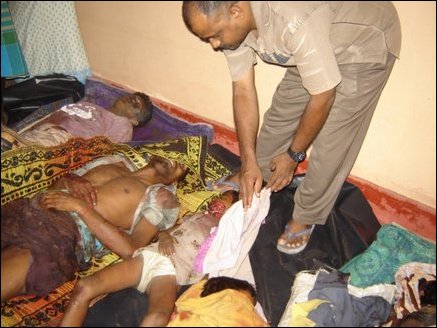
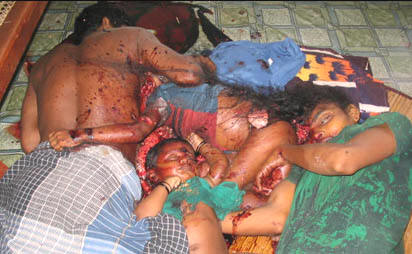
account of the very tragic and deteriorating situation in Sri Lanka. I can say I
think for all of us that we're all very much disturbed by the increased level of
violence, the killings that have taken place in Sri Lanka over the last several
months. And all of us are united in asking the Government of Sri Lanka as well
as the LTTE to cease and desist from violence, to affect a ceasefire and to
return to the negotiations. We also support very, very much what Mr. Solheim,
the Norwegian Government, have been doing to try to mediate, try to bring these
parties together and to try to find a solution that will lead to lasting peace
in Sri Lanka itself. You will shortly have a statement that has been agreed
to by all of us that represent our views. We'll pass that out to you as soon as
we possibly can, in a matter of moments, but since you don't have it in front of
you let me just read a few portions which will give you a headline and give you
a sense of what we've agreed. The Co-Chairs view with alarm the rising level
of violence in Sri Lanka that has led to significant loss of life and widespread
human rights violations. We condemn the continued and systematic ceasefire
violations by the Government of Sri Lanka as well as by the LTTE. We call upon
both sides to seize this opportunity which we believe to be a historic
opportunity created by the 2002 ceasefire agreement to resolve the country's
conflict peacefully. The Co-Chairs particularly condemn the LTTE for initiating
hostilities from heavily populated areas and the Government of Sri Lanka for
firing into such vulnerable areas and killing and wounding innocent civilians.
The Co-Chairs call on both sides to respect international humanitarian law and
to set aside demilitarized zones to protect internally displaced persons. The
Co-Chairs also recall the responsibility of both of these parties to guarantee
the security of the Sri Lanka monitoring mission to fully exercise its mandate.
The Co-Chairs were disturbed by the incident on November 8 when the head of
mission of the monitoring mission came under fire. We remind the parties of
their responsibility to respect all of the rulings of the monitoring mission.
The Co-Chairs welcome the Government of Sri Lanka's progress in establishing
a commission of inquiry for human rights with international observers. We
condemn the growing violations of human rights by both sides and the fear that
pervades civil society and politics and the media. The commission of inquiry and
the government should work promptly to bring the perpetrators to justice and to
address the climate of impunity. We are mindful that it is the civilians and
the citizens of this country that are caught in this crossfire and that are so
often the victims of this conflict. And our responsibility as governments and as
institutions must be to those people to help protect them and to remind the
government and the LTTE of their responsibility to protect innocent human life.
Finally, the Co-Chairs urge both parties to depoliticize the issue of
humanitarian access and for the immediate, permanent and unconditional opening
of the sea and road routes for humanitarian convoys and essential supplies. As a
first step towards this objective, the Co-Chairs welcome the readiness of the
Government to send one convoy via the A9 highway to Jaffna and to allow
international nongovernmental organizations with a proven track record immediate
access to uncleared areas to restart their relief work. The Co-Chairs call on
the LTTE to cooperate with this initiative. It is imperative that this kind of
humanitarian relief reach the civilian population that is badly in need of it.
That is a summary of the joint statement to which we've agreed. You'll soon
have a written version of this and you can look at those words and hopefully
report them to the people of Sri Lanka and to both sides. I wanted to thank
again the heads of delegation for being here in Washington, D.C. It's been a
pleasure to host them and we hope very much that we can be successful in
convincing the government and the LTTE to adopt a more meaningful and more
responsible path towards peace. I should also note that we met with the
Deputy Chief of Mission of the Government of India, Mr. Jassal, just now
following our meeting to brief him on the results of the meeting and also to
seek the views and support of the Indian Government. And we're very grateful for
the role that India's playing, a responsible role, also to fulfill this mandated
peace. With that by way of summary, I think all of us would be very happy to
take your questions. If you could just identify yourself by name and
organization, that would also be helpful to us. Yes sir. QUESTION: The
group has been -- UNDER SECRETARY BURNS: I think there's a microphone, if you
would just wait for it. Why don't you come and give this individual a
microphone. Thank you. QUESTION: How long -- it's Parameswaran from Agence
France-Presse. How long more would the group be giving the -- both sides to come
up to a amicable solution to the dispute? I mean, it's been going on for a long
time. The Contact Group has met so many times around the same tone, the
statements have been issuing both -- asking both sides to come to the table, but
there seems to be no solution to the problem. UNDER SECRETARY BURNS: So your
question is how long do we intend to meet together, the Co-Chairs? QUESTION:
Yes. UNDER SECRETARY BURNS: I think all of us -- I'll be happy to start as
the host and ask others to comment as they wish. We are dedicated to fulfilling
the international mandate for a peace in Sri Lanka. All of us, I can speak on
behalf of my own government, we have a very good and close relationship with the
Government of Sri Lanka, but we want to see the government work on a responsible
basis to move towards peace and we wish to see a reciprocal gesture from the
LTTE. And so we can't simply give up because the work is hard. It's our
responsibility as governments and institutions that have some influence in the
country to use that influence on a responsible basis. And I think what's
important about the Co-Chairs is that we're all united. We work together. We
particularly work to support Minister Solheim and we stand by him and the
excellent work that he and the Norwegian Government have been doing for many
years. And we again today reaffirm our support for his mission. The goal is to
have the parties agree to a ceasefire and then to have them move back towards
negotiations and have those negotiations end up in peace and stability for the
people of the country. But I should ask others if they want to answer that
very basic question. MR. AKASHI: I think you have summarized our common
views. Of course, we hope that the end result of durable peace will be achieved
as soon as possible. We are impatient to see some concrete results. But we know
also that there's a long history behind this conflict and all of us are
determined to work for a most expeditious durable peace. MR. JOUANJEAN: Just
to add that from the European Union side, we are as well committed to the
process. We are fully supportive of Norway and we spare no effort to help Norway
as a facilitator, as a member of our group. We will bring our support to any
initiatives on the ground to bring peace. MR. SOLHEIM: There is not much to
add because we very much share and understand and (inaudible) impatience which
is in your question. I mean there is absolutely no doubt that we are also very
much impatient. And I think time has come for a complete respect for the
ceasefire and immediate move to the -- to peace talks to sort out this problem.
Because even more impatient than us, we believe that the different peoples of
Sri Lanka are because they are suffering from these. And the present atmosphere
of fear in the land where the disappearances, where the killings, where
civilians are deliberately target by both sides and the civilians are both
coming into the crossfire between the two sides is a completely unacceptable
situation. And a lot of people are coming to us and asking what we can do to
make certain that they can come out of this (inaudible) situation. But at the
end of the day, just to add that, of course, it's the Government of Sri Lanka
and LTTE who can make peace in Sri Lanka. We can be of support to them, but it's
their responsibility to make peace. QUESTION: Foster Klug with the Associated
Press. Was there any talk, discussion of financial or other types of assistance
that might be provided to help the peace process? Or were there any specific
strategies that you determined during your meetings? UNDER SECRETARY BURNS:
I'll just answer for my own government. We, of course, are a friend to the Sri
Lankan Government and we do have an assistance program for that government, in
fact, a very intensive one and we intend to continue that of course. We hope
that the assistance that we provide, the varied assistance to the government,
will contribute to this larger cause of peace in Sri Lanka itself. MR.
AKASHI: As you know, in June 2003, following the ceasefire agreement reached in
the previous year, the Government of Japan organized an international conference
for rehabilitation and development of Sri Lanka and collected pledges amounting
to $4.5 billion. The great bulk of this has already been delivered by the way of
pledge to close linkage between the peace process and the assistance process.
The more progress there is on the peace front, I'm sure that all the governments
and the organizations which made original pledges are prepared to be even more
generous. But what has been happening lately has been rather negative to the
hoped for consequences. So we'll keep reviewing the situation and appropriate
mix of incentives and disincentives has to be always weighed and considered.
MR. SOLHEIM: If I may add that the international community has, in fact, been
rather generous towards Sri Lanka, Japan taking the lead in giving long-term
development assistance to Sri Lanka. We have been able to share all costs of the
peace process as such and there's a great willingness to go with the government
and the LTTE as long as they move towards peace, we are ready to contribute
financially and in many other ways. The immediate concern is not even money.
The immediate concern is access. And UN organizations and nongovernment
organizations, I mean, all involved in humanitarian affairs should be given
access to the victims of this conflict on all sides so they can help them. I
think money is not really at the moment the critical factor. It's access. MR.
JOUANJEAN: Maybe I can add a word as far as the European Union is concerned. I
mean, together with our colleagues we are a major donor of assistance
cooperation, assistance to Sri Lanka, acting both in the framework of the Tokyo
Declaration as well as in the normal framework of our development policy. The
amounts of money are quite huge. We have been acting not only the humanitarian
sector, but also on action on the ground, for instance, very active through the
de-mining process in the north where a lot of assistance has been granted in the
recent years. So I think the four of us are very active there. We have not
discussed the future of our cooperation during these discussions.
QUESTION: Sridhar
from Press Trust of India. My question is to Mr. Burns. Sir,
there has been a lot of writing in the media that there is
somehow two different tracks of U.S. policy towards this
conflict in Sri Lanka. The hard line espoused by Mr. Burns
supposedly is for allowing military offensives for the state of
Sri Lanka to preserve the territorial integrity. And supposedly
there is a softer line that is pushing for the homeland, you
know, of the Sri Lankan Tamils. Can you please clarify for the
record what it is that the U.S. is pushing there now in Sri
Lanka?
UNDER SECRETARY BURNS: Well, I'm very happy to set the record
straight if you're confused or if any of your colleagues are
confused. The United States doesn't normally have two policies
towards one country; we normally follow one. And in the case of
Sri Lanka, the Sri Lankan people and government are a good
friend to the United States. We support the government. We have
a good relationship with the government. We believe the
government has a right to try to protect the territorial
integrity and sovereignty of the country. The government has a
right to protect the stability and security in the country. We
meet often with the government at the highest levels and
consider the government to be a friend to our country.
We also believe that the Tamil Tigers, the LTTE, is a
terrorist group responsible for massive bloodshed in the country
and we hold the Tamil Tigers responsible for much of what has
gone wrong in the country. We are not neutral in this respect.
I'm talking about the United States Government now. And
therefore we hope very much that the people of Sri Lanka will be
able to live in peace in the future.
Now, there are times when the government takes actions that
we have to speak out because of our opposition to those actions.
There have been, as you know, a number of incidents over the
last few months that have given us a great deal of concern about
the use of military power against civilians and against aid
workers. And we have called on the government and in our direct
conversations with the government to establish a committee of
inquiry -- the government has done this -- and international
observers to help find out the truth of what happened and then
to ask the government to hold those people responsible. And we
have been apprised by the government just in recent days that
they intend to do that.
So that would be a general sense of the United States policy
towards Sri Lanka. But we share in this respect with our
Co-Chairs partners an abiding hope for peace and for an end to
the conflict, and we hope to use the combined influence of the
European Union and Japan, Norway and the United States, working
with countries like India, to see if we can bring our influence
to bear to make some suggestions that might be helpful to the
government and helpful in bringing about a ceasefire and peace
negotiations. That is our immediate objective and that is the
policy of my government.
QUESTION: Can I just have a quick follow-up?
UNDER SECRETARY BURNS: Please.
QUESTION: Just a follow-up on how -- what military assistance
does the United States provide to the Government of Sri Lanka
and whether any of the arms have been used by the government
troops in alleged atrocities? Thank you.
UNDER SECRETARY BURNS: Well, as I said before, the United
States does have an assistance program to Sri Lanka. It is an
assistance program first and foremost based on our hope for
development of the country, for further trade, investment, for
attention to some of the economic and health problems of the
country. We are working with Sri Lanka as a partner in
counterterrorism as well as counterproliferation. All that is
happening. We also do have -- we have engaged in military
assistance to Sri Lanka. I can't give you an exact accounting
for it, but we'd be happy to take your question and get back to
you.
|
QUESTION: Hi, my name is Judy Matthews. I'm with Bloomberg News. And I'm just
wondering what kind of leverage really you all can hope to have over the LTTE or
way to persuade them to come back to the peace talks? UNDER SECRETARY BURNS:
Gentlemen. MR. AKASHI: I think there are a number of ways in which the
Co-Chairs have been working. Norway has been on the forefront of being a
diplomatic facilitator, honest messenger of ideas from both sides. And some of
us, like Japan, feel that as the largest donor country to that country we have a
certain clout which we use to encourage the government to make imaginative as
well as realistic offers of negotiation with LTTE. We have also not severed our
relationship with LTTE in the hope that somehow we can try to persuade them that
the path of peace is more conducive to a better life for all their people. And
in our distribution of assistance we have been very mindful of geographical as
well as ethnic balance so that we not only not exacerbate the conflict but
ameliorate the conflict. Japan is committed to the policy of not only keeping
peace but building peace through economic, social, political and other means.
And we are delighted that we are working with the United States, Norway, and as
a regional organization EU together, and as mentioned by Mr. Burns, India, even
though it is not part of the Co-Chairs, is working hand in hand with us in
promoting peace. So I think with regard to LTTE while some of us -- not Japan at
this time -- have been exerting more pressures, we feel that our approach of a
better life for Tamil people and the nondiscriminatory treatment of all ethnic
groups and working with those political elements in Sri Lanka which are for
considerable devolution of power or sharing of power. We want to work with them
and encourage them so that the peace which is acceptable to the government, to
the majority as well as minority populations in that country, which include not
only Tamil people but Muslim people can be found. MR. SOLHEIM: You may add to
that, Yasushi and myself have been working with the Tamil Tigers now for, I
think, five or six years, so of course we and of course with different Sri
Lankan governments in the same period of time. Because there is simply no way
the international community can impose peace in Sri Lanka. It must be homegrown
in the sense that Sri Lankan Government and the LTTE they must move towards
peace then we can all assist them. What is new, however, and positive was
that last month it was agreed between the two side that there are really three
tracks in this peace process which have to be discussed at the same time. Number
one is the humanitarian suffering of the people, including the long-term
economic development. Second is the need for a sustained ceasefire. You cannot
simply sit and talk for long in an atmosphere of constant violence. And the
third is the political track, how to find a settlement to the Tamil ethnic
problem in Sri Lanka. The two parties have agreed to discuss this. What is
the need of the other is for the two sides to agree to a ceasefire which can be
the platform for moving forward on all these three tracks. The political track
will be more easy than hopefully this present agreement between the two main
parties, including ruling Sri Lanka Freedom Party and the United National Party.
And they come together within the framework of this (inaudible) committee which
the President has established. If they then can present the political proposal,
of course, it will be much more easy to move forward on the political track. But
immediate is simply both parties should cease violence, put a full stop to all
sorts of violence (inaudible) and if they do so, we would be able to move
rapidly forward. QUESTION: I wasn't quite sure is the government doing
enough, everything that it can from your point of view, to show that it's ready
for peace? MR. SOLHEIM: Well, I think in my role as facilitator, it's very
difficult also to be the judge, so I would prefer someone else to answer that
question. UNDER SECRETARY BURNS: I'd just say on behalf of the United States
that we have faith in the government and faith in the President of Sri Lanka.
They do want to make peace. And we are urging the government to choose peace.
Now, I think we've all been disturbed, certainly in my government we have been,
by the breakdown in the ceasefire. There's been a tremendous level of fighting
and bloodshed over the last few months. So we ask the government to redouble
its efforts. We ask the government to seek a ceasefire from the point of view of
the United States and I'm just speaking here on behalf of my own government, not
certainly on behalf of the Co-Chairs, we see the LTTE as greatly responsible for
the present conflict and we are a fierce critic of their terrorist tactics and
the fact that so many people have been victimized by those terrorist tactics.
But clearly what we are seeing today, and my government very much agrees with
this, is that it takes both sides to agree to peace. It has been both sides that
have caused the violence over the last several months. And so any situation like
this, it's incumbent upon us to use the influence that we have to try to move
both of them, influence both of them to move towards peace. And as Ambassador
Akashi has said, they all have to be mindful, both sides have to be mindful of
the fact that we are all donors, we are all countries that have influence and we
will seek to use that influence for peace and that's why we're together in this
Co-Chairs arrangement to see if we can pool our efforts to be influential and to
be convincing in what we ask them to do. Thank you. Any remaining questions?
QUESTION: Other than Sri Lanka? UNDER SECRETARY BURNS: We're here to talk
about Sri Lanka, I can assure you. Thank you very much.
|